Identification
- Summary
Candesartan cilexetil is an angiotensin receptor blocker used to treat hypertension, systolic hypertension, left ventricular hypertrophy, and delay progression of diabetic nephropathy.
- Brand Names
- Atacand, Atacand Hct
- Generic Name
- Candesartan cilexetil
- DrugBank Accession Number
- DB00796
- Background
Candesartan is an angiotensin-receptor blocker (ARB) that may be used alone or with other agents to treat hypertension. It is administered orally as the prodrug, candesartan cilexetil, which is rapidly converted to its active metabolite, candesartan, during absorption in the gastrointestinal tract. Candesartan lowers blood pressure by antagonizing the renin-angiotensin-aldosterone system (RAAS); it competes with angiotensin II for binding to the type-1 angiotensin II receptor (AT1) subtype and prevents the blood pressure increasing effects of angiotensin II. Unlike angiotensin-converting enzyme (ACE) inhibitors, ARBs do not have the adverse effect of dry cough. Candesartan may be used to treat hypertension, isolated systolic hypertension, left ventricular hypertrophy and diabetic nephropathy. It may also be used as an alternative agent for the treatment of heart failure, systolic dysfunction, myocardial infarction and coronary artery disease.
- Type
- Small Molecule
- Groups
- Approved
- Structure
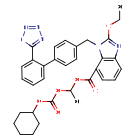
Structure for Candesartan cilexetil (DB00796)
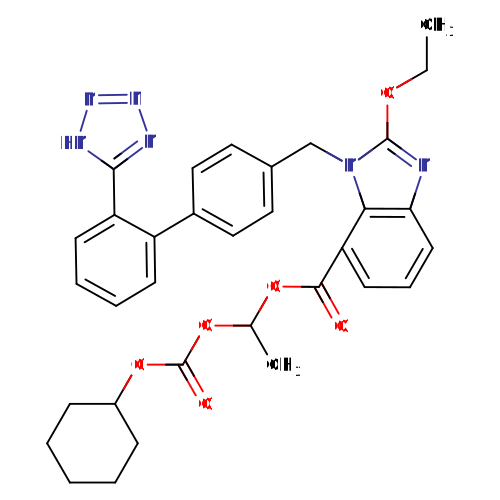
- Weight
- Average: 610.671
Monoisotopic: 610.253982839 - Chemical Formula
- C33H34N6O6
- Synonyms
- Candesartan cilexetil
- External IDs
- TCV 116
- TCV-116

Pharmacology
- Indication
May be used as a first line agent to treat uncomplicated hypertension, isolated systolic hypertension and left ventricular hypertrophy. May be used as a first line agent to delay progression of diabetic nephropathy. Candesartan may be also used as a second line agent in the treatment of congestive heart failure, systolic dysfunction, myocardial infarction and coronary artery disease in those intolerant of ACE inhibitors.
 Reduce drug development failure ratesBuild, train, & validate machine-learning modelswith evidence-based and structured datasets.Build, train, & validate predictive machine-learning models with structured datasets.
- Associated Conditions
Indication Type Indication Combined Product Details Approval Level Age Group Patient Characteristics Dose Form Management of Diabetic nephropathy ••• ••••• Management of Hypertension •••••••••••• Used in combination to manage Hypertension Combination Product in combination with: Hydrochlorothiazide (DB00999) •••••••••••• Prophylaxis of Migraine ••• ••••• Management of Nyha class ii heart failure •••••••••••• - Contraindications & Blackbox Warnings
 Prevent Adverse Drug Events TodayTap into our Clinical API for life-saving information on contraindications & blackbox warnings, population restrictions, harmful risks, & more.Avoid life-threatening adverse drug events with our Clinical API
- Pharmacodynamics
Candesartan cilexetil is an ARB prodrug that is rapidly converted to candesartan, its active metabolite, during absorption from the gastrointestinal tract. Candesartan confers blood pressure lowering effects by antagonizing the hypertensive effects of angiotensin II via the RAAS. RAAS is a homeostatic mechanism for regulating hemodynamics, water and electrolyte balance. During sympathetic stimulation or when renal blood pressure or blood flow is reduced, renin is released from granular cells of the juxtaglomerular apparatus in the kidneys. Renin cleaves circulating angiotensinogen to angiotensin I, which is cleaved by angiotensin converting enzyme (ACE) to angiotensin II. Angiotensin II increases blood pressure by increasing total peripheral resistance, increasing sodium and water reabsorption in the kidneys via aldosterone secretion, and altering cardiovascular structure. Angiotensin II binds to two receptors: type-1 angiotensin II receptor (AT1) and type-2 angiotensin II receptor (AT2). AT1 is a G-protein coupled receptor (GPCR) that mediates the vasoconstrictive and aldosterone-secreting effects of angiotensin II. Studies performed in recent years suggest that AT2 antagonizes AT1-mediated effects and directly affects long-term blood pressure control by inducing vasorelaxation and increasing urinary sodium excretion. Angiotensin receptor blockers (ARBs) are non-peptide competitive inhibitors of AT1. ARBs block the ability of angiotensin II to stimulate pressor and cell proliferative effects. Unlike ACE inhibitors, ARBs do not affect bradykinin-induced vasodilation. The overall effect of ARBs is a decrease in blood pressure.
- Mechanism of action
Candesartan selectively blocks the binding of angiotensin II to AT1 in many tissues including vascular smooth muscle and the adrenal glands. This inhibits the AT1-mediated vasoconstrictive and aldosterone-secreting effects of angiotensin II and results in an overall decrease in blood pressure. Candesartan is greater than 10,000 times more selective for AT1 than AT2. Inhibition of aldosterone secretion may increase sodium and water excretion while decreasing potassium excretion.
Target Actions Organism AType-1 angiotensin II receptor antagonistHumans - Absorption
Following administration of the candesartan cilexetil prodrug, the absolute bioavailability of candesartan was estimated to be 15%. Food with a high fat content has no effect on the bioavailability of candesartan from candesartan cilexetil.
- Volume of distribution
- 0.13 L/kg
- Protein binding
Candesartan is highly bound to plasma proteins (>99%) and does not penetrate red blood cells.
- Metabolism
The prodrug candesartan cilexetil undergoes rapid and complete ester hydrolysis in the intestinal wall to form the active drug, candesartan. Elimination of candesartan is primarily as unchanged drug in the urine and, by the biliary route, in the feces. Minor hepatic metabolism of candesartan (<20%) occurs by O-deethylation via cytochrome P450 2C9 to form an inactive metabolite. Candesartan undergoes N-glucuronidation in the tetrazole ring by uridine diphosphate glucuronosyltransferase 1A3 (UGT1A3). O-glucuronidation may also occur. 75% of candesartan is excreted as unchanged drug in urine and feces.
Hover over products below to view reaction partners
- Route of elimination
When candesartan is administered orally, about 26% of the dose is excreted unchanged in urine. Candesartan is mainly excreted unchanged in urine and feces (via bile).
- Half-life
Approximately 9 hours.
- Clearance
- 0.37 mL/min/kg
- Adverse Effects
 Improve decision support & research outcomesWith structured adverse effects data, including: blackbox warnings, adverse reactions, warning & precautions, & incidence rates. View sample adverse effects data in our new Data Library!Improve decision support & research outcomes with our structured adverse effects data.
- Toxicity
No lethality was observed in acute toxicity studies in mice, rats and dogs given single oral doses of up to 2000 mg/kg of candesartan cilexetil or in rats given single oral doses of up to 2000 mg/kg of candesartan cilexetil in combination with 1000 mg/kg of hydrochlorothiazide. In mice given single oral doses of the primary metabolite, candesartan, the minimum lethal dose was greater than 1000 mg/kg but less than 2000 mg/kg.
- Pathways
Pathway Category Candesartan Action Pathway Drug action - Pharmacogenomic Effects/ADRs
- Not Available
Interactions
- Drug Interactions
- This information should not be interpreted without the help of a healthcare provider. If you believe you are experiencing an interaction, contact a healthcare provider immediately. The absence of an interaction does not necessarily mean no interactions exist.
Drug Interaction Integrate drug-drug
interactions in your softwareAbaloparatide The risk or severity of adverse effects can be increased when Candesartan cilexetil is combined with Abaloparatide. Abatacept The metabolism of Candesartan cilexetil can be increased when combined with Abatacept. Abrocitinib The metabolism of Abrocitinib can be decreased when combined with Candesartan cilexetil. Acebutolol Candesartan cilexetil may increase the hypotensive activities of Acebutolol. Aceclofenac The risk or severity of renal failure, hyperkalemia, and hypertension can be increased when Candesartan cilexetil is combined with Aceclofenac. - Food Interactions
- Take at the same time every day.
- Take with or without food. The absorption is unaffected by food.
Products
 Drug product information from 10+ global regionsOur datasets provide approved product information including:dosage, form, labeller, route of administration, and marketing period.Access drug product information from over 10 global regions.
- Active Moieties
Name Kind UNII CAS InChI Key Candesartan prodrug S8Q36MD2XX 139481-59-7 HTQMVQVXFRQIKW-UHFFFAOYSA-N - Product Images
- International/Other Brands
- Amias (Eureco (Netherlands), Takeda (United Kingdom)) / Blopress (Takeda)
- Brand Name Prescription Products
Name Dosage Strength Route Labeller Marketing Start Marketing End Region Image Act Candesartan Tablet 8 mg Oral Actavis Pharma Company 2011-11-30 2019-08-13 Canada 
Act Candesartan Tablet 32 mg Oral Actavis Pharma Company 2011-11-30 2019-08-13 Canada Act Candesartan Tablet 4 mg Oral Actavis Pharma Company 2011-11-30 2019-08-13 Canada Act Candesartan Tablet 16 mg Oral Actavis Pharma Company 2011-12-15 2019-08-13 Canada Atacand Tablet 4 mg Oral Astra Zeneca 2005-06-28 Not applicable Canada - Generic Prescription Products
Name Dosage Strength Route Labeller Marketing Start Marketing End Region Image Accel-candesartan Tablet 32 mg Oral Accel Pharma Inc 2017-12-27 2020-03-05 Canada Accel-candesartan Tablet 4 mg Oral Accel Pharma Inc Not applicable Not applicable Canada Accel-candesartan Tablet 16 mg Oral Accel Pharma Inc 2017-12-27 2020-03-05 Canada Accel-candesartan Tablet 8 mg Oral Accel Pharma Inc 2017-12-27 2020-03-05 Canada Ach-candesartan Tablet 16 mg Oral Accord Healthcare Inc 2012-02-16 Not applicable Canada - Mixture Products
Name Ingredients Dosage Route Labeller Marketing Start Marketing End Region Image Accel-candesartan/hctz Candesartan cilexetil (32 mg) + Hydrochlorothiazide (25 mg) Tablet Oral Accel Pharma Inc 2017-12-27 2020-03-05 Canada Accel-candesartan/hctz Candesartan cilexetil (32 mg) + Hydrochlorothiazide (12.5 mg) Tablet Oral Accel Pharma Inc 2017-12-27 2020-03-05 Canada Accel-candesartan/hctz Candesartan cilexetil (16 mg) + Hydrochlorothiazide (12.5 mg) Tablet Oral Accel Pharma Inc 2017-12-27 2020-03-05 Canada Act Candesartan/hct Candesartan cilexetil (16 mg) + Hydrochlorothiazide (12.5 mg) Tablet Oral Actavis Pharma Company 2012-09-24 2018-06-12 Canada Ag-candesartan HCT Candesartan cilexetil (32 mg) + Hydrochlorothiazide (12.5 mg) Tablet Oral Angita Pharma Inc. Not applicable Not applicable Canada


Categories
- Drug Categories
- Agents Acting on the Renin-Angiotensin System
- Agents causing hyperkalemia
- Angiotensin 2 Receptor Blocker
- Angiotensin II Antagonists and Diuretics
- Angiotensin II receptor antagonists
- Angiotensin Receptor Antagonists
- Antihypertensive Agents
- Antihypertensive Agents Indicated for Hypertension
- Benzene Derivatives
- Cardiovascular Agents
- Cytochrome P-450 CYP2C8 Inhibitors
- Cytochrome P-450 CYP2C8 Inhibitors (strong)
- Cytochrome P-450 CYP2C9 Substrates
- Cytochrome P-450 Enzyme Inhibitors
- Cytochrome P-450 Substrates
- Heterocyclic Compounds, Fused-Ring
- Hypotensive Agents
- P-glycoprotein inhibitors
- UGT1A3 substrates
- Chemical TaxonomyProvided by Classyfire
- Description
- This compound belongs to the class of organic compounds known as biphenyls and derivatives. These are organic compounds containing to benzene rings linked together by a C-C bond.
- Kingdom
- Organic compounds
- Super Class
- Benzenoids
- Class
- Benzene and substituted derivatives
- Sub Class
- Biphenyls and derivatives
- Direct Parent
- Biphenyls and derivatives
- Alternative Parents
- Phenyltetrazoles and derivatives / Benzimidazoles / Alkyl aryl ethers / N-substituted imidazoles / Carbonic acid diesters / Vinylogous amides / Heteroaromatic compounds / Carboxylic acid esters / Acetals / Azacyclic compounds show 6 more
- Substituents
- Acetal / Alkyl aryl ether / Aromatic heteropolycyclic compound / Azacycle / Azole / Benzimidazole / Biphenyl / Carbonic acid derivative / Carbonic acid diester / Carbonyl group show 18 more
- Molecular Framework
- Aromatic heteropolycyclic compounds
- External Descriptors
- biphenyls (CHEBI:3348)
- Affected organisms
- Humans and other mammals
Chemical Identifiers
- UNII
- R85M2X0D68
- CAS number
- 145040-37-5
- InChI Key
- GHOSNRCGJFBJIB-UHFFFAOYSA-N
- InChI
- InChI=1S/C33H34N6O6/c1-3-42-32-34-28-15-9-14-27(31(40)43-21(2)44-33(41)45-24-10-5-4-6-11-24)29(28)39(32)20-22-16-18-23(19-17-22)25-12-7-8-13-26(25)30-35-37-38-36-30/h7-9,12-19,21,24H,3-6,10-11,20H2,1-2H3,(H,35,36,37,38)
- IUPAC Name
- 1-{[(cyclohexyloxy)carbonyl]oxy}ethyl 2-ethoxy-1-{[2'-(1H-1,2,3,4-tetrazol-5-yl)-[1,1'-biphenyl]-4-yl]methyl}-1H-1,3-benzodiazole-7-carboxylate
- SMILES
- CCOC1=NC2=C(N1CC1=CC=C(C=C1)C1=CC=CC=C1C1=NN=NN1)C(=CC=C2)C(=O)OC(C)OC(=O)OC1CCCCC1
References
- Synthesis Reference
Marina Etinger, Boris Fedotev, Ben-Zion Dolitzky, "Preparation of candesartan cilexetil." U.S. Patent US20050131037, issued June 16, 2005.
US20050131037- General References
- Pfeffer MA, Swedberg K, Granger CB, Held P, McMurray JJ, Michelson EL, Olofsson B, Ostergren J, Yusuf S, Pocock S: Effects of candesartan on mortality and morbidity in patients with chronic heart failure: the CHARM-Overall programme. Lancet. 2003 Sep 6;362(9386):759-66. [Article]
- Mendis B, Page SR: Candesartan: widening indications for this angiotensin II receptor blocker? Expert Opin Pharmacother. 2009 Aug;10(12):1995-2007. doi: 10.1517/14656560903092197. [Article]
- Baguet JP, Barone-Rochette G, Neuder Y: Candesartan cilexetil in the treatment of chronic heart failure. Vasc Health Risk Manag. 2009;5(1):257-64. Epub 2009 Apr 8. [Article]
- Stanfield, Cindy L.;Germann, William J. (2009). Principles of Human Physiology (3rd ed.). Benjamin-Cummings Publishing Company. [ISBN:978-0321556660]
- Bader, M. (2004). Renin-angiotensin-aldosterone system. In Encyclopedic reference of molecular pharmacology (pp. 810-814). Berlin: Springer. [ISBN:9783540298328]
- FDA Approved Drug Products: Atacand (candesartan cilexetil) oral tablets [Link]
- FDA Approved Drug Products: ATACAND HCT (candesartan cilexetil and hydrochlorothiazide) tablets [Link]
- External Links
- Human Metabolome Database
- HMDB0249581
- KEGG Drug
- D00626
- PubChem Compound
- 2540
- PubChem Substance
- 46508342
- ChemSpider
- 2444
- BindingDB
- 50318907
- 135481
- ChEBI
- 3348
- ChEMBL
- CHEMBL1014
- Therapeutic Targets Database
- DAP001442
- Guide to Pharmacology
- GtP Drug Page
- RxList
- RxList Drug Page
- Drugs.com
- Drugs.com Drug Page
- Wikipedia
- Candesartan
- FDA label
- Download (49.4 KB)
Clinical Trials
- Clinical Trials
Phase Status Purpose Conditions Count 4 Completed Other Hypertension / Hypertension, White Coat / Obesity / Resistant Hypertension 1 4 Completed Prevention Coronary Artery Disease (CAD) / Hypertension 1 4 Completed Screening Chronic Kidney Disease (CKD) / Hypertension / Proteinuria 1 4 Completed Treatment Acute Heart Failure (AHF) 1 4 Completed Treatment Congestive Heart Failure (CHF) / Hypertension 1
Pharmacoeconomics
- Manufacturers
- Astrazeneca pharmaceuticals lp
- Packagers
- A-S Medication Solutions LLC
- AstraZeneca Inc.
- Bryant Ranch Prepack
- Lake Erie Medical and Surgical Supply
- Physicians Total Care Inc.
- Prepak Systems Inc.
- Resource Optimization and Innovation LLC
- Southwood Pharmaceuticals
- Dosage Forms
Form Route Strength Tablet Oral 16 mg/1 Tablet Oral 32 mg/1 Tablet Oral 32 mg Tablet Oral 4 mg/1 Tablet Oral 8 mg/1 Tablet Oral Tablet Oral Tablet Oral 16 mg Tablet Oral 4 mg Capsule Oral Capsule, gelatin coated Oral Tablet, film coated Oral 6.93 mg Tablet Oral 8.000 mg Tablet, film coated Oral Tablet, coated Oral 32 mg Tablet, coated Oral 16 mg Tablet, coated Oral 8 mg Tablet, coated Oral Tablet Oral 16.000 mg Tablet Oral 16 mg Tablet Oral 8 mg - Prices
Unit description Cost Unit Atacand 30 4 mg tablet Bottle 75.98USD bottle Atacand 30 8 mg tablet Bottle 74.96USD bottle Atacand hct 32-25 mg tablet 3.64USD tablet Atacand hct 32-12.5 mg tablet 3.43USD tablet Atacand 32 mg tablet 3.36USD tablet Atacand hct 16-12.5 mg tablet 3.36USD tablet Atacand 16 mg tablet 2.49USD tablet Atacand 4 mg tablet 2.44USD tablet Atacand 8 mg tablet 2.44USD tablet Atacand 16 mg Tablet 1.28USD tablet Atacand 32 mg Tablet 1.28USD tablet Atacand 8 mg Tablet 1.28USD tablet DrugBank does not sell nor buy drugs. Pricing information is supplied for informational purposes only.- Patents
Patent Number Pediatric Extension Approved Expires (estimated) Region US5534534 No 1996-07-09 2014-01-09 US 
US5705517 No 1998-01-06 2011-04-18 US CA2083305 No 2003-12-09 2012-11-19 Canada CA2040955 No 1998-02-03 2011-04-22 Canada
Properties
- State
- Solid
- Experimental Properties
Property Value Source logP 6.1 Not Available - Predicted Properties
Property Value Source Water Solubility 0.00204 mg/mL ALOGPS logP 5.12 ALOGPS logP 7.53 Chemaxon logS -5.5 ALOGPS pKa (Strongest Acidic) 4.23 Chemaxon pKa (Strongest Basic) 1.45 Chemaxon Physiological Charge -1 Chemaxon Hydrogen Acceptor Count 8 Chemaxon Hydrogen Donor Count 1 Chemaxon Polar Surface Area 143.34 Å2 Chemaxon Rotatable Bond Count 13 Chemaxon Refractivity 177.42 m3·mol-1 Chemaxon Polarizability 63.94 Å3 Chemaxon Number of Rings 6 Chemaxon Bioavailability 0 Chemaxon Rule of Five No Chemaxon Ghose Filter No Chemaxon Veber's Rule No Chemaxon MDDR-like Rule Yes Chemaxon - Predicted ADMET Features
Property Value Probability Human Intestinal Absorption + 1.0 Blood Brain Barrier + 0.8717 Caco-2 permeable - 0.6208 P-glycoprotein substrate Substrate 0.5186 P-glycoprotein inhibitor I Non-inhibitor 0.848 P-glycoprotein inhibitor II Non-inhibitor 0.9115 Renal organic cation transporter Non-inhibitor 0.8266 CYP450 2C9 substrate Non-substrate 0.7397 CYP450 2D6 substrate Non-substrate 0.9116 CYP450 3A4 substrate Non-substrate 0.6504 CYP450 1A2 substrate Inhibitor 0.5594 CYP450 2C9 inhibitor Inhibitor 0.5195 CYP450 2D6 inhibitor Non-inhibitor 0.889 CYP450 2C19 inhibitor Inhibitor 0.5151 CYP450 3A4 inhibitor Inhibitor 0.7392 CYP450 inhibitory promiscuity High CYP Inhibitory Promiscuity 0.7895 Ames test AMES toxic 0.556 Carcinogenicity Non-carcinogens 0.7561 Biodegradation Not ready biodegradable 0.9972 Rat acute toxicity 2.5515 LD50, mol/kg Not applicable hERG inhibition (predictor I) Weak inhibitor 0.794 hERG inhibition (predictor II) Non-inhibitor 0.5837
Spectra
- Mass Spec (NIST)
- Not Available
- Spectra
- Chromatographic Properties
Collision Cross Sections (CCS)
Adduct CCS Value (Å2) Source type Source [M-H]- 229.15889 predictedDeepCCS 1.0 (2019) [M+H]+ 231.55446 predictedDeepCCS 1.0 (2019) [M+Na]+ 237.46698 predictedDeepCCS 1.0 (2019)
Targets

- Kind
- Protein
- Organism
- Humans
- Pharmacological action
- Yes
- Actions
- Antagonist
- General Function
- Protein heterodimerization activity
- Specific Function
- Receptor for angiotensin II. Mediates its action by association with G proteins that activate a phosphatidylinositol-calcium second messenger system.
- Gene Name
- AGTR1
- Uniprot ID
- P30556
- Uniprot Name
- Type-1 angiotensin II receptor
- Molecular Weight
- 41060.53 Da
References
- Chen X, Ji ZL, Chen YZ: TTD: Therapeutic Target Database. Nucleic Acids Res. 2002 Jan 1;30(1):412-5. [Article]
- Cervenka L, Navar LG: Renal responses of the nonclipped kidney of two-kidney/one-clip Goldblatt hypertensive rats to type 1 angiotensin II receptor blockade with candesartan. J Am Soc Nephrol. 1999 Jan;10 Suppl 11:S197-201. [Article]
- Malmqvist K, Kahan T, Dahl M: Angiotensin II type 1 (AT1) receptor blockade in hypertensive women: benefits of candesartan cilexetil versus enalapril or hydrochlorothiazide. Am J Hypertens. 2000 May;13(5 Pt 1):504-11. [Article]
- Wada T, Inada Y, Ojima M, Sanada T, Shibouta Y, Nishikawa K: Comparison of the antihypertensive effects of the new angiotensin II (AT1) receptor antagonist candesartan cilexetil (TCV-116) and the angiotensin converting enzyme inhibitor enalapril in rats. Hypertens Res. 1996 Jun;19(2):75-81. [Article]
- Engelhorn T, Doerfler A, Heusch G, Schulz R: Reduction of cerebral infarct size by the AT1-receptor blocker candesartan, the HMG-CoA reductase inhibitor rosuvastatin and their combination. An experimental study in rats. Neurosci Lett. 2006 Oct 2;406(1-2):92-6. Epub 2006 Aug 9. [Article]
- Caballero-George C, Vanderheyden PM, Solis PN, Gupta MP, Pieters L, Vauquelin G, Vlietinck A: In vitro effect of sanguinarine alkaloid on binding of [3H]candesartan to the human angiotensin AT1 receptor. Eur J Pharmacol. 2003 Jan 5;458(3):257-62. [Article]
- McInnes GT, O'Kane KP, Istad H, Keinanen-Kiukaanniemi S, Van Mierlo HF: Comparison of the AT1-receptor blocker, candesartan cilexetil, and the ACE inhibitor, lisinopril, in fixed combination with low dose hydrochlorothiazide in hypertensive patients. J Hum Hypertens. 2000 Apr;14(4):263-9. [Article]
- Vauquelin G, Fierens F, Van Liefde I: Long-lasting angiotensin type 1 receptor binding and protection by candesartan: comparison with other biphenyl-tetrazole sartans. J Hypertens Suppl. 2006 Mar;24(1):S23-30. [Article]
- Mendis B, Page SR: Candesartan: widening indications for this angiotensin II receptor blocker? Expert Opin Pharmacother. 2009 Aug;10(12):1995-2007. doi: 10.1517/14656560903092197. [Article]
- Meredith PA: Candesartan cilexetil--a review of effects on cardiovascular complications in hypertension and chronic heart failure. Curr Med Res Opin. 2007 Jul;23(7):1693-705. [Article]
- Baguet JP, Barone-Rochette G, Neuder Y: Candesartan cilexetil in the treatment of chronic heart failure. Vasc Health Risk Manag. 2009;5(1):257-64. Epub 2009 Apr 8. [Article]
Enzymes
- Kind
- Protein
- Organism
- Humans
- Pharmacological action
- Unknown
- Actions
- Substrate
- General Function
- Steroid hydroxylase activity
- Specific Function
- Cytochromes P450 are a group of heme-thiolate monooxygenases. In liver microsomes, this enzyme is involved in an NADPH-dependent electron transport pathway. It oxidizes a variety of structurally un...
- Gene Name
- CYP2C9
- Uniprot ID
- P11712
- Uniprot Name
- Cytochrome P450 2C9
- Molecular Weight
- 55627.365 Da
References
- Atacand Monograph [File]
- Kind
- Protein
- Organism
- Humans
- Pharmacological action
- Unknown
- Actions
- Inhibitor
- General Function
- Steroid hydroxylase activity
- Specific Function
- Cytochromes P450 are a group of heme-thiolate monooxygenases. In liver microsomes, this enzyme is involved in an NADPH-dependent electron transport pathway. It oxidizes a variety of structurally un...
- Gene Name
- CYP2C8
- Uniprot ID
- P10632
- Uniprot Name
- Cytochrome P450 2C8
- Molecular Weight
- 55824.275 Da
References
- Walsky RL, Gaman EA, Obach RS: Examination of 209 drugs for inhibition of cytochrome P450 2C8. J Clin Pharmacol. 2005 Jan;45(1):68-78. [Article]
- Backman JT, Filppula AM, Niemi M, Neuvonen PJ: Role of Cytochrome P450 2C8 in Drug Metabolism and Interactions. Pharmacol Rev. 2016 Jan;68(1):168-241. doi: 10.1124/pr.115.011411. [Article]
- Kind
- Protein
- Organism
- Humans
- Pharmacological action
- Unknown
- Actions
- Substrate
- General Function
- Retinoic acid binding
- Specific Function
- UDPGT is of major importance in the conjugation and subsequent elimination of potentially toxic xenobiotics and endogenous compounds. Isoform 2 lacks transferase activity but acts as a negative reg...
- Gene Name
- UGT1A3
- Uniprot ID
- P35503
- Uniprot Name
- UDP-glucuronosyltransferase 1-3
- Molecular Weight
- 60337.835 Da
References
- Zhou SF, Zhou ZW, Yang LP, Cai JP: Substrates, inducers, inhibitors and structure-activity relationships of human Cytochrome P450 2C9 and implications in drug development. Curr Med Chem. 2009;16(27):3480-675. Epub 2009 Sep 1. [Article]
- Kind
- Protein
- Organism
- Humans
- Pharmacological action
- Unknown
- Actions
- Substrate
- General Function
- Prostaglandin-endoperoxide synthase activity
- Specific Function
- Converts arachidonate to prostaglandin H2 (PGH2), a committed step in prostanoid synthesis. Involved in the constitutive production of prostanoids in particular in the stomach and platelets. In gas...
- Gene Name
- PTGS1
- Uniprot ID
- P23219
- Uniprot Name
- Prostaglandin G/H synthase 1
- Molecular Weight
- 68685.82 Da
References
- Zhou SF, Zhou ZW, Yang LP, Cai JP: Substrates, inducers, inhibitors and structure-activity relationships of human Cytochrome P450 2C9 and implications in drug development. Curr Med Chem. 2009;16(27):3480-675. Epub 2009 Sep 1. [Article]
Transporters
- Kind
- Protein
- Organism
- Humans
- Pharmacological action
- Unknown
- Actions
- Inhibitor
- General Function
- Xenobiotic-transporting atpase activity
- Specific Function
- Energy-dependent efflux pump responsible for decreased drug accumulation in multidrug-resistant cells.
- Gene Name
- ABCB1
- Uniprot ID
- P08183
- Uniprot Name
- Multidrug resistance protein 1
- Molecular Weight
- 141477.255 Da
References
- Takara K, Kakumoto M, Tanigawara Y, Funakoshi J, Sakaeda T, Okumura K: Interaction of digoxin with antihypertensive drugs via MDR1. Life Sci. 2002 Feb 15;70(13):1491-500. [Article]

Drug created at June 13, 2005 13:24 / Updated at April 26, 2024 00:45