Identification
- Generic Name
- Enprofylline
- DrugBank Accession Number
- DB00824
- Background
Enprofylline is a derivative of theophylline which shares bronchodilator properties. Enprofylline is used in asthma, chronic obstructive pulmonary disease, and in the management of cerebrovascular insufficiency, sickle cell disease, and diabetic neuropathy. Long-term enprofylline administration may be associated with elevation in liver enzyme levels and unpredictable blood levels.
- Type
- Small Molecule
- Groups
- Approved, Experimental
- Structure
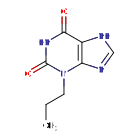
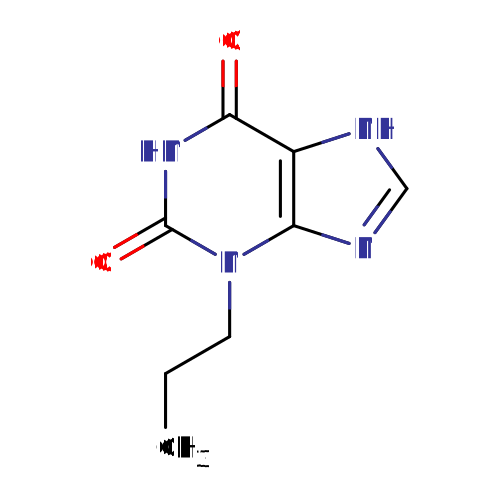
Structure for Enprofylline (DB00824)
- Weight
- Average: 194.1906
Monoisotopic: 194.080375584 - Chemical Formula
- C8H10N4O2
- Synonyms
- 3-n-propylxanthine
- 3-Propyl-3,7-dihydro-purine-2,6-dione
- 3-propylxanthine
- 3,7-dihydro-3-propyl-1H-purine-2,6-dione
- Enprofilina
- Enprofylline
- Enprofyllinum
- External IDs
- D 4028
- D-4028

Pharmacology
- Indication
Used in the management of symptoms of asthma. Also used in the treatment of peripheral vascular diseases and in the management of cerebrovascular insufficiency, sickle cell disease, and diabetic neuropathy.
 Reduce drug development failure ratesBuild, train, & validate machine-learning modelswith evidence-based and structured datasets.Build, train, & validate predictive machine-learning models with structured datasets.
- Contraindications & Blackbox Warnings
 Prevent Adverse Drug Events TodayTap into our Clinical API for life-saving information on contraindications & blackbox warnings, population restrictions, harmful risks, & more.Avoid life-threatening adverse drug events with our Clinical API
- Pharmacodynamics
Enprofylline is a synthetic dimethylxanthine derivative structurally related to theophylline and caffeine. It antagonizes erythrocyte phosphodiesterase, increasing cAMP activity.
- Mechanism of action
Enprofylline inhibits erythrocyte phosphodiesterase, resulting in an increase in erythrocyte cAMP activity. Subsequently, the erythrocyte membrane becomes more resistant to deformity. Along with erythrocyte activity, enprofylline also decreases blood viscosity by reducing plasma fibrinogen concentrations and increasing fibrinolytic activity.
Target Actions Organism AcAMP-specific 3',5'-cyclic phosphodiesterase 4B inhibitorHumans AAdenosine receptor A2b antagonistHumans AcAMP-specific 3',5'-cyclic phosphodiesterase 4A inhibitorHumans UAdenosine receptor A1 inhibitorHumans UAdenosine receptor A2a inhibitorHumans UAdenosine receptor A3 inhibitorHumans - Absorption
Rapidly absorbed from the digestive tract
- Volume of distribution
Not Available
- Protein binding
49%
- Metabolism
- Not Available
- Route of elimination
Not Available
- Half-life
1.9 hours
- Clearance
Not Available
- Adverse Effects
 Improve decision support & research outcomesWith structured adverse effects data, including: blackbox warnings, adverse reactions, warning & precautions, & incidence rates. View sample adverse effects data in our new Data Library!Improve decision support & research outcomes with our structured adverse effects data.
- Toxicity
Not Available
- Pathways
- Not Available
- Pharmacogenomic Effects/ADRs
- Not Available
Interactions
- Drug Interactions
- This information should not be interpreted without the help of a healthcare provider. If you believe you are experiencing an interaction, contact a healthcare provider immediately. The absence of an interaction does not necessarily mean no interactions exist.Not Available
- Food Interactions
- Not Available
Products
 Drug product information from 10+ global regionsOur datasets provide approved product information including:dosage, form, labeller, route of administration, and marketing period.Access drug product information from over 10 global regions.
- International/Other Brands
- Nilyph / Oxeze
Categories
- Drug Categories
- Adenosine A2 Receptor Antagonists
- Alkaloids
- Anti-Asthmatic Agents
- Autonomic Agents
- Bronchodilator Agents
- Heterocyclic Compounds, Fused-Ring
- Neurotransmitter Agents
- Peripheral Nervous System Agents
- Purinergic Agents
- Purinergic Antagonists
- Purinergic P1 Receptor Antagonists
- Purines
- Purinones
- Respiratory System Agents
- Chemical TaxonomyProvided by Classyfire
- Description
- This compound belongs to the class of organic compounds known as xanthines. These are purine derivatives with a ketone group conjugated at carbons 2 and 6 of the purine moiety.
- Kingdom
- Organic compounds
- Super Class
- Organoheterocyclic compounds
- Class
- Imidazopyrimidines
- Sub Class
- Purines and purine derivatives
- Direct Parent
- Xanthines
- Alternative Parents
- 6-oxopurines / Alkaloids and derivatives / Pyrimidones / Vinylogous amides / Imidazoles / Heteroaromatic compounds / Ureas / Lactams / Azacyclic compounds / Organopnictogen compounds show 4 more
- Substituents
- 6-oxopurine / Alkaloid or derivatives / Aromatic heteropolycyclic compound / Azacycle / Azole / Heteroaromatic compound / Hydrocarbon derivative / Imidazole / Lactam / Organic nitrogen compound show 11 more
- Molecular Framework
- Aromatic heteropolycyclic compounds
- External Descriptors
- oxopurine (CHEBI:126237)
- Affected organisms
- Humans and other mammals
Chemical Identifiers
- UNII
- DT7DT5E518
- CAS number
- 41078-02-8
- InChI Key
- SIQPXVQCUCHWDI-UHFFFAOYSA-N
- InChI
- InChI=1S/C8H10N4O2/c1-2-3-12-6-5(9-4-10-6)7(13)11-8(12)14/h4H,2-3H2,1H3,(H,9,10)(H,11,13,14)
- IUPAC Name
- 3-propyl-2,3,6,7-tetrahydro-1H-purine-2,6-dione
- SMILES
- CCCN1C2=C(NC=N2)C(=O)NC1=O
References
- General References
- Not Available
- External Links
- Human Metabolome Database
- HMDB0014962
- KEGG Drug
- D04006
- PubChem Compound
- 1676
- PubChem Substance
- 46505790
- ChemSpider
- 1613
- BindingDB
- 50001493
- ChEBI
- 126237
- ChEMBL
- CHEMBL279898
- ZINC
- ZINC000000403567
- Therapeutic Targets Database
- DAP001375
- PharmGKB
- PA164749350
- Wikipedia
- Enprofylline
Clinical Trials
- Clinical Trials
Phase Status Purpose Conditions Count 4 Withdrawn Treatment Asthma 1 2 Unknown Status Treatment Chronic Obstructive Pulmonary Disease (COPD) 1
Pharmacoeconomics
- Manufacturers
- Not Available
- Packagers
- Not Available
- Dosage Forms
Form Route Strength Syrup Oral 800 mg - Prices
- Not Available
- Patents
- Not Available
Properties
- State
- Solid
- Experimental Properties
Property Value Source melting point (°C) 287-289 °C PhysProp water solubility 1200 mg/L Not Available logP 0.33 SANGSTER (1993) - Predicted Properties
Property Value Source Water Solubility 5.68 mg/mL ALOGPS logP 0.35 ALOGPS logP -0.11 Chemaxon logS -1.5 ALOGPS pKa (Strongest Acidic) 7.83 Chemaxon pKa (Strongest Basic) -0.77 Chemaxon Physiological Charge 0 Chemaxon Hydrogen Acceptor Count 3 Chemaxon Hydrogen Donor Count 2 Chemaxon Polar Surface Area 78.09 Å2 Chemaxon Rotatable Bond Count 2 Chemaxon Refractivity 49.31 m3·mol-1 Chemaxon Polarizability 18.72 Å3 Chemaxon Number of Rings 2 Chemaxon Bioavailability 1 Chemaxon Rule of Five Yes Chemaxon Ghose Filter Yes Chemaxon Veber's Rule No Chemaxon MDDR-like Rule No Chemaxon - Predicted ADMET Features
Property Value Probability Human Intestinal Absorption + 1.0 Blood Brain Barrier + 0.8963 Caco-2 permeable - 0.6282 P-glycoprotein substrate Substrate 0.6567 P-glycoprotein inhibitor I Non-inhibitor 0.7819 P-glycoprotein inhibitor II Non-inhibitor 0.9559 Renal organic cation transporter Non-inhibitor 0.796 CYP450 2C9 substrate Non-substrate 0.7883 CYP450 2D6 substrate Non-substrate 0.8691 CYP450 3A4 substrate Non-substrate 0.5557 CYP450 1A2 substrate Non-inhibitor 0.9046 CYP450 2C9 inhibitor Non-inhibitor 0.907 CYP450 2D6 inhibitor Non-inhibitor 0.9303 CYP450 2C19 inhibitor Non-inhibitor 0.912 CYP450 3A4 inhibitor Non-inhibitor 0.9561 CYP450 inhibitory promiscuity Low CYP Inhibitory Promiscuity 0.9259 Ames test Non AMES toxic 0.73 Carcinogenicity Non-carcinogens 0.9402 Biodegradation Not ready biodegradable 0.7406 Rat acute toxicity 2.6371 LD50, mol/kg Not applicable hERG inhibition (predictor I) Weak inhibitor 0.6953 hERG inhibition (predictor II) Non-inhibitor 0.7663
Spectra
- Mass Spec (NIST)
- Not Available
- Spectra
Spectrum Spectrum Type Splash Key Predicted GC-MS Spectrum - GC-MS Predicted GC-MS splash10-016r-2900000000-c23c015100b016aff55f Predicted MS/MS Spectrum - 10V, Positive (Annotated) Predicted LC-MS/MS splash10-0002-0900000000-14948646871b497a248b Predicted MS/MS Spectrum - 10V, Negative (Annotated) Predicted LC-MS/MS splash10-0006-6900000000-f567262f42fc9578f666 Predicted MS/MS Spectrum - 20V, Positive (Annotated) Predicted LC-MS/MS splash10-0002-0900000000-e7ee2c7d5731b2fb5fec Predicted MS/MS Spectrum - 20V, Negative (Annotated) Predicted LC-MS/MS splash10-0006-4900000000-326759fd3a695efc26b1 Predicted MS/MS Spectrum - 40V, Positive (Annotated) Predicted LC-MS/MS splash10-0229-0900000000-77236c337d52ed14a218 Predicted MS/MS Spectrum - 40V, Negative (Annotated) Predicted LC-MS/MS splash10-0006-7900000000-4bf55bfc4d85d50d3687 Predicted 1H NMR Spectrum 1D NMR Not Applicable Predicted 13C NMR Spectrum 1D NMR Not Applicable - Chromatographic Properties
Collision Cross Sections (CCS)
Adduct CCS Value (Å2) Source type Source [M-H]- 144.894083 predictedDarkChem Lite v0.1.0 [M-H]- 144.579683 predictedDarkChem Lite v0.1.0 [M-H]- 144.473383 predictedDarkChem Lite v0.1.0 [M-H]- 133.37401 predictedDeepCCS 1.0 (2019) [M+H]+ 145.197683 predictedDarkChem Lite v0.1.0 [M+H]+ 144.708583 predictedDarkChem Lite v0.1.0 [M+H]+ 144.670883 predictedDarkChem Lite v0.1.0 [M+H]+ 137.20155 predictedDeepCCS 1.0 (2019) [M+Na]+ 144.632083 predictedDarkChem Lite v0.1.0 [M+Na]+ 144.796083 predictedDarkChem Lite v0.1.0 [M+Na]+ 146.60397 predictedDeepCCS 1.0 (2019)
Targets

- Kind
- Protein
- Organism
- Humans
- Pharmacological action
- Yes
- Actions
- Inhibitor
- General Function
- Metal ion binding
- Specific Function
- Hydrolyzes the second messenger cAMP, which is a key regulator of many important physiological processes. May be involved in mediating central nervous system effects of therapeutic agents ranging f...
- Gene Name
- PDE4B
- Uniprot ID
- Q07343
- Uniprot Name
- cAMP-specific 3',5'-cyclic phosphodiesterase 4B
- Molecular Weight
- 83342.695 Da
References
- Monteiro JP, Alves MG, Oliveira PF, Silva BM: Structure-Bioactivity Relationships of Methylxanthines: Trying to Make Sense of All the Promises and the Drawbacks. Molecules. 2016 Jul 27;21(8). pii: molecules21080974. doi: 10.3390/molecules21080974. [Article]
- Ukena D, Schudt C, Sybrecht GW: Adenosine receptor-blocking xanthines as inhibitors of phosphodiesterase isozymes. Biochem Pharmacol. 1993 Feb 24;45(4):847-51. [Article]
- Kind
- Protein
- Organism
- Humans
- Pharmacological action
- Yes
- Actions
- Antagonist
- General Function
- G-protein coupled adenosine receptor activity
- Specific Function
- Receptor for adenosine. The activity of this receptor is mediated by G proteins which activate adenylyl cyclase.
- Gene Name
- ADORA2B
- Uniprot ID
- P29275
- Uniprot Name
- Adenosine receptor A2b
- Molecular Weight
- 36332.655 Da
References
- Kind
- Protein
- Organism
- Humans
- Pharmacological action
- Yes
- Actions
- Inhibitor
- General Function
- Metal ion binding
- Specific Function
- Hydrolyzes the second messenger cAMP, which is a key regulator of many important physiological processes.
- Gene Name
- PDE4A
- Uniprot ID
- P27815
- Uniprot Name
- cAMP-specific 3',5'-cyclic phosphodiesterase 4A
- Molecular Weight
- 98142.155 Da
References
- Featherstone RL, Chambers DJ: Long-term hypothermic lung preservation: does adenosine A1 receptor antagonism have a role in ischemic preconditioning protection? Interact Cardiovasc Thorac Surg. 2004 Mar;3(1):182-7. [Article]
- Dulloo AG, Seydoux J, Girardier L: Peripheral mechanisms of thermogenesis induced by ephedrine and caffeine in brown adipose tissue. Int J Obes. 1991 May;15(5):317-26. [Article]
- Dar MS: Central adenosinergic system involvement in ethanol-induced motor incoordination in mice. J Pharmacol Exp Ther. 1990 Dec;255(3):1202-9. [Article]
- Ukena D, Schirren CG, Schwabe U: Effects of enprofylline on A1 and A2 adenosine receptors. Eur J Pharmacol. 1985 Oct 29;117(1):25-33. [Article]
- Berg G, Andersson RG, Ryden G: Effects of different phosphodiesterase-inhibiting drugs on human pregnant myometrium: an in vitro study. Arch Int Pharmacodyn Ther. 1987 Dec;290(2):288-92. [Article]
- Chen X, Ji ZL, Chen YZ: TTD: Therapeutic Target Database. Nucleic Acids Res. 2002 Jan 1;30(1):412-5. [Article]
- Kind
- Protein
- Organism
- Humans
- Pharmacological action
- Unknown
- Actions
- Inhibitor
- General Function
- Purine nucleoside binding
- Specific Function
- Receptor for adenosine. The activity of this receptor is mediated by G proteins which inhibit adenylyl cyclase.
- Gene Name
- ADORA1
- Uniprot ID
- P30542
- Uniprot Name
- Adenosine receptor A1
- Molecular Weight
- 36511.325 Da
References
- Linden J, Thai T, Figler H, Jin X, Robeva AS: Characterization of human A(2B) adenosine receptors: radioligand binding, western blotting, and coupling to G(q) in human embryonic kidney 293 cells and HMC-1 mast cells. Mol Pharmacol. 1999 Oct;56(4):705-13. [Article]
- Kind
- Protein
- Organism
- Humans
- Pharmacological action
- Unknown
- Actions
- Inhibitor
- General Function
- Identical protein binding
- Specific Function
- Receptor for adenosine. The activity of this receptor is mediated by G proteins which activate adenylyl cyclase.
- Gene Name
- ADORA2A
- Uniprot ID
- P29274
- Uniprot Name
- Adenosine receptor A2a
- Molecular Weight
- 44706.925 Da
References
- Linden J, Thai T, Figler H, Jin X, Robeva AS: Characterization of human A(2B) adenosine receptors: radioligand binding, western blotting, and coupling to G(q) in human embryonic kidney 293 cells and HMC-1 mast cells. Mol Pharmacol. 1999 Oct;56(4):705-13. [Article]
- Kind
- Protein
- Organism
- Humans
- Pharmacological action
- Unknown
- Actions
- Inhibitor
- General Function
- G-protein coupled adenosine receptor activity
- Specific Function
- Receptor for adenosine. The activity of this receptor is mediated by G proteins which inhibits adenylyl cyclase. Possible role in reproduction.
- Gene Name
- ADORA3
- Uniprot ID
- P0DMS8
- Uniprot Name
- Adenosine receptor A3
- Molecular Weight
- 36184.175 Da
References
- Linden J, Thai T, Figler H, Jin X, Robeva AS: Characterization of human A(2B) adenosine receptors: radioligand binding, western blotting, and coupling to G(q) in human embryonic kidney 293 cells and HMC-1 mast cells. Mol Pharmacol. 1999 Oct;56(4):705-13. [Article]

Drug created at June 13, 2005 13:24 / Updated at February 02, 2024 22:45