Identification
- Summary
Testolactone is a medication used to treat advanced breast cancer.
- Generic Name
- Testolactone
- DrugBank Accession Number
- DB00894
- Background
An antineoplastic agent that is a derivative of progesterone and used to treat advanced breast cancer.
- Type
- Small Molecule
- Groups
- Approved, Investigational
- Structure
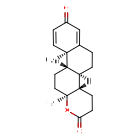
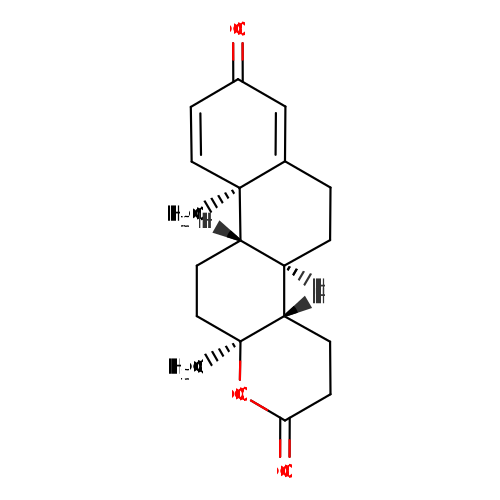
Structure for Testolactone (DB00894)
- Weight
- Average: 300.3921
Monoisotopic: 300.172544634 - Chemical Formula
- C19H24O3
- Synonyms
- (4aS,4bR,10aR,10bS,12aS)-10a,12a-dimethyl-3,4,4a,5,6,10a,10b,11,12,12a-decahydro-2H-naphtho[2,1-f]chromene-2,8(4bH)-dione
- 1-dehydrotestololactone
- 1,2-didehydrotestololactone
- 13-hydroxy-3-oxo-13,17-secoandrosta-1,4-dien-17-oic acid δ-lactone
- D-homo-17a-oxaandrosta-1,4-diene-3,17-dione
- delta(1)-testololactone
- Testolactona
- Testolactone
- Testolactonum
- Testolattone
- Δ1-testololactone
- External IDs
- NSC-23759
- SQ 9538
- SQ-9538

Pharmacology
- Indication
For palliative treatment of advanced breast cancer in postmenopausal women.
 Reduce drug development failure ratesBuild, train, & validate machine-learning modelswith evidence-based and structured datasets.Build, train, & validate predictive machine-learning models with structured datasets.
- Contraindications & Blackbox Warnings
 Prevent Adverse Drug Events TodayTap into our Clinical API for life-saving information on contraindications & blackbox warnings, population restrictions, harmful risks, & more.Avoid life-threatening adverse drug events with our Clinical API
- Pharmacodynamics
Testolactone is a synthetic anti-neoplastic agent that is structurally distinct from the androgen steroid nucleus in possessing a six-membered lactone ring in place of the usual five-membered carbocyclic D-ring. Despite some similarity to testosterone, testolactone has no in vivo androgenic effect. No other hormonal effects have been reported in clinical studies in patients receiving testolactone.
- Mechanism of action
Although the precise mechanism by which testolactone produces its clinical antineoplastic effects has not been established, its principal action is reported to be inhibition of steroid aromatase activity and consequent reduction in estrone synthesis from adrenal androstenedione, the major source of estrogen in postmenopausal women. Based on in vitro studies, the aromatase inhibition may be noncompetitive and irreversible. This phenomenon may account for the persistence of testolactone's effect on estrogen synthesis after drug withdrawal.
Target Actions Organism ACytochrome P450 19A1 inhibitorHumans - Absorption
Testolactone is well absorbed from the gastrointestinal tract.
- Volume of distribution
Not Available
- Protein binding
~85%
- Metabolism
Hepatic. Metabolized to several derivatives in the liver, all of which preserve the lactone D-ring.
- Route of elimination
No clinical effects in humans of testolactone on adrenal function have been reported; however, one study noted an increase in urinary excretion of 17-ketosteroids in most of the patients treated with 150 mg/day orally. It is metabolized to several derivatives in the liver, all of which preserve the lactone D-ring. These metabolites, as well as some unmetabolized drug, are excreted in the urine.
- Half-life
Not Available
- Clearance
Not Available
- Adverse Effects
 Improve decision support & research outcomesWith structured adverse effects data, including: blackbox warnings, adverse reactions, warning & precautions, & incidence rates. View sample adverse effects data in our new Data Library!Improve decision support & research outcomes with our structured adverse effects data.
- Toxicity
Oral LD50s in mouse and dog are 1630 mg/kg and 593-926 mg/kg, respectively.
- Pathways
- Not Available
- Pharmacogenomic Effects/ADRs
- Not Available
Interactions
- Drug Interactions
- This information should not be interpreted without the help of a healthcare provider. If you believe you are experiencing an interaction, contact a healthcare provider immediately. The absence of an interaction does not necessarily mean no interactions exist.
Drug Interaction Integrate drug-drug
interactions in your softwareAbacavir Testolactone may decrease the excretion rate of Abacavir which could result in a higher serum level. Aceclofenac Aceclofenac may decrease the excretion rate of Testolactone which could result in a higher serum level. Acemetacin Acemetacin may decrease the excretion rate of Testolactone which could result in a higher serum level. Acetaminophen Acetaminophen may decrease the excretion rate of Testolactone which could result in a higher serum level. Acetazolamide Acetazolamide may increase the excretion rate of Testolactone which could result in a lower serum level and potentially a reduction in efficacy. - Food Interactions
- Not Available
Products
 Drug product information from 10+ global regionsOur datasets provide approved product information including:dosage, form, labeller, route of administration, and marketing period.Access drug product information from over 10 global regions.
- International/Other Brands
- Fludestrin (Bristol-Myers Squibb)
- Brand Name Prescription Products
Name Dosage Strength Route Labeller Marketing Start Marketing End Region Image Teslac Tablet 50 mg/1 Oral E.R. Squibb & Sons, L.L.C. 2009-06-01 2010-04-30 US 
Categories
- Drug Categories
- Chemical TaxonomyProvided by Classyfire
- Description
- This compound belongs to the class of organic compounds known as naphthopyrans. These are compounds containing a pyran ring fused to a naphthalene moiety. Furan is a 6 membered-ring non-aromatic ring with five carbon and one oxygen atoms. Naphthalene is a polycyclic aromatic hydrocarbon made up of two fused benzene rings.
- Kingdom
- Organic compounds
- Super Class
- Organoheterocyclic compounds
- Class
- Naphthopyrans
- Sub Class
- Not Available
- Direct Parent
- Naphthopyrans
- Alternative Parents
- Naphthalenes / Delta valerolactones / Pyrans / Oxanes / Cyclic ketones / Carboxylic acid esters / Oxacyclic compounds / Monocarboxylic acids and derivatives / Organic oxides / Hydrocarbon derivatives
- Substituents
- Aliphatic heteropolycyclic compound / Carbonyl group / Carboxylic acid derivative / Carboxylic acid ester / Cyclic ketone / Delta valerolactone / Delta_valerolactone / Hydrocarbon derivative / Ketone / Lactone
- Molecular Framework
- Aliphatic heteropolycyclic compounds
- External Descriptors
- 3-oxo-Delta(1),Delta(4)-steroid, seco-androstane (CHEBI:9460) / Androstane and derivatives (C02197) / C19 steroids (androgens) and derivatives (LMST02020084)
- Affected organisms
- Humans and other mammals
Chemical Identifiers
- UNII
- 6J9BLA949Q
- CAS number
- 968-93-4
- InChI Key
- BPEWUONYVDABNZ-DZBHQSCQSA-N
- InChI
- InChI=1S/C19H24O3/c1-18-9-7-13(20)11-12(18)3-4-14-15(18)8-10-19(2)16(14)5-6-17(21)22-19/h7,9,11,14-16H,3-6,8,10H2,1-2H3/t14-,15+,16+,18+,19+/m1/s1
- IUPAC Name
- (4aS,4bR,10aR,10bS,12aS)-10a,12a-dimethyl-2H,3H,4H,4aH,4bH,5H,6H,8H,10aH,10bH,11H,12H,12aH-phenanthro[2,1-b]pyran-2,8-dione
- SMILES
- [H][C@@]12CCC3=CC(=O)C=C[C@]3(C)[C@@]1([H])CC[C@]1(C)OC(=O)CC[C@@]21[H]
References
- Synthesis Reference
Ivan Gilbert, Michael White, "Fermentation method for the preparation of testolactone by fusarium species." U.S. Patent US20060292666, issued December 28, 2006.
US20060292666- General References
- Not Available
- External Links
- Human Metabolome Database
- HMDB0015031
- KEGG Drug
- D00153
- KEGG Compound
- C02197
- PubChem Compound
- 13769
- PubChem Substance
- 46508076
- ChemSpider
- 13172
- BindingDB
- 50367848
- 10378
- ChEBI
- 9460
- ChEMBL
- CHEMBL1571
- ZINC
- ZINC000004081771
- Therapeutic Targets Database
- DAP000624
- PharmGKB
- PA164743056
- RxList
- RxList Drug Page
- Drugs.com
- Drugs.com Drug Page
- Wikipedia
- Testolactone
- FDA label
- Download (105 KB)
- MSDS
- Download (58.6 KB)
Clinical Trials
- Clinical Trials
Phase Status Purpose Conditions Count 4 Completed Basic Science Transsexualism 1 2 Completed Treatment Fibrous Dysplasia, Polyostotic / Puberty, Precocious 1 2 Completed Treatment Puberty, Precocious 1
Pharmacoeconomics
- Manufacturers
- Bristol myers squibb
- Bristol myers squibb co
- Packagers
- B&B Pharmaceuticals
- Bristol-Myers Squibb Co.
- E.R. Squibb and Sons LLC
- Dosage Forms
Form Route Strength Tablet Oral 50 mg/1 - Prices
- Not Available
- Patents
- Not Available
Properties
- State
- Solid
- Experimental Properties
Property Value Source melting point (°C) 218.5 °C PhysProp water solubility Slightly soluble (27.4 mg/L) Not Available logP 3.7 Not Available - Predicted Properties
Property Value Source Water Solubility 0.023 mg/mL ALOGPS logP 2.33 ALOGPS logP 3.23 Chemaxon logS -4.1 ALOGPS pKa (Strongest Acidic) 18.37 Chemaxon pKa (Strongest Basic) -5 Chemaxon Physiological Charge 0 Chemaxon Hydrogen Acceptor Count 2 Chemaxon Hydrogen Donor Count 0 Chemaxon Polar Surface Area 43.37 Å2 Chemaxon Rotatable Bond Count 0 Chemaxon Refractivity 85.79 m3·mol-1 Chemaxon Polarizability 33.42 Å3 Chemaxon Number of Rings 4 Chemaxon Bioavailability 1 Chemaxon Rule of Five Yes Chemaxon Ghose Filter Yes Chemaxon Veber's Rule No Chemaxon MDDR-like Rule No Chemaxon - Predicted ADMET Features
Property Value Probability Human Intestinal Absorption + 0.9945 Blood Brain Barrier + 0.9379 Caco-2 permeable + 0.7355 P-glycoprotein substrate Substrate 0.6792 P-glycoprotein inhibitor I Inhibitor 0.6476 P-glycoprotein inhibitor II Non-inhibitor 0.6498 Renal organic cation transporter Non-inhibitor 0.7565 CYP450 2C9 substrate Non-substrate 0.8542 CYP450 2D6 substrate Non-substrate 0.9116 CYP450 3A4 substrate Substrate 0.6459 CYP450 1A2 substrate Non-inhibitor 0.7315 CYP450 2C9 inhibitor Non-inhibitor 0.8996 CYP450 2D6 inhibitor Non-inhibitor 0.9177 CYP450 2C19 inhibitor Non-inhibitor 0.8484 CYP450 3A4 inhibitor Non-inhibitor 0.7612 CYP450 inhibitory promiscuity Low CYP Inhibitory Promiscuity 0.9224 Ames test Non AMES toxic 0.9515 Carcinogenicity Non-carcinogens 0.9515 Biodegradation Not ready biodegradable 0.9096 Rat acute toxicity 1.7356 LD50, mol/kg Not applicable hERG inhibition (predictor I) Weak inhibitor 0.8719 hERG inhibition (predictor II) Non-inhibitor 0.8734
Spectra
- Mass Spec (NIST)
- Not Available
- Spectra
Spectrum Spectrum Type Splash Key Predicted GC-MS Spectrum - GC-MS Predicted GC-MS splash10-05g0-0690000000-49e361148d5394e26c86 Predicted MS/MS Spectrum - 10V, Positive (Annotated) Predicted LC-MS/MS splash10-0ue9-0489000000-e90551869ceac0dbb4e2 Predicted MS/MS Spectrum - 10V, Negative (Annotated) Predicted LC-MS/MS splash10-0002-0090000000-3e207648342b01b5bec1 Predicted MS/MS Spectrum - 20V, Negative (Annotated) Predicted LC-MS/MS splash10-0002-0090000000-1a87f09fca43695aab15 Predicted MS/MS Spectrum - 20V, Positive (Annotated) Predicted LC-MS/MS splash10-0kh9-0961000000-c30ab61f6f0ecc79e4a4 Predicted MS/MS Spectrum - 40V, Negative (Annotated) Predicted LC-MS/MS splash10-05o0-0090000000-b2b8c414e58c71ca346a Predicted MS/MS Spectrum - 40V, Positive (Annotated) Predicted LC-MS/MS splash10-03xr-0900000000-cf9cadc419c15a0456e4 Predicted 1H NMR Spectrum 1D NMR Not Applicable Predicted 13C NMR Spectrum 1D NMR Not Applicable - Chromatographic Properties
Collision Cross Sections (CCS)
Adduct CCS Value (Å2) Source type Source [M-H]- 180.4966459 predictedDarkChem Lite v0.1.0 [M-H]- 179.9121459 predictedDarkChem Lite v0.1.0 [M-H]- 173.2028 predictedDeepCCS 1.0 (2019) [M+H]+ 181.0484459 predictedDarkChem Lite v0.1.0 [M+H]+ 180.6083459 predictedDarkChem Lite v0.1.0 [M+H]+ 175.59837 predictedDeepCCS 1.0 (2019) [M+Na]+ 180.7207459 predictedDarkChem Lite v0.1.0 [M+Na]+ 180.3520459 predictedDarkChem Lite v0.1.0 [M+Na]+ 181.8072 predictedDeepCCS 1.0 (2019)
Targets

- Kind
- Protein
- Organism
- Humans
- Pharmacological action
- Yes
- Actions
- Inhibitor
- General Function
- Oxygen binding
- Specific Function
- Catalyzes the formation of aromatic C18 estrogens from C19 androgens.
- Gene Name
- CYP19A1
- Uniprot ID
- P11511
- Uniprot Name
- Aromatase
- Molecular Weight
- 57882.48 Da
References
- Chen X, Ji ZL, Chen YZ: TTD: Therapeutic Target Database. Nucleic Acids Res. 2002 Jan 1;30(1):412-5. [Article]
- Raman JD, Schlegel PN: Aromatase inhibitors for male infertility. J Urol. 2002 Feb;167(2 Pt 1):624-9. [Article]
- Herzog AG, Klein P, Jacobs AR: Testosterone versus testosterone and testolactone in treating reproductive and sexual dysfunction in men with epilepsy and hypogonadism. Neurology. 1998 Mar;50(3):782-4. [Article]
- Dunkel L: Use of aromatase inhibitors to increase final height. Mol Cell Endocrinol. 2006 Jul 25;254-255:207-16. [Article]
- Cepa MM, Tavares da Silva EJ, Correia-da-Silva G, Roleira FM, Teixeira NA: Structure-activity relationships of new A,D-ring modified steroids as aromatase inhibitors: design, synthesis, and biological activity evaluation. J Med Chem. 2005 Oct 6;48(20):6379-85. [Article]

Drug created at June 13, 2005 13:24 / Updated at February 02, 2024 22:45