Identification
- Summary
Cinacalcet is a calcium sensing receptor agonist used to treat secondary hyperparathyroidism in chronic kidney disease and hypercalcemia in parathyroid carcinoma.
- Brand Names
- Mimpara, Sensipar
- Generic Name
- Cinacalcet
- DrugBank Accession Number
- DB01012
- Background
Cinacalcet is a calcimimetic sold by Amgen under the trade name Sensipar® in North America and Australia and as Mimpara® in Europe. It is used to treat hyperparathyroidism due to parathyroid tumours or renal failure.
- Type
- Small Molecule
- Groups
- Approved
- Structure
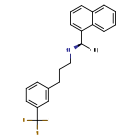
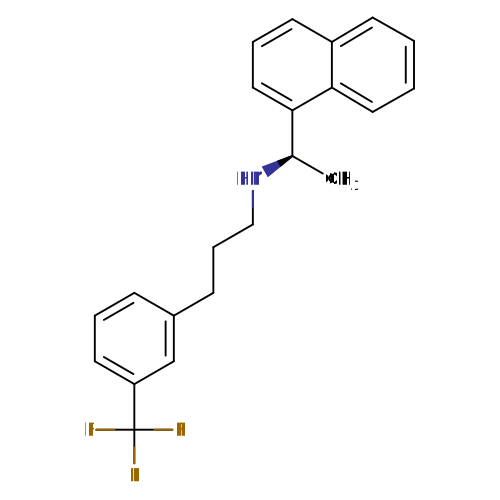
Structure for Cinacalcet (DB01012)
- Weight
- Average: 357.412
Monoisotopic: 357.170434324 - Chemical Formula
- C22H22F3N
- Synonyms
- (R)-α-methyl-N-[3-[3-(trifluoromethyl)phenyl]propyl]-1-naphthalenemethane amine
- Cinacalcet
- CNC
- N-((1R)-1-(Naphthalen-1-yl)ethyl)-3-(3-(trifluoromethyl)phenyl)propan-1-amine
- External IDs
- AMG 073
- AMG-073
- AMG073
- KRN-1493
- KRN1493

Pharmacology
- Indication
For the treatment of secondary hyperparathyroidism in patients with Chronic Kidney Disease who are on hemodialysis or peritoneal dialysis. Also for the treatment of hypercalcemia in patients with parathyroid carcinoma.
 Reduce drug development failure ratesBuild, train, & validate machine-learning modelswith evidence-based and structured datasets.Build, train, & validate predictive machine-learning models with structured datasets.
- Associated Conditions
Indication Type Indication Combined Product Details Approval Level Age Group Patient Characteristics Dose Form Treatment of Hypercalcemia •••••••••••• ••••• ••••••• ••••••••••••••••••• •••••• Treatment of Hypercalcemia •••••••••••• ••••• ••••••••••• ••••••••• •••••• Treatment of Secondary hyperparathyroidism (shpt) •••••••••••• ••••• ••••••• •••••• ••••••• •••••• •••••••• ••••••• •••••• - Contraindications & Blackbox Warnings
 Prevent Adverse Drug Events TodayTap into our Clinical API for life-saving information on contraindications & blackbox warnings, population restrictions, harmful risks, & more.Avoid life-threatening adverse drug events with our Clinical API
- Pharmacodynamics
Cinacalcet is a drug that acts as a calcimimetic (i.e. it mimics the action of calcium on tissues). Secondary hyperparathyroidism (HPT) in patients with chronic kidney disease (CKD) is a progressive disease, associated with increases in parathyroid hormone (PTH) levels and derangements in calcium and phosphorus metabolism. Increased PTH stimulates osteoclastic activity resulting in cortical bone resorption and marrow fibrosis. The goals of treatment of secondary hyperparathyroidism are to lower levels of PTH, calcium, and phosphorus in the blood, in order to prevent progressive bone disease and the systemic consequences of disordered mineral metabolism. In CKD patients on dialysis with uncontrolled secondary HPT, reductions in PTH are associated with a favorable impact on bone-specific alkaline phosphatase (BALP), bone turnover and bone fibrosis. Cinacalcet reduces calcium levels by increasing the sensitivity of the calcium sensing receptor to extracellular calcium.
- Mechanism of action
Cinacalcet directly lowers parathyroid hormone levels by increasing the sensitivity of the calcium sensing receptors to activation by extracellular calcium, resulting in the inhibition of PTH secretion. The reduction in PTH is associated with a concomitant decrease in serum calcium levels.
Target Actions Organism AExtracellular calcium-sensing receptor agonistHumans - Absorption
Rapidly absorbed following oral administration.
- Volume of distribution
- 1000 L
- Protein binding
Approximately 93 to 97% bound to plasma proteins.
- Metabolism
Metabolism is hepatic by multiple enzymes, primarily CYP3A4, CYP2D6, and CYP1A2. After administration of a 75 mg radiolabeled dose to healthy volunteers, cinacalcet was rapidly and extensively metabolized via: 1) oxidative N-dealkylation to hydrocinnamic acid and hydroxy-hydrocinnamic acid, which are further metabolized via ß-oxidation and glycine conjugation; the oxidative N-dealkylation process also generates metabolites that contain the naphthalene ring; and 2) oxidation of the naphthalene ring on the parent drug to form dihydrodiols, which are further conjugated with glucuronic acid.
Hover over products below to view reaction partners
- Route of elimination
Cinacalcet is metabolized by multiple enzymes, primarily CYP3A4, CYP2D6 and CYP1A2. Renal excretion of metabolites was the primary route of elimination of radioactivity.
- Half-life
Terminal half-life is 30 to 40 hours. The mean half-life of cinacalcet is prolonged by 33% and 70% in patients with moderate and severe hepatic impairment, respectively.
- Clearance
Not Available
- Adverse Effects
 Improve decision support & research outcomesWith structured adverse effects data, including: blackbox warnings, adverse reactions, warning & precautions, & incidence rates. View sample adverse effects data in our new Data Library!Improve decision support & research outcomes with our structured adverse effects data.
- Toxicity
Doses titrated up to 300 mg once daily have been safely administered to patients on dialysis. Overdosage of cinacalcet may lead to hypocalcemia.
- Pathways
- Not Available
- Pharmacogenomic Effects/ADRs
- Not Available
Interactions
- Drug Interactions
- This information should not be interpreted without the help of a healthcare provider. If you believe you are experiencing an interaction, contact a healthcare provider immediately. The absence of an interaction does not necessarily mean no interactions exist.
Drug Interaction Integrate drug-drug
interactions in your softwareAbametapir The serum concentration of Cinacalcet can be increased when it is combined with Abametapir. Abatacept The metabolism of Cinacalcet can be increased when combined with Abatacept. Abiraterone The serum concentration of Cinacalcet can be increased when it is combined with Abiraterone. Acebutolol The metabolism of Acebutolol can be decreased when combined with Cinacalcet. Acenocoumarol The metabolism of Acenocoumarol can be decreased when combined with Cinacalcet. - Food Interactions
- Take with food. Food markedly increases product bioavailability.
Products
 Drug product information from 10+ global regionsOur datasets provide approved product information including:dosage, form, labeller, route of administration, and marketing period.Access drug product information from over 10 global regions.
- Product Ingredients
Ingredient UNII CAS InChI Key Cinacalcet hydrochloride 1K860WSG25 364782-34-3 QANQWUQOEJZMLL-PKLMIRHRSA-N - Product Images
- International/Other Brands
- Mimpara
- Brand Name Prescription Products
Name Dosage Strength Route Labeller Marketing Start Marketing End Region Image Cinacalcet Tablet 90 mg Oral Sanis Health Inc Not applicable Not applicable Canada 
Cinacalcet Tablet 90 mg Oral Jubilant Generics Limited Not applicable Not applicable Canada Cinacalcet Tablet 60 mg Oral Sanis Health Inc Not applicable Not applicable Canada Cinacalcet Tablet 60 mg Oral Jubilant Generics Limited Not applicable Not applicable Canada Cinacalcet Tablet 30 mg Oral Sanis Health Inc 2022-06-22 Not applicable Canada - Generic Prescription Products
Name Dosage Strength Route Labeller Marketing Start Marketing End Region Image Apo-cinacalcet Tablet 90 mg Oral Apotex Corporation 2016-05-20 Not applicable Canada Apo-cinacalcet Tablet 60 mg Oral Apotex Corporation 2016-05-20 Not applicable Canada Apo-cinacalcet Tablet 30 mg Oral Apotex Corporation 2016-05-20 Not applicable Canada Auro-cinacalcet Tablet 60 mg Oral Auro Pharma Inc 2019-02-01 Not applicable Canada Auro-cinacalcet Tablet 30 mg Oral Auro Pharma Inc 2019-02-01 Not applicable Canada


Categories
- ATC Codes
- H05BX01 — Cinacalcet
- Drug Categories
- Anti-Parathyroid Agents
- Calcimimetic Agents
- Calcium Homeostasis
- Calcium-Regulating Hormones and Agents
- Calcium-sensing Receptor Agonist
- Cytochrome P-450 CYP1A2 Substrates
- Cytochrome P-450 CYP2D6 Inhibitors
- Cytochrome P-450 CYP2D6 Inhibitors (strong)
- Cytochrome P-450 CYP3A Substrates
- Cytochrome P-450 CYP3A4 Substrates
- Cytochrome P-450 Enzyme Inhibitors
- Cytochrome P-450 Substrates
- Hormone Antagonists
- Hormones, Hormone Substitutes, and Hormone Antagonists
- Increased Calcium-sensing Receptor Sensitivity
- Naphthalenes
- Other Miscellaneous Therapeutic Agents
- Systemic Hormonal Preparations, Excl. Sex Hormones and Insulins
- Chemical TaxonomyProvided by Classyfire
- Description
- This compound belongs to the class of organic compounds known as naphthalenes. These are compounds containing a naphthalene moiety, which consists of two fused benzene rings.
- Kingdom
- Organic compounds
- Super Class
- Benzenoids
- Class
- Naphthalenes
- Sub Class
- Not Available
- Direct Parent
- Naphthalenes
- Alternative Parents
- Trifluoromethylbenzenes / Phenylpropylamines / Aralkylamines / Dialkylamines / Organopnictogen compounds / Organofluorides / Hydrocarbon derivatives / Alkyl fluorides
- Substituents
- Alkyl fluoride / Alkyl halide / Amine / Aralkylamine / Aromatic homopolycyclic compound / Hydrocarbon derivative / Monocyclic benzene moiety / Naphthalene / Organic nitrogen compound / Organofluoride
- Molecular Framework
- Aromatic homopolycyclic compounds
- External Descriptors
- secondary amino compound, naphthalenes, (trifluoromethyl)benzenes (CHEBI:48390)
- Affected organisms
- Humans and other mammals
Chemical Identifiers
- UNII
- UAZ6V7728S
- CAS number
- 226256-56-0
- InChI Key
- VDHAWDNDOKGFTD-MRXNPFEDSA-N
- InChI
- InChI=1S/C22H22F3N/c1-16(20-13-5-10-18-9-2-3-12-21(18)20)26-14-6-8-17-7-4-11-19(15-17)22(23,24)25/h2-5,7,9-13,15-16,26H,6,8,14H2,1H3/t16-/m1/s1
- IUPAC Name
- [(1R)-1-(naphthalen-1-yl)ethyl]({3-[3-(trifluoromethyl)phenyl]propyl})amine
- SMILES
- C[C@@H](NCCCC1=CC(=CC=C1)C(F)(F)F)C1=CC=CC2=CC=CC=C12
References
- Synthesis Reference
Revital Lifshitz-Liron, "Process for the preparation of cinacalcet base." U.S. Patent US20070259964, issued November 08, 2007.
US20070259964- General References
- Torres PU: Cinacalcet HCl: a novel treatment for secondary hyperparathyroidism caused by chronic kidney disease. J Ren Nutr. 2006 Jul;16(3):253-8. [Article]
- Padhi D, Harris R: Clinical pharmacokinetic and pharmacodynamic profile of cinacalcet hydrochloride. Clin Pharmacokinet. 2009;48(5):303-11. doi: 10.2165/00003088-200948050-00002. [Article]
- Dong BJ: Cinacalcet: An oral calcimimetic agent for the management of hyperparathyroidism. Clin Ther. 2005 Nov;27(11):1725-51. [Article]
- FDA Approved Drug Products: SENSIPAR (cinacalcet) tablets [Link]
- External Links
- Human Metabolome Database
- HMDB0015147
- KEGG Drug
- D03504
- PubChem Compound
- 156419
- PubChem Substance
- 46506315
- ChemSpider
- 137743
- BindingDB
- 50416875
- 407990
- ChEBI
- 48390
- ChEMBL
- CHEMBL1201284
- ZINC
- ZINC000001550499
- Therapeutic Targets Database
- DAP000256
- PharmGKB
- PA164776671
- Guide to Pharmacology
- GtP Drug Page
- PDBe Ligand
- YP4
- RxList
- RxList Drug Page
- Drugs.com
- Drugs.com Drug Page
- Wikipedia
- Cinacalcet
- PDB Entries
- 7m3f / 8szf / 8szg / 8szh / 8wpg / 8wpu
- FDA label
- Download (278 KB)
Clinical Trials
- Clinical Trials
Phase Status Purpose Conditions Count 4 Completed Not Available Chronic Kidney Disease (CKD) 1 4 Completed Diagnostic Chronic Kidney Disease (CKD) / Kidney Diseases / Secondary Hyperparathyroidism (SHPT) 1 4 Completed Diagnostic Parathyroid Hormone Suppression Test With Cinacalcet 1 4 Completed Supportive Care Effect of Drugs 1 4 Completed Treatment Anemia / Secondary Hyperparathyroidism (SHPT) 1
Pharmacoeconomics
- Manufacturers
- Amgen inc
- Packagers
- Amgen Inc.
- Cardinal Health
- Dept Health Central Pharmacy
- Kaiser Foundation Hospital
- Patheon Inc.
- Physicians Total Care Inc.
- Dosage Forms
Form Route Strength Tablet Oral 66.12 mg Tablet Oral 30.000 mg Tablet Oral 30 mg/1 Tablet Oral 33.064 mg Tablet Oral 60 mg/1 Tablet Oral 90 mg/1 Tablet, film coated Oral 30 mg/1 Tablet, film coated Oral 60 mg/1 Tablet, film coated Oral 90 mg/1 Tablet, film coated Oral Powder Not applicable 20 kg/20kg Tablet, film coated Oral 30 MG Tablet, film coated Oral 60 MG Tablet, film coated Oral 90 MG Tablet, coated Oral 3000000 mg Tablet, coated Oral 90 mg Granule Oral 1 MG Granule Oral 2.5 MG Granule Oral 5 MG Tablet Oral 1 mg Tablet Oral 2.5 mg Tablet Oral 5 mg Tablet Oral 90.000 mg Tablet, coated Oral 6000000 mg Tablet Oral Tablet Oral 30 mg Tablet Oral 60 mg Tablet Oral 90 mg Tablet, coated Oral 30 mg/1 Tablet, coated Oral 60 mg/1 Tablet, coated Oral 90 mg/1 Tablet, coated Oral 60 mg Tablet, coated Oral 30 mg Tablet, film coated Oral 25 mg - Prices
Unit description Cost Unit Sensipar 90 mg tablet 44.03USD tablet Sensipar 60 mg tablet 29.35USD tablet Sensipar 30 mg tablet 14.69USD tablet DrugBank does not sell nor buy drugs. Pricing information is supplied for informational purposes only.- Patents
Patent Number Pediatric Extension Approved Expires (estimated) Region CA2202879 No 2005-08-30 2015-10-23 Canada US6031003 No 2000-02-29 2016-12-14 US 
US6211244 No 2001-04-03 2015-10-23 US US7829595 No 2010-11-09 2026-09-22 US US6011068 No 2000-01-04 2018-03-08 US US6313146 No 2001-11-06 2016-12-14 US US9375405 No 2016-06-28 2026-09-22 US
Properties
- State
- Solid
- Experimental Properties
Property Value Source water solubility Slightly soluble (in HCl salt form) Not Available logP 6.5 Not Available - Predicted Properties
Property Value Source Water Solubility 5.59e-05 mg/mL ALOGPS logP 5.57 ALOGPS logP 6.27 Chemaxon logS -6.8 ALOGPS pKa (Strongest Basic) 10.01 Chemaxon Physiological Charge 1 Chemaxon Hydrogen Acceptor Count 1 Chemaxon Hydrogen Donor Count 1 Chemaxon Polar Surface Area 12.03 Å2 Chemaxon Rotatable Bond Count 7 Chemaxon Refractivity 100.12 m3·mol-1 Chemaxon Polarizability 37.9 Å3 Chemaxon Number of Rings 3 Chemaxon Bioavailability 1 Chemaxon Rule of Five No Chemaxon Ghose Filter No Chemaxon Veber's Rule Yes Chemaxon MDDR-like Rule Yes Chemaxon - Predicted ADMET Features
Property Value Probability Human Intestinal Absorption + 1.0 Blood Brain Barrier + 0.9927 Caco-2 permeable + 0.7058 P-glycoprotein substrate Substrate 0.5309 P-glycoprotein inhibitor I Inhibitor 0.8512 P-glycoprotein inhibitor II Inhibitor 0.6937 Renal organic cation transporter Inhibitor 0.5305 CYP450 2C9 substrate Non-substrate 0.7761 CYP450 2D6 substrate Substrate 0.8293 CYP450 3A4 substrate Non-substrate 0.5425 CYP450 1A2 substrate Inhibitor 0.9206 CYP450 2C9 inhibitor Non-inhibitor 0.8572 CYP450 2D6 inhibitor Inhibitor 0.8188 CYP450 2C19 inhibitor Inhibitor 0.8795 CYP450 3A4 inhibitor Inhibitor 0.7166 CYP450 inhibitory promiscuity High CYP Inhibitory Promiscuity 0.5904 Ames test Non AMES toxic 0.5152 Carcinogenicity Non-carcinogens 0.8785 Biodegradation Not ready biodegradable 0.9932 Rat acute toxicity 2.8511 LD50, mol/kg Not applicable hERG inhibition (predictor I) Weak inhibitor 0.9175 hERG inhibition (predictor II) Inhibitor 0.8494
Spectra
- Mass Spec (NIST)
- Not Available
- Spectra
Spectrum Spectrum Type Splash Key Predicted GC-MS Spectrum - GC-MS Predicted GC-MS splash10-0a4i-1900000000-ff50504d0f6ffef59a7b Predicted MS/MS Spectrum - 10V, Positive (Annotated) Predicted LC-MS/MS splash10-0a4i-0009000000-30de3a35c06e2a4cd476 Predicted MS/MS Spectrum - 10V, Negative (Annotated) Predicted LC-MS/MS splash10-0a4i-0109000000-0f06d743b71ba9afe6b2 Predicted MS/MS Spectrum - 20V, Positive (Annotated) Predicted LC-MS/MS splash10-0a4i-0659000000-052fb83cfa9b7a8ddfb4 Predicted MS/MS Spectrum - 20V, Negative (Annotated) Predicted LC-MS/MS splash10-0a4i-1419000000-ea1cc2b109f130827c89 Predicted MS/MS Spectrum - 40V, Positive (Annotated) Predicted LC-MS/MS splash10-0a4i-0900000000-ee0697ef986f03240d06 Predicted MS/MS Spectrum - 40V, Negative (Annotated) Predicted LC-MS/MS splash10-004j-1920000000-8cc62f64015e54be64d5 Predicted 1H NMR Spectrum 1D NMR Not Applicable Predicted 13C NMR Spectrum 1D NMR Not Applicable - Chromatographic Properties
Collision Cross Sections (CCS)
Adduct CCS Value (Å2) Source type Source [M-H]- 197.3458841 predictedDarkChem Lite v0.1.0 [M-H]- 180.98474 predictedDeepCCS 1.0 (2019) [M+H]+ 197.6766841 predictedDarkChem Lite v0.1.0 [M+H]+ 183.34274 predictedDeepCCS 1.0 (2019) [M+Na]+ 197.8125841 predictedDarkChem Lite v0.1.0 [M+Na]+ 189.95772 predictedDeepCCS 1.0 (2019)
Targets

- Kind
- Protein
- Organism
- Humans
- Pharmacological action
- Yes
- Actions
- Agonist
- General Function
- Phosphatidylinositol phospholipase c activity
- Specific Function
- Senses changes in the extracellular concentration of calcium ions. The activity of this receptor is mediated by a G-protein that activates a phosphatidylinositol-calcium second messenger system.
- Gene Name
- CASR
- Uniprot ID
- P41180
- Uniprot Name
- Extracellular calcium-sensing receptor
- Molecular Weight
- 120672.385 Da
References
- de Francisco AL: Cinacalcet HCl: a novel therapeutic for hyperparathyroidism. Expert Opin Pharmacother. 2005 Mar;6(3):441-52. [Article]
- Rothe HM, Shapiro WB, Sun WY, Chou SY: Calcium-sensing receptor gene polymorphism Arg990Gly and its possible effect on response to cinacalcet HCl. Pharmacogenet Genomics. 2005 Jan;15(1):29-34. [Article]
- Tasic V: Management of renal osteodystrophy in children. Turk J Pediatr. 2005;47 Suppl:13-8. [Article]
- Moe SM, Cunningham J, Bommer J, Adler S, Rosansky SJ, Urena-Torres P, Albizem MB, Guo MD, Zani VJ, Goodman WG, Sprague SM: Long-term treatment of secondary hyperparathyroidism with the calcimimetic cinacalcet HCl. Nephrol Dial Transplant. 2005 Oct;20(10):2186-93. Epub 2005 Jul 19. [Article]
- Cunningham J: Management of secondary hyperparathyroidism. Ther Apher Dial. 2005 Aug;9 Suppl 1:S35-40. [Article]
- Eriguchi R, Umakoshi J, Tominaga Y, Sato Y: Successful treatment of inoperable recurrent secondary hyperparathyroidism with cinacalcet HCl. NDT Plus. 2008 Aug;1(4):218-220. Epub 2008 May 25. [Article]
- Belozeroff V, Goodman WG, Ren L, Kalantar-Zadeh K: Cinacalcet lowers serum alkaline phosphatase in maintenance hemodialysis patients. Clin J Am Soc Nephrol. 2009 Mar;4(3):673-9. doi: 10.2215/CJN.03790808. Epub 2009 Mar 4. [Article]
- Meola M, Petrucci I, Barsotti G: Long-term treatment with cinacalcet and conventional therapy reduces parathyroid hyperplasia in severe secondary hyperparathyroidism. Nephrol Dial Transplant. 2009 Mar;24(3):982-9. doi: 10.1093/ndt/gfn654. Epub 2009 Jan 30. [Article]
- Drueke TB, Ritz E: Treatment of secondary hyperparathyroidism in CKD patients with cinacalcet and/or vitamin D derivatives. Clin J Am Soc Nephrol. 2009 Jan;4(1):234-41. doi: 10.2215/CJN.04520908. Epub 2008 Dec 3. [Article]
- Chen X, Ji ZL, Chen YZ: TTD: Therapeutic Target Database. Nucleic Acids Res. 2002 Jan 1;30(1):412-5. [Article]
Enzymes
- Kind
- Protein
- Organism
- Humans
- Pharmacological action
- Unknown
- Actions
- Substrate
- General Function
- Vitamin d3 25-hydroxylase activity
- Specific Function
- Cytochromes P450 are a group of heme-thiolate monooxygenases. In liver microsomes, this enzyme is involved in an NADPH-dependent electron transport pathway. It performs a variety of oxidation react...
- Gene Name
- CYP3A4
- Uniprot ID
- P08684
- Uniprot Name
- Cytochrome P450 3A4
- Molecular Weight
- 57342.67 Da
References
- Padhi D, Harris R: Clinical pharmacokinetic and pharmacodynamic profile of cinacalcet hydrochloride. Clin Pharmacokinet. 2009;48(5):303-11. doi: 10.2165/00003088-200948050-00002. [Article]
- Dong BJ: Cinacalcet: An oral calcimimetic agent for the management of hyperparathyroidism. Clin Ther. 2005 Nov;27(11):1725-51. [Article]
- Kind
- Protein
- Organism
- Humans
- Pharmacological action
- Unknown
- Actions
- Inhibitor
- General Function
- Steroid hydroxylase activity
- Specific Function
- Responsible for the metabolism of many drugs and environmental chemicals that it oxidizes. It is involved in the metabolism of drugs such as antiarrhythmics, adrenoceptor antagonists, and tricyclic...
- Gene Name
- CYP2D6
- Uniprot ID
- P10635
- Uniprot Name
- Cytochrome P450 2D6
- Molecular Weight
- 55768.94 Da
References
- Padhi D, Harris R: Clinical pharmacokinetic and pharmacodynamic profile of cinacalcet hydrochloride. Clin Pharmacokinet. 2009;48(5):303-11. doi: 10.2165/00003088-200948050-00002. [Article]
- Dong BJ: Cinacalcet: An oral calcimimetic agent for the management of hyperparathyroidism. Clin Ther. 2005 Nov;27(11):1725-51. [Article]
- Flockhart Table of Drug Interactions [Link]
- Kind
- Protein
- Organism
- Humans
- Pharmacological action
- Unknown
- Actions
- Substrate
- General Function
- Oxidoreductase activity, acting on paired donors, with incorporation or reduction of molecular oxygen, reduced flavin or flavoprotein as one donor, and incorporation of one atom of oxygen
- Specific Function
- Cytochromes P450 are a group of heme-thiolate monooxygenases. In liver microsomes, this enzyme is involved in an NADPH-dependent electron transport pathway. It oxidizes a variety of structurally un...
- Gene Name
- CYP1A2
- Uniprot ID
- P05177
- Uniprot Name
- Cytochrome P450 1A2
- Molecular Weight
- 58293.76 Da
References
- Padhi D, Harris R: Clinical pharmacokinetic and pharmacodynamic profile of cinacalcet hydrochloride. Clin Pharmacokinet. 2009;48(5):303-11. doi: 10.2165/00003088-200948050-00002. [Article]
- Dong BJ: Cinacalcet: An oral calcimimetic agent for the management of hyperparathyroidism. Clin Ther. 2005 Nov;27(11):1725-51. [Article]
- Poon G: Cinacalcet hydrochloride (Sensipar). Proc (Bayl Univ Med Cent). 2005 Apr;18(2):181-4. [Article]
- Cinacalcet FDA label [File]

Drug created at June 13, 2005 13:24 / Updated at April 26, 2024 00:46