Identification
- Summary
Isosorbide mononitrate is a nitrate used to prevent and treat angina and to treat angina caused by coronary artery disease.
- Brand Names
- Imdur, Ismo, Monoket
- Generic Name
- Isosorbide mononitrate
- DrugBank Accession Number
- DB01020
- Background
Isosorbide mononitrate is an organic nitrate with vasodilating properties. It is an anti-anginal agent that works by relaxing the smooth muscles of both arteries and veins, but but predominantly veins to reduce cardiac preload.4,7 Isosorbide mononitrate is an active metabolite of isosorbide dinitrate. Like other organic nitrates, isosorbide mononitrate acts as a prodrug for its active metabolite, nitric oxide, which mediates the therapeutic action of isosorbide mononitrate.7 Isosorbide mononitrate has a longer duration of action than nitroglycerin due to its slow onset of absorption and metabolism.3
First approved by the FDA in 1991,7 isosorbide mononitrate is used for the prevention and management of angina pectoris caused by coronary artery disease; however, the onset of action of orally-administered isosorbide mononitrate is not rapid enough to offset an acute anginal episode.4 It is available in oral tablets generically and under the brand name ISMO and Monoket. The extended-release forms of the drug are also available generically and under the brand name Imdur.7
- Type
- Small Molecule
- Groups
- Approved
- Structure
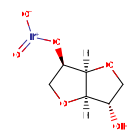
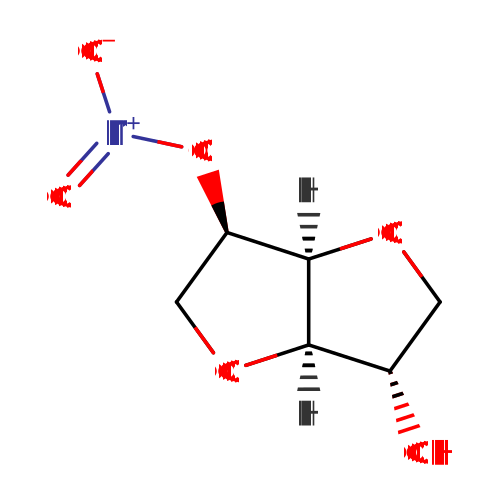
Structure for Isosorbide mononitrate (DB01020)
- Weight
- Average: 191.1388
Monoisotopic: 191.042987025 - Chemical Formula
- C6H9NO6
- Synonyms
- IS 5-MN
- IS-5-MN
- IS-5MN
- ISMN
- Iso-5-mononitrate
- Isosorbide 5-mononitrate
- Isosorbide 5-nitrate
- Isosorbide mononitrate
- Isosorbide-5-mononitrate
- Isosorbidi mononitras
- Mononitrate d'isosorbide
- Mononitrato de isosorbida
- Monosorbitrate
- External IDs
- AHR-4698
- BM 22.145
- BM-22.145
- BM-22145

Pharmacology
- Indication
Isosorbide mononitrate is indicated for the prevention and management of angina pectoris due to coronary artery disease. The onset of action of oral isosorbide mononitrate is not sufficiently rapid to be useful in aborting an acute anginal episode.4
 Reduce drug development failure ratesBuild, train, & validate machine-learning modelswith evidence-based and structured datasets.Build, train, & validate predictive machine-learning models with structured datasets.
- Associated Conditions
Indication Type Indication Combined Product Details Approval Level Age Group Patient Characteristics Dose Form Prevention of Angina pectoris •••••••••••• ••••••• ••••••• •••••••• ••••••• Management of Angina pectoris •••••••••••• ••••••• ••••••• •••••••• ••••••• - Contraindications & Blackbox Warnings
 Prevent Adverse Drug Events TodayTap into our Clinical API for life-saving information on contraindications & blackbox warnings, population restrictions, harmful risks, & more.Avoid life-threatening adverse drug events with our Clinical API
- Pharmacodynamics
Isosorbide mononitrate is an anti-anginal agent and vasodilator that relaxes vascular smooth muscle to prevent and manage angina pectoris. The pharmacological action is mediated by the active metabolite, nitric oxide, which is released when isosorbide mononitrate is metabolized.3 Nitric oxide works on both arteries and veins, but predominantly veins: by relaxing veins and reducing the central venous pressure, nitric oxide causes venous pooling and a decrease in the venous return to the heart, thus decreasing cardiac preload.7 In healthy subjects, the stroke volume is decreased and venous pooling can occur in the standing posture, leading to postural hypotension and dizziness.3
At therapeutic doses of isosorbide mononitrate, nitric oxide has a bigger effect on larger muscular arteries over small resistance arteries. Arterial relaxation leads to reduced systemic vascular resistance and systolic blood (aortic) pressure, decreasing to decreased cardiac afterload.7,3 The direct dilator effect on coronary arteries opposes the coronary artery spasm in variant angina or angina pectoris.3 At larger doses, nitric oxide causes the resistance arteries and arterioles to dilate, reducing arterial pressure via coronary vasodilatation. This leads to increased coronary blood flow.7,3 Reduced cardiac preload and afterload caused by nitric oxide causes a reduction in myocardial oxygen consumption; decreased myocardial oxygen demand, along with increased coronary blood flow, leads to an increased in the oxygen content of coronary sinus blood 3 and the relief from ischemia.7
The end effect of isosorbide mononitrate include decreased cardiac oxygen consumption, redistribution coronary flow toward ischemic areas via collaterals, and the relief of coronary spasms. Nitric oxide can also increase the rate of relaxation of cardiac muscles, which is an effect outside of vascular smooth muscles.3 Organic nitrates can also relax other types of smooth muscles, including esophageal and biliary smooth muscle.3 The anti-anginal activity of isosorbide mononitrate was observed about 1 hour after dosing, and the peak effect was achieved from 1-4 hours after dosing.4 The duration of anti-anginal action of at least 12 hours was observed with an asymmetrical dosing regimen.2
- Mechanism of action
Isosorbide mononitrate acts as a prodrug for nitric oxide (NO), which is a potent vasodilator gas that is released when the drug is metabolized. NO activates soluble guanylyl cyclase in vascular endothelial cells, which increases the intracellular concentrations of cyclic GMP (cGMP). cGMP activates cGMP-dependent protein kinases, such as protein kinase G and I, which activates the downstream intracellular cascades.1 The downstream cascade results in reduced intracellular concentrations of calcium, caused by processes including inhibition of IP3-mediated pathway, phosphorylation of big calcium-activated potassium channel leading to cell hyperpolarization and reduced calcium influx, and increased calcium efflux via the Ca2+-ATPase-pump.1 Reduced intracellular calcium concentrations lead to the dephosphorylation of myosin light chains and the relaxation of smooth muscle cells.7,3
Target Actions Organism AGuanylate cyclase soluble subunit alpha-2 activatorHumans - Absorption
Upon oral administration, isosorbide mononitrate is rapidly and completely absorbed from the gastrointestinal tract. Isosorbide mononitrate has a dose-linear kinetics and the absolute bioavailability is nearly 100%. The Cmax is reached within 30 to 60 minutes following administration.4
- Volume of distribution
The volume of distribution is approximately 0.6 L/kg, which is approximately the volume of total body water.2,4
- Protein binding
Isosorbide mononitrate is about 5% bound to plasma proteins.4
- Metabolism
Isosorbide mononitrate is not subject to first pass metabolism in human liver.4 Detectable metabolites include isosorbide, sorbitol, and 2-glucuronide of mononitrate, which are pharmacologically inactive.2,4
Hover over products below to view reaction partners
- Route of elimination
In a human radio-labelled drug study, about 93% of the total dose was excreted in the urine within 48 hours.4 Following oral administration of 20 mg, only 2% of isosorbide mononitrate was excreted unchanged in the urine within 24 hours. 2 Among the excreted dose, nearly half of the dose was found de-nitrated in urine as isosorbide and sorbitol: approximately 30% is excreted as isosorbide and about 17% is the 2-glucuronide of mononitrate.2 These metabolites were not vasoactive or pharmacologically active. Renal excretion was complete after 5 days, and fecal excretion accounted for only 1% of drug elimination.4
- Half-life
The elimination half-life of isosorbide mononitrate is about 5 hours.4 The elimination half-life of its metabolites, isosorbide and 2-glucuronide of mononitrate, are 8 hours and 6 hours, respectively.2
- Clearance
The total body clearance is 115-120 mL/min.2
- Adverse Effects
 Improve decision support & research outcomesWith structured adverse effects data, including: blackbox warnings, adverse reactions, warning & precautions, & incidence rates. View sample adverse effects data in our new Data Library!Improve decision support & research outcomes with our structured adverse effects data.
- Toxicity
The oral LD50 is 2010 mg/kg in rats and 1771 mg/kg in mice.5
The symptoms of overdose from isosorbide mononitrate is associated with vasodilatation, venous pooling, reduced cardiac output, and hypotension. These symptoms can be accompanied by several manifestations, including increased intracranial pressure (possibly along with persistent throbbing headache, confusion, and moderate fever), vertigo, palpitations, visual disturbances, nausea and vomiting (possibly along with colic and bloody diarrhea), syncope (especially in the upright posture), air hunger and dyspnea (later followed by reduced ventilatory effort), diaphoresis (with flushed or cold and clammy skin), heart blocks and bradycardia, paralysis, coma, seizures, and death.4
There is limited clinical information on the management of isosorbide mononitrate overdose; it is advised that venodilatation and arterial hypovolemia from overdose are responded with therapy aimed to increase in central fluid volume. However, this method may be potentially hazardous in patients with renal disease or congestive heart failure: invasive monitoring may be required in these patients. The patient's legs should be passively elevated, and intravenous infusion of normal saline or similar fluid is recommended. Isosorbide mononitrate was shown to be significantly removed from the systemic circulation via hemodialysis. The use of epinephrine or other arterial vasoconstrictors is not recommended.4
- Pathways
- Not Available
- Pharmacogenomic Effects/ADRs
- Not Available
Interactions
- Drug Interactions
- This information should not be interpreted without the help of a healthcare provider. If you believe you are experiencing an interaction, contact a healthcare provider immediately. The absence of an interaction does not necessarily mean no interactions exist.
Drug Interaction Integrate drug-drug
interactions in your softwareAbacavir Isosorbide mononitrate may decrease the excretion rate of Abacavir which could result in a higher serum level. Abaloparatide The risk or severity of adverse effects can be increased when Isosorbide mononitrate is combined with Abaloparatide. Acebutolol The risk or severity of adverse effects can be increased when Isosorbide mononitrate is combined with Acebutolol. Aceclofenac Aceclofenac may decrease the excretion rate of Isosorbide mononitrate which could result in a higher serum level. Acemetacin Acemetacin may decrease the excretion rate of Isosorbide mononitrate which could result in a higher serum level. - Food Interactions
- Take with or without food. The absorption is unaffected by food.
Products
 Drug product information from 10+ global regionsOur datasets provide approved product information including:dosage, form, labeller, route of administration, and marketing period.Access drug product information from over 10 global regions.
- Active Moieties
Name Kind UNII CAS InChI Key Isosorbide unknown WXR179L51S 652-67-5 KLDXJTOLSGUMSJ-JGWLITMVSA-N - Product Images
- International/Other Brands
- Chemydur / Corangin / Dilatrate / Duride / Elantan / Etimonis / Imodur / Imtrate / Ismexin / Ismox / Isomon / Isomonit / Isonorm / Medocor / Monicor / Monit / Mono Corax / Mono Mack / Monocedocard / Monoclair / Monocord / Monodur Durules / Monolong / Monomax / Mononit / Monopront / Monosorb / Monosordil / Monotrate / Nitramin / Olicard / Olicardin / Orasorbil / Pertil / Plodin / Promocard / Sigacora / Solotrate / Sorbimon / Turimonit / Uniket / Vasdilat
- Brand Name Prescription Products
Name Dosage Strength Route Labeller Marketing Start Marketing End Region Image Imdur Tablet 30 mg/1 Oral Schering Corporation 2003-09-01 2006-10-31 US 
Imdur Tablet 120 mg/1 Oral Schering Corporation 2003-09-01 2006-11-30 US Imdur Tablet, extended release 60 mg Oral Juno Pharmaceuticals Corp. 1994-12-31 Not applicable Canada 
Imdur Tablet 60 mg/1 Oral Schering Corporation 2003-09-01 2006-10-31 US Ismn Tablet, extended release 60 mg Oral Sivem Pharmaceuticals Ulc 2015-10-08 2017-06-27 Canada - Generic Prescription Products
Name Dosage Strength Route Labeller Marketing Start Marketing End Region Image Apo-ismn Tablet, extended release 60 mg Oral Apotex Corporation 2006-03-03 Not applicable Canada Dom-ismn Tablet, extended release 60 mg Oral Dominion Pharmacal Not applicable Not applicable Canada Imdur Tablet, extended release 60 mg/1 Oral Schering Corporation 2006-01-05 2017-04-06 US Imdur Tablet, extended release 30 mg/1 Oral Physicians Total Care, Inc. 2009-12-02 2012-06-30 US Imdur Tablet, extended release 30 mg/1 Oral Schering Corporation 2006-01-05 2017-04-06 US


Categories
- ATC Codes
- C01DA14 — Isosorbide mononitrate
- Drug Categories
- Alcohols
- Antianginal Agents
- Carbohydrates
- Cardiac Therapy
- Cardiovascular Agents
- Delayed-Action Preparations
- Drugs that are Mainly Renally Excreted
- Hypotensive Agents
- Methemoglobinemia Associated Agents
- Nitrate Vasodilator
- Nitrates and Nitrites
- Nitric Oxide Donors
- Organic Nitrates
- Sugar Alcohols
- Vasodilating Agents
- Vasodilation
- Vasodilators Used in Cardiac Diseases
- Chemical TaxonomyProvided by Classyfire
- Description
- This compound belongs to the class of organic compounds known as isosorbides. These are organic polycyclic compounds containing an isosorbide(1,4-Dianhydrosorbitol) moiety, which consists of two -oxolan-3-ol rings.
- Kingdom
- Organic compounds
- Super Class
- Organoheterocyclic compounds
- Class
- Furofurans
- Sub Class
- Isosorbides
- Direct Parent
- Isosorbides
- Alternative Parents
- Tetrahydrofurans / Alkyl nitrates / Secondary alcohols / Organic nitro compounds / Organic nitric acids and derivatives / Oxacyclic compounds / Dialkyl ethers / Organic zwitterions / Organic oxides / Organic nitrogen compounds show 1 more
- Substituents
- Alcohol / Aliphatic heteropolycyclic compound / Alkyl nitrate / Allyl-type 1,3-dipolar organic compound / Dialkyl ether / Ether / Hydrocarbon derivative / Isosorbide / Organic 1,3-dipolar compound / Organic nitrate show 10 more
- Molecular Framework
- Aliphatic heteropolycyclic compounds
- External Descriptors
- nitrate ester, glucitol derivative (CHEBI:6062)
- Affected organisms
- Humans and other mammals
Chemical Identifiers
- UNII
- LX1OH63030
- CAS number
- 16051-77-7
- InChI Key
- YWXYYJSYQOXTPL-SLPGGIOYSA-N
- InChI
- InChI=1S/C6H9NO6/c8-3-1-11-6-4(13-7(9)10)2-12-5(3)6/h3-6,8H,1-2H2/t3-,4+,5+,6+/m0/s1
- IUPAC Name
- (3R,3aS,6S,6aR)-6-hydroxy-hexahydrofuro[3,2-b]furan-3-yl nitrate
- SMILES
- [H][C@]12OC[C@@H](O[N+]([O-])=O)[C@@]1([H])OC[C@@H]2O
References
- General References
- Munzel T, Steven S, Daiber A: Organic nitrates: update on mechanisms underlying vasodilation, tolerance and endothelial dysfunction. Vascul Pharmacol. 2014 Dec;63(3):105-13. doi: 10.1016/j.vph.2014.09.002. Epub 2014 Oct 14. [Article]
- Abshagen UW: Pharmacokinetics of isosorbide mononitrate. Am J Cardiol. 1992 Nov 27;70(17):61G-66G. doi: 10.1016/0002-9149(92)90028-w. [Article]
- 21. (2012). In Rang and Dale's Pharmacology (7th ed., pp. 260-261). Edinburgh: Elsevier/Churchill Livingstone. [ISBN:978-0-7020-3471-8]
- FDA Approved Drug Products: Monoket (isosorbide mononitrate) tablets [Link]
- Spectrum Chemical: 5-Isosorbide Mononitrate MSDS [Link]
- DailyMed Label: Isosorbide Mononitrate (ISMN) extended-release tablets [Link]
- Organic Nitrates - LiverTox - NCBI Bookshelf [Link]
- External Links
- Human Metabolome Database
- HMDB0015155
- KEGG Drug
- D00630
- KEGG Compound
- C07714
- PubChem Compound
- 27661
- PubChem Substance
- 46506594
- ChemSpider
- 25736
- 28004
- ChEBI
- 6062
- ChEMBL
- CHEMBL1311
- ZINC
- ZINC000001849548
- Therapeutic Targets Database
- DAP001058
- PharmGKB
- PA450126
- RxList
- RxList Drug Page
- Drugs.com
- Drugs.com Drug Page
- Wikipedia
- Isosorbide_mononitrate
- FDA label
- Download (217 KB)
- MSDS
- Download (66.5 KB)
Clinical Trials
- Clinical Trials
Phase Status Purpose Conditions Count 4 Completed Prevention Cirrhosis of the Liver / Gastrointestinal Hemorrhage / Portal Hypertension 1 4 Completed Prevention Pre-Eclampsia / Premature Labour 1 4 Completed Prevention Variceal Rebleeding 1 4 Completed Treatment Abortion in Second Trimester 1 4 Completed Treatment Acute Heart Failure (AHF) 1
Pharmacoeconomics
- Manufacturers
- Schering plough corp
- Actavis elizabeth llc
- Brightstone pharma inc
- Dexcel ltd
- Elan pharmaceutical research corp
- Ivax pharmaceuticals inc sub teva pharmaceuticals usa
- Kremers urban co
- Kv pharmaceutical co
- Vintage pharmaceuticals inc
- West ward pharmaceutical corp
- Promius pharma llc
- Teva pharmaceuticals usa inc
- Schwarz gmbh
- Packagers
- Actavis Group
- Advanced Pharmaceutical Services Inc.
- Alvogen Inc.
- Apothecon
- A-S Medication Solutions LLC
- AstraZeneca Inc.
- Atlantic Biologicals Corporation
- Bryant Ranch Prepack
- Cardinal Health
- Comprehensive Consultant Services Inc.
- Dexcel Ltd.
- Dispensing Solutions
- Diversified Healthcare Services Inc.
- Elan Pharmaceuticals Inc.
- Ethex Corp.
- Heartland Repack Services LLC
- Ivax Pharmaceuticals
- Kaiser Foundation Hospital
- Lake Erie Medical and Surgical Supply
- Mckesson Corp.
- Murfreesboro Pharmaceutical Nursing Supply
- Neuman Distributors Inc.
- Nucare Pharmaceuticals Inc.
- Palmetto Pharmaceuticals Inc.
- Pharmaceutical Utilization Management Program VA Inc.
- Physicians Total Care Inc.
- Prepak Systems Inc.
- Promius Pharma
- Remedy Repack
- Resource Optimization and Innovation LLC
- Schering Corp.
- Schwarz Pharma Inc.
- Southwood Pharmaceuticals
- Stat Rx Usa
- Teva Pharmaceutical Industries Ltd.
- Vangard Labs Inc.
- West-Ward Pharmaceuticals
- Dosage Forms
Form Route Strength Capsule, coated pellets Oral Tablet Oral Capsule Oral 50.000 mg Tablet, extended release Oral 60 mg Tablet Oral 120 mg/1 Tablet Oral 30 mg/1 Tablet Oral 60 mg/1 Tablet, film coated, extended release Oral Tablet, film coated Oral 60 mg Tablet, extended release Oral Tablet, extended release Oral 100 MG Tablet, extended release Oral 40 MG Capsule, extended release Oral 50 MG Capsule Oral 40 mg Tablet Oral 40 mg Capsule Oral 60 mg Capsule, extended release Oral 40 mg Tablet, extended release Oral 80 MG Tablet, film coated Oral 20 mg/1 Tablet Oral 10 mg/1 Tablet Oral 20 mg/1 Tablet, coated Oral 20 mg/1 Tablet, extended release Oral 120 mg/1 Tablet, extended release Oral 30 mg/1 Tablet, extended release Oral 60 mg/1 Tablet, film coated, extended release Oral 120 mg/1 Tablet, film coated, extended release Oral 30 mg/1 Tablet, film coated, extended release Oral 60 mg/1 Capsule Oral 50 MG Capsule, extended release Oral Capsule, extended release Oral 80 MG Tablet Oral 50.000 mg Tablet Oral 60 MG Capsule, coated pellets Oral 40 mg Capsule, coated pellets Oral 60 mg Capsule Oral Tablet Oral 20 mg Capsule, extended release Oral 20 mg Capsule, extended release Oral 60 mg - Prices
Unit description Cost Unit Imdur er 120 mg tablet 4.19USD tablet Imdur 120 mg 24 Hour tablet 3.15USD tablet Imdur 60 mg 24 Hour tablet 3.11USD tablet Imdur er 60 mg tablet 2.99USD tablet Imdur 30 mg 24 Hour tablet 2.87USD tablet Imdur er 30 mg tablet 2.85USD tablet Monoket 20 mg tablet 2.65USD tablet Ismo 20 mg tablet 2.1USD tablet Monoket 10 mg tablet 1.75USD tablet Isosorbide Mononitrate CR 60 mg 24 Hour tablet 1.48USD tablet Isosorbide Mononitrate CR 30 mg 24 Hour tablet 1.16USD tablet Isosorbide Mononitrate 20 mg tablet 0.78USD tablet Isosorbide Mononitrate 10 mg tablet 0.74USD tablet Imdur 60 mg Extended-Release Tablet 0.74USD tablet Isosorbide mn 20 mg tablet 0.72USD tablet Isosorbide mn 10 mg tablet 0.71USD tablet Apo-Ismn 60 mg Extended-Release Tablet 0.42USD tablet Pms-Ismn 60 mg Extended-Release Tablet 0.42USD tablet DrugBank does not sell nor buy drugs. Pricing information is supplied for informational purposes only.- Patents
- Not Available
Properties
- State
- Solid
- Experimental Properties
Property Value Source logP -0.15 SANGSTER (1993) - Predicted Properties
Property Value Source Water Solubility 57.0 mg/mL ALOGPS logP -0.74 ALOGPS logP -0.71 Chemaxon logS -0.53 ALOGPS pKa (Strongest Acidic) 13.34 Chemaxon pKa (Strongest Basic) -3.5 Chemaxon Physiological Charge 0 Chemaxon Hydrogen Acceptor Count 6 Chemaxon Hydrogen Donor Count 1 Chemaxon Polar Surface Area 91.06 Å2 Chemaxon Rotatable Bond Count 2 Chemaxon Refractivity 37.07 m3·mol-1 Chemaxon Polarizability 15.89 Å3 Chemaxon Number of Rings 2 Chemaxon Bioavailability 1 Chemaxon Rule of Five Yes Chemaxon Ghose Filter No Chemaxon Veber's Rule No Chemaxon MDDR-like Rule No Chemaxon - Predicted ADMET Features
Property Value Probability Human Intestinal Absorption + 0.9156 Blood Brain Barrier + 0.9355 Caco-2 permeable - 0.579 P-glycoprotein substrate Non-substrate 0.7621 P-glycoprotein inhibitor I Non-inhibitor 0.7159 P-glycoprotein inhibitor II Non-inhibitor 0.9116 Renal organic cation transporter Non-inhibitor 0.8563 CYP450 2C9 substrate Non-substrate 0.8674 CYP450 2D6 substrate Non-substrate 0.8613 CYP450 3A4 substrate Substrate 0.5357 CYP450 1A2 substrate Non-inhibitor 0.8532 CYP450 2C9 inhibitor Non-inhibitor 0.8769 CYP450 2D6 inhibitor Non-inhibitor 0.9106 CYP450 2C19 inhibitor Non-inhibitor 0.8469 CYP450 3A4 inhibitor Non-inhibitor 0.9471 CYP450 inhibitory promiscuity Low CYP Inhibitory Promiscuity 0.9596 Ames test Non AMES toxic 0.9133 Carcinogenicity Non-carcinogens 0.7696 Biodegradation Ready biodegradable 0.8359 Rat acute toxicity 2.0753 LD50, mol/kg Not applicable hERG inhibition (predictor I) Weak inhibitor 0.5741 hERG inhibition (predictor II) Non-inhibitor 0.9304
Spectra
- Mass Spec (NIST)
- Not Available
- Spectra
Spectrum Spectrum Type Splash Key Predicted GC-MS Spectrum - GC-MS Predicted GC-MS splash10-000f-9300000000-b4ec727e72efe8ad217b Predicted 1H NMR Spectrum 1D NMR Not Applicable Predicted 13C NMR Spectrum 1D NMR Not Applicable - Chromatographic Properties
Collision Cross Sections (CCS)
Adduct CCS Value (Å2) Source type Source [M-H]- 137.3706034 predictedDarkChem Lite v0.1.0 [M-H]- 137.4513034 predictedDarkChem Lite v0.1.0 [M-H]- 130.3091 predictedDeepCCS 1.0 (2019) [M+H]+ 138.2758034 predictedDarkChem Lite v0.1.0 [M+H]+ 137.8881034 predictedDarkChem Lite v0.1.0 [M+H]+ 132.61838 predictedDeepCCS 1.0 (2019) [M+Na]+ 137.4948034 predictedDarkChem Lite v0.1.0 [M+Na]+ 139.67915 predictedDeepCCS 1.0 (2019)
Targets

- Kind
- Protein
- Organism
- Humans
- Pharmacological action
- Yes
- Actions
- Activator
- General Function
- Heme binding
- Specific Function
- Has guanylyl cyclase on binding to the beta-1 subunit.Isoform 2 acts as a negative regulator of guanylyl cyclase activity as it forms non-functional heterodimers with the beta subunits.
- Gene Name
- GUCY1A2
- Uniprot ID
- P33402
- Uniprot Name
- Guanylate cyclase soluble subunit alpha-2
- Molecular Weight
- 81749.185 Da
References
- Moncada S, Palmer RM, Higgs EA: Nitric oxide: physiology, pathophysiology, and pharmacology. Pharmacol Rev. 1991 Jun;43(2):109-42. [Article]
- Mancuso C, Navarra P, Preziosi P: Roles of nitric oxide, carbon monoxide, and hydrogen sulfide in the regulation of the hypothalamic-pituitary-adrenal axis. J Neurochem. 2010 May;113(3):563-75. doi: 10.1111/j.1471-4159.2010.06606.x. Epub 2010 Jan 20. [Article]
- Munzel T, Steven S, Daiber A: Organic nitrates: update on mechanisms underlying vasodilation, tolerance and endothelial dysfunction. Vascul Pharmacol. 2014 Dec;63(3):105-13. doi: 10.1016/j.vph.2014.09.002. Epub 2014 Oct 14. [Article]
Enzymes
- Kind
- Protein
- Organism
- Humans
- Pharmacological action
- No
- Actions
- Substrate
- General Function
- Protein homodimerization activity
- Specific Function
- Conjugation of reduced glutathione to a wide number of exogenous and endogenous hydrophobic electrophiles.
- Gene Name
- GSTM1
- Uniprot ID
- P09488
- Uniprot Name
- Glutathione S-transferase Mu 1
- Molecular Weight
- 25711.555 Da
References
- Munzel T, Steven S, Daiber A: Organic nitrates: update on mechanisms underlying vasodilation, tolerance and endothelial dysfunction. Vascul Pharmacol. 2014 Dec;63(3):105-13. doi: 10.1016/j.vph.2014.09.002. Epub 2014 Oct 14. [Article]
- Kind
- Protein
- Organism
- Humans
- Pharmacological action
- No
- Actions
- Substrate
- General Function
- Xanthine oxidase activity
- Specific Function
- Key enzyme in purine degradation. Catalyzes the oxidation of hypoxanthine to xanthine. Catalyzes the oxidation of xanthine to uric acid. Contributes to the generation of reactive oxygen species. Ha...
- Gene Name
- XDH
- Uniprot ID
- P47989
- Uniprot Name
- Xanthine dehydrogenase/oxidase
- Molecular Weight
- 146422.99 Da
References
- Munzel T, Steven S, Daiber A: Organic nitrates: update on mechanisms underlying vasodilation, tolerance and endothelial dysfunction. Vascul Pharmacol. 2014 Dec;63(3):105-13. doi: 10.1016/j.vph.2014.09.002. Epub 2014 Oct 14. [Article]
- Kind
- Protein
- Organism
- Humans
- Pharmacological action
- No
- Actions
- Substrate
- General Function
- Zinc ion binding
- Specific Function
- Class-III ADH is remarkably ineffective in oxidizing ethanol, but it readily catalyzes the oxidation of long-chain primary alcohols and the oxidation of S-(hydroxymethyl) glutathione.
- Gene Name
- ADH5
- Uniprot ID
- P11766
- Uniprot Name
- Alcohol dehydrogenase class-3
- Molecular Weight
- 39723.945 Da
References
- Munzel T, Steven S, Daiber A: Organic nitrates: update on mechanisms underlying vasodilation, tolerance and endothelial dysfunction. Vascul Pharmacol. 2014 Dec;63(3):105-13. doi: 10.1016/j.vph.2014.09.002. Epub 2014 Oct 14. [Article]

Drug created at June 13, 2005 13:24 / Updated at April 27, 2024 09:44