Identification
- Generic Name
- Methoxyflurane
- DrugBank Accession Number
- DB01028
- Background
An inhalation anesthetic. Currently, methoxyflurane is rarely used for surgical, obstetric, or dental anesthesia. If so employed, it should be administered with nitrous oxide to achieve a relatively light level of anesthesia, and a neuromuscular blocking agent given concurrently to obtain the desired degree of muscular relaxation. (From AMA Drug Evaluations Annual, 1994, p180)
In the US, methoxyflurane is one of the products that have been withdrawn or removed from the market for reasons of safety or effectiveness.1
- Type
- Small Molecule
- Groups
- Approved, Investigational, Vet approved, Withdrawn
- Structure
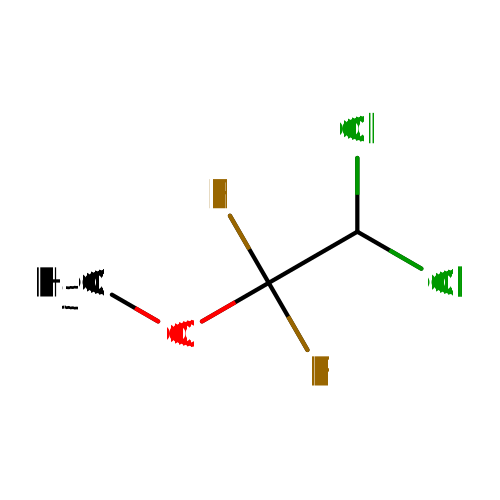
Structure for Methoxyflurane (DB01028)
- Weight
- Average: 164.966
Monoisotopic: 163.960726574 - Chemical Formula
- C3H4Cl2F2O
- Synonyms
- Methoflurane
- Methoxyfluoran
- Methoxyfluran
- Methoxyflurane
- Methoxyfluranum
- Methyl 1,1-difluoro-2,2-dichloroethyl ether
- Metoxiflurano
- External IDs
- DA-759
- NSC-110432

Pharmacology
- Indication
For use in the induction and maintenance of general anesthesia
 Reduce drug development failure ratesBuild, train, & validate machine-learning modelswith evidence-based and structured datasets.Build, train, & validate predictive machine-learning models with structured datasets.
- Associated Conditions
Indication Type Indication Combined Product Details Approval Level Age Group Patient Characteristics Dose Form Management of Severe pain •••••••••••• ••••• ••••••••• Management of Moderate pain •••••••••••• ••••• ••••••••• - Contraindications & Blackbox Warnings
 Prevent Adverse Drug Events TodayTap into our Clinical API for life-saving information on contraindications & blackbox warnings, population restrictions, harmful risks, & more.Avoid life-threatening adverse drug events with our Clinical API
- Pharmacodynamics
Methoxyflurane is a general inhalation anesthetic used for induction and maintenance of general anesthesia. It induces muscle relaxation and reduces pains sensitivity by altering tissue excitability. It does so by decreasing the extent of gap junction mediated cell-cell coupling and altering the activity of the channels that underlie the action potential.
- Mechanism of action
Methoxyflurane induces a reduction in junctional conductance by decreasing gap junction channel opening times and increasing gap junction channel closing times. Methoxyflurane also activates calcium dependent ATPase in the sarcoplasmic reticulum by increasing the fluidity of the lipid membrane. It also appears to bind the D subunit of ATP synthase and NADH dehydogenase. Methoxyflurane also binds to the GABA receptor, the large conductance Ca2+ activated potassium channel, the glutamate receptor and the glycine receptor.
Target Actions Organism AGamma-aminobutyric acid receptor subunit alpha-1 agonistHumans AGlutamate receptor 1 antagonistHumans AGlycine receptor subunit alpha-1 agonistHumans APotassium voltage-gated channel subfamily A member 1 inducerHumans AGABA(A) Receptor positive allosteric modulatorHumans UCalcium-transporting ATPase type 2C member 1 inhibitorHumans UNADH-ubiquinone oxidoreductase chain 1 unknownHumans - Absorption
Not Available
- Volume of distribution
Not Available
- Protein binding
Not Available
- Metabolism
Hepatic.
- Route of elimination
Not Available
- Half-life
Not Available
- Clearance
Not Available
- Adverse Effects
 Improve decision support & research outcomesWith structured adverse effects data, including: blackbox warnings, adverse reactions, warning & precautions, & incidence rates. View sample adverse effects data in our new Data Library!Improve decision support & research outcomes with our structured adverse effects data.
- Toxicity
LD50=3600 mg/kg (Orally in rats). Symptoms of overexposure include eye irritation, CNS depression, analgesia, anesthesia, seizures, respiratory depression, and liver and kidney damage.
- Pathways
- Not Available
- Pharmacogenomic Effects/ADRs
- Not Available
Interactions
- Drug Interactions
- This information should not be interpreted without the help of a healthcare provider. If you believe you are experiencing an interaction, contact a healthcare provider immediately. The absence of an interaction does not necessarily mean no interactions exist.
Drug Interaction Integrate drug-drug
interactions in your software1,2-Benzodiazepine The risk or severity of CNS depression can be increased when Methoxyflurane is combined with 1,2-Benzodiazepine. Abametapir The serum concentration of Methoxyflurane can be increased when it is combined with Abametapir. Abatacept The metabolism of Methoxyflurane can be increased when combined with Abatacept. Abiraterone The metabolism of Methoxyflurane can be decreased when combined with Abiraterone. Abrocitinib The metabolism of Abrocitinib can be decreased when combined with Methoxyflurane. - Food Interactions
- Avoid alcohol. Ingesting alcohol may increase the CNS depressant effects of methoxyflurane.
Products
 Drug product information from 10+ global regionsOur datasets provide approved product information including:dosage, form, labeller, route of administration, and marketing period.Access drug product information from over 10 global regions.
- International/Other Brands
- Penthrane (Abbott Laboratories)
- Brand Name Prescription Products
Name Dosage Strength Route Labeller Marketing Start Marketing End Region Image Penthrox Solution 99.9 % Respiratory (inhalation) Endo Ventures Ltd. 2018-06-13 Not applicable Canada 
Penthrox Kit; Solution 99.9 % Respiratory (inhalation) Endo Ventures Ltd. 2018-06-12 Not applicable Canada
Categories
- ATC Codes
- N02BG09 — Methoxyflurane
- Drug Categories
- Agents that produce hypertension
- Analgesics
- Anesthetics
- Anesthetics, General
- Anesthetics, Inhalation
- Central Nervous System Agents
- Central Nervous System Depressants
- Cytochrome P-450 CYP1A2 Substrates
- Cytochrome P-450 CYP2A6 Substrates
- Cytochrome P-450 CYP2B6 Substrates
- Cytochrome P-450 CYP2C9 Substrates
- Cytochrome P-450 CYP2D6 Substrates
- Cytochrome P-450 CYP2E1 Substrates
- Cytochrome P-450 CYP3A Substrates
- Cytochrome P-450 CYP3A4 Substrates
- Cytochrome P-450 Substrates
- Ethers
- Ethyl Ethers
- Methyl Ethers
- Miscellaneous Analgesics and Antipyretics
- Nervous System
- Chemical TaxonomyProvided by Classyfire
- Description
- This compound belongs to the class of organic compounds known as dialkyl ethers. These are organic compounds containing the dialkyl ether functional group, with the formula ROR', where R and R' are alkyl groups.
- Kingdom
- Organic compounds
- Super Class
- Organic oxygen compounds
- Class
- Organooxygen compounds
- Sub Class
- Ethers
- Direct Parent
- Dialkyl ethers
- Alternative Parents
- Organofluorides / Organochlorides / Hydrocarbon derivatives / Alkyl fluorides / Alkyl chlorides
- Substituents
- Aliphatic acyclic compound / Alkyl chloride / Alkyl fluoride / Alkyl halide / Dialkyl ether / Hydrocarbon derivative / Organochloride / Organofluoride / Organohalogen compound
- Molecular Framework
- Aliphatic acyclic compounds
- External Descriptors
- organofluorine compound, organochlorine compound, ether (CHEBI:6843)
- Affected organisms
- Humans and other mammals
Chemical Identifiers
- UNII
- 30905R8O7B
- CAS number
- 76-38-0
- InChI Key
- RFKMCNOHBTXSMU-UHFFFAOYSA-N
- InChI
- InChI=1S/C3H4Cl2F2O/c1-8-3(6,7)2(4)5/h2H,1H3
- IUPAC Name
- 2,2-dichloro-1,1-difluoro-1-methoxyethane
- SMILES
- COC(F)(F)C(Cl)Cl
References
- General References
- Code of Federal Regulations 216.24: Drug products withdrawn or removed from the market for reasons of safety or effectiveness. [Link]
- External Links
- Human Metabolome Database
- HMDB0015162
- KEGG Drug
- D00544
- KEGG Compound
- C07517
- PubChem Compound
- 4116
- PubChem Substance
- 46508879
- ChemSpider
- 3973
- 6857
- ChEBI
- 6843
- ChEMBL
- CHEMBL1341
- ZINC
- ZINC000000896988
- Therapeutic Targets Database
- DAP000682
- PharmGKB
- PA450434
- Wikipedia
- Methoxyflurane
- MSDS
- Download (52.9 KB)
Clinical Trials
- Clinical Trials
Phase Status Purpose Conditions Count 4 Completed Other Acute Pain / Trauma 1 4 Completed Prevention Benign Prostatic Hypertrophy / Pain 1 4 Completed Treatment Acute Pain 3 4 Completed Treatment Acute Pain / Hypovolaemia / Trauma 1 4 Completed Treatment Pain Measurement 1
Pharmacoeconomics
- Manufacturers
- Not Available
- Packagers
- Medical Development Int Ltd.
- Dosage Forms
Form Route Strength Solution Oral 99.90 % Aerosol, metered Respiratory (inhalation) 99.9 % Kit; solution Respiratory (inhalation) 99.9 % Solution Respiratory (inhalation) 99.9 % Inhalant Respiratory (inhalation) 99.9 % Solution Oral; Respiratory (inhalation) 999 mg - Prices
- Not Available
- Patents
- Not Available
Properties
- State
- Liquid
- Experimental Properties
Property Value Source melting point (°C) -35 °C PhysProp boiling point (°C) 105 °C PhysProp water solubility 2.83E+004 mg/L (at 37 °C) YALKOWSKY,SH & DANNENFELSER,RM (1992) logP 2.21 HANSCH,C ET AL. (1995) - Predicted Properties
Property Value Source Water Solubility 6.46 mg/mL ALOGPS logP 2.01 ALOGPS logP 2.31 Chemaxon logS -1.4 ALOGPS pKa (Strongest Basic) -4.5 Chemaxon Physiological Charge 0 Chemaxon Hydrogen Acceptor Count 1 Chemaxon Hydrogen Donor Count 0 Chemaxon Polar Surface Area 9.23 Å2 Chemaxon Rotatable Bond Count 2 Chemaxon Refractivity 27.98 m3·mol-1 Chemaxon Polarizability 11.46 Å3 Chemaxon Number of Rings 0 Chemaxon Bioavailability 1 Chemaxon Rule of Five Yes Chemaxon Ghose Filter No Chemaxon Veber's Rule Yes Chemaxon MDDR-like Rule No Chemaxon - Predicted ADMET Features
Property Value Probability Human Intestinal Absorption + 1.0 Blood Brain Barrier + 0.9921 Caco-2 permeable + 0.6119 P-glycoprotein substrate Non-substrate 0.8535 P-glycoprotein inhibitor I Non-inhibitor 0.9588 P-glycoprotein inhibitor II Non-inhibitor 0.9203 Renal organic cation transporter Non-inhibitor 0.9227 CYP450 2C9 substrate Non-substrate 0.7959 CYP450 2D6 substrate Non-substrate 0.9116 CYP450 3A4 substrate Non-substrate 0.6542 CYP450 1A2 substrate Non-inhibitor 0.6508 CYP450 2C9 inhibitor Non-inhibitor 0.8587 CYP450 2D6 inhibitor Non-inhibitor 0.9407 CYP450 2C19 inhibitor Non-inhibitor 0.6081 CYP450 3A4 inhibitor Non-inhibitor 0.9753 CYP450 inhibitory promiscuity Low CYP Inhibitory Promiscuity 0.8956 Ames test Non AMES toxic 0.9132 Carcinogenicity Carcinogens 0.7261 Biodegradation Not ready biodegradable 0.9737 Rat acute toxicity 1.6296 LD50, mol/kg Not applicable hERG inhibition (predictor I) Weak inhibitor 0.9515 hERG inhibition (predictor II) Non-inhibitor 0.9016
Spectra
- Mass Spec (NIST)
- Download (7.12 KB)
- Spectra
- Chromatographic Properties
Collision Cross Sections (CCS)
Adduct CCS Value (Å2) Source type Source [M-H]- 104.2173284 predictedDarkChem Lite v0.1.0 [M-H]- 126.78183 predictedDeepCCS 1.0 (2019) [M+H]+ 105.3408284 predictedDarkChem Lite v0.1.0 [M+H]+ 129.0424 predictedDeepCCS 1.0 (2019) [M+Na]+ 104.6475284 predictedDarkChem Lite v0.1.0 [M+Na]+ 137.81529 predictedDeepCCS 1.0 (2019)
Targets

- Kind
- Protein
- Organism
- Humans
- Pharmacological action
- Yes
- Actions
- Agonist
- General Function
- Inhibitory extracellular ligand-gated ion channel activity
- Specific Function
- Component of the heteropentameric receptor for GABA, the major inhibitory neurotransmitter in the vertebrate brain. Functions also as histamine receptor and mediates cellular responses to histamine...
- Gene Name
- GABRA1
- Uniprot ID
- P14867
- Uniprot Name
- Gamma-aminobutyric acid receptor subunit alpha-1
- Molecular Weight
- 51801.395 Da
References
- Overington JP, Al-Lazikani B, Hopkins AL: How many drug targets are there? Nat Rev Drug Discov. 2006 Dec;5(12):993-6. [Article]
- Imming P, Sinning C, Meyer A: Drugs, their targets and the nature and number of drug targets. Nat Rev Drug Discov. 2006 Oct;5(10):821-34. [Article]
- Moody EJ, Suzdak PD, Paul SM, Skolnick P: Modulation of the benzodiazepine/gamma-aminobutyric acid receptor chloride channel complex by inhalation anesthetics. J Neurochem. 1988 Nov;51(5):1386-93. [Article]
- Moody EJ, Skolnick P: The imidazobenzodiazepine Ro 15-4513 antagonizes methoxyflurane anesthesia. Life Sci. 1988;43(16):1269-76. [Article]
- Krasowski MD, Harrison NL: The actions of ether, alcohol and alkane general anaesthetics on GABAA and glycine receptors and the effects of TM2 and TM3 mutations. Br J Pharmacol. 2000 Feb;129(4):731-43. [Article]
- Chen X, Ji ZL, Chen YZ: TTD: Therapeutic Target Database. Nucleic Acids Res. 2002 Jan 1;30(1):412-5. [Article]
- Kind
- Protein
- Organism
- Humans
- Pharmacological action
- Yes
- Actions
- Antagonist
- General Function
- Pdz domain binding
- Specific Function
- Ionotropic glutamate receptor. L-glutamate acts as an excitatory neurotransmitter at many synapses in the central nervous system. Binding of the excitatory neurotransmitter L-glutamate induces a co...
- Gene Name
- GRIA1
- Uniprot ID
- P42261
- Uniprot Name
- Glutamate receptor 1
- Molecular Weight
- 101505.245 Da
References
- Overington JP, Al-Lazikani B, Hopkins AL: How many drug targets are there? Nat Rev Drug Discov. 2006 Dec;5(12):993-6. [Article]
- Imming P, Sinning C, Meyer A: Drugs, their targets and the nature and number of drug targets. Nat Rev Drug Discov. 2006 Oct;5(10):821-34. [Article]
- Martin DC, Plagenhoef M, Abraham J, Dennison RL, Aronstam RS: Volatile anesthetics and glutamate activation of N-methyl-D-aspartate receptors. Biochem Pharmacol. 1995 Mar 15;49(6):809-17. [Article]
- Kind
- Protein
- Organism
- Humans
- Pharmacological action
- Yes
- Actions
- Agonist
- General Function
- Transmitter-gated ion channel activity
- Specific Function
- The glycine receptor is a neurotransmitter-gated ion channel. Binding of glycine to its receptor increases the chloride conductance and thus produces hyperpolarization (inhibition of neuronal firing).
- Gene Name
- GLRA1
- Uniprot ID
- P23415
- Uniprot Name
- Glycine receptor subunit alpha-1
- Molecular Weight
- 52623.35 Da
References
- Overington JP, Al-Lazikani B, Hopkins AL: How many drug targets are there? Nat Rev Drug Discov. 2006 Dec;5(12):993-6. [Article]
- Imming P, Sinning C, Meyer A: Drugs, their targets and the nature and number of drug targets. Nat Rev Drug Discov. 2006 Oct;5(10):821-34. [Article]
- Krasowski MD, Harrison NL: The actions of ether, alcohol and alkane general anaesthetics on GABAA and glycine receptors and the effects of TM2 and TM3 mutations. Br J Pharmacol. 2000 Feb;129(4):731-43. [Article]
- Kind
- Protein
- Organism
- Humans
- Pharmacological action
- Yes
- Actions
- Inducer
- General Function
- Voltage-gated potassium channel activity
- Specific Function
- Voltage-gated potassium channel that mediates transmembrane potassium transport in excitable membranes, primarily in the brain and the central nervous system, but also in the kidney (PubMed:1990381...
- Gene Name
- KCNA1
- Uniprot ID
- Q09470
- Uniprot Name
- Potassium voltage-gated channel subfamily A member 1
- Molecular Weight
- 56465.01 Da
References
- Overington JP, Al-Lazikani B, Hopkins AL: How many drug targets are there? Nat Rev Drug Discov. 2006 Dec;5(12):993-6. [Article]
- Imming P, Sinning C, Meyer A: Drugs, their targets and the nature and number of drug targets. Nat Rev Drug Discov. 2006 Oct;5(10):821-34. [Article]
- Elliott JR, Elliott AA, Harper AA, Winpenny JP: Effects of general anaesthetics on neuronal sodium and potassium channels. Gen Pharmacol. 1992 Nov;23(6):1005-11. [Article]
- Kind
- Protein group
- Organism
- Humans
- Pharmacological action
- Yes
- Actions
- Positive allosteric modulator
- General Function
- Inhibitory extracellular ligand-gated ion channel activity
- Specific Function
- Component of the heteropentameric receptor for GABA, the major inhibitory neurotransmitter in the vertebrate brain. Functions also as histamine receptor and mediates cellular responses to histamine...
Components:
References
- ChEMBL Compound Report Card [Link]
- Kind
- Protein
- Organism
- Humans
- Pharmacological action
- Unknown
- Actions
- Inhibitor
- General Function
- Signal transducer activity
- Specific Function
- This magnesium-dependent enzyme catalyzes the hydrolysis of ATP coupled with the transport of the calcium.
- Gene Name
- ATP2C1
- Uniprot ID
- P98194
- Uniprot Name
- Calcium-transporting ATPase type 2C member 1
- Molecular Weight
- 100576.42 Da
References
- Overington JP, Al-Lazikani B, Hopkins AL: How many drug targets are there? Nat Rev Drug Discov. 2006 Dec;5(12):993-6. [Article]
- Imming P, Sinning C, Meyer A: Drugs, their targets and the nature and number of drug targets. Nat Rev Drug Discov. 2006 Oct;5(10):821-34. [Article]
- Lopez MM, Kosk-Kosicka D: How do volatile anesthetics inhibit Ca(2+)-ATPases? J Biol Chem. 1995 Nov 24;270(47):28239-45. [Article]
- Kind
- Protein
- Organism
- Humans
- Pharmacological action
- Unknown
- Actions
- Unknown
- General Function
- Nadh dehydrogenase (ubiquinone) activity
- Specific Function
- Core subunit of the mitochondrial membrane respiratory chain NADH dehydrogenase (Complex I) that is believed to belong to the minimal assembly required for catalysis. Complex I functions in the tra...
- Gene Name
- MT-ND1
- Uniprot ID
- P03886
- Uniprot Name
- NADH-ubiquinone oxidoreductase chain 1
- Molecular Weight
- 35660.055 Da
References
- Britt BA, Kalow W, Endrenyi L: Effects of halothane and methoxyflurane on rat skeletal muscle mitochondria. Biochem Pharmacol. 1972 Apr 15;21(8):1159-69. doi: 10.1016/0006-2952(72)90110-4. [Article]
- Hall GM, Kirtland SJ, Baum H: The inhibition of mitochondrial respiration by inhalational anaesthetic agents. Br J Anaesth. 1973 Oct;45(10):1005-9. doi: 10.1093/bja/45.10.1005. [Article]
Enzymes
- Kind
- Protein
- Organism
- Humans
- Pharmacological action
- Unknown
- Actions
- Substrate
- Curator comments
- Data supporting this enzyme action are limited to an in vitro study.
- General Function
- Oxidoreductase activity, acting on paired donors, with incorporation or reduction of molecular oxygen, reduced flavin or flavoprotein as one donor, and incorporation of one atom of oxygen
- Specific Function
- Cytochromes P450 are a group of heme-thiolate monooxygenases. In liver microsomes, this enzyme is involved in an NADPH-dependent electron transport pathway. It oxidizes a variety of structurally un...
- Gene Name
- CYP1A2
- Uniprot ID
- P05177
- Uniprot Name
- Cytochrome P450 1A2
- Molecular Weight
- 58293.76 Da
References
- Kharasch ED, Thummel KE: Identification of cytochrome P450 2E1 as the predominant enzyme catalyzing human liver microsomal defluorination of sevoflurane, isoflurane, and methoxyflurane. Anesthesiology. 1993 Oct;79(4):795-807. [Article]
- Kind
- Protein
- Organism
- Humans
- Pharmacological action
- Unknown
- Actions
- Substrate
- General Function
- Steroid hydroxylase activity
- Specific Function
- Exhibits a high coumarin 7-hydroxylase activity. Can act in the hydroxylation of the anti-cancer drugs cyclophosphamide and ifosphamide. Competent in the metabolic activation of aflatoxin B1. Const...
- Gene Name
- CYP2A6
- Uniprot ID
- P11509
- Uniprot Name
- Cytochrome P450 2A6
- Molecular Weight
- 56501.005 Da
References
- Liu J, Flockhart PJ, Lu D, Lv W, Lu WJ, Han X, Cushman M, Flockhart DA: Inhibition of cytochrome p450 enzymes by the e- and z-isomers of norendoxifen. Drug Metab Dispos. 2013 Sep;41(9):1715-20. doi: 10.1124/dmd.113.052506. Epub 2013 Jul 3. [Article]
- Kharasch ED, Hankins DC, Thummel KE: Human kidney methoxyflurane and sevoflurane metabolism. Intrarenal fluoride production as a possible mechanism of methoxyflurane nephrotoxicity. Anesthesiology. 1995 Mar;82(3):689-99. doi: 10.1097/00000542-199503000-00011. [Article]
- Kind
- Protein
- Organism
- Humans
- Pharmacological action
- Unknown
- Actions
- Substrate
- General Function
- Steroid hydroxylase activity
- Specific Function
- Cytochromes P450 are a group of heme-thiolate monooxygenases. In liver microsomes, this enzyme is involved in an NADPH-dependent electron transport pathway. It oxidizes a variety of structurally un...
- Gene Name
- CYP2B6
- Uniprot ID
- P20813
- Uniprot Name
- Cytochrome P450 2B6
- Molecular Weight
- 56277.81 Da
References
- Rendic S: Summary of information on human CYP enzymes: human P450 metabolism data. Drug Metab Rev. 2002 Feb-May;34(1-2):83-448. [Article]
- Kind
- Protein
- Organism
- Humans
- Pharmacological action
- Unknown
- Actions
- Substrate
- General Function
- Steroid hydroxylase activity
- Specific Function
- Cytochromes P450 are a group of heme-thiolate monooxygenases. In liver microsomes, this enzyme is involved in an NADPH-dependent electron transport pathway. It oxidizes a variety of structurally un...
- Gene Name
- CYP2C9
- Uniprot ID
- P11712
- Uniprot Name
- Cytochrome P450 2C9
- Molecular Weight
- 55627.365 Da
References
- Kharasch ED, Thummel KE: Identification of cytochrome P450 2E1 as the predominant enzyme catalyzing human liver microsomal defluorination of sevoflurane, isoflurane, and methoxyflurane. Anesthesiology. 1993 Oct;79(4):795-807. [Article]
- Kind
- Protein
- Organism
- Humans
- Pharmacological action
- Unknown
- Actions
- Substrate
- General Function
- Steroid hydroxylase activity
- Specific Function
- Responsible for the metabolism of many drugs and environmental chemicals that it oxidizes. It is involved in the metabolism of drugs such as antiarrhythmics, adrenoceptor antagonists, and tricyclic...
- Gene Name
- CYP2D6
- Uniprot ID
- P10635
- Uniprot Name
- Cytochrome P450 2D6
- Molecular Weight
- 55768.94 Da
References
- Kharasch ED, Thummel KE: Identification of cytochrome P450 2E1 as the predominant enzyme catalyzing human liver microsomal defluorination of sevoflurane, isoflurane, and methoxyflurane. Anesthesiology. 1993 Oct;79(4):795-807. [Article]
- Kind
- Protein
- Organism
- Humans
- Pharmacological action
- Unknown
- Actions
- Substrate
- General Function
- Vitamin d3 25-hydroxylase activity
- Specific Function
- Cytochromes P450 are a group of heme-thiolate monooxygenases. In liver microsomes, this enzyme is involved in an NADPH-dependent electron transport pathway. It performs a variety of oxidation react...
- Gene Name
- CYP3A4
- Uniprot ID
- P08684
- Uniprot Name
- Cytochrome P450 3A4
- Molecular Weight
- 57342.67 Da
References
- Kharasch ED, Hankins DC, Thummel KE: Human kidney methoxyflurane and sevoflurane metabolism. Intrarenal fluoride production as a possible mechanism of methoxyflurane nephrotoxicity. Anesthesiology. 1995 Mar;82(3):689-99. doi: 10.1097/00000542-199503000-00011. [Article]
- Kind
- Protein
- Organism
- Humans
- Pharmacological action
- Unknown
- Actions
- Substrate
- General Function
- Steroid hydroxylase activity
- Specific Function
- Metabolizes several precarcinogens, drugs, and solvents to reactive metabolites. Inactivates a number of drugs and xenobiotics and also bioactivates many xenobiotic substrates to their hepatotoxic ...
- Gene Name
- CYP2E1
- Uniprot ID
- P05181
- Uniprot Name
- Cytochrome P450 2E1
- Molecular Weight
- 56848.42 Da
References
- Kharasch ED, Thummel KE: Identification of cytochrome P450 2E1 as the predominant enzyme catalyzing human liver microsomal defluorination of sevoflurane, isoflurane, and methoxyflurane. Anesthesiology. 1993 Oct;79(4):795-807. [Article]
- Chang GW, Kam PC: The physiological and pharmacological roles of cytochrome P450 isoenzymes. Anaesthesia. 1999 Jan;54(1):42-50. doi: 10.1046/j.1365-2044.1999.00602.x. [Article]
- Flockhart Table of Drug Interactions [Link]


Drug created at June 13, 2005 13:24 / Updated at February 02, 2024 22:47