Identification
- Summary
Doxacurium chloride is a nondepolarizing neuromuscular blocking agent used as an adjunct to general anesthesia to facilitate tracheal intubation, and to provide skeletal muscle relaxation during surgical procedures.
- Generic Name
- Doxacurium
Commonly known or available as Doxacurium chloride - DrugBank Accession Number
- DB01135
- Background
Doxacurium chloride is a long-acting, nondepolarizing skeletal muscle relaxant for intravenous administration.
- Type
- Small Molecule
- Groups
- Approved
- Structure
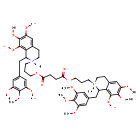
Structure for Doxacurium (DB01135)
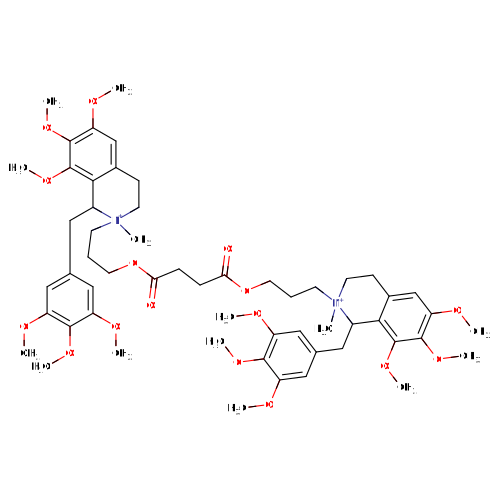
- Weight
- Average: 1035.2223
Monoisotopic: 1034.535134458 - Chemical Formula
- C56H78N2O16
- Synonyms
- Not Available

Pharmacology
- Indication
Used to provide skeletal muscle relaxation as an adjunct to general anesthesia, for endotracheal intubation or to facilitate mechanical ventilation.
 Reduce drug development failure ratesBuild, train, & validate machine-learning modelswith evidence-based and structured datasets.Build, train, & validate predictive machine-learning models with structured datasets.
- Contraindications & Blackbox Warnings
 Prevent Adverse Drug Events TodayTap into our Clinical API for life-saving information on contraindications & blackbox warnings, population restrictions, harmful risks, & more.Avoid life-threatening adverse drug events with our Clinical API
- Pharmacodynamics
Doxacurium chloride is a long-acting, nondepolarizing skeletal muscle relaxant. The neuromuscular block produced by doxacurium chloride may be antagonized by anticholinesterase agents. As with other nondepolarizing neuromuscular blocking agents, the more profound the neuromuscular block at reversal, the longer the time and the greater the dose of anticholinesterase required for recovery of neuromuscular function. Doxacurium chloride is approximately 2.5 to 3 times more potent than pancuronium and 10 to 12 times more potent than metocurine.
- Mechanism of action
Doxacurium chloride binds competitively to cholinergic receptors on the motor end-plate to antagonize the action of acetylcholine, resulting in a block of neuromuscular transmission (non-depolarizing). This action is antagonized by acetylcholinesterase inhibitors, such as neostigmine.
Target Actions Organism ANeuronal acetylcholine receptor subunit alpha-2 antagonistHumans UMuscarinic acetylcholine receptor M2 antagonistHumans - Absorption
Not Available
- Volume of distribution
- 0.11-0.43 L/kg [Healthy Young Adult Patients]
- 0.17-0.55 L/kg [Kidney Transplant Patients]
- 0.17-0.35 L/kg [Liver Transplant Patients]
- Protein binding
Approximately 30%.
- Metabolism
In vivo data from humans suggest that doxacurium chloride is not metabolized and that the major elimination pathway is excretion of unchanged drug in urine and bile.
- Route of elimination
In vivo data from humans suggest that NUROMAX is not metabolized and that the major elimination pathway is excretion of unchanged drug in urine and bile.
- Half-life
99 minutes in normal healthy adults.
- Clearance
- 2.66 mL/min/kg [Healthy Young Adult Patients]
- 1.23 mL/min/kg [Kidney Transplant Patients]
- 2.3 mL/min/kg [Liver Transplant Patients]
- 1.75 +/- 0.16 mL/min/kg [Elderly patients (70-83 yrs)]
- 2.54 +/- 0.24 mL/min/kg [younger patients (19-39 yrs)]
- Adverse Effects
 Improve decision support & research outcomesWith structured adverse effects data, including: blackbox warnings, adverse reactions, warning & precautions, & incidence rates. View sample adverse effects data in our new Data Library!Improve decision support & research outcomes with our structured adverse effects data.
- Toxicity
Overdosage with neuromuscular blocking agents may result in neuromuscular block beyond the time needed for surgery and anesthesia.
- Pathways
- Not Available
- Pharmacogenomic Effects/ADRs
- Not Available
Interactions
- Drug Interactions
- This information should not be interpreted without the help of a healthcare provider. If you believe you are experiencing an interaction, contact a healthcare provider immediately. The absence of an interaction does not necessarily mean no interactions exist.
Drug Interaction Integrate drug-drug
interactions in your software1,2-Benzodiazepine The risk or severity of CNS depression can be increased when Doxacurium is combined with 1,2-Benzodiazepine. Abacavir Abacavir may decrease the excretion rate of Doxacurium which could result in a higher serum level. Aceclofenac Aceclofenac may decrease the excretion rate of Doxacurium which could result in a higher serum level. Acemetacin Acemetacin may decrease the excretion rate of Doxacurium which could result in a higher serum level. Acetaminophen Acetaminophen may decrease the excretion rate of Doxacurium which could result in a higher serum level. - Food Interactions
- Not Available
Products
 Drug product information from 10+ global regionsOur datasets provide approved product information including:dosage, form, labeller, route of administration, and marketing period.Access drug product information from over 10 global regions.
- Product Ingredients
Ingredient UNII CAS InChI Key Doxacurium chloride M78TVM3G5Z 83348-52-1 APADFLLAXHIMFU-UHFFFAOYSA-L - Brand Name Prescription Products
Name Dosage Strength Route Labeller Marketing Start Marketing End Region Image Nuromax Injection 1 mg/1mL Intravenous Abbott 2010-12-08 2010-12-09 US 
Nuromax Liquid 1 mg / mL Intravenous Abbvie 1992-12-31 2012-11-03 Canada 
Categories
- ATC Codes
- M03AC07 — Doxacurium chloride
- Drug Categories
- Anticholinergic Agents
- Central Nervous System Depressants
- Cholinesterase substrates
- Drugs that are Mainly Renally Excreted
- Heterocyclic Compounds, Fused-Ring
- Muscarinic Antagonists
- Muscle Relaxants
- Muscle Relaxants, Peripherally Acting Agents
- Musculo-Skeletal System
- Neuromuscular Agents
- Neuromuscular Blocking Agents
- Neuromuscular-Blocking Agents (Nondepolarizing)
- Nicotinic Antagonists
- Peripheral Nervous System Agents
- Classification
- Not classified
- Affected organisms
- Humans and other mammals
Chemical Identifiers
- UNII
- P40015Y3WW
- CAS number
- 106791-39-3
- InChI Key
- GBLRQXKSCRCLBZ-UHFFFAOYSA-N
- InChI
- InChI=1S/C56H78N2O16/c1-57(23-19-37-33-45(65-7)53(69-11)55(71-13)49(37)39(57)27-35-29-41(61-3)51(67-9)42(30-35)62-4)21-15-25-73-47(59)17-18-48(60)74-26-16-22-58(2)24-20-38-34-46(66-8)54(70-12)56(72-14)50(38)40(58)28-36-31-43(63-5)52(68-10)44(32-36)64-6/h29-34,39-40H,15-28H2,1-14H3/q+2
- IUPAC Name
- 6,7,8-trimethoxy-2-methyl-2-(3-{[4-oxo-4-(3-{6,7,8-trimethoxy-2-methyl-1-[(3,4,5-trimethoxyphenyl)methyl]-1,2,3,4-tetrahydroisoquinolin-2-ium-2-yl}propoxy)butanoyl]oxy}propyl)-1-[(3,4,5-trimethoxyphenyl)methyl]-1,2,3,4-tetrahydroisoquinolin-2-ium
- SMILES
- COC1=CC(CC2C3=C(OC)C(OC)=C(OC)C=C3CC[N+]2(C)CCCOC(=O)CCC(=O)OCCC[N+]2(C)CCC3=CC(OC)=C(OC)C(OC)=C3C2CC2=CC(OC)=C(OC)C(OC)=C2)=CC(OC)=C1OC
References
- General References
- Martinez EA, Wooldridge AA, Hartsfield SM, Mealey KL: Neuromuscular effects of doxacurium chloride in isoflurane-anesthetized dogs. Vet Surg. 1998 May-Jun;27(3):279-83. [Article]
- External Links
- Human Metabolome Database
- HMDB0015266
- KEGG Drug
- D00760
- KEGG Compound
- C07549
- PubChem Compound
- 5284551
- PubChem Substance
- 46506733
- ChemSpider
- 54249
- 23651
- ChEBI
- 59819
- ChEMBL
- CHEMBL1237123
- Therapeutic Targets Database
- DAP000350
- PharmGKB
- PA164744927
- RxList
- RxList Drug Page
- Wikipedia
- Doxacurium_chloride
Clinical Trials
Pharmacoeconomics
- Manufacturers
- Not Available
- Packagers
- Not Available
- Dosage Forms
Form Route Strength Injection Intravenous 1 mg/1mL Liquid Intravenous 1 mg / mL - Prices
- Not Available
- Patents
- Not Available
Properties
- State
- Solid
- Experimental Properties
- Not Available
- Predicted Properties
Property Value Source Water Solubility 9.02e-05 mg/mL ALOGPS logP 3.44 ALOGPS logP -2.5 Chemaxon logS -7.1 ALOGPS pKa (Strongest Acidic) 18.41 Chemaxon pKa (Strongest Basic) -4.1 Chemaxon Physiological Charge 2 Chemaxon Hydrogen Acceptor Count 14 Chemaxon Hydrogen Donor Count 0 Chemaxon Polar Surface Area 163.36 Å2 Chemaxon Rotatable Bond Count 29 Chemaxon Refractivity 302.15 m3·mol-1 Chemaxon Polarizability 113.56 Å3 Chemaxon Number of Rings 6 Chemaxon Bioavailability 0 Chemaxon Rule of Five No Chemaxon Ghose Filter No Chemaxon Veber's Rule No Chemaxon MDDR-like Rule Yes Chemaxon - Predicted ADMET Features
Property Value Probability Human Intestinal Absorption - 0.9919 Blood Brain Barrier + 0.9419 Caco-2 permeable + 0.6166 P-glycoprotein substrate Substrate 0.8274 P-glycoprotein inhibitor I Non-inhibitor 0.5903 P-glycoprotein inhibitor II Inhibitor 0.6915 Renal organic cation transporter Non-inhibitor 0.5328 CYP450 2C9 substrate Non-substrate 0.8563 CYP450 2D6 substrate Non-substrate 0.7468 CYP450 3A4 substrate Substrate 0.6802 CYP450 1A2 substrate Non-inhibitor 0.9149 CYP450 2C9 inhibitor Non-inhibitor 0.963 CYP450 2D6 inhibitor Non-inhibitor 0.9124 CYP450 2C19 inhibitor Non-inhibitor 0.9355 CYP450 3A4 inhibitor Non-inhibitor 0.8601 CYP450 inhibitory promiscuity Low CYP Inhibitory Promiscuity 0.9305 Ames test Non AMES toxic 0.6828 Carcinogenicity Non-carcinogens 0.9133 Biodegradation Not ready biodegradable 0.8219 Rat acute toxicity 2.7335 LD50, mol/kg Not applicable hERG inhibition (predictor I) Weak inhibitor 0.8508 hERG inhibition (predictor II) Non-inhibitor 0.5553
Spectra
- Mass Spec (NIST)
- Not Available
- Spectra
- Not Available
- Chromatographic Properties
Collision Cross Sections (CCS)
Adduct CCS Value (Å2) Source type Source [M-H]- 356.2853261 predictedDarkChem Lite v0.1.0 [M-H]- 308.63065 predictedDeepCCS 1.0 (2019) [M+H]+ 356.7808261 predictedDarkChem Lite v0.1.0 [M+H]+ 310.5261 predictedDeepCCS 1.0 (2019) [M+Na]+ 357.1549261 predictedDarkChem Lite v0.1.0 [M+Na]+ 316.34274 predictedDeepCCS 1.0 (2019)
Targets

- Kind
- Protein
- Organism
- Humans
- Pharmacological action
- Yes
- Actions
- Antagonist
- General Function
- Drug binding
- Specific Function
- After binding acetylcholine, the AChR responds by an extensive change in conformation that affects all subunits and leads to opening of an ion-conducting channel across the plasma membrane.
- Gene Name
- CHRNA2
- Uniprot ID
- Q15822
- Uniprot Name
- Neuronal acetylcholine receptor subunit alpha-2
- Molecular Weight
- 59764.82 Da
References
- Overington JP, Al-Lazikani B, Hopkins AL: How many drug targets are there? Nat Rev Drug Discov. 2006 Dec;5(12):993-6. [Article]
- Imming P, Sinning C, Meyer A: Drugs, their targets and the nature and number of drug targets. Nat Rev Drug Discov. 2006 Oct;5(10):821-34. [Article]
- Liu M, Dilger JP: Synergy between pairs of competitive antagonists at adult human muscle acetylcholine receptors. Anesth Analg. 2008 Aug;107(2):525-33. doi: 10.1213/ane.0b013e31817b4469. [Article]
- Chen X, Ji ZL, Chen YZ: TTD: Therapeutic Target Database. Nucleic Acids Res. 2002 Jan 1;30(1):412-5. [Article]
- Kind
- Protein
- Organism
- Humans
- Pharmacological action
- Unknown
- Actions
- Antagonist
- General Function
- G-protein coupled acetylcholine receptor activity
- Specific Function
- The muscarinic acetylcholine receptor mediates various cellular responses, including inhibition of adenylate cyclase, breakdown of phosphoinositides and modulation of potassium channels through the...
- Gene Name
- CHRM2
- Uniprot ID
- P08172
- Uniprot Name
- Muscarinic acetylcholine receptor M2
- Molecular Weight
- 51714.605 Da
References
- Overington JP, Al-Lazikani B, Hopkins AL: How many drug targets are there? Nat Rev Drug Discov. 2006 Dec;5(12):993-6. [Article]
- Imming P, Sinning C, Meyer A: Drugs, their targets and the nature and number of drug targets. Nat Rev Drug Discov. 2006 Oct;5(10):821-34. [Article]
- Hou VY, Hirshman CA, Emala CW: Neuromuscular relaxants as antagonists for M2 and M3 muscarinic receptors. Anesthesiology. 1998 Mar;88(3):744-50. [Article]
Enzymes
- Kind
- Protein
- Organism
- Humans
- Pharmacological action
- Unknown
- Actions
- Substrate
- General Function
- Identical protein binding
- Specific Function
- Esterase with broad substrate specificity. Contributes to the inactivation of the neurotransmitter acetylcholine. Can degrade neurotoxic organophosphate esters.
- Gene Name
- BCHE
- Uniprot ID
- P06276
- Uniprot Name
- Cholinesterase
- Molecular Weight
- 68417.575 Da
References
- Basta SJ, Savarese JJ, Ali HH, Embree PB, Schwartz AF, Rudd GD, Wastila WB: Clinical pharmacology of doxacurium chloride. A new long-acting nondepolarizing muscle relaxant. Anesthesiology. 1988 Oct;69(4):478-86. [Article]
- Dresner DL, Basta SJ, Ali HH, Schwartz AF, Embree PB, Wargin WA, Lai AA, Brady KA, Savarese JJ: Pharmacokinetics and pharmacodynamics of doxacurium in young and elderly patients during isoflurane anesthesia. Anesth Analg. 1990 Nov;71(5):498-502. [Article]

Drug created at June 13, 2005 13:24 / Updated at May 07, 2021 21:24