Identification
- Summary
Guanethidine is an antihypertensive agent used in the management of moderate and severe hypertension, either alone or as an adjunct, and for the management of renal hypertension.
- Generic Name
- Guanethidine
- DrugBank Accession Number
- DB01170
- Background
An antihypertensive agent that acts by inhibiting selectively transmission in post-ganglionic adrenergic nerves. It is believed to act mainly by preventing the release of norepinephrine at nerve endings and causes depletion of norepinephrine in peripheral sympathetic nerve terminals as well as in tissues. [PubChem]
- Type
- Small Molecule
- Groups
- Approved
- Structure
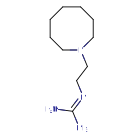
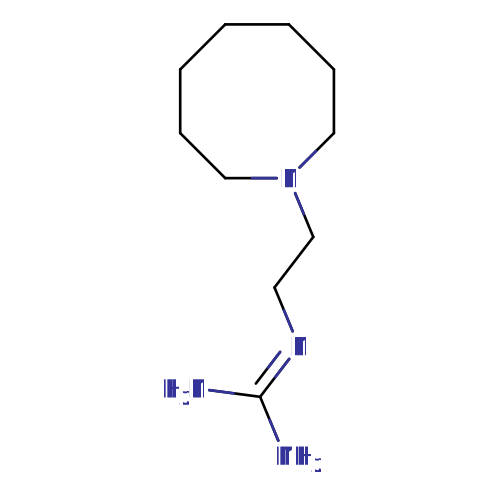
Structure for Guanethidine (DB01170)
- Weight
- Average: 198.3085
Monoisotopic: 198.184446724 - Chemical Formula
- C10H22N4
- Synonyms
- (2-(hexahydro-1(2h)-azocinyl)ethyl)guanidine
- (2-(Octahydro-1-azocinyl)ethyl)guanidine
- 2-(1-N,N-Heptamethyleneimino)ethylguanidine
- 2-(1'-Azacyclooctyl)ethylguanidine
- Azocine, 1-(2-guanidinoethyl)octahydro-
- guanéthidine
- Guanethidine
- guanethidinum
- guanetidina
- Guanidine, (2-(hexahydro-1(2H)-azocinyl)ethyl)-
- Heptamethylenimine, 1-(2-guanidinoethyl)-
- N-(2-Perhydroazocin-1-ylethyl)guanidine

Pharmacology
- Indication
For the treatment of moderate and severe hypertension, either alone or as an adjunct, and for the treatment of renal hypertension.
 Reduce drug development failure ratesBuild, train, & validate machine-learning modelswith evidence-based and structured datasets.Build, train, & validate predictive machine-learning models with structured datasets.
- Contraindications & Blackbox Warnings
 Prevent Adverse Drug Events TodayTap into our Clinical API for life-saving information on contraindications & blackbox warnings, population restrictions, harmful risks, & more.Avoid life-threatening adverse drug events with our Clinical API
- Pharmacodynamics
High blood pressure can cause the heart and arteries to not function properly. This can damage the blood vessels of the brain, heart, and kidneys, resulting in a stroke, heart failure, or kidney failure. High blood pressure may also increase the risk of heart attacks. These problems may be less likely to occur if blood pressure is controlled. Guanethidine works by decreasing the heart rate and relaxing the blood vessels so that blood can flow more easily through the body, thereby reducing these risks. It is a postganglionic sympathetic nerve terminal blocker that prevents the release of norepinephrine from nerve terminals.
- Mechanism of action
Guanethidine acts at the sympathetic neuroeffector junction by inhibiting or interfering with the release and/or distribution of norepinephrine (NE), rather than acting at the effector cell by inhibiting the association of norepinephrine with its receptors. It is taken up by norepinephrine transporters to be concentrated within the transmitter vesicles in place of NE, leading to gradual depletion of NE stores in the nerve endings. Guanethidine at the nerve terminal blocks the release of noradrenaline in response to an action potential. In contrast to ganglionic blocking agents, Guanethidine suppresses equally the responses mediated by alpha-and beta-adrenergic receptors but does not produce parasympathetic blockade. Since sympathetic blockade results in modest decreases in peripheral resistance and cardiac output, Guanethidine lowers blood pressure in the supine position. It further reduces blood pressure by decreasing the degree of vasoconstriction that normally results from reflex sympathetic nervous activity upon assumption of the upright posture, thus reducing venous return and cardiac output more.
Target Actions Organism ASodium-dependent noradrenaline transporter inducerHumans - Absorption
3-30% of oral dose (poor and highly variable)
- Volume of distribution
Not Available
- Protein binding
Not Available
- Metabolism
Guanethidine is converted by the liver to three metabolites, which are excreted in the urine. The metabolites are pharmacologically less active than the parent compound.
- Route of elimination
Ismelin is converted by the liver to three metabolites, which are excreted in the urine.
- Half-life
1.5 days
- Clearance
- Renal cl=56 ml/min
- Adverse Effects
 Improve decision support & research outcomesWith structured adverse effects data, including: blackbox warnings, adverse reactions, warning & precautions, & incidence rates. View sample adverse effects data in our new Data Library!Improve decision support & research outcomes with our structured adverse effects data.
- Toxicity
Side effects include drowsiness, dizziness, tiredness or confusion. LD50=1000 mg/kg (mouse, oral)
- Pathways
- Not Available
- Pharmacogenomic Effects/ADRs
- Not Available
Interactions
- Drug Interactions
- This information should not be interpreted without the help of a healthcare provider. If you believe you are experiencing an interaction, contact a healthcare provider immediately. The absence of an interaction does not necessarily mean no interactions exist.
Drug Interaction Integrate drug-drug
interactions in your softwareAbacavir Abacavir may decrease the excretion rate of Guanethidine which could result in a higher serum level. Abaloparatide Abaloparatide may increase the hypotensive activities of Guanethidine. Acebutolol Guanethidine may increase the hypotensive activities of Acebutolol. Aceclofenac The therapeutic efficacy of Guanethidine can be decreased when used in combination with Aceclofenac. Acemetacin The therapeutic efficacy of Guanethidine can be decreased when used in combination with Acemetacin. - Food Interactions
- Take with or without food. The absorption is unaffected by food.
Products
 Drug product information from 10+ global regionsOur datasets provide approved product information including:dosage, form, labeller, route of administration, and marketing period.Access drug product information from over 10 global regions.
- Product Ingredients
Ingredient UNII CAS InChI Key Guanethidine monosulfate 5UBY8Y002G 645-43-2 YUFWAVFNITUSHI-UHFFFAOYSA-N Guanethidine sulfate 8AQ60474G9 60-02-6 NBJGGHFXCGHTNJ-UHFFFAOYSA-N - International/Other Brands
- Ismedine (Chen Ho)
- Brand Name Prescription Products
Name Dosage Strength Route Labeller Marketing Start Marketing End Region Image Guanethidine 10 Tab 10mg Tablet 10 mg / tab Oral Pro Doc Limitee 1984-12-31 1999-08-12 Canada 
Ismelin Tablet 25 mg/1 Oral Novartis 1960-07-05 2008-07-31 US 
Ismelin Tablet 10 mg/1 Oral Novartis 1960-07-05 2008-07-31 US Ismelin 25mg Tablet 25 mg / tab Oral Geigy Pharmaceuticals, Ciba Geigy Canada Ltd. 1960-12-31 1996-09-09 Canada - Generic Prescription Products
Name Dosage Strength Route Labeller Marketing Start Marketing End Region Image Apo Guanethidine Sulfate Tab 10mg Tablet 10 mg Oral Apotex Corporation 1977-12-31 2013-03-28 Canada Apo Guanethidine Sulfate Tab 25mg Tablet 25 mg Oral Apotex Corporation 1977-12-31 2013-03-28 Canada
Categories
- ATC Codes
- S01EX01 — Guanethidine
- S01EX — Other antiglaucoma preparations
- S01E — ANTIGLAUCOMA PREPARATIONS AND MIOTICS
- S01 — OPHTHALMOLOGICALS
- S — SENSORY ORGANS
- C02CC — Guanidine derivatives
- C02C — ANTIADRENERGIC AGENTS, PERIPHERALLY ACTING
- C02 — ANTIHYPERTENSIVES
- C — CARDIOVASCULAR SYSTEM
- Drug Categories
- Adrenergic Agents
- Adrenergic Antagonists
- Amidines
- Antiadrenergic Agents, Peripherally Acting
- Antiglaucoma Preparations and Miotics
- Antihypertensive Agents
- Autonomic Agents
- Cardiovascular Agents
- Catecholamine-depleting Sympatholytic
- Drugs that are Mainly Renally Excreted
- Gastrointestinal Acidifying Agents
- Guanidine Derivatives
- Guanidine Derivatives and Diuretics
- Guanidines
- Neurotransmitter Agents
- Ophthalmologicals
- Peripheral Nervous System Agents
- Sensory Organs
- Sympatholytics
- Chemical TaxonomyProvided by Classyfire
- Description
- This compound belongs to the class of organic compounds known as guanidines. These are compounds containing a guanidine moiety, with the general structure (R1R2N)(R3R4N)C=N-R5.
- Kingdom
- Organic compounds
- Super Class
- Organic nitrogen compounds
- Class
- Organonitrogen compounds
- Sub Class
- Guanidines
- Direct Parent
- Guanidines
- Alternative Parents
- Trialkylamines / Carboximidamides / Azacyclic compounds / Organopnictogen compounds / Imines / Hydrocarbon derivatives
- Substituents
- Aliphatic heteromonocyclic compound / Amine / Azacycle / Carboximidamide / Guanidine / Hydrocarbon derivative / Imine / Organoheterocyclic compound / Organopnictogen compound / Tertiary aliphatic amine
- Molecular Framework
- Aliphatic heteromonocyclic compounds
- External Descriptors
- guanidines, azocanes (CHEBI:5557)
- Affected organisms
- Humans and other mammals
Chemical Identifiers
- UNII
- ZTI6C33Q2Q
- CAS number
- 55-65-2
- InChI Key
- ACGDKVXYNVEAGU-UHFFFAOYSA-N
- InChI
- InChI=1S/C10H22N4/c11-10(12)13-6-9-14-7-4-2-1-3-5-8-14/h1-9H2,(H4,11,12,13)
- IUPAC Name
- N''-[2-(azocan-1-yl)ethyl]guanidine
- SMILES
- NC(N)=NCCN1CCCCCCC1
References
- Synthesis Reference
U.S. Patent 2,928,829 U.S. Patent 3,006,913 U.S. Patent 3,055,882
- General References
- Not Available
- External Links
- Human Metabolome Database
- HMDB0015301
- KEGG Drug
- D02237
- KEGG Compound
- C07036
- PubChem Compound
- 3518
- PubChem Substance
- 46507567
- ChemSpider
- 3398
- BindingDB
- 50239969
- 5036
- ChEBI
- 5557
- ChEMBL
- CHEMBL765
- ZINC
- ZINC000001530648
- Therapeutic Targets Database
- DAP000124
- PharmGKB
- PA449823
- RxList
- RxList Drug Page
- Drugs.com
- Drugs.com Drug Page
- Wikipedia
- Guanethidine
- MSDS
- Download (74.5 KB)
Clinical Trials
Pharmacoeconomics
- Manufacturers
- Not Available
- Packagers
- Novartis AG
- Professional Co.
- Dosage Forms
Form Route Strength Tablet Oral 10 mg Tablet Oral 25 mg Tablet Oral 10 mg / tab Tablet Oral 10 mg/1 Tablet Oral 25 mg/1 Tablet Oral 25 mg / tab - Prices
Unit description Cost Unit Guanethidine monosulf powder 102.0USD g DrugBank does not sell nor buy drugs. Pricing information is supplied for informational purposes only.- Patents
- Not Available
Properties
- State
- Solid
- Experimental Properties
Property Value Source melting point (°C) 276-281 U.S. Patent 2,928,829 U.S. Patent 3,006,913 U.S. Patent 3,055,882 water solubility Very soluble Not Available logP 0.8 Not Available - Predicted Properties
Property Value Source Water Solubility 2.25 mg/mL ALOGPS logP 0.89 ALOGPS logP 0.74 Chemaxon logS -2 ALOGPS pKa (Strongest Basic) 11.77 Chemaxon Physiological Charge 2 Chemaxon Hydrogen Acceptor Count 4 Chemaxon Hydrogen Donor Count 2 Chemaxon Polar Surface Area 67.64 Å2 Chemaxon Rotatable Bond Count 3 Chemaxon Refractivity 59.7 m3·mol-1 Chemaxon Polarizability 23.67 Å3 Chemaxon Number of Rings 1 Chemaxon Bioavailability 1 Chemaxon Rule of Five Yes Chemaxon Ghose Filter Yes Chemaxon Veber's Rule No Chemaxon MDDR-like Rule No Chemaxon - Predicted ADMET Features
Property Value Probability Human Intestinal Absorption + 0.945 Blood Brain Barrier + 0.9015 Caco-2 permeable - 0.5683 P-glycoprotein substrate Substrate 0.7743 P-glycoprotein inhibitor I Non-inhibitor 0.9342 P-glycoprotein inhibitor II Inhibitor 0.5063 Renal organic cation transporter Inhibitor 0.7586 CYP450 2C9 substrate Non-substrate 0.8981 CYP450 2D6 substrate Substrate 0.6426 CYP450 3A4 substrate Non-substrate 0.7884 CYP450 1A2 substrate Non-inhibitor 0.908 CYP450 2C9 inhibitor Non-inhibitor 0.9363 CYP450 2D6 inhibitor Non-inhibitor 0.9231 CYP450 2C19 inhibitor Non-inhibitor 0.939 CYP450 3A4 inhibitor Non-inhibitor 0.9611 CYP450 inhibitory promiscuity Low CYP Inhibitory Promiscuity 0.9748 Ames test Non AMES toxic 0.6626 Carcinogenicity Non-carcinogens 0.9595 Biodegradation Not ready biodegradable 0.9883 Rat acute toxicity 2.4210 LD50, mol/kg Not applicable hERG inhibition (predictor I) Weak inhibitor 0.6083 hERG inhibition (predictor II) Non-inhibitor 0.8115
Spectra
- Mass Spec (NIST)
- Not Available
- Spectra
- Chromatographic Properties
Collision Cross Sections (CCS)
Adduct CCS Value (Å2) Source type Source [M-H]- 152.8716292 predictedDarkChem Lite v0.1.0 [M-H]- 148.9734 predictedDeepCCS 1.0 (2019) [M+H]+ 153.7240292 predictedDarkChem Lite v0.1.0 [M+H]+ 151.80434 predictedDeepCCS 1.0 (2019) [M+Na]+ 153.4816292 predictedDarkChem Lite v0.1.0 [M+Na]+ 160.22717 predictedDeepCCS 1.0 (2019)
Targets

- Kind
- Protein
- Organism
- Humans
- Pharmacological action
- Yes
- Actions
- Inducer
- General Function
- Norepinephrine:sodium symporter activity
- Specific Function
- Amine transporter. Terminates the action of noradrenaline by its high affinity sodium-dependent reuptake into presynaptic terminals.
- Gene Name
- SLC6A2
- Uniprot ID
- P23975
- Uniprot Name
- Sodium-dependent noradrenaline transporter
- Molecular Weight
- 69331.42 Da
References
- Joyce PI, Atcheson R, Marcus RJ, Heffernan AM, Rowbotham DJ, Lambert DG: Interaction of local anaesthetic agents with the endogenous norepinephrine transporter in SH-SY5Y human neuroblastoma cells. Neurosci Lett. 2001 Jun 15;305(3):161-4. [Article]
- Yi E, Love JA: Alpha-adrenergic modulation of synaptic transmission in rabbit pancreatic ganglia. Auton Neurosci. 2005 Oct 30;122(1-2):45-57. Epub 2005 Aug 25. [Article]
- Galli A, Blakely RD, DeFelice LJ: Norepinephrine transporters have channel modes of conduction. Proc Natl Acad Sci U S A. 1996 Aug 6;93(16):8671-6. [Article]

Drug created at June 13, 2005 13:24 / Updated at December 02, 2023 07:00