Identification
- Summary
Fomepizole is an inhibitor of alcohol dehydrogenase used as an antidote in confirmed or suspected methanol or ethylene glycol poisoning.
- Brand Names
- Antizol
- Generic Name
- Fomepizole
- DrugBank Accession Number
- DB01213
- Background
Fomepizole is used as an antidote in confirmed or suspected methanol or ethylene glycol poisoning. Fomepizole is a competitive inhibitor of alcohol dehydrogenase, the enzyme that catalyzes the initial steps in the metabolism of ethylene glycol and methanol to their toxic metabolites.
- Type
- Small Molecule
- Groups
- Approved, Vet approved
- Structure
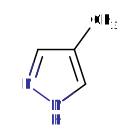
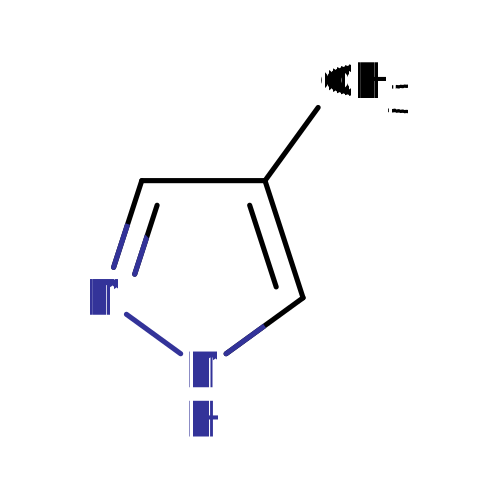
Structure for Fomepizole (DB01213)
- Weight
- Average: 82.1038
Monoisotopic: 82.053098202 - Chemical Formula
- C4H6N2
- Synonyms
- 4-methylpyrazol
- 4-methylpyrazole
- Fomepizol
- Fomepizole
- Fomepizolum

Pharmacology
- Indication
Antizol is indicated as an antidote for ethylene glycol (such as antifreeze) or methanol poisoning, or for use in suspected ethylene glycol or methanol ingestion, either alone or in combination with hemodialysis
 Reduce drug development failure ratesBuild, train, & validate machine-learning modelswith evidence-based and structured datasets.Build, train, & validate predictive machine-learning models with structured datasets.
- Associated Conditions
Indication Type Indication Combined Product Details Approval Level Age Group Patient Characteristics Dose Form Treatment of Ethylene glycol poisoning •••••••••••• Treatment of Methanol poisoning •••••••••••• - Contraindications & Blackbox Warnings
 Prevent Adverse Drug Events TodayTap into our Clinical API for life-saving information on contraindications & blackbox warnings, population restrictions, harmful risks, & more.Avoid life-threatening adverse drug events with our Clinical API
- Pharmacodynamics
Fomepizole is a competitive inhibitor of alcohol dehydrogenase, the enzyme that catalyzes the initial steps in the metabolism of ethylene glycol and methanol to their toxic metabolites. Ethylene glycol is first metabolized to glycoaldehyde which then undergoes further oxidation to glycolate, glyoxylate, and oxalate. Glycolate and oxalate are primarily responsible for metabolic acidosis and renal damage seen in ethylene glycol toxicity. {01}{03} Methanol is first metabolized to formaldehyde and then undergoes subsequent oxidation via formaldehyde dehydrogenase to become formic acid. It is formic acid that is primarily responsible for the metabolic acidosis and visual disturbances that are associated with methanol poisoning.
- Mechanism of action
Antizol (fomepizole) is a competitive inhibitor of alcohol dehydrogenase. Alcohol dehydrogenase catalyzes the oxidation of ethanol to acetaldehyde. Alcohol dehydrogenase also catalyzes the initial steps in the metabolism of ethylene glycol and methanol to their toxic metabolites.
Target Actions Organism AAlcohol dehydrogenase 1A inhibitorHumans AAlcohol dehydrogenase 1B inhibitorHumans AAlcohol dehydrogenase 1C inhibitorHumans ACatalase inhibitorHumans - Absorption
Rapid and complete
- Volume of distribution
- 0.6 to 1.02 L/kg
- Protein binding
Not Available
- Metabolism
Primarily hepatic. the primary metabolite is 4-carboxypyrazole (approximately 80 to 85% of an administered dose). Minor metabolites include 4-hydroxymethylpyrazole and the N -glucuronide conjugates of 4-carboxypyrazole and 4-hydroxymethylpyrazole.
Hover over products below to view reaction partners
- Route of elimination
In healthy volunteers, only 1-3.5% of the administered dose of Antizol® (7-20 mg/kg oral and IV) was excreted unchanged in the urine, indicating that metabolism is the major route of elimination. In humans, the primary metabolite of Antizol® is 4-carboxypyrazole (approximately 80-85% of administered dose), which is excreted in the urine. The metabolites of Antizol® are excreted renally.
- Half-life
The plasma half-life of Antizol varies with dose, even in patients with normal renal function, and has not been calculated.
- Clearance
Not Available
- Adverse Effects
 Improve decision support & research outcomesWith structured adverse effects data, including: blackbox warnings, adverse reactions, warning & precautions, & incidence rates. View sample adverse effects data in our new Data Library!Improve decision support & research outcomes with our structured adverse effects data.
- Toxicity
Headache, nausea, dizziness
- Pathways
- Not Available
- Pharmacogenomic Effects/ADRs
- Not Available
Interactions
- Drug Interactions
- This information should not be interpreted without the help of a healthcare provider. If you believe you are experiencing an interaction, contact a healthcare provider immediately. The absence of an interaction does not necessarily mean no interactions exist.
Drug Interaction Integrate drug-drug
interactions in your softwareAbacavir Abacavir may decrease the excretion rate of Fomepizole which could result in a higher serum level. Aceclofenac Aceclofenac may decrease the excretion rate of Fomepizole which could result in a higher serum level. Acemetacin Acemetacin may decrease the excretion rate of Fomepizole which could result in a higher serum level. Acetaminophen Fomepizole may increase the hepatotoxic activities of Acetaminophen. Acetazolamide Acetazolamide may increase the excretion rate of Fomepizole which could result in a lower serum level and potentially a reduction in efficacy. - Food Interactions
- Avoid alcohol. Fomepizole reduces the metabolism of alcohol by alcohol dehydrogenase, and alcohol also reduces fomepizole metabolism and elimination.
Products
 Drug product information from 10+ global regionsOur datasets provide approved product information including:dosage, form, labeller, route of administration, and marketing period.Access drug product information from over 10 global regions.
- Product Ingredients
Ingredient UNII CAS InChI Key Fomepizole sulfate 93AY3O3G2W 211626-47-0 Not applicable - Brand Name Prescription Products
Name Dosage Strength Route Labeller Marketing Start Marketing End Region Image Antizol Injection 1 g/1mL Intravenous Paladin Labs Inc 2009-07-31 Not applicable US 
Antizol Liquid 1 g / mL Intravenous Paladin Labs Inc 2001-03-30 Not applicable Canada 
Antizol Injection, solution 1 g/1mL Intravenous UNSPECIFIED 2007-02-08 Not applicable US Fomepizole Injection, solution 1 g/1mL Intravenous EMCURE 2008-11-18 Not applicable US Fomepizole for Injection Solution 1 g / mL Intravenous Sterimax Inc 2015-09-22 Not applicable Canada - Generic Prescription Products
Name Dosage Strength Route Labeller Marketing Start Marketing End Region Image Fomepizole Injection, solution 1 g/1mL Intravenous Navinta Llc 2021-04-02 Not applicable US Fomepizole Injection 1 g/1mL Intravenous Gland Pharma Limited 2023-07-06 Not applicable US Fomepizole Injection, solution 1 g/1mL Intravenous Zydus Pharmaceuticals USA Inc. 2021-03-18 Not applicable US Fomepizole Injection, solution 1 g/1mL Intravenous AMERICAN REGENT, INC. 2020-07-31 Not applicable US Fomepizole Injection, solution 1 g/1mL Intravenous Mylan Institutional LLC 2012-10-09 Not applicable US
Categories
- ATC Codes
- V03AB34 — Fomepizole
- Drug Categories
- Antidotes
- Compounds used in a research, industrial, or household setting
- Cytochrome P-450 CYP2A6 Inhibitors
- Cytochrome P-450 CYP2A6 Inhibitors (strength unknown)
- Cytochrome P-450 CYP2E1 Inducers
- Cytochrome P-450 CYP2E1 Inducers (strength unknown)
- Cytochrome P-450 CYP2E1 Inhibitors
- Cytochrome P-450 CYP2E1 Inhibitors (strength unknown)
- Cytochrome P-450 CYP2E1 Substrates
- Cytochrome P-450 Enzyme Inducers
- Cytochrome P-450 Enzyme Inhibitors
- Cytochrome P-450 Substrates
- Drugs that are Mainly Renally Excreted
- Enzyme Inhibitors
- Protective Agents
- Pyrazoles
- Chemical TaxonomyProvided by Classyfire
- Description
- This compound belongs to the class of organic compounds known as pyrazoles. These are compounds containing a pyrazole ring, which is a five-member aromatic ring with two nitrogen atoms (at positions 1 and 2) and three carbon atoms.
- Kingdom
- Organic compounds
- Super Class
- Organoheterocyclic compounds
- Class
- Azoles
- Sub Class
- Pyrazoles
- Direct Parent
- Pyrazoles
- Alternative Parents
- Heteroaromatic compounds / Azacyclic compounds / Organopnictogen compounds / Organonitrogen compounds / Hydrocarbon derivatives
- Substituents
- Aromatic heteromonocyclic compound / Azacycle / Heteroaromatic compound / Hydrocarbon derivative / Organic nitrogen compound / Organonitrogen compound / Organopnictogen compound / Pyrazole
- Molecular Framework
- Aromatic heteromonocyclic compounds
- External Descriptors
- pyrazoles (CHEBI:5141) / a small molecule (CPD0-1652)
- Affected organisms
- Humans and other mammals
Chemical Identifiers
- UNII
- 83LCM6L2BY
- CAS number
- 7554-65-6
- InChI Key
- RIKMMFOAQPJVMX-UHFFFAOYSA-N
- InChI
- InChI=1S/C4H6N2/c1-4-2-5-6-3-4/h2-3H,1H3,(H,5,6)
- IUPAC Name
- 4-methyl-1H-pyrazole
- SMILES
- CC1=CNN=C1
References
- General References
- Not Available
- External Links
- Human Metabolome Database
- HMDB0015344
- KEGG Drug
- D00707
- KEGG Compound
- C07837
- PubChem Compound
- 3406
- PubChem Substance
- 46508566
- ChemSpider
- 3289
- BindingDB
- 50226186
- 15226
- ChEBI
- 5141
- ChEMBL
- CHEMBL1308
- ZINC
- ZINC000000897288
- Therapeutic Targets Database
- DAP000568
- PharmGKB
- PA449697
- PDBe Ligand
- 4PZ
- RxList
- RxList Drug Page
- Drugs.com
- Drugs.com Drug Page
- Wikipedia
- Fomepizole
- PDB Entries
- 3e4e
- MSDS
- Download (64.1 KB)
Clinical Trials
- Clinical Trials
Phase Status Purpose Conditions Count 2 Completed Treatment Aldehyde Dehydrogenase-2 (ALDH2) Deficiency 1 2 Recruiting Treatment Acetaminophen / Acetaminophen Overdose / Acetaminophen Poisoning / Drug Induced Liver Injury / Drug Overdose / Hepatic Failure / Hepatotoxicity 1 1 Completed Treatment Macular Dystrophy, Corneal 1 0 Completed Other Healthy Adult Volunteers 1 Not Available Completed Not Available Ethylene Glycol Poisoning, Methanol Poisoning 1
Pharmacoeconomics
- Manufacturers
- Not Available
- Packagers
- Alliance Medical Products
- Ben Venue Laboratories Inc.
- Bioniche Pharma
- Emcure Pharmaceuticals Ltd.
- Generamedix Inc.
- Jazz Pharmaceuticals
- Orphan Medical Inc.
- Paladin Laboratories Usa Inc.
- Pharmaforce Inc.
- Sandoz
- X-Gen Pharmaceuticals
- Dosage Forms
Form Route Strength Injection Intravenous 1 g/1mL Injection, solution Intravenous 1 g/1mL Liquid Intravenous 1 g / mL Injection, solution, concentrate Intravenous 8 mg/ml Injection Intravenous 1.5 g/1.5mL Powder Not applicable 1 kg/1kg Solution Intravenous 1 g / mL - Prices
Unit description Cost Unit Antizol 1.5 gm/1.5 ml vial 1849.8USD ml Antizol 1 gm/ml vial 1516.5USD ml Fomepizole 1.5 gm/1.5 ml vial 1364.85USD ml DrugBank does not sell nor buy drugs. Pricing information is supplied for informational purposes only.- Patents
Patent Number Pediatric Extension Approved Expires (estimated) Region US7553863 No 2009-06-30 2027-06-30 US
Properties
- State
- Liquid
- Experimental Properties
Property Value Source melting point (°C) 25 °C Not Available logP 0.9 Not Available - Predicted Properties
Property Value Source Water Solubility 559.0 mg/mL ALOGPS logP 0.41 ALOGPS logP 0.79 Chemaxon logS 0.83 ALOGPS pKa (Strongest Acidic) 15.82 Chemaxon pKa (Strongest Basic) 2.63 Chemaxon Physiological Charge 0 Chemaxon Hydrogen Acceptor Count 1 Chemaxon Hydrogen Donor Count 1 Chemaxon Polar Surface Area 28.68 Å2 Chemaxon Rotatable Bond Count 0 Chemaxon Refractivity 24.79 m3·mol-1 Chemaxon Polarizability 8.58 Å3 Chemaxon Number of Rings 1 Chemaxon Bioavailability 1 Chemaxon Rule of Five Yes Chemaxon Ghose Filter No Chemaxon Veber's Rule Yes Chemaxon MDDR-like Rule No Chemaxon - Predicted ADMET Features
Property Value Probability Human Intestinal Absorption + 1.0 Blood Brain Barrier + 0.9902 Caco-2 permeable + 0.526 P-glycoprotein substrate Non-substrate 0.8392 P-glycoprotein inhibitor I Non-inhibitor 0.9617 P-glycoprotein inhibitor II Non-inhibitor 0.9872 Renal organic cation transporter Non-inhibitor 0.8355 CYP450 2C9 substrate Non-substrate 0.8533 CYP450 2D6 substrate Non-substrate 0.8888 CYP450 3A4 substrate Non-substrate 0.7657 CYP450 1A2 substrate Non-inhibitor 0.9046 CYP450 2C9 inhibitor Non-inhibitor 0.9085 CYP450 2D6 inhibitor Non-inhibitor 0.9231 CYP450 2C19 inhibitor Non-inhibitor 0.9026 CYP450 3A4 inhibitor Non-inhibitor 0.8505 CYP450 inhibitory promiscuity Low CYP Inhibitory Promiscuity 0.7534 Ames test Non AMES toxic 0.6456 Carcinogenicity Non-carcinogens 0.7102 Biodegradation Not ready biodegradable 0.9152 Rat acute toxicity 2.1558 LD50, mol/kg Not applicable hERG inhibition (predictor I) Weak inhibitor 0.9162 hERG inhibition (predictor II) Non-inhibitor 0.9683
Spectra
- Mass Spec (NIST)
- Download (8.42 KB)
- Spectra
- Chromatographic Properties
Collision Cross Sections (CCS)
Adduct CCS Value (Å2) Source type Source [M-H]- 105.2507528 predictedDarkChem Lite v0.1.0 [M-H]- 105.3245528 predictedDarkChem Lite v0.1.0 [M-H]- 116.60616 predictedDeepCCS 1.0 (2019) [M+H]+ 106.4214528 predictedDarkChem Lite v0.1.0 [M+H]+ 106.5099528 predictedDarkChem Lite v0.1.0 [M+H]+ 118.681335 predictedDeepCCS 1.0 (2019) [M+Na]+ 105.9467528 predictedDarkChem Lite v0.1.0 [M+Na]+ 105.7572528 predictedDarkChem Lite v0.1.0 [M+Na]+ 126.90425 predictedDeepCCS 1.0 (2019)
Targets

- Kind
- Protein
- Organism
- Humans
- Pharmacological action
- Yes
- Actions
- Inhibitor
- General Function
- Zinc ion binding
- Specific Function
- Not Available
- Gene Name
- ADH1A
- Uniprot ID
- P07327
- Uniprot Name
- Alcohol dehydrogenase 1A
- Molecular Weight
- 39858.37 Da
References
- Nagata H, Sekizuka E, Morishita T, Tatemichi M, Kurokawa T, Mizuki A, Ishii H: Adenosine A2-receptor mediates ethanol-induced arteriolar dilation in rat stomach. Am J Physiol. 1996 Dec;271(6 Pt 1):G1028-33. [Article]
- Mukherjee PK, Mohamed S, Chandra J, Kuhn D, Liu S, Antar OS, Munyon R, Mitchell AP, Andes D, Chance MR, Rouabhia M, Ghannoum MA: Alcohol dehydrogenase restricts the ability of the pathogen Candida albicans to form a biofilm on catheter surfaces through an ethanol-based mechanism. Infect Immun. 2006 Jul;74(7):3804-16. [Article]
- Nussrallah BA, Dam R, Wagner FW: Characterization of Coturnix quail liver alcohol dehydrogenase enzymes. Biochemistry. 1989 Jul 25;28(15):6245-51. [Article]
- Brent J: Fomepizole for ethylene glycol and methanol poisoning. N Engl J Med. 2009 May 21;360(21):2216-23. doi: 10.1056/NEJMct0806112. [Article]
- Calello DP, Osterhoudt KC, Henretig FM: New and novel antidotes in pediatrics. Pediatr Emerg Care. 2006 Jul;22(7):523-30. [Article]
- Betten DP, Vohra RB, Cook MD, Matteucci MJ, Clark RF: Antidote use in the critically ill poisoned patient. J Intensive Care Med. 2006 Sep-Oct;21(5):255-77. [Article]
- Kind
- Protein
- Organism
- Humans
- Pharmacological action
- Yes
- Actions
- Inhibitor
- General Function
- Zinc ion binding
- Specific Function
- Not Available
- Gene Name
- ADH1B
- Uniprot ID
- P00325
- Uniprot Name
- Alcohol dehydrogenase 1B
- Molecular Weight
- 39854.21 Da
References
- Yin SJ, Liao CS, Chen CM, Fan FT, Lee SC: Genetic polymorphism and activities of human lung alcohol and aldehyde dehydrogenases: implications for ethanol metabolism and cytotoxicity. Biochem Genet. 1992 Apr;30(3-4):203-15. [Article]
- Eriksson CJ, Fukunaga T, Sarkola T, Chen WJ, Chen CC, Ju JM, Cheng AT, Yamamoto H, Kohlenberg-Muller K, Kimura M, Murayama M, Matsushita S, Kashima H, Higuchi S, Carr L, Viljoen D, Brooke L, Stewart T, Foroud T, Su J, Li TK, Whitfield JB: Functional relevance of human adh polymorphism. Alcohol Clin Exp Res. 2001 May;25(5 Suppl ISBRA):157S-163S. [Article]
- Kassam JP, Tang BK, Kadar D, Kalow W: In vitro studies of human liver alcohol dehydrogenase variants using a variety of substrates. Drug Metab Dispos. 1989 Sep-Oct;17(5):567-72. [Article]
- Brent J: Fomepizole for ethylene glycol and methanol poisoning. N Engl J Med. 2009 May 21;360(21):2216-23. doi: 10.1056/NEJMct0806112. [Article]
- Calello DP, Osterhoudt KC, Henretig FM: New and novel antidotes in pediatrics. Pediatr Emerg Care. 2006 Jul;22(7):523-30. [Article]
- Betten DP, Vohra RB, Cook MD, Matteucci MJ, Clark RF: Antidote use in the critically ill poisoned patient. J Intensive Care Med. 2006 Sep-Oct;21(5):255-77. [Article]
- Kind
- Protein
- Organism
- Humans
- Pharmacological action
- Yes
- Actions
- Inhibitor
- General Function
- Zinc ion binding
- Specific Function
- Not Available
- Gene Name
- ADH1C
- Uniprot ID
- P00326
- Uniprot Name
- Alcohol dehydrogenase 1C
- Molecular Weight
- 39867.27 Da
References
- Eriksson CJ, Fukunaga T, Sarkola T, Chen WJ, Chen CC, Ju JM, Cheng AT, Yamamoto H, Kohlenberg-Muller K, Kimura M, Murayama M, Matsushita S, Kashima H, Higuchi S, Carr L, Viljoen D, Brooke L, Stewart T, Foroud T, Su J, Li TK, Whitfield JB: Functional relevance of human adh polymorphism. Alcohol Clin Exp Res. 2001 May;25(5 Suppl ISBRA):157S-163S. [Article]
- Brent J: Fomepizole for ethylene glycol and methanol poisoning. N Engl J Med. 2009 May 21;360(21):2216-23. doi: 10.1056/NEJMct0806112. [Article]
- Calello DP, Osterhoudt KC, Henretig FM: New and novel antidotes in pediatrics. Pediatr Emerg Care. 2006 Jul;22(7):523-30. [Article]
- Betten DP, Vohra RB, Cook MD, Matteucci MJ, Clark RF: Antidote use in the critically ill poisoned patient. J Intensive Care Med. 2006 Sep-Oct;21(5):255-77. [Article]
- Kind
- Protein
- Organism
- Humans
- Pharmacological action
- Yes
- Actions
- Inhibitor
- General Function
- Receptor binding
- Specific Function
- Occurs in almost all aerobically respiring organisms and serves to protect cells from the toxic effects of hydrogen peroxide. Promotes growth of cells including T-cells, B-cells, myeloid leukemia c...
- Gene Name
- CAT
- Uniprot ID
- P04040
- Uniprot Name
- Catalase
- Molecular Weight
- 59755.82 Da
References
- Thurman RG, McKenna WR, Brentzel HJ Jr, Hesse S: Significant pathways of hepatic ethanol metabolism. Fed Proc. 1975 Oct;34(11):2075-81. [Article]
- Handler JA, Thurman RG: Catalase-dependent ethanol oxidation in perfused rat liver. Requirement for fatty-acid-stimulated H2O2 production by peroxisomes. Eur J Biochem. 1988 Sep 15;176(2):477-84. [Article]
- Bradford BU, Forman DT, Thurman RG: 4-Methylpyrazole inhibits fatty acyl coenzyme synthetase and diminishes catalase-dependent alcohol metabolism: has the contribution of alcohol dehydrogenase to alcohol metabolism been previously overestimated? Mol Pharmacol. 1993 Jan;43(1):115-9. [Article]
Enzymes
- Kind
- Protein
- Organism
- Humans
- Pharmacological action
- Unknown
- Actions
- Inhibitor
- General Function
- Steroid hydroxylase activity
- Specific Function
- Exhibits a high coumarin 7-hydroxylase activity. Can act in the hydroxylation of the anti-cancer drugs cyclophosphamide and ifosphamide. Competent in the metabolic activation of aflatoxin B1. Const...
- Gene Name
- CYP2A6
- Uniprot ID
- P11509
- Uniprot Name
- Cytochrome P450 2A6
- Molecular Weight
- 56501.005 Da
References
- Rendic S: Summary of information on human CYP enzymes: human P450 metabolism data. Drug Metab Rev. 2002 Feb-May;34(1-2):83-448. [Article]
- Kind
- Protein
- Organism
- Humans
- Pharmacological action
- Unknown
- Actions
- SubstrateInhibitorInducer
- General Function
- Steroid hydroxylase activity
- Specific Function
- Metabolizes several precarcinogens, drugs, and solvents to reactive metabolites. Inactivates a number of drugs and xenobiotics and also bioactivates many xenobiotic substrates to their hepatotoxic ...
- Gene Name
- CYP2E1
- Uniprot ID
- P05181
- Uniprot Name
- Cytochrome P450 2E1
- Molecular Weight
- 56848.42 Da
References
- Megarbane B: Treatment of patients with ethylene glycol or methanol poisoning: focus on fomepizole. Open Access Emerg Med. 2010 Aug 24;2:67-75. doi: 10.2147/OAEM.S5346. eCollection 2010. [Article]
- Bestic M, Blackford M, Reed M: Fomepizole: a critical assessment of current dosing recommendations. J Clin Pharmacol. 2009 Feb;49(2):130-7. doi: 10.1177/0091270008327142. Epub 2008 Nov 11. [Article]
- McMartin KE, Sebastian CS, Dies D, Jacobsen D: Kinetics and metabolism of fomepizole in healthy humans. Clin Toxicol (Phila). 2012 Jun;50(5):375-83. doi: 10.3109/15563650.2012.683197. Epub 2012 May 4. [Article]


Drug created at June 13, 2005 13:24 / Updated at April 27, 2024 09:44