Identification
- Generic Name
- Bromodiphenhydramine
- DrugBank Accession Number
- DB01237
- Background
Bromodiphenhydramine is an ethanolamine antihistamine with antimicrobial property. Bromodiphenhydramine is used in the control of cutaneous allergies. Ethanolamine antihistamines produce marked sedation in most patients.
- Type
- Small Molecule
- Groups
- Approved
- Structure
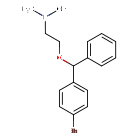
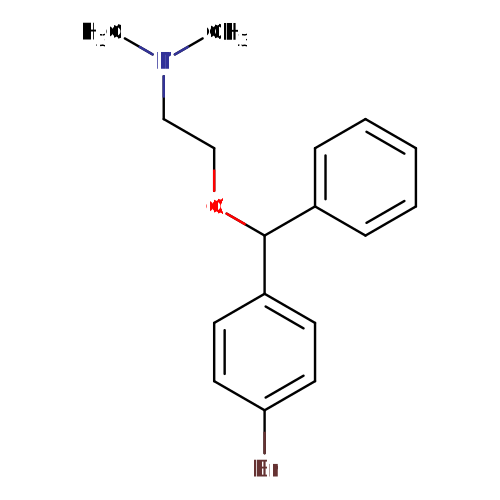
Structure for Bromodiphenhydramine (DB01237)
- Weight
- Average: 334.251
Monoisotopic: 333.072826914 - Chemical Formula
- C17H20BrNO
- Synonyms
- 2-(p-bromo-α-phenylbenzyloxy)-N,N-dimethylethylamine
- Bromazina
- Bromazine
- Bromazinum
- β-(p-bromobenzhydryloxy)ethyldimethylamine
- β-dimethylaminoethyl p-bromobenzhydryl ether

Pharmacology
- Indication
For management of symptoms related to hay fever and other types of allergy and used to help bring up phlegm, thin secretions, and make a cough productive.
 Reduce drug development failure ratesBuild, train, & validate machine-learning modelswith evidence-based and structured datasets.Build, train, & validate predictive machine-learning models with structured datasets.
- Contraindications & Blackbox Warnings
 Prevent Adverse Drug Events TodayTap into our Clinical API for life-saving information on contraindications & blackbox warnings, population restrictions, harmful risks, & more.Avoid life-threatening adverse drug events with our Clinical API
- Pharmacodynamics
Bromodiphenhydramine is an antihistamine of the ethanolamine class. Ethanolamine antihistamines have significant antimuscarinic activity and produce marked sedation in most patients. In addition to the usual allergic symptoms, the drug also treats irritant cough and nausea, vomiting, and vertigo associated with motion sickness. It also is used commonly to treat drug-induced extrapyramidal symptoms as well as to treat mild cases of Parkinson's disease. Rather than preventing the release of histamine, as do cromolyn and nedocromil, Bromodiphenhydramine competes with free histamine for binding at HA-receptor sites. Bromodiphenhydramine competitively antagonizes the effects of histamine on HA-receptors in the GI tract, uterus, large blood vessels, and bronchial muscle. Ethanolamine derivatives have greater anticholinergic activity than do other antihistamines, which probably accounts for the antidyskinetic action of Bromodiphenhydramine. This anticholinergic action appears to be due to a central antimuscarinic effect, which also may be responsible for its antiemetic effects, although the exact mechanism is unknown.
- Mechanism of action
Bromodiphenhydramine competes with free histamine for binding at HA-receptor sites. This antagonizes the effects of histamine on HA-receptors, leading to a reduction of the negative symptoms brought on by histamine HA-receptor binding.
Target Actions Organism AHistamine H1 receptor antagonistHumans - Absorption
Well absorbed in the digestive tract.
- Volume of distribution
Not Available
- Protein binding
96%
- Metabolism
Hepatic (cytochrome P-450 system); some renal.
- Route of elimination
Not Available
- Half-life
1 to 4 hours
- Clearance
Not Available
- Adverse Effects
 Improve decision support & research outcomesWith structured adverse effects data, including: blackbox warnings, adverse reactions, warning & precautions, & incidence rates. View sample adverse effects data in our new Data Library!Improve decision support & research outcomes with our structured adverse effects data.
- Toxicity
Signs of overdose include wheezing, tightness in the chest, fever, itching, bad cough, blue skin color, fits, swelling of face, lips, tongue, or throat.
- Pathways
Pathway Category Bromodiphenhydramine H1-Antihistamine Action Drug action - Pharmacogenomic Effects/ADRs
- Not Available
Interactions
- Drug Interactions
- This information should not be interpreted without the help of a healthcare provider. If you believe you are experiencing an interaction, contact a healthcare provider immediately. The absence of an interaction does not necessarily mean no interactions exist.
Drug Interaction Integrate drug-drug
interactions in your softwareHyoscyamine Bromodiphenhydramine may increase the anticholinergic activities of Hyoscyamine. - Food Interactions
- No interactions found.
Products
 Drug product information from 10+ global regionsOur datasets provide approved product information including:dosage, form, labeller, route of administration, and marketing period.Access drug product information from over 10 global regions.
- Product Ingredients
Ingredient UNII CAS InChI Key Bromodiphenhydramine hydrochloride 202J683U97 1808-12-4 ZQDJSWUEGOYDGT-UHFFFAOYSA-N - Mixture Products
Name Ingredients Dosage Route Labeller Marketing Start Marketing End Region Image Diphenhydramine HCI and Zinc Acetate Bromodiphenhydramine hydrochloride (1.52 g/76g) + Zinc acetate dihydrate (0.076 g/76g) Aerosol, spray Topical Foodhold Usa 2019-03-04 Not applicable US 
Categories
- ATC Codes
- R06AA01 — Bromazine
- Drug Categories
- Chemical TaxonomyProvided by Classyfire
- Description
- This compound belongs to the class of organic compounds known as diphenylmethanes. These are compounds containing a diphenylmethane moiety, which consists of a methane wherein two hydrogen atoms are replaced by two phenyl groups.
- Kingdom
- Organic compounds
- Super Class
- Benzenoids
- Class
- Benzene and substituted derivatives
- Sub Class
- Diphenylmethanes
- Direct Parent
- Diphenylmethanes
- Alternative Parents
- Benzylethers / Bromobenzenes / Aryl bromides / Trialkylamines / Dialkyl ethers / Organopnictogen compounds / Organobromides / Hydrocarbon derivatives
- Substituents
- Amine / Aromatic homomonocyclic compound / Aryl bromide / Aryl halide / Benzylether / Bromobenzene / Dialkyl ether / Diphenylmethane / Ether / Halobenzene
- Molecular Framework
- Aromatic homomonocyclic compounds
- External Descriptors
- organobromine compound, tertiary amino compound (CHEBI:59177)
- Affected organisms
- Humans and other mammals
Chemical Identifiers
- UNII
- T032BI7727
- CAS number
- 118-23-0
- InChI Key
- NUNIWXHYABYXKF-UHFFFAOYSA-N
- InChI
- InChI=1S/C17H20BrNO/c1-19(2)12-13-20-17(14-6-4-3-5-7-14)15-8-10-16(18)11-9-15/h3-11,17H,12-13H2,1-2H3
- IUPAC Name
- {2-[(4-bromophenyl)(phenyl)methoxy]ethyl}dimethylamine
- SMILES
- CN(C)CCOC(C1=CC=CC=C1)C1=CC=C(Br)C=C1
References
- Synthesis Reference
- US2527963
- General References
- Not Available
- External Links
- Human Metabolome Database
- HMDB0015367
- PubChem Compound
- 2444
- PubChem Substance
- 46506082
- ChemSpider
- 2350
- BindingDB
- 81465
- 19759
- ChEBI
- 59177
- ChEMBL
- CHEMBL1201245
- Therapeutic Targets Database
- DAP001072
- PharmGKB
- PA164760854
- Wikipedia
- Bromodiphenhydramine
Clinical Trials
Pharmacoeconomics
- Manufacturers
- Not Available
- Packagers
- Not Available
- Dosage Forms
Form Route Strength Aerosol, spray Topical - Prices
- Not Available
- Patents
- Not Available
Properties
- State
- Solid
- Experimental Properties
Property Value Source logP 4 Not Available - Predicted Properties
Property Value Source Water Solubility 0.00345 mg/mL ALOGPS logP 4.16 ALOGPS logP 4.42 Chemaxon logS -5 ALOGPS pKa (Strongest Basic) 8.87 Chemaxon Physiological Charge 1 Chemaxon Hydrogen Acceptor Count 2 Chemaxon Hydrogen Donor Count 0 Chemaxon Polar Surface Area 12.47 Å2 Chemaxon Rotatable Bond Count 6 Chemaxon Refractivity 87.55 m3·mol-1 Chemaxon Polarizability 33.48 Å3 Chemaxon Number of Rings 2 Chemaxon Bioavailability 1 Chemaxon Rule of Five Yes Chemaxon Ghose Filter Yes Chemaxon Veber's Rule Yes Chemaxon MDDR-like Rule No Chemaxon - Predicted ADMET Features
Property Value Probability Human Intestinal Absorption + 0.9871 Blood Brain Barrier + 0.9525 Caco-2 permeable + 0.7916 P-glycoprotein substrate Substrate 0.6199 P-glycoprotein inhibitor I Non-inhibitor 0.6681 P-glycoprotein inhibitor II Non-inhibitor 0.7076 Renal organic cation transporter Inhibitor 0.7733 CYP450 2C9 substrate Non-substrate 0.8289 CYP450 2D6 substrate Substrate 0.7231 CYP450 3A4 substrate Substrate 0.6411 CYP450 1A2 substrate Inhibitor 0.7747 CYP450 2C9 inhibitor Non-inhibitor 0.8483 CYP450 2D6 inhibitor Inhibitor 0.8438 CYP450 2C19 inhibitor Non-inhibitor 0.719 CYP450 3A4 inhibitor Non-inhibitor 0.917 CYP450 inhibitory promiscuity High CYP Inhibitory Promiscuity 0.5526 Ames test Non AMES toxic 0.8547 Carcinogenicity Non-carcinogens 0.6627 Biodegradation Not ready biodegradable 0.9892 Rat acute toxicity 2.7517 LD50, mol/kg Not applicable hERG inhibition (predictor I) Weak inhibitor 0.5627 hERG inhibition (predictor II) Inhibitor 0.7917
Spectra
- Mass Spec (NIST)
- Not Available
- Spectra
- Chromatographic Properties
Collision Cross Sections (CCS)
Adduct CCS Value (Å2) Source type Source [M-H]- 169.8216954 predictedDarkChem Lite v0.1.0 [M-H]- 165.92491 predictedDeepCCS 1.0 (2019) [M+H]+ 170.0367954 predictedDarkChem Lite v0.1.0 [M+H]+ 168.28293 predictedDeepCCS 1.0 (2019) [M+Na]+ 169.7351954 predictedDarkChem Lite v0.1.0 [M+Na]+ 174.37607 predictedDeepCCS 1.0 (2019)
Targets

- Kind
- Protein
- Organism
- Humans
- Pharmacological action
- Yes
- Actions
- Antagonist
- General Function
- Histamine receptor activity
- Specific Function
- In peripheral tissues, the H1 subclass of histamine receptors mediates the contraction of smooth muscles, increase in capillary permeability due to contraction of terminal venules, and catecholamin...
- Gene Name
- HRH1
- Uniprot ID
- P35367
- Uniprot Name
- Histamine H1 receptor
- Molecular Weight
- 55783.61 Da
References
- Overington JP, Al-Lazikani B, Hopkins AL: How many drug targets are there? Nat Rev Drug Discov. 2006 Dec;5(12):993-6. [Article]
- Imming P, Sinning C, Meyer A: Drugs, their targets and the nature and number of drug targets. Nat Rev Drug Discov. 2006 Oct;5(10):821-34. [Article]
- Chen X, Ji ZL, Chen YZ: TTD: Therapeutic Target Database. Nucleic Acids Res. 2002 Jan 1;30(1):412-5. [Article]
Transporters
- Kind
- Protein
- Organism
- Humans
- Pharmacological action
- Unknown
- General Function
- Sodium-independent organic anion transmembrane transporter activity
- Specific Function
- Involved in the renal elimination of endogenous and exogenous organic anions. Functions as organic anion exchanger when the uptake of one molecule of organic anion is coupled with an efflux of one ...
- Gene Name
- SLC22A6
- Uniprot ID
- Q4U2R8
- Uniprot Name
- Solute carrier family 22 member 6
- Molecular Weight
- 61815.78 Da
References
- Ullrich KJ, Rumrich G, David C, Fritzsch G: Bisubstrates: substances that interact with renal contraluminal organic anion and organic cation transport systems. I. Amines, piperidines, piperazines, azepines, pyridines, quinolines, imidazoles, thiazoles, guanidines and hydrazines. Pflugers Arch. 1993 Nov;425(3-4):280-99. [Article]

Drug created at June 13, 2005 13:24 / Updated at March 03, 2024 02:34