Identification
- Generic Name
- Paramethasone
- DrugBank Accession Number
- DB01384
- Background
A glucocorticoid with the general properties of corticosteroids. It has been used by mouth in the treatment of all conditions in which corticosteroid therapy is indicated except adrenal-deficiency states for which its lack of sodium-retaining properties makes it less suitable than hydrocortisone with supplementary fludrocortisone. (From Martindale, The Extra Pharmacopoeia, 30th ed, p737)
- Type
- Small Molecule
- Groups
- Experimental
- Structure
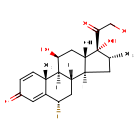
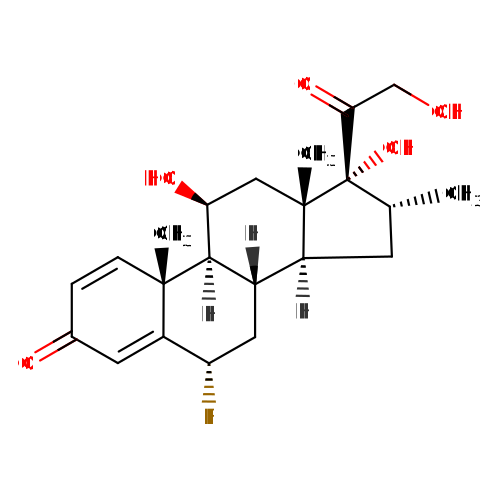
Structure for Paramethasone (DB01384)
- Weight
- Average: 392.4611
Monoisotopic: 392.199902243 - Chemical Formula
- C22H29FO5
- Synonyms
- Parametasona
- Parametasone
- Paramethasone
- Paramethasonum
- External IDs
- CS 1483

Pharmacology
- Indication
For the treatment of all conditions in which corticosteroid therapy is indicated except adrenal-deficiency states for which its lack of sodium-retaining properties makes it less suitable than hydrocortisone with supplementary fludrocortisone.
 Reduce drug development failure ratesBuild, train, & validate machine-learning modelswith evidence-based and structured datasets.Build, train, & validate predictive machine-learning models with structured datasets.
- Contraindications & Blackbox Warnings
 Prevent Adverse Drug Events TodayTap into our Clinical API for life-saving information on contraindications & blackbox warnings, population restrictions, harmful risks, & more.Avoid life-threatening adverse drug events with our Clinical API
- Pharmacodynamics
Paramethasone is a glucocorticoid with the general properties of corticosteroids. Glucocorticoids are a class of steroid hormones characterised by an ability to bind with the cortisol receptor and trigger a variety of important cardiovascular, metabolic, immunologic and homeostatic effects. Glucocorticoids are distinguished from mineralocorticoids and sex steroids by having different receptors, target cells, and effects. Technically, the term corticosteroid refers to both glucocorticoids and mineralocorticoids, but is often used as a synonym for glucocorticoid. Glucocorticoids suppress cell-mediated immunity. They act by inhibiting genes that code for the cytokines IL-1, IL-2, IL-3, IL-4, IL-5, IL-6, IL-8 and TNF-alpha, the most important of which is the IL-2. Reduced cytokine production limits T cell proliferation. Glucocorticoids also suppress humoral immunity, causing B cells to express lower amounts of IL-2 and IL-2 receptors. This diminishes both B cell clonal expansion and antibody synthesis. The diminished amounts of IL-2 also leads to fewer T lymphocyte cells being activated.
- Mechanism of action
Glucocorticoids such as paramethasone can inhibit leukocyte infiltration at the site of inflammation, interfere with mediators of inflammatory response, and suppress humoral immune responses. The antiinflammatory actions of glucocorticoids are thought to involve phospholipase A2 inhibitory proteins, lipocortins, which control the biosynthesis of potent mediators of inflammation such as prostaglandins and leukotrienes. Paramethasone reduces inflammatory reaction by limiting the capillary dilatation and permeability of the vascular structures. These compounds restrict the accumulation of polymorphonuclear leukocytes and macrophages and reduce the release of vasoactive kinins. Recent research suggests that corticosteroids may inhibit the release of arachidonic acid from phospholipids, thereby reducing the formation of prostaglandins. Prednisolone is a glucocorticoid receptor agonist. On binding, the corticoreceptor-ligand complex translocates itself into the cell nucleus, where it binds to many glucocorticoid response elements (GRE) in the promoter region of the target genes. The DNA bound receptor then interacts with basic transcription factors, causing an increase or decrease in expression of specific target genes, including suppression of IL2 (interleukin 2) expression.
Target Actions Organism AGlucocorticoid receptor agonistHumans - Absorption
Not Available
- Volume of distribution
Not Available
- Protein binding
80%
- Metabolism
Hepatic.
- Route of elimination
Corticosteroids are metabolized primarily in the liver and are then excreted by the kidneys. Some of the topical corticosteroids and their metabolites are also excreted into the bile.
- Half-life
Not Available
- Clearance
Not Available
- Adverse Effects
 Improve decision support & research outcomesWith structured adverse effects data, including: blackbox warnings, adverse reactions, warning & precautions, & incidence rates. View sample adverse effects data in our new Data Library!Improve decision support & research outcomes with our structured adverse effects data.
- Toxicity
Side effects include inhibition of bone formation, suppression of calcium absorption delayed wound healing, immune suppression, and hyperglycemia.
- Pathways
- Not Available
- Pharmacogenomic Effects/ADRs
- Not Available
Interactions
- Drug Interactions
- This information should not be interpreted without the help of a healthcare provider. If you believe you are experiencing an interaction, contact a healthcare provider immediately. The absence of an interaction does not necessarily mean no interactions exist.
Drug Interaction Integrate drug-drug
interactions in your softwareAbametapir The serum concentration of Paramethasone can be increased when it is combined with Abametapir. Abatacept The risk or severity of adverse effects can be increased when Abatacept is combined with Paramethasone. Abemaciclib The metabolism of Abemaciclib can be increased when combined with Paramethasone. Acalabrutinib The metabolism of Acalabrutinib can be increased when combined with Paramethasone. Acarbose The risk or severity of hyperglycemia can be increased when Paramethasone is combined with Acarbose. - Food Interactions
- Not Available
Products
 Drug product information from 10+ global regionsOur datasets provide approved product information including:dosage, form, labeller, route of administration, and marketing period.Access drug product information from over 10 global regions.
- International/Other Brands
- Dillar
Categories
- ATC Codes
- H02AB05 — Paramethasone
- Drug Categories
- Adrenal Cortex Hormones
- Anti-Inflammatory Agents
- Corticosteroids
- Corticosteroids for Systemic Use
- Corticosteroids for Systemic Use, Plain
- Cytochrome P-450 CYP3A Inducers
- Cytochrome P-450 CYP3A Inhibitors
- Cytochrome P-450 CYP3A Substrates
- Cytochrome P-450 CYP3A4 Inducers
- Cytochrome P-450 CYP3A4 Inducers (strength unknown)
- Cytochrome P-450 CYP3A4 Inhibitors
- Cytochrome P-450 CYP3A4 Inhibitors (strength unknown)
- Cytochrome P-450 CYP3A4 Substrates
- Cytochrome P-450 CYP3A5 Inducers
- Cytochrome P-450 CYP3A5 Inducers (strength unknown)
- Cytochrome P-450 Enzyme Inducers
- Cytochrome P-450 Enzyme Inhibitors
- Cytochrome P-450 Substrates
- Fused-Ring Compounds
- Glucocorticoids
- Hormones
- Hormones, Hormone Substitutes, and Hormone Antagonists
- Hyperglycemia-Associated Agents
- Immunosuppressive Agents
- Pregnadienes
- Pregnadienetriols
- Pregnanes
- Steroids
- Steroids, Fluorinated
- Systemic Hormonal Preparations, Excl. Sex Hormones and Insulins
- Chemical TaxonomyProvided by Classyfire
- Description
- This compound belongs to the class of organic compounds known as 21-hydroxysteroids. These are steroids carrying a hydroxyl group at the 21-position of the steroid backbone.
- Kingdom
- Organic compounds
- Super Class
- Lipids and lipid-like molecules
- Class
- Steroids and steroid derivatives
- Sub Class
- Hydroxysteroids
- Direct Parent
- 21-hydroxysteroids
- Alternative Parents
- Gluco/mineralocorticoids, progestogins and derivatives / 20-oxosteroids / 11-beta-hydroxysteroids / 17-hydroxysteroids / 3-oxo delta-1,4-steroids / Halogenated steroids / Delta-1,4-steroids / Tertiary alcohols / Alpha-hydroxy ketones / Secondary alcohols show 7 more
- Substituents
- 11-beta-hydroxysteroid / 11-hydroxysteroid / 17-hydroxysteroid / 20-oxosteroid / 21-hydroxysteroid / 3-oxo-delta-1,4-steroid / 3-oxosteroid / 6-halo-steroid / Alcohol / Aliphatic homopolycyclic compound show 21 more
- Molecular Framework
- Aliphatic homopolycyclic compounds
- External Descriptors
- fluorinated steroid (CHEBI:7922)
- Affected organisms
- Humans and other mammals
Chemical Identifiers
- UNII
- VFC6ZX3584
- CAS number
- 53-33-8
- InChI Key
- MKPDWECBUAZOHP-AFYJWTTESA-N
- InChI
- InChI=1S/C22H29FO5/c1-11-6-14-13-8-16(23)15-7-12(25)4-5-20(15,2)19(13)17(26)9-21(14,3)22(11,28)18(27)10-24/h4-5,7,11,13-14,16-17,19,24,26,28H,6,8-10H2,1-3H3/t11-,13+,14+,16+,17+,19-,20+,21+,22+/m1/s1
- IUPAC Name
- (1R,2R,3aS,3bS,5S,9aR,9bS,10S,11aS)-5-fluoro-1,10-dihydroxy-1-(2-hydroxyacetyl)-2,9a,11a-trimethyl-1H,2H,3H,3aH,3bH,4H,5H,7H,9aH,9bH,10H,11H,11aH-cyclopenta[a]phenanthren-7-one
- SMILES
- [H][C@@]12C[C@@H](C)[C@](O)(C(=O)CO)[C@@]1(C)C[C@H](O)[C@@]1([H])[C@@]2([H])C[C@H](F)C2=CC(=O)C=C[C@]12C
References
- General References
- Not Available
- External Links
- Human Metabolome Database
- HMDB0015462
- KEGG Drug
- D07464
- KEGG Compound
- C07413
- PubChem Compound
- 5875
- PubChem Substance
- 46504651
- ChemSpider
- 5664
- 7910
- ChEBI
- 7922
- ChEMBL
- CHEMBL1579
- ZINC
- ZINC000004097384
- Therapeutic Targets Database
- DAP000422
- PharmGKB
- PA164777035
- Wikipedia
- Paramethasone
Clinical Trials
Pharmacoeconomics
- Manufacturers
- Not Available
- Packagers
- Not Available
- Dosage Forms
- Not Available
- Prices
- Not Available
- Patents
- Not Available
Properties
- State
- Solid
- Experimental Properties
- Not Available
- Predicted Properties
Property Value Source Water Solubility 0.145 mg/mL ALOGPS logP 1.51 ALOGPS logP 1.3 Chemaxon logS -3.4 ALOGPS pKa (Strongest Acidic) 12.45 Chemaxon pKa (Strongest Basic) -2.9 Chemaxon Physiological Charge 0 Chemaxon Hydrogen Acceptor Count 5 Chemaxon Hydrogen Donor Count 3 Chemaxon Polar Surface Area 94.83 Å2 Chemaxon Rotatable Bond Count 2 Chemaxon Refractivity 102.79 m3·mol-1 Chemaxon Polarizability 40.81 Å3 Chemaxon Number of Rings 4 Chemaxon Bioavailability 1 Chemaxon Rule of Five Yes Chemaxon Ghose Filter Yes Chemaxon Veber's Rule No Chemaxon MDDR-like Rule No Chemaxon - Predicted ADMET Features
Property Value Probability Human Intestinal Absorption + 0.9948 Blood Brain Barrier + 0.971 Caco-2 permeable + 0.747 P-glycoprotein substrate Substrate 0.7725 P-glycoprotein inhibitor I Non-inhibitor 0.7629 P-glycoprotein inhibitor II Non-inhibitor 0.9002 Renal organic cation transporter Non-inhibitor 0.8405 CYP450 2C9 substrate Non-substrate 0.8789 CYP450 2D6 substrate Non-substrate 0.9031 CYP450 3A4 substrate Substrate 0.6991 CYP450 1A2 substrate Non-inhibitor 0.9313 CYP450 2C9 inhibitor Non-inhibitor 0.9254 CYP450 2D6 inhibitor Non-inhibitor 0.939 CYP450 2C19 inhibitor Non-inhibitor 0.9234 CYP450 3A4 inhibitor Non-inhibitor 0.7563 CYP450 inhibitory promiscuity Low CYP Inhibitory Promiscuity 0.8979 Ames test Non AMES toxic 0.8509 Carcinogenicity Non-carcinogens 0.9232 Biodegradation Not ready biodegradable 1.0 Rat acute toxicity 2.3293 LD50, mol/kg Not applicable hERG inhibition (predictor I) Weak inhibitor 0.9794 hERG inhibition (predictor II) Non-inhibitor 0.6022
Spectra
- Mass Spec (NIST)
- Not Available
- Spectra
Spectrum Spectrum Type Splash Key Predicted GC-MS Spectrum - GC-MS Predicted GC-MS splash10-0ab9-4889000000-fdfca86534eb8016e0ab Predicted MS/MS Spectrum - 10V, Positive (Annotated) Predicted LC-MS/MS splash10-0a6r-0009000000-e95a1eeed7d71bff5507 Predicted MS/MS Spectrum - 10V, Negative (Annotated) Predicted LC-MS/MS splash10-03di-0009000000-de18d1f3f74904d0061a Predicted MS/MS Spectrum - 20V, Positive (Annotated) Predicted LC-MS/MS splash10-06vi-0179000000-7d657f6efbc7fabb5475 Predicted MS/MS Spectrum - 20V, Negative (Annotated) Predicted LC-MS/MS splash10-052f-9007000000-a6516a354ba773fdf4cc Predicted MS/MS Spectrum - 40V, Positive (Annotated) Predicted LC-MS/MS splash10-00m0-0961000000-3069fd36e169e5dfec97 Predicted MS/MS Spectrum - 40V, Negative (Annotated) Predicted LC-MS/MS splash10-0006-0009000000-c6f2bffe6a91b06ea905 Predicted 1H NMR Spectrum 1D NMR Not Applicable Predicted 13C NMR Spectrum 1D NMR Not Applicable - Chromatographic Properties
Collision Cross Sections (CCS)
Adduct CCS Value (Å2) Source type Source [M-H]- 194.8687403 predictedDarkChem Lite v0.1.0 [M-H]- 188.74069 predictedDeepCCS 1.0 (2019) [M+H]+ 196.7731403 predictedDarkChem Lite v0.1.0 [M+H]+ 190.60094 predictedDeepCCS 1.0 (2019) [M+Na]+ 195.1418403 predictedDarkChem Lite v0.1.0 [M+Na]+ 196.99733 predictedDeepCCS 1.0 (2019)
Targets

- Kind
- Protein
- Organism
- Humans
- Pharmacological action
- Yes
- Actions
- Agonist
- General Function
- Zinc ion binding
- Specific Function
- Receptor for glucocorticoids (GC). Has a dual mode of action: as a transcription factor that binds to glucocorticoid response elements (GRE), both for nuclear and mitochondrial DNA, and as a modula...
- Gene Name
- NR3C1
- Uniprot ID
- P04150
- Uniprot Name
- Glucocorticoid receptor
- Molecular Weight
- 85658.57 Da
References
- Fitzgerald P, O'Brien SM, Scully P, Rijkers K, Scott LV, Dinan TG: Cutaneous glucocorticoid receptor sensitivity and pro-inflammatory cytokine levels in antidepressant-resistant depression. Psychol Med. 2006 Jan;36(1):37-43. Epub 2005 Oct 28. [Article]
- Grossman R, Yehuda R, Golier J, McEwen B, Harvey P, Maria NS: Cognitive effects of intravenous hydrocortisone in subjects with PTSD and healthy control subjects. Ann N Y Acad Sci. 2006 Jul;1071:410-21. [Article]
- Rautanen A, Eriksson JG, Kere J, Andersson S, Osmond C, Tienari P, Sairanen H, Barker DJ, Phillips DI, Forsen T, Kajantie E: Associations of body size at birth with late-life cortisol concentrations and glucose tolerance are modified by haplotypes of the glucocorticoid receptor gene. J Clin Endocrinol Metab. 2006 Nov;91(11):4544-51. Epub 2006 Aug 8. [Article]
- Hammer F, Stewart PM: Cortisol metabolism in hypertension. Best Pract Res Clin Endocrinol Metab. 2006 Sep;20(3):337-53. [Article]
- Shaw JR, Gabor K, Hand E, Lankowski A, Durant L, Thibodeau R, Stanton CR, Barnaby R, Coutermarsh B, Karlson KH, Sato JD, Hamilton JW, Stanton BA: Role of glucocorticoid receptor in acclimation of killifish (Fundulus heteroclitus) to seawater and effects of arsenic. Am J Physiol Regul Integr Comp Physiol. 2007 Feb;292(2):R1052-60. Epub 2006 Oct 12. [Article]
- Sher L: Combined dexamethasone suppression-corticotropin-releasing hormone stimulation test in studies of depression, alcoholism, and suicidal behavior. ScientificWorldJournal. 2006 Oct 31;6:1398-404. [Article]
Enzymes
- Kind
- Protein
- Organism
- Humans
- Pharmacological action
- Unknown
- Actions
- SubstrateInhibitorInducer
- Curator comments
- Induction likely occurs indirectly due to transcriptional modulation via the glucocorticoid receptor.
- General Function
- Vitamin d3 25-hydroxylase activity
- Specific Function
- Cytochromes P450 are a group of heme-thiolate monooxygenases. In liver microsomes, this enzyme is involved in an NADPH-dependent electron transport pathway. It performs a variety of oxidation react...
- Gene Name
- CYP3A4
- Uniprot ID
- P08684
- Uniprot Name
- Cytochrome P450 3A4
- Molecular Weight
- 57342.67 Da
References
- Ekins S, Bravi G, Wikel JH, Wrighton SA: Three-dimensional-quantitative structure activity relationship analysis of cytochrome P-450 3A4 substrates. J Pharmacol Exp Ther. 1999 Oct;291(1):424-33. [Article]
- Dvorak Z, Pavek P: Regulation of drug-metabolizing cytochrome P450 enzymes by glucocorticoids. Drug Metab Rev. 2010 Nov;42(4):621-35. doi: 10.3109/03602532.2010.484462. [Article]
- Flockhart Table of Drug Interactions [Link]
- Kind
- Protein
- Organism
- Humans
- Pharmacological action
- Unknown
- Actions
- Inducer
- General Function
- Oxygen binding
- Specific Function
- Cytochromes P450 are a group of heme-thiolate monooxygenases. In liver microsomes, this enzyme is involved in an NADPH-dependent electron transport pathway. It oxidizes a variety of structurally un...
- Gene Name
- CYP3A5
- Uniprot ID
- P20815
- Uniprot Name
- Cytochrome P450 3A5
- Molecular Weight
- 57108.065 Da
References
- Dvorak Z, Pavek P: Regulation of drug-metabolizing cytochrome P450 enzymes by glucocorticoids. Drug Metab Rev. 2010 Nov;42(4):621-35. doi: 10.3109/03602532.2010.484462. [Article]
Carriers
- Kind
- Protein
- Organism
- Humans
- Pharmacological action
- Unknown
- Actions
- Binder
- General Function
- Steroid binding
- Specific Function
- Major transport protein for glucocorticoids and progestins in the blood of almost all vertebrate species.
- Gene Name
- SERPINA6
- Uniprot ID
- P08185
- Uniprot Name
- Corticosteroid-binding globulin
- Molecular Weight
- 45140.49 Da
References
- Overington JP, Al-Lazikani B, Hopkins AL: How many drug targets are there? Nat Rev Drug Discov. 2006 Dec;5(12):993-6. [Article]
- Imming P, Sinning C, Meyer A: Drugs, their targets and the nature and number of drug targets. Nat Rev Drug Discov. 2006 Oct;5(10):821-34. [Article]
- Chen X, Ji ZL, Chen YZ: TTD: Therapeutic Target Database. Nucleic Acids Res. 2002 Jan 1;30(1):412-5. [Article]

Drug created at July 06, 2007 20:34 / Updated at February 21, 2021 18:51