Identification
- Summary
Clenbuterol is a decongestant and bronchodilator used in a variety of respiratory conditions.
- Generic Name
- Clenbuterol
- DrugBank Accession Number
- DB01407
- Background
A substituted phenylaminoethanol that has beta-2 adrenomimetic properties at very low doses. It is used as a bronchodilator in asthma.
- Type
- Small Molecule
- Groups
- Approved, Investigational, Vet approved
- Structure
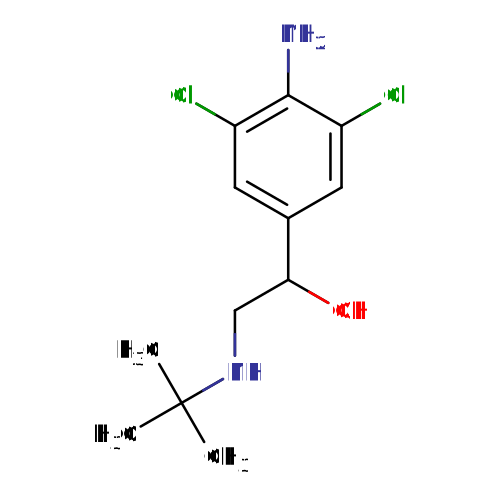
Structure for Clenbuterol (DB01407)
- Weight
- Average: 277.19
Monoisotopic: 276.079618622 - Chemical Formula
- C12H18Cl2N2O
- Synonyms
- (±)-clenbuterol
- 1-(4-Amino-3,5-dichloro-phenyl)-2-tert-butylamino-ethanol
- 4-amino-3,5-dichloro-α-(((1,1-dimethylethyl)amino)methyl)benzenemethanol
- 4-amino-α-((tert-butylamino)methyl)-3,5-dichlorobenzyl alcohol
- Clenbuterol
- Clenbutérol
- Clenbuterolum

Pharmacology
- Indication
Used as a bronchodilator in the treatment of asthma patients.
 Reduce drug development failure ratesBuild, train, & validate machine-learning modelswith evidence-based and structured datasets.Build, train, & validate predictive machine-learning models with structured datasets.
- Associated Conditions
Indication Type Indication Combined Product Details Approval Level Age Group Patient Characteristics Dose Form Used in combination to treat Bronchitis Combination Product in combination with: Ambroxol (DB06742) •••••••••••• ••••••••• •••••• •••••• Used in combination to treat Chronic lung diseases Combination Product in combination with: Ambroxol (DB06742) •••••••••••• ••••••••• •••••• •••••• Used in combination to treat Chronic obstructive pulmonary disease (copd) Combination Product in combination with: Ambroxol (DB06742) •••••••••••• ••••••••• •••••• •••••• - Contraindications & Blackbox Warnings
 Prevent Adverse Drug Events TodayTap into our Clinical API for life-saving information on contraindications & blackbox warnings, population restrictions, harmful risks, & more.Avoid life-threatening adverse drug events with our Clinical API
- Pharmacodynamics
Clenbuterol is a substituted phenylaminoethanol that has beta-2 adrenomimetic properties at very low doses. It is used as a bronchodilator in asthma. Although approved for use in some countries, as of fall, 2006, clenbuterol is not an ingredient of any therapeutic drug approved by the U.S. Food and Drug Administration.
- Mechanism of action
Clenbuterol is a Beta(2) agonist similar in some structural respects to salbutamol. Agonism of the beta(2) receptor stimulates adenylyl cyclase activity which ultimately leads to downstream effects of smooth muscle relaxation in the bronchioles.
Target Actions Organism ABeta-2 adrenergic receptor agonistHumans UBeta-1 adrenergic receptor agonistHumans UBeta-3 adrenergic receptor agonistHumans UBeta-nerve growth factor stimulatorHumans UTumor necrosis factor other/unknownHumans - Absorption
89-98% orally
- Volume of distribution
Not Available
- Protein binding
Not Available
- Metabolism
- Not Available
- Route of elimination
Not Available
- Half-life
36-39 hours
- Clearance
Not Available
- Adverse Effects
 Improve decision support & research outcomesWith structured adverse effects data, including: blackbox warnings, adverse reactions, warning & precautions, & incidence rates. View sample adverse effects data in our new Data Library!Improve decision support & research outcomes with our structured adverse effects data.
- Toxicity
Not Available
- Pathways
- Not Available
- Pharmacogenomic Effects/ADRs
- Not Available
Interactions
- Drug Interactions
- This information should not be interpreted without the help of a healthcare provider. If you believe you are experiencing an interaction, contact a healthcare provider immediately. The absence of an interaction does not necessarily mean no interactions exist.
Drug Interaction Integrate drug-drug
interactions in your softwareAcebutolol The therapeutic efficacy of Clenbuterol can be decreased when used in combination with Acebutolol. Aceclofenac The risk or severity of hypertension can be increased when Clenbuterol is combined with Aceclofenac. Acemetacin The risk or severity of hypertension can be increased when Clenbuterol is combined with Acemetacin. Acetylsalicylic acid The risk or severity of hypertension can be increased when Acetylsalicylic acid is combined with Clenbuterol. Aclidinium The risk or severity of Tachycardia can be increased when Clenbuterol is combined with Aclidinium. - Food Interactions
- Not Available
Products
 Drug product information from 10+ global regionsOur datasets provide approved product information including:dosage, form, labeller, route of administration, and marketing period.Access drug product information from over 10 global regions.
- Product Ingredients
Ingredient UNII CAS InChI Key Clenbuterol hydrochloride GOR5747GWU 21898-19-1 OPXKTCUYRHXSBK-UHFFFAOYSA-N - International/Other Brands
- Monores (Valeas) / Spiropent (Boehringer Ingelheim)
- Mixture Products
Name Ingredients Dosage Route Labeller Marketing Start Marketing End Region Image BRONCOCHEM® F JARABE ADULTOS Clenbuterol (0.2 mg) + Cetirizine hydrochloride (36 mg) + Dextromethorphan hydrobromide (400 mg) Solution Oral LABORATORIOS SIEGFRIED S.A.S. 2006-11-10 2020-10-29 Colombia 
BRONSINEX JARABE Clenbuterol (0.2 mg) + Ambroxol hydrochloride (300 mg) Syrup Oral GONHER FARMACEUTICA LTDA 2009-06-04 Not applicable Colombia MUCOSOLVAN COMPOSITUM JARABE ADULTOS Clenbuterol (0.2 mg) + Ambroxol hydrochloride (300 mg) Syrup Oral PHARMETIQUE S.A. 2006-11-10 2021-04-01 Colombia MUCOSOLVAN COMPOSITUM JARABE PEDIATRICO. 7.5 MG / 0.005MG / 5ML. Clenbuterol hydrochloride (0.1 mg) + Ambroxol hydrochloride (0.15 g) Syrup Oral PHARMETIQUE S.A. 2006-11-10 2018-02-20 Colombia Mucospas - Saft Clenbuterol hydrochloride (0.005 mg/5ml) + Ambroxol hydrochloride (7.5 mg/5ml) Solution Oral Opella Healthcare Austria Gmb H 1987-03-12 Not applicable Austria 
Categories
- ATC Codes
- R03CC13 — Clenbuterol
- R03CC — Selective beta-2-adrenoreceptor agonists
- R03C — ADRENERGICS FOR SYSTEMIC USE
- R03 — DRUGS FOR OBSTRUCTIVE AIRWAY DISEASES
- R — RESPIRATORY SYSTEM
- R03AC — Selective beta-2-adrenoreceptor agonists
- R03A — ADRENERGICS, INHALANTS
- R03 — DRUGS FOR OBSTRUCTIVE AIRWAY DISEASES
- R — RESPIRATORY SYSTEM
- Drug Categories
- Adrenergic Agents
- Adrenergic Agonists
- Adrenergic beta-2 Receptor Agonists
- Adrenergic beta-Agonists
- Adrenergics for Systemic Use
- Adrenergics, Inhalants
- Agents producing tachycardia
- Agents that produce hypertension
- Agents to Treat Airway Disease
- Alcohols
- Amines
- Amino Alcohols
- Anti-Asthmatic Agents
- Autonomic Agents
- Bronchodilator Agents
- Drugs for Obstructive Airway Diseases
- Ethanolamines
- Long-acting beta-adrenoceptor agonists
- Neurotransmitter Agents
- Peripheral Nervous System Agents
- Respiratory System Agents
- Selective Beta 2-adrenergic Agonists
- Sympathomimetics
- Chemical TaxonomyProvided by Classyfire
- Description
- This compound belongs to the class of organic compounds known as dichlorobenzenes. These are compounds containing a benzene with exactly two chlorine atoms attached to it.
- Kingdom
- Organic compounds
- Super Class
- Benzenoids
- Class
- Benzene and substituted derivatives
- Sub Class
- Halobenzenes
- Direct Parent
- Dichlorobenzenes
- Alternative Parents
- Aniline and substituted anilines / Aralkylamines / Aryl chlorides / Secondary alcohols / 1,2-aminoalcohols / Dialkylamines / Primary amines / Organopnictogen compounds / Organochlorides / Hydrocarbon derivatives show 1 more
- Substituents
- 1,2-aminoalcohol / 1,3-dichlorobenzene / Alcohol / Amine / Aniline or substituted anilines / Aralkylamine / Aromatic alcohol / Aromatic homomonocyclic compound / Aryl chloride / Aryl halide show 12 more
- Molecular Framework
- Aromatic homomonocyclic compounds
- External Descriptors
- substituted aniline, secondary amino compound, dichlorobenzene, primary arylamine, ethanolamines, amino alcohol (CHEBI:174690)
- Affected organisms
- Humans and other mammals
Chemical Identifiers
- UNII
- XTZ6AXU7KN
- CAS number
- 37148-27-9
- InChI Key
- STJMRWALKKWQGH-UHFFFAOYSA-N
- InChI
- InChI=1S/C12H18Cl2N2O/c1-12(2,3)16-6-10(17)7-4-8(13)11(15)9(14)5-7/h4-5,10,16-17H,6,15H2,1-3H3
- IUPAC Name
- 1-(4-amino-3,5-dichlorophenyl)-2-(tert-butylamino)ethan-1-ol
- SMILES
- CC(C)(C)NCC(O)C1=CC(Cl)=C(N)C(Cl)=C1
References
- Synthesis Reference
Keck, J., Kruger, G., Machleidt, H., Noll, K., Engelhardt, G. and Eckenfels, A.; U S . Patent 3,536,712; October 27,1970: assigned to Boehringer lngelheim G.m.b.H. (Germany).
- General References
- Not Available
- External Links
- Human Metabolome Database
- HMDB0015477
- PubChem Compound
- 2783
- PubChem Substance
- 46508373
- ChemSpider
- 2681
- BindingDB
- 27958
- 2580
- ChEBI
- 174690
- ChEMBL
- CHEMBL49080
- Therapeutic Targets Database
- DAP000945
- PharmGKB
- PA164745640
- Wikipedia
- Clenbuterol
- MSDS
- Download (73.9 KB)
Clinical Trials
- Clinical Trials
Phase Status Purpose Conditions Count 2 Completed Treatment Amyotrophic Lateral Sclerosis (ALS) 1 2 Completed Treatment Healthy Volunteers (HV) 1 2 Not Yet Recruiting Treatment Type 2 Diabetes Mellitus 1 2 Recruiting Treatment Spinal and Bulbar Muscular Atrophy (SBMA) 1 2 Withdrawn Treatment Late-onset Pompe Disease 1
Pharmacoeconomics
- Manufacturers
- Not Available
- Packagers
- Not Available
- Dosage Forms
Form Route Strength Solution Oral Syrup Oral 0.2 mg Syrup Oral 5 cg Aerosol Respiratory (inhalation) Syrup Oral Tablet Oral Syrup Oral Tablet Oral Tablet Oral 0.02 mg Syrup Oral 0.1 mg Syrup Oral 0.15 g - Prices
- Not Available
- Patents
- Not Available
Properties
- State
- Solid
- Experimental Properties
Property Value Source melting point (°C) 174-175.5 Keck, J., Kruger, G., Machleidt, H., Noll, K., Engelhardt, G. and Eckenfels, A.; U S . Patent 3,536,712; October 27,1970: assigned to Boehringer lngelheim G.m.b.H. (Germany). - Predicted Properties
Property Value Source Water Solubility 0.112 mg/mL ALOGPS logP 2.94 ALOGPS logP 2.33 Chemaxon logS -3.4 ALOGPS pKa (Strongest Acidic) 14.06 Chemaxon pKa (Strongest Basic) 9.63 Chemaxon Physiological Charge 1 Chemaxon Hydrogen Acceptor Count 3 Chemaxon Hydrogen Donor Count 3 Chemaxon Polar Surface Area 58.28 Å2 Chemaxon Rotatable Bond Count 4 Chemaxon Refractivity 73.38 m3·mol-1 Chemaxon Polarizability 28.81 Å3 Chemaxon Number of Rings 1 Chemaxon Bioavailability 1 Chemaxon Rule of Five Yes Chemaxon Ghose Filter Yes Chemaxon Veber's Rule No Chemaxon MDDR-like Rule No Chemaxon - Predicted ADMET Features
Property Value Probability Human Intestinal Absorption + 0.9484 Blood Brain Barrier + 0.8631 Caco-2 permeable + 0.5375 P-glycoprotein substrate Substrate 0.5588 P-glycoprotein inhibitor I Non-inhibitor 0.8863 P-glycoprotein inhibitor II Non-inhibitor 0.9627 Renal organic cation transporter Non-inhibitor 0.9052 CYP450 2C9 substrate Non-substrate 0.8142 CYP450 2D6 substrate Non-substrate 0.683 CYP450 3A4 substrate Non-substrate 0.5835 CYP450 1A2 substrate Non-inhibitor 0.9045 CYP450 2C9 inhibitor Non-inhibitor 0.907 CYP450 2D6 inhibitor Non-inhibitor 0.9231 CYP450 2C19 inhibitor Non-inhibitor 0.9025 CYP450 3A4 inhibitor Non-inhibitor 0.831 CYP450 inhibitory promiscuity Low CYP Inhibitory Promiscuity 0.5428 Ames test Non AMES toxic 0.8858 Carcinogenicity Non-carcinogens 0.5199 Biodegradation Not ready biodegradable 1.0 Rat acute toxicity 2.6024 LD50, mol/kg Not applicable hERG inhibition (predictor I) Weak inhibitor 0.9704 hERG inhibition (predictor II) Non-inhibitor 0.8546
Spectra
- Mass Spec (NIST)
- Not Available
- Spectra
- Chromatographic Properties
Collision Cross Sections (CCS)
Adduct CCS Value (Å2) Source type Source [M-H]- 159.8879692 predictedDarkChem Lite v0.1.0 [M-H]- 165.38387 predictedDeepCCS 1.0 (2019) [M+H]+ 160.1304692 predictedDarkChem Lite v0.1.0 [M+H]+ 167.74187 predictedDeepCCS 1.0 (2019) [M+Na]+ 159.8697692 predictedDarkChem Lite v0.1.0 [M+Na]+ 173.835 predictedDeepCCS 1.0 (2019)
Targets

- Kind
- Protein
- Organism
- Humans
- Pharmacological action
- Yes
- Actions
- Agonist
- General Function
- Protein homodimerization activity
- Specific Function
- Beta-adrenergic receptors mediate the catecholamine-induced activation of adenylate cyclase through the action of G proteins. The beta-2-adrenergic receptor binds epinephrine with an approximately ...
- Gene Name
- ADRB2
- Uniprot ID
- P07550
- Uniprot Name
- Beta-2 adrenergic receptor
- Molecular Weight
- 46458.32 Da
References
- Zhu Y, Culmsee C, Roth-Eichhorn S, Krieglstein J: Beta(2)-adrenoceptor stimulation enhances latent transforming growth factor-beta-binding protein-1 and transforming growth factor-beta1 expression in rat hippocampus after transient forebrain ischemia. Neuroscience. 2001;107(4):593-602. [Article]
- Ryall JG, Gregorevic P, Plant DR, Sillence MN, Lynch GS: Beta 2-agonist fenoterol has greater effects on contractile function of rat skeletal muscles than clenbuterol. Am J Physiol Regul Integr Comp Physiol. 2002 Dec;283(6):R1386-94. Epub 2002 Sep 5. [Article]
- Choo JJ, Horan MA, Little RA, Rothwell NJ: Anabolic effects of clenbuterol on skeletal muscle are mediated by beta 2-adrenoceptor activation. Am J Physiol. 1992 Jul;263(1 Pt 1):E50-6. [Article]
- Sillence MN, Matthews ML, Spiers WG, Pegg GG, Lindsay DB: Effects of clenbuterol, ICI118551 and sotalol on the growth of cardiac and skeletal muscle and on beta 2-adrenoceptor density in female rats. Naunyn Schmiedebergs Arch Pharmacol. 1991 Oct;344(4):449-53. [Article]
- Mazzanti G, Di Sotto A, Daniele C, Battinelli L, Brambilla G, Fiori M, Loizzo S, Loizzo A: A pharmacodynamic study on clenbuterol-induced toxicity: beta1- and beta2-adrenoceptors involvement in guinea-pig tachycardia in an in vitro model. Food Chem Toxicol. 2007 Sep;45(9):1694-9. Epub 2007 Mar 12. [Article]
- Chen X, Ji ZL, Chen YZ: TTD: Therapeutic Target Database. Nucleic Acids Res. 2002 Jan 1;30(1):412-5. [Article]
- Coleman RA, Johnson M, Nials AT, Vardey CJ: Exosites: their current status, and their relevance to the duration of action of long-acting beta 2-adrenoceptor agonists. Trends Pharmacol Sci. 1996 Sep;17(9):324-30. [Article]
- Kind
- Protein
- Organism
- Humans
- Pharmacological action
- Unknown
- Actions
- Agonist
- General Function
- Receptor signaling protein activity
- Specific Function
- Beta-adrenergic receptors mediate the catecholamine-induced activation of adenylate cyclase through the action of G proteins. This receptor binds epinephrine and norepinephrine with approximately e...
- Gene Name
- ADRB1
- Uniprot ID
- P08588
- Uniprot Name
- Beta-1 adrenergic receptor
- Molecular Weight
- 51322.1 Da
References
- Baker JG: The selectivity of beta-adrenoceptor agonists at human beta1-, beta2- and beta3-adrenoceptors. Br J Pharmacol. 2010 Jul;160(5):1048-61. doi: 10.1111/j.1476-5381.2010.00754.x. [Article]
- Kind
- Protein
- Organism
- Humans
- Pharmacological action
- Unknown
- Actions
- Agonist
- General Function
- Protein homodimerization activity
- Specific Function
- Beta-adrenergic receptors mediate the catecholamine-induced activation of adenylate cyclase through the action of G proteins. Beta-3 is involved in the regulation of lipolysis and thermogenesis.
- Gene Name
- ADRB3
- Uniprot ID
- P13945
- Uniprot Name
- Beta-3 adrenergic receptor
- Molecular Weight
- 43518.615 Da
References
- Baker JG: The selectivity of beta-adrenoceptor agonists at human beta1-, beta2- and beta3-adrenoceptors. Br J Pharmacol. 2010 Jul;160(5):1048-61. doi: 10.1111/j.1476-5381.2010.00754.x. [Article]
- Kind
- Protein
- Organism
- Humans
- Pharmacological action
- Unknown
- Actions
- Stimulator
- General Function
- Receptor signaling protein activity
- Specific Function
- Nerve growth factor is important for the development and maintenance of the sympathetic and sensory nervous systems. Extracellular ligand for the NTRK1 and NGFR receptors, activates cellular signal...
- Gene Name
- NGF
- Uniprot ID
- P01138
- Uniprot Name
- Beta-nerve growth factor
- Molecular Weight
- 26958.53 Da
References
- Culmsee C, Semkova I, Krieglstein J: NGF mediates the neuroprotective effect of the beta2-adrenoceptor agonist clenbuterol in vitro and in vivo: evidence from an NGF-antisense study. Neurochem Int. 1999 Jul;35(1):47-57. [Article]
- Semkova I, Krieglstein J: Neuroprotection mediated via neurotrophic factors and induction of neurotrophic factors. Brain Res Brain Res Rev. 1999 Aug;30(2):176-88. [Article]
- Puls I, Beck M, Giess R, Magnus T, Ochs G, Toyka KV: [Clenbuterol in amyotrophic lateral sclerosis. No indication for a positive effect]. Nervenarzt. 1999 Dec;70(12):1112-5. [Article]
- Samina Riaz S, Tomlinson DR: Pharmacological modulation of nerve growth factor synthesis: a mechanistic comparison of vitamin D receptor and beta(2)-adrenoceptor agonists. Brain Res Mol Brain Res. 2000 Dec 28;85(1-2):179-88. [Article]
- Riaz SS, Tomlinson DR: Clenbuterol stimulates neurotrophic support in streptozotocin-diabetic rats. Diabetes Obes Metab. 1999 Jan;1(1):43-51. [Article]
- Kind
- Protein
- Organism
- Humans
- Pharmacological action
- Unknown
- Actions
- Other/unknown
- General Function
- Tumor necrosis factor receptor binding
- Specific Function
- Cytokine that binds to TNFRSF1A/TNFR1 and TNFRSF1B/TNFBR. It is mainly secreted by macrophages and can induce cell death of certain tumor cell lines. It is potent pyrogen causing fever by direct ac...
- Gene Name
- TNF
- Uniprot ID
- P01375
- Uniprot Name
- Tumor necrosis factor
- Molecular Weight
- 25644.15 Da
References
- Izeboud CA, Mocking JA, Monshouwer M, van Miert AS, Witkamp RF: Participation of beta-adrenergic receptors on macrophages in modulation of LPS-induced cytokine release. J Recept Signal Transduct Res. 1999 Jan-Jul;19(1-4):191-202. [Article]
- Yoshimura T: [Modulation of cytokine production from human mononuclear cells by several agents]. Yakugaku Zasshi. 2000 Dec;120(12):1277-90. [Article]
- Izeboud CA, Hoebe KH, Grootendorst AF, Nijmeijer SM, van Miert AS, Witkamp RR, Rodenburg RJ: Endotoxin-induced liver damage in rats is minimized by beta 2-adrenoceptor stimulation. Inflamm Res. 2004 Mar;53(3):93-9. Epub 2004 Feb 16. [Article]
- Laan TT, Bull S, Pirie RS, Fink-Gremmels J: Evaluation of cytokine production by equine alveolar macrophages exposed to lipopolysaccharide, Aspergillus fumigatus, and a suspension of hay dust. Am J Vet Res. 2005 Sep;66(9):1584-9. [Article]
- van den Hoven R, Duvigneau JC, Hartl RT, Gemeiner M: Clenbuterol affects the expression of messenger RNA for interleukin 10 in peripheral leukocytes from horses challenged intrabronchially with lipopolysaccharides. Vet Res Commun. 2006 Nov;30(8):921-8. [Article]
Enzymes
- Kind
- Protein
- Organism
- Humans
- Pharmacological action
- Unknown
- Actions
- Substrate
- General Function
- Vitamin d 24-hydroxylase activity
- Specific Function
- Cytochromes P450 are a group of heme-thiolate monooxygenases. In liver microsomes, this enzyme is involved in an NADPH-dependent electron transport pathway. It oxidizes a variety of structurally un...
- Gene Name
- CYP1A1
- Uniprot ID
- P04798
- Uniprot Name
- Cytochrome P450 1A1
- Molecular Weight
- 58164.815 Da
References
- Abdulla D, Renton KW: Beta-adrenergic receptor modulation of the LPS-mediated depression in CYP1A activity in astrocytes. Biochem Pharmacol. 2005 Mar 1;69(5):741-50. doi: 10.1016/j.bcp.2004.11.020. Epub 2005 Jan 13. [Article]

Drug created at July 17, 2007 12:33 / Updated at June 12, 2021 10:52