Identification
- Generic Name
- Midomafetamine
- DrugBank Accession Number
- DB01454
- Background
An N-substituted amphetamine analog. It is a widely abused drug classified as a hallucinogen and causes marked, long-lasting changes in brain serotonergic systems. It is commonly referred to as MDMA or ecstasy. It is a widely abused drug classified as a hallucinogen and causes marked, long-lasting changes in brain serotonergic systems.
- Type
- Small Molecule
- Groups
- Experimental, Illicit, Investigational
- Structure
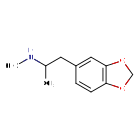
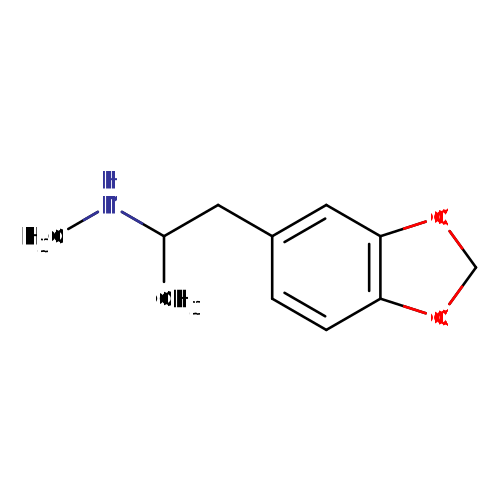
Structure for Midomafetamine (DB01454)
- Weight
- Average: 193.2423
Monoisotopic: 193.110278729 - Chemical Formula
- C11H15NO2
- Synonyms
- 3,4-Methylenedioxymethamphetamine
- Ecstasy
- MDMA
- Methylenedioxymethamphetamine
- Midomafetamine

Pharmacology
- Indication
Clinical trials are now testing the therapeutic potential of MDMA for post-traumatic stress disorder (PTSD) and anxiety associated with terminal cancer. MDMA is one of the four most widely used illicit drugs in the U.S.
 Reduce drug development failure ratesBuild, train, & validate machine-learning modelswith evidence-based and structured datasets.Build, train, & validate predictive machine-learning models with structured datasets.
- Contraindications & Blackbox Warnings
 Prevent Adverse Drug Events TodayTap into our Clinical API for life-saving information on contraindications & blackbox warnings, population restrictions, harmful risks, & more.Avoid life-threatening adverse drug events with our Clinical API
- Pharmacodynamics
MDMA acts as a releasing agent of serotonin, norepinephrine, and dopamine.
- Mechanism of action
It enters neurons via carriage by the monoamine transporters. Once inside, MDMA inhibits the vesicular monoamine transporter, which results in increased concentrations of serotonin, norepinephrine, and dopamine into the cytoplasm, and induces their release by reversing their respective transporters through a process known as phosphorylation. It also acts as a weak 5-HT1 and 5-HT2 receptor agonist. MDMA's unusual entactogenic effects have been hypothesized to be, at least partly, the result of indirect oxytocin secretion via activation of the serotonin system. Oxytocin is a hormone released following events like hugging, orgasm, and childbirth, and is thought to facilitate bonding and the establishment of trust. Based on studies in rats, MDMA is believed to cause the release of oxytocin, at least in part, by both directly and indirectly agonizing the serotonin 5-HT1A receptor.
Target Actions Organism ASynaptic vesicular amine transporter inhibitorHumans ASodium-dependent noradrenaline transporter negative modulatorHumans ASodium-dependent serotonin transporter negative modulatorHumans USodium-dependent dopamine transporter negative modulatorHumans U5-hydroxytryptamine receptor 2A agonistHumans U5-hydroxytryptamine receptor 2B agonistHumans U5-hydroxytryptamine receptor 2C agonistHumans - Absorption
Not Available
- Volume of distribution
Not Available
- Protein binding
Not Available
- Metabolism
Midomafetamine, or MDMA, is reported to undergo extensive CYP-mediated hepatic metabolism, with CYP2D6 playing a major role in humans. Other CYP enzymes contributing to MDMA metabolism are CYP3A4 and COMT. MDMA is metabolized via two primary metabolic pathways. It may undergo O-demethylenation followed by catechol-O-methyltransferase (COMT)-catalyzed methylation and/or glucuronide/sulfate conjugation. In contrast, it may also undergo N-dealkylation, deamination, and oxidation to the corresponding benzoic acid derivatives conjugated with glycine. Due to autoinhibition of CYP2D6 and CYP2D8, MDMA displays a complex, nonlinear pharmacokinetics profile, with the zeroth order kinetics occurring at higher doses. It is thought that this can result in sustained and higher concentrations of MDMA if the user takes consecutive doses of the drug.
- Route of elimination
renal
- Half-life
6–10 (though duration of effects is typically actually 3–5 hours)
- Clearance
Not Available
- Adverse Effects
 Improve decision support & research outcomesWith structured adverse effects data, including: blackbox warnings, adverse reactions, warning & precautions, & incidence rates. View sample adverse effects data in our new Data Library!Improve decision support & research outcomes with our structured adverse effects data.
- Toxicity
Not Available
- Pathways
- Not Available
- Pharmacogenomic Effects/ADRs
- Not Available
Interactions
- Drug Interactions
- This information should not be interpreted without the help of a healthcare provider. If you believe you are experiencing an interaction, contact a healthcare provider immediately. The absence of an interaction does not necessarily mean no interactions exist.
Drug Interaction Integrate drug-drug
interactions in your software1,2-Benzodiazepine The risk or severity of CNS depression can be increased when Midomafetamine is combined with 1,2-Benzodiazepine. Abatacept The metabolism of Midomafetamine can be increased when combined with Abatacept. Abiraterone The metabolism of Midomafetamine can be decreased when combined with Abiraterone. Acebutolol The therapeutic efficacy of Acebutolol can be decreased when used in combination with Midomafetamine. Aceclofenac The risk or severity of hypertension can be increased when Midomafetamine is combined with Aceclofenac. - Food Interactions
- Not Available
Products
 Drug product information from 10+ global regionsOur datasets provide approved product information including:dosage, form, labeller, route of administration, and marketing period.Access drug product information from over 10 global regions.
- Product Ingredients
Ingredient UNII CAS InChI Key Midomafetamine hydrochloride KNB4E1K0AV Not Available LUWHVONVCYWRMZ-UHFFFAOYSA-N
Categories
- Drug Categories
- Adrenergic Agents
- Adrenergic Uptake Inhibitors
- Agents producing tachycardia
- Agents that produce hypertension
- Amines
- Amphetamines
- Antidepressive Agents
- Central Nervous System Agents
- Central Nervous System Depressants
- Cytochrome P-450 CYP2D6 Substrates
- Cytochrome P-450 Substrates
- Ethylamines
- Hallucinogens
- Membrane Transport Modulators
- Neurotransmitter Agents
- Neurotransmitter Uptake Inhibitors
- Phenethylamines
- Psychotropic Drugs
- Serotonergic Drugs Shown to Increase Risk of Serotonin Syndrome
- Serotonin 5-HT2 Receptor Agonists
- Serotonin Agents
- Serotonin Receptor Agonists
- Sympathomimetics
- Chemical TaxonomyProvided by Classyfire
- Description
- This compound belongs to the class of organic compounds known as benzodioxoles. These are organic compounds containing a benzene ring fused to either isomers of dioxole. Dioxole is a five-membered unsaturated ring of two oxygen atoms and three carbon atoms.
- Kingdom
- Organic compounds
- Super Class
- Organoheterocyclic compounds
- Class
- Benzodioxoles
- Sub Class
- Not Available
- Direct Parent
- Benzodioxoles
- Alternative Parents
- Aralkylamines / Benzenoids / Oxacyclic compounds / Dialkylamines / Acetals / Organopnictogen compounds / Hydrocarbon derivatives
- Substituents
- Acetal / Amine / Aralkylamine / Aromatic heteropolycyclic compound / Benzenoid / Benzodioxole / Hydrocarbon derivative / Organic nitrogen compound / Organic oxygen compound / Organonitrogen compound
- Molecular Framework
- Aromatic heteropolycyclic compounds
- External Descriptors
- benzodioxoles, amphetamines (CHEBI:1391)
- Affected organisms
- Not Available
Chemical Identifiers
- UNII
- KE1SEN21RM
- CAS number
- 42542-10-9
- InChI Key
- SHXWCVYOXRDMCX-UHFFFAOYSA-N
- InChI
- InChI=1S/C11H15NO2/c1-8(12-2)5-9-3-4-10-11(6-9)14-7-13-10/h3-4,6,8,12H,5,7H2,1-2H3
- IUPAC Name
- [1-(2H-1,3-benzodioxol-5-yl)propan-2-yl](methyl)amine
- SMILES
- CNC(C)CC1=CC2=C(OCO2)C=C1
References
- General References
- Freudenmann RW, Oxler F, Bernschneider-Reif S: The origin of MDMA (ecstasy) revisited: the true story reconstructed from the original documents. Addiction. 2006 Sep;101(9):1241-5. [Article]
- Jayanthi LD, Ramamoorthy S: Regulation of monoamine transporters: influence of psychostimulants and therapeutic antidepressants. AAPS J. 2005 Oct 27;7(3):E728-38. [Article]
- Verrico CD, Miller GM, Madras BK: MDMA (Ecstasy) and human dopamine, norepinephrine, and serotonin transporters: implications for MDMA-induced neurotoxicity and treatment. Psychopharmacology (Berl). 2007 Jan;189(4):489-503. Epub 2005 Oct 12. [Article]
- External Links
- KEGG Compound
- C07577
- PubChem Compound
- 1615
- PubChem Substance
- 46506404
- ChemSpider
- 1556
- BindingDB
- 50010588
- ChEBI
- 1391
- ChEMBL
- CHEMBL43048
- PharmGKB
- PA131887008
- Wikipedia
- 3,4-Methylenedioxymethamphetamine
Clinical Trials
- Clinical Trials
Phase Status Purpose Conditions Count 4 Recruiting Treatment Post Traumatic Stress Disorder (PTSD) 1 3 Completed Treatment Coronavirus Disease 2019 (COVID‑19) / Post Traumatic Stress Disorder (PTSD) 1 3 Completed Treatment Post Traumatic Stress Disorder (PTSD) 2 3 Not Yet Recruiting Treatment Post Traumatic Stress Disorder (PTSD) 1 2 Active Not Recruiting Treatment Post Traumatic Stress Disorder (PTSD) 1
Pharmacoeconomics
- Manufacturers
- Not Available
- Packagers
- Not Available
- Dosage Forms
- Not Available
- Prices
- Not Available
- Patents
- Not Available
Properties
- State
- Solid
- Experimental Properties
- Not Available
- Predicted Properties
Property Value Source Water Solubility 3.22 mg/mL ALOGPS logP 1.65 ALOGPS logP 1.86 Chemaxon logS -1.8 ALOGPS pKa (Strongest Basic) 10.14 Chemaxon Physiological Charge 1 Chemaxon Hydrogen Acceptor Count 3 Chemaxon Hydrogen Donor Count 1 Chemaxon Polar Surface Area 30.49 Å2 Chemaxon Rotatable Bond Count 3 Chemaxon Refractivity 54.25 m3·mol-1 Chemaxon Polarizability 21.46 Å3 Chemaxon Number of Rings 2 Chemaxon Bioavailability 1 Chemaxon Rule of Five Yes Chemaxon Ghose Filter Yes Chemaxon Veber's Rule Yes Chemaxon MDDR-like Rule No Chemaxon - Predicted ADMET Features
Property Value Probability Human Intestinal Absorption + 1.0 Blood Brain Barrier + 0.9639 Caco-2 permeable + 0.6781 P-glycoprotein substrate Non-substrate 0.6447 P-glycoprotein inhibitor I Non-inhibitor 0.8631 P-glycoprotein inhibitor II Non-inhibitor 0.8926 Renal organic cation transporter Non-inhibitor 0.7568 CYP450 2C9 substrate Non-substrate 0.8507 CYP450 2D6 substrate Non-substrate 0.5776 CYP450 3A4 substrate Non-substrate 0.5325 CYP450 1A2 substrate Inhibitor 0.7626 CYP450 2C9 inhibitor Non-inhibitor 0.8324 CYP450 2D6 inhibitor Inhibitor 0.7708 CYP450 2C19 inhibitor Non-inhibitor 0.6331 CYP450 3A4 inhibitor Non-inhibitor 0.6106 CYP450 inhibitory promiscuity Low CYP Inhibitory Promiscuity 0.5857 Ames test Non AMES toxic 0.6597 Carcinogenicity Non-carcinogens 0.9001 Biodegradation Ready biodegradable 0.5643 Rat acute toxicity 2.7501 LD50, mol/kg Not applicable hERG inhibition (predictor I) Weak inhibitor 0.9585 hERG inhibition (predictor II) Non-inhibitor 0.9417
Spectra
- Mass Spec (NIST)
- Not Available
- Spectra
- Chromatographic Properties
Collision Cross Sections (CCS)
Adduct CCS Value (Å2) Source type Source [M-H]- 139.65141 predictedDeepCCS 1.0 (2019) [M+H]+ 142.95476 predictedDeepCCS 1.0 (2019) [M+Na]+ 152.12439 predictedDeepCCS 1.0 (2019)
Targets

- Kind
- Protein
- Organism
- Humans
- Pharmacological action
- Yes
- Actions
- Inhibitor
- General Function
- Monoamine transmembrane transporter activity
- Specific Function
- Involved in the ATP-dependent vesicular transport of biogenic amine neurotransmitters. Pumps cytosolic monoamines including dopamine, norepinephrine, serotonin, and histamine into synaptic vesicles...
- Gene Name
- SLC18A2
- Uniprot ID
- Q05940
- Uniprot Name
- Synaptic vesicular amine transporter
- Molecular Weight
- 55712.075 Da
References
- Biezonski DK, Meyer JS: Effects of 3,4-methylenedioxymethamphetamine (MDMA) on serotonin transporter and vesicular monoamine transporter 2 protein and gene expression in rats: implications for MDMA neurotoxicity. J Neurochem. 2010 Feb;112(4):951-62. doi: 10.1111/j.1471-4159.2009.06515.x. Epub 2009 Nov 30. [Article]
- Hansen JP, Riddle EL, Sandoval V, Brown JM, Gibb JW, Hanson GR, Fleckenstein AE: Methylenedioxymethamphetamine decreases plasmalemmal and vesicular dopamine transport: mechanisms and implications for neurotoxicity. J Pharmacol Exp Ther. 2002 Mar;300(3):1093-100. [Article]
- Kind
- Protein
- Organism
- Humans
- Pharmacological action
- Yes
- Actions
- Negative modulator
- General Function
- Norepinephrine:sodium symporter activity
- Specific Function
- Amine transporter. Terminates the action of noradrenaline by its high affinity sodium-dependent reuptake into presynaptic terminals.
- Gene Name
- SLC6A2
- Uniprot ID
- P23975
- Uniprot Name
- Sodium-dependent noradrenaline transporter
- Molecular Weight
- 69331.42 Da
References
- Sulzer D, Sonders MS, Poulsen NW, Galli A: Mechanisms of neurotransmitter release by amphetamines: a review. Prog Neurobiol. 2005 Apr;75(6):406-33. [Article]
- Fleckenstein AE, Volz TJ, Riddle EL, Gibb JW, Hanson GR: New insights into the mechanism of action of amphetamines. Annu Rev Pharmacol Toxicol. 2007;47:681-98. [Article]
- Haughey HM, Brown JM, Wilkins DG, Hanson GR, Fleckenstein AE: Differential effects of methamphetamine on Na(+)/Cl(-)-dependent transporters. Brain Res. 2000 Apr 28;863(1-2):59-65. [Article]
- Kind
- Protein
- Organism
- Humans
- Pharmacological action
- Yes
- Actions
- Negative modulator
- General Function
- Serotonin:sodium symporter activity
- Specific Function
- Serotonin transporter whose primary function in the central nervous system involves the regulation of serotonergic signaling via transport of serotonin molecules from the synaptic cleft back into t...
- Gene Name
- SLC6A4
- Uniprot ID
- P31645
- Uniprot Name
- Sodium-dependent serotonin transporter
- Molecular Weight
- 70324.165 Da
References
- Shankaran M, Yamamoto BK, Gudelsky GA: Involvement of the serotonin transporter in the formation of hydroxyl radicals induced by 3,4-methylenedioxymethamphetamine. Eur J Pharmacol. 1999 Dec 3;385(2-3):103-10. [Article]
- Whitworth TL, Herndon LC, Quick MW: Psychostimulants differentially regulate serotonin transporter expression in thalamocortical neurons. J Neurosci. 2002 Jan 1;22(1):RC192. [Article]
- Szabo Z, McCann UD, Wilson AA, Scheffel U, Owonikoko T, Mathews WB, Ravert HT, Hilton J, Dannals RF, Ricaurte GA: Comparison of (+)-(11)C-McN5652 and (11)C-DASB as serotonin transporter radioligands under various experimental conditions. J Nucl Med. 2002 May;43(5):678-92. [Article]
- Boot BP, Mechan AO, McCann UD, Ricaurte GA: MDMA- and p-chlorophenylalanine-induced reduction in 5-HT concentrations: effects on serotonin transporter densities. Eur J Pharmacol. 2002 Oct 25;453(2-3):239-44. [Article]
- Saldana SN, Barker EL: Temperature and 3,4-methylenedioxymethamphetamine alter human serotonin transporter-mediated dopamine uptake. Neurosci Lett. 2004 Jan 16;354(3):209-12. [Article]
- Bogen IL, Haug KH, Myhre O, Fonnum F: Short- and long-term effects of MDMA ("ecstasy") on synaptosomal and vesicular uptake of neurotransmitters in vitro and ex vivo. Neurochem Int. 2003 Sep-Oct;43(4-5):393-400. [Article]
- Kind
- Protein
- Organism
- Humans
- Pharmacological action
- Unknown
- Actions
- Negative modulator
- General Function
- Monoamine transmembrane transporter activity
- Specific Function
- Amine transporter. Terminates the action of dopamine by its high affinity sodium-dependent reuptake into presynaptic terminals.
- Gene Name
- SLC6A3
- Uniprot ID
- Q01959
- Uniprot Name
- Sodium-dependent dopamine transporter
- Molecular Weight
- 68494.255 Da
References
- Hansen JP, Riddle EL, Sandoval V, Brown JM, Gibb JW, Hanson GR, Fleckenstein AE: Methylenedioxymethamphetamine decreases plasmalemmal and vesicular dopamine transport: mechanisms and implications for neurotoxicity. J Pharmacol Exp Ther. 2002 Mar;300(3):1093-100. [Article]
- Fitzgerald JL, Reid JJ: Effects of methylenedioxymethamphetamine on the release of monoamines from rat brain slices. Eur J Pharmacol. 1990 Nov 27;191(2):217-20. [Article]
- Fleckenstein AE, Volz TJ, Riddle EL, Gibb JW, Hanson GR: New insights into the mechanism of action of amphetamines. Annu Rev Pharmacol Toxicol. 2007;47:681-98. [Article]
- Kind
- Protein
- Organism
- Humans
- Pharmacological action
- Unknown
- Actions
- Agonist
- General Function
- Virus receptor activity
- Specific Function
- G-protein coupled receptor for 5-hydroxytryptamine (serotonin). Also functions as a receptor for various drugs and psychoactive substances, including mescaline, psilocybin, 1-(2,5-dimethoxy-4-iodop...
- Gene Name
- HTR2A
- Uniprot ID
- P28223
- Uniprot Name
- 5-hydroxytryptamine receptor 2A
- Molecular Weight
- 52602.58 Da
References
- Lyon RA, Glennon RA, Titeler M: 3,4-Methylenedioxymethamphetamine (MDMA): stereoselective interactions at brain 5-HT1 and 5-HT2 receptors. Psychopharmacology (Berl). 1986;88(4):525-6. [Article]
- Nash JF, Roth BL, Brodkin JD, Nichols DE, Gudelsky GA: Effect of the R(-) and S(+) isomers of MDA and MDMA on phosphatidyl inositol turnover in cultured cells expressing 5-HT2A or 5-HT2C receptors. Neurosci Lett. 1994 Aug 15;177(1-2):111-5. [Article]
- Kind
- Protein
- Organism
- Humans
- Pharmacological action
- Unknown
- Actions
- Agonist
- General Function
- Serotonin receptor activity
- Specific Function
- G-protein coupled receptor for 5-hydroxytryptamine (serotonin). Also functions as a receptor for various ergot alkaloid derivatives and psychoactive substances. Ligand binding causes a conformation...
- Gene Name
- HTR2B
- Uniprot ID
- P41595
- Uniprot Name
- 5-hydroxytryptamine receptor 2B
- Molecular Weight
- 54297.41 Da
References
- Lyon RA, Glennon RA, Titeler M: 3,4-Methylenedioxymethamphetamine (MDMA): stereoselective interactions at brain 5-HT1 and 5-HT2 receptors. Psychopharmacology (Berl). 1986;88(4):525-6. [Article]
- Kind
- Protein
- Organism
- Humans
- Pharmacological action
- Unknown
- Actions
- Agonist
- General Function
- Serotonin receptor activity
- Specific Function
- G-protein coupled receptor for 5-hydroxytryptamine (serotonin). Also functions as a receptor for various drugs and psychoactive substances, including ergot alkaloid derivatives, 1-2,5,-dimethoxy-4-...
- Gene Name
- HTR2C
- Uniprot ID
- P28335
- Uniprot Name
- 5-hydroxytryptamine receptor 2C
- Molecular Weight
- 51820.705 Da
References
- Nash JF, Roth BL, Brodkin JD, Nichols DE, Gudelsky GA: Effect of the R(-) and S(+) isomers of MDA and MDMA on phosphatidyl inositol turnover in cultured cells expressing 5-HT2A or 5-HT2C receptors. Neurosci Lett. 1994 Aug 15;177(1-2):111-5. [Article]
- Lyon RA, Glennon RA, Titeler M: 3,4-Methylenedioxymethamphetamine (MDMA): stereoselective interactions at brain 5-HT1 and 5-HT2 receptors. Psychopharmacology (Berl). 1986;88(4):525-6. [Article]
Enzymes
- Kind
- Protein
- Organism
- Humans
- Pharmacological action
- No
- Actions
- Substrate
- General Function
- Steroid hydroxylase activity
- Specific Function
- Responsible for the metabolism of many drugs and environmental chemicals that it oxidizes. It is involved in the metabolism of drugs such as antiarrhythmics, adrenoceptor antagonists, and tricyclic...
- Gene Name
- CYP2D6
- Uniprot ID
- P10635
- Uniprot Name
- Cytochrome P450 2D6
- Molecular Weight
- 55768.94 Da
References
- Williams D, Feely J: Pharmacokinetic-pharmacodynamic drug interactions with HMG-CoA reductase inhibitors. Clin Pharmacokinet. 2002;41(5):343-70. doi: 10.2165/00003088-200241050-00003. [Article]
Transporters
- Kind
- Protein
- Organism
- Humans
- Pharmacological action
- Unknown
- General Function
- Norepinephrine:sodium symporter activity
- Specific Function
- Amine transporter. Terminates the action of noradrenaline by its high affinity sodium-dependent reuptake into presynaptic terminals.
- Gene Name
- SLC6A2
- Uniprot ID
- P23975
- Uniprot Name
- Sodium-dependent noradrenaline transporter
- Molecular Weight
- 69331.42 Da
References
- Verrico CD, Miller GM, Madras BK: MDMA (Ecstasy) and human dopamine, norepinephrine, and serotonin transporters: implications for MDMA-induced neurotoxicity and treatment. Psychopharmacology (Berl). 2007 Jan;189(4):489-503. Epub 2005 Oct 12. [Article]
- Kind
- Protein
- Organism
- Humans
- Pharmacological action
- Unknown
- General Function
- Monoamine transmembrane transporter activity
- Specific Function
- Amine transporter. Terminates the action of dopamine by its high affinity sodium-dependent reuptake into presynaptic terminals.
- Gene Name
- SLC6A3
- Uniprot ID
- Q01959
- Uniprot Name
- Sodium-dependent dopamine transporter
- Molecular Weight
- 68494.255 Da
References
- Verrico CD, Miller GM, Madras BK: MDMA (Ecstasy) and human dopamine, norepinephrine, and serotonin transporters: implications for MDMA-induced neurotoxicity and treatment. Psychopharmacology (Berl). 2007 Jan;189(4):489-503. Epub 2005 Oct 12. [Article]
- Kind
- Protein
- Organism
- Humans
- Pharmacological action
- Unknown
- General Function
- Serotonin:sodium symporter activity
- Specific Function
- Serotonin transporter whose primary function in the central nervous system involves the regulation of serotonergic signaling via transport of serotonin molecules from the synaptic cleft back into t...
- Gene Name
- SLC6A4
- Uniprot ID
- P31645
- Uniprot Name
- Sodium-dependent serotonin transporter
- Molecular Weight
- 70324.165 Da
References
- Verrico CD, Miller GM, Madras BK: MDMA (Ecstasy) and human dopamine, norepinephrine, and serotonin transporters: implications for MDMA-induced neurotoxicity and treatment. Psychopharmacology (Berl). 2007 Jan;189(4):489-503. Epub 2005 Oct 12. [Article]

Drug created at July 31, 2007 13:09 / Updated at February 21, 2021 18:51