Identification
- Generic Name
- Ximelagatran
- DrugBank Accession Number
- DB04898
- Background
Ximelagatran is an anticoagulant intended to become a replacement for warfarin by overcoming the dietary restrictions, drug interaction, and monitoring issues associated with the former. In 2006, its manufacturer AstraZeneca announced that it would not attempt to market ximelagatran after reports of hepatotoxicity (liver damage) during trials, and to discontinue its distribution in countries where the drug had been approved.
- Type
- Small Molecule
- Groups
- Approved, Investigational, Withdrawn
- Structure
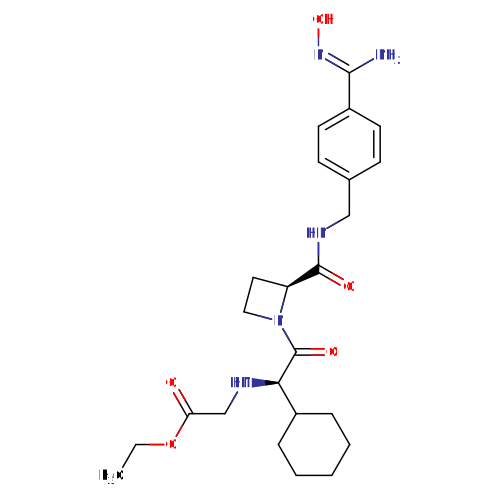
Structure for Ximelagatran (DB04898)
- Weight
- Average: 473.5652
Monoisotopic: 473.263819255 - Chemical Formula
- C24H35N5O5
- Synonyms
- ethyl 2-[[(1R)-1-cyclohexyl-2- [(2S)-2-[[4-(N'-hydroxycarbamimidoyl) phenyl]methylcarbamoyl]azetidin-1-yl]- 2-oxo-ethyl]amino]acetate
- Ximelagatrán
- Ximelagatran
- Ximélagatran
- Ximelagatranum
- External IDs
- H 376-95
- H 376/95
- H 37695

Pharmacology
- Indication
For the treatment of acute deep vein thrombosis.
 Reduce drug development failure ratesBuild, train, & validate machine-learning modelswith evidence-based and structured datasets.Build, train, & validate predictive machine-learning models with structured datasets.
- Contraindications & Blackbox Warnings
 Prevent Adverse Drug Events TodayTap into our Clinical API for life-saving information on contraindications & blackbox warnings, population restrictions, harmful risks, & more.Avoid life-threatening adverse drug events with our Clinical API
- Pharmacodynamics
Not Available
- Mechanism of action
Ximelagatran was the first member of the drug class of direct thrombin inhibitors that can be taken orally. Its effect is solely related to the inhibition of thrombin.
Target Actions Organism AProthrombin inhibitorHumans - Absorption
Rapidly absorbed by the small intestine with an oral bioavailability of 20%.
- Volume of distribution
Not Available
- Protein binding
Not Available
- Metabolism
Ximelagatran is a prodrug, and hence, it requires in vivo conversion to the active agent, melagatran. The activation of ximelagatran is produced in the liver and many other tissues mainly by reactions of dealkylation and dehydroxylation.
- Route of elimination
Not Available
- Half-life
3-5 hours
- Clearance
Not Available
- Adverse Effects
 Improve decision support & research outcomesWith structured adverse effects data, including: blackbox warnings, adverse reactions, warning & precautions, & incidence rates. View sample adverse effects data in our new Data Library!Improve decision support & research outcomes with our structured adverse effects data.
- Toxicity
Hepatotoxicity (liver damage) was reported during trials.
- Pathways
Pathway Category Ximelagatran Action Pathway Drug action - Pharmacogenomic Effects/ADRs
- Not Available
Interactions
- Drug Interactions
- This information should not be interpreted without the help of a healthcare provider. If you believe you are experiencing an interaction, contact a healthcare provider immediately. The absence of an interaction does not necessarily mean no interactions exist.
Drug Interaction Integrate drug-drug
interactions in your softwareAbatacept The metabolism of Ximelagatran can be increased when combined with Abatacept. Abciximab The risk or severity of bleeding can be increased when Abciximab is combined with Ximelagatran. Abrocitinib The metabolism of Abrocitinib can be decreased when combined with Ximelagatran. Aceclofenac The risk or severity of bleeding and hemorrhage can be increased when Aceclofenac is combined with Ximelagatran. Acemetacin The risk or severity of bleeding and hemorrhage can be increased when Ximelagatran is combined with Acemetacin. - Food Interactions
- Avoid herbs and supplements with anticoagulant/antiplatelet activity. Examples include garlic, ginger, bilberry, danshen, piracetam, and ginkgo biloba.
Products
 Drug product information from 10+ global regionsOur datasets provide approved product information including:dosage, form, labeller, route of administration, and marketing period.Access drug product information from over 10 global regions.
- International/Other Brands
- Exanta / Exarta
Categories
- ATC Codes
- B01AE05 — Ximelagatran
- Drug Categories
- Chemical TaxonomyProvided by Classyfire
- Description
- This compound belongs to the class of organic compounds known as dipeptides. These are organic compounds containing a sequence of exactly two alpha-amino acids joined by a peptide bond.
- Kingdom
- Organic compounds
- Super Class
- Organic acids and derivatives
- Class
- Carboxylic acids and derivatives
- Sub Class
- Amino acids, peptides, and analogues
- Direct Parent
- Dipeptides
- Alternative Parents
- Alpha amino acid esters / Alpha amino acid amides / Benzene and substituted derivatives / Tertiary carboxylic acid amides / Amidoximes / Secondary carboxylic acid amides / Carboxylic acid esters / Azetidines / Monocarboxylic acids and derivatives / Dialkylamines show 5 more
- Substituents
- Alpha-amino acid amide / Alpha-amino acid ester / Alpha-amino acid or derivatives / Alpha-dipeptide / Amidine / Amidoxime / Amine / Amino acid or derivatives / Aromatic heteromonocyclic compound / Azacycle show 19 more
- Molecular Framework
- Aromatic heteromonocyclic compounds
- External Descriptors
- ethyl ester, secondary amino compound, carboxamide, azetidines, amidoxime (CHEBI:65172)
- Affected organisms
- Humans and other mammals
Chemical Identifiers
- UNII
- 49HFB70472
- CAS number
- 192939-46-1
- InChI Key
- ZXIBCJHYVWYIKI-PZJWPPBQSA-N
- InChI
- InChI=1S/C24H35N5O5/c1-2-34-20(30)15-26-21(17-6-4-3-5-7-17)24(32)29-13-12-19(29)23(31)27-14-16-8-10-18(11-9-16)22(25)28-33/h8-11,17,19,21,26,33H,2-7,12-15H2,1H3,(H2,25,28)(H,27,31)/t19-,21+/m0/s1
- IUPAC Name
- ethyl 2-{[(1R)-1-cyclohexyl-2-[(2S)-2-[({4-[(Z)-N'-hydroxycarbamimidoyl]phenyl}methyl)carbamoyl]azetidin-1-yl]-2-oxoethyl]amino}acetate
- SMILES
- CCOC(=O)CN[C@@H](C(=O)N1CC[C@H]1C(=O)NCC1=CC=C(C=C1)C(\N)=N\O)C1CCCCC1
References
- General References
- Eriksson H, Wahlander K, Gustafsson D, Welin LT, Frison L, Schulman S: A randomized, controlled, dose-guiding study of the oral direct thrombin inhibitor ximelagatran compared with standard therapy for the treatment of acute deep vein thrombosis: THRIVE I. J Thromb Haemost. 2003 Jan;1(1):41-7. [Article]
- Weitz JI: New anticoagulants for treatment of venous thromboembolism. Circulation. 2004 Aug 31;110(9 Suppl 1):I19-26. [Article]
- Francis CW, Berkowitz SD, Comp PC, Lieberman JR, Ginsberg JS, Paiement G, Peters GR, Roth AW, McElhattan J, Colwell CW Jr: Comparison of ximelagatran with warfarin for the prevention of venous thromboembolism after total knee replacement. N Engl J Med. 2003 Oct 30;349(18):1703-12. [Article]
- Bergqvist D, Solhaug JH, Holmdahl L, Eriksson UG, Andersson M, Boberg B, Ogren M: Pharmacokinetics, preliminary efficacy and safety of subcutaneous melagatran and oral ximelagatran : a multicentre study of thromboprophylaxis in elective abdominal surgery. Clin Drug Investig. 2004;24(3):127-36. [Article]
- Koscielny J, Kiesewetter H, Jorg I, Harenberg J: Ximelagatran for treatment and prophylaxis of recurrent events in deep vein thrombosis. Clin Appl Thromb Hemost. 2007 Jul;13(3):299-307. [Article]
- External Links
- Human Metabolome Database
- HMDB0015603
- PubChem Compound
- 9574101
- PubChem Substance
- 46509040
- ChemSpider
- 7848559
- ChEBI
- 65172
- ChEMBL
- CHEMBL522038
- ZINC
- ZINC000012504524
- Therapeutic Targets Database
- DAP001218
- PharmGKB
- PA161748474
- Wikipedia
- Ximelagatran
Clinical Trials
- Clinical Trials
Phase Status Purpose Conditions Count 3 Terminated Prevention Thromboembolism 1 2 Terminated Prevention Stroke Prevention in Patients With Atrial Fibrillation 1
Pharmacoeconomics
- Manufacturers
- Not Available
- Packagers
- Not Available
- Dosage Forms
Form Route Strength Tablet, film coated - Prices
- Not Available
- Patents
- Not Available
Properties
- State
- Solid
- Experimental Properties
- Not Available
- Predicted Properties
Property Value Source Water Solubility 0.0845 mg/mL ALOGPS logP 1.35 ALOGPS logP 0.87 Chemaxon logS -3.8 ALOGPS pKa (Strongest Acidic) 8.7 Chemaxon pKa (Strongest Basic) 5.48 Chemaxon Physiological Charge 0 Chemaxon Hydrogen Acceptor Count 7 Chemaxon Hydrogen Donor Count 4 Chemaxon Polar Surface Area 146.35 Å2 Chemaxon Rotatable Bond Count 11 Chemaxon Refractivity 126.57 m3·mol-1 Chemaxon Polarizability 52.18 Å3 Chemaxon Number of Rings 3 Chemaxon Bioavailability 1 Chemaxon Rule of Five Yes Chemaxon Ghose Filter Yes Chemaxon Veber's Rule No Chemaxon MDDR-like Rule Yes Chemaxon - Predicted ADMET Features
Property Value Probability Human Intestinal Absorption + 0.6065 Blood Brain Barrier - 0.7499 Caco-2 permeable - 0.7534 P-glycoprotein substrate Substrate 0.84 P-glycoprotein inhibitor I Non-inhibitor 0.755 P-glycoprotein inhibitor II Non-inhibitor 0.947 Renal organic cation transporter Non-inhibitor 0.7588 CYP450 2C9 substrate Non-substrate 0.8632 CYP450 2D6 substrate Non-substrate 0.8163 CYP450 3A4 substrate Non-substrate 0.597 CYP450 1A2 substrate Non-inhibitor 0.8409 CYP450 2C9 inhibitor Non-inhibitor 0.7261 CYP450 2D6 inhibitor Non-inhibitor 0.844 CYP450 2C19 inhibitor Non-inhibitor 0.669 CYP450 3A4 inhibitor Non-inhibitor 0.6775 CYP450 inhibitory promiscuity Low CYP Inhibitory Promiscuity 0.9157 Ames test Non AMES toxic 0.6238 Carcinogenicity Non-carcinogens 0.7863 Biodegradation Not ready biodegradable 0.8515 Rat acute toxicity 2.4109 LD50, mol/kg Not applicable hERG inhibition (predictor I) Weak inhibitor 0.9654 hERG inhibition (predictor II) Inhibitor 0.6003
Spectra
- Mass Spec (NIST)
- Not Available
- Spectra
Spectrum Spectrum Type Splash Key Predicted GC-MS Spectrum - GC-MS Predicted GC-MS splash10-004j-4982400000-32fe628a565ad95d34f7 Predicted MS/MS Spectrum - 10V, Positive (Annotated) Predicted LC-MS/MS splash10-00fr-0323900000-3a4a8733aa1091d35734 Predicted MS/MS Spectrum - 10V, Negative (Annotated) Predicted LC-MS/MS splash10-00dr-0212900000-b94fdfc809190f07de51 Predicted MS/MS Spectrum - 20V, Positive (Annotated) Predicted LC-MS/MS splash10-05fs-1267900000-89537a80d9674f8c1c79 Predicted MS/MS Spectrum - 20V, Negative (Annotated) Predicted LC-MS/MS splash10-0fkc-0219100000-d5d758e20b43b7a328eb Predicted MS/MS Spectrum - 40V, Positive (Annotated) Predicted LC-MS/MS splash10-053s-4970200000-f3576aac64a832965111 Predicted MS/MS Spectrum - 40V, Negative (Annotated) Predicted LC-MS/MS splash10-0a4l-0292200000-91a0b9e84caf630428d1 Predicted 1H NMR Spectrum 1D NMR Not Applicable Predicted 13C NMR Spectrum 1D NMR Not Applicable - Chromatographic Properties
Collision Cross Sections (CCS)
Adduct CCS Value (Å2) Source type Source [M-H]- 229.1504999 predictedDarkChem Lite v0.1.0 [M-H]- 225.3894999 predictedDarkChem Lite v0.1.0 [M-H]- 225.2495999 predictedDarkChem Lite v0.1.0 [M-H]- 215.08531 predictedDeepCCS 1.0 (2019) [M+H]+ 227.1895999 predictedDarkChem Lite v0.1.0 [M+H]+ 222.9677999 predictedDarkChem Lite v0.1.0 [M+H]+ 226.8274999 predictedDarkChem Lite v0.1.0 [M+H]+ 217.4809 predictedDeepCCS 1.0 (2019) [M+Na]+ 226.8869999 predictedDarkChem Lite v0.1.0 [M+Na]+ 224.5735999 predictedDarkChem Lite v0.1.0 [M+Na]+ 224.8681999 predictedDarkChem Lite v0.1.0 [M+Na]+ 223.39343 predictedDeepCCS 1.0 (2019)
Targets

- Kind
- Protein
- Organism
- Humans
- Pharmacological action
- Yes
- Actions
- Inhibitor
- General Function
- Thrombospondin receptor activity
- Specific Function
- Thrombin, which cleaves bonds after Arg and Lys, converts fibrinogen to fibrin and activates factors V, VII, VIII, XIII, and, in complex with thrombomodulin, protein C. Functions in blood homeostas...
- Gene Name
- F2
- Uniprot ID
- P00734
- Uniprot Name
- Prothrombin
- Molecular Weight
- 70036.295 Da
References
- Testa L, Bhindi R, Agostoni P, Abbate A, Zoccai GG, van Gaal WJ: The direct thrombin inhibitor ximelagatran/melagatran: a systematic review on clinical applications and an evidence based assessment of risk benefit profile. Expert Opin Drug Saf. 2007 Jul;6(4):397-406. [Article]
- Ho SJ, Brighton TA: Ximelagatran: direct thrombin inhibitor. Vasc Health Risk Manag. 2006;2(1):49-58. [Article]
- Bergqvist D, Solhaug JH, Holmdahl L, Eriksson UG, Andersson M, Boberg B, Ogren M: Pharmacokinetics, preliminary efficacy and safety of subcutaneous melagatran and oral ximelagatran : a multicentre study of thromboprophylaxis in elective abdominal surgery. Clin Drug Investig. 2004;24(3):127-36. [Article]
- Ersdal E, Schutzer KM, Lonnerstedt C, Ohlsson L, Wall U, Eriksson UG: No influence of food on the pharmacokinetics, pharmacodynamics or tolerability of the 24mg and 36mg oral tablet formulations of ximelagatran. Clin Drug Investig. 2005;25(7):425-33. [Article]
- Chen X, Ji ZL, Chen YZ: TTD: Therapeutic Target Database. Nucleic Acids Res. 2002 Jan 1;30(1):412-5. [Article]
Enzymes
- Kind
- Protein
- Organism
- Humans
- Pharmacological action
- Unknown
- Actions
- Substrate
- General Function
- Steroid hydroxylase activity
- Specific Function
- Cytochromes P450 are a group of heme-thiolate monooxygenases. In liver microsomes, this enzyme is involved in an NADPH-dependent electron transport pathway. It oxidizes a variety of structurally un...
- Gene Name
- CYP2C9
- Uniprot ID
- P11712
- Uniprot Name
- Cytochrome P450 2C9
- Molecular Weight
- 55627.365 Da
References

Drug created at October 21, 2007 22:23 / Updated at February 21, 2021 18:51