Identification
- Generic Name
- Tamibarotene
- DrugBank Accession Number
- DB04942
- Background
Tamibarotene is a novel synthetic retinoid for acute promyelocytic leukaemia (APL). Tamibarotene is currently approved in Japan for treatment of recurrent APL, and is undergoing clinical trials in the United States.
- Type
- Small Molecule
- Groups
- Investigational
- Structure
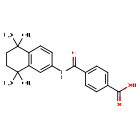
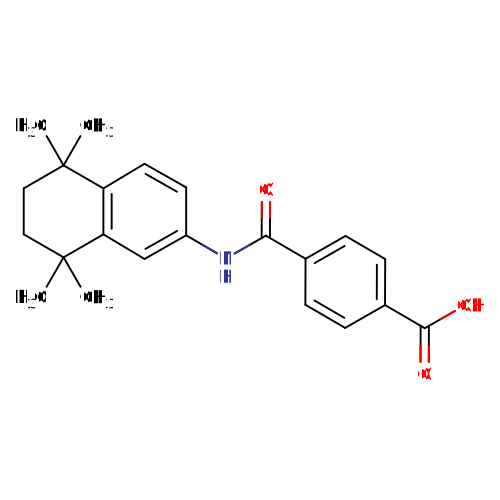
Structure for Tamibarotene (DB04942)
- Weight
- Average: 351.4388
Monoisotopic: 351.183443671 - Chemical Formula
- C22H25NO3
- Synonyms
- retinobenzoic acid
- Tamibarotene
- External IDs
- AM-80
- AM80
- NSC-608000

Pharmacology
- Indication
Investigated for use/treatment in leukemia (unspecified).
 Reduce drug development failure ratesBuild, train, & validate machine-learning modelswith evidence-based and structured datasets.Build, train, & validate predictive machine-learning models with structured datasets.
- Contraindications & Blackbox Warnings
 Prevent Adverse Drug Events TodayTap into our Clinical API for life-saving information on contraindications & blackbox warnings, population restrictions, harmful risks, & more.Avoid life-threatening adverse drug events with our Clinical API
- Pharmacodynamics
Tamibarotene is a new synthetic retinoid drug recently approved for relapsed or refractory acute promyelocytic leukemia (APL) in Japan. It is a specific agonist for retinoic acid receptor alpha/beta. Compared to all-trans retinoic acid (ATRA), a natural retinoid indicated for a first-line treatment of APL, tamibarotene is chemically more stable and several times more potent as an inducer of differentiation in promyelocytic leukemia cells. In contrast to ATRA, whose plasma concentration declines considerably during daily administration, tamibarotene sustains plasma level probably due to a lower affinity for cellular retinoic acid binding protein. Furthermore, adverse side effects were milder than those of ATRA in clinical trials.
- Mechanism of action
Tamibarotene is a specific agonist for retinoic acid receptor alpha/beta with possible binding to retinoid X receptors (RXR).
Target Actions Organism ARetinoic acid receptor alpha agonistHumans ARetinoic acid receptor beta agonistHumans - Absorption
Not Available
- Volume of distribution
Not Available
- Protein binding
Over 99%, predominantly to serum albumin.
- Metabolism
- Not Available
- Route of elimination
Not Available
- Half-life
Not Available
- Clearance
Not Available
- Adverse Effects
 Improve decision support & research outcomesWith structured adverse effects data, including: blackbox warnings, adverse reactions, warning & precautions, & incidence rates. View sample adverse effects data in our new Data Library!Improve decision support & research outcomes with our structured adverse effects data.
- Toxicity
Not Available
- Pathways
- Not Available
- Pharmacogenomic Effects/ADRs
- Not Available
Interactions
- Drug Interactions
- This information should not be interpreted without the help of a healthcare provider. If you believe you are experiencing an interaction, contact a healthcare provider immediately. The absence of an interaction does not necessarily mean no interactions exist.Not Available
- Food Interactions
- Not Available
Products
 Drug product information from 10+ global regionsOur datasets provide approved product information including:dosage, form, labeller, route of administration, and marketing period.Access drug product information from over 10 global regions.
- International/Other Brands
- Amnoid / Tamibaro
Categories
- Drug Categories
- Chemical TaxonomyProvided by Classyfire
- Description
- This compound belongs to the class of organic compounds known as tetralins. These are polycyclic aromatic compounds containing a tetralin moiety, which consists of a benzene fused to a cyclohexane.
- Kingdom
- Organic compounds
- Super Class
- Benzenoids
- Class
- Tetralins
- Sub Class
- Not Available
- Direct Parent
- Tetralins
- Alternative Parents
- Benzoic acids / Benzamides / Benzoyl derivatives / Secondary carboxylic acid amides / Monocarboxylic acids and derivatives / Carboxylic acids / Organopnictogen compounds / Organooxygen compounds / Organonitrogen compounds / Organic oxides show 1 more
- Substituents
- Aromatic homopolycyclic compound / Benzamide / Benzoic acid / Benzoic acid or derivatives / Benzoyl / Carboxamide group / Carboxylic acid / Carboxylic acid derivative / Hydrocarbon derivative / Monocarboxylic acid or derivatives show 9 more
- Molecular Framework
- Aromatic homopolycyclic compounds
- External Descriptors
- retinoid, dicarboxylic acid monoamide, tetralins (CHEBI:32181)
- Affected organisms
- Humans and other mammals
Chemical Identifiers
- UNII
- 08V52GZ3H9
- CAS number
- 94497-51-5
- InChI Key
- MUTNCGKQJGXKEM-UHFFFAOYSA-N
- InChI
- InChI=1S/C22H25NO3/c1-21(2)11-12-22(3,4)18-13-16(9-10-17(18)21)23-19(24)14-5-7-15(8-6-14)20(25)26/h5-10,13H,11-12H2,1-4H3,(H,23,24)(H,25,26)
- IUPAC Name
- 4-[(5,5,8,8-tetramethyl-5,6,7,8-tetrahydronaphthalen-2-yl)carbamoyl]benzoic acid
- SMILES
- CC1(C)CCC(C)(C)C2=C1C=CC(NC(=O)C1=CC=C(C=C1)C(O)=O)=C2
References
- Synthesis Reference
Hisao Ekimoto, "TAMIBAROTENE CAPSULE PREPARATION." U.S. Patent US20100048708, issued February 25, 2010.
US20100048708- General References
- Miwako I, Kagechika H: Tamibarotene. Drugs Today (Barc). 2007 Aug;43(8):563-8. [Article]
- Authors unspecified: Tamibarotene: AM 80, retinobenzoic acid, Tamibaro. Drugs R D. 2004;5(6):359-62. [Article]
- Sanda T, Kuwano T, Nakao S, Iida S, Ishida T, Komatsu H, Shudo K, Kuwano M, Ono M, Ueda R: Antimyeloma effects of a novel synthetic retinoid Am80 (Tamibarotene) through inhibition of angiogenesis. Leukemia. 2005 Jun;19(6):901-9. [Article]
- Takeuchi M: [Clinical experience with a new synthetic retinoid, tamibarotene (Am-80) for relapsed or refractory acute promyelocytic leukemia]. Gan To Kagaku Ryoho. 2006 Mar;33(3):397-401. [Article]
- Mizojiri K, Okabe H, Sugeno K, Misaki A, Ito M, Kominami G, Esumi Y, Takaichi M, Harada T, Seki H, Inaba A: Studies on the metabolism and disposition of the new retinoid 4-[(5,6,7,8-tetrahydro-5,5,8,8-tetramethyl-2-naphthyl)carbamoyl] benzoic acid. 4th communication: absorption, metabolism, excretion and plasma protein binding in various animals and man. Arzneimittelforschung. 1997 Mar;47(3):259-69. [Article]
- External Links
- Human Metabolome Database
- HMDB0015605
- KEGG Drug
- D01418
- KEGG Compound
- C12864
- PubChem Compound
- 108143
- PubChem Substance
- 46509039
- ChemSpider
- 97231
- BindingDB
- 50061625
- ChEBI
- 32181
- ChEMBL
- CHEMBL25202
- ZINC
- ZINC000000538415
- Therapeutic Targets Database
- DAP000461
- PharmGKB
- PA164743464
- Guide to Pharmacology
- GtP Drug Page
- PDBe Ligand
- A80
- Wikipedia
- Tamibarotene
- PDB Entries
- 2cbr / 7er7
Clinical Trials
- Clinical Trials
Phase Status Purpose Conditions Count 3 Recruiting Treatment Myelodysplastic Syndrome 1 2 Completed Treatment Acute Myeloid Leukemia / Myelodysplastic Syndrome 1 2 Completed Treatment Acute Promyelocytic Leukemia 1 2 Completed Treatment Crohn's Disease (CD) 1 2 Recruiting Treatment Acute Myeloid Leukemia 1
Pharmacoeconomics
- Manufacturers
- Not Available
- Packagers
- Not Available
- Dosage Forms
- Not Available
- Prices
- Not Available
- Patents
- Not Available
Properties
- State
- Solid
- Experimental Properties
- Not Available
- Predicted Properties
Property Value Source Water Solubility 0.000575 mg/mL ALOGPS logP 4.99 ALOGPS logP 5.35 Chemaxon logS -5.8 ALOGPS pKa (Strongest Acidic) 3.69 Chemaxon pKa (Strongest Basic) -4 Chemaxon Physiological Charge -1 Chemaxon Hydrogen Acceptor Count 3 Chemaxon Hydrogen Donor Count 2 Chemaxon Polar Surface Area 66.4 Å2 Chemaxon Rotatable Bond Count 3 Chemaxon Refractivity 104.38 m3·mol-1 Chemaxon Polarizability 39.98 Å3 Chemaxon Number of Rings 3 Chemaxon Bioavailability 1 Chemaxon Rule of Five No Chemaxon Ghose Filter Yes Chemaxon Veber's Rule No Chemaxon MDDR-like Rule No Chemaxon - Predicted ADMET Features
Property Value Probability Human Intestinal Absorption + 0.9674 Blood Brain Barrier + 0.9589 Caco-2 permeable + 0.5697 P-glycoprotein substrate Non-substrate 0.5279 P-glycoprotein inhibitor I Non-inhibitor 0.8669 P-glycoprotein inhibitor II Non-inhibitor 0.7046 Renal organic cation transporter Non-inhibitor 0.944 CYP450 2C9 substrate Non-substrate 0.7094 CYP450 2D6 substrate Non-substrate 0.8324 CYP450 3A4 substrate Substrate 0.6002 CYP450 1A2 substrate Inhibitor 0.9107 CYP450 2C9 inhibitor Non-inhibitor 0.7524 CYP450 2D6 inhibitor Non-inhibitor 0.9231 CYP450 2C19 inhibitor Non-inhibitor 0.6225 CYP450 3A4 inhibitor Non-inhibitor 0.925 CYP450 inhibitory promiscuity Low CYP Inhibitory Promiscuity 0.7513 Ames test Non AMES toxic 0.8459 Carcinogenicity Non-carcinogens 0.7487 Biodegradation Not ready biodegradable 0.9496 Rat acute toxicity 2.1477 LD50, mol/kg Not applicable hERG inhibition (predictor I) Weak inhibitor 0.9979 hERG inhibition (predictor II) Non-inhibitor 0.9012
Spectra
- Mass Spec (NIST)
- Not Available
- Spectra
Spectrum Spectrum Type Splash Key Predicted GC-MS Spectrum - GC-MS Predicted GC-MS splash10-0002-0926000000-4e20d564460f24f3bee6 Predicted MS/MS Spectrum - 10V, Positive (Annotated) Predicted LC-MS/MS splash10-0ue9-0219000000-765686a16ad5b9903e1f Predicted MS/MS Spectrum - 10V, Negative (Annotated) Predicted LC-MS/MS splash10-0zfr-0009000000-77960646cc2ec80dca00 Predicted MS/MS Spectrum - 20V, Positive (Annotated) Predicted LC-MS/MS splash10-001i-0459000000-1c4c6f707663e2199cbe Predicted MS/MS Spectrum - 20V, Negative (Annotated) Predicted LC-MS/MS splash10-0udi-0289000000-e347eeb3dc16bb4d0c31 Predicted MS/MS Spectrum - 40V, Positive (Annotated) Predicted LC-MS/MS splash10-0a59-1901000000-9b11091e2d81f977873f Predicted MS/MS Spectrum - 40V, Negative (Annotated) Predicted LC-MS/MS splash10-052o-4891000000-9d802a57585354ba69a0 Predicted 1H NMR Spectrum 1D NMR Not Applicable Predicted 13C NMR Spectrum 1D NMR Not Applicable - Chromatographic Properties
Collision Cross Sections (CCS)
Adduct CCS Value (Å2) Source type Source [M-H]- 210.3745015 predictedDarkChem Lite v0.1.0 [M-H]- 209.2949015 predictedDarkChem Lite v0.1.0 [M-H]- 191.2614 predictedDeepCCS 1.0 (2019) [M+H]+ 210.6778015 predictedDarkChem Lite v0.1.0 [M+H]+ 210.7593015 predictedDarkChem Lite v0.1.0 [M+H]+ 193.6194 predictedDeepCCS 1.0 (2019) [M+Na]+ 209.3741015 predictedDarkChem Lite v0.1.0 [M+Na]+ 209.8110015 predictedDarkChem Lite v0.1.0 [M+Na]+ 200.52554 predictedDeepCCS 1.0 (2019)
Targets

- Kind
- Protein
- Organism
- Humans
- Pharmacological action
- Yes
- Actions
- Agonist
- General Function
- Zinc ion binding
- Specific Function
- Receptor for retinoic acid. Retinoic acid receptors bind as heterodimers to their target response elements in response to their ligands, all-trans or 9-cis retinoic acid, and regulate gene expressi...
- Gene Name
- RARA
- Uniprot ID
- P10276
- Uniprot Name
- Retinoic acid receptor alpha
- Molecular Weight
- 50770.805 Da
References
- Miwako I, Kagechika H: Tamibarotene. Drugs Today (Barc). 2007 Aug;43(8):563-8. [Article]
- Sanda T, Kuwano T, Nakao S, Iida S, Ishida T, Komatsu H, Shudo K, Kuwano M, Ono M, Ueda R: Antimyeloma effects of a novel synthetic retinoid Am80 (Tamibarotene) through inhibition of angiogenesis. Leukemia. 2005 Jun;19(6):901-9. [Article]
- Chen X, Ji ZL, Chen YZ: TTD: Therapeutic Target Database. Nucleic Acids Res. 2002 Jan 1;30(1):412-5. [Article]
- Jimi S, Mashima K, Matsumoto T, Hara S, Suzumiya J, Tamura K: RARalpha is a regulatory factor for Am-80-induced cell growth inhibition of hematologic malignant cells. Int J Oncol. 2007 Aug;31(2):397-404. [Article]
- Authors unspecified: Tamibarotene: AM 80, retinobenzoic acid, Tamibaro. Drugs R D. 2004;5(6):359-62. [Article]
- Kind
- Protein
- Organism
- Humans
- Pharmacological action
- Yes
- Actions
- Agonist
- General Function
- Zinc ion binding
- Specific Function
- Receptor for retinoic acid. Retinoic acid receptors bind as heterodimers to their target response elements in response to their ligands, all-trans or 9-cis retinoic acid, and regulate gene expressi...
- Gene Name
- RARB
- Uniprot ID
- P10826
- Uniprot Name
- Retinoic acid receptor beta
- Molecular Weight
- 50488.63 Da
References
- Miwako I, Kagechika H: Tamibarotene. Drugs Today (Barc). 2007 Aug;43(8):563-8. [Article]
- Sanda T, Kuwano T, Nakao S, Iida S, Ishida T, Komatsu H, Shudo K, Kuwano M, Ono M, Ueda R: Antimyeloma effects of a novel synthetic retinoid Am80 (Tamibarotene) through inhibition of angiogenesis. Leukemia. 2005 Jun;19(6):901-9. [Article]
- Jimi S, Mashima K, Matsumoto T, Hara S, Suzumiya J, Tamura K: RARalpha is a regulatory factor for Am-80-induced cell growth inhibition of hematologic malignant cells. Int J Oncol. 2007 Aug;31(2):397-404. [Article]
- Authors unspecified: Tamibarotene: AM 80, retinobenzoic acid, Tamibaro. Drugs R D. 2004;5(6):359-62. [Article]
Carriers
- Kind
- Protein
- Organism
- Humans
- Pharmacological action
- Unknown
- General Function
- Transporter activity
- Specific Function
- Cytosolic CRABPs may regulate the access of retinoic acid to the nuclear retinoic acid receptors.
- Gene Name
- CRABP1
- Uniprot ID
- P29762
- Uniprot Name
- Cellular retinoic acid-binding protein 1
- Molecular Weight
- 15565.45 Da
References
- Berman HM, Westbrook J, Feng Z, Gilliland G, Bhat TN, Weissig H, Shindyalov IN, Bourne PE: The Protein Data Bank. Nucleic Acids Res. 2000 Jan 1;28(1):235-42. [Article]

Drug created at October 21, 2007 22:23 / Updated at June 30, 2022 18:35