Identification
- Summary
Flunisolide is an inhaled corticosteroid used as a prophylactic therapy in the maintenance treatment of asthma.
- Generic Name
- Flunisolide
- DrugBank Accession Number
- DB00180
- Background
Flunisolide (marketed as AeroBid, Nasalide, Nasarel) is a corticosteroid with anti-inflammatory actions. It is often prescribed as treatment for allergic rhinitis and its principle mechanism of action involves activation of glucocorticoid receptors.
- Type
- Small Molecule
- Groups
- Approved, Investigational
- Structure
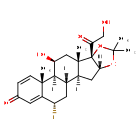
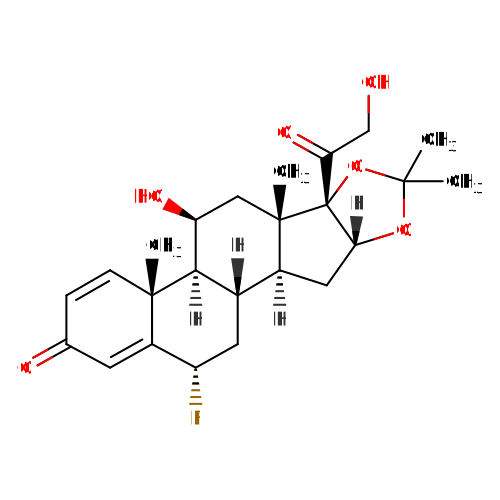
Structure for Flunisolide (DB00180)
- Weight
- Average: 434.4977
Monoisotopic: 434.210466929 - Chemical Formula
- C24H31FO6
- Synonyms
- Flunisolida
- Flunisolide
- Flunisolide anhydrous
- Flunisolidum

Pharmacology
- Indication
For the maintenance treatment of asthma as a prophylactic therapy.
 Reduce drug development failure ratesBuild, train, & validate machine-learning modelswith evidence-based and structured datasets.Build, train, & validate predictive machine-learning models with structured datasets.
- Associated Conditions
Indication Type Indication Combined Product Details Approval Level Age Group Patient Characteristics Dose Form Treatment of Allergic rhinitis •••••••••••• Treatment of Asthma •••••••••••• •••••••• - Contraindications & Blackbox Warnings
 Prevent Adverse Drug Events TodayTap into our Clinical API for life-saving information on contraindications & blackbox warnings, population restrictions, harmful risks, & more.Avoid life-threatening adverse drug events with our Clinical API
- Pharmacodynamics
Flunisolide is a synthetic corticosteroid. It is administered either as an oral metered-dose inhaler for the treatment of asthma or as a nasal spray for treating allergic rhinitis. Corticosteroids are naturally occurring hormones that prevent or suppress inflammation and immune responses. When given as an intranasal spray, flunisolide reduces watery nasal discharge (rhinorrhea), nasal congestion, postnasal drip, sneezing, and itching oat the back of the throat that are common allergic symptoms.
- Mechanism of action
Flunisolide is a glucocorticoid receptor agonist. The antiinflammatory actions of corticosteroids are thought to involve lipocortins, phospholipase A2 inhibitory proteins which, through inhibition arachidonic acid, control the biosynthesis of prostaglandins and leukotrienes. The immune system is suppressed by corticosteroids due to a decrease in the function of the lymphatic system, a reduction in immunoglobulin and complement concentrations, the precipitation of lymphocytopenia, and interference with antigen-antibody binding. Flunisolide binds to plasma transcortin, and it becomes active when it is not bound to transcortin.
Target Actions Organism AGlucocorticoid receptor agonistHumans - Absorption
Absorbed rapidly
- Volume of distribution
Not Available
- Protein binding
Approximately 40% after oral inhalation
- Metabolism
Primarily hepatic, converted to the S beta-OH metabolite.
- Route of elimination
Not Available
- Half-life
1.8 hours
- Clearance
Not Available
- Adverse Effects
 Improve decision support & research outcomesWith structured adverse effects data, including: blackbox warnings, adverse reactions, warning & precautions, & incidence rates. View sample adverse effects data in our new Data Library!Improve decision support & research outcomes with our structured adverse effects data.
- Toxicity
Not Available
- Pathways
- Not Available
- Pharmacogenomic Effects/ADRs
- Not Available
Interactions
- Drug Interactions
- This information should not be interpreted without the help of a healthcare provider. If you believe you are experiencing an interaction, contact a healthcare provider immediately. The absence of an interaction does not necessarily mean no interactions exist.
Drug Interaction Integrate drug-drug
interactions in your softwareAbametapir The serum concentration of Flunisolide can be increased when it is combined with Abametapir. Abatacept The risk or severity of adverse effects can be increased when Flunisolide is combined with Abatacept. Abemaciclib The metabolism of Abemaciclib can be increased when combined with Flunisolide. Acalabrutinib The metabolism of Acalabrutinib can be increased when combined with Flunisolide. Acarbose The risk or severity of hyperglycemia can be increased when Flunisolide is combined with Acarbose. - Food Interactions
- No interactions found.
Products
 Drug product information from 10+ global regionsOur datasets provide approved product information including:dosage, form, labeller, route of administration, and marketing period.Access drug product information from over 10 global regions.
- Product Ingredients
Ingredient UNII CAS InChI Key Flunisolide hemihydrate QK4DYS664X 77326-96-6 MIXMJCQRHVAJIO-TZHJZOAOSA-N - International/Other Brands
- Bronalide (Krewel) / Nasalide (Teva Santé) / Syntaris (Teva)
- Brand Name Prescription Products
Name Dosage Strength Route Labeller Marketing Start Marketing End Region Image Aerobid Aerosol, metered 250 ug/1 Respiratory (inhalation) Physicians Total Care, Inc. 1995-11-29 2011-05-31 US 
Aerobid Aerosol, metered 250 ug/1 Respiratory (inhalation) Physicians Total Care, Inc. 2005-05-16 2011-06-30 US Aerobid Aerosol, metered 250 ug/1 Respiratory (inhalation) Forest Laboratories 2005-03-02 2012-03-21 US Aerobid-M Aerosol, metered 250 ug/1 Respiratory (inhalation) Forest Laboratories 2005-03-02 2011-06-30 US Aerospan Aerosol, metered 80 ug/1 Respiratory (inhalation) MEDA Pharmaceuticals 2012-03-01 2019-04-30 US - Generic Prescription Products
Name Dosage Strength Route Labeller Marketing Start Marketing End Region Image Apo-flunisolide Nasal Spray Spray, metered 0.25 mg / mL Nasal Apotex Corporation 2000-03-10 2018-02-20 Canada 
Flunisolide Spray, metered 0.25 mg/1mL Nasal Rising Pharmaceuticals 2006-08-03 Not applicable US Flunisolide Solution 0.25 mg/1mL Nasal REMEDYREPACK INC. 2017-08-18 Not applicable US Flunisolide Solution 0.25 mg/1mL Nasal Remedy Repack 2016-02-17 2017-02-23 US Flunisolide Solution 0.25 mg/1mL Nasal Physicians Total Care, Inc. 2003-05-23 Not applicable US - Mixture Products
Name Ingredients Dosage Route Labeller Marketing Start Marketing End Region Image PLENAER Flunisolide (10 MG) + Albuterol (25 MG) Aerosol; Suspension Respiratory (inhalation) Valeas Spa Industria Chimica E Farmaceutica 2014-07-08 Not applicable Italy 
PLENAER Flunisolide (0.5 MG) + Albuterol (0.5 MG) Spray Respiratory (inhalation) Valeas Spa Industria Chimica E Farmaceutica 2014-07-08 Not applicable Italy - Unapproved/Other Products
Name Ingredients Dosage Route Labeller Marketing Start Marketing End Region Image Aerobid Flunisolide hemihydrate (250 ug/1) Aerosol, metered Respiratory (inhalation) Physicians Total Care, Inc. 2005-05-16 2011-06-30 US Aerobid Flunisolide hemihydrate (250 ug/1) Aerosol, metered Respiratory (inhalation) Physicians Total Care, Inc. 1995-11-29 2011-05-31 US
Categories
- ATC Codes
- R01AD04 — Flunisolide
- R01AD — Corticosteroids
- R01A — DECONGESTANTS AND OTHER NASAL PREPARATIONS FOR TOPICAL USE
- R01 — NASAL PREPARATIONS
- R — RESPIRATORY SYSTEM
- Drug Categories
- Adrenal Cortex Hormones
- Adrenals
- Agents to Treat Airway Disease
- Anti-Asthmatic Agents
- Anti-Inflammatory Agents
- Corticosteroid Hormone Receptor Agonists
- Corticosteroids
- Corticosteroids for Systemic Use
- Cytochrome P-450 CYP3A Inducers
- Cytochrome P-450 CYP3A Substrates
- Cytochrome P-450 CYP3A4 Inducers
- Cytochrome P-450 CYP3A4 Inducers (strength unknown)
- Cytochrome P-450 CYP3A4 Substrates
- Cytochrome P-450 Enzyme Inducers
- Cytochrome P-450 Substrates
- Drugs for Obstructive Airway Diseases
- Fused-Ring Compounds
- Immunosuppressive Agents
- Nasal Preparations
- Pregnadienes
- Pregnanes
- Respiratory System Agents
- Steroids
- Steroids, Fluorinated
- Chemical TaxonomyProvided by Classyfire
- Description
- This compound belongs to the class of organic compounds known as 21-hydroxysteroids. These are steroids carrying a hydroxyl group at the 21-position of the steroid backbone.
- Kingdom
- Organic compounds
- Super Class
- Lipids and lipid-like molecules
- Class
- Steroids and steroid derivatives
- Sub Class
- Hydroxysteroids
- Direct Parent
- 21-hydroxysteroids
- Alternative Parents
- Gluco/mineralocorticoids, progestogins and derivatives / 20-oxosteroids / 11-beta-hydroxysteroids / 3-oxo delta-1,4-steroids / Halogenated steroids / Delta-1,4-steroids / Ketals / 1,3-dioxolanes / Alpha-hydroxy ketones / Secondary alcohols show 8 more
- Substituents
- 11-beta-hydroxysteroid / 11-hydroxysteroid / 20-oxosteroid / 21-hydroxysteroid / 3-oxo-delta-1,4-steroid / 3-oxosteroid / 6-halo-steroid / Acetal / Alcohol / Aliphatic heteropolycyclic compound show 24 more
- Molecular Framework
- Aliphatic heteropolycyclic compounds
- External Descriptors
- 11beta-hydroxy steroid, cyclic ketal, 20-oxo steroid, fluorinated steroid, 3-oxo-Delta(1),Delta(4)-steroid, 21-hydroxy steroid (CHEBI:5106)
- Affected organisms
- Humans and other mammals
Chemical Identifiers
- UNII
- 78M02AA8KF
- CAS number
- 3385-03-3
- InChI Key
- XSFJVAJPIHIPKU-XWCQMRHXSA-N
- InChI
- InChI=1S/C24H31FO6/c1-21(2)30-19-9-14-13-8-16(25)15-7-12(27)5-6-22(15,3)20(13)17(28)10-23(14,4)24(19,31-21)18(29)11-26/h5-7,13-14,16-17,19-20,26,28H,8-11H2,1-4H3/t13-,14-,16-,17-,19+,20+,22-,23-,24+/m0/s1
- IUPAC Name
- (1S,2S,4R,8S,9S,11S,12S,13R,19S)-19-fluoro-11-hydroxy-8-(2-hydroxyacetyl)-6,6,9,13-tetramethyl-5,7-dioxapentacyclo[10.8.0.0^{2,9}.0^{4,8}.0^{13,18}]icosa-14,17-dien-16-one
- SMILES
- [H][C@@]12C[C@@]3([H])[C@]4([H])C[C@H](F)C5=CC(=O)C=C[C@]5(C)[C@@]4([H])[C@@H](O)C[C@]3(C)[C@@]1(OC(C)(C)O2)C(=O)CO
References
- Synthesis Reference
Richard E. Jones, Jacquelyn A. Smithers, "Process for preparing flunisolide." U.S. Patent US4273710, issued July, 1965.
US4273710- General References
- Not Available
- External Links
- Human Metabolome Database
- HMDB0014326
- KEGG Compound
- C07005
- PubChem Compound
- 82153
- PubChem Substance
- 46507894
- ChemSpider
- 74144
- BindingDB
- 50248007
- 1546428
- ChEBI
- 5106
- ChEMBL
- CHEMBL1512
- ZINC
- ZINC000004097305
- Therapeutic Targets Database
- DAP001046
- PharmGKB
- PA449661
- RxList
- RxList Drug Page
- Drugs.com
- Drugs.com Drug Page
- PDRhealth
- PDRhealth Drug Page
- Wikipedia
- Flunisolide
- FDA label
- Download (4.31 MB)
- MSDS
- Download (74.3 KB)
Clinical Trials
- Clinical Trials
Phase Status Purpose Conditions Count 3 Completed Treatment Perennial Allergic Rhinitis (PAR) 1 1, 2 Unknown Status Diagnostic Asthma / Distal Lung Inflammation 1 Not Available Completed Treatment Childhood Asthma 1
Pharmacoeconomics
- Manufacturers
- Roche palo alto llc
- Acton pharmaceuticals inc
- Apotex inc richmond hill
- Bausch and lomb pharmaceuticals inc
- Qpharma llc
- Ivax research inc
- Teva branded pharmaceutical products r and d inc
- Packagers
- 3M Health Care
- Apotex Inc.
- Bausch & Lomb Inc.
- Dispensing Solutions
- Elan Pharmaceuticals Inc.
- Forest Pharmaceuticals
- Patheon Inc.
- PD-Rx Pharmaceuticals Inc.
- Pharmedix
- Physicians Total Care Inc.
- QPharm Inc.
- Rising Pharmaceuticals
- Teva Pharmaceutical Industries Ltd.
- Dosage Forms
Form Route Strength Spray Respiratory (inhalation) 0.5 mg/ml Aerosol, metered Respiratory (inhalation) 250 ug/1 Aerosol, metered Respiratory (inhalation) 80 ug/1 Spray, metered Nasal 0.25 mg / mL Solution / drops Respiratory (inhalation) 1 mg/2ml Solution / drops Respiratory (inhalation) 2 mg/2ml Spray Respiratory (inhalation) 0.1 % Spray Respiratory (inhalation) 0.5 MG/1ML Spray Respiratory (inhalation) 1 MG/1ML Aerosol, metered Respiratory (inhalation) 250 mcg / act Solution / drops Respiratory (inhalation) Solution Respiratory (inhalation) 1 MG/ML Solution Respiratory (inhalation) 1 MG/2ML Solution Respiratory (inhalation) 2 MG/2ML Spray Nasal 0025 % Spray Nasal; Respiratory (inhalation) 0025 % Spray Respiratory (inhalation) 0.05 % Solution Nasal 0.25 mg/1mL Spray, metered Nasal 0.25 mg/1mL Spray, metered Nasal 29 ug/1 Spray Respiratory (inhalation) 1 mg/ml Spray Respiratory (inhalation) 30 MG/30ML Solution Nasal 29 ug/1 Spray Respiratory (inhalation) Spray Nasal 25 mcg / dose Spray Respiratory (inhalation) 1 MG/2ML Spray Respiratory (inhalation) 2 MG/2ML Aerosol; suspension Respiratory (inhalation) Spray Respiratory (inhalation) Spray Nasal 0.025 % Aerosol, metered Respiratory (inhalation) 250 MICROGRAMMI Solution / drops Nasal 25 MG/100ML Suspension Respiratory (inhalation) 250 MCG Spray Nasal 25 mcg / act Spray Nasal .025 % Solution; spray Nasal 25 mcg / act Aerosol, metered Respiratory (inhalation) Spray Nasal Spray Nasal 0.025 mg/0.1mL - Prices
Unit description Cost Unit Aerobid 250 mcg/act Aerosol 7 gm Inhaler 101.95USD inhaler Aerobid-M 250 mcg/act Aerosol 7 gm Inhaler 101.95USD inhaler Flunisolide 29 mcg/act Solution 25ml Bottle 57.16USD bottle Flunisolide 0.025% Solution 25ml Bottle 48.35USD bottle Aerobid aerosol with adapter 14.0USD g Aerobid-m aerosol with adapter 14.0USD g Flunisolide 29 mcg-0.025% spray 2.2USD ml Nasarel 29 mcg-0.025% spray 1.98USD ml Apo-Flunisolide 0.025 % Spray 0.62USD ml DrugBank does not sell nor buy drugs. Pricing information is supplied for informational purposes only.- Patents
Patent Number Pediatric Extension Approved Expires (estimated) Region US5776433 No 1998-07-07 2015-07-07 US
Properties
- State
- Solid
- Experimental Properties
Property Value Source melting point (°C) 226-230 American Cyanamid Co.; British Patent 933,867; August 14, 1963. water solubility Practically insoluble Not Available logP 1.1 Not Available - Predicted Properties
Property Value Source Water Solubility 0.0374 mg/mL ALOGPS logP 2.2 ALOGPS logP 1.56 Chemaxon logS -4.1 ALOGPS pKa (Strongest Acidic) 13.73 Chemaxon pKa (Strongest Basic) -2.9 Chemaxon Physiological Charge 0 Chemaxon Hydrogen Acceptor Count 6 Chemaxon Hydrogen Donor Count 2 Chemaxon Polar Surface Area 93.06 Å2 Chemaxon Rotatable Bond Count 2 Chemaxon Refractivity 111.89 m3·mol-1 Chemaxon Polarizability 44.67 Å3 Chemaxon Number of Rings 5 Chemaxon Bioavailability 1 Chemaxon Rule of Five Yes Chemaxon Ghose Filter Yes Chemaxon Veber's Rule No Chemaxon MDDR-like Rule No Chemaxon - Predicted ADMET Features
Property Value Probability Human Intestinal Absorption + 0.9865 Blood Brain Barrier + 0.9683 Caco-2 permeable + 0.5 P-glycoprotein substrate Substrate 0.7912 P-glycoprotein inhibitor I Non-inhibitor 0.5674 P-glycoprotein inhibitor II Non-inhibitor 0.8383 Renal organic cation transporter Non-inhibitor 0.8304 CYP450 2C9 substrate Non-substrate 0.8679 CYP450 2D6 substrate Non-substrate 0.8856 CYP450 3A4 substrate Substrate 0.6964 CYP450 1A2 substrate Non-inhibitor 0.9327 CYP450 2C9 inhibitor Non-inhibitor 0.9394 CYP450 2D6 inhibitor Non-inhibitor 0.9559 CYP450 2C19 inhibitor Non-inhibitor 0.9311 CYP450 3A4 inhibitor Non-inhibitor 0.8309 CYP450 inhibitory promiscuity Low CYP Inhibitory Promiscuity 0.8806 Ames test Non AMES toxic 0.7682 Carcinogenicity Non-carcinogens 0.9174 Biodegradation Not ready biodegradable 1.0 Rat acute toxicity 2.7033 LD50, mol/kg Not applicable hERG inhibition (predictor I) Weak inhibitor 0.9838 hERG inhibition (predictor II) Non-inhibitor 0.671
Spectra
- Mass Spec (NIST)
- Not Available
- Spectra
- Chromatographic Properties
Collision Cross Sections (CCS)
Adduct CCS Value (Å2) Source type Source [M-H]- 208.7729484 predictedDarkChem Lite v0.1.0 [M-H]- 207.59612 predictedDeepCCS 1.0 (2019) [M+H]+ 208.5122484 predictedDarkChem Lite v0.1.0 [M+H]+ 209.37834 predictedDeepCCS 1.0 (2019) [M+Na]+ 208.1585484 predictedDarkChem Lite v0.1.0 [M+Na]+ 216.09761 predictedDeepCCS 1.0 (2019)
Targets

- Kind
- Protein
- Organism
- Humans
- Pharmacological action
- Yes
- Actions
- Agonist
- General Function
- Zinc ion binding
- Specific Function
- Receptor for glucocorticoids (GC). Has a dual mode of action: as a transcription factor that binds to glucocorticoid response elements (GRE), both for nuclear and mitochondrial DNA, and as a modula...
- Gene Name
- NR3C1
- Uniprot ID
- P04150
- Uniprot Name
- Glucocorticoid receptor
- Molecular Weight
- 85658.57 Da
References
- Hochhaus G, Moellmann HW: Binding affinities of rimexolone (ORG 6216), flunisolide and their putative metabolites for the glucocorticoid receptor of human synovial tissue. Agents Actions. 1990 Jun;30(3-4):377-80. [Article]
- Johnson M: Development of fluticasone propionate and comparison with other inhaled corticosteroids. J Allergy Clin Immunol. 1998 Apr;101(4 Pt 2):S434-9. [Article]
- Valotis A, Hogger P: Significant receptor affinities of metabolites and a degradation product of mometasone furoate. Respir Res. 2004 Jul 22;5:7. [Article]
- Hogger P, Erpenstein U, Rohdewald P, Sorg C: Biochemical characterization of a glucocorticoid-induced membrane protein (RM3/1) in human monocytes and its application as model system for ranking glucocorticoid potency. Pharm Res. 1998 Feb;15(2):296-302. [Article]
- Badia L, Lund V: Topical corticosteroids in nasal polyposis. Drugs. 2001;61(5):573-8. [Article]
- Philibert D, Bouchoux F, Cerede E, Corallo F, Allaire JM: [Pharmacologic study of the glucocorticoid activity of flunisolide compared with other steroids in the rat]. Allerg Immunol (Paris). 1993 Feb;25(2):77-81. [Article]
- Chen X, Ji ZL, Chen YZ: TTD: Therapeutic Target Database. Nucleic Acids Res. 2002 Jan 1;30(1):412-5. [Article]
Enzymes
- Kind
- Protein
- Organism
- Humans
- Pharmacological action
- Unknown
- Actions
- SubstrateInducer
- General Function
- Vitamin d3 25-hydroxylase activity
- Specific Function
- Cytochromes P450 are a group of heme-thiolate monooxygenases. In liver microsomes, this enzyme is involved in an NADPH-dependent electron transport pathway. It performs a variety of oxidation react...
- Gene Name
- CYP3A4
- Uniprot ID
- P08684
- Uniprot Name
- Cytochrome P450 3A4
- Molecular Weight
- 57342.67 Da
References
- Usui T, Saitoh Y, Komada F: Induction of CYP3As in HepG2 cells by several drugs. Association between induction of CYP3A4 and expression of glucocorticoid receptor. Biol Pharm Bull. 2003 Apr;26(4):510-7. doi: 10.1248/bpb.26.510. [Article]
- Pichard L, Fabre I, Daujat M, Domergue J, Joyeux H, Maurel P: Effect of corticosteroids on the expression of cytochromes P450 and on cyclosporin A oxidase activity in primary cultures of human hepatocytes. Mol Pharmacol. 1992 Jun;41(6):1047-55. [Article]
- Matoulkova P, Pavek P, Maly J, Vlcek J: Cytochrome P450 enzyme regulation by glucocorticoids and consequences in terms of drug interaction. Expert Opin Drug Metab Toxicol. 2014 Mar;10(3):425-35. doi: 10.1517/17425255.2014.878703. Epub 2014 Jan 23. [Article]
- Litt J. (2016). Litt's Drug eruption & reaction manual (22nd ed.). CRC Press LLc.
Carriers
- Kind
- Protein
- Organism
- Humans
- Pharmacological action
- No
- Actions
- Binder
- General Function
- Steroid binding
- Specific Function
- Major transport protein for glucocorticoids and progestins in the blood of almost all vertebrate species.
- Gene Name
- SERPINA6
- Uniprot ID
- P08185
- Uniprot Name
- Corticosteroid-binding globulin
- Molecular Weight
- 45140.49 Da
References
- Gardill BR, Vogl MR, Lin HY, Hammond GL, Muller YA: Corticosteroid-binding globulin: structure-function implications from species differences. PLoS One. 2012;7(12):e52759. doi: 10.1371/journal.pone.0052759. Epub 2012 Dec 26. [Article]

Drug created at June 13, 2005 13:24 / Updated at April 26, 2024 00:45