Identification
- Summary
Benzatropine is an anticholinergic drug used to treat Parkinson's disease (PD) and extrapyramidal symptoms, except tardive dyskinesia.
- Brand Names
- Cogentin
- Generic Name
- Benzatropine
- DrugBank Accession Number
- DB00245
- Background
Benztropine, with the chemical formula 3alpha-diphenylmethoxytropane, is a tropane-based dopamine inhibitor used for the symptomatic treatment of Parkinson's disease. It is a combination molecule between a tropane ring, similar to cocaine, and a diphenyl ether from the dialkylpiperazines determined to be a dopamine uptake inhibitor since 1970. The generation of structure-activity relationships proved that benztropine derivatives with the presence of a chlorine substituent in the para position in one of the phenyl rings produces an increased potency for dopamine uptake inhibition as well as a decreased inhibition of serotonin and norepinephrine.1 Benztropine was developed by USL Pharma and officially approved by the FDA on 1996.9
- Type
- Small Molecule
- Groups
- Approved
- Structure
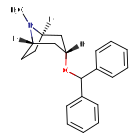
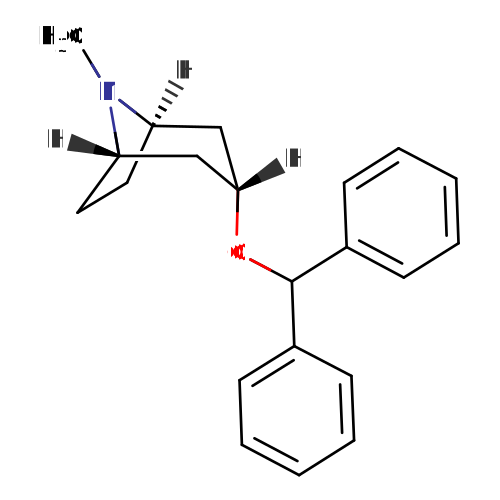
Structure for Benzatropine (DB00245)
- Weight
- Average: 307.4293
Monoisotopic: 307.193614427 - Chemical Formula
- C21H25NO
- Synonyms
- 3-alpha-(diphenylmethoxy)tropane
- 3endo-benzhydryloxytropane
- 3α-(diphenylmethoxy)-1αH,5αH-tropane
- 3α-(diphenylmethoxy)tropane
- 3α-benzhydryloxy-8-methyl-8-azabicyclo[3.2.1]octane
- Benzatropina
- Benzatropine
- Benzatropinum
- benzhydryl 8-methyl-8-azabicyclo[3.2.1]oct-3-yl ether
- Benztropine
- Tropine benzohydryl ether
- External IDs
- NK-02

Pharmacology
- Indication
Benztropine is indicated to be used as an adjunct in the therapy of all forms of parkinsonism. It can also be used for the control of extrapyramidal disorders due to neuroleptic drugs.7
The extrapyramidal symptoms are defined as drug-induced disorders that include symptoms of dystonia, akathisia, parkinsonism, bradykinesia, tremors, and dyskinesia.4
Parkinsonism is a general term that refers to the group of neurological disorders that produce symptoms similar to Parkinson's disease such as tremors, slow movement, and stiffness. The parkinsonism includes a large number of disorders and some of them have not been clearly defined.10
 Reduce drug development failure ratesBuild, train, & validate machine-learning modelswith evidence-based and structured datasets.Build, train, & validate predictive machine-learning models with structured datasets.
- Associated Conditions
Indication Type Indication Combined Product Details Approval Level Age Group Patient Characteristics Dose Form Adjunct therapy in management of Parkinsonism •••••••••••• - Contraindications & Blackbox Warnings
 Prevent Adverse Drug Events TodayTap into our Clinical API for life-saving information on contraindications & blackbox warnings, population restrictions, harmful risks, & more.Avoid life-threatening adverse drug events with our Clinical API
- Pharmacodynamics
The inhibition of dopamine reuptake by benztropine produces a dose-dependent increase of dopamine in the nerve terminal of the dopaminergic system.5
Clinically the activity of benztropine is observed after 1-2 hours of oral administration and after a few minutes of intramuscular administration with a last-longing effect of about 24 hours. Reports have indicated that benztropine has a very large sedative effect.5
The antihistaminic effect of benztropine is very similar to the effect found in pyrilamine and the anticholinergic activity was found to be equal to atropine ex vivo and of about 50% activity in vivo.12
- Mechanism of action
Benztropine is an agent with anti-muscarinic and antihistaminic effects. Its main mechanism of action is presented by the selective inhibition of dopamine transporters but it also presents affinity for histamine and muscarine receptors.2
It is widely known that benztropine is a potent inhibitor of presynaptic carrier-mediated dopamine transport. As well, it is known to be an analog of atropine and hence, it has a large affinity for muscarinic receptors M1 in the human brain. Once bound, benztropine blocks the activity of the muscarinic receptors mainly in the striatum.5
The increased advantage of benztropine lays on the antagonism of acetylcholine activity which corrects the imbalance between dopamine and acetylcholine in Parkinson patients.12
Target Actions Organism AMuscarinic acetylcholine receptor M1 antagonistHumans ASodium-dependent dopamine transporter inhibitorHumans UHistamine H1 receptor antagonistHumans NSodium-dependent serotonin transporter inhibitorHumans NSodium-dependent noradrenaline transporter inhibitorHumans - Absorption
Oral administration of 1.5 mg of benztropine is slowly absorbed in the gastrointestinal tract and it reaches a peak concentration of 2.5 ng/ml in about 7 hours.3 It has an approximate oral bioavailability of 29%.8
- Volume of distribution
Benztropine is expected to present a large volume of distribution between 12-30 L/kg.6
- Protein binding
About 95% of the administered dose of benztropine is found bound to plasma proteins.8
- Metabolism
Benztropine has been shown to undergo metabolism mainly marked by N-oxidation, N-dealkylation and ring hydroxylation.3 The extensive metabolism of benztropine produces eight phase-I metabolites plus four glucuronide conjugates.5
Hover over products below to view reaction partners
- Route of elimination
Benztropine is mainly excreted in the urine but it is also found in the feces unchanged.5
- Half-life
The elimination half-life of benztropine is very variable and it is reported to be of around 36 hours.13
- Clearance
Extensive pharmacodynamic or pharmacokinetic studies have not been performed.
- Adverse Effects
 Improve decision support & research outcomesWith structured adverse effects data, including: blackbox warnings, adverse reactions, warning & precautions, & incidence rates. View sample adverse effects data in our new Data Library!Improve decision support & research outcomes with our structured adverse effects data.
- Toxicity
The oral LD50 of benztropine is reported to be of 940 mg/kg in rats.MSDS In the presence of overdose with benztropine, it has been observed symptoms of circulatory collapse, cardiac arrest, respiratory depression, respiratory arrest, psychosis, shock, coma, seizure, ataxia, combativeness, anhidrosis, hyperthermia, fever, dysphagia, decreased bowel sounds and sluggish pupils.13
- Pathways
- Not Available
- Pharmacogenomic Effects/ADRs
- Not Available
Interactions
- Drug Interactions
- This information should not be interpreted without the help of a healthcare provider. If you believe you are experiencing an interaction, contact a healthcare provider immediately. The absence of an interaction does not necessarily mean no interactions exist.
Drug Interaction Integrate drug-drug
interactions in your softwareAbacavir Benzatropine may decrease the excretion rate of Abacavir which could result in a higher serum level. Abatacept The metabolism of Benzatropine can be increased when combined with Abatacept. Abiraterone The metabolism of Benzatropine can be decreased when combined with Abiraterone. Acebutolol The metabolism of Benzatropine can be decreased when combined with Acebutolol. Aceclofenac Aceclofenac may decrease the excretion rate of Benzatropine which could result in a higher serum level. - Food Interactions
- Avoid alcohol.
- Take with food. Food reduces irritation.
Products
 Drug product information from 10+ global regionsOur datasets provide approved product information including:dosage, form, labeller, route of administration, and marketing period.Access drug product information from over 10 global regions.
- Product Ingredients
Ingredient UNII CAS InChI Key Benzatropine mesylate WMJ8TL7510 132-17-2 CPFJLLXFNPCTDW-BWSPSPBFSA-N - Product Images
- International/Other Brands
- Apo-Benztropine (Apotex) / Cogentinol (Astra (Germany, discontinued)) / PMS Benztropine (Pharmascience)
- Brand Name Prescription Products
Name Dosage Strength Route Labeller Marketing Start Marketing End Region Image Bensylate Tab 2mg Tablet 2 mg Oral Icn Pharmaceuticals 1978-12-31 2005-04-26 Canada 
Benztropine Solution 2 mg / 2 mL Intramuscular; Intravenous Phebra Pty Ltd 2019-12-03 Not applicable Canada Benztropine 2 Tab 2mg Tablet 2 mg Oral Pro Doc Limitee 1982-12-31 2009-07-23 Canada Benztropine Mesylate Tablet 0.5 mg/1 Oral Remedy Repack 2011-09-06 2011-10-20 US 

Benztropine Mesylate Injection, USP Liquid 1 mg / mL Intramuscular; Intravenous Sabex Inc Not applicable Not applicable Canada - Generic Prescription Products
Name Dosage Strength Route Labeller Marketing Start Marketing End Region Image Benztropine Tablet 1 mg/1 Oral Contract Pharmacy Services-PA 2017-04-13 Not applicable US Benztropine Mesylate Tablet 1 mg/1 Oral American Health Packaging 2009-12-29 Not applicable US Benztropine Mesylate Tablet 0.5 mg/1 Oral Major Pharmaceuticals 2007-08-27 2018-09-30 US Benztropine Mesylate Tablet 1 mg/1 Oral Remedy Repack 2010-09-21 2015-07-11 US Benztropine Mesylate Tablet 1 mg/1 Oral Camber Pharmaceuticals 2013-08-01 Not applicable US - Unapproved/Other Products
Name Ingredients Dosage Route Labeller Marketing Start Marketing End Region Image Benztropine Mesylate Benzatropine mesylate (0.5 mg/1) Tablet Oral Remedy Repack 2011-09-06 2011-10-20 US


Categories
- ATC Codes
- N04AC01 — Benzatropine
- Drug Categories
- Agents producing tachycardia
- Alkaloids
- Anti-Dyskinesia Agents
- Anti-Parkinson Drugs
- Anticholinergic Agents
- Aza Compounds
- Central Nervous System Agents
- Cholinergic Agents
- Cytochrome P-450 CYP2D6 Substrates
- Cytochrome P-450 Substrates
- Dopamine Agents
- Dopamine Uptake Inhibitors
- Drugs that are Mainly Renally Excreted
- Ethers of Tropine or Tropine Derivatives
- Histamine Antagonists
- Histamine H1 Antagonists
- Histamine Receptor Antagonists
- Membrane Transport Modulators
- Muscarinic Antagonists
- Nervous System
- Neurotransmitter Agents
- Neurotransmitter Uptake Inhibitors
- Peripheral Nervous System Agents
- Potential QTc-Prolonging Agents
- QTc Prolonging Agents
- Tropanes
- Chemical TaxonomyProvided by Classyfire
- Description
- This compound belongs to the class of organic compounds known as diphenylmethanes. These are compounds containing a diphenylmethane moiety, which consists of a methane wherein two hydrogen atoms are replaced by two phenyl groups.
- Kingdom
- Organic compounds
- Super Class
- Benzenoids
- Class
- Benzene and substituted derivatives
- Sub Class
- Diphenylmethanes
- Direct Parent
- Diphenylmethanes
- Alternative Parents
- Tropane alkaloids / Benzylethers / Piperidines / N-alkylpyrrolidines / Trialkylamines / Dialkyl ethers / Azacyclic compounds / Organopnictogen compounds / Hydrocarbon derivatives
- Substituents
- Amine / Aromatic heteropolycyclic compound / Azacycle / Benzylether / Dialkyl ether / Diphenylmethane / Ether / Hydrocarbon derivative / N-alkylpyrrolidine / Organic nitrogen compound
- Molecular Framework
- Aromatic heteropolycyclic compounds
- External Descriptors
- tertiary amino compound (CHEBI:3048)
- Affected organisms
- Humans and other mammals
Chemical Identifiers
- UNII
- 1NHL2J4X8K
- CAS number
- 86-13-5
- InChI Key
- GIJXKZJWITVLHI-PMOLBWCYSA-N
- InChI
- InChI=1S/C21H25NO/c1-22-18-12-13-19(22)15-20(14-18)23-21(16-8-4-2-5-9-16)17-10-6-3-7-11-17/h2-11,18-21H,12-15H2,1H3/t18-,19+,20+
- IUPAC Name
- (1R,3R,5S)-3-(diphenylmethoxy)-8-methyl-8-azabicyclo[3.2.1]octane
- SMILES
- [H][C@]12CC[C@]([H])(C[C@@]([H])(C1)OC(C1=CC=CC=C1)C1=CC=CC=C1)N2C
References
- General References
- Rothman RB, Baumann MH, Prisinzano TE, Newman AH: Dopamine transport inhibitors based on GBR12909 and benztropine as potential medications to treat cocaine addiction. Biochem Pharmacol. 2008 Jan 1;75(1):2-16. doi: 10.1016/j.bcp.2007.08.007. Epub 2007 Aug 9. [Article]
- Reith ME, Blough BE, Hong WC, Jones KT, Schmitt KC, Baumann MH, Partilla JS, Rothman RB, Katz JL: Behavioral, biological, and chemical perspectives on atypical agents targeting the dopamine transporter. Drug Alcohol Depend. 2015 Feb 1;147:1-19. doi: 10.1016/j.drugalcdep.2014.12.005. Epub 2014 Dec 18. [Article]
- Brocks DR: Anticholinergic drugs used in Parkinson's disease: An overlooked class of drugs from a pharmacokinetic perspective. J Pharm Pharm Sci. 1999 May-Aug;2(2):39-46. [Article]
- Blair DT, Dauner A: Extrapyramidal symptoms are serious side-effects of antipsychotic and other drugs. Nurse Pract. 1992 Nov;17(11):56, 62-4, 67. [Article]
- Deleu D, Northway MG, Hanssens Y: Clinical pharmacokinetic and pharmacodynamic properties of drugs used in the treatment of Parkinson's disease. Clin Pharmacokinet. 2002;41(4):261-309. [Article]
- Raje S, Cao J, Newman AH, Gao H, Eddington ND: Evaluation of the blood-brain barrier transport, population pharmacokinetics, and brain distribution of benztropine analogs and cocaine using in vitro and in vivo techniques. J Pharmacol Exp Ther. 2003 Nov;307(2):801-8. doi: 10.1124/jpet.103.053504. Epub 2003 Sep 9. [Article]
- Troy B. and Beringer P. (2006). Remington: The Science and Practice of Pharmacy (21st ed.). Lippincott Williams & Wilkins.
- Hale T. and Rowe H. (2017). MEdications & mothers' milk (17th ed.). Springer publishing company. [ISBN:978-0-8261-2858-4]
- FDA approvals [Link]
- Parkinson [Link]
- FDA Approved Drug Products: Cogentin (benztropine mesylate) for intravenous/intramuscular injection [Link]
- pdp-BENZTROPINE (benztropine) Prescribing information [File]
- Benztropine informational sheet [File]
- External Links
- Human Metabolome Database
- HMDB0014390
- KEGG Drug
- D07511
- KEGG Compound
- C06846
- PubChem Compound
- 1201549
- PubChem Substance
- 46505349
- ChemSpider
- 16736541
- BindingDB
- 50366775
- 1424
- ChEBI
- 3048
- ChEMBL
- CHEMBL1201203
- ZINC
- ZINC000100036536
- Therapeutic Targets Database
- DAP001460
- PharmGKB
- PA448591
- PDBe Ligand
- CXQ
- RxList
- RxList Drug Page
- Drugs.com
- Drugs.com Drug Page
- Wikipedia
- Benzatropine
- PDB Entries
- 6f6s
- FDA label
- Download (54.9 KB)
- MSDS
- Download (73.3 KB)
Clinical Trials
Pharmacoeconomics
- Manufacturers
- Hikma farmaceutica (portugal) sa
- Nexus pharmaceuticals inc
- Pharmaforce inc
- Lundbeck inc
- Actavis totowa llc
- Corepharma llc
- Invagen pharmaceuticals inc
- Lannett holdings inc
- Mutual pharmaceutical co inc
- Pliva inc
- Quantum pharmics ltd
- Usl pharma inc
- Vintage pharmaceuticals llc
- Merck and co inc
- Packagers
- Advanced Pharmaceutical Services Inc.
- Amerisource Health Services Corp.
- Amneal Pharmaceuticals
- AQ Pharmaceuticals Inc.
- Cardinal Health
- Comprehensive Consultant Services Inc.
- Corepharma LLC
- Coupler Enterprises Inc.
- Dept Health Central Pharmacy
- Direct Dispensing Inc.
- Dispensing Solutions
- Goldline Laboratories Inc.
- Heartland Repack Services LLC
- Hikma Pharmaceuticals
- Ivax Pharmaceuticals
- Liberty Pharmaceuticals
- Lundbeck Inc.
- Major Pharmaceuticals
- Medisca Inc.
- Merck & Co.
- Murfreesboro Pharmaceutical Nursing Supply
- Neuman Distributors Inc.
- Nexus Pharmaceuticals
- Nucare Pharmaceuticals Inc.
- PCA LLC
- Pharmaceutical Packaging Center
- Pharmedix
- Physicians Total Care Inc.
- Pliva Inc.
- Prepackage Specialists
- Prepak Systems Inc.
- Qualitest
- Rebel Distributors Corp.
- Remedy Repack
- Rising Pharmaceuticals
- Sandhills Packaging Inc.
- Schein Pharmaceutical Inc.
- Southwood Pharmaceuticals
- Tya Pharmaceuticals
- UDL Laboratories
- United Research Laboratories Inc.
- USL Pharma Inc.
- Vangard Labs Inc.
- Vintage Pharmaceuticals Inc.
- West-Ward Pharmaceuticals
- Dosage Forms
Form Route Strength Tablet Oral 2 mg Injection, solution Intramuscular; Intravenous 2.0 mg/2ml Solution Intramuscular; Intravenous 2 mg / 2 mL Injection Intramuscular; Intravenous 1 mg/1mL Injection, solution Intramuscular; Intravenous 1 mg/1mL Tablet Oral 0.5 mg/1 Tablet Oral 1 mg/1 Tablet Oral 2 mg/1 Injection Parenteral 1 mg/1mL Liquid Intramuscular; Intravenous 1 mg / mL Solution Intramuscular; Intravenous 1 mg / mL Injection Intramuscular; Intravenous 2 mg/2ml Solution Oral 2 mg / 5 mL Tablet Oral 1 mg Tablet Oral 0.5 mg Injection, solution Intramuscular; Intravenous 2 mg/2ml Solution 1 mg/1ml - Prices
Unit description Cost Unit Cogentin 2 mg/2 ml ampule 70.09USD ml Benztropine 2 mg/2 ml ampule 37.5USD ml Benztropine 2 mg/2 ml vial 33.0USD ml Benztropine mesylate powder 26.38USD g Benztropine mes 2 mg tablet 0.41USD tablet Benztropine mes 1 mg tablet 0.38USD tablet Benztropine mes 0.5 mg tablet 0.34USD tablet Benztropine Mesylate 0.5 mg tablet 0.27USD tablet Benztropine Mesylate 1 mg tablet 0.27USD tablet Benztropine Mesylate 2 mg tablet 0.26USD tablet Apo-Benztropine 2 mg Tablet 0.06USD tablet Pms-Benztropine 2 mg Tablet 0.05USD tablet Pms-Benztropine 1 mg Tablet 0.02USD tablet DrugBank does not sell nor buy drugs. Pricing information is supplied for informational purposes only.- Patents
- Not Available
Properties
- State
- Solid
- Experimental Properties
Property Value Source melting point (°C) 135ºC 'MSDS' boiling point (°C) 547.8 ºC at 760 mm Hg CAS water solubility 81 mg/ml 'MSDS' logP 4.27 Xu A. and Madden T. 2012. LC-MS in Drug Bioanalysis. pKa 10 Troy D. and Beringer P. 2006. Remington: The Science and Practice of Pharmacy. - Predicted Properties
Property Value Source Water Solubility 0.00121 mg/mL ALOGPS logP 4.47 ALOGPS logP 4.19 Chemaxon logS -5.4 ALOGPS pKa (Strongest Basic) 9.54 Chemaxon Physiological Charge 1 Chemaxon Hydrogen Acceptor Count 2 Chemaxon Hydrogen Donor Count 0 Chemaxon Polar Surface Area 12.47 Å2 Chemaxon Rotatable Bond Count 4 Chemaxon Refractivity 94.24 m3·mol-1 Chemaxon Polarizability 35.42 Å3 Chemaxon Number of Rings 4 Chemaxon Bioavailability 1 Chemaxon Rule of Five Yes Chemaxon Ghose Filter Yes Chemaxon Veber's Rule Yes Chemaxon MDDR-like Rule No Chemaxon - Predicted ADMET Features
Property Value Probability Human Intestinal Absorption + 0.9766 Blood Brain Barrier + 0.9929 Caco-2 permeable + 0.7912 P-glycoprotein substrate Non-substrate 0.5145 P-glycoprotein inhibitor I Inhibitor 0.8428 P-glycoprotein inhibitor II Non-inhibitor 0.9561 Renal organic cation transporter Inhibitor 0.8218 CYP450 2C9 substrate Non-substrate 0.7188 CYP450 2D6 substrate Non-substrate 0.5 CYP450 3A4 substrate Substrate 0.669 CYP450 1A2 substrate Non-inhibitor 0.9383 CYP450 2C9 inhibitor Non-inhibitor 0.9072 CYP450 2D6 inhibitor Inhibitor 0.7739 CYP450 2C19 inhibitor Non-inhibitor 0.871 CYP450 3A4 inhibitor Non-inhibitor 0.9627 CYP450 inhibitory promiscuity Low CYP Inhibitory Promiscuity 0.8925 Ames test Non AMES toxic 0.5994 Carcinogenicity Non-carcinogens 0.9729 Biodegradation Not ready biodegradable 0.8768 Rat acute toxicity 2.5708 LD50, mol/kg Not applicable hERG inhibition (predictor I) Weak inhibitor 0.6077 hERG inhibition (predictor II) Non-inhibitor 0.534
Spectra
- Mass Spec (NIST)
- Not Available
- Spectra
Spectrum Spectrum Type Splash Key Predicted GC-MS Spectrum - GC-MS Predicted GC-MS splash10-014i-7910000000-522d5f59ab66fd491865 Predicted MS/MS Spectrum - 10V, Positive (Annotated) Predicted LC-MS/MS splash10-0a4i-0109000000-7d7ac7e4d98b0531bbbd Predicted MS/MS Spectrum - 10V, Negative (Annotated) Predicted LC-MS/MS splash10-0a4i-0109000000-8795825f63fd2ef1cf14 Predicted MS/MS Spectrum - 20V, Positive (Annotated) Predicted LC-MS/MS splash10-0a4i-0319000000-f6f57bef0ffdab5185cf Predicted MS/MS Spectrum - 20V, Negative (Annotated) Predicted LC-MS/MS splash10-0a4i-2906000000-27eb8781be96176539ec Predicted MS/MS Spectrum - 40V, Positive (Annotated) Predicted LC-MS/MS splash10-0006-9400000000-6cdd298d32c1cbe1a5e6 Predicted MS/MS Spectrum - 40V, Negative (Annotated) Predicted LC-MS/MS splash10-0ab9-0900000000-7802b3d3d3751fc23e81 Predicted 1H NMR Spectrum 1D NMR Not Applicable Predicted 13C NMR Spectrum 1D NMR Not Applicable - Chromatographic Properties
Collision Cross Sections (CCS)
Adduct CCS Value (Å2) Source type Source [M-H]- 182.4387798 predictedDarkChem Lite v0.1.0 [M-H]- 169.81898 predictedDeepCCS 1.0 (2019) [M+H]+ 183.9700798 predictedDarkChem Lite v0.1.0 [M+H]+ 172.21455 predictedDeepCCS 1.0 (2019) [M+Na]+ 182.4495798 predictedDarkChem Lite v0.1.0 [M+Na]+ 178.60257 predictedDeepCCS 1.0 (2019)
Targets

- Kind
- Protein
- Organism
- Humans
- Pharmacological action
- Yes
- Actions
- Antagonist
- General Function
- Phosphatidylinositol phospholipase c activity
- Specific Function
- The muscarinic acetylcholine receptor mediates various cellular responses, including inhibition of adenylate cyclase, breakdown of phosphoinositides and modulation of potassium channels through the...
- Gene Name
- CHRM1
- Uniprot ID
- P11229
- Uniprot Name
- Muscarinic acetylcholine receptor M1
- Molecular Weight
- 51420.375 Da
References
- Imming P, Sinning C, Meyer A: Drugs, their targets and the nature and number of drug targets. Nat Rev Drug Discov. 2006 Oct;5(10):821-34. [Article]
- Overington JP, Al-Lazikani B, Hopkins AL: How many drug targets are there? Nat Rev Drug Discov. 2006 Dec;5(12):993-6. [Article]
- Chen X, Ji ZL, Chen YZ: TTD: Therapeutic Target Database. Nucleic Acids Res. 2002 Jan 1;30(1):412-5. [Article]
- Kind
- Protein
- Organism
- Humans
- Pharmacological action
- Yes
- Actions
- Inhibitor
- General Function
- Monoamine transmembrane transporter activity
- Specific Function
- Amine transporter. Terminates the action of dopamine by its high affinity sodium-dependent reuptake into presynaptic terminals.
- Gene Name
- SLC6A3
- Uniprot ID
- Q01959
- Uniprot Name
- Sodium-dependent dopamine transporter
- Molecular Weight
- 68494.255 Da
References
- Katz JL, Agoston GE, Alling KL, Kline RH, Forster MJ, Woolverton WL, Kopajtic TA, Newman AH: Dopamine transporter binding without cocaine-like behavioral effects: synthesis and evaluation of benztropine analogs alone and in combination with cocaine in rodents. Psychopharmacology (Berl). 2001 Apr;154(4):362-74. [Article]
- Kulkarni SS, Kopajtic TA, Katz JL, Newman AH: Comparative structure-activity relationships of benztropine analogues at the dopamine transporter and histamine H(1) receptors. Bioorg Med Chem. 2006 Jun 1;14(11):3625-34. Epub 2006 Feb 3. [Article]
- Reith ME, Berfield JL, Wang LC, Ferrer JV, Javitch JA: The uptake inhibitors cocaine and benztropine differentially alter the conformation of the human dopamine transporter. J Biol Chem. 2001 Aug 3;276(31):29012-8. Epub 2001 Jun 6. [Article]
- Simoni D, Roberti M, Rondanin R, Baruchello R, Rossi M, Invidiata FP, Merighi S, Varani K, Gessi S, Borea PA, Marino S, Cavallini S, Bianchi C, Siniscalchi A: Effects of two-carbon bridge region methoxylation of benztropine: discovery of novel chiral ligands for the dopamine transporter. Bioorg Med Chem Lett. 2001 Mar 26;11(6):823-7. [Article]
- Todd CL, Grace AA: Interaction of benztropine and haloperidol actions on rat substantia nigra dopamine cell electrophysiological activity in vivo. Brain Res Bull. 1999 Jan 15;48(2):219-22. [Article]
- Zou MF, Kopajtic T, Katz JL, Wirtz S, Justice JB Jr, Newman AH: Novel tropane-based irreversible ligands for the dopamine transporter. J Med Chem. 2001 Dec 6;44(25):4453-61. [Article]
- Kind
- Protein
- Organism
- Humans
- Pharmacological action
- Unknown
- Actions
- Antagonist
- General Function
- Histamine receptor activity
- Specific Function
- In peripheral tissues, the H1 subclass of histamine receptors mediates the contraction of smooth muscles, increase in capillary permeability due to contraction of terminal venules, and catecholamin...
- Gene Name
- HRH1
- Uniprot ID
- P35367
- Uniprot Name
- Histamine H1 receptor
- Molecular Weight
- 55783.61 Da
References
- Kulkarni SS, Kopajtic TA, Katz JL, Newman AH: Comparative structure-activity relationships of benztropine analogues at the dopamine transporter and histamine H(1) receptors. Bioorg Med Chem. 2006 Jun 1;14(11):3625-34. Epub 2006 Feb 3. [Article]
- Kind
- Protein
- Organism
- Humans
- Pharmacological action
- No
- Actions
- Inhibitor
- General Function
- Serotonin:sodium symporter activity
- Specific Function
- Serotonin transporter whose primary function in the central nervous system involves the regulation of serotonergic signaling via transport of serotonin molecules from the synaptic cleft back into t...
- Gene Name
- SLC6A4
- Uniprot ID
- P31645
- Uniprot Name
- Sodium-dependent serotonin transporter
- Molecular Weight
- 70324.165 Da
References
- Rothman RB, Baumann MH, Prisinzano TE, Newman AH: Dopamine transport inhibitors based on GBR12909 and benztropine as potential medications to treat cocaine addiction. Biochem Pharmacol. 2008 Jan 1;75(1):2-16. doi: 10.1016/j.bcp.2007.08.007. Epub 2007 Aug 9. [Article]
- Kind
- Protein
- Organism
- Humans
- Pharmacological action
- No
- Actions
- Inhibitor
- General Function
- Norepinephrine:sodium symporter activity
- Specific Function
- Amine transporter. Terminates the action of noradrenaline by its high affinity sodium-dependent reuptake into presynaptic terminals.
- Gene Name
- SLC6A2
- Uniprot ID
- P23975
- Uniprot Name
- Sodium-dependent noradrenaline transporter
- Molecular Weight
- 69331.42 Da
References
- Rothman RB, Baumann MH, Prisinzano TE, Newman AH: Dopamine transport inhibitors based on GBR12909 and benztropine as potential medications to treat cocaine addiction. Biochem Pharmacol. 2008 Jan 1;75(1):2-16. doi: 10.1016/j.bcp.2007.08.007. Epub 2007 Aug 9. [Article]
Carriers
- Kind
- Protein
- Organism
- Humans
- Pharmacological action
- No
- Actions
- Binder
- General Function
- Toxic substance binding
- Specific Function
- Serum albumin, the main protein of plasma, has a good binding capacity for water, Ca(2+), Na(+), K(+), fatty acids, hormones, bilirubin and drugs. Its main function is the regulation of the colloid...
- Gene Name
- ALB
- Uniprot ID
- P02768
- Uniprot Name
- Serum albumin
- Molecular Weight
- 69365.94 Da
References
- Hale T. and Rowe H. (2017). MEdications & mothers' milk (17th ed.). Springer publishing company. [ISBN:978-0-8261-2858-4]

Drug created at June 13, 2005 13:24 / Updated at April 26, 2024 00:45