Identification
- Generic Name
- Dicoumarol
- DrugBank Accession Number
- DB00266
- Background
Dicoumarol is an oral anticoagulant agent that works by interfering with the metabolism of vitamin K. In addition to its clinical use, it is also used in biochemical experiments as an inhibitor of reductases.
- Type
- Small Molecule
- Groups
- Approved
- Structure
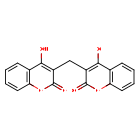
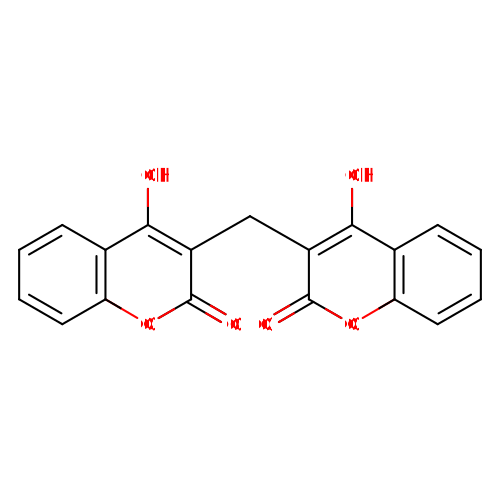
Structure for Dicoumarol (DB00266)
- Weight
- Average: 336.295
Monoisotopic: 336.063388116 - Chemical Formula
- C19H12O6
- Synonyms
- 3,3'-methylen-bis(4-hydroxy-cumarin)
- 3,3'-methylene-bis(4-hydroxycoumarine)
- 3,3'-methylenebis(4-hydroxy-1,2-benzopyrone)
- 3,3'-methylenebis(4-hydroxy-2H-1-benzopyran-2-one)
- 3,3'-methylenebis(4-hydroxycoumarin)
- bis-3,3'-(4-hydroxycoumarinyl)methane
- bis-hydroxycoumarin
- bis(4-hydroxycoumarin-3-yl)methane
- di-(4-hydroxy-3-coumarinyl)methane
- Dicoumarol
- Dicoumarolum
- Dicumarol
- External IDs
- NSC-17860
- NSC-221570
- NSC-41834

Pharmacology
- Indication
For decreasing blood clotting. Often used along with heparin for treatment of deep vein thrombosis.
 Reduce drug development failure ratesBuild, train, & validate machine-learning modelswith evidence-based and structured datasets.Build, train, & validate predictive machine-learning models with structured datasets.
- Contraindications & Blackbox Warnings
 Prevent Adverse Drug Events TodayTap into our Clinical API for life-saving information on contraindications & blackbox warnings, population restrictions, harmful risks, & more.Avoid life-threatening adverse drug events with our Clinical API
- Pharmacodynamics
Dicumarol is an coumarin-like compound found in sweet clover. It is used as an oral anticoagulant and acts by inhibiting the hepatic synthesis of vitamin K-dependent coagulation factors (prothrombin and factors VII, IX, and X).
- Mechanism of action
Dicumarol inhibits vitamin K reductase, resulting in depletion of the reduced form of vitamin K (vitamin KH2). As vitamin K is a cofactor for the carboxylation of glutamate residues on the N-terminal regions of vitamin K-dependent proteins, this limits the gamma-carboxylation and subsequent activation of the vitamin K-dependent coagulant proteins. The synthesis of vitamin K-dependent coagulation factors II, VII, IX, and X and anticoagulant proteins C and S is inhibited. Depression of three of the four vitamin K-dependent coagulation factors (factors II, VII, and X) results in decresed prothrombin levels and a decrease in the amount of thrombin generated and bound to fibrin. This reduces the thrombogenicity of clots.
Target Actions Organism AVitamin K epoxide reductase complex subunit 1 inhibitorHumans UNAD(P)H dehydrogenase [quinone] 1 inhibitorHumans UQuinone oxidoreductase inhibitorHumans - Absorption
Not Available
- Volume of distribution
Not Available
- Protein binding
Not Available
- Metabolism
- Not Available
- Route of elimination
Not Available
- Half-life
Not Available
- Clearance
Not Available
- Adverse Effects
 Improve decision support & research outcomesWith structured adverse effects data, including: blackbox warnings, adverse reactions, warning & precautions, & incidence rates. View sample adverse effects data in our new Data Library!Improve decision support & research outcomes with our structured adverse effects data.
- Toxicity
LD50=233 mg/kg (orally in mice); LD50=250 mg/kg (orally in rats)
- Pathways
Pathway Category Dicumarol Action Pathway Drug action Dicoumarol Action Pathway Drug action - Pharmacogenomic Effects/ADRs
- Not Available
Interactions
- Drug Interactions
- This information should not be interpreted without the help of a healthcare provider. If you believe you are experiencing an interaction, contact a healthcare provider immediately. The absence of an interaction does not necessarily mean no interactions exist.
Drug Interaction Integrate drug-drug
interactions in your softwareAbatacept The metabolism of Dicoumarol can be increased when combined with Abatacept. Abciximab The risk or severity of bleeding can be increased when Abciximab is combined with Dicoumarol. Abrocitinib The metabolism of Abrocitinib can be decreased when combined with Dicoumarol. Aceclofenac The risk or severity of bleeding and hemorrhage can be increased when Aceclofenac is combined with Dicoumarol. Acemetacin The risk or severity of bleeding and hemorrhage can be increased when Dicoumarol is combined with Acemetacin. - Food Interactions
- Avoid herbs and supplements with anticoagulant/antiplatelet activity. Examples include ginseng, ginkgo, ginger, and garlic.
Categories
- ATC Codes
- B01AA01 — Dicoumarol
- Drug Categories
- 4-Hydroxycoumarins
- Anticoagulants
- Benzopyrans
- Blood and Blood Forming Organs
- Coumarins
- Cytochrome P-450 CYP2C9 Substrates
- Cytochrome P-450 CYP2C9 Substrates with a Narrow Therapeutic Index
- Cytochrome P-450 Substrates
- Enzyme Inhibitors
- Fibrinolytic Agents
- Hematologic Agents
- Heterocyclic Compounds, Fused-Ring
- Narrow Therapeutic Index Drugs
- Pyrans
- Uncoupling Agents
- Vitamin K Antagonists
- Chemical TaxonomyProvided by Classyfire
- Description
- This compound belongs to the class of organic compounds known as 4-hydroxycoumarins. These are coumarins that contain one or more hydroxyl groups attached to C4-position the coumarin skeleton.
- Kingdom
- Organic compounds
- Super Class
- Phenylpropanoids and polyketides
- Class
- Coumarins and derivatives
- Sub Class
- Hydroxycoumarins
- Direct Parent
- 4-hydroxycoumarins
- Alternative Parents
- 1-benzopyrans / Pyranones and derivatives / Benzenoids / Vinylogous acids / Heteroaromatic compounds / Lactones / Oxacyclic compounds / Organooxygen compounds / Organic oxides / Hydrocarbon derivatives
- Substituents
- 1-benzopyran / 4-hydroxycoumarin / Aromatic heteropolycyclic compound / Benzenoid / Benzopyran / Heteroaromatic compound / Hydrocarbon derivative / Lactone / Organic oxide / Organic oxygen compound
- Molecular Framework
- Aromatic heteropolycyclic compounds
- External Descriptors
- hydroxycoumarin (CHEBI:4513) / coumarins (C00796)
- Affected organisms
- Humans and other mammals
Chemical Identifiers
- UNII
- 7QID3E7BG7
- CAS number
- 66-76-2
- InChI Key
- DOBMPNYZJYQDGZ-UHFFFAOYSA-N
- InChI
- InChI=1S/C19H12O6/c20-16-10-5-1-3-7-14(10)24-18(22)12(16)9-13-17(21)11-6-2-4-8-15(11)25-19(13)23/h1-8,20-21H,9H2
- IUPAC Name
- 4-hydroxy-3-[(4-hydroxy-2-oxo-2H-chromen-3-yl)methyl]-2H-chromen-2-one
- SMILES
- OC1=C(CC2=C(O)C3=C(OC2=O)C=CC=C3)C(=O)OC2=C1C=CC=C2
References
- General References
- Cullen JJ, Hinkhouse MM, Grady M, Gaut AW, Liu J, Zhang YP, Weydert CJ, Domann FE, Oberley LW: Dicumarol inhibition of NADPH:quinone oxidoreductase induces growth inhibition of pancreatic cancer via a superoxide-mediated mechanism. Cancer Res. 2003 Sep 1;63(17):5513-20. [Article]
- Mironov AA, Colanzi A, Polishchuk RS, Beznoussenko GV, Mironov AA Jr, Fusella A, Di Tullio G, Silletta MG, Corda D, De Matteis MA, Luini A: Dicumarol, an inhibitor of ADP-ribosylation of CtBP3/BARS, fragments golgi non-compact tubular zones and inhibits intra-golgi transport. Eur J Cell Biol. 2004 Jul;83(6):263-79. [Article]
- Abdelmohsen K, Stuhlmann D, Daubrawa F, Klotz LO: Dicumarol is a potent reversible inhibitor of gap junctional intercellular communication. Arch Biochem Biophys. 2005 Feb 15;434(2):241-7. [Article]
- Thanos CG, Liu Z, Reineke J, Edwards E, Mathiowitz E: Improving relative bioavailability of dicumarol by reducing particle size and adding the adhesive poly(fumaric-co-sebacic) anhydride. Pharm Res. 2003 Jul;20(7):1093-100. [Article]
- External Links
- Human Metabolome Database
- HMDB0014411
- KEGG Drug
- D03798
- KEGG Compound
- C00796
- PubChem Compound
- 54676038
- PubChem Substance
- 46505536
- ChemSpider
- 10183330
- BindingDB
- 35525
- 1598
- ChEBI
- 4513
- ChEMBL
- CHEMBL1466
- ZINC
- ZINC000003869855
- Therapeutic Targets Database
- DAP000768
- PharmGKB
- PA449298
- Wikipedia
- Dicoumarol
- MSDS
- Download (64.7 KB)
Clinical Trials
Pharmacoeconomics
- Manufacturers
- Eli lilly and co
- Abbott laboratories pharmaceutical products div
- Packagers
- Not Available
- Dosage Forms
- Not Available
- Prices
- Not Available
- Patents
- Not Available
Properties
- State
- Solid
- Experimental Properties
Property Value Source melting point (°C) 290 °C PhysProp water solubility 128 mg/L Not Available logP 2.07 HANSCH,C ET AL. (1995) - Predicted Properties
Property Value Source Water Solubility 0.0662 mg/mL ALOGPS logP 1.54 ALOGPS logP 1.94 Chemaxon logS -3.7 ALOGPS pKa (Strongest Acidic) 4.66 Chemaxon pKa (Strongest Basic) -6.8 Chemaxon Physiological Charge -2 Chemaxon Hydrogen Acceptor Count 4 Chemaxon Hydrogen Donor Count 2 Chemaxon Polar Surface Area 93.06 Å2 Chemaxon Rotatable Bond Count 2 Chemaxon Refractivity 89.19 m3·mol-1 Chemaxon Polarizability 32.32 Å3 Chemaxon Number of Rings 4 Chemaxon Bioavailability 1 Chemaxon Rule of Five Yes Chemaxon Ghose Filter Yes Chemaxon Veber's Rule No Chemaxon MDDR-like Rule No Chemaxon - Predicted ADMET Features
Property Value Probability Human Intestinal Absorption + 0.8724 Blood Brain Barrier + 0.8343 Caco-2 permeable - 0.5899 P-glycoprotein substrate Non-substrate 0.5073 P-glycoprotein inhibitor I Non-inhibitor 0.9304 P-glycoprotein inhibitor II Non-inhibitor 0.8972 Renal organic cation transporter Non-inhibitor 0.8982 CYP450 2C9 substrate Non-substrate 0.8264 CYP450 2D6 substrate Non-substrate 0.9116 CYP450 3A4 substrate Non-substrate 0.7557 CYP450 1A2 substrate Non-inhibitor 0.7905 CYP450 2C9 inhibitor Inhibitor 0.8948 CYP450 2D6 inhibitor Non-inhibitor 0.9681 CYP450 2C19 inhibitor Non-inhibitor 0.6071 CYP450 3A4 inhibitor Non-inhibitor 0.9098 CYP450 inhibitory promiscuity Low CYP Inhibitory Promiscuity 0.9165 Ames test Non AMES toxic 0.9048 Carcinogenicity Non-carcinogens 0.9549 Biodegradation Not ready biodegradable 0.8347 Rat acute toxicity 3.1251 LD50, mol/kg Not applicable hERG inhibition (predictor I) Weak inhibitor 0.9269 hERG inhibition (predictor II) Non-inhibitor 0.9435
Spectra
- Mass Spec (NIST)
- Download (9.73 KB)
- Spectra
- Chromatographic Properties
Collision Cross Sections (CCS)
Adduct CCS Value (Å2) Source type Source [M-H]- 185.6293781 predictedDarkChem Lite v0.1.0 [M-H]- 185.6385781 predictedDarkChem Lite v0.1.0 [M-H]- 185.6094781 predictedDarkChem Lite v0.1.0 [M-H]- 172.72295 predictedDeepCCS 1.0 (2019) [M+H]+ 187.5571781 predictedDarkChem Lite v0.1.0 [M+H]+ 184.4325781 predictedDarkChem Lite v0.1.0 [M+H]+ 186.6663781 predictedDarkChem Lite v0.1.0 [M+H]+ 175.17355 predictedDeepCCS 1.0 (2019) [M+Na]+ 185.3408781 predictedDarkChem Lite v0.1.0 [M+Na]+ 185.4225781 predictedDarkChem Lite v0.1.0 [M+Na]+ 182.67883 predictedDeepCCS 1.0 (2019)
Targets

- Kind
- Protein
- Organism
- Humans
- Pharmacological action
- Yes
- Actions
- Inhibitor
- General Function
- Vitamin-k-epoxide reductase (warfarin-sensitive) activity
- Specific Function
- Involved in vitamin K metabolism. Catalytic subunit of the vitamin K epoxide reductase (VKOR) complex which reduces inactive vitamin K 2,3-epoxide to active vitamin K. Vitamin K is required for the...
- Gene Name
- VKORC1
- Uniprot ID
- Q9BQB6
- Uniprot Name
- Vitamin K epoxide reductase complex subunit 1
- Molecular Weight
- 18234.3 Da
References
- Overington JP, Al-Lazikani B, Hopkins AL: How many drug targets are there? Nat Rev Drug Discov. 2006 Dec;5(12):993-6. [Article]
- Imming P, Sinning C, Meyer A: Drugs, their targets and the nature and number of drug targets. Nat Rev Drug Discov. 2006 Oct;5(10):821-34. [Article]
- Wallin R, Patrick SD, Ballard JO: Vitamin K antagonism of coumarin intoxication in the rat. Thromb Haemost. 1986 Apr 30;55(2):235-9. [Article]
- Chen X, Ji ZL, Chen YZ: TTD: Therapeutic Target Database. Nucleic Acids Res. 2002 Jan 1;30(1):412-5. [Article]
- Kind
- Protein
- Organism
- Humans
- Pharmacological action
- Unknown
- Actions
- Inhibitor
- General Function
- Superoxide dismutase activity
- Specific Function
- The enzyme apparently serves as a quinone reductase in connection with conjugation reactions of hydroquinons involved in detoxification pathways as well as in biosynthetic processes such as the vit...
- Gene Name
- NQO1
- Uniprot ID
- P15559
- Uniprot Name
- NAD(P)H dehydrogenase [quinone] 1
- Molecular Weight
- 30867.405 Da
References
- Chen S, Wu K, Zhang D, Sherman M, Knox R, Yang CS: Molecular characterization of binding of substrates and inhibitors to DT-diaphorase: combined approach involving site-directed mutagenesis, inhibitor-binding analysis, and computer modeling. Mol Pharmacol. 1999 Aug;56(2):272-8. [Article]
- Jaiswal AK: Characterization and partial purification of microsomal NAD(P)H:quinone oxidoreductases. Arch Biochem Biophys. 2000 Mar 1;375(1):62-8. [Article]
- Joseph P, Jaiswal AK: A unique cytosolic activity related but distinct from NQO1 catalyses metabolic activation of mitomycin C. Br J Cancer. 2000 Apr;82(7):1305-11. [Article]
- Floreani M, Napoli E, Palatini P: Protective action of cardiac DT-diaphorase against menadione toxicity in guinea pig isolated atria. Biochem Pharmacol. 2000 Aug 15;60(4):601-5. [Article]
- Arriagada C, Dagnino-Subiabre A, Caviedes P, Armero JM, Caviedes R, Segura-Aguilar J: Studies of aminochrome toxicity in a mouse derived neuronal cell line: is this toxicity mediated via glutamate transmission? Amino Acids. 2000;18(4):363-73. [Article]
- Preusch PC, Smalley DM: Vitamin K1 2,3-epoxide and quinone reduction: mechanism and inhibition. Free Radic Res Commun. 1990;8(4-6):401-15. [Article]
- Kind
- Protein
- Organism
- Humans
- Pharmacological action
- Unknown
- Actions
- Inhibitor
- General Function
- Zinc ion binding
- Specific Function
- Does not have alcohol dehydrogenase activity. Binds NADP and acts through a one-electron transfer process. Orthoquinones, such as 1,2-naphthoquinone or 9,10-phenanthrenequinone, are the best substr...
- Gene Name
- CRYZ
- Uniprot ID
- Q08257
- Uniprot Name
- Quinone oxidoreductase
- Molecular Weight
- 35206.36 Da
References
- Evans PJ: Decreased intracellular proteolysis correlates with the maintenance of a specific isoenzyme of cytochrome P-450. Cell Biol Int. 1999;23(2):117-24. [Article]
- Audi SH, Bongard RD, Dawson CA, Siegel D, Roerig DL, Merker MP: Duroquinone reduction during passage through the pulmonary circulation. Am J Physiol Lung Cell Mol Physiol. 2003 Nov;285(5):L1116-31. Epub 2003 Jul 25. [Article]
- Asher G, Dym O, Tsvetkov P, Adler J, Shaul Y: The crystal structure of NAD(P)H quinone oxidoreductase 1 in complex with its potent inhibitor dicoumarol. Biochemistry. 2006 May 23;45(20):6372-8. [Article]
- Maser E, Gebel T, Netter KJ: Carbonyl reduction of metyrapone in human liver. Biochem Pharmacol. 1991 Dec 11;42 Suppl:S93-8. [Article]
- Hao H, Wang G, Cui N, Li J, Xie L, Ding Z: Identification of a novel intestinal first pass metabolic pathway: NQO1 mediated quinone reduction and subsequent glucuronidation. Curr Drug Metab. 2007 Feb;8(2):137-49. [Article]
Enzymes
- Kind
- Protein
- Organism
- Humans
- Pharmacological action
- Unknown
- Actions
- Substrate
- Curator comments
- In general, anticoagulants such as warfarin and coumarin derivatives are substrates of CYP2C9. Dicoumarol, a coumarin derivative, is likely metabolized by this enzyme.
- General Function
- Steroid hydroxylase activity
- Specific Function
- Cytochromes P450 are a group of heme-thiolate monooxygenases. In liver microsomes, this enzyme is involved in an NADPH-dependent electron transport pathway. It oxidizes a variety of structurally un...
- Gene Name
- CYP2C9
- Uniprot ID
- P11712
- Uniprot Name
- Cytochrome P450 2C9
- Molecular Weight
- 55627.365 Da
References
- Militaru FC, Vesa SC, Pop TR, Buzoianu AD: Pharmacogenetics aspects of oral anticoagulants therapy. J Med Life. 2015 Apr-Jun;8(2):171-5. [Article]
- Limdi NA, Arnett DK, Goldstein JA, Beasley TM, McGwin G, Adler BK, Acton RT: Influence of CYP2C9 and VKORC1 on warfarin dose, anticoagulation attainment and maintenance among European-Americans and African-Americans. Pharmacogenomics. 2008 May;9(5):511-26. doi: 10.2217/14622416.9.5.511. [Article]
- Fung E, Patsopoulos NA, Belknap SM, O'Rourke DJ, Robb JF, Anderson JL, Shworak NW, Moore JH: Effect of genetic variants, especially CYP2C9 and VKORC1, on the pharmacology of warfarin. Semin Thromb Hemost. 2012 Nov;38(8):893-904. doi: 10.1055/s-0032-1328891. Epub 2012 Oct 6. [Article]
- Kind
- Protein
- Organism
- Rat
- Pharmacological action
- Unknown
- Actions
- Inhibitor
- General Function
- Cytochromes P450 are a group of heme-thiolate monooxygenases. In liver microsomes, this enzyme is involved in an NADPH-dependent electron transport pathway. It oxidizes a variety of structurally unrelated compounds, including steroids, fatty acids, and xenobiotics.
- Specific Function
- Arachidonic acid epoxygenase activity
- Gene Name
- Cyp2c6
- Uniprot ID
- P05178
- Uniprot Name
- Cytochrome P450 2C6
- Molecular Weight
- 56002.315 Da
References
- Stiborova M, Levova K, Barta F, Sulc M, Frei E, Arlt VM, Schmeiser HH: The influence of dicoumarol on the bioactivation of the carcinogen aristolochic acid I in rats. Mutagenesis. 2014 May;29(3):189-200. doi: 10.1093/mutage/geu004. Epub 2014 Mar 5. [Article]
- Kind
- Protein
- Organism
- Rat
- Pharmacological action
- Unknown
- Actions
- Inhibitor
- General Function
- Metabolizes testosterone mainly in positions 2 alpha and 16 alpha.
- Specific Function
- Arachidonic acid epoxygenase activity
- Gene Name
- Cyp2c11
- Uniprot ID
- P08683
- Uniprot Name
- Cytochrome P450 2C11
- Molecular Weight
- 57180.595 Da
References
- Stiborova M, Levova K, Barta F, Sulc M, Frei E, Arlt VM, Schmeiser HH: The influence of dicoumarol on the bioactivation of the carcinogen aristolochic acid I in rats. Mutagenesis. 2014 May;29(3):189-200. doi: 10.1093/mutage/geu004. Epub 2014 Mar 5. [Article]
Carriers
- Kind
- Protein
- Organism
- Humans
- Pharmacological action
- Unknown
- General Function
- Toxic substance binding
- Specific Function
- Serum albumin, the main protein of plasma, has a good binding capacity for water, Ca(2+), Na(+), K(+), fatty acids, hormones, bilirubin and drugs. Its main function is the regulation of the colloid...
- Gene Name
- ALB
- Uniprot ID
- P02768
- Uniprot Name
- Serum albumin
- Molecular Weight
- 69365.94 Da
References
- Rahman MH, Miyoshi T, Sukimoto K, Takadate A, Otagiri M: Interaction mode of dicumarol and its derivatives with human serum albumin, alpha 1-acid glycoprotein and asialo alpha 1-acid glycoprotein. J Pharmacobiodyn. 1992 Jan;15(1):7-16. [Article]


Drug created at June 13, 2005 13:24 / Updated at April 09, 2024 18:14