Identification
- Summary
Chlorambucil is a chemotherapy agent used in the management of chronic lymphocytic leukemia and malignant lymphomas.
- Brand Names
- Leukeran
- Generic Name
- Chlorambucil
- DrugBank Accession Number
- DB00291
- Background
A nitrogen mustard alkylating agent used as antineoplastic agent for the treatment of various malignant and nonmalignant diseases. Although it is less toxic than most other nitrogen mustards, it has been listed as a known carcinogen in the Fourth Annual Report on Carcinogens (NTP 85-002, 1985). (Merck Index, 11th ed)
- Type
- Small Molecule
- Groups
- Approved
- Structure
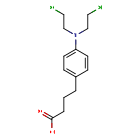
Structure for Chlorambucil (DB00291)

- Weight
- Average: 304.212
Monoisotopic: 303.079284271 - Chemical Formula
- C14H19Cl2NO2
- Synonyms
- 4-(p-bis(beta-chloroethyl)aminophenyl)butyric acid
- 4-(p-bis(β-chloroethyl)aminophenyl)butyric acid
- 4-[p-[bis(2-chloroethyl)amino]phenyl]butyric acid
- Ambochlorin
- Chlorambucil
- Chloraminophen
- Clorambucilo
- gamma-[p-di(2-chloroethyl)aminophenyl]butyric acid
- N,N-di-2-chloroethyl-gamma-p-aminophenylbutyric acid
- N,N-di-2-chloroethyl-γ-p-aminophenylbutyric acid
- Phenylbutyric acid nitrogen mustard
- γ-[p-di(2-chloroethyl)aminophenyl]butyric acid
- External IDs
- CB-1348
- NCI-3088
- NSC-3088

Pharmacology
- Indication
For treatment of chronic lymphatic (lymphocytic) leukemia, childhood minimal-change nephrotic syndrome, and malignant lymphomas including lymphosarcoma, giant follicular lymphoma, Hodgkin's disease, non-Hodgkin's lymphomas, and Waldenström’s Macroglobulinemia.
 Reduce drug development failure ratesBuild, train, & validate machine-learning modelswith evidence-based and structured datasets.Build, train, & validate predictive machine-learning models with structured datasets.
- Associated Conditions
Indication Type Indication Combined Product Details Approval Level Age Group Patient Characteristics Dose Form Treatment of Chronic lymphocytic leukemia •••••••••••• Treatment of Hodgkin's disease •••••••••••• Treatment of Indolent lymphoma •••••••••••• Treatment of Lymphoma, diffuse •••••••••••• Treatment of Malt lymphoma •••••••••••• - Contraindications & Blackbox Warnings
 Prevent Adverse Drug Events TodayTap into our Clinical API for life-saving information on contraindications & blackbox warnings, population restrictions, harmful risks, & more.Avoid life-threatening adverse drug events with our Clinical API
- Pharmacodynamics
Chlorambucil is an antineoplastic in the class of alkylating agents that is used to treat various forms of cancer. Alkylating agents are so named because of their ability to add alkyl groups to many electronegative groups under conditions present in cells. They stop tumor growth by cross-linking guanine bases in DNA double-helix strands - directly attacking DNA. This makes the strands unable to uncoil and separate. As this is necessary in DNA replication, the cells can no longer divide. In addition, these drugs add methyl or other alkyl groups onto molecules where they do not belong which in turn inhibits their correct utilization by base pairing and causes a miscoding of DNA. Alkylating agents are cell cycle-nonspecific. Alkylating agents work by three different mechanisms all of which achieve the same end result - disruption of DNA function and cell death.
- Mechanism of action
Alkylating agents work by three different mechanisms: 1) attachment of alkyl groups to DNA bases, resulting in the DNA being fragmented by repair enzymes in their attempts to replace the alkylated bases, preventing DNA synthesis and RNA transcription from the affected DNA, 2) DNA damage via the formation of cross-links (bonds between atoms in the DNA) which prevents DNA from being separated for synthesis or transcription, and 3) the induction of mispairing of the nucleotides leading to mutations.
Target Actions Organism UDNA cross-linking/alkylationHumans - Absorption
Not Available
- Volume of distribution
Not Available
- Protein binding
99%
- Metabolism
- Not Available
- Route of elimination
Chlorambucil is extensively metabolized in the liver primarily to phenylacetic acid mustard. The pharmacokinetic data suggests that oral chlorambucil undergoes rapid gastrointestinal absorption and plasma clearance and that it is almost completely metabolized, having extremely low urinary excretion.
- Half-life
1.5 hours
- Clearance
Not Available
- Adverse Effects
 Improve decision support & research outcomesWith structured adverse effects data, including: blackbox warnings, adverse reactions, warning & precautions, & incidence rates. View sample adverse effects data in our new Data Library!Improve decision support & research outcomes with our structured adverse effects data.
- Toxicity
Not Available
- Pathways
- Not Available
- Pharmacogenomic Effects/ADRs
- Not Available
Interactions
- Drug Interactions
- This information should not be interpreted without the help of a healthcare provider. If you believe you are experiencing an interaction, contact a healthcare provider immediately. The absence of an interaction does not necessarily mean no interactions exist.
Drug Interaction Integrate drug-drug
interactions in your softwareAbatacept The risk or severity of adverse effects can be increased when Chlorambucil is combined with Abatacept. Abciximab The risk or severity of bleeding can be increased when Abciximab is combined with Chlorambucil. Acenocoumarol The risk or severity of bleeding can be increased when Acenocoumarol is combined with Chlorambucil. Acetazolamide The therapeutic efficacy of Acetazolamide can be decreased when used in combination with Chlorambucil. Acetylsalicylic acid The risk or severity of bleeding can be increased when Acetylsalicylic acid is combined with Chlorambucil. - Food Interactions
- Avoid echinacea. Echinacea should be used with caution, if at all, in patients receiving therapeutic immunosuppressants. Monitor for reduced efficacy of the immunosuppressant during concomitant use.
- Drink plenty of fluids.
- Take on an empty stomach. Co-administration with food decreases bioavailability.
Products
 Drug product information from 10+ global regionsOur datasets provide approved product information including:dosage, form, labeller, route of administration, and marketing period.Access drug product information from over 10 global regions.
- Product Images

- International/Other Brands
- Celkeran (Celon) / Chloraminophène (Techni-Pharma)
- Brand Name Prescription Products
Name Dosage Strength Route Labeller Marketing Start Marketing End Region Image Leukeran Tablet, film coated 2 mg/1 Oral Woodward Pharma Services Llc 2022-06-30 Not applicable US 
Leukeran Tablet, film coated 2 mg/1 Oral Physicians Total Care, Inc. 1985-02-13 2012-06-30 US Leukeran Tablet 2 mg Oral Aspen Pharmacare Canada Inc. 1957-12-31 Not applicable Canada 
Leukeran Tablet, film coated 2 mg/1 Oral Glaxosmithkline Inc 1985-02-13 2014-06-30 US 
Leukeran Tablet, film coated 2 mg/1 Oral Waylis Therapeutics LLC 2023-05-15 Not applicable US - Unapproved/Other Products
Name Ingredients Dosage Route Labeller Marketing Start Marketing End Region Image LEUKERAN 2 MG TABLET, 25 ADET Chlorambucil (2 mg) Tablet Oral VLD DANIŞMANLIK TIBBİ ÜRÜNLER VE TANITIM HİZMETLERİ LTD. ŞTİ. 2018-05-29 Not applicable Turkey 


Categories
- ATC Codes
- L01AA02 — Chlorambucil
- Drug Categories
- Agents that reduce seizure threshold
- Alkylating Activity
- Alkylating Drugs
- Antineoplastic Agents
- Antineoplastic Agents, Alkylating
- Antineoplastic and Immunomodulating Agents
- Hydrocarbons, Halogenated
- Immunosuppressive Agents
- Mustard Compounds
- Myelosuppressive Agents
- Narrow Therapeutic Index Drugs
- Nitrogen Mustard Analogues
- Nitrogen Mustard Compounds
- Noxae
- Toxic Actions
- Chemical TaxonomyProvided by Classyfire
- Description
- This compound belongs to the class of organic compounds known as nitrogen mustard compounds. These are compounds having two beta-haloalkyl groups bound to a nitrogen atom.
- Kingdom
- Organic compounds
- Super Class
- Organic nitrogen compounds
- Class
- Organonitrogen compounds
- Sub Class
- Nitrogen mustard compounds
- Direct Parent
- Nitrogen mustard compounds
- Alternative Parents
- Dialkylarylamines / Aniline and substituted anilines / Amino acids / Monocarboxylic acids and derivatives / Carboxylic acids / Organopnictogen compounds / Organochlorides / Organic oxides / Hydrocarbon derivatives / Carbonyl compounds show 1 more
- Substituents
- Alkyl chloride / Alkyl halide / Amine / Amino acid / Amino acid or derivatives / Aniline or substituted anilines / Aromatic homomonocyclic compound / Benzenoid / Carbonyl group / Carboxylic acid show 14 more
- Molecular Framework
- Aromatic homomonocyclic compounds
- External Descriptors
- tertiary amino compound, monocarboxylic acid, organochlorine compound, aromatic amine, nitrogen mustard (CHEBI:28830)
- Affected organisms
- Humans and other mammals
Chemical Identifiers
- UNII
- 18D0SL7309
- CAS number
- 305-03-3
- InChI Key
- JCKYGMPEJWAADB-UHFFFAOYSA-N
- InChI
- InChI=1S/C14H19Cl2NO2/c15-8-10-17(11-9-16)13-6-4-12(5-7-13)2-1-3-14(18)19/h4-7H,1-3,8-11H2,(H,18,19)
- IUPAC Name
- 4-{4-[bis(2-chloroethyl)amino]phenyl}butanoic acid
- SMILES
- OC(=O)CCCC1=CC=C(C=C1)N(CCCl)CCCl
References
- Synthesis Reference
Phillips, A. P. and Mentha, J.W.; U.S.Patent 3,046,301; July 24, 1962; assigned to Burroughs Wellcome & Co. (U.S.A.) Inc.
US2944079- General References
- Rai KR, Peterson BL, Appelbaum FR, Kolitz J, Elias L, Shepherd L, Hines J, Threatte GA, Larson RA, Cheson BD, Schiffer CA: Fludarabine compared with chlorambucil as primary therapy for chronic lymphocytic leukemia. N Engl J Med. 2000 Dec 14;343(24):1750-7. [Article]
- Yang K, Tan J, Wu T: Alkylating agents for Waldenstrom's macroglobulinaemia. Cochrane Database Syst Rev. 2009 Jan 21;(1):CD006719. doi: 10.1002/14651858.CD006719.pub3. [Article]
- Foon KA, Hallek MJ: Changing paradigms in the treatment of chronic lymphocytic leukemia. Leukemia. 2010 Mar;24(3):500-11. doi: 10.1038/leu.2009.266. Epub 2009 Dec 24. [Article]
- FDA Approved Drug Products: LEUKERAN (chlorambucil) tablets [Link]
- External Links
- Human Metabolome Database
- HMDB0014436
- KEGG Drug
- D00266
- KEGG Compound
- C06900
- PubChem Compound
- 2708
- PubChem Substance
- 46506842
- ChemSpider
- 2607
- BindingDB
- 50003677
- 2346
- ChEBI
- 28830
- ChEMBL
- CHEMBL515
- ZINC
- ZINC000000001115
- Therapeutic Targets Database
- DNC001110
- PharmGKB
- PA448926
- PDBe Ligand
- CBL
- RxList
- RxList Drug Page
- Drugs.com
- Drugs.com Drug Page
- Wikipedia
- Chlorambucil
- PDB Entries
- 3csj
- MSDS
- Download (74.6 KB)
Clinical Trials
- Clinical Trials
Phase Status Purpose Conditions Count 4 Completed Treatment Chronic Lymphocytic Leukemia 1 4 Completed Treatment Uveitis 1 4 Terminated Treatment Chronic Lymphocytic Leukemia 1 3 Active Not Recruiting Treatment B-Cell Chronic Lymphocytic Leukemia 1 3 Active Not Recruiting Treatment Chronic Lymphocytic Leukemia 2
Pharmacoeconomics
- Manufacturers
- Smithkline beecham corp dba glaxosmithkline
- Packagers
- Excella GmbH
- GlaxoSmithKline Inc.
- Physicians Total Care Inc.
- Dosage Forms
Form Route Strength Tablet Oral 2 mg Tablet Oral 2.000 mg Tablet Oral 5 MG Tablet, film coated Oral 2 mg/1 Tablet, film coated Oral Tablet, film coated Oral 2 mg Tablet Oral Pill Tablet, coated Oral 2 mg - Prices
Unit description Cost Unit Leukeran 2 mg tablet 3.92USD tablet DrugBank does not sell nor buy drugs. Pricing information is supplied for informational purposes only.- Patents
- Not Available
Properties
- State
- Solid
- Experimental Properties
Property Value Source melting point (°C) 65 °C PhysProp water solubility 1.24E+004 mg/L Not Available logP 1.70 HANSCH,C ET AL. (1995), pH 7.4 pKa 5.75 HANSCH,C & LEO,AJ (1987) - Predicted Properties
Property Value Source Water Solubility 0.0773 mg/mL ALOGPS logP 3.81 ALOGPS logP 3.94 Chemaxon logS -3.6 ALOGPS pKa (Strongest Acidic) 4.46 Chemaxon pKa (Strongest Basic) 1.72 Chemaxon Physiological Charge -1 Chemaxon Hydrogen Acceptor Count 3 Chemaxon Hydrogen Donor Count 1 Chemaxon Polar Surface Area 40.54 Å2 Chemaxon Rotatable Bond Count 9 Chemaxon Refractivity 79.68 m3·mol-1 Chemaxon Polarizability 31.98 Å3 Chemaxon Number of Rings 1 Chemaxon Bioavailability 1 Chemaxon Rule of Five Yes Chemaxon Ghose Filter Yes Chemaxon Veber's Rule No Chemaxon MDDR-like Rule No Chemaxon - Predicted ADMET Features
Property Value Probability Human Intestinal Absorption + 0.9739 Blood Brain Barrier + 0.7889 Caco-2 permeable + 0.5734 P-glycoprotein substrate Non-substrate 0.6721 P-glycoprotein inhibitor I Non-inhibitor 0.9394 P-glycoprotein inhibitor II Non-inhibitor 0.9222 Renal organic cation transporter Non-inhibitor 0.6185 CYP450 2C9 substrate Non-substrate 0.7651 CYP450 2D6 substrate Non-substrate 0.744 CYP450 3A4 substrate Non-substrate 0.6044 CYP450 1A2 substrate Non-inhibitor 0.9045 CYP450 2C9 inhibitor Non-inhibitor 0.9071 CYP450 2D6 inhibitor Non-inhibitor 0.9231 CYP450 2C19 inhibitor Non-inhibitor 0.909 CYP450 3A4 inhibitor Non-inhibitor 0.8309 CYP450 inhibitory promiscuity Low CYP Inhibitory Promiscuity 0.9576 Ames test AMES toxic 0.9107 Carcinogenicity Non-carcinogens 0.7851 Biodegradation Not ready biodegradable 0.9378 Rat acute toxicity 3.5709 LD50, mol/kg Not applicable hERG inhibition (predictor I) Weak inhibitor 0.6531 hERG inhibition (predictor II) Non-inhibitor 0.8609
Spectra
- Mass Spec (NIST)
- Download (8.25 KB)
- Spectra
- Chromatographic Properties
Collision Cross Sections (CCS)
Adduct CCS Value (Å2) Source type Source [M-H]- 175.7353599 predictedDarkChem Lite v0.1.0 [M-H]- 175.5828599 predictedDarkChem Lite v0.1.0 [M-H]- 162.9834 predictedDeepCCS 1.0 (2019) [M+H]+ 177.3200599 predictedDarkChem Lite v0.1.0 [M+H]+ 175.3856599 predictedDarkChem Lite v0.1.0 [M+H]+ 165.3414 predictedDeepCCS 1.0 (2019) [M+Na]+ 176.2628599 predictedDarkChem Lite v0.1.0 [M+Na]+ 176.1770599 predictedDarkChem Lite v0.1.0 [M+Na]+ 171.43454 predictedDeepCCS 1.0 (2019)
Targets

References
- Begleiter A, Mowat M, Israels LG, Johnston JB: Chlorambucil in chronic lymphocytic leukemia: mechanism of action. Leuk Lymphoma. 1996 Oct;23(3-4):187-201. [Article]
- Kashiwazaki G, Bando T, Shinohara K, Minoshima M, Kumamoto H, Nishijima S, Sugiyama H: Alkylation of a human telomere sequence by heterotrimeric chlorambucil PI polyamide conjugates. Bioorg Med Chem. 2010 Apr 15;18(8):2887-93. doi: 10.1016/j.bmc.2010.03.011. Epub 2010 Mar 10. [Article]
- Bielawska A, Bielawski K, Muszynska A: Synthesis and biological evaluation of new cyclic amidine analogs of chlorambucil. Farmaco. 2004 Feb;59(2):111-7. [Article]
- Minoshima M, Bando T, Shinohara K, Sugiyama H: Molecular design of sequence specific DNA alkylating agents. Nucleic Acids Symp Ser (Oxf). 2009;(53):69-70. doi: 10.1093/nass/nrp035. [Article]
Enzymes
- Kind
- Protein
- Organism
- Humans
- Pharmacological action
- Unknown
- Actions
- Substrate
- General Function
- S-nitrosoglutathione binding
- Specific Function
- Conjugation of reduced glutathione to a wide number of exogenous and endogenous hydrophobic electrophiles. Regulates negatively CDK5 activity via p25/p35 translocation to prevent neurodegeneration.
- Gene Name
- GSTP1
- Uniprot ID
- P09211
- Uniprot Name
- Glutathione S-transferase P
- Molecular Weight
- 23355.625 Da
References
- Parker LJ, Ciccone S, Italiano LC, Primavera A, Oakley AJ, Morton CJ, Hancock NC, Bello ML, Parker MW: The anti-cancer drug chlorambucil as a substrate for the human polymorphic enzyme glutathione transferase P1-1: kinetic properties and crystallographic characterisation of allelic variants. J Mol Biol. 2008 Jun 27;380(1):131-44. doi: 10.1016/j.jmb.2008.04.066. Epub 2008 May 4. [Article]
- Zhang J, Lou YJ: Relationship between activation of microsomal glutathione S-transferase and metabolism behavior of chlorambucil. Pharmacol Res. 2003 Dec;48(6):623-30. [Article]
- Kind
- Protein group
- Organism
- Humans
- Pharmacological action
- Unknown
- Actions
- Substrate
- General Function
- Glutathione transferase activity
- Specific Function
- Conjugation of reduced glutathione to a wide number of exogenous and endogenous hydrophobic electrophiles.
Components:
References
- Zhang K, Wong KP: Active transport of glutathione S-conjugate in human colon adenocarcinoma cells. Cancer Lett. 1996 Nov 12;108(1):143-51. doi: 10.1016/s0304-3835(96)04457-6. [Article]
Transporters
- Kind
- Protein
- Organism
- Humans
- Pharmacological action
- Unknown
- General Function
- Sodium-independent organic anion transmembrane transporter activity
- Specific Function
- Mediates the Na(+)-independent transport of organic anions such as sulfobromophthalein (BSP) and conjugated (taurocholate) and unconjugated (cholate) bile acids (By similarity). Selectively inhibit...
- Gene Name
- SLCO1A2
- Uniprot ID
- P46721
- Uniprot Name
- Solute carrier organic anion transporter family member 1A2
- Molecular Weight
- 74144.105 Da
References
- Kullak-Ublick GA, Glasa J, Boker C, Oswald M, Grutzner U, Hagenbuch B, Stieger B, Meier PJ, Beuers U, Kramer W, Wess G, Paumgartner G: Chlorambucil-taurocholate is transported by bile acid carriers expressed in human hepatocellular carcinomas. Gastroenterology. 1997 Oct;113(4):1295-305. [Article]


Drug created at June 13, 2005 13:24 / Updated at April 23, 2024 11:38