Identification
- Summary
Chlorzoxazone is a drug with muscle relaxant properties that is used as an adjunct to physical therapy and analgesics to treat stiffness and pain caused by a variety of musculoskeletal conditions.
- Brand Names
- Lorzone, Parafon Forte
- Generic Name
- Chlorzoxazone
- DrugBank Accession Number
- DB00356
- Background
A centrally acting central muscle relaxant with sedative properties. It is claimed to inhibit muscle spasm by exerting an effect primarily at the level of the spinal cord and subcortical areas of the brain. (From Martindale, The Extra Pharmacopoea, 30th ed, p1202)
- Type
- Small Molecule
- Groups
- Approved
- Structure
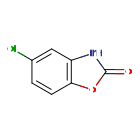
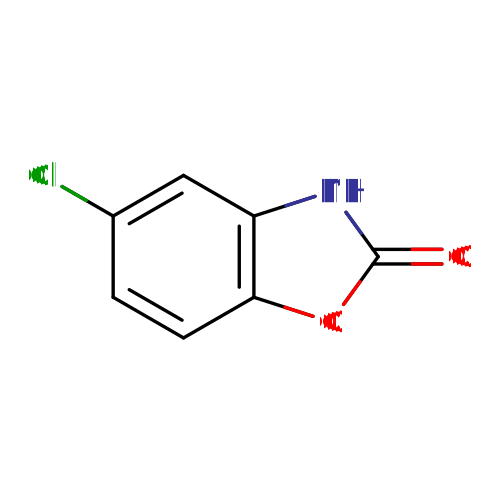
Structure for Chlorzoxazone (DB00356)
- Weight
- Average: 169.565
Monoisotopic: 168.993056084 - Chemical Formula
- C7H4ClNO2
- Synonyms
- 2-hydroxy-5-chlorobenzoxazole
- 5-chloro-2-benzoxazolinone
- 5-chloro-2-benzoxazolol
- 5-chloro-2-benzoxazolone
- 5-chloro-2-hydroxybenzoxazole
- 5-chloro-2(3H)-benzoxazolone
- 5-chloro-3H-benzooxazol-2-one
- 5-chlorobenzoxazolidone
- 5-chlorobenzoxazolin-2-one
- Chlorzoxane
- Chlorzoxazon
- Chlorzoxazona
- Chlorzoxazone
- Chlorzoxazonum
- Clorzoxazona
- Clorzoxazone
- External IDs
- MI 315
- USAF MA-10

Pharmacology
- Indication
For the relief of discomfort associated with acute painful musculoskeletal conditions.
 Reduce drug development failure ratesBuild, train, & validate machine-learning modelswith evidence-based and structured datasets.Build, train, & validate predictive machine-learning models with structured datasets.
- Associated Conditions
Indication Type Indication Combined Product Details Approval Level Age Group Patient Characteristics Dose Form Adjunct therapy in management of Acute painful musculoskeletal conditions •••••••••••• •••••• - Contraindications & Blackbox Warnings
 Prevent Adverse Drug Events TodayTap into our Clinical API for life-saving information on contraindications & blackbox warnings, population restrictions, harmful risks, & more.Avoid life-threatening adverse drug events with our Clinical API
- Pharmacodynamics
Chlorzoxazone is a centrally-acting agent for painful musculoskeletal conditions. Data available from animal experiments as well as human study indicate that chlorzoxazone acts primarily at the level of the spinal cord and subcortical areas of the brain where it inhibits multisynaptic reflex a.c. involved in producing and maintaining skeletal muscle spasm of varied etiology. The clinical result is a reduction of the skeletal muscle spasm with relief of pain and increased mobility of the involved muscles.
- Mechanism of action
Chlorzoxazone inhibits degranulation of mast cells, subsequently preventing the release of histamine and slow-reacting substance of anaphylaxis (SRS-A), mediators of type I allergic reactions. Chlorzoxazone also may reduce the release of inflammatory leukotrienes. Chlorzoxazone may act by inhibiting calcium and potassium influx which would lead to neuronal inhibition and muscle relaxation. Data available from animal experiments as well as human study indicate that chlorzoxazone acts primarily at the level of the spinal cord and subcortical areas of the brain where it inhibits multisynaptic reflex arcs involved in producing and maintaining skeletal muscle spasm
Target Actions Organism ACalcium-activated potassium channel subunit alpha-1 Not Available Humans - Absorption
Not Available
- Volume of distribution
Not Available
- Protein binding
13-18%
- Metabolism
Chlorzoxazone is rapidly metabolized in the liver and is excreted in the urine, primarily in a conjugated form as the glucuronide.
Hover over products below to view reaction partners
- Route of elimination
Chlorzoxazone is rapidly metabolized and is excreted in the urine, primarily in a conjugated form as the glucuronide.
- Half-life
Not Available
- Clearance
Not Available
- Adverse Effects
 Improve decision support & research outcomesWith structured adverse effects data, including: blackbox warnings, adverse reactions, warning & precautions, & incidence rates. View sample adverse effects data in our new Data Library!Improve decision support & research outcomes with our structured adverse effects data.
- Toxicity
Oral, mouse: LD50 = 440 mg/kg; Oral, rat: LD50 = 763 mg/kg; Symptoms of overdose include diarrhea, dizziness, drowsiness, headache, light-headedness, nausea, and vomiting.
- Pathways
- Not Available
- Pharmacogenomic Effects/ADRs
- Not Available
Interactions
- Drug Interactions
- This information should not be interpreted without the help of a healthcare provider. If you believe you are experiencing an interaction, contact a healthcare provider immediately. The absence of an interaction does not necessarily mean no interactions exist.
Drug Interaction Integrate drug-drug
interactions in your software1,2-Benzodiazepine The risk or severity of CNS depression can be increased when Chlorzoxazone is combined with 1,2-Benzodiazepine. Abacavir Chlorzoxazone may decrease the excretion rate of Abacavir which could result in a higher serum level. Abametapir The serum concentration of Chlorzoxazone can be increased when it is combined with Abametapir. Abatacept The metabolism of Chlorzoxazone can be increased when combined with Abatacept. Abiraterone The serum concentration of Chlorzoxazone can be increased when it is combined with Abiraterone. - Food Interactions
- Avoid alcohol.
- Take with or without food. The absorption is unaffected by food.
Products
 Drug product information from 10+ global regionsOur datasets provide approved product information including:dosage, form, labeller, route of administration, and marketing period.Access drug product information from over 10 global regions.
- Product Images
- International/Other Brands
- Myoflexin (Zentiva) / Paraflex (BioPhausia) / Relaxazone / Remular / Remular-S / Solaxin (Eisai) / Strifon Forte DSC
- Brand Name Prescription Products
Name Dosage Strength Route Labeller Marketing Start Marketing End Region Image Parafon Forte Tablet 500 mg/1 Oral Ortho-McNeil Pharmaceutical, Inc. 1958-08-15 2013-05-31 US 
Parafon Forte DSC Tablet 500 mg/1 Oral Remedy Repack 2016-11-07 2016-11-07 US Parafon Forte DSC Tablet 500 mg/1 Oral Janssen Pharmaceuticals 1987-06-15 2017-10-31 US - Generic Prescription Products
Name Dosage Strength Route Labeller Marketing Start Marketing End Region Image Chlorzoxazone Tablet 750 mg/1 Oral Trupharma, Llc 2020-10-12 Not applicable US Chlorzoxazone Tablet 750 mg/1 Oral Rising Pharma Holdings, Inc. 2022-04-05 Not applicable US Chlorzoxazone Tablet 250 mg/1 Oral Mikart, LLC 2016-06-24 Not applicable US Chlorzoxazone Tablet 750 mg/1 Oral Glenmark Pharmaceuticals Inc., USA 2020-05-26 2022-09-01 US Chlorzoxazone Tablet 500 mg/1 Oral A-S Medication Solutions 2019-09-12 Not applicable US - Mixture Products
Name Ingredients Dosage Route Labeller Marketing Start Marketing End Region Image Acetazone Forte Chlorzoxazone (250 mg) + Acetaminophen (300 mg) Tablet Oral TEVA Canada Limited 1991-12-31 2018-03-20 Canada 
Acetazone Forte C8 Chlorzoxazone (250 mg) + Acetaminophen (300 mg) + Codeine phosphate (8 mg) Tablet Oral TEVA Canada Limited 1991-12-31 Not applicable Canada Back-aid Forte - Tab Chlorzoxazone (250 mg) + Acetaminophen (300 mg) Tablet Oral Rougier Pharma Division Of Ratiopharm Inc 1995-12-31 2015-10-01 Canada Extra Strength Tylenol Aches and Strains Chlorzoxazone (250 mg) + Acetaminophen (500 mg) Tablet Oral Mcneil Consumer Healthcare Division Of Johnson & Johnson Inc 1996-12-31 2008-08-07 Canada Gin Pain Pills - Tab Chlorzoxazone (250 mg) + Acetaminophen (300 mg) Tablet Oral Stella Pharmaceutical Canada Inc. 1996-09-05 2002-07-05 Canada


Categories
- ATC Codes
- M03BB03 — Chlorzoxazone
- M03BB — Oxazol, thiazine, and triazine derivatives
- M03B — MUSCLE RELAXANTS, CENTRALLY ACTING AGENTS
- M03 — MUSCLE RELAXANTS
- M — MUSCULO-SKELETAL SYSTEM
- M03BB — Oxazol, thiazine, and triazine derivatives
- M03B — MUSCLE RELAXANTS, CENTRALLY ACTING AGENTS
- M03 — MUSCLE RELAXANTS
- M — MUSCULO-SKELETAL SYSTEM
- Drug Categories
- Benzoxazoles and derivatives
- Central Nervous System Agents
- Central Nervous System Depressants
- Centrally-mediated Muscle Relaxation
- Cytochrome P-450 CYP1A2 Substrates
- Cytochrome P-450 CYP2A6 Substrates
- Cytochrome P-450 CYP2D6 Substrates
- Cytochrome P-450 CYP2E1 Inhibitors
- Cytochrome P-450 CYP2E1 Inhibitors (strength unknown)
- Cytochrome P-450 CYP2E1 Substrates
- Cytochrome P-450 CYP3A Inhibitors
- Cytochrome P-450 CYP3A Substrates
- Cytochrome P-450 CYP3A4 Inhibitors
- Cytochrome P-450 CYP3A4 Inhibitors (weak)
- Cytochrome P-450 CYP3A4 Substrates
- Cytochrome P-450 Enzyme Inhibitors
- Cytochrome P-450 Substrates
- Drugs that are Mainly Renally Excreted
- Heterocyclic Compounds, Fused-Ring
- Muscle Relaxants
- Muscle Relaxants, Centrally Acting Agents
- Musculo-Skeletal System
- Oxazol, Thiazine, and Triazine Derivatives
- Peripheral Nervous System Agents
- Chemical TaxonomyProvided by Classyfire
- Description
- This compound belongs to the class of organic compounds known as benzoxazolones. These are organic compounds containing a benzene fused to an oxazole ring (a five-member aliphatic ring with three carbon atoms, one oxygen atom, and one nitrogen atom) bearing a ketone group.
- Kingdom
- Organic compounds
- Super Class
- Organoheterocyclic compounds
- Class
- Benzoxazoles
- Sub Class
- Benzoxazolones
- Direct Parent
- Benzoxazolones
- Alternative Parents
- Benzenoids / Aryl chlorides / Oxazoles / Heteroaromatic compounds / Oxacyclic compounds / Azacyclic compounds / Organopnictogen compounds / Organooxygen compounds / Organonitrogen compounds / Organochlorides show 2 more
- Substituents
- Aromatic heteropolycyclic compound / Aryl chloride / Aryl halide / Azacycle / Azole / Benzenoid / Benzoxazolone / Heteroaromatic compound / Hydrocarbon derivative / Organic nitrogen compound show 9 more
- Molecular Framework
- Aromatic heteropolycyclic compounds
- External Descriptors
- 1,3-benzoxazoles, organochlorine compound, heteroaryl hydroxy compound (CHEBI:3655)
- Affected organisms
- Humans and other mammals
Chemical Identifiers
- UNII
- H0DE420U8G
- CAS number
- 95-25-0
- InChI Key
- TZFWDZFKRBELIQ-UHFFFAOYSA-N
- InChI
- InChI=1S/C7H4ClNO2/c8-4-1-2-6-5(3-4)9-7(10)11-6/h1-3H,(H,9,10)
- IUPAC Name
- 5-chloro-2,3-dihydro-1,3-benzoxazol-2-one
- SMILES
- ClC1=CC2=C(OC(=O)N2)C=C1
References
- Synthesis Reference
Marsh, D.F.; US. Patent 2,895,877; July 21, 1959; assigned to McNeil Laboratories, Inc.
- General References
- Dong DL, Luan Y, Feng TM, Fan CL, Yue P, Sun ZJ, Gu RM, Yang BF: Chlorzoxazone inhibits contraction of rat thoracic aorta. Eur J Pharmacol. 2006 Sep 18;545(2-3):161-6. Epub 2006 Jun 29. [Article]
- Park JY, Kim KA, Park PW, Ha JM: Effect of high-dose aspirin on CYP2E1 activity in healthy subjects measured using chlorzoxazone as a probe. J Clin Pharmacol. 2006 Jan;46(1):109-14. [Article]
- Wan J, Ernstgard L, Song BJ, Shoaf SE: Chlorzoxazone metabolism is increased in fasted Sprague-Dawley rats. J Pharm Pharmacol. 2006 Jan;58(1):51-61. [Article]
- External Links
- Human Metabolome Database
- HMDB0014500
- KEGG Drug
- D00771
- KEGG Compound
- C07931
- PubChem Compound
- 2733
- PubChem Substance
- 46507755
- ChemSpider
- 2632
- BindingDB
- 50290811
- 2410
- ChEBI
- 3655
- ChEMBL
- CHEMBL1371
- ZINC
- ZINC000084843283
- Therapeutic Targets Database
- DAP000952
- PharmGKB
- PA448971
- Guide to Pharmacology
- GtP Drug Page
- PDBe Ligand
- CLW
- RxList
- RxList Drug Page
- Drugs.com
- Drugs.com Drug Page
- PDRhealth
- PDRhealth Drug Page
- Wikipedia
- Chlorzoxazone
- PDB Entries
- 1m8d / 1m9j / 5row / 5rvi / 7nhw / 8i2l
- MSDS
- Download (61.8 KB)
Clinical Trials
- Clinical Trials
Phase Status Purpose Conditions Count 4 Completed Basic Science Alcohol Abuse 1 4 Completed Basic Science Type 2 Diabetes Mellitus 1 4 Completed Treatment Chlorzoxazone / Postoperative pain 1 4 Completed Treatment Osteoarthritis in the Hip Joint / Osteoarthritis of the Knee 1 1 Completed Basic Science Drug Drug Interaction (DDI) 1
Pharmacoeconomics
- Manufacturers
- Actavis totowa llc
- Barr laboratories inc
- Mikart inc
- Mutual pharmaceutical co inc
- Ohm laboratories inc
- Par pharmaceutical inc
- Pioneer pharmaceuticals inc
- Sandoz inc
- Watson laboratories inc
- Ortho mcneil pharmaceutical inc
- Ortho mcneil janssen pharmaceuticals inc
- Ferndale laboratories inc
- Packagers
- A-S Medication Solutions LLC
- Barr Pharmaceuticals
- Bryant Ranch Prepack
- Deliz Pharmaceutical Corp.
- Direct Dispensing Inc.
- Dispensing Solutions
- Diversified Healthcare Services Inc.
- H.J. Harkins Co. Inc.
- Innoviant Pharmacy Inc.
- International Ethical Labs Inc.
- Janssen-Ortho Inc.
- Keltman Pharmaceuticals Inc.
- Lake Erie Medical and Surgical Supply
- Major Pharmaceuticals
- McNeil Laboratories
- Murfreesboro Pharmaceutical Nursing Supply
- Nucare Pharmaceuticals Inc.
- Ortho-McNeil-Janssen Pharmaceuticals Inc.
- Palmetto Pharmaceuticals Inc.
- Par Pharmaceuticals
- PCA LLC
- PD-Rx Pharmaceuticals Inc.
- Pharmaceutical Utilization Management Program VA Inc.
- Physicians Total Care Inc.
- Preferred Pharmaceuticals Inc.
- Prepackage Specialists
- Prescript Pharmaceuticals
- Rebel Distributors Corp.
- Redpharm Drug
- Scruggs Pharmacal Co. Inc.
- Southwood Pharmaceuticals
- Stat Rx Usa
- Teva Pharmaceutical Industries Ltd.
- UDL Laboratories
- United Research Laboratories Inc.
- Watson Pharmaceuticals
- Dosage Forms
Form Route Strength Tablet Occlusive dressing technique 500 mg/1 Tablet Oral 250 mg/1 Tablet Oral 500 mg/1 Tablet Oral 750 mg/1 Tablet, orally disintegrating Oral 250 mg/1 Capsule, liquid filled Oral Tablet Oral 375 mg/1 Tablet 250 mg Tablet Oral Tablet Oral 250.000 mg Tablet - Prices
Unit description Cost Unit Parafon forte dsc 500 mg caplet 2.65USD caplet Chlorzoxazone 500 mg tablet 0.87USD tablet Chlorzoxazone 250 mg tablet 0.18USD tablet DrugBank does not sell nor buy drugs. Pricing information is supplied for informational purposes only.- Patents
- Not Available
Properties
- State
- Solid
- Experimental Properties
Property Value Source melting point (°C) 191-191.5 Marsh, D.F.; US. Patent 2,895,877; July 21, 1959; assigned to McNeil Laboratories, Inc. water solubility 1000 mg/L Not Available logP 1.6 Not Available - Predicted Properties
Property Value Source Water Solubility 2.96 mg/mL ALOGPS logP 2.09 ALOGPS logP 1.94 Chemaxon logS -1.8 ALOGPS pKa (Strongest Acidic) 9.39 Chemaxon pKa (Strongest Basic) -2.2 Chemaxon Physiological Charge 0 Chemaxon Hydrogen Acceptor Count 2 Chemaxon Hydrogen Donor Count 1 Chemaxon Polar Surface Area 38.33 Å2 Chemaxon Rotatable Bond Count 0 Chemaxon Refractivity 41.07 m3·mol-1 Chemaxon Polarizability 14.94 Å3 Chemaxon Number of Rings 2 Chemaxon Bioavailability 1 Chemaxon Rule of Five Yes Chemaxon Ghose Filter No Chemaxon Veber's Rule Yes Chemaxon MDDR-like Rule No Chemaxon - Predicted ADMET Features
Property Value Probability Human Intestinal Absorption + 1.0 Blood Brain Barrier + 0.991 Caco-2 permeable + 0.5 P-glycoprotein substrate Non-substrate 0.8733 P-glycoprotein inhibitor I Non-inhibitor 0.9784 P-glycoprotein inhibitor II Non-inhibitor 0.9263 Renal organic cation transporter Non-inhibitor 0.9001 CYP450 2C9 substrate Non-substrate 0.8243 CYP450 2D6 substrate Substrate 0.6471 CYP450 3A4 substrate Non-substrate 0.5372 CYP450 1A2 substrate Inhibitor 0.9107 CYP450 2C9 inhibitor Non-inhibitor 0.9539 CYP450 2D6 inhibitor Non-inhibitor 0.9338 CYP450 2C19 inhibitor Non-inhibitor 0.9025 CYP450 3A4 inhibitor Non-inhibitor 0.9522 CYP450 inhibitory promiscuity Low CYP Inhibitory Promiscuity 0.8682 Ames test Non AMES toxic 0.7957 Carcinogenicity Non-carcinogens 0.9467 Biodegradation Not ready biodegradable 0.9655 Rat acute toxicity 2.2388 LD50, mol/kg Not applicable hERG inhibition (predictor I) Weak inhibitor 0.8675 hERG inhibition (predictor II) Non-inhibitor 0.9659
Spectra
- Mass Spec (NIST)
- Not Available
- Spectra
- Chromatographic Properties
Collision Cross Sections (CCS)
Adduct CCS Value (Å2) Source type Source [M-H]- 123.9263653 predictedDarkChem Lite v0.1.0 [M-H]- 130.57915 predictedDeepCCS 1.0 (2019) [M+H]+ 124.6511653 predictedDarkChem Lite v0.1.0 [M+H]+ 133.76369 predictedDeepCCS 1.0 (2019) [M+Na]+ 124.1420653 predictedDarkChem Lite v0.1.0 [M+Na]+ 143.04436 predictedDeepCCS 1.0 (2019)
Targets

- Kind
- Protein
- Organism
- Humans
- Pharmacological action
- Yes
- General Function
- Voltage-gated potassium channel activity
- Specific Function
- Potassium channel activated by both membrane depolarization or increase in cytosolic Ca(2+) that mediates export of K(+). It is also activated by the concentration of cytosolic Mg(2+). Its activati...
- Gene Name
- KCNMA1
- Uniprot ID
- Q12791
- Uniprot Name
- Calcium-activated potassium channel subunit alpha-1
- Molecular Weight
- 137558.115 Da
References
- Dong DL, Luan Y, Feng TM, Fan CL, Yue P, Sun ZJ, Gu RM, Yang BF: Chlorzoxazone inhibits contraction of rat thoracic aorta. Eur J Pharmacol. 2006 Sep 18;545(2-3):161-6. Epub 2006 Jun 29. [Article]
- Alvina K, Khodakhah K: KCa channels as therapeutic targets in episodic ataxia type-2. J Neurosci. 2010 May 26;30(21):7249-57. doi: 10.1523/JNEUROSCI.6341-09.2010. [Article]
- Syme CA, Gerlach AC, Singh AK, Devor DC: Pharmacological activation of cloned intermediate- and small-conductance Ca(2+)-activated K(+) channels. Am J Physiol Cell Physiol. 2000 Mar;278(3):C570-81. [Article]
Enzymes
- Kind
- Protein
- Organism
- Humans
- Pharmacological action
- Unknown
- Actions
- SubstrateInhibitor
- General Function
- Steroid hydroxylase activity
- Specific Function
- Metabolizes several precarcinogens, drugs, and solvents to reactive metabolites. Inactivates a number of drugs and xenobiotics and also bioactivates many xenobiotic substrates to their hepatotoxic ...
- Gene Name
- CYP2E1
- Uniprot ID
- P05181
- Uniprot Name
- Cytochrome P450 2E1
- Molecular Weight
- 56848.42 Da
References
- Pelkonen O, Maenpaa J, Taavitsainen P, Rautio A, Raunio H: Inhibition and induction of human cytochrome P450 (CYP) enzymes. Xenobiotica. 1998 Dec;28(12):1203-53. [Article]
- Kurata N, Nishimura Y, Iwase M, Fischer NE, Tang BK, Inaba T, Yasuhara H: Trimethadione metabolism by human liver cytochrome P450: evidence for the involvement of CYP2E1. Xenobiotica. 1998 Nov;28(11):1041-7. [Article]
- Ernstgard L, Warholm M, Johanson G: Robustness of chlorzoxazone as an in vivo measure of cytochrome P450 2E1 activity. Br J Clin Pharmacol. 2004 Aug;58(2):190-200. [Article]
- Flockhart Table of Drug Interactions [Link]
- Kind
- Protein
- Organism
- Humans
- Pharmacological action
- Unknown
- Actions
- Substrate
- General Function
- Vitamin d 24-hydroxylase activity
- Specific Function
- Cytochromes P450 are a group of heme-thiolate monooxygenases. In liver microsomes, this enzyme is involved in an NADPH-dependent electron transport pathway. It oxidizes a variety of structurally un...
- Gene Name
- CYP1A1
- Uniprot ID
- P04798
- Uniprot Name
- Cytochrome P450 1A1
- Molecular Weight
- 58164.815 Da
References
- Wiercinska P, Squires EJ: Chlorzoxazone metabolism by porcine cytochrome P450 enzymes and the effect of cytochrome b5. Drug Metab Dispos. 2010 May;38(5):857-62. doi: 10.1124/dmd.109.030528. Epub 2010 Feb 17. [Article]
- Warrington JS, Court MH, Greenblatt DJ, von Moltke LL: Phenacetin and chlorzoxazone biotransformation in aging male Fischer 344 rats. J Pharm Pharmacol. 2004 Jun;56(6):819-25. [Article]
- Kind
- Protein
- Organism
- Humans
- Pharmacological action
- Unknown
- Actions
- Substrate
- General Function
- Oxidoreductase activity, acting on paired donors, with incorporation or reduction of molecular oxygen, reduced flavin or flavoprotein as one donor, and incorporation of one atom of oxygen
- Specific Function
- Cytochromes P450 are a group of heme-thiolate monooxygenases. In liver microsomes, this enzyme is involved in an NADPH-dependent electron transport pathway. It oxidizes a variety of structurally un...
- Gene Name
- CYP1A2
- Uniprot ID
- P05177
- Uniprot Name
- Cytochrome P450 1A2
- Molecular Weight
- 58293.76 Da
References
- Yang TJ, Sai Y, Krausz KW, Gonzalez FJ, Gelboin HV: Inhibitory monoclonal antibodies to human cytochrome P450 1A2: analysis of phenacetin O-deethylation in human liver. Pharmacogenetics. 1998 Oct;8(5):375-82. [Article]
- Ono S, Hatanaka T, Hotta H, Tsutsui M, Satoh T, Gonzalez FJ: Chlorzoxazone is metabolized by human CYP1A2 as well as by human CYP2E1. Pharmacogenetics. 1995 Jun;5(3):143-50. [Article]
- Kind
- Protein
- Organism
- Humans
- Pharmacological action
- Unknown
- Actions
- Substrate
- General Function
- Steroid hydroxylase activity
- Specific Function
- Exhibits a high coumarin 7-hydroxylase activity. Can act in the hydroxylation of the anti-cancer drugs cyclophosphamide and ifosphamide. Competent in the metabolic activation of aflatoxin B1. Const...
- Gene Name
- CYP2A6
- Uniprot ID
- P11509
- Uniprot Name
- Cytochrome P450 2A6
- Molecular Weight
- 56501.005 Da
References
- Shimada T, Tsumura F, Yamazaki H: Prediction of human liver microsomal oxidations of 7-ethoxycoumarin and chlorzoxazone with kinetic parameters of recombinant cytochrome P-450 enzymes. Drug Metab Dispos. 1999 Nov;27(11):1274-80. [Article]
- Hukkanen J, Jacob Iii P, Peng M, Dempsey D, Benowitz NL: Effects of nicotine on cytochrome P450 2A6 and 2E1 activities. Br J Clin Pharmacol. 2010 Feb;69(2):152-9. doi: 10.1111/j.1365-2125.2009.03568.x. [Article]
- Soucek P: Expression of cytochrome P450 2A6 in Escherichia coli: purification, spectral and catalytic characterization, and preparation of polyclonal antibodies. Arch Biochem Biophys. 1999 Oct 15;370(2):190-200. doi: 10.1006/abbi.1999.1388. [Article]
- Kind
- Protein
- Organism
- Humans
- Pharmacological action
- Unknown
- Actions
- SubstrateInhibitor
- Curator comments
- The FDA document attached suggests that this drug is a weak CYP3A inhibitor.
- General Function
- Vitamin d3 25-hydroxylase activity
- Specific Function
- Cytochromes P450 are a group of heme-thiolate monooxygenases. In liver microsomes, this enzyme is involved in an NADPH-dependent electron transport pathway. It performs a variety of oxidation react...
- Gene Name
- CYP3A4
- Uniprot ID
- P08684
- Uniprot Name
- Cytochrome P450 3A4
- Molecular Weight
- 57342.67 Da
References
- Gorski JC, Jones DR, Wrighton SA, Hall SD: Contribution of human CYP3A subfamily members to the 6-hydroxylation of chlorzoxazone. Xenobiotica. 1997 Mar;27(3):243-56. [Article]
- Wiercinska P, Squires EJ: Chlorzoxazone metabolism by porcine cytochrome P450 enzymes and the effect of cytochrome b5. Drug Metab Dispos. 2010 May;38(5):857-62. doi: 10.1124/dmd.109.030528. Epub 2010 Feb 17. [Article]
- Gurley BJ, Gardner SF, Hubbard MA, Williams DK, Gentry WB, Cui Y, Ang CY: Cytochrome P450 phenotypic ratios for predicting herb-drug interactions in humans. Clin Pharmacol Ther. 2002 Sep;72(3):276-87. doi: 10.1067/mcp.2002.126913. [Article]
- FDA Drug Development and Drug Interactions: Table of Substrates, Inhibitors and Inducers [Link]
- Kind
- Protein
- Organism
- Humans
- Pharmacological action
- Unknown
- Actions
- Substrate
- General Function
- Steroid hydroxylase activity
- Specific Function
- Responsible for the metabolism of many drugs and environmental chemicals that it oxidizes. It is involved in the metabolism of drugs such as antiarrhythmics, adrenoceptor antagonists, and tricyclic...
- Gene Name
- CYP2D6
- Uniprot ID
- P10635
- Uniprot Name
- Cytochrome P450 2D6
- Molecular Weight
- 55768.94 Da
References
- Shimada T, Tsumura F, Yamazaki H: Prediction of human liver microsomal oxidations of 7-ethoxycoumarin and chlorzoxazone with kinetic parameters of recombinant cytochrome P-450 enzymes. Drug Metab Dispos. 1999 Nov;27(11):1274-80. [Article]
- Gorski JC, Jones DR, Wrighton SA, Hall SD: Contribution of human CYP3A subfamily members to the 6-hydroxylation of chlorzoxazone. Xenobiotica. 1997 Mar;27(3):243-56. [Article]

Drug created at June 13, 2005 13:24 / Updated at March 03, 2024 02:24