Identification
- Summary
Valrubicin is an anthracycline used intravesically in the treatment of BCG-resistant bladder carcinoma.
- Brand Names
- Valstar
- Generic Name
- Valrubicin
- DrugBank Accession Number
- DB00385
- Background
Valrubicin (N-trifluoroacetyladriamycin-14-valerate) is a chemotherapy drug commonly marketed under the trade name VALSTAR. It is a semisynthetic analog of the doxorubicin, which is an anthracycline drug. Used in the treatment of the bladder cancer, valrubicin is administered by direct infusion into the bladder.
- Type
- Small Molecule
- Groups
- Approved
- Structure
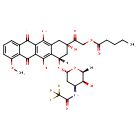
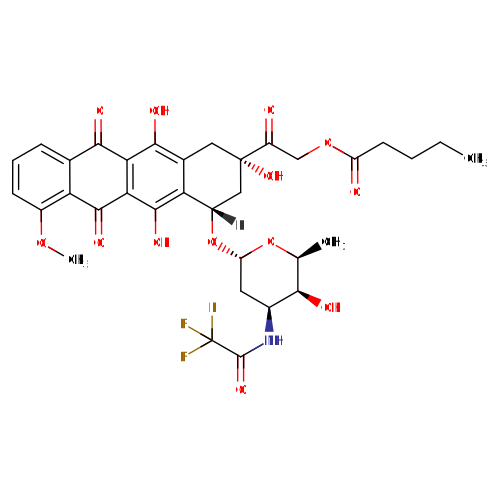
Structure for Valrubicin (DB00385)
- Weight
- Average: 723.651
Monoisotopic: 723.213874712 - Chemical Formula
- C34H36F3NO13
- Synonyms
- (8S, 10S)-8-glycoloyl-7,8,9,10-tetrahydro-6,8,11-trihydroxy-1-methoxy-10-[[2,3,6-trideoxy-3-(2,2,2-trifluoroacetamido)-α-L-lyxo-hexopyranosyl]oxy]-5,12-naphthacenedione 8²-valerate
- 2-oxo-2-[(2S,4S)-2,5,12-trihydroxy-7-methoxy-6,11-dioxo-4-({2,3,6-trideoxy-3-[(trifluoroacetyl)amino]hexopyranosyl}oxy)-1,2,3,4,6,11-hexahydrotetracen-2-yl]ethyl pentanoate
- Valrubicin
- Valrubicina
- Valrubicine
- Valrubicinum
- External IDs
- AD 32
- AD-32
- NSC 246131
- NSC-246131

Pharmacology
- Indication
For the treatment of cancer of the bladder.
 Reduce drug development failure ratesBuild, train, & validate machine-learning modelswith evidence-based and structured datasets.Build, train, & validate predictive machine-learning models with structured datasets.
- Associated Conditions
Indication Type Indication Combined Product Details Approval Level Age Group Patient Characteristics Dose Form Treatment of In situ bcg-refractory bladder carcinoma •••••••••••• •••••••• - Contraindications & Blackbox Warnings
 Prevent Adverse Drug Events TodayTap into our Clinical API for life-saving information on contraindications & blackbox warnings, population restrictions, harmful risks, & more.Avoid life-threatening adverse drug events with our Clinical API
- Pharmacodynamics
Valrubicin is an anticancer agent.
- Mechanism of action
Valrubicin is an anthracycline that affects a variety of inter-related biological functions, most of which involve nucleic acid metabolism. It readily penetrates into cells, where after DNA intercalation, it inhibits the incorporation of nucleosides into nucleic acids, causes extensive chromosomal damage, and arrests cell cycle in G2. Although valrubicin does not bind strongly to DNA, a principal mechanism of its action, mediated by valrubicin metabolites, is interference with the normal DNA breaking-resealing action of DNA topoisomerase II.
Target Actions Organism ADNA intercalationHumans ADNA topoisomerase 2-alpha inhibitorHumans - Absorption
Not Available
- Volume of distribution
Not Available
- Protein binding
>99%
- Metabolism
Valrubicin is metabolized to two primary metabolites: N-trifluoroacetyladriamycin and N-trifluoroacetyladriamycinol.
Hover over products below to view reaction partners
- Route of elimination
Not Available
- Half-life
Not Available
- Clearance
Not Available
- Adverse Effects
 Improve decision support & research outcomesWith structured adverse effects data, including: blackbox warnings, adverse reactions, warning & precautions, & incidence rates. View sample adverse effects data in our new Data Library!Improve decision support & research outcomes with our structured adverse effects data.
- Toxicity
The primary anticipated complications of overdosage associated with intravesical administration would be consistent with irritable bladder symptoms. Myelosuppression is possible if valrubicin is inadvertently administered systemically or if significant systemic exposure occurs following intravesical administration (e.g., in patients with bladder/rupture perforation). The maximum tolerated dose in humans by either intraperitoneal or intravenous administration is 600 mg/m2.
- Pathways
- Not Available
- Pharmacogenomic Effects/ADRs
- Not Available
Interactions
- Drug Interactions
- This information should not be interpreted without the help of a healthcare provider. If you believe you are experiencing an interaction, contact a healthcare provider immediately. The absence of an interaction does not necessarily mean no interactions exist.
Drug Interaction Integrate drug-drug
interactions in your softwareAmbroxol The risk or severity of methemoglobinemia can be increased when Valrubicin is combined with Ambroxol. Articaine The risk or severity of methemoglobinemia can be increased when Valrubicin is combined with Articaine. Benzocaine The risk or severity of methemoglobinemia can be increased when Valrubicin is combined with Benzocaine. Benzyl alcohol The risk or severity of methemoglobinemia can be increased when Valrubicin is combined with Benzyl alcohol. Bupivacaine The risk or severity of methemoglobinemia can be increased when Valrubicin is combined with Bupivacaine. - Food Interactions
- No interactions found.
Products
 Drug product information from 10+ global regionsOur datasets provide approved product information including:dosage, form, labeller, route of administration, and marketing period.Access drug product information from over 10 global regions.
- Brand Name Prescription Products
Name Dosage Strength Route Labeller Marketing Start Marketing End Region Image Valstar Solution, concentrate 40 mg/1mL Intravesical Endo Pharmaceuticals Solutions Inc. 1998-10-01 Not applicable US 
Valtaxin Solution 40 mg / mL Intravesical Endo Pharmaceuticals Solutions Inc. 2001-04-23 2017-08-01 Canada 
- Generic Prescription Products
Name Dosage Strength Route Labeller Marketing Start Marketing End Region Image Valrubicin Intravesical Solution Solution, concentrate 40 mg/1mL Intravesical Hikma Pharmaceuticals USA Inc. 2019-04-23 Not applicable US
Categories
- ATC Codes
- L01DB09 — Valrubicin
- Drug Categories
- Anthracycline Topoisomerase Inhibitor
- Anthracyclines
- Anthracyclines and Related Substances
- Antineoplastic Agents
- Antineoplastic and Immunomodulating Agents
- Carbohydrates
- Cytotoxic Antibiotics and Related Substances
- Enzyme Inhibitors
- Glycosides
- Naphthacenes
- Topoisomerase II Inhibitors
- Topoisomerase Inhibitors
- Chemical TaxonomyProvided by Classyfire
- Description
- This compound belongs to the class of organic compounds known as anthracyclines. These are polyketides containing a tetracenequinone ring structure with a sugar attached by glycosidic linkage.
- Kingdom
- Organic compounds
- Super Class
- Phenylpropanoids and polyketides
- Class
- Anthracyclines
- Sub Class
- Not Available
- Direct Parent
- Anthracyclines
- Alternative Parents
- Tetracenequinones / Anthraquinones / O-glycosyl compounds / Tetralins / Anisoles / Aryl ketones / Alkyl aryl ethers / Alpha-acyloxy ketones / Fatty acid esters / Oxanes show 17 more
- Substituents
- 1,4-anthraquinone / 9,10-anthraquinone / Acetal / Alcohol / Alkyl aryl ether / Alkyl fluoride / Alkyl halide / Alpha-acyloxy ketone / Alpha-hydroxy ketone / Anisole show 37 more
- Molecular Framework
- Aromatic heteropolycyclic compounds
- External Descriptors
- Not Available
- Affected organisms
- Humans and other mammals
Chemical Identifiers
- UNII
- 2C6NUM6878
- CAS number
- 56124-62-0
- InChI Key
- ZOCKGBMQLCSHFP-KQRAQHLDSA-N
- InChI
- InChI=1S/C34H36F3NO13/c1-4-5-9-21(40)49-13-20(39)33(47)11-16-24(19(12-33)51-22-10-17(27(41)14(2)50-22)38-32(46)34(35,36)37)31(45)26-25(29(16)43)28(42)15-7-6-8-18(48-3)23(15)30(26)44/h6-8,14,17,19,22,27,41,43,45,47H,4-5,9-13H2,1-3H3,(H,38,46)/t14-,17-,19-,22-,27+,33-/m0/s1
- IUPAC Name
- 2-oxo-2-[(2S,4S)-2,5,12-trihydroxy-4-{[(2R,4S,5S,6S)-5-hydroxy-6-methyl-4-(2,2,2-trifluoroacetamido)oxan-2-yl]oxy}-7-methoxy-6,11-dioxo-1,2,3,4,6,11-hexahydrotetracen-2-yl]ethyl pentanoate
- SMILES
- [H][C@@]1(C[C@@](O)(CC2=C(O)C3=C(C(O)=C12)C(=O)C1=C(OC)C=CC=C1C3=O)C(=O)COC(=O)CCCC)O[C@H]1C[C@H](NC(=O)C(F)(F)F)[C@H](O)[C@H](C)O1
References
- Synthesis Reference
Francesca Scarpitta, Csilla Nemethne Racz, "Crystalline forms of valrubicin and processes for their preparation." U.S. Patent US20080139490, issued June 12, 2008.
US20080139490- General References
- Not Available
- External Links
- PubChem Compound
- 454216
- PubChem Substance
- 46506642
- ChemSpider
- 399974
- BindingDB
- 50248236
- 31435
- ChEBI
- 135876
- ChEMBL
- CHEMBL1096885
- ZINC
- ZINC000049783788
- Therapeutic Targets Database
- DAP000650
- PharmGKB
- PA164748616
- RxList
- RxList Drug Page
- Drugs.com
- Drugs.com Drug Page
- Wikipedia
- Valrubicin
- FDA label
- Download (80 KB)
Clinical Trials
- Clinical Trials
Phase Status Purpose Conditions Count 3 Terminated Treatment In Situ Carcinoma / Non-Muscle-invasive Bladder Cancer (NMIBC) / Transitional Cell Carcinoma 1 3 Unknown Status Treatment Bladder Cancer 1 2 Completed Treatment Bladder Cancer 2 2, 3 Completed Treatment Bladder Cancer / In Situ Carcinoma 1 1 Completed Treatment Urothelial Carcinoma 1
Pharmacoeconomics
- Manufacturers
- Endo pharmaceutical solutions inc
- Packagers
- Endo Pharmaceuticals Inc.
- Primapharm Inc.
- Dosage Forms
Form Route Strength Solution, concentrate Intravesical 40 mg/1mL Solution Intravesical 40 mg / mL - Prices
Unit description Cost Unit Valstar 40 mg/ml vial 219.96USD ml DrugBank does not sell nor buy drugs. Pricing information is supplied for informational purposes only.- Patents
- Not Available
Properties
- State
- Solid
- Experimental Properties
Property Value Source melting point (°C) 116-117 °C Not Available water solubility insoluble Not Available logP 2.2 Not Available - Predicted Properties
Property Value Source Water Solubility 0.0325 mg/mL ALOGPS logP 2.67 ALOGPS logP 4.49 Chemaxon logS -4.4 ALOGPS pKa (Strongest Acidic) 8 Chemaxon pKa (Strongest Basic) -3.4 Chemaxon Physiological Charge 0 Chemaxon Hydrogen Acceptor Count 12 Chemaxon Hydrogen Donor Count 5 Chemaxon Polar Surface Area 215.22 Å2 Chemaxon Rotatable Bond Count 12 Chemaxon Refractivity 168.03 m3·mol-1 Chemaxon Polarizability 69.2 Å3 Chemaxon Number of Rings 5 Chemaxon Bioavailability 0 Chemaxon Rule of Five No Chemaxon Ghose Filter No Chemaxon Veber's Rule No Chemaxon MDDR-like Rule Yes Chemaxon - Predicted ADMET Features
Property Value Probability Human Intestinal Absorption + 0.8596 Blood Brain Barrier - 0.8907 Caco-2 permeable - 0.6894 P-glycoprotein substrate Substrate 0.8165 P-glycoprotein inhibitor I Non-inhibitor 0.5747 P-glycoprotein inhibitor II Non-inhibitor 0.5584 Renal organic cation transporter Non-inhibitor 0.9348 CYP450 2C9 substrate Non-substrate 0.8061 CYP450 2D6 substrate Non-substrate 0.7947 CYP450 3A4 substrate Substrate 0.7203 CYP450 1A2 substrate Non-inhibitor 0.7239 CYP450 2C9 inhibitor Non-inhibitor 0.8228 CYP450 2D6 inhibitor Non-inhibitor 0.9016 CYP450 2C19 inhibitor Non-inhibitor 0.7565 CYP450 3A4 inhibitor Non-inhibitor 0.6895 CYP450 inhibitory promiscuity Low CYP Inhibitory Promiscuity 0.7154 Ames test Non AMES toxic 0.5421 Carcinogenicity Non-carcinogens 0.9272 Biodegradation Not ready biodegradable 0.9972 Rat acute toxicity 2.8652 LD50, mol/kg Not applicable hERG inhibition (predictor I) Weak inhibitor 0.9846 hERG inhibition (predictor II) Inhibitor 0.5129
Spectra
- Mass Spec (NIST)
- Not Available
- Spectra
- Chromatographic Properties
Collision Cross Sections (CCS)
Adduct CCS Value (Å2) Source type Source [M-H]- 240.5913 predictedDeepCCS 1.0 (2019) [M+H]+ 242.91576 predictedDeepCCS 1.0 (2019) [M+Na]+ 248.82826 predictedDeepCCS 1.0 (2019)
Targets

References
- Brox L, Gowans B, Belch A: N-trifluoroacetyladriamycin-14-valerate and adriamycin induced DNA damage in the RPMI-6410 human lymphoblastoid cell line. Can J Biochem. 1980 Sep;58(9):720-5. [Article]
- Perabo FG, Muller SC: New agents in intravesical chemotherapy of superficial bladder cancer. Scand J Urol Nephrol. 2005;39(2):108-16. [Article]
- Kind
- Protein
- Organism
- Humans
- Pharmacological action
- Yes
- Actions
- Inhibitor
- General Function
- Ubiquitin binding
- Specific Function
- Control of topological states of DNA by transient breakage and subsequent rejoining of DNA strands. Topoisomerase II makes double-strand breaks. Essential during mitosis and meiosis for proper segr...
- Gene Name
- TOP2A
- Uniprot ID
- P11388
- Uniprot Name
- DNA topoisomerase 2-alpha
- Molecular Weight
- 174383.88 Da
References

Drug created at June 13, 2005 13:24 / Updated at April 27, 2024 09:44