Identification
- Summary
Entecavir is a nucleoside analogue used in the treatment of chronic hepatitis B for patients with active viral replication, histological evidence of active disease, or persistent elevations in liver transaminases.
- Brand Names
- Baraclude
- Generic Name
- Entecavir
- DrugBank Accession Number
- DB00442
- Background
Entecavir is an oral antiviral drug used in the treatment of hepatitis B infection. It is marketed under the trade name Baraclude (BMS).
Entecavir is a guanine analogue that inhibits all three steps in the viral replication process, and the manufacturer claims that it is more efficacious than previous agents used to treat hepatitis B (lamivudine and adefovir). It was approved by the U.S. Food and Drug Administration (FDA) in March 2005.
- Type
- Small Molecule
- Groups
- Approved, Investigational
- Structure

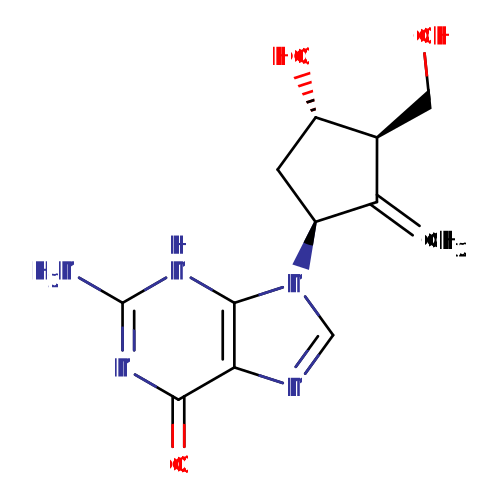
Structure for Entecavir (DB00442)
- Weight
- Average: 277.2792
Monoisotopic: 277.117489371 - Chemical Formula
- C12H15N5O3
- Synonyms
- Anhydrous entecavir
- Entecavir
- Entecavir (anhydrous)
- Entecavir anhydrous
- Entecavirum
- External IDs
- BMS-200475-01
- ETV
- SQ34676

Pharmacology
- Indication
For the treatment of chronic hepatitis B virus infection in adults with evidence of active viral replication and either evidence of persistent elevations in serum aminotransferases (ALT or AST) or histologically active disease.
 Reduce drug development failure ratesBuild, train, & validate machine-learning modelswith evidence-based and structured datasets.Build, train, & validate predictive machine-learning models with structured datasets.
- Associated Conditions
Indication Type Indication Combined Product Details Approval Level Age Group Patient Characteristics Dose Form Treatment of Hepatitis b chronic infection •••••••••••• •••••• •••••••• ••••• •••••••••••• •••••••• ••••••••••••• ••••••••• •••••• - Contraindications & Blackbox Warnings
 Prevent Adverse Drug Events TodayTap into our Clinical API for life-saving information on contraindications & blackbox warnings, population restrictions, harmful risks, & more.Avoid life-threatening adverse drug events with our Clinical API
- Pharmacodynamics
Entecavir is a guanosine nucleoside analogue with selective activity against hepatitis B virus (HBV). It is designed to selectively inhibit the Hepatitis B virus, blocking all three steps in the replication process. Entecavir is more efficient than an older Hepatitis B drug, lamivudine.
- Mechanism of action
By competing with the natural substrate deoxyguanosine triphosphate, entecavir functionally inhibits all three activities of the HBV polymerase (reverse transcriptase, rt): (1) base priming, (2) reverse transcription of the negative strand from the pregenomic messenger RNA, and (3) synthesis of the positive strand of HBV DNA. Upon activation by kinases, the drug can be incorporated into the DNA which has the ultimate effect of inhibiting the HBV polymerase activity.
Target Actions Organism ADNA otherHumans - Absorption
Absorption Following oral administration in healthy subjects, entecavir peak plasma concentrations occurred between 0.5 and 1.5 hours. In healthy subjects, the bioavailability of the tablet is 100% relative to the oral solution.
- Volume of distribution
Not Available
- Protein binding
Binding of entecavir to human serum proteins in vitro is approximately 13%.
- Metabolism
Entecavir is not a substrate, inhibitor, or inducer of the cytochrome P450 (CYP450) enzyme system. Entecavir is efficiently phosphorylated to the active triphosphate form.
- Route of elimination
Not Available
- Half-life
After reaching peak concentration, entecavir plasma concentrations decreased in a bi-exponential manner with a terminal elimination half-life of approximately 128-149 hours. The phosphorylated metabolite has a half-life of 15 hours.
- Clearance
- renal cl=383.2 +/- 101.8 mL/min [Unimpaired renal function]
- renal cl=197.9 +/- 78.1 mL/min [Mild impaired renal function]
- renal cl=135.6 +/- 31.6 mL/min [Moderate impaired renal function]
- renal cl=40.3 +/- 10.1 mL/min [severe impaired renal function]
- apparent oral cl=588.1 +/- 153.7 mL/min [Unimpaired renal function]
- apparent oral cl=309.2 +/- 62.6 mL/min [Mild impaired renal function]
- apparent oral cl=226.3 +/- 60.1 mL/min [Moderate impaired renal function]
- apparent oral cl=100.6 +/- 29.1 mL/min [severe impaired renal function]
- apparent oral cl=50.6 +/- 16.5 mL/min [severe impaired renal function amnaged with Hemodialysis]
- apparent oral cl=35.7 +/- 19.6 mL/min [severe impaired renal function amnaged with CAPD]
- Adverse Effects
 Improve decision support & research outcomesWith structured adverse effects data, including: blackbox warnings, adverse reactions, warning & precautions, & incidence rates. View sample adverse effects data in our new Data Library!Improve decision support & research outcomes with our structured adverse effects data.
- Toxicity
Healthy subjects who received single entecavir doses up to 40 mg or multiple doses up to 20 mg/day for up to 14 days had no increase in or unexpected adverse events. If overdose occurs, the patient must be monitored for evidence of toxicity, and standard supportive treatment applied as necessary.
- Pathways
- Not Available
- Pharmacogenomic Effects/ADRs
- Not Available
Interactions
- Drug Interactions
- This information should not be interpreted without the help of a healthcare provider. If you believe you are experiencing an interaction, contact a healthcare provider immediately. The absence of an interaction does not necessarily mean no interactions exist.
Drug Interaction Integrate drug-drug
interactions in your softwareAbametapir The serum concentration of Entecavir can be increased when it is combined with Abametapir. Abatacept The metabolism of Entecavir can be increased when combined with Abatacept. Abiraterone The serum concentration of Entecavir can be increased when it is combined with Abiraterone. Acenocoumarol The metabolism of Acenocoumarol can be decreased when combined with Entecavir. Acetaminophen The metabolism of Entecavir can be decreased when combined with Acetaminophen. - Food Interactions
- Take on an empty stomach. Take 2 hours before or 2 hours after a meal.
Products
 Drug product information from 10+ global regionsOur datasets provide approved product information including:dosage, form, labeller, route of administration, and marketing period.Access drug product information from over 10 global regions.
- Product Ingredients
Ingredient UNII CAS InChI Key Entecavir monohydrate 5968Y6H45M 209216-23-9 YXPVEXCTPGULBZ-WQYNNSOESA-N Entecavir triphosphate Not Available Not Available ZTWBIZVVFNIRSF-HAFWLYHUSA-N - Product Images

- International/Other Brands
- Barcavir (Incepta) / Caavirel (PMP) / Entaliv (Dr. Reddy's Laboratories) / Teviral (ACI)
- Brand Name Prescription Products
Name Dosage Strength Route Labeller Marketing Start Marketing End Region Image Baraclude Tablet, film coated 0.5 mg Oral Bristol Myers Squibb Pharma Eeig 2016-09-08 Not applicable EU 
Baraclude Tablet, film coated 0.5 mg Oral Bristol Myers Squibb Pharma Eeig 2016-09-08 Not applicable EU Baraclude Tablet, film coated 1.0 mg/1 Oral E.R. Squibb & Sons, L.L.C. 2005-03-29 Not applicable US 
Baraclude Tablet 0.5 mg Oral Bristol Myers Squibb 2006-09-12 Not applicable Canada 
Baraclude Tablet, film coated 0.5 mg Oral Bristol Myers Squibb Pharma Eeig 2016-09-08 Not applicable EU - Generic Prescription Products
Name Dosage Strength Route Labeller Marketing Start Marketing End Region Image Accel-entecavir Tablet 0.5 mg Oral Accel Pharma Inc 2020-03-11 Not applicable Canada Apo-entecavir Tablet 0.5 mg Oral Apotex Corporation 2013-01-18 Not applicable Canada Auro-entecavir Tablet 0.5 mg Oral Auro Pharma Inc 2015-12-01 Not applicable Canada Entecavir Tablet, film coated 0.5 mg/1 Oral Northstar RxLLC 2017-06-15 Not applicable US Entecavir Tablet 1 mg/1 Oral Breckenridge Pharmaceutical, Inc. 2018-03-16 2025-01-31 US - Unapproved/Other Products
Name Ingredients Dosage Route Labeller Marketing Start Marketing End Region Image HEDNAVIR 0,5 MG FILM TABLET, 30 ADET Entecavir monohydrate (0.5 mg) Tablet, film coated Oral ATABAY KİMYA SAN. VE TİC. A.Ş. 2013-01-29 Not applicable Turkey 
HEDNAVIR 1 MG FILM TABLET, 30 ADET Entecavir monohydrate (1 mg) Tablet, film coated Oral ATABAY KİMYA SAN. VE TİC. A.Ş. 2013-01-29 Not applicable Turkey

Categories
- ATC Codes
- J05AF10 — Entecavir
- Drug Categories
- Anti-Infective Agents
- Antiinfectives for Systemic Use
- Antiviral Agents
- Antivirals for Systemic Use
- Cytochrome P-450 CYP1A2 Substrates
- Cytochrome P-450 Substrates
- Direct Acting Antivirals
- Hepatitis B virus
- Hepatitis B Virus Nucleoside Analog Reverse Transcriptase Inhibitor
- Heterocyclic Compounds, Fused-Ring
- Nucleoside and Nucleotide Reverse Transcriptase Inhibitors
- Nucleoside Reverse Transcriptase Inhibitors
- Nucleosides and Nucleotides
- Purines
- Purinones
- Chemical TaxonomyProvided by Classyfire
- Description
- This compound belongs to the class of organic compounds known as nucleoside and nucleotide analogues. These are analogues of nucleosides and nucleotides. These include phosphonated nucleosides, C-glycosylated nucleoside bases, analogues where the sugar unit is a pyranose, and carbocyclic nucleosides, among others.
- Kingdom
- Organic compounds
- Super Class
- Nucleosides, nucleotides, and analogues
- Class
- Nucleoside and nucleotide analogues
- Sub Class
- Not Available
- Direct Parent
- Nucleoside and nucleotide analogues
- Alternative Parents
- Hypoxanthines / 6-oxopurines / Pyrimidones / Aminopyrimidines and derivatives / N-substituted imidazoles / Cyclopentanols / Vinylogous amides / Heteroaromatic compounds / Cyclic alcohols and derivatives / Azacyclic compounds show 5 more
- Substituents
- 6-oxopurine / Alcohol / Amine / Aminopyrimidine / Aromatic heteropolycyclic compound / Azacycle / Azole / Cyclic alcohol / Cyclopentanol / Heteroaromatic compound show 20 more
- Molecular Framework
- Aromatic heteropolycyclic compounds
- External Descriptors
- secondary alcohol, oxopurine, primary alcohol, 2-aminopurines (CHEBI:473990)
- Affected organisms
- Hepatitis B virus
Chemical Identifiers
- UNII
- NNU2O4609D
- CAS number
- 142217-69-4
- InChI Key
- QDGZDCVAUDNJFG-FXQIFTODSA-N
- InChI
- InChI=1S/C12H15N5O3/c1-5-6(3-18)8(19)2-7(5)17-4-14-9-10(17)15-12(13)16-11(9)20/h4,6-8,18-19H,1-3H2,(H3,13,15,16,20)/t6-,7-,8-/m0/s1
- IUPAC Name
- 2-amino-9-[(1S,3R,4S)-4-hydroxy-3-(hydroxymethyl)-2-methylidenecyclopentyl]-6,9-dihydro-3H-purin-6-one
- SMILES
- NC1=NC(=O)C2=C(N1)N(C=N2)[C@H]1C[C@H](O)[C@@H](CO)C1=C
References
- Synthesis Reference
- US5206244
- General References
- Not Available
- External Links
- Human Metabolome Database
- HMDB0014585
- KEGG Drug
- D04008
- PubChem Compound
- 153941
- PubChem Substance
- 46504864
- ChemSpider
- 135679
- BindingDB
- 50248008
- 1546027
- ChEBI
- 473990
- ChEMBL
- CHEMBL713
- ZINC
- ZINC000003802690
- Therapeutic Targets Database
- DAP000697
- PharmGKB
- PA164784025
- RxList
- RxList Drug Page
- Drugs.com
- Drugs.com Drug Page
- Wikipedia
- Entecavir
- FDA label
- Download (628 KB)
Clinical Trials
- Clinical Trials
Phase Status Purpose Conditions Count 4 Active Not Recruiting Treatment Chronic Hepatitis B Infection 1 4 Active Not Recruiting Treatment Cirrhosis of the Liver / Viral Hepatitis B 1 4 Active Not Recruiting Treatment HBV Coinfection / HCC 1 4 Active Not Recruiting Treatment Viral Hepatitis B 1 4 Completed Prevention Non-Hodgkin's Lymphoma (NHL) / Viral Hepatitis B 1
Pharmacoeconomics
- Manufacturers
- Bristol myers squibb
- Packagers
- Bristol-Myers Squibb Co.
- E.R. Squibb and Sons LLC
- Dosage Forms
Form Route Strength Solution Oral 0.05 MG/ML Solution Oral 0.05 mg/1mL Tablet Oral 1.000 mg Tablet, film coated Oral 1.0 MG Solution Oral 5 mg Tablet, coated Oral 1 mg Tablet Oral 0.500 mg Tablet Oral Tablet Oral 0.5 mg/1 Tablet Oral 1 mg/1 Tablet, coated Oral 0.5 mg/1 Tablet, coated Oral 1 mg/1 Tablet, film coated Oral 0.5 mg/1 Tablet, film coated Oral 1 mg/1 Tablet, film coated Oral 1.0 mg/1 Tablet, film coated Oral 1.00 mg Tablet, film coated Oral Tablet, film coated Oral 0532 Mg Tablet, film coated Oral 1.06 MG Tablet, film coated Oral 1.064 Mg Tablet, coated Oral 0.5 mg Tablet Oral 0.50 mg Tablet Oral 0.5 mg Tablet, soluble Oral 0.5 Mg Tablet Oral 1 mg Tablet, film coated Oral 0.50 mg Tablet, coated Oral 100000 mg Tablet, film coated Oral 0.53 Mg Tablet, film coated Oral 0.5 mg Tablet, film coated Oral 1 mg - Prices
Unit description Cost Unit Baraclude 0.5 mg tablet 28.94USD tablet Baraclude 1 mg tablet 28.94USD tablet DrugBank does not sell nor buy drugs. Pricing information is supplied for informational purposes only.- Patents
Patent Number Pediatric Extension Approved Expires (estimated) Region CA2053339 No 2001-05-29 2011-10-11 Canada US5206244 Yes 1993-04-27 2015-08-21 US
Properties
- State
- Solid
- Experimental Properties
Property Value Source water solubility Slightly soluble (2.4 mg/mL at pH 7.9, 25 °C) Not Available logP -0.8 Not Available - Predicted Properties
Property Value Source Water Solubility 6.59 mg/mL ALOGPS logP -0.81 ALOGPS logP -1.4 Chemaxon logS -1.6 ALOGPS pKa (Strongest Acidic) 12 Chemaxon pKa (Strongest Basic) 3.14 Chemaxon Physiological Charge 0 Chemaxon Hydrogen Acceptor Count 7 Chemaxon Hydrogen Donor Count 4 Chemaxon Polar Surface Area 125.76 Å2 Chemaxon Rotatable Bond Count 2 Chemaxon Refractivity 71 m3·mol-1 Chemaxon Polarizability 27.48 Å3 Chemaxon Number of Rings 3 Chemaxon Bioavailability 1 Chemaxon Rule of Five Yes Chemaxon Ghose Filter No Chemaxon Veber's Rule No Chemaxon MDDR-like Rule No Chemaxon - Predicted ADMET Features
Property Value Probability Human Intestinal Absorption + 1.0 Blood Brain Barrier + 0.873 Caco-2 permeable - 0.7601 P-glycoprotein substrate Substrate 0.5802 P-glycoprotein inhibitor I Non-inhibitor 0.863 P-glycoprotein inhibitor II Non-inhibitor 0.9185 Renal organic cation transporter Non-inhibitor 0.8465 CYP450 2C9 substrate Non-substrate 0.8817 CYP450 2D6 substrate Non-substrate 0.8164 CYP450 3A4 substrate Non-substrate 0.5346 CYP450 1A2 substrate Non-inhibitor 0.7641 CYP450 2C9 inhibitor Non-inhibitor 0.848 CYP450 2D6 inhibitor Non-inhibitor 0.915 CYP450 2C19 inhibitor Non-inhibitor 0.87 CYP450 3A4 inhibitor Non-inhibitor 0.9647 CYP450 inhibitory promiscuity Low CYP Inhibitory Promiscuity 0.9552 Ames test Non AMES toxic 0.7523 Carcinogenicity Non-carcinogens 0.8026 Biodegradation Not ready biodegradable 0.9669 Rat acute toxicity 2.3879 LD50, mol/kg Not applicable hERG inhibition (predictor I) Weak inhibitor 0.8865 hERG inhibition (predictor II) Non-inhibitor 0.9062
Spectra
- Mass Spec (NIST)
- Not Available
- Spectra
Spectrum Spectrum Type Splash Key Predicted GC-MS Spectrum - GC-MS Predicted GC-MS splash10-001j-3190000000-4c1e30013236fcf851e8 Predicted MS/MS Spectrum - 10V, Positive (Annotated) Predicted LC-MS/MS splash10-004i-0290000000-bb5f8d6cdfb86e002cdf Predicted MS/MS Spectrum - 10V, Negative (Annotated) Predicted LC-MS/MS splash10-004i-0190000000-f64aa2e9cf595f63978e Predicted MS/MS Spectrum - 20V, Positive (Annotated) Predicted LC-MS/MS splash10-0udi-0930000000-3f7bfd760a6c9acce9eb Predicted MS/MS Spectrum - 20V, Negative (Annotated) Predicted LC-MS/MS splash10-0ufr-0690000000-1057b158f1e8bc724d2c Predicted MS/MS Spectrum - 40V, Positive (Annotated) Predicted LC-MS/MS splash10-0zfr-1920000000-6f6942556248526ca139 Predicted MS/MS Spectrum - 40V, Negative (Annotated) Predicted LC-MS/MS splash10-0ka6-4930000000-28b3ba4a5a47f8d90f0a Predicted 1H NMR Spectrum 1D NMR Not Applicable Predicted 13C NMR Spectrum 1D NMR Not Applicable - Chromatographic Properties
Collision Cross Sections (CCS)
Adduct CCS Value (Å2) Source type Source [M-H]- 171.8567714 predictedDarkChem Lite v0.1.0 [M-H]- 174.3804714 predictedDarkChem Lite v0.1.0 [M-H]- 163.43626 predictedDeepCCS 1.0 (2019) [M+H]+ 172.1151714 predictedDarkChem Lite v0.1.0 [M+H]+ 173.9144714 predictedDarkChem Lite v0.1.0 [M+H]+ 165.79425 predictedDeepCCS 1.0 (2019) [M+Na]+ 172.6638714 predictedDarkChem Lite v0.1.0 [M+Na]+ 175.1248714 predictedDarkChem Lite v0.1.0 [M+Na]+ 172.97803 predictedDeepCCS 1.0 (2019)
Targets

References
- Sims KA, Woodland AM: Entecavir: a new nucleoside analog for the treatment of chronic hepatitis B infection. Pharmacotherapy. 2006 Dec;26(12):1745-57. [Article]
- Walsh AW, Langley DR, Colonno RJ, Tenney DJ: Mechanistic characterization and molecular modeling of hepatitis B virus polymerase resistance to entecavir. PLoS One. 2010 Feb 12;5(2):e9195. doi: 10.1371/journal.pone.0009195. [Article]

Drug created at June 13, 2005 13:24 / Updated at April 26, 2024 00:45