Identification
- Summary
Droperidol is a butyrophenone derivative and dopamine antagonist used to prevent and treat postoperative nausea and vomiting.
- Brand Names
- Inapsine
- Generic Name
- Droperidol
- DrugBank Accession Number
- DB00450
- Background
A butyrophenone with general properties similar to those of haloperidol. It is used in conjunction with an opioid analgesic such as fentanyl to maintain the patient in a calm state of neuroleptanalgesia with indifference to surroundings but still able to cooperate with the surgeon. It is also used as a premedicant, as an antiemetic, and for the control of agitation in acute psychoses. (From Martindale, The Extra Pharmacopoeia, 29th ed, p593)
- Type
- Small Molecule
- Groups
- Approved, Vet approved
- Structure
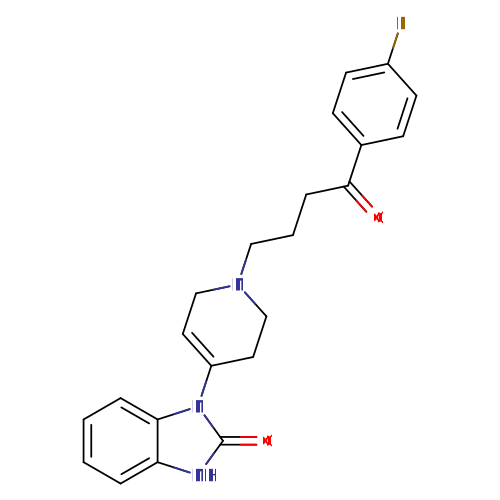
Structure for Droperidol (DB00450)
- Weight
- Average: 379.4274
Monoisotopic: 379.169605168 - Chemical Formula
- C22H22FN3O2
- Synonyms
- 1-(1-(3-(p-fluorobenzoyl)propyl)-1,2,3,6-tetrahydro-4-pyridyl)-2-benzimidazolinone
- 1-(1-(4-(p-fluorophenyl)-4-oxobutyl)-1,2,3,6-tetrahydro-4-pyridyl)-2-benzimidazolinone
- 1-{1-[4-(4-Fluoro-phenyl)-4-oxo-butyl]-1,2,3,6-tetrahydro-pyridin-4-yl}-1,3-dihydro-benzoimidazol-2-one
- 1-{1-[4-(4-fluorophenyl)-4-oxobutyl]-1,2,3,6-tetrahydro-4-pyridinyl}-2,3-dihydro-1H-benzo[d]imidazol-2-one
- Droperidol
- Dropéridol
- Droperidolo
- Droperidolum
- External IDs
- McN-JR 4749
- MCN-JR-4749
- R 4749
- R-4749

Pharmacology
- Indication
Droperidol is used to produce tranquilization and to reduce the incidence of nausea and vomiting in surgical and diagnostic procedures.
 Reduce drug development failure ratesBuild, train, & validate machine-learning modelswith evidence-based and structured datasets.Build, train, & validate predictive machine-learning models with structured datasets.
- Associated Conditions
Indication Type Indication Combined Product Details Approval Level Age Group Patient Characteristics Dose Form Management of Agitation ••• ••••• Management of Delirium ••• ••••• Prevention of Nausea and vomiting •••••••••••• •••••••••• ••••••• •••••••• Prevention of Nausea and vomiting •••••••••••• •••••••••• ••••••• •••••••• - Contraindications & Blackbox Warnings
 Prevent Adverse Drug Events TodayTap into our Clinical API for life-saving information on contraindications & blackbox warnings, population restrictions, harmful risks, & more.Avoid life-threatening adverse drug events with our Clinical API
- Pharmacodynamics
Droperidol produces marked tranquilization and sedation. It allays apprehension and provides a state of mental detachment and indifference while maintaining a state of reflex alertness. Droperidol produces an antiemetic effect as evidenced by the antagonism of apomorphine in dogs. It lowers the incidence of nausea and vomiting during surgical procedures and provides antiemetic protection in the postoperative period. Droperidol potentiates other CNS depressants. It produces mild alpha-adrenergic blockade, peripheral vascular dilatation and reduction of the pressor effect of epinephrine. It can produce hypotension and decreased peripheral vascular resistance and may decrease pulmonary arterial pressure (particularly if it is abnormally high). It may reduce the incidence of epinephrine-induced arrhythmias, but it does not prevent other cardiac arrhythmias.
- Mechanism of action
The exact mechanism of action is unknown, however, droperidol causes a CNS depression at subcortical levels of the brain, midbrain, and brainstem reticular formation. It may antagonize the actions of glutamic acid within the extrapyramidal system. It may also inhibit cathecolamine receptors and the reuptake of neurotransmiters and has strong central antidopaminergic action and weak central anticholinergic action. It can also produce ganglionic blockade and reduced affective response. The main actions seem to stem from its potent Dopamine(2) receptor antagonism with minor antagonistic effects on alpha-1 adrenergic receptors as well.
Target Actions Organism AAlpha-1A adrenergic receptor antagonistHumans ADopamine D2 receptor antagonistHumans - Absorption
Completely absorbed following intramuscular administration.
- Volume of distribution
Not Available
- Protein binding
Not Available
- Metabolism
Extensively metabolized.
- Route of elimination
Not Available
- Half-life
Biphasic distribution. The rapid distribution phase is 1.4 ± 0.5 minutes and the slower distribution phase is 14.3 ± 6.5 minutes. Elimination half-life in adults is 134 ± 13 minutes and may be increased in geriatric patients. In children, it is 101.5 ± 26.4 minutes.
- Clearance
Not Available
- Adverse Effects
 Improve decision support & research outcomesWith structured adverse effects data, including: blackbox warnings, adverse reactions, warning & precautions, & incidence rates. View sample adverse effects data in our new Data Library!Improve decision support & research outcomes with our structured adverse effects data.
- Toxicity
The intravenous LD50 of droperidol is 20-43 mg/kg in mice; 30 mg/kg in rats; 25 mg/kg in dogs and 11-13 mg/kg in rabbits. The intramuscular LD50 of droperidol is 195 mg/kg in mice, 104-110 mg/kg in rats; 97 mg/kg in rabbits and 200 mg/kg in guinea pigs. The manifestations of droperidol overdosage are an extension of its pharmacologic actions.
- Pathways
- Not Available
- Pharmacogenomic Effects/ADRs
- Not Available
Interactions
- Drug Interactions
- This information should not be interpreted without the help of a healthcare provider. If you believe you are experiencing an interaction, contact a healthcare provider immediately. The absence of an interaction does not necessarily mean no interactions exist.
Drug Interaction Integrate drug-drug
interactions in your software1,2-Benzodiazepine Droperidol may increase the central nervous system depressant (CNS depressant) activities of 1,2-Benzodiazepine. Acebutolol Acebutolol may increase the orthostatic hypotensive activities of Droperidol. Aceclofenac The risk or severity of hypertension can be increased when Droperidol is combined with Aceclofenac. Acemetacin The risk or severity of hypertension can be increased when Droperidol is combined with Acemetacin. Acetazolamide Droperidol may increase the central nervous system depressant (CNS depressant) activities of Acetazolamide. - Food Interactions
- No interactions found.
Products
 Drug product information from 10+ global regionsOur datasets provide approved product information including:dosage, form, labeller, route of administration, and marketing period.Access drug product information from over 10 global regions.
- International/Other Brands
- Dehydrobenzperidol (Janssen) / Dridol (Prostrakan) / Droleptan (Daiichi Sankyo) / Dropedol (Excelsior) / Dropel (Siu Guan) / Droperdal (Cristália) / Droperidols (Grindeks) / Xomolix (Arzneimittel ProStrakan)
- Brand Name Prescription Products
Name Dosage Strength Route Labeller Marketing Start Marketing End Region Image Droperidol Injection Liquid 2.5 mg / mL Intramuscular; Intravenous Novopharm Limited 1998-04-20 2002-03-14 Canada 
Droperidol Injection USP 2.5mg/ml Solution 2.5 mg / mL Intramuscular; Intravenous Sandoz Canada Incorporated 1995-12-31 2019-08-01 Canada Inapsine Injection 2.5 mg/1mL Intramuscular; Intravenous Akorn 1996-07-01 2012-01-01 US 
Inapsine Injection 2.5 mg/1mL Intramuscular; Intravenous Taylor Pharmaceuticals 2007-08-09 Not applicable US Inapsine Injection 2.5 mg/1mL Intramuscular; Intravenous Akorn 1996-07-01 2012-01-01 US - Generic Prescription Products
Name Dosage Strength Route Labeller Marketing Start Marketing End Region Image Droperidol Injection, solution 2.5 mg/1mL Intramuscular; Intravenous Hikma Pharmaceuticals USA Inc. 2022-06-01 Not applicable US Droperidol Injection, solution 2.5 mg/1mL Intramuscular; Intravenous AMERICAN REGENT, INC. 1990-09-30 Not applicable US Droperidol Injection, solution 2.5 mg/1mL Intramuscular; Intravenous Physicians Total Care, Inc. 1988-02-29 2002-06-30 US Droperidol Injection, solution 2.5 mg/1mL Intramuscular; Intravenous Hikma Pharmaceuticals USA Inc. 2022-06-01 Not applicable US Droperidol Injection, solution 2.5 mg/1mL Intramuscular; Intravenous Cardinal Health 1990-09-30 2014-08-31 US - Mixture Products
Name Ingredients Dosage Route Labeller Marketing Start Marketing End Region Image Innovar Inj Droperidol (2.5 mg / mL) + Fentanyl citrate (.05 mg / mL) Liquid Intramuscular; Intravenous Janssen Pharmaceutica, Division Of Janssen Ortho Inc. 1982-12-31 1996-09-10 Canada
Categories
- ATC Codes
- N05AD08 — Droperidol
- Drug Categories
- Adjuvants, Anesthesia
- Adrenergic alpha-1 Receptor Antagonists
- Adrenergic alpha-Antagonists
- Adrenergic Antagonists
- Agents that produce hypertension
- Antiemetics
- Antipsychotic Agents
- Antipsychotic Agents (First Generation [Typical])
- Autonomic Agents
- Benzimidazoles
- Butyrophenone Derivatives
- Butyrophenones
- Central Nervous System Agents
- Central Nervous System Depressants
- Dopamine Agents
- Dopamine Antagonists
- Dopamine D2 Receptor Antagonists
- Gastrointestinal Agents
- Heterocyclic Compounds, Fused-Ring
- Ketones
- Miscellaneous Anxiolytics Sedatives and Hypnotics
- Moderate Risk QTc-Prolonging Agents
- Nervous System
- Neurotoxic agents
- Neurotransmitter Agents
- Peripheral Nervous System Agents
- Psycholeptics
- Psychotropic Drugs
- QTc Prolonging Agents
- Tranquilizing Agents
- Chemical TaxonomyProvided by Classyfire
- Description
- This compound belongs to the class of organic compounds known as alkyl-phenylketones. These are aromatic compounds containing a ketone substituted by one alkyl group, and a phenyl group.
- Kingdom
- Organic compounds
- Super Class
- Organic oxygen compounds
- Class
- Organooxygen compounds
- Sub Class
- Carbonyl compounds
- Direct Parent
- Alkyl-phenylketones
- Alternative Parents
- Phenylbutylamines / Butyrophenones / Benzimidazoles / Aryl alkyl ketones / Benzoyl derivatives / Fluorobenzenes / Aryl fluorides / N-substituted imidazoles / Hydropyridines / Gamma-amino ketones show 8 more
- Substituents
- Alkyl-phenylketone / Amine / Aromatic heteropolycyclic compound / Aryl alkyl ketone / Aryl fluoride / Aryl halide / Azacycle / Azole / Benzenoid / Benzimidazole show 22 more
- Molecular Framework
- Aromatic heteropolycyclic compounds
- External Descriptors
- organofluorine compound, aromatic ketone, benzimidazoles (CHEBI:4717)
- Affected organisms
- Humans and other mammals
Chemical Identifiers
- UNII
- O9U0F09D5X
- CAS number
- 548-73-2
- InChI Key
- RMEDXOLNCUSCGS-UHFFFAOYSA-N
- InChI
- InChI=1S/C22H22FN3O2/c23-17-9-7-16(8-10-17)21(27)6-3-13-25-14-11-18(12-15-25)26-20-5-2-1-4-19(20)24-22(26)28/h1-2,4-5,7-11H,3,6,12-15H2,(H,24,28)
- IUPAC Name
- 1-{1-[4-(4-fluorophenyl)-4-oxobutyl]-1,2,3,6-tetrahydropyridin-4-yl}-2,3-dihydro-1H-1,3-benzodiazol-2-one
- SMILES
- FC1=CC=C(C=C1)C(=O)CCCN1CCC(=CC1)N1C(=O)NC2=CC=CC=C12
References
- Synthesis Reference
Janssen, P.A.J. and Gardocki, J.F.; U.S. Patent 3,141,823; July 21, 1964; assigned to Research Laboratorium Dr. C. Janssen NV, Belgium. Januen, P.A.J.; U.S. Patent 3,161,645; December 15,1964: assigned to Research Laboratorium Dr. C. Janssen NV, Belgium.
US3161645- General References
- External Links
- Human Metabolome Database
- HMDB0014593
- KEGG Drug
- D00308
- PubChem Compound
- 3168
- PubChem Substance
- 46505291
- ChemSpider
- 3056
- BindingDB
- 50017705
- 3648
- ChEBI
- 4717
- ChEMBL
- CHEMBL1108
- ZINC
- ZINC000019796080
- Therapeutic Targets Database
- DAP000412
- PharmGKB
- PA449422
- PDBe Ligand
- USS
- RxList
- RxList Drug Page
- Drugs.com
- Drugs.com Drug Page
- Wikipedia
- Droperidol
- PDB Entries
- 6x6g
- MSDS
- Download (74 KB)
Clinical Trials
- Clinical Trials
Phase Status Purpose Conditions Count 4 Completed Prevention Cardiac Repolarization 1 4 Completed Prevention Post Operative Nausea and Vomiting (PONV) 1 4 Completed Prevention Vomiting 1 4 Completed Treatment Breast Cancer 1 4 Terminated Prevention Nausea / Vomiting 1
Pharmacoeconomics
- Manufacturers
- Abraxis pharmaceutical products
- Astrazeneca lp
- Hospira inc
- Luitpold pharmaceuticals inc
- Smith and nephew solopak div smith and nephew
- Solopak laboratories inc
- Watson laboratories inc
- Akorn inc
- Packagers
- Akorn Inc.
- American Regent
- Cardinal Health
- Hospira Inc.
- Luitpold Pharmaceuticals Inc.
- Neuman Distributors Inc.
- Physicians Total Care Inc.
- Taylor Pharmaceuticals
- Dosage Forms
Form Route Strength Injection, solution Intramuscular; Intravenous 2.5 mg/1mL Injection, solution Parenteral 2.5 mg/ml Solution Intramuscular; Intravenous 2.5 mg / mL Injection, solution 1.25 MG/ML Injection, solution 2.5 MG/ML Injection, solution 0.5 MG/ML Injection Intramuscular; Intravenous 2.5 mg/1mL Liquid Intramuscular; Intravenous 2.5 mg / mL Liquid Intramuscular; Intravenous Injection, solution Parenteral Pill - Prices
Unit description Cost Unit Inapsine 2.5 mg/ml ampul 4.59USD ml Droperidol 2.5 mg/ml vial 2.04USD ml Droperidol 2.5 mg/ml ampul 0.7USD ml DrugBank does not sell nor buy drugs. Pricing information is supplied for informational purposes only.- Patents
- Not Available
Properties
- State
- Solid
- Experimental Properties
Property Value Source melting point (°C) 145-146.5 Janssen, P.A.J. and Gardocki, J.F.; U.S. Patent 3,141,823; July 21, 1964; assigned to Research Laboratorium Dr. C. Janssen NV, Belgium. Januen, P.A.J.; U.S. Patent 3,161,645; December 15,1964: assigned to Research Laboratorium Dr. C. Janssen NV, Belgium. water solubility 4.21 mg/L Not Available logP 3.50 SANGSTER (1993) pKa 7.46 SANGSTER (1994) - Predicted Properties
Property Value Source Water Solubility 0.0966 mg/mL ALOGPS logP 3.93 ALOGPS logP 3.01 Chemaxon logS -3.6 ALOGPS pKa (Strongest Acidic) 12.72 Chemaxon pKa (Strongest Basic) 6.75 Chemaxon Physiological Charge 0 Chemaxon Hydrogen Acceptor Count 3 Chemaxon Hydrogen Donor Count 1 Chemaxon Polar Surface Area 52.65 Å2 Chemaxon Rotatable Bond Count 6 Chemaxon Refractivity 109.52 m3·mol-1 Chemaxon Polarizability 40.71 Å3 Chemaxon Number of Rings 4 Chemaxon Bioavailability 1 Chemaxon Rule of Five Yes Chemaxon Ghose Filter Yes Chemaxon Veber's Rule No Chemaxon MDDR-like Rule Yes Chemaxon - Predicted ADMET Features
Property Value Probability Human Intestinal Absorption + 1.0 Blood Brain Barrier + 0.9602 Caco-2 permeable - 0.7521 P-glycoprotein substrate Substrate 0.7471 P-glycoprotein inhibitor I Inhibitor 0.9128 P-glycoprotein inhibitor II Inhibitor 0.7451 Renal organic cation transporter Inhibitor 0.67 CYP450 2C9 substrate Non-substrate 0.7884 CYP450 2D6 substrate Non-substrate 0.8756 CYP450 3A4 substrate Substrate 0.6751 CYP450 1A2 substrate Non-inhibitor 0.9045 CYP450 2C9 inhibitor Non-inhibitor 0.9071 CYP450 2D6 inhibitor Inhibitor 0.8932 CYP450 2C19 inhibitor Non-inhibitor 0.9026 CYP450 3A4 inhibitor Inhibitor 0.796 CYP450 inhibitory promiscuity High CYP Inhibitory Promiscuity 0.9279 Ames test Non AMES toxic 0.6353 Carcinogenicity Non-carcinogens 0.9104 Biodegradation Not ready biodegradable 1.0 Rat acute toxicity 2.5820 LD50, mol/kg Not applicable hERG inhibition (predictor I) Strong inhibitor 0.8955 hERG inhibition (predictor II) Inhibitor 0.835
Spectra
- Mass Spec (NIST)
- Not Available
- Spectra
- Chromatographic Properties
Collision Cross Sections (CCS)
Adduct CCS Value (Å2) Source type Source [M-H]- 206.26976 predictedDarkChem Lite v0.1.0 [M-H]- 183.98785 predictedDeepCCS 1.0 (2019) [M+H]+ 207.07946 predictedDarkChem Lite v0.1.0 [M+H]+ 186.34807 predictedDeepCCS 1.0 (2019) [M+Na]+ 206.96936 predictedDarkChem Lite v0.1.0 [M+Na]+ 194.30763 predictedDeepCCS 1.0 (2019)
Targets

- Kind
- Protein
- Organism
- Humans
- Pharmacological action
- Yes
- Actions
- Antagonist
- General Function
- Protein heterodimerization activity
- Specific Function
- This alpha-adrenergic receptor mediates its action by association with G proteins that activate a phosphatidylinositol-calcium second messenger system. Its effect is mediated by G(q) and G(11) prot...
- Gene Name
- ADRA1A
- Uniprot ID
- P35348
- Uniprot Name
- Alpha-1A adrenergic receptor
- Molecular Weight
- 51486.005 Da
References
- Zupko I, Janossy K, Maul K, Marki A, Falkay G: Alpha-adrenergic blockade: a possible mechanism of tocolytic action of certain benzodiazepines in a postpartum rat model in vivo. Life Sci. 2003 Jan 24;72(10):1093-102. [Article]
- Kind
- Protein
- Organism
- Humans
- Pharmacological action
- Yes
- Actions
- Antagonist
- General Function
- Potassium channel regulator activity
- Specific Function
- Dopamine receptor whose activity is mediated by G proteins which inhibit adenylyl cyclase.
- Gene Name
- DRD2
- Uniprot ID
- P14416
- Uniprot Name
- D(2) dopamine receptor
- Molecular Weight
- 50618.91 Da
References
- Grip G, Svensson BA, Gordh T Jr, Post C, Hartvig P: Histopathology and evaluation of potentiation of morphine-induced antinociception by intrathecal droperidol in the rat. Acta Anaesthesiol Scand. 1992 Feb;36(2):145-52. [Article]
- Hamik A, Peroutka SJ: Differential interactions of traditional and novel antiemetics with dopamine D2 and 5-hydroxytryptamine3 receptors. Cancer Chemother Pharmacol. 1989;24(5):307-10. [Article]
- Larson MD: The effect of antiemetics on pupillary reflex dilation during epidural/general anesthesia. Anesth Analg. 2003 Dec;97(6):1652-6. [Article]
- Gao HR, Shi TF, Yang CX, Zhang D, Zhang GW, Zhang Y, Jiao RS, Zhang H, Xu MY: The effect of dopamine on pain-related neurons in the parafascicular nucleus of rats. J Neural Transm (Vienna). 2010 May;117(5):585-91. doi: 10.1007/s00702-010-0398-3. Epub 2010 Apr 1. [Article]

Drug created at June 13, 2005 13:24 / Updated at April 27, 2024 09:44