Identification
- Generic Name
- Enoxacin
- DrugBank Accession Number
- DB00467
- Background
A broad-spectrum 6-fluoronaphthyridinone antibacterial agent (fluoroquinolones) structurally related to nalidixic acid.
- Type
- Small Molecule
- Groups
- Approved, Investigational
- Structure
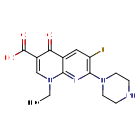
Structure for Enoxacin (DB00467)

- Weight
- Average: 320.3189
Monoisotopic: 320.128468635 - Chemical Formula
- C15H17FN4O3
- Synonyms
- 1-ethyl-6-fluoro-1,4-dihydro-4-oxo-7-(1-piperazinyl)-1,8-naphthyridine-3-carboxylic acid
- 1-Ethyl-6-fluoro-4-oxo-7-piperazin-1-yl-1,4-dihydro-[1,8]naphthyridine-3-carboxylic acid
- Enoxacin
- Enoxacina
- Énoxacine
- Enoxacino
- Enoxacinum
- External IDs
- AT 2266
- AT-2266
- CI 919
- CI-919
- PD 107779
- PD-107779

Pharmacology
- Indication
For the treatment of adults (≥18 years of age) with the following infections caused by susceptible strains of the designated microorganisms: (1) uncomplicated urethral or cervical gonorrhea due to Neisseria gonorrhoeae, (2) uncomplicated urinary tract infections (cystitis) due to Escherichia coli, Staphylococcus epidermidis, or Staphylococcus saprophyticus, and (3) complicated urinary tract infections due to Escherichia coli, Klebsiella pneumoniae, Proteus mirabilis, Pseudomonas aeruginosa, Staphylococcus epidermidis, or Enterobacter cloacae.
 Reduce drug development failure ratesBuild, train, & validate machine-learning modelswith evidence-based and structured datasets.Build, train, & validate predictive machine-learning models with structured datasets.
- Contraindications & Blackbox Warnings
 Prevent Adverse Drug Events TodayTap into our Clinical API for life-saving information on contraindications & blackbox warnings, population restrictions, harmful risks, & more.Avoid life-threatening adverse drug events with our Clinical API
- Pharmacodynamics
Enoxacin is a quinolone/fluoroquinolone antibiotic. Enoxacin is bactericidal and its mode of action depends on blocking of bacterial DNA replication by binding itself to an enzyme called DNA gyrase, which allows the untwisting required to replicate one DNA double helix into two. Enoxacin is a broad-spectrum antibiotic that is active against both Gram-positive and Gram-negative bacteria. Enoxacin may be active against pathogens resistant to drugs that act by different mechanisms.
- Mechanism of action
Enoxacin exerts its bactericidal action via the inhibition of the essential bacterial enzyme DNA gyrase (DNA Topoisomerase II).
Target Actions Organism ADNA gyrase subunit A inhibitorHaemophilus influenzae (strain ATCC 51907 / DSM 11121 / KW20 / Rd) ADNA topoisomerase 4 subunit A inhibitorHaemophilus influenzae (strain ATCC 51907 / DSM 11121 / KW20 / Rd) NDNA topoisomerase 2-alpha inhibitorHumans - Absorption
Rapidly absorbed following oral administration, with an absolute oral bioavailability of approximately 90%.
- Volume of distribution
Not Available
- Protein binding
Enoxacin is approximately 40% bound to plasma proteins in healthy subjects and is approximately 14% bound to plasma proteins in patients with impaired renal function.
- Metabolism
Hepatic. Some isozymes of the cytochrome P-450 hepatic microsomal enzyme system are inhibited by enoxacin. After a single dose, greater than 40% was recovered in urine by 48 hours as unchanged drug.
- Route of elimination
Not Available
- Half-life
Plasma half-life is 3 to 6 hours.
- Clearance
Not Available
- Adverse Effects
 Improve decision support & research outcomesWith structured adverse effects data, including: blackbox warnings, adverse reactions, warning & precautions, & incidence rates. View sample adverse effects data in our new Data Library!Improve decision support & research outcomes with our structured adverse effects data.
- Toxicity
Not Available
- Pathways
- Not Available
- Pharmacogenomic Effects/ADRs
- Not Available
Interactions
- Drug Interactions
- This information should not be interpreted without the help of a healthcare provider. If you believe you are experiencing an interaction, contact a healthcare provider immediately. The absence of an interaction does not necessarily mean no interactions exist.
Drug Interaction Integrate drug-drug
interactions in your softwareAcarbose The therapeutic efficacy of Acarbose can be increased when used in combination with Enoxacin. Aceclofenac Aceclofenac may increase the neuroexcitatory activities of Enoxacin. Acemetacin Acemetacin may increase the neuroexcitatory activities of Enoxacin. Acenocoumarol The therapeutic efficacy of Acenocoumarol can be increased when used in combination with Enoxacin. Acetaminophen The metabolism of Acetaminophen can be decreased when combined with Enoxacin. - Food Interactions
- Not Available
Products
 Drug product information from 10+ global regionsOur datasets provide approved product information including:dosage, form, labeller, route of administration, and marketing period.Access drug product information from over 10 global regions.
- International/Other Brands
- Almitil / Bactidan / Comprecin / Enoksetin / Enoxen / Enoxin / Enoxor (Pierre Fabre) / Enroxil / Flumark / Gyramid / Penetrex / Vinone
Categories
- ATC Codes
- J01MA04 — Enoxacin
- Drug Categories
- Anti-Bacterial Agents
- Anti-Infective Agents
- Antibacterials for Systemic Use
- Antiinfectives for Systemic Use
- Cytochrome P-450 CYP1A2 Inhibitors
- Cytochrome P-450 CYP1A2 Inhibitors (strong)
- Cytochrome P-450 Enzyme Inhibitors
- Enzyme Inhibitors
- Fluoroquinolones
- Heterocyclic Compounds, Fused-Ring
- Potential QTc-Prolonging Agents
- QTc Prolonging Agents
- Quinolines
- Quinolones
- Topoisomerase II Inhibitors
- Topoisomerase Inhibitors
- Chemical TaxonomyProvided by Classyfire
- Description
- This compound belongs to the class of organic compounds known as naphthyridine carboxylic acids and derivatives. These are compounds containing a naphthyridine moiety, where one of the ring atoms bears a carboxylic acid group.
- Kingdom
- Organic compounds
- Super Class
- Organoheterocyclic compounds
- Class
- Diazanaphthalenes
- Sub Class
- Naphthyridines
- Direct Parent
- Naphthyridine carboxylic acids and derivatives
- Alternative Parents
- Pyridinylpiperazines / N-arylpiperazines / Fluoroquinolones / Pyridinecarboxylic acids / Dialkylarylamines / Aminopyridines and derivatives / Aryl fluorides / Imidolactams / Vinylogous amides / Heteroaromatic compounds show 10 more
- Substituents
- 1,4-diazinane / Amine / Amino acid / Amino acid or derivatives / Aminopyridine / Aromatic heteropolycyclic compound / Aryl fluoride / Aryl halide / Azacycle / Carboxylic acid show 25 more
- Molecular Framework
- Aromatic heteropolycyclic compounds
- External Descriptors
- N-arylpiperazine, monocarboxylic acid, amino acid, 1,8-naphthyridine derivative, quinolone antibiotic, fluoroquinolone antibiotic (CHEBI:157175)
- Affected organisms
- Enteric bacteria and other eubacteria
Chemical Identifiers
- UNII
- 325OGW249P
- CAS number
- 74011-58-8
- InChI Key
- IDYZIJYBMGIQMJ-UHFFFAOYSA-N
- InChI
- InChI=1S/C15H17FN4O3/c1-2-19-8-10(15(22)23)12(21)9-7-11(16)14(18-13(9)19)20-5-3-17-4-6-20/h7-8,17H,2-6H2,1H3,(H,22,23)
- IUPAC Name
- 1-ethyl-6-fluoro-4-oxo-7-(piperazin-1-yl)-1,4-dihydro-1,8-naphthyridine-3-carboxylic acid
- SMILES
- CCN1C=C(C(O)=O)C(=O)C2=CC(F)=C(N=C12)N1CCNCC1
References
- Synthesis Reference
- US4359578
- General References
- Not Available
- External Links
- Human Metabolome Database
- HMDB0014610
- KEGG Drug
- D00310
- KEGG Compound
- C06979
- PubChem Compound
- 3229
- PubChem Substance
- 46507505
- ChemSpider
- 3116
- BindingDB
- 50296358
- 3925
- ChEBI
- 157175
- ChEMBL
- CHEMBL826
- ZINC
- ZINC000019594549
- Therapeutic Targets Database
- DAP001000
- PharmGKB
- PA449462
- RxList
- RxList Drug Page
- Drugs.com
- Drugs.com Drug Page
- Wikipedia
- Enoxacin
- MSDS
- Download (44.5 KB)
Clinical Trials
- Clinical Trials
Phase Status Purpose Conditions Count 1, 2 Completed Treatment Amyotrophic Lateral Sclerosis (ALS) 1 0 Terminated Treatment Osteomyelitis 1
Pharmacoeconomics
- Manufacturers
- Sanofi aventis us llc
- Packagers
- Not Available
- Dosage Forms
Form Route Strength Tablet Tablet, coated Tablet, film coated - Prices
- Not Available
- Patents
- Not Available
Properties
- State
- Solid
- Experimental Properties
Property Value Source melting point (°C) 220-224 °C PhysProp water solubility 3.43 g/L Not Available logP -0.20 SANGSTER (1994) (ION-CORRECT) - Predicted Properties
Property Value Source Water Solubility 1.09 mg/mL ALOGPS logP -0.97 ALOGPS logP -1 Chemaxon logS -2.5 ALOGPS pKa (Strongest Acidic) 5.31 Chemaxon pKa (Strongest Basic) 8.68 Chemaxon Physiological Charge 0 Chemaxon Hydrogen Acceptor Count 7 Chemaxon Hydrogen Donor Count 2 Chemaxon Polar Surface Area 85.77 Å2 Chemaxon Rotatable Bond Count 3 Chemaxon Refractivity 83.95 m3·mol-1 Chemaxon Polarizability 31.63 Å3 Chemaxon Number of Rings 3 Chemaxon Bioavailability 1 Chemaxon Rule of Five Yes Chemaxon Ghose Filter No Chemaxon Veber's Rule No Chemaxon MDDR-like Rule No Chemaxon - Predicted ADMET Features
Property Value Probability Human Intestinal Absorption + 0.995 Blood Brain Barrier - 0.9659 Caco-2 permeable - 0.8957 P-glycoprotein substrate Substrate 0.8683 P-glycoprotein inhibitor I Non-inhibitor 0.8978 P-glycoprotein inhibitor II Non-inhibitor 0.8606 Renal organic cation transporter Non-inhibitor 0.7736 CYP450 2C9 substrate Non-substrate 0.8078 CYP450 2D6 substrate Non-substrate 0.9115 CYP450 3A4 substrate Non-substrate 0.7557 CYP450 1A2 substrate Non-inhibitor 0.9046 CYP450 2C9 inhibitor Non-inhibitor 0.907 CYP450 2D6 inhibitor Non-inhibitor 0.9231 CYP450 2C19 inhibitor Non-inhibitor 0.9026 CYP450 3A4 inhibitor Non-inhibitor 0.8862 CYP450 inhibitory promiscuity High CYP Inhibitory Promiscuity 0.5351 Ames test AMES toxic 0.9124 Carcinogenicity Non-carcinogens 0.802 Biodegradation Not ready biodegradable 1.0 Rat acute toxicity 1.8383 LD50, mol/kg Not applicable hERG inhibition (predictor I) Weak inhibitor 0.6527 hERG inhibition (predictor II) Non-inhibitor 0.5448
Spectra
- Mass Spec (NIST)
- Not Available
- Spectra
- Chromatographic Properties
Collision Cross Sections (CCS)
Adduct CCS Value (Å2) Source type Source [M-H]- 184.9969156 predictedDarkChem Lite v0.1.0 [M-H]- 166.65088 predictedDeepCCS 1.0 (2019) [M+H]+ 186.0396156 predictedDarkChem Lite v0.1.0 [M+H]+ 169.00888 predictedDeepCCS 1.0 (2019) [M+Na]+ 185.2845156 predictedDarkChem Lite v0.1.0 [M+Na]+ 175.96172 predictedDeepCCS 1.0 (2019)
Targets

- Kind
- Protein
- Organism
- Haemophilus influenzae (strain ATCC 51907 / DSM 11121 / KW20 / Rd)
- Pharmacological action
- Yes
- Actions
- Inhibitor
- General Function
- Dna topoisomerase type ii (atp-hydrolyzing) activity
- Specific Function
- DNA gyrase negatively supercoils closed circular double-stranded DNA in an ATP-dependent manner and also catalyzes the interconversion of other topological isomers of double-stranded DNA rings, inc...
- Gene Name
- gyrA
- Uniprot ID
- P43700
- Uniprot Name
- DNA gyrase subunit A
- Molecular Weight
- 97817.145 Da
References
- Overington JP, Al-Lazikani B, Hopkins AL: How many drug targets are there? Nat Rev Drug Discov. 2006 Dec;5(12):993-6. [Article]
- Imming P, Sinning C, Meyer A: Drugs, their targets and the nature and number of drug targets. Nat Rev Drug Discov. 2006 Oct;5(10):821-34. [Article]
- Yoshida H, Nakamura M, Bogaki M, Ito H, Kojima T, Hattori H, Nakamura S: Mechanism of action of quinolones against Escherichia coli DNA gyrase. Antimicrob Agents Chemother. 1993 Apr;37(4):839-45. [Article]
- Weisser J, Wiedemann B: Elimination of plasmids by enoxacin and ofloxacin at near inhibitory concentrations. J Antimicrob Chemother. 1986 Nov;18(5):575-83. [Article]
- Courtright JB, Turowski DA, Sonstein SA: Alteration of bacterial DNA structure, gene expression, and plasmid encoded antibiotic resistance following exposure to enoxacin. J Antimicrob Chemother. 1988 Feb;21 Suppl B:1-18. [Article]
- Neuman M: Clinical pharmacokinetics of the newer antibacterial 4-quinolones. Clin Pharmacokinet. 1988 Feb;14(2):96-121. [Article]
- Castora FJ, Vissering FF, Simpson MV: The effect of bacterial DNA gyrase inhibitors on DNA synthesis in mammalian mitochondria. Biochim Biophys Acta. 1983 Sep 9;740(4):417-27. [Article]
- Kind
- Protein
- Organism
- Haemophilus influenzae (strain ATCC 51907 / DSM 11121 / KW20 / Rd)
- Pharmacological action
- Yes
- Actions
- Inhibitor
- General Function
- Dna topoisomerase type ii (atp-hydrolyzing) activity
- Specific Function
- Topoisomerase IV is essential for chromosome segregation. It relaxes supercoiled DNA. Performs the decatenation events required during the replication of a circular DNA molecule.
- Gene Name
- parC
- Uniprot ID
- P43702
- Uniprot Name
- DNA topoisomerase 4 subunit A
- Molecular Weight
- 83366.24 Da
References
- Overington JP, Al-Lazikani B, Hopkins AL: How many drug targets are there? Nat Rev Drug Discov. 2006 Dec;5(12):993-6. [Article]
- Imming P, Sinning C, Meyer A: Drugs, their targets and the nature and number of drug targets. Nat Rev Drug Discov. 2006 Oct;5(10):821-34. [Article]
- Neuman M: Clinical pharmacokinetics of the newer antibacterial 4-quinolones. Clin Pharmacokinet. 1988 Feb;14(2):96-121. [Article]
- Takahashi H, Hayakawa I, Akimoto T: [The history of the development and changes of quinolone antibacterial agents]. Yakushigaku Zasshi. 2003;38(2):161-79. [Article]
- Kind
- Protein
- Organism
- Humans
- Pharmacological action
- No
- Actions
- Inhibitor
- General Function
- Ubiquitin binding
- Specific Function
- Control of topological states of DNA by transient breakage and subsequent rejoining of DNA strands. Topoisomerase II makes double-strand breaks. Essential during mitosis and meiosis for proper segr...
- Gene Name
- TOP2A
- Uniprot ID
- P11388
- Uniprot Name
- DNA topoisomerase 2-alpha
- Molecular Weight
- 174383.88 Da
References
- Chen X, Ji ZL, Chen YZ: TTD: Therapeutic Target Database. Nucleic Acids Res. 2002 Jan 1;30(1):412-5. [Article]
- Maki T, Hirono I, Kondo H, Aoki T: Drug resistance mechanism of the fish-pathogenic bacterium Lactococcus garvieae. J Fish Dis. 2008 Jun;31(6):461-8. doi: 10.1111/j.1365-2761.2008.00927.x. [Article]
- Snyder RD, Cooper CS: Photogenotoxicity of fluoroquinolones in Chinese hamster V79 cells: dependency on active topoisomerase II. Photochem Photobiol. 1999 Mar;69(3):288-93. [Article]
Enzymes
- Kind
- Protein
- Organism
- Humans
- Pharmacological action
- Unknown
- Actions
- Inhibitor
- General Function
- Oxidoreductase activity, acting on paired donors, with incorporation or reduction of molecular oxygen, reduced flavin or flavoprotein as one donor, and incorporation of one atom of oxygen
- Specific Function
- Cytochromes P450 are a group of heme-thiolate monooxygenases. In liver microsomes, this enzyme is involved in an NADPH-dependent electron transport pathway. It oxidizes a variety of structurally un...
- Gene Name
- CYP1A2
- Uniprot ID
- P05177
- Uniprot Name
- Cytochrome P450 1A2
- Molecular Weight
- 58293.76 Da
References
- Kinzig-Schippers M, Fuhr U, Zaigler M, Dammeyer J, Rusing G, Labedzki A, Bulitta J, Sorgel F: Interaction of pefloxacin and enoxacin with the human cytochrome P450 enzyme CYP1A2. Clin Pharmacol Ther. 1999 Mar;65(3):262-74. doi: 10.1016/S0009-9236(99)70105-0. [Article]
- Drug Interactions & Labeling - FDA [Link]
- FDA Drug Development and Drug Interactions: Table of Substrates, Inhibitors and Inducers [Link]

Drug created at June 13, 2005 13:24 / Updated at March 03, 2024 02:26