Identification
- Summary
Nortriptyline is a tricyclic antidepressant used in the treatment of depression.
- Brand Names
- Aventyl, Pamelor
- Generic Name
- Nortriptyline
- DrugBank Accession Number
- DB00540
- Background
Nortriptyline hydrochloride, the active metabolite of amitriptyline, is a tricyclic antidepressant (TCA).18 It is used in the treatment of major depression and is also used off-label for chronic pain and other conditions.19
- Type
- Small Molecule
- Groups
- Approved
- Structure

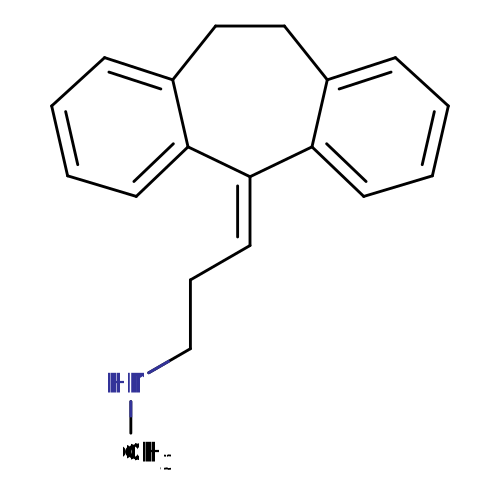
Structure for Nortriptyline (DB00540)
- Weight
- Average: 263.3767
Monoisotopic: 263.167399677 - Chemical Formula
- C19H21N
- Synonyms
- 10,11-dihydro-N-methyl-5H-dibenzo[a,d]cycloheptene-Δ5,γ-propylamine
- 3-(10,11-dihydro-5H-dibenzo[a,d]cyclohepten-5-ylidene)-N-methyl-1-propanamine
- Demethylamitriptyline
- Desmethylamitriptyline
- Nortriptylina
- Nortriptyline
- Nortriptylinum
- External IDs
- NCI-169453

Pharmacology
- Indication
Nortriptyline is indicated for the relief of the symptoms of major depressive disorder (MDD).18 Some off-label uses for this drug include treatment of chronic pain, myofascial pain, neuralgia, and irritable bowel syndrome.7,18
 Reduce drug development failure ratesBuild, train, & validate machine-learning modelswith evidence-based and structured datasets.Build, train, & validate predictive machine-learning models with structured datasets.
- Associated Conditions
Indication Type Indication Combined Product Details Approval Level Age Group Patient Characteristics Dose Form Management of Chronic pain ••• ••••• Management of Irritable bowel syndrome ••• ••••• Treatment of Major depressive disorder •••••••••••• Management of Myofascial pain ••• ••••• Management of Orofacial pain ••• ••••• - Contraindications & Blackbox Warnings
 Prevent Adverse Drug Events TodayTap into our Clinical API for life-saving information on contraindications & blackbox warnings, population restrictions, harmful risks, & more.Avoid life-threatening adverse drug events with our Clinical API
- Pharmacodynamics
Nortriptyline exerts antidepressant effects likely by inhibiting the reuptake of serotonin and norepinephrine at neuronal cell membranes. It also exerts antimuscarinic effects through its actions on the acetylcholine receptor.18,19
- Mechanism of action
Though prescribing information does not identify a specific mechanism of action for nortriptyline18, is believed that nortriptyline either inhibits the reuptake of the neurotransmitter serotonin at the neuronal membrane or acts at the level of the beta-adrenergic receptors. It displays a more selective reuptake inhibition for noradrenaline, which may explain increased symptom improvement after nortriptyline therapy.16 Tricyclic antidepressants do not inhibit monoamine oxidase nor do they affect dopamine reuptake.18 As with other tricyclics, nortriptyline displays affinity for other receptors including mACh receptors, histamine receptors, 5-HT receptors, in addition to other receptors.10,11,16
Target Actions Organism ASodium-dependent noradrenaline transporter inhibitorHumans ASodium-dependent serotonin transporter inhibitorHumans A5-hydroxytryptamine receptor 2A antagonistHumans U5-hydroxytryptamine receptor 1A antagonistHumans NHistamine H1 receptor antagonistHumans NAlpha-1A adrenergic receptor antagonistHumans NAlpha-1D adrenergic receptor antagonistHumans U5-hydroxytryptamine receptor 2C antagonistdownregulatorHumans UAlpha-1B adrenergic receptor antagonistHumans UAlpha-2 adrenergic receptors antagonistHumans UBeta adrenergic receptor antagonistHumans UDopamine D2 receptor antagonistHumans USigma receptor binderHumans U5-hydroxytryptamine receptor 1C antagonistRat UMuscarinic acetylcholine receptor antagonistHumans - Absorption
Nortriptyline is readily absorbed in the gastrointestinal tract with extensive variation in plasma levels, depending on the patient. This drug undergoes first-pass metabolism and its plasma concentrations are attained within 7 to 8.5 hours after oral administration.20 The bioavailability of nortriptyline varies considerably and ranges from 45 to 85%.12,21
- Volume of distribution
The apparent volume of distribution (Vd)β, estimated after intravenous administration is 1633 ± 268 L within the range of 1460 to 2030 (21 ± 4 L/kg).21 Nortriptyline crosses the placenta and is found in the breast milk. It distributes to the heart, lungs, brain, and the liver.20
- Protein binding
The plasma protein binding of nortriptyline is approximately 93%.21
- Metabolism
Nortriptyline is metabolized via demethylation and hydroxylation in the liver followed by glucuronic acid conjugation. CYP2D6 plays a large role in nortriptyline metabolism, with contributions from CYP1A2, CYP2C19 and CYP3A4.14,18,15 The main active metabolite is 10-hydroxynortriptyline exists in both cis and a trans form, with the trans form is higher in potency. 10-hydroxynortriptyline is the most frequently found in the plasma. Most of the other metabolites are conjugated, and are less potent.21
Hover over products below to view reaction partners
- Route of elimination
Nortriptyline and its metabolites are mainly excreted in the urine, where only small amounts (2%) of the total drug is recovered as unchanged parent compound.21 Approximately one-third of a single orally administered dose is excreted in urine within 24 hours.20 Small amounts are excreted in feces via biliary elimination.21
- Half-life
The average plasma half-life of nortriptyline in healthy volunteers is about 26 hours, but is said to range from 16 to 38 hours.8,18,21 One study mentions a mean half-life of about 39 hours.9
- Clearance
The average plasma clearance of nortriptyline in a study of healthy volunteers was 54 L/h.8 The average systemic clearance of nortriptyline is 30.6 ± 6.9 L / h, within the range of 18.6 to 39.6 L/hour.21
- Adverse Effects
 Improve decision support & research outcomesWith structured adverse effects data, including: blackbox warnings, adverse reactions, warning & precautions, & incidence rates. View sample adverse effects data in our new Data Library!Improve decision support & research outcomes with our structured adverse effects data.
- Toxicity
The oral LD50 of nortriptyline in the rat is 405 mg/kg.22Symptoms of overdose with nortriptyline include cardiac arrhythmias, severe hypotension, shock, congestive heart failure, pulmonary edema, convulsions, coma, and CNS depression.18,20 Changes in the electrocardiogram, particularly in QRS segment, may be indicative of tricyclic antidepressant toxicity.13
- Pathways
- Not Available
- Pharmacogenomic Effects/ADRs
Interacting Gene/Enzyme Allele name Genotype(s) Defining Change(s) Type(s) Description Details Cytochrome P450 2D6 CYP2D6*4 (A;A) A Allele Effect Directly Studied Patients with this genotype have reduced metabolism of nortriptyline. Details Cytochrome P450 2D6 CYP2D6*3 Not Available 2549delA Effect Directly Studied The presence of this polymorphism in CYP2D6 is associated with reduced or poor metabolism of nortriptyline. Details Cytochrome P450 2D6 CYP2D6*4 Not Available A allele Effect Directly Studied The presence of this polymorphism in CYP2D6 is associated with reduced or poor metabolism of nortriptyline. Details Cytochrome P450 2D6 CYP2D6*5 Not Available Whole-gene deletion Effect Directly Studied The presence of this polymorphism in CYP2D6 is associated with reduced or poor metabolism of nortriptyline. Details Cytochrome P450 2D6 CYP2D6*6 Not Available 1707delT Effect Directly Studied The presence of this polymorphism in CYP2D6 is associated with reduced or poor metabolism of nortriptyline. Details Cytochrome P450 2D6 CYP2D6*7 Not Available 2935A>C Effect Inferred Poor drug metabolizer. For individual with two non-functional alleles, alternative drug or dose reduction recommended. Details Cytochrome P450 2D6 CYP2D6*8 Not Available 1758G>T Effect Inferred Poor drug metabolizer. For individual with two non-functional alleles, alternative drug or dose reduction recommended. Details Cytochrome P450 2D6 CYP2D6*11 Not Available 883G>C Effect Inferred Poor drug metabolizer. For individual with two non-functional alleles, alternative drug or dose reduction recommended. Details Cytochrome P450 2D6 CYP2D6*12 Not Available 124G>A Effect Inferred Poor drug metabolizer. For individual with two non-functional alleles, alternative drug or dose reduction recommended. Details Cytochrome P450 2D6 CYP2D6*13 Not Available CYP2D7/2D6 hybrid gene structure Effect Inferred Poor drug metabolizer. For individual with two non-functional alleles, alternative drug or dose reduction recommended. Details Cytochrome P450 2D6 CYP2D6*14A Not Available 1758G>A Effect Inferred Poor drug metabolizer. For individual with two non-functional alleles, alternative drug or dose reduction recommended. Details Cytochrome P450 2D6 CYP2D6*15 Not Available 137insT, 137_138insT Effect Inferred Poor drug metabolizer. For individual with two non-functional alleles, alternative drug or dose reduction recommended. Details Cytochrome P450 2D6 CYP2D6*19 Not Available 2539_2542delAACT Effect Inferred Poor drug metabolizer. For individual with two non-functional alleles, alternative drug or dose reduction recommended. Details Cytochrome P450 2D6 CYP2D6*20 Not Available 1973_1974insG Effect Inferred Poor drug metabolizer. For individual with two non-functional alleles, alternative drug or dose reduction recommended. Details Cytochrome P450 2D6 CYP2D6*21 Not Available 2573insC Effect Inferred Poor drug metabolizer. For individual with two non-functional alleles, alternative drug or dose reduction recommended. Details Cytochrome P450 2D6 CYP2D6*31 Not Available -1770G>A / -1584C>G … show all Effect Inferred Poor drug metabolizer. For individual with two non-functional alleles, alternative drug or dose reduction recommended. Details Cytochrome P450 2D6 CYP2D6*36 Not Available 100C>T / -1426C>T … show all Effect Inferred Poor drug metabolizer. For individual with two non-functional alleles, alternative drug or dose reduction recommended. Details Cytochrome P450 2D6 CYP2D6*38 Not Available 2587_2590delGACT Effect Inferred Poor drug metabolizer. For individual with two non-functional alleles, alternative drug or dose reduction recommended. Details Cytochrome P450 2D6 CYP2D6*40 Not Available 1863_1864ins(TTT CGC CCC)2 Effect Inferred Poor drug metabolizer. For individual with two non-functional alleles, alternative drug or dose reduction recommended. Details Cytochrome P450 2D6 CYP2D6*42 Not Available 3259_3260insGT Effect Inferred Poor drug metabolizer. For individual with two non-functional alleles, alternative drug or dose reduction recommended. Details Cytochrome P450 2D6 CYP2D6*44 Not Available 2950G>C Effect Inferred Poor drug metabolizer. For individual with two non-functional alleles, alternative drug or dose reduction recommended. Details Cytochrome P450 2D6 CYP2D6*47 Not Available 100C>T / -1426C>T … show all Effect Inferred Poor drug metabolizer. For individual with two non-functional alleles, alternative drug or dose reduction recommended. Details Cytochrome P450 2D6 CYP2D6*51 Not Available -1584C>G / -1235A>G … show all Effect Inferred Poor drug metabolizer. For individual with two non-functional alleles, alternative drug or dose reduction recommended. Details Cytochrome P450 2D6 CYP2D6*56 Not Available 3201C>T Effect Inferred Poor drug metabolizer. For individual with two non-functional alleles, alternative drug or dose reduction recommended. Details Cytochrome P450 2D6 CYP2D6*57 Not Available 100C>T / 310G>T … show all Effect Inferred Poor drug metabolizer. For individual with two non-functional alleles, alternative drug or dose reduction recommended. Details Cytochrome P450 2D6 CYP2D6*62 Not Available 4044C>T Effect Inferred Poor drug metabolizer. For individual with two non-functional alleles, alternative drug or dose reduction recommended. Details Cytochrome P450 2D6 CYP2D6*68A Not Available -1426C>T / -1235A>G … show all Effect Inferred Poor drug metabolizer. For individual with two non-functional alleles, alternative drug or dose reduction recommended. Details Cytochrome P450 2D6 CYP2D6*68B Not Available Similar but not identical switch region compared to CYP2D6*68A. Found in tandem arrangement with CYP2D6*4. Effect Inferred Poor drug metabolizer. For individual with two non-functional alleles, alternative drug or dose reduction recommended. Details Cytochrome P450 2D6 CYP2D6*69 Not Available 2988G>A / -1426C>T … show all Effect Inferred Poor drug metabolizer. For individual with two non-functional alleles, alternative drug or dose reduction recommended. Details Cytochrome P450 2D6 CYP2D6*92 Not Available 1995delC Effect Inferred Poor drug metabolizer. For individual with two non-functional alleles, alternative drug or dose reduction recommended. Details Cytochrome P450 2D6 CYP2D6*100 Not Available -1426C>T / -1235A>G … show all Effect Inferred Poor drug metabolizer. For individual with two non-functional alleles, alternative drug or dose reduction recommended. Details Cytochrome P450 2D6 CYP2D6*101 Not Available -1426C>T / -1235A>G … show all Effect Inferred Poor drug metabolizer. For individual with two non-functional alleles, alternative drug or dose reduction recommended. Details Cytochrome P450 2D6 CYP2D6*3 Not Available C allele Effect Inferred Poor drug metabolizer, lower dose requirements, higher risk for adverse side effects Details Cytochrome P450 2D6 CYP2D6*5 Not Available Whole-gene deletion Effect Inferred Poor drug metabolizer, lower dose requirements, higher risk for adverse side effects Details Cytochrome P450 2D6 CYP2D6*6 Not Available 1707delT Effect Inferred Poor drug metabolizer, lower dose requirements, higher risk for adverse side effects Details Cytochrome P450 2D6 CYP2D6*7 Not Available 2935A>C Effect Inferred Poor drug metabolizer, lower dose requirements, higher risk for adverse side effects Details Cytochrome P450 2D6 CYP2D6*8 Not Available 1758G>T Effect Inferred Poor drug metabolizer, lower dose requirements, higher risk for adverse side effects Details Cytochrome P450 2D6 CYP2D6*11 Not Available 883G>C Effect Inferred Poor drug metabolizer, lower dose requirements, higher risk for adverse side effects Details Cytochrome P450 2D6 CYP2D6*12 Not Available 124G>A Effect Inferred Poor drug metabolizer, lower dose requirements, higher risk for adverse side effects Details Cytochrome P450 2D6 CYP2D6*13 Not Available CYP2D7/2D6 hybrid gene structure Effect Inferred Poor drug metabolizer, lower dose requirements, higher risk for adverse side effects Details Cytochrome P450 2D6 CYP2D6*14A Not Available 1758G>A Effect Inferred Poor drug metabolizer, lower dose requirements, higher risk for adverse side effects Details Cytochrome P450 2D6 CYP2D6*15 Not Available 137insT, 137_138insT Effect Inferred Poor drug metabolizer, lower dose requirements, higher risk for adverse side effects Details Cytochrome P450 2D6 CYP2D6*19 Not Available 2539_2542delAACT Effect Inferred Poor drug metabolizer, lower dose requirements, higher risk for adverse side effects Details Cytochrome P450 2D6 CYP2D6*20 Not Available 1973_1974insG Effect Inferred Poor drug metabolizer, lower dose requirements, higher risk for adverse side effects Details Cytochrome P450 2D6 CYP2D6*21 Not Available 2573insC Effect Inferred Poor drug metabolizer, lower dose requirements, higher risk for adverse side effects Details Cytochrome P450 2D6 CYP2D6*31 Not Available -1770G>A / -1584C>G … show all Effect Inferred Poor drug metabolizer, lower dose requirements, higher risk for adverse side effects Details Cytochrome P450 2D6 CYP2D6*36 Not Available 100C>T / -1426C>T … show all Effect Inferred Poor drug metabolizer, lower dose requirements, higher risk for adverse side effects Details Cytochrome P450 2D6 CYP2D6*38 Not Available 2587_2590delGACT Effect Inferred Poor drug metabolizer, lower dose requirements, higher risk for adverse side effects Details Cytochrome P450 2D6 CYP2D6*40 Not Available 1863_1864ins(TTT CGC CCC)2 Effect Inferred Poor drug metabolizer, lower dose requirements, higher risk for adverse side effects Details Cytochrome P450 2D6 CYP2D6*42 Not Available 3259_3260insGT Effect Inferred Poor drug metabolizer, lower dose requirements, higher risk for adverse side effects Details Cytochrome P450 2D6 CYP2D6*44 Not Available 2950G>C Effect Inferred Poor drug metabolizer, lower dose requirements, higher risk for adverse side effects Details Cytochrome P450 2D6 CYP2D6*47 Not Available 100C>T / -1426C>T … show all Effect Inferred Poor drug metabolizer, lower dose requirements, higher risk for adverse side effects Details Cytochrome P450 2D6 CYP2D6*51 Not Available -1584C>G / -1235A>G … show all Effect Inferred Poor drug metabolizer, lower dose requirements, higher risk for adverse side effects Details Cytochrome P450 2D6 CYP2D6*56 Not Available 3201C>T Effect Inferred Poor drug metabolizer, lower dose requirements, higher risk for adverse side effects Details Cytochrome P450 2D6 CYP2D6*57 Not Available 100C>T / 310G>T … show all Effect Inferred Poor drug metabolizer, lower dose requirements, higher risk for adverse side effects Details Cytochrome P450 2D6 CYP2D6*62 Not Available 4044C>T Effect Inferred Poor drug metabolizer, lower dose requirements, higher risk for adverse side effects Details Cytochrome P450 2D6 CYP2D6*68A Not Available -1426C>T / -1235A>G … show all Effect Inferred Poor drug metabolizer, lower dose requirements, higher risk for adverse side effects Details Cytochrome P450 2D6 CYP2D6*68B Not Available Similar but not identical switch region compared to CYP2D6*68A. Found in tandem arrangement with CYP2D6*4. Effect Inferred Poor drug metabolizer, lower dose requirements, higher risk for adverse side effects Details Cytochrome P450 2D6 CYP2D6*69 Not Available 2988G>A / -1426C>T … show all Effect Inferred Poor drug metabolizer, lower dose requirements, higher risk for adverse side effects Details Cytochrome P450 2D6 CYP2D6*92 Not Available 1995delC Effect Inferred Poor drug metabolizer, lower dose requirements, higher risk for adverse side effects Details Cytochrome P450 2D6 CYP2D6*100 Not Available -1426C>T / -1235A>G … show all Effect Inferred Poor drug metabolizer, lower dose requirements, higher risk for adverse side effects Details Cytochrome P450 2D6 CYP2D6*101 Not Available -1426C>T / -1235A>G … show all Effect Inferred Poor drug metabolizer, lower dose requirements, higher risk for adverse side effects Details Cytochrome P450 2D6 CYP2D6*3 Not Available G allele Effect Directly Studied The presence of this polymorphism in CYP2D6 is associated with reduced or poor metabolism of nortriptyline. Details Cytochrome P450 2D6 CYP2D6*4 Not Available 3877G>A Effect Directly Studied The presence of this polymorphism in CYP2D6 is associated with reduced or poor metabolism of nortriptyline. Details
Interactions
- Drug Interactions
- This information should not be interpreted without the help of a healthcare provider. If you believe you are experiencing an interaction, contact a healthcare provider immediately. The absence of an interaction does not necessarily mean no interactions exist.
Drug Interaction Integrate drug-drug
interactions in your software1,2-Benzodiazepine The risk or severity of CNS depression can be increased when Nortriptyline is combined with 1,2-Benzodiazepine. Abametapir The serum concentration of Nortriptyline can be increased when it is combined with Abametapir. Abatacept The metabolism of Nortriptyline can be increased when combined with Abatacept. Abiraterone The metabolism of Nortriptyline can be decreased when combined with Abiraterone. Abrocitinib The serum concentration of Nortriptyline can be increased when it is combined with Abrocitinib. - Food Interactions
- Avoid alcohol.
- Take with or without food. Food decreases gastrointestinal irritation.
Products
 Drug product information from 10+ global regionsOur datasets provide approved product information including:dosage, form, labeller, route of administration, and marketing period.Access drug product information from over 10 global regions.
- Product Ingredients
Ingredient UNII CAS InChI Key Nortriptyline hydrochloride 00FN6IH15D 894-71-3 SHAYBENGXDALFF-UHFFFAOYSA-N - Product Images
- International/Other Brands
- Allegron / Ateben / Avantyl / Noritren / Norpress / Nortrilen / Psychostyl / Sensaval / Sensoval
- Brand Name Prescription Products
Name Dosage Strength Route Labeller Marketing Start Marketing End Region Image Aventyl Capsule 25 mg Oral Aa Pharma Inc 1965-12-31 Not applicable Canada 
Aventyl Capsule 10 mg Oral Aa Pharma Inc 1965-12-31 Not applicable Canada Nortriptyline Capsule 10 mg Oral Apotex Corporation 1996-07-23 Not applicable Canada Nortriptyline Capsule 25 mg Oral Pharmel Inc 1998-06-04 2014-09-08 Canada Nortriptyline Capsule 10 mg Oral Pharmel Inc 1998-06-04 2014-09-08 Canada - Generic Prescription Products
Name Dosage Strength Route Labeller Marketing Start Marketing End Region Image Apo-nortriptyline Capsule 10 mg Oral Apotex Corporation 1996-09-26 Not applicable Canada Apo-nortriptyline Capsule 25 mg Oral Apotex Corporation 1996-09-26 Not applicable Canada Ava-nortriptyline Capsule 25 mg Oral Avanstra Inc 2011-11-28 2014-08-21 Canada Ava-nortriptyline Capsule 10 mg Oral Avanstra Inc 2011-11-28 2014-08-21 Canada Dom-nortriptyline 10mg Capsules Capsule 10 mg Oral Dominion Pharmacal 1995-10-01 2014-09-08 Canada - Mixture Products
Name Ingredients Dosage Route Labeller Marketing Start Marketing End Region Image เซตาวอล Nortriptyline (10 MG) + Fluphenazine (0.5 MG) Tablet, sugar coated Oral บริษัท ฟาร์มาสันต์ แล็บบอราตอรี่ส์ จำกัด จำกัด 1996-08-12 Not applicable Thailand 


Categories
- ATC Codes
- N06AA10 — Nortriptyline
- Drug Categories
- Adrenergic Agents
- Adrenergic alpha-1 Receptor Antagonists
- Adrenergic alpha-Antagonists
- Adrenergic Antagonists
- Adrenergic Uptake Inhibitors
- Agents producing tachycardia
- Agents that produce hypertension
- Agents that reduce seizure threshold
- Anticholinergic Agents
- Antidepressive Agents
- Antidepressive Agents Indicated for Depression
- Antidepressive Agents, Tricyclic
- Benzocycloheptenes
- Central Nervous System Agents
- Central Nervous System Depressants
- Combined Inhibitors of Serotonin/Norepinephrine Reuptake
- Cytochrome P-450 CYP1A2 Substrates
- Cytochrome P-450 CYP1A2 Substrates with a Narrow Therapeutic Index
- Cytochrome P-450 CYP2C19 Substrates
- Cytochrome P-450 CYP2C19 Substrates with a Narrow Therapeutic Index
- Cytochrome P-450 CYP2D6 Inhibitors
- Cytochrome P-450 CYP2D6 Inhibitors (strength unknown)
- Cytochrome P-450 CYP2D6 Substrates
- Cytochrome P-450 CYP2D6 Substrates with a Narrow Therapeutic Index
- Cytochrome P-450 CYP2E1 Inhibitors
- Cytochrome P-450 CYP2E1 Inhibitors (strength unknown)
- Cytochrome P-450 CYP3A Substrates
- Cytochrome P-450 CYP3A4 Substrates
- Cytochrome P-450 CYP3A4 Substrates with a Narrow Therapeutic Index
- Cytochrome P-450 CYP3A5 Substrates
- Cytochrome P-450 CYP3A5 Substrates with a Narrow Therapeutic Index
- Cytochrome P-450 Enzyme Inhibitors
- Cytochrome P-450 Substrates
- Dibenzocycloheptenes
- Dopamine Antagonists
- Dopamine D2 Receptor Antagonists
- Histamine Antagonists
- Histamine H1 Antagonists
- Membrane Transport Modulators
- Muscarinic Antagonists
- Narrow Therapeutic Index Drugs
- Nervous System
- Neurotoxic agents
- Neurotransmitter Agents
- Neurotransmitter Uptake Inhibitors
- Non-Selective Monoamine Reuptake Inhibitors
- P-glycoprotein substrates
- P-glycoprotein substrates with a Narrow Therapeutic Index
- Potential QTc-Prolonging Agents
- Psychoanaleptics
- Psychotropic Drugs
- QTc Prolonging Agents
- Serotonergic Drugs Shown to Increase Risk of Serotonin Syndrome
- Serotonin 5-HT1 Receptor Antagonists
- Serotonin 5-HT1A Receptor Antagonists
- Serotonin 5-HT2 Receptor Antagonists
- Serotonin 5-HT2A Receptor Antagonists
- Serotonin 5-HT2C Receptor Antagonists
- Serotonin Agents
- Serotonin Modulators
- Serotonin Receptor Antagonists
- Tricyclics and Other Norepinephrine-reuptake Inhibitors
- Chemical TaxonomyProvided by Classyfire
- Description
- This compound belongs to the class of organic compounds known as dibenzocycloheptenes. These are compounds containing a dibenzocycloheptene moiety, which consists of two benzene rings connected by a cycloheptene ring.
- Kingdom
- Organic compounds
- Super Class
- Benzenoids
- Class
- Dibenzocycloheptenes
- Sub Class
- Not Available
- Direct Parent
- Dibenzocycloheptenes
- Alternative Parents
- Dialkylamines / Organopnictogen compounds / Hydrocarbon derivatives
- Substituents
- Amine / Aromatic homopolycyclic compound / Dibenzocycloheptene / Hydrocarbon derivative / Organic nitrogen compound / Organonitrogen compound / Organopnictogen compound / Secondary aliphatic amine / Secondary amine
- Molecular Framework
- Aromatic homopolycyclic compounds
- External Descriptors
- organic tricyclic compound (CHEBI:7640)
- Affected organisms
- Humans and other mammals
Chemical Identifiers
- UNII
- BL03SY4LXB
- CAS number
- 72-69-5
- InChI Key
- PHVGLTMQBUFIQQ-UHFFFAOYSA-N
- InChI
- InChI=1S/C19H21N/c1-20-14-6-11-19-17-9-4-2-7-15(17)12-13-16-8-3-5-10-18(16)19/h2-5,7-11,20H,6,12-14H2,1H3
- IUPAC Name
- methyl(3-{tricyclo[9.4.0.0^{3,8}]pentadeca-1(15),3,5,7,11,13-hexaen-2-ylidene}propyl)amine
- SMILES
- CNCCC=C1C2=CC=CC=C2CCC2=CC=CC=C12
References
- Synthesis Reference
Abraham Nudelman, "ACID ADDITION SALT OF A NORTRIPTYLINE-GABA CONJUGATE AND A PROCESS OF PREPARING SAME." U.S. Patent US20130184347, issued July 18, 2013.
US20130184347- General References
- Prochazka AV, Weaver MJ, Keller RT, Fryer GE, Licari PA, Lofaso D: A randomized trial of nortriptyline for smoking cessation. Arch Intern Med. 1998 Oct 12;158(18):2035-9. [Article]
- Nelson JC, Kennedy JS, Pollock BG, Laghrissi-Thode F, Narayan M, Nobler MS, Robin DW, Gergel I, McCafferty J, Roose S: Treatment of major depression with nortriptyline and paroxetine in patients with ischemic heart disease. Am J Psychiatry. 1999 Jul;156(7):1024-8. doi: 10.1176/ajp.156.7.1024. [Article]
- Fabre LF, Scharf MB, Itil TM: Comparative efficacy and safety of nortriptyline and fluoxetine in the treatment of major depression: a clinical study. J Clin Psychiatry. 1991 Jun;52 Suppl:62-7. [Article]
- Heymann RE, Helfenstein M, Feldman D: A double-blind, randomized, controlled study of amitriptyline, nortriptyline and placebo in patients with fibromyalgia. An analysis of outcome measures. Clin Exp Rheumatol. 2001 Nov-Dec;19(6):697-702. [Article]
- Lustman PJ, Griffith LS, Clouse RE, Freedland KE, Eisen SA, Rubin EH, Carney RM, McGill JB: Effects of nortriptyline on depression and glycemic control in diabetes: results of a double-blind, placebo-controlled trial. Psychosom Med. 1997 May-Jun;59(3):241-50. [Article]
- Gillman PK: Tricyclic antidepressant pharmacology and therapeutic drug interactions updated. Br J Pharmacol. 2007 Jul;151(6):737-48. Epub 2007 Apr 30. [Article]
- Clouse RE: Antidepressants for irritable bowel syndrome. Gut. 2003 Apr;52(4):598-9. doi: 10.1136/gut.52.4.598. [Article]
- Dawling S, Crome P, Braithwaite R: Pharmacokinetics of single oral doses of nortriptyline in depressed elderly hospital patients and young healthy volunteers. Clin Pharmacokinet. 1980 Jul-Aug;5(4):394-401. doi: 10.2165/00003088-198005040-00007. [Article]
- Overo KF: Pharmacokinetic aspects on once-daily nortriptyline administration. Neuropsychobiology. 1980;6(1):34-41. doi: 10.1159/000117730. [Article]
- Peroutka SJ, Snyder SH: Antiemetics: neurotransmitter receptor binding predicts therapeutic actions. Lancet. 1982 Mar 20;1(8273):658-9. [Article]
- Cusack B, Nelson A, Richelson E: Binding of antidepressants to human brain receptors: focus on newer generation compounds. Psychopharmacology (Berl). 1994 May;114(4):559-65. [Article]
- Gibaldi M: Comparison of observed and predicted bioavailability of nortriptyline in humans following oral administration. J Pharm Sci. 1975 Jun;64(6):1036-7. doi: 10.1002/jps.2600640635. [Article]
- Elsamadisi P, Sclafani A, Eche IM: Delayed Cardiotoxicity From a Massive Nortriptyline Overdose Requiring Prolonged Treatment. J Pharm Pract. 2019 Apr 14:897190019838700. doi: 10.1177/0897190019838700. [Article]
- Venkatakrishnan K, von Moltke LL, Greenblatt DJ: Nortriptyline E-10-hydroxylation in vitro is mediated by human CYP2D6 (high affinity) and CYP3A4 (low affinity): implications for interactions with enzyme-inducing drugs. J Clin Pharmacol. 1999 Jun;39(6):567-77. [Article]
- Olesen OV, Linnet K: Hydroxylation and demethylation of the tricyclic antidepressant nortriptyline by cDNA-expressed human cytochrome P-450 isozymes. Drug Metab Dispos. 1997 Jun;25(6):740-4. [Article]
- 46. (2012). In Rang and Dale's Pharmacology (7th ed., pp. 574-575). Edinburgh: Elsevier/Churchill Livingstone. [ISBN:978-0-7020-3471-8]
- EMC Summary of product characteristics: Nortriptyline [Link]
- FDA Approved Products: Nortriptyline oral capsules and oral solution [Link]
- NIH StatPearls: Nortriptyline [Link]
- Product monograph: Nortriptyline tablets [Link]
- MedSafe NZ data sheet: Nortriptyline tablets [Link]
- CaymanChem MSDS: Nortriptyline [Link]
- External Links
- Human Metabolome Database
- HMDB0014680
- KEGG Drug
- D08288
- KEGG Compound
- C07274
- PubChem Compound
- 4543
- PubChem Substance
- 46507783
- ChemSpider
- 4384
- BindingDB
- 112777
- 7531
- ChEBI
- 7640
- ChEMBL
- CHEMBL445
- ZINC
- ZINC000001530741
- Therapeutic Targets Database
- DAP001152
- PharmGKB
- PA450657
- Guide to Pharmacology
- GtP Drug Page
- PDBe Ligand
- 21B
- RxList
- RxList Drug Page
- Drugs.com
- Drugs.com Drug Page
- Wikipedia
- Nortriptyline
- PDB Entries
- 4m48
- FDA label
- Download (376 KB)
- MSDS
- Download (38.8 KB)
Clinical Trials
- Clinical Trials
Phase Status Purpose Conditions Count 4 Active Not Recruiting Treatment Dementia / Depression / Geriatric Depression / Late Life Depression (LLD) / Major Depressive Disorder (MDD) / Major depressive disorder, recurrent episode / Mild Cognitive Impairment (MCI) / Treatment-Refractory Depression 1 4 Active Not Recruiting Treatment Mild Traumatic Brain Injury (MTBI) / Post Concussion Syndrome / Post-Traumatic Headaches 1 4 Completed Treatment Bipolar Disorder (BD) 1 4 Completed Treatment Bipolar Disorder (BD) / Depression / Depressive Disorder 1 4 Completed Treatment Cryptogenic Sensory Peripheral Neuropathy 1
Pharmacoeconomics
- Manufacturers
- Eli lilly and co
- Mylan pharmaceuticals inc
- Sandoz inc
- Taro pharmaceuticals inc
- Teva pharmaceuticals usa inc
- Watson laboratories inc
- Tyco healthcare group lp
- Ranbaxy pharmaceuticals inc
- Pharmaceutical assoc inc
- Taro pharmaceutical industries ltd
- Packagers
- Advanced Pharmaceutical Services Inc.
- Amerisource Health Services Corp.
- Apotheca Inc.
- A-S Medication Solutions LLC
- Bryant Ranch Prepack
- Caremark LLC
- Dispensing Solutions
- Diversified Healthcare Services Inc.
- Gallipot
- H.J. Harkins Co. Inc.
- Heartland Repack Services LLC
- Innoviant Pharmacy Inc.
- Kaiser Foundation Hospital
- Keltman Pharmaceuticals Inc.
- Lake Erie Medical and Surgical Supply
- Major Pharmaceuticals
- Mallinckrodt Inc.
- Mckesson Corp.
- Medvantx Inc.
- Murfreesboro Pharmaceutical Nursing Supply
- Mylan
- Novartis AG
- Nucare Pharmaceuticals Inc.
- Palmetto Pharmaceuticals Inc.
- Patheon Inc.
- PD-Rx Pharmaceuticals Inc.
- Pharmaceutical Association
- Physicians Total Care Inc.
- Preferred Pharmaceuticals Inc.
- Prepackage Specialists
- Prepak Systems Inc.
- Prescription Dispensing Service Inc.
- Ranbaxy Laboratories
- Rebel Distributors Corp.
- Remedy Repack
- Southwood Pharmaceuticals
- St Mary's Medical Park Pharmacy
- Stat Rx Usa
- Taro Pharmaceuticals USA
- Teva Pharmaceutical Industries Ltd.
- UDL Laboratories
- Vangard Labs Inc.
- Watson Pharmaceuticals
- Dosage Forms
Form Route Strength Capsule Oral 10 mg Capsule Oral 25 mg Tablet, coated Oral 500 mg Capsule Oral 10 mg / cap Capsule Oral 25 mg / cap Solution Oral 5 MG/ML Tablet, coated Oral 10 MG Tablet, coated Oral 25 MG Capsule Oral 10 mg/1 Capsule Oral 25 mg/1 Capsule Oral 50 mg/1 Capsule Oral 75 mg/1 Solution Oral 10 mg/5mL Solution Oral 20 mg/10mL Solution Oral 2 mg/1mL Capsule Oral Tablet 25 mg Tablet, sugar coated Oral 10 mg Tablet, sugar coated Oral 25 mg Tablet, film coated Oral 10 mg Tablet, film coated Oral 25 mg Tablet, sugar coated Oral - Prices
Unit description Cost Unit Pamelor 30 10 mg capsule Bottle 750.05USD bottle Pamelor 30 25 mg capsule Bottle 750.05USD bottle Pamelor 30 50 mg capsule Bottle 750.05USD bottle Pamelor 10 mg/5ml Solution 480ml Bottle 325.97USD bottle Pamelor 10 mg capsule 24.04USD capsule Pamelor 25 mg capsule 24.04USD capsule Pamelor 50 mg capsule 24.04USD capsule Pamelor 75 mg capsule 19.34USD capsule Nortriptyline hcl powder 11.09USD g Nortriptyline hcl 75 mg capsule 1.33USD capsule Nortriptyline hcl 50 mg capsule 0.94USD capsule Nortriptyline hcl 25 mg capsule 0.6USD capsule Aventyl 25 mg Capsule 0.48USD capsule Nortriptyline HCl 10 mg/5ml Solution 0.4USD ml Nortriptyline hcl 10 mg capsule 0.28USD capsule Apo-Nortriptyline 25 mg Capsule 0.27USD capsule Novo-Nortriptyline 25 mg Capsule 0.27USD capsule Nu-Nortriptyline 25 mg Capsule 0.27USD capsule Pms-Nortriptyline 25 mg Capsule 0.27USD capsule Aventyl 10 mg Capsule 0.24USD capsule Apo-Nortriptyline 10 mg Capsule 0.13USD capsule Novo-Nortriptyline 10 mg Capsule 0.13USD capsule Nu-Nortriptyline 10 mg Capsule 0.13USD capsule Pms-Nortriptyline 10 mg Capsule 0.13USD capsule DrugBank does not sell nor buy drugs. Pricing information is supplied for informational purposes only.- Patents
- Not Available
Properties
- State
- Solid
- Experimental Properties
Property Value Source melting point (°C) 58 https://www.chemicalbook.com/ChemicalProductProperty_US_CB1317147.aspx boiling point (°C) 396.62 https://www.chemicalbook.com/ChemicalProductProperty_US_CB1317147.aspx water solubility 0.00087 g/L http://www.hmdb.ca/metabolites/HMDB0014680 logP 3.9 Lead Optimization for Medicinal Chemists (2012) logS -5.5 http://www.hmdb.ca/metabolites/HMDB0014680 pKa 9.7 https://www.chemicalbook.com/ChemicalProductProperty_US_CB1317147.aspx - Predicted Properties
Property Value Source Water Solubility 0.000874 mg/mL ALOGPS logP 4.65 ALOGPS logP 4.43 Chemaxon logS -5.5 ALOGPS pKa (Strongest Basic) 10.47 Chemaxon Physiological Charge 1 Chemaxon Hydrogen Acceptor Count 1 Chemaxon Hydrogen Donor Count 1 Chemaxon Polar Surface Area 12.03 Å2 Chemaxon Rotatable Bond Count 3 Chemaxon Refractivity 96.21 m3·mol-1 Chemaxon Polarizability 31.87 Å3 Chemaxon Number of Rings 3 Chemaxon Bioavailability 1 Chemaxon Rule of Five Yes Chemaxon Ghose Filter Yes Chemaxon Veber's Rule Yes Chemaxon MDDR-like Rule No Chemaxon - Predicted ADMET Features
Property Value Probability Human Intestinal Absorption + 1.0 Blood Brain Barrier + 0.9478 Caco-2 permeable + 0.774 P-glycoprotein substrate Substrate 0.7863 P-glycoprotein inhibitor I Inhibitor 0.8876 P-glycoprotein inhibitor II Inhibitor 0.5376 Renal organic cation transporter Inhibitor 0.6903 CYP450 2C9 substrate Non-substrate 0.7508 CYP450 2D6 substrate Substrate 0.8919 CYP450 3A4 substrate Substrate 0.5593 CYP450 1A2 substrate Inhibitor 0.9107 CYP450 2C9 inhibitor Non-inhibitor 0.907 CYP450 2D6 inhibitor Inhibitor 0.8932 CYP450 2C19 inhibitor Non-inhibitor 0.9025 CYP450 3A4 inhibitor Non-inhibitor 0.7665 CYP450 inhibitory promiscuity Low CYP Inhibitory Promiscuity 0.5194 Ames test Non AMES toxic 0.5315 Carcinogenicity Non-carcinogens 0.9182 Biodegradation Ready biodegradable 0.5 Rat acute toxicity 2.7513 LD50, mol/kg Not applicable hERG inhibition (predictor I) Weak inhibitor 0.5809 hERG inhibition (predictor II) Inhibitor 0.7763
Spectra
- Mass Spec (NIST)
- Download (7.76 KB)
- Spectra
- Chromatographic Properties
Collision Cross Sections (CCS)
Adduct CCS Value (Å2) Source type Source [M-H]- 177.8510806 predictedDarkChem Lite v0.1.0 [M-H]- 158.99388 predictedDeepCCS 1.0 (2019) [M+H]+ 178.4202806 predictedDarkChem Lite v0.1.0 [M+H]+ 161.35188 predictedDeepCCS 1.0 (2019) [M+Na]+ 178.3275806 predictedDarkChem Lite v0.1.0 [M+Na]+ 167.44502 predictedDeepCCS 1.0 (2019)
Targets

- Kind
- Protein
- Organism
- Humans
- Pharmacological action
- Yes
- Actions
- Inhibitor
- General Function
- Norepinephrine:sodium symporter activity
- Specific Function
- Amine transporter. Terminates the action of noradrenaline by its high affinity sodium-dependent reuptake into presynaptic terminals.
- Gene Name
- SLC6A2
- Uniprot ID
- P23975
- Uniprot Name
- Sodium-dependent noradrenaline transporter
- Molecular Weight
- 69331.42 Da
References
- Roubert C, Cox PJ, Bruss M, Hamon M, Bonisch H, Giros B: Determination of residues in the norepinephrine transporter that are critical for tricyclic antidepressant affinity. J Biol Chem. 2001 Mar 16;276(11):8254-60. Epub 2000 Nov 22. [Article]
- Roubert C, Sagne C, Kapsimali M, Vernier P, Bourrat F, Giros B: A Na(+)/Cl(-)-dependent transporter for catecholamines, identified as a norepinephrine transporter, is expressed in the brain of the teleost fish medaka (Oryzias latipes). Mol Pharmacol. 2001 Sep;60(3):462-73. [Article]
- Vaishnavi SN, Nemeroff CB, Plott SJ, Rao SG, Kranzler J, Owens MJ: Milnacipran: a comparative analysis of human monoamine uptake and transporter binding affinity. Biol Psychiatry. 2004 Feb 1;55(3):320-2. [Article]
- Kim H, Lim SW, Kim S, Kim JW, Chang YH, Carroll BJ, Kim DK: Monoamine transporter gene polymorphisms and antidepressant response in koreans with late-life depression. JAMA. 2006 Oct 4;296(13):1609-18. [Article]
- Barker EL, Blakely RD: Identification of a single amino acid, phenylalanine 586, that is responsible for high affinity interactions of tricyclic antidepressants with the human serotonin transporter. Mol Pharmacol. 1996 Oct;50(4):957-65. [Article]
- Tatsumi M, Groshan K, Blakely RD, Richelson E: Pharmacological profile of antidepressants and related compounds at human monoamine transporters. Eur J Pharmacol. 1997 Dec 11;340(2-3):249-58. [Article]
- NIH StatPearls: Nortriptyline [Link]
- Kind
- Protein
- Organism
- Humans
- Pharmacological action
- Yes
- Actions
- Inhibitor
- General Function
- Serotonin:sodium symporter activity
- Specific Function
- Serotonin transporter whose primary function in the central nervous system involves the regulation of serotonergic signaling via transport of serotonin molecules from the synaptic cleft back into t...
- Gene Name
- SLC6A4
- Uniprot ID
- P31645
- Uniprot Name
- Sodium-dependent serotonin transporter
- Molecular Weight
- 70324.165 Da
References
- Joyce PR, Mulder RT, Luty SE, McKenzie JM, Miller AL, Rogers GR, Kennedy MA: Age-dependent antidepressant pharmacogenomics: polymorphisms of the serotonin transporter and G protein beta3 subunit as predictors of response to fluoxetine and nortriptyline. Int J Neuropsychopharmacol. 2003 Dec;6(4):339-46. [Article]
- Wisner KL, Hanusa BH, Perel JM, Peindl KS, Piontek CM, Sit DK, Findling RL, Moses-Kolko EL: Postpartum depression: a randomized trial of sertraline versus nortriptyline. J Clin Psychopharmacol. 2006 Aug;26(4):353-60. [Article]
- Pollock BG, Ferrell RE, Mulsant BH, Mazumdar S, Miller M, Sweet RA, Davis S, Kirshner MA, Houck PR, Stack JA, Reynolds CF, Kupfer DJ: Allelic variation in the serotonin transporter promoter affects onset of paroxetine treatment response in late-life depression. Neuropsychopharmacology. 2000 Nov;23(5):587-90. [Article]
- Vaishnavi SN, Nemeroff CB, Plott SJ, Rao SG, Kranzler J, Owens MJ: Milnacipran: a comparative analysis of human monoamine uptake and transporter binding affinity. Biol Psychiatry. 2004 Feb 1;55(3):320-2. [Article]
- Rausch JL, Moeller FG, Johnson ME: Initial platelet serotonin (5-HT) transport kinetics predict nortriptyline treatment outcome. J Clin Psychopharmacol. 2003 Apr;23(2):138-44. [Article]
- Tatsumi M, Groshan K, Blakely RD, Richelson E: Pharmacological profile of antidepressants and related compounds at human monoamine transporters. Eur J Pharmacol. 1997 Dec 11;340(2-3):249-58. [Article]
- NIH StatPearls: Nortriptyline [Link]
- Kind
- Protein
- Organism
- Humans
- Pharmacological action
- Yes
- Actions
- Antagonist
- General Function
- Virus receptor activity
- Specific Function
- G-protein coupled receptor for 5-hydroxytryptamine (serotonin). Also functions as a receptor for various drugs and psychoactive substances, including mescaline, psilocybin, 1-(2,5-dimethoxy-4-iodop...
- Gene Name
- HTR2A
- Uniprot ID
- P28223
- Uniprot Name
- 5-hydroxytryptamine receptor 2A
- Molecular Weight
- 52602.58 Da
References
- Cusack B, Nelson A, Richelson E: Binding of antidepressants to human brain receptors: focus on newer generation compounds. Psychopharmacology (Berl). 1994 May;114(4):559-65. [Article]
- Sanchez C, Hyttel J: Comparison of the effects of antidepressants and their metabolites on reuptake of biogenic amines and on receptor binding. Cell Mol Neurobiol. 1999 Aug;19(4):467-89. [Article]
- Bravo L, Llorca-Torralba M, Berrocoso E, Mico JA: Monoamines as Drug Targets in Chronic Pain: Focusing on Neuropathic Pain. Front Neurosci. 2019 Nov 26;13:1268. doi: 10.3389/fnins.2019.01268. eCollection 2019. [Article]
- NIH StatPearls: Nortriptyline [Link]
- Kind
- Protein
- Organism
- Humans
- Pharmacological action
- Unknown
- Actions
- Antagonist
- General Function
- Serotonin receptor activity
- Specific Function
- G-protein coupled receptor for 5-hydroxytryptamine (serotonin). Also functions as a receptor for various drugs and psychoactive substances. Ligand binding causes a conformation change that triggers...
- Gene Name
- HTR1A
- Uniprot ID
- P08908
- Uniprot Name
- 5-hydroxytryptamine receptor 1A
- Molecular Weight
- 46106.335 Da
References
- Cusack B, Nelson A, Richelson E: Binding of antidepressants to human brain receptors: focus on newer generation compounds. Psychopharmacology (Berl). 1994 May;114(4):559-65. [Article]
- Shrestha SS, Pine DS, Luckenbaugh DA, Varnas K, Henter ID, Innis RB, Mathe AA, Svenningsson P: Antidepressant effects on serotonin 1A/1B receptors in the rat brain using a gene x environment model. Neurosci Lett. 2014 Jan 24;559:163-8. doi: 10.1016/j.neulet.2013.11.034. Epub 2013 Nov 25. [Article]
- Bravo L, Llorca-Torralba M, Berrocoso E, Mico JA: Monoamines as Drug Targets in Chronic Pain: Focusing on Neuropathic Pain. Front Neurosci. 2019 Nov 26;13:1268. doi: 10.3389/fnins.2019.01268. eCollection 2019. [Article]
- Kind
- Protein
- Organism
- Humans
- Pharmacological action
- No
- Actions
- Antagonist
- General Function
- Histamine receptor activity
- Specific Function
- In peripheral tissues, the H1 subclass of histamine receptors mediates the contraction of smooth muscles, increase in capillary permeability due to contraction of terminal venules, and catecholamin...
- Gene Name
- HRH1
- Uniprot ID
- P35367
- Uniprot Name
- Histamine H1 receptor
- Molecular Weight
- 55783.61 Da
References
- Cusack B, Nelson A, Richelson E: Binding of antidepressants to human brain receptors: focus on newer generation compounds. Psychopharmacology (Berl). 1994 May;114(4):559-65. [Article]
- Sadava D, Wilmington K: Tricyclic antidepressant drugs affect histamine receptors in human leukocytes. Life Sci. 1984 Dec 17;35(25):2545-8. [Article]
- Taylor JE, Richelson E: High affinity binding of tricyclic antidepressants to histamine H1-receptors: fact and artifact. Eur J Pharmacol. 1980 Oct 3;67(1):41-6. [Article]
- NIH StatPearls: Nortriptyline [Link]
- Kind
- Protein
- Organism
- Humans
- Pharmacological action
- No
- Actions
- Antagonist
- General Function
- Protein heterodimerization activity
- Specific Function
- This alpha-adrenergic receptor mediates its action by association with G proteins that activate a phosphatidylinositol-calcium second messenger system. Its effect is mediated by G(q) and G(11) prot...
- Gene Name
- ADRA1A
- Uniprot ID
- P35348
- Uniprot Name
- Alpha-1A adrenergic receptor
- Molecular Weight
- 51486.005 Da
References
- Cusack B, Nelson A, Richelson E: Binding of antidepressants to human brain receptors: focus on newer generation compounds. Psychopharmacology (Berl). 1994 May;114(4):559-65. [Article]
- Nojimoto FD, Mueller A, Hebeler-Barbosa F, Akinaga J, Lima V, Kiguti LR, Pupo AS: The tricyclic antidepressants amitriptyline, nortriptyline and imipramine are weak antagonists of human and rat alpha1B-adrenoceptors. Neuropharmacology. 2010 Jul-Aug;59(1-2):49-57. doi: 10.1016/j.neuropharm.2010.03.015. Epub 2010 Apr 2. [Article]
- Ferry DG, Caplan NB, Cubeddu LX: Interaction between antidepressants and alpha 1-adrenergic receptor antagonists on the binding to alpha 1-acid glycoprotein. J Pharm Sci. 1986 Feb;75(2):146-9. doi: 10.1002/jps.2600750208. [Article]
- Kind
- Protein
- Organism
- Humans
- Pharmacological action
- No
- Actions
- Antagonist
- General Function
- Alpha1-adrenergic receptor activity
- Specific Function
- This alpha-adrenergic receptor mediates its effect through the influx of extracellular calcium.
- Gene Name
- ADRA1D
- Uniprot ID
- P25100
- Uniprot Name
- Alpha-1D adrenergic receptor
- Molecular Weight
- 60462.205 Da
References
- Nojimoto FD, Mueller A, Hebeler-Barbosa F, Akinaga J, Lima V, Kiguti LR, Pupo AS: The tricyclic antidepressants amitriptyline, nortriptyline and imipramine are weak antagonists of human and rat alpha1B-adrenoceptors. Neuropharmacology. 2010 Jul-Aug;59(1-2):49-57. doi: 10.1016/j.neuropharm.2010.03.015. Epub 2010 Apr 2. [Article]
- Kind
- Protein
- Organism
- Humans
- Pharmacological action
- Unknown
- Actions
- AntagonistDownregulator
- General Function
- Serotonin receptor activity
- Specific Function
- G-protein coupled receptor for 5-hydroxytryptamine (serotonin). Also functions as a receptor for various drugs and psychoactive substances, including ergot alkaloid derivatives, 1-2,5,-dimethoxy-4-...
- Gene Name
- HTR2C
- Uniprot ID
- P28335
- Uniprot Name
- 5-hydroxytryptamine receptor 2C
- Molecular Weight
- 51820.705 Da
References
- Palvimaki EP, Roth BL, Majasuo H, Laakso A, Kuoppamaki M, Syvalahti E, Hietala J: Interactions of selective serotonin reuptake inhibitors with the serotonin 5-HT2c receptor. Psychopharmacology (Berl). 1996 Aug;126(3):234-40. [Article]
- Stahl SM, Hauger RL, Rausch JL, Fleishaker JC, Hubbell-Alberts E: Downregulation of serotonin receptor subtypes by nortriptyline and adinazolam in major depressive disorder: neuroendocrine and platelet markers. Clin Neuropharmacol. 1993;16 Suppl 3:S19-31. [Article]
- Kind
- Protein
- Organism
- Humans
- Pharmacological action
- Unknown
- Actions
- Antagonist
- General Function
- Protein heterodimerization activity
- Specific Function
- This alpha-adrenergic receptor mediates its action by association with G proteins that activate a phosphatidylinositol-calcium second messenger system. Its effect is mediated by G(q) and G(11) prot...
- Gene Name
- ADRA1B
- Uniprot ID
- P35368
- Uniprot Name
- Alpha-1B adrenergic receptor
- Molecular Weight
- 56835.375 Da
References
- Nojimoto FD, Mueller A, Hebeler-Barbosa F, Akinaga J, Lima V, Kiguti LR, Pupo AS: The tricyclic antidepressants amitriptyline, nortriptyline and imipramine are weak antagonists of human and rat alpha1B-adrenoceptors. Neuropharmacology. 2010 Jul-Aug;59(1-2):49-57. doi: 10.1016/j.neuropharm.2010.03.015. Epub 2010 Apr 2. [Article]
- Kind
- Protein group
- Organism
- Humans
- Pharmacological action
- Unknown
- Actions
- Antagonist
- General Function
- Thioesterase binding
- Specific Function
- Alpha-2 adrenergic receptors mediate the catecholamine-induced inhibition of adenylate cyclase through the action of G proteins. The rank order of potency for agonists of this receptor is oxymetazo...
Components:
| Name | UniProt ID |
|---|---|
| Alpha-2A adrenergic receptor | P08913 |
| Alpha-2B adrenergic receptor | P18089 |
| Alpha-2C adrenergic receptor | P18825 |
References
- Zebrowska-Lupina I, Kozyrska C, Stelmasiak M: Interaction between antidepressants and alpha-adrenergic receptor blocking agents. Pol J Pharmacol Pharm. 1980 Sep-Oct;32(5):673-80. [Article]
- Goodman, Louis Sanford;Brunton, Laurence L.;Chabner, Bruce;Knollman, Bjorn (2011). The Pharmacological Basis of Therapeutics (12th ed.). McGraw-Hill Professional Publishing. [ISBN:978-0-07-162442-8]
- PDSP Ki Database [Link]
- Kind
- Protein group
- Organism
- Humans
- Pharmacological action
- Unknown
- Actions
- Antagonist
- General Function
- Receptor signaling protein activity
- Specific Function
- Beta-adrenergic receptors mediate the catecholamine-induced activation of adenylate cyclase through the action of G proteins. This receptor binds epinephrine and norepinephrine with approximately e...
Components:
| Name | UniProt ID |
|---|---|
| Beta-1 adrenergic receptor | P08588 |
| Beta-2 adrenergic receptor | P07550 |
| Beta-3 adrenergic receptor | P13945 |
References
- Yalcin I, Choucair-Jaafar N, Benbouzid M, Tessier LH, Muller A, Hein L, Freund-Mercier MJ, Barrot M: beta(2)-adrenoceptors are critical for antidepressant treatment of neuropathic pain. Ann Neurol. 2009 Feb;65(2):218-25. doi: 10.1002/ana.21542. [Article]
- Goodman, Louis Sanford;Brunton, Laurence L.;Chabner, Bruce;Knollman, Bjorn (2011). The Pharmacological Basis of Therapeutics (12th ed.). McGraw-Hill Professional Publishing. [ISBN:978-0-07-162442-8]
- PDSP Ki Database [Link]
- Kind
- Protein
- Organism
- Humans
- Pharmacological action
- Unknown
- Actions
- Antagonist
- General Function
- Potassium channel regulator activity
- Specific Function
- Dopamine receptor whose activity is mediated by G proteins which inhibit adenylyl cyclase.
- Gene Name
- DRD2
- Uniprot ID
- P14416
- Uniprot Name
- D(2) dopamine receptor
- Molecular Weight
- 50618.91 Da
References
- Peroutka SJ, Snyder SH: Antiemetics: neurotransmitter receptor binding predicts therapeutic actions. Lancet. 1982 Mar 20;1(8273):658-9. [Article]
- Goodman, Louis Sanford;Brunton, Laurence L.;Chabner, Bruce;Knollman, Bjorn (2011). The Pharmacological Basis of Therapeutics (12th ed.). McGraw-Hill Professional Publishing. [ISBN:978-0-07-162442-8]
- PDSP Ki Database [Link]
- Kind
- Protein group
- Organism
- Humans
- Pharmacological action
- Unknown
- Actions
- Binder
- General Function
- Steroid binding
- Specific Function
- Receptor for progesterone.
Components:
| Name | UniProt ID |
|---|---|
| Membrane-associated progesterone receptor component 1 | O00264 |
| Sigma non-opioid intracellular receptor 1 | Q99720 |
References
- Goodman, Louis Sanford;Brunton, Laurence L.;Chabner, Bruce;Knollman, Bjorn (2011). The Pharmacological Basis of Therapeutics (12th ed.). McGraw-Hill Professional Publishing. [ISBN:978-0-07-162442-8]
- PDSP Ki Database [Link]
- Kind
- Protein
- Organism
- Rat
- Pharmacological action
- Unknown
- Actions
- Antagonist
- General Function
- Serotonin receptor activity
- Specific Function
- G-protein coupled receptor for 5-hydroxytryptamine (serotonin). Also functions as a receptor for various drugs and psychoactive substances, including ergot alkaloid derivatives, 1-2,5,-dimethoxy-4-...
- Gene Name
- Htr2c
- Uniprot ID
- P08909
- Uniprot Name
- 5-hydroxytryptamine receptor 2C
- Molecular Weight
- 51916.005 Da
References
- Jenck F, Moreau JL, Mutel V, Martin JR, Haefely WE: Evidence for a role of 5-HT1C receptors in the antiserotonergic properties of some antidepressant drugs. Eur J Pharmacol. 1993 Feb 9;231(2):223-9. doi: 10.1016/0014-2999(93)90453-o. [Article]
- Kind
- Protein group
- Organism
- Humans
- Pharmacological action
- Unknown
- Actions
- Antagonist
- General Function
- Phosphatidylinositol phospholipase c activity
- Specific Function
- The muscarinic acetylcholine receptor mediates various cellular responses, including inhibition of adenylate cyclase, breakdown of phosphoinositides and modulation of potassium channels through the...
Components:
References
- Cusack B, Nelson A, Richelson E: Binding of antidepressants to human brain receptors: focus on newer generation compounds. Psychopharmacology (Berl). 1994 May;114(4):559-65. [Article]
Enzymes
- Kind
- Protein
- Organism
- Humans
- Pharmacological action
- Unknown
- Actions
- SubstrateInhibitor
- General Function
- Steroid hydroxylase activity
- Specific Function
- Responsible for the metabolism of many drugs and environmental chemicals that it oxidizes. It is involved in the metabolism of drugs such as antiarrhythmics, adrenoceptor antagonists, and tricyclic...
- Gene Name
- CYP2D6
- Uniprot ID
- P10635
- Uniprot Name
- Cytochrome P450 2D6
- Molecular Weight
- 55768.94 Da
References
- Wen B, Ma L, Zhu M: Bioactivation of the tricyclic antidepressant amitriptyline and its metabolite nortriptyline to arene oxide intermediates in human liver microsomes and recombinant P450s. Chem Biol Interact. 2008 May 9;173(1):59-67. doi: 10.1016/j.cbi.2008.02.001. Epub 2008 Feb 14. [Article]
- Zhou SF, Zhou ZW, Yang LP, Cai JP: Substrates, inducers, inhibitors and structure-activity relationships of human Cytochrome P450 2C9 and implications in drug development. Curr Med Chem. 2009;16(27):3480-675. Epub 2009 Sep 1. [Article]
- Venkatakrishnan K, von Moltke LL, Greenblatt DJ: Nortriptyline E-10-hydroxylation in vitro is mediated by human CYP2D6 (high affinity) and CYP3A4 (low affinity): implications for interactions with enzyme-inducing drugs. J Clin Pharmacol. 1999 Jun;39(6):567-77. [Article]
- Olesen OV, Linnet K: Hydroxylation and demethylation of the tricyclic antidepressant nortriptyline by cDNA-expressed human cytochrome P-450 isozymes. Drug Metab Dispos. 1997 Jun;25(6):740-4. [Article]
- Ryu S, Park S, Lee JH, Kim YR, Na HS, Lim HS, Choi HY, Hwang IY, Lee JG, Park ZW, Oh WY, Kim JM, Choi SE: A Study on CYP2C19 and CYP2D6 Polymorphic Effects on Pharmacokinetics and Pharmacodynamics of Amitriptyline in Healthy Koreans. Clin Transl Sci. 2017 Mar;10(2):93-101. doi: 10.1111/cts.12451. Epub 2017 Mar 14. [Article]
- Flockhart Table of Drug Interactions [Link]
- Kind
- Protein
- Organism
- Humans
- Pharmacological action
- Unknown
- Actions
- Substrate
- General Function
- Vitamin d3 25-hydroxylase activity
- Specific Function
- Cytochromes P450 are a group of heme-thiolate monooxygenases. In liver microsomes, this enzyme is involved in an NADPH-dependent electron transport pathway. It performs a variety of oxidation react...
- Gene Name
- CYP3A4
- Uniprot ID
- P08684
- Uniprot Name
- Cytochrome P450 3A4
- Molecular Weight
- 57342.67 Da
References
- Wen B, Ma L, Zhu M: Bioactivation of the tricyclic antidepressant amitriptyline and its metabolite nortriptyline to arene oxide intermediates in human liver microsomes and recombinant P450s. Chem Biol Interact. 2008 May 9;173(1):59-67. doi: 10.1016/j.cbi.2008.02.001. Epub 2008 Feb 14. [Article]
- Venkatakrishnan K, von Moltke LL, Greenblatt DJ: Nortriptyline E-10-hydroxylation in vitro is mediated by human CYP2D6 (high affinity) and CYP3A4 (low affinity): implications for interactions with enzyme-inducing drugs. J Clin Pharmacol. 1999 Jun;39(6):567-77. [Article]
- Kind
- Protein
- Organism
- Humans
- Pharmacological action
- Unknown
- Actions
- Substrate
- General Function
- Oxidoreductase activity, acting on paired donors, with incorporation or reduction of molecular oxygen, reduced flavin or flavoprotein as one donor, and incorporation of one atom of oxygen
- Specific Function
- Cytochromes P450 are a group of heme-thiolate monooxygenases. In liver microsomes, this enzyme is involved in an NADPH-dependent electron transport pathway. It oxidizes a variety of structurally un...
- Gene Name
- CYP1A2
- Uniprot ID
- P05177
- Uniprot Name
- Cytochrome P450 1A2
- Molecular Weight
- 58293.76 Da
References
- Wen B, Ma L, Zhu M: Bioactivation of the tricyclic antidepressant amitriptyline and its metabolite nortriptyline to arene oxide intermediates in human liver microsomes and recombinant P450s. Chem Biol Interact. 2008 May 9;173(1):59-67. doi: 10.1016/j.cbi.2008.02.001. Epub 2008 Feb 14. [Article]
- Olesen OV, Linnet K: Hydroxylation and demethylation of the tricyclic antidepressant nortriptyline by cDNA-expressed human cytochrome P-450 isozymes. Drug Metab Dispos. 1997 Jun;25(6):740-4. [Article]
- Kind
- Protein
- Organism
- Humans
- Pharmacological action
- Unknown
- Actions
- Substrate
- General Function
- Steroid hydroxylase activity
- Specific Function
- Responsible for the metabolism of a number of therapeutic agents such as the anticonvulsant drug S-mephenytoin, omeprazole, proguanil, certain barbiturates, diazepam, propranolol, citalopram and im...
- Gene Name
- CYP2C19
- Uniprot ID
- P33261
- Uniprot Name
- Cytochrome P450 2C19
- Molecular Weight
- 55930.545 Da
References
- Olesen OV, Linnet K: Hydroxylation and demethylation of the tricyclic antidepressant nortriptyline by cDNA-expressed human cytochrome P-450 isozymes. Drug Metab Dispos. 1997 Jun;25(6):740-4. [Article]
- Zhou SF, Zhou ZW, Yang LP, Cai JP: Substrates, inducers, inhibitors and structure-activity relationships of human Cytochrome P450 2C9 and implications in drug development. Curr Med Chem. 2009;16(27):3480-675. Epub 2009 Sep 1. [Article]
- Kind
- Protein
- Organism
- Humans
- Pharmacological action
- Unknown
- Actions
- Substrate
- General Function
- Oxygen binding
- Specific Function
- Cytochromes P450 are a group of heme-thiolate monooxygenases. In liver microsomes, this enzyme is involved in an NADPH-dependent electron transport pathway. It oxidizes a variety of structurally un...
- Gene Name
- CYP3A5
- Uniprot ID
- P20815
- Uniprot Name
- Cytochrome P450 3A5
- Molecular Weight
- 57108.065 Da
References
- Wen B, Ma L, Zhu M: Bioactivation of the tricyclic antidepressant amitriptyline and its metabolite nortriptyline to arene oxide intermediates in human liver microsomes and recombinant P450s. Chem Biol Interact. 2008 May 9;173(1):59-67. doi: 10.1016/j.cbi.2008.02.001. Epub 2008 Feb 14. [Article]
- Kind
- Protein
- Organism
- Humans
- Pharmacological action
- Unknown
- Actions
- Inhibitor
- Curator comments
- Information regarding this enzyme action in the literature is limited to one in vitro study. Clinical correlation is unknown.
- General Function
- Steroid hydroxylase activity
- Specific Function
- Metabolizes several precarcinogens, drugs, and solvents to reactive metabolites. Inactivates a number of drugs and xenobiotics and also bioactivates many xenobiotic substrates to their hepatotoxic ...
- Gene Name
- CYP2E1
- Uniprot ID
- P05181
- Uniprot Name
- Cytochrome P450 2E1
- Molecular Weight
- 56848.42 Da
References
- Tassaneeyakul W, Birkett DJ, Miners JO: Inhibition of human hepatic cytochrome P4502E1 by azole antifungals, CNS-active drugs and non-steroidal anti-inflammatory agents. Xenobiotica. 1998 Mar;28(3):293-301. doi: 10.1080/004982598239579 . [Article]
Carriers
- Kind
- Protein
- Organism
- Humans
- Pharmacological action
- No
- Actions
- Binder
- General Function
- Toxic substance binding
- Specific Function
- Serum albumin, the main protein of plasma, has a good binding capacity for water, Ca(2+), Na(+), K(+), fatty acids, hormones, bilirubin and drugs. Its main function is the regulation of the colloid...
- Gene Name
- ALB
- Uniprot ID
- P02768
- Uniprot Name
- Serum albumin
- Molecular Weight
- 69365.94 Da
References
- Brinkschulte M, Breyer-Pfaff U: The contribution of alpha 1-acid glycoprotein, lipoproteins, and albumin to the plasma binding of perazine, amitriptyline, and nortriptyline in healthy man. Naunyn Schmiedebergs Arch Pharmacol. 1980 Oct;314(1):61-6. doi: 10.1007/bf00498432. [Article]
- Pike E, Skuterud B: Plasma binding variations of amitriptyline and nortriptyline. Clin Pharmacol Ther. 1982 Aug;32(2):228-34. doi: 10.1038/clpt.1982.152. [Article]
- Kind
- Protein
- Organism
- Humans
- Pharmacological action
- No
- Actions
- Binder
- General Function
- Not Available
- Specific Function
- Functions as transport protein in the blood stream. Binds various ligands in the interior of its beta-barrel domain. Also binds synthetic drugs and influences their distribution and availability in...
- Gene Name
- ORM1
- Uniprot ID
- P02763
- Uniprot Name
- Alpha-1-acid glycoprotein 1
- Molecular Weight
- 23511.38 Da
References
- Brinkschulte M, Breyer-Pfaff U: The contribution of alpha 1-acid glycoprotein, lipoproteins, and albumin to the plasma binding of perazine, amitriptyline, and nortriptyline in healthy man. Naunyn Schmiedebergs Arch Pharmacol. 1980 Oct;314(1):61-6. doi: 10.1007/bf00498432. [Article]
- Ferry DG, Caplan NB, Cubeddu LX: Interaction between antidepressants and alpha 1-adrenergic receptor antagonists on the binding to alpha 1-acid glycoprotein. J Pharm Sci. 1986 Feb;75(2):146-9. doi: 10.1002/jps.2600750208. [Article]
- Pike E, Skuterud B: Plasma binding variations of amitriptyline and nortriptyline. Clin Pharmacol Ther. 1982 Aug;32(2):228-34. doi: 10.1038/clpt.1982.152. [Article]
Transporters
- Kind
- Protein
- Organism
- Humans
- Pharmacological action
- Unknown
- Actions
- SubstrateInhibitor
- General Function
- Norepinephrine:sodium symporter activity
- Specific Function
- Amine transporter. Terminates the action of noradrenaline by its high affinity sodium-dependent reuptake into presynaptic terminals.
- Gene Name
- SLC6A2
- Uniprot ID
- P23975
- Uniprot Name
- Sodium-dependent noradrenaline transporter
- Molecular Weight
- 69331.42 Da
References
- Takano H, Arakawa R, Nogami T, Suzuki M, Nagashima T, Fujiwara H, Kimura Y, Kodaka F, Takahata K, Shimada H, Murakami Y, Tateno A, Yamada M, Ito H, Kawamura K, Zhang MR, Takahashi H, Kato M, Okubo Y, Suhara T: Norepinephrine transporter occupancy by nortriptyline in patients with depression: a positron emission tomography study with (S,S)-[(1)(8)F]FMeNER-D(2). Int J Neuropsychopharmacol. 2014 Apr;17(4):553-60. doi: 10.1017/S1461145713001521. Epub 2013 Dec 18. [Article]
- Zhou J: Norepinephrine transporter inhibitors and their therapeutic potential. Drugs Future. 2004 Dec;29(12):1235-1244. [Article]
- Kind
- Protein
- Organism
- Humans
- Pharmacological action
- Unknown
- Actions
- Substrate
- General Function
- Xenobiotic-transporting atpase activity
- Specific Function
- Energy-dependent efflux pump responsible for decreased drug accumulation in multidrug-resistant cells.
- Gene Name
- ABCB1
- Uniprot ID
- P08183
- Uniprot Name
- Multidrug resistance protein 1
- Molecular Weight
- 141477.255 Da
References
- Roberts RL, Joyce PR, Mulder RT, Begg EJ, Kennedy MA: A common P-glycoprotein polymorphism is associated with nortriptyline-induced postural hypotension in patients treated for major depression. Pharmacogenomics J. 2002;2(3):191-6. [Article]
- Ejsing TB, Linnet K: Influence of P-glycoprotein inhibition on the distribution of the tricyclic antidepressant nortriptyline over the blood-brain barrier. Hum Psychopharmacol. 2005 Mar;20(2):149-53. doi: 10.1002/hup.667. [Article]


Drug created at June 13, 2005 13:24 / Updated at April 27, 2024 09:44