Identification
- Summary
Doxapram is a short acting respiratory stimulant used to treat acute respiratory insufficiency in COPD patients.
- Brand Names
- Dopram
- Generic Name
- Doxapram
- DrugBank Accession Number
- DB00561
- Background
A central respiratory stimulant with a brief duration of action. (From Martindale, The Extra Pharmocopoeia, 30th ed, p1225)
- Type
- Small Molecule
- Groups
- Approved, Vet approved
- Structure
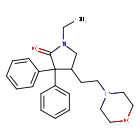
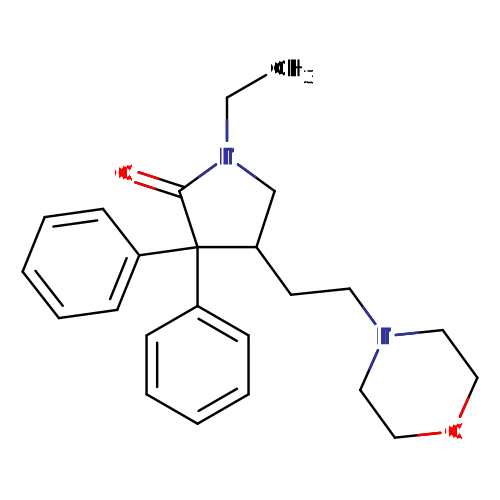
Structure for Doxapram (DB00561)
- Weight
- Average: 378.5072
Monoisotopic: 378.230728214 - Chemical Formula
- C24H30N2O2
- Synonyms
- (±)-doxapram
- 1-ethyl-4-(2-morpholinoethyl)-3,3-diphenyl-2-pyrrolidinone
- Doxapram
- Doxapramum

Pharmacology
- Indication
For use as a temporary measure in hospitalized patients with acute respiratory insufficiency superimposed on chronic obstructive pulmonary disease.
 Reduce drug development failure ratesBuild, train, & validate machine-learning modelswith evidence-based and structured datasets.Build, train, & validate predictive machine-learning models with structured datasets.
- Associated Conditions
Indication Type Indication Combined Product Details Approval Level Age Group Patient Characteristics Dose Form Treatment of Anesthetic complication pulmonary •••••••••••• ••••••••• Treatment of Respiratory depression postoper •••••••••••• ••••••••• Management of Acute hypercapnia •••••••••••• ••••••••• Treatment of Drug-induced respiratory depression •••••••••••• ••••••••• - Associated Therapies
- Contraindications & Blackbox Warnings
 Prevent Adverse Drug Events TodayTap into our Clinical API for life-saving information on contraindications & blackbox warnings, population restrictions, harmful risks, & more.Avoid life-threatening adverse drug events with our Clinical API
- Pharmacodynamics
Doxapram is an analeptic agent (a stimulant of the central nervous system). The respiratory stimulant action is manifested by an increase in tidal volume associated with a slight increase in respiratory rate. A pressor response may result following doxapram administration. Provided there is no impairment of cardiac function, the pressor effect is more marked in hypovolemic than in normovolemic states. The pressor response is due to the improved cardiac output rather than peripheral vasoconstriction. Following doxapram administration, an increased release of catecholamines has been noted.
- Mechanism of action
Doxapram produces respiratory stimulation mediated through the peripheral carotid chemoreceptors. It is thought to stimulate the carotid body by inhibiting certain potassium channels.
Target Actions Organism APotassium channel subfamily K member 3 inhibitorHumans APotassium channel subfamily K member 9 inhibitorHumans - Absorption
Not Available
- Volume of distribution
Not Available
- Protein binding
Not Available
- Metabolism
- Not Available
- Route of elimination
Not Available
- Half-life
Not Available
- Clearance
Not Available
- Adverse Effects
 Improve decision support & research outcomesWith structured adverse effects data, including: blackbox warnings, adverse reactions, warning & precautions, & incidence rates. View sample adverse effects data in our new Data Library!Improve decision support & research outcomes with our structured adverse effects data.
- Toxicity
Intravenous LD50 values in the mouse and rat were approximately 75 mg/kg and in the cat and dog were 40 to 80 mg/kg. Symptoms of overdosage are extensions of the pharmacologic effects of the drug. Excessive pressor effect, tachycardia, skeletal muscle hyperactivity, and enhanced deep tendon reflexes may be early signs of overdosage.
- Pathways
- Not Available
- Pharmacogenomic Effects/ADRs
- Not Available
Interactions
- Drug Interactions
- This information should not be interpreted without the help of a healthcare provider. If you believe you are experiencing an interaction, contact a healthcare provider immediately. The absence of an interaction does not necessarily mean no interactions exist.
Drug Interaction Integrate drug-drug
interactions in your softwareAcebutolol Doxapram may decrease the antihypertensive activities of Acebutolol. Aceclofenac The risk or severity of hypertension can be increased when Doxapram is combined with Aceclofenac. Acemetacin The risk or severity of hypertension can be increased when Doxapram is combined with Acemetacin. Acetylsalicylic acid The risk or severity of hypertension can be increased when Doxapram is combined with Acetylsalicylic acid. Albuterol The risk or severity of hypertension can be increased when Doxapram is combined with Salbutamol. - Food Interactions
- No interactions found.
Products
 Drug product information from 10+ global regionsOur datasets provide approved product information including:dosage, form, labeller, route of administration, and marketing period.Access drug product information from over 10 global regions.
- Product Ingredients
Ingredient UNII CAS InChI Key Doxapram hydrochloride P5RU6UOQ5Y 7081-53-0 ZOMBFZRWMLIDPX-UHFFFAOYSA-N - International/Other Brands
- Caropram (Khandelwal) / Dai Er Song (Bosen Bio Pharmaceutical) / Jia Su Lun (Nhwa) / Stimulex / Ze Lun (Jiuxu Pharmaceutical)
- Brand Name Prescription Products
Name Dosage Strength Route Labeller Marketing Start Marketing End Region Image Dopram Injection 20 mg/1mL Intravenous Hikma Pharmaceuticals USA Inc. 1965-06-23 Not applicable US 
Dopram Injection 20 mg/1mL Intravenous Baxter Laboratories 2010-11-29 2013-06-30 US Dopram Inj 20mg/ml Liquid 20 mg / mL Intravenous Ayerst Laboratories 1992-12-31 1996-09-10 Canada 
Dopram Injectable Liq 20mg/ml Liquid 20 mg / mL Intravenous Wyeth Ayerst Canada Inc. 1994-12-31 2001-04-23 Canada Doxapram Hydrochloride Injection 20 mg/1mL Intravenous HF Acquisition Co LLC, DBA HealthFirst 2019-10-19 Not applicable US - Generic Prescription Products
Name Dosage Strength Route Labeller Marketing Start Marketing End Region Image Doxapram Hydrochloride Injection 20 mg/1mL Intravenous Bedford Pharmaceuticals 2003-02-10 2011-12-31 US
Categories
- ATC Codes
- R07AB01 — Doxapram
- Drug Categories
- Chemical TaxonomyProvided by Classyfire
- Description
- This compound belongs to the class of organic compounds known as diphenylmethanes. These are compounds containing a diphenylmethane moiety, which consists of a methane wherein two hydrogen atoms are replaced by two phenyl groups.
- Kingdom
- Organic compounds
- Super Class
- Benzenoids
- Class
- Benzene and substituted derivatives
- Sub Class
- Diphenylmethanes
- Direct Parent
- Diphenylmethanes
- Alternative Parents
- Phenylpyrrolidines / Aralkylamines / Morpholines / N-alkylpyrrolidines / Pyrrolidine-2-ones / Tertiary carboxylic acid amides / Pyrroles / Trialkylamines / Amino acids and derivatives / Lactams show 7 more
- Substituents
- 2-pyrrolidone / 3-phenylpyrrolidine / Amine / Amino acid or derivatives / Aralkylamine / Aromatic heteromonocyclic compound / Azacycle / Carbonyl group / Carboxamide group / Carboxylic acid derivative show 22 more
- Molecular Framework
- Aromatic heteromonocyclic compounds
- External Descriptors
- morpholines, pyrrolidin-2-ones (CHEBI:681848)
- Affected organisms
- Humans and other mammals
Chemical Identifiers
- UNII
- 94F3830Q73
- CAS number
- 309-29-5
- InChI Key
- XFDJYSQDBULQSI-UHFFFAOYSA-N
- InChI
- InChI=1S/C24H30N2O2/c1-2-26-19-22(13-14-25-15-17-28-18-16-25)24(23(26)27,20-9-5-3-6-10-20)21-11-7-4-8-12-21/h3-12,22H,2,13-19H2,1H3
- IUPAC Name
- 1-ethyl-4-[2-(morpholin-4-yl)ethyl]-3,3-diphenylpyrrolidin-2-one
- SMILES
- CCN1CC(CCN2CCOCC2)C(C1=O)(C1=CC=CC=C1)C1=CC=CC=C1
References
- Synthesis Reference
Lunsford, C.D. and Cale, A.D. Jr.; U S . Patent 3,192,230; June 29, 1965; assigned to A.H. Robins Company, Inc.
- General References
- Singh P, Dimitriou V, Mahajan RP, Crossley AW: Double-blind comparison between doxapram and pethidine in the treatment of postanaesthetic shivering. Br J Anaesth. 1993 Nov;71(5):685-8. [Article]
- Yost CS: A new look at the respiratory stimulant doxapram. CNS Drug Rev. 2006 Fall-Winter;12(3-4):236-49. [Article]
- External Links
- Human Metabolome Database
- HMDB0014701
- KEGG Drug
- D07873
- PubChem Compound
- 3156
- PubChem Substance
- 46506829
- ChemSpider
- 3044
- BindingDB
- 50505297
- 3637
- ChEBI
- 681848
- ChEMBL
- CHEMBL1754
- Therapeutic Targets Database
- DAP001295
- PharmGKB
- PA164784026
- RxList
- RxList Drug Page
- Drugs.com
- Drugs.com Drug Page
- Wikipedia
- Doxapram
- FDA label
- Download (224 KB)
- MSDS
- Download (50.7 KB)
Clinical Trials
- Clinical Trials
Phase Status Purpose Conditions Count 4 Completed Supportive Care Hypoxia / Sedation 1 4 Completed Treatment Apnea / Infants, Premature 1 3 Recruiting Treatment Primary apnea of premature newborns / Respiratory Insufficiency 1 2 Completed Treatment Anaesthesia 1 2 Completed Treatment Treatment of Induced Panic Attack 1
Pharmacoeconomics
- Manufacturers
- Baxter healthcare corp anesthesia and critical care
- Bedford laboratories div ben venue laboratories inc
- Watson laboratories inc
- Packagers
- Baxter International Inc.
- Bedford Labs
- Ben Venue Laboratories Inc.
- Modern Veterinary Therapeutics LLC
- Dosage Forms
Form Route Strength Liquid Intravenous 20 mg / mL Injection Intravenous 20 mg/1mL Injection, solution Intravenous 20 mg/ml - Prices
Unit description Cost Unit Doxapram hcl 20 mg/ml vial 4.67USD ml Dopram 20 mg/ml vial 2.52USD ml DrugBank does not sell nor buy drugs. Pricing information is supplied for informational purposes only.- Patents
- Not Available
Properties
- State
- Solid
- Experimental Properties
Property Value Source melting point (°C) 217-219 Lunsford, C.D. and Cale, A.D. Jr.; U S . Patent 3,192,230; June 29, 1965; assigned to A.H. Robins Company, Inc. water solubility Sparingly soluble Not Available logP 3.6 Not Available - Predicted Properties
Property Value Source Water Solubility 0.0343 mg/mL ALOGPS logP 3.65 ALOGPS logP 3.23 Chemaxon logS -4 ALOGPS pKa (Strongest Basic) 7.23 Chemaxon Physiological Charge 1 Chemaxon Hydrogen Acceptor Count 3 Chemaxon Hydrogen Donor Count 0 Chemaxon Polar Surface Area 32.78 Å2 Chemaxon Rotatable Bond Count 6 Chemaxon Refractivity 112.85 m3·mol-1 Chemaxon Polarizability 43.02 Å3 Chemaxon Number of Rings 4 Chemaxon Bioavailability 1 Chemaxon Rule of Five Yes Chemaxon Ghose Filter Yes Chemaxon Veber's Rule Yes Chemaxon MDDR-like Rule Yes Chemaxon - Predicted ADMET Features
Property Value Probability Human Intestinal Absorption + 1.0 Blood Brain Barrier + 0.9877 Caco-2 permeable + 0.6673 P-glycoprotein substrate Substrate 0.7033 P-glycoprotein inhibitor I Inhibitor 0.8564 P-glycoprotein inhibitor II Non-inhibitor 0.7037 Renal organic cation transporter Non-inhibitor 0.5199 CYP450 2C9 substrate Non-substrate 0.7735 CYP450 2D6 substrate Non-substrate 0.7295 CYP450 3A4 substrate Substrate 0.6409 CYP450 1A2 substrate Non-inhibitor 0.6917 CYP450 2C9 inhibitor Non-inhibitor 0.8071 CYP450 2D6 inhibitor Non-inhibitor 0.7945 CYP450 2C19 inhibitor Non-inhibitor 0.7838 CYP450 3A4 inhibitor Non-inhibitor 0.5697 CYP450 inhibitory promiscuity Low CYP Inhibitory Promiscuity 0.7109 Ames test Non AMES toxic 0.8198 Carcinogenicity Non-carcinogens 0.8969 Biodegradation Not ready biodegradable 0.9931 Rat acute toxicity 3.1933 LD50, mol/kg Not applicable hERG inhibition (predictor I) Weak inhibitor 0.9226 hERG inhibition (predictor II) Non-inhibitor 0.6145
Spectra
- Mass Spec (NIST)
- Not Available
- Spectra
- Chromatographic Properties
Collision Cross Sections (CCS)
Adduct CCS Value (Å2) Source type Source [M-H]- 207.2591265 predictedDarkChem Lite v0.1.0 [M-H]- 187.19981 predictedDeepCCS 1.0 (2019) [M+H]+ 208.1585265 predictedDarkChem Lite v0.1.0 [M+H]+ 189.64064 predictedDeepCCS 1.0 (2019) [M+Na]+ 208.0580265 predictedDarkChem Lite v0.1.0 [M+Na]+ 198.19304 predictedDeepCCS 1.0 (2019)
Targets

- Kind
- Protein
- Organism
- Humans
- Pharmacological action
- Yes
- Actions
- Inhibitor
- General Function
- S100 protein binding
- Specific Function
- pH-dependent, voltage-insensitive, background potassium channel protein. Rectification direction results from potassium ion concentration on either side of the membrane. Acts as an outward rectifie...
- Gene Name
- KCNK3
- Uniprot ID
- O14649
- Uniprot Name
- Potassium channel subfamily K member 3
- Molecular Weight
- 43517.665 Da
References
- Yost CS: A new look at the respiratory stimulant doxapram. CNS Drug Rev. 2006 Fall-Winter;12(3-4):236-49. [Article]
- Anderson-Beck R, Wilson L, Brazier S, Hughes IE, Peers C: Doxapram stimulates dopamine release from the intact rat carotid body in vitro. Neurosci Lett. 1995 Feb 24;187(1):25-8. [Article]
- Peers C: Effects of doxapram on ionic currents recorded in isolated type I cells of the neonatal rat carotid body. Brain Res. 1991 Dec 24;568(1-2):116-22. [Article]
- Kind
- Protein
- Organism
- Humans
- Pharmacological action
- Yes
- Actions
- Inhibitor
- General Function
- Voltage-gated potassium channel activity
- Specific Function
- pH-dependent, voltage-insensitive, background potassium channel protein.
- Gene Name
- KCNK9
- Uniprot ID
- Q9NPC2
- Uniprot Name
- Potassium channel subfamily K member 9
- Molecular Weight
- 42263.485 Da
References
- Yost CS: A new look at the respiratory stimulant doxapram. CNS Drug Rev. 2006 Fall-Winter;12(3-4):236-49. [Article]
- Anderson-Beck R, Wilson L, Brazier S, Hughes IE, Peers C: Doxapram stimulates dopamine release from the intact rat carotid body in vitro. Neurosci Lett. 1995 Feb 24;187(1):25-8. [Article]
- Peers C: Effects of doxapram on ionic currents recorded in isolated type I cells of the neonatal rat carotid body. Brain Res. 1991 Dec 24;568(1-2):116-22. [Article]

Drug created at June 13, 2005 13:24 / Updated at March 03, 2024 02:33