Identification
- Summary
Fondaparinux is an anticoagulant used to prevent venous thromboembolism, to treat deep vein thrombosis, and to improve survival following myocardial infarction.
- Brand Names
- Arixtra
- Generic Name
- Fondaparinux
- DrugBank Accession Number
- DB00569
- Background
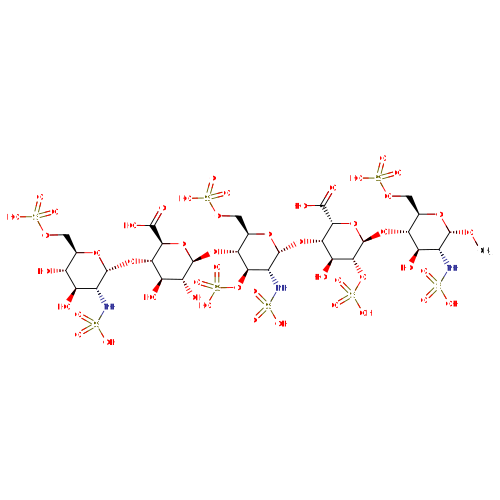
Fondaparinux (Arixtra) is a synthetic anticoagulant agent consisting of five monomeric sugar units and a O-methyl group at the reducing end of the molecule. It is structurally similar to polymeric glycosaminoglycan heparin and heparan sulfate (HS) when they are cleaved into monomeric units. The monomeric sequence in heparin and HS is thought to form the high affinity binding site for the natural anti-coagulant factor, antithrombin III (ATIII). Once bound to heparin or HS, the anticoagulant activity of ATIII is potentiated by 1000-fold. Fondaparinux potentiates the neutralizing action of ATIII on activated Factor X 300-fold. Fondaparinux may be used: to prevent venous thromboembolism in patients who have undergone orthopedic surgery of the lower limbs (e.g. hip fracture, hip replacement and knee surgery); to prevent VTE in patients undergoing abdominal surgery who are are at high risk of thromboembolic complications; in the treatment of deep vein thrombosis (DVT) and pumonary embolism (PE); in the management of unstable angina (UA) and non-ST segment elevation myocardial infarction (NSTEMI); and in the management of ST segment elevation myocardial infarction (STEMI).
- Type
- Small Molecule
- Groups
- Approved, Investigational
- Structure
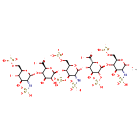
Structure for Fondaparinux (DB00569)
- Weight
- Average: 1508.263
Monoisotopic: 1506.951330709 - Chemical Formula
- C31H53N3O49S8
- Synonyms
- Natural heparin pentasaccharide

Pharmacology
- Indication
Approved for: (1) prophylaxis of VTE for up to one month post surgery in patients undergoing orthopedic surgery of the lower limbs such as hip fracture, hip replacement and knee surgery; (2) prophylaxis of VTE patients undergoing abdominal surgery who are at high risk of thromboembolic complications (e.g. patients undergoing abdominal cancer surgery); (3) treatment of acute DVT and PE; (4) management of UA and NSTEMI for the prevention of death and subsequent myocardial infarction (MI); and (5) management of STEMI for the prevention of death and myocardial reinfarction in patients who are managed with thrombolytics or who are initially to receive no form of reperfusion therapy. Fondaparinux should not be used as the sole anticoagulant during percutaneous coronary intervention (PCI) due to an increased risk of guiding catheter thrombosis.
 Reduce drug development failure ratesBuild, train, & validate machine-learning modelswith evidence-based and structured datasets.Build, train, & validate predictive machine-learning models with structured datasets.
- Associated Conditions
Indication Type Indication Combined Product Details Approval Level Age Group Patient Characteristics Dose Form Used in combination to treat Acute pulmonary embolism •••••••••••• Prophylaxis of Deep vein thrombosis •••••••••••• Prophylaxis of Deep vein thrombosis •••••••••••• Prophylaxis of Deep vein thrombosis •••••••••••• Prophylaxis of Deep vein thrombosis •••••••••••• - Contraindications & Blackbox Warnings
 Prevent Adverse Drug Events TodayTap into our Clinical API for life-saving information on contraindications & blackbox warnings, population restrictions, harmful risks, & more.Avoid life-threatening adverse drug events with our Clinical API
- Pharmacodynamics
Fondaparinux binds specifically to the natural anticoagulant factor, ATIII. Binding to ATIII potentiates the neutralizing action of ATIII on Factor Xa 300-times. Neutralization of Factor Xa decreases the conversion of prothrombin to thrombin, which subsequently decreases the conversion of fibrinogen to fibrin (loose meshwork). The decrease in thrombin also decreases the activation of Factor XIII, which decreases the conversion of fibrin in its loose meshwork form to its stabilized meshwork form. Disruption of the coagulation cascade effectively decreases the formation of blood clots. Fondaparinux does not inactivate thrombin (activated Factor II). According to the manufacturer, fondaparinux has no known effect on platelet function. In studies comparing fondaparinux to enoxaparin, decreases in platelet levels were observed in similar numbers of patients from both groups (2-5%) 1,2. At the recommended dose, Fondaparinux does not affect fibrinolytic activity or bleeding time. There is no antidote for fondaparinux. Monitoring of the anticoagulant activity of fondaparinux is not generally required. The anti-factor Xa assay may be used to monitor therapy in special populations such as those with renal impairment or who are pregnant. Complete blood count (CBC) and kidney function should be monitored during treatment.
- Mechanism of action
The antithrombotic activity of fondaparinux is the result of ATIII-mediated selective inhibition of Factor Xa. By selectively binding to ATIII, Fondaparinux potentiates (about 300 times) the neutralization of Factor Xa by ATIII. Neutralization of Factor Xa interrupts the blood coagulation cascade and thus inhibits thrombin formation and thrombus development. It is thought that fondaparinux is unlikely to induce thrombocytopenia via a heparin-induced thrombocytopenia (HIT)-like mechanism given its chemical structure 22. As a result, fondaparinux has been used as an alternative anticoagulant in heparin-induced thrombocytopenia (HIT) patients 23,24,25. However, it is important to note that rare cases of HIT have been reported in patients treated with fondaparinux 26,27.
Target Actions Organism ACoagulation factor X inhibitorHumans AAntithrombin-III potentiatorHumans - Absorption
100% bioavailability when administered subcutaneously
- Volume of distribution
- 7 - 11 L (healthy adults), distributed primarily in blood
- Protein binding
94% in vitro protein binding specifically to ATIII
- Metabolism
Not metabolized
- Route of elimination
In individuals with normal kidney function, fondaparinux is eliminated in urine mainly as unchanged drug.
- Half-life
17-21 hours
- Clearance
Not Available
- Adverse Effects
 Improve decision support & research outcomesWith structured adverse effects data, including: blackbox warnings, adverse reactions, warning & precautions, & incidence rates. View sample adverse effects data in our new Data Library!Improve decision support & research outcomes with our structured adverse effects data.
- Toxicity
As with other anticoagulants, the main concern is increased bleed risk. The risk of hemorrhage may increase with decreased renal function, body mass less than 50 kg, and moderate to severe hepatic function.
- Pathways
Pathway Category Fondaparinux Action Pathway Drug action - Pharmacogenomic Effects/ADRs
- Not Available
Interactions
- Drug Interactions
- This information should not be interpreted without the help of a healthcare provider. If you believe you are experiencing an interaction, contact a healthcare provider immediately. The absence of an interaction does not necessarily mean no interactions exist.
Drug Interaction Integrate drug-drug
interactions in your softwareAbacavir Fondaparinux may decrease the excretion rate of Abacavir which could result in a higher serum level. Abciximab The risk or severity of bleeding can be increased when Abciximab is combined with Fondaparinux. Aceclofenac The risk or severity of bleeding and hemorrhage can be increased when Aceclofenac is combined with Fondaparinux. Acemetacin The risk or severity of bleeding and hemorrhage can be increased when Fondaparinux is combined with Acemetacin. Acenocoumarol The risk or severity of bleeding can be increased when Fondaparinux is combined with Acenocoumarol. - Food Interactions
- Avoid herbs and supplements with anticoagulant/antiplatelet activity. Examples include ginseng, ginkgo, ginger, and garlic.
Products
 Drug product information from 10+ global regionsOur datasets provide approved product information including:dosage, form, labeller, route of administration, and marketing period.Access drug product information from over 10 global regions.
- Product Ingredients
Ingredient UNII CAS InChI Key Fondaparinux sodium X0Q6N9USOZ 114870-03-0 XEKSTYNIJLDDAZ-JASSWCPGSA-D - Brand Name Prescription Products
Name Dosage Strength Route Labeller Marketing Start Marketing End Region Image Arixtra Injection, solution 7.5 mg/0.6mL Subcutaneous Glaxosmithkline Inc 2004-11-17 2016-11-30 US 
Arixtra Injection, solution 7.5 mg/0.6ml Subcutaneous Mylan Ire Healthcare Limited 2016-09-08 Not applicable EU 
Arixtra Injection, solution 5 mg/0.4ml Subcutaneous Mylan Ire Healthcare Limited 2016-09-08 Not applicable EU Arixtra Solution 5 mg / 0.4 mL Subcutaneous Aspen Pharmacare Canada Inc. 2008-04-17 Not applicable Canada 
Arixtra Injection, solution 7.5 mg/0.6mL Subcutaneous Physicians Total Care, Inc. 2004-11-17 Not applicable US - Generic Prescription Products
Name Dosage Strength Route Labeller Marketing Start Marketing End Region Image Fondaparinux Sodium Injection, solution 2.5 mg/0.5mL Subcutaneous Zydus Pharmaceuticals (USA) Inc. 2019-02-06 Not applicable US Fondaparinux Sodium Injection, solution 2.5 mg/0.5mL Subcutaneous Mylan Institutional LLC 2015-01-05 Not applicable US Fondaparinux Sodium Injection, solution 5 mg/0.4mL Subcutaneous Italfarmaco S.p.A 2019-02-06 Not applicable US Fondaparinux Sodium Injection 5 mg/0.4mL Subcutaneous Sandoz Inc. 2019-06-18 Not applicable US Fondaparinux Sodium Injection 7.5 mg/0.6mL Subcutaneous Dr. Reddy's Laboratories Inc. 2017-07-27 Not applicable US
Categories
- ATC Codes
- B01AX05 — Fondaparinux
- Drug Categories
- Anticoagulants
- Antithrombins
- Blood and Blood Forming Organs
- Carbohydrates
- Cardiovascular Agents
- Drugs that are Mainly Renally Excreted
- Enzyme Inhibitors
- Factor Xa Inhibitors
- Fibrin Modulating Agents
- Hematologic Agents
- Indirect factor Xa inhibitors
- Miscellaneous Anticoagulants
- Oligosaccharides
- Polysaccharides
- Protease Inhibitors
- Serine Protease Inhibitors
- Classification
- Not classified
- Affected organisms
- Humans and other mammals
Chemical Identifiers
- UNII
- J177FOW5JL
- CAS number
- 104993-28-4
- InChI Key
- KANJSNBRCNMZMV-ABRZTLGGSA-N
- InChI
- InChI=1S/C31H53N3O49S8/c1-69-27-9(33-85(48,49)50)13(37)17(6(74-27)3-71-88(57,58)59)76-31-22(83-91(66,67)68)16(40)21(24(81-31)26(43)44)79-29-10(34-86(51,52)53)19(82-90(63,64)65)18(7(75-29)4-72-89(60,61)62)77-30-15(39)14(38)20(23(80-30)25(41)42)78-28-8(32-84(45,46)47)12(36)11(35)5(73-28)2-70-87(54,55)56/h5-24,27-40H,2-4H2,1H3,(H,41,42)(H,43,44)(H,45,46,47)(H,48,49,50)(H,51,52,53)(H,54,55,56)(H,57,58,59)(H,60,61,62)(H,63,64,65)(H,66,67,68)/t5-,6-,7-,8-,9-,10-,11-,12-,13-,14-,15-,16+,17-,18-,19-,20+,21+,22-,23+,24-,27+,28-,29-,30-,31-/m1/s1
- IUPAC Name
- (2R,3S,4S,5R,6R)-3-{[(2R,3R,4R,5R,6R)-5-{[(2R,3R,4R,5S,6S)-6-carboxy-5-{[(2R,3R,4R,5S,6R)-4,5-dihydroxy-3-(sulfoamino)-6-[(sulfooxy)methyl]oxan-2-yl]oxy}-3,4-dihydroxyoxan-2-yl]oxy}-3-(sulfoamino)-4-(sulfooxy)-6-[(sulfooxy)methyl]oxan-2-yl]oxy}-4-hydroxy-6-{[(2R,3S,4R,5R,6S)-4-hydroxy-6-methoxy-5-(sulfoamino)-2-[(sulfooxy)methyl]oxan-3-yl]oxy}-5-(sulfooxy)oxane-2-carboxylic acid
- SMILES
- CO[C@H]1O[C@H](COS(O)(=O)=O)[C@@H](O[C@@H]2O[C@H]([C@@H](O[C@H]3O[C@H](COS(O)(=O)=O)[C@@H](O[C@@H]4O[C@@H]([C@@H](O[C@H]5O[C@H](COS(O)(=O)=O)[C@@H](O)[C@H](O)[C@H]5NS(O)(=O)=O)[C@H](O)[C@H]4O)C(O)=O)[C@H](OS(O)(=O)=O)[C@H]3NS(O)(=O)=O)[C@H](O)[C@H]2OS(O)(=O)=O)C(O)=O)[C@H](O)[C@H]1NS(O)(=O)=O
References
- Synthesis Reference
Jean-Francois Branellec, Christian Morello, Pierre Potier, Patrick Trouilleux, Petrus Marcus Bastiaansen, Henricus Cornelis Claassen, "Highly pure fondaparinux sodium composition, process for preparing said composition and pharmaceutical compositions containing it as active principle." U.S. Patent US20050020536, issued January 27, 2005.
US20050020536- General References
- Eriksson BI, Bauer KA, Lassen MR, Turpie AG: Fondaparinux compared with enoxaparin for the prevention of venous thromboembolism after hip-fracture surgery. N Engl J Med. 2001 Nov 1;345(18):1298-304. [Article]
- Turpie AG, Bauer KA, Eriksson BI, Lassen MR: Postoperative fondaparinux versus postoperative enoxaparin for prevention of venous thromboembolism after elective hip-replacement surgery: a randomised double-blind trial. Lancet. 2002 May 18;359(9319):1721-6. [Article]
- Lassen MR, Bauer KA, Eriksson BI, Turpie AG: Postoperative fondaparinux versus preoperative enoxaparin for prevention of venous thromboembolism in elective hip-replacement surgery: a randomised double-blind comparison. Lancet. 2002 May 18;359(9319):1715-20. [Article]
- Bauer KA, Eriksson BI, Lassen MR, Turpie AG: Fondaparinux compared with enoxaparin for the prevention of venous thromboembolism after elective major knee surgery. N Engl J Med. 2001 Nov 1;345(18):1305-10. [Article]
- Agnelli G, Bergqvist D, Cohen AT, Gallus AS, Gent M: Randomized clinical trial of postoperative fondaparinux versus perioperative dalteparin for prevention of venous thromboembolism in high-risk abdominal surgery. Br J Surg. 2005 Oct;92(10):1212-20. [Article]
- Buller HR, Davidson BL, Decousus H, Gallus A, Gent M, Piovella F, Prins MH, Raskob G, Segers AE, Cariou R, Leeuwenkamp O, Lensing AW: Fondaparinux or enoxaparin for the initial treatment of symptomatic deep venous thrombosis: a randomized trial. Ann Intern Med. 2004 Jun 1;140(11):867-73. [Article]
- Buller HR, Davidson BL, Decousus H, Gallus A, Gent M, Piovella F, Prins MH, Raskob G, van den Berg-Segers AE, Cariou R, Leeuwenkamp O, Lensing AW: Subcutaneous fondaparinux versus intravenous unfractionated heparin in the initial treatment of pulmonary embolism. N Engl J Med. 2003 Oct 30;349(18):1695-702. [Article]
- Yusuf S, Mehta SR, Chrolavicius S, Afzal R, Pogue J, Granger CB, Budaj A, Peters RJ, Bassand JP, Wallentin L, Joyner C, Fox KA: Comparison of fondaparinux and enoxaparin in acute coronary syndromes. N Engl J Med. 2006 Apr 6;354(14):1464-76. Epub 2006 Mar 14. [Article]
- Bassand JP, Richard-Lordereau I, Cadroy Y: Efficacy and safety of fondaparinux in patients with acute coronary syndromes. Expert Rev Cardiovasc Ther. 2007 Nov;5(6):1013-26. [Article]
- Steg PG, Jolly SS, Mehta SR, Afzal R, Xavier D, Rupprecht HJ, Lopez-Sendon JL, Budaj A, Diaz R, Avezum A, Widimsky P, Rao SV, Chrolavicius S, Meeks B, Joyner C, Pogue J, Yusuf S: Low-dose vs standard-dose unfractionated heparin for percutaneous coronary intervention in acute coronary syndromes treated with fondaparinux: the FUTURA/OASIS-8 randomized trial. JAMA. 2010 Sep 22;304(12):1339-49. doi: 10.1001/jama.2010.1320. Epub 2010 Aug 31. [Article]
- Yusuf S, Mehta SR, Chrolavicius S, Afzal R, Pogue J, Granger CB, Budaj A, Peters RJ, Bassand JP, Wallentin L, Joyner C, Fox KA: Effects of fondaparinux on mortality and reinfarction in patients with acute ST-segment elevation myocardial infarction: the OASIS-6 randomized trial. JAMA. 2006 Apr 5;295(13):1519-30. Epub 2006 Mar 14. [Article]
- Kuo KH, Kovacs MJ: Successful treatment of heparin induced thrombocytopenia (HIT) with fondaparinux. Thromb Haemost. 2005 May;93(5):999-1000. [Article]
- Ortel TL: Heparin-induced thrombocytopenia: when a low platelet count is a mandate for anticoagulation. Hematology Am Soc Hematol Educ Program. 2009:225-32. doi: 10.1182/asheducation-2009.1.225. [Article]
- Moser M, Bode C: New antithrombotic agents in acute coronary syndromes. Curr Opin Cardiol. 2009 Jul;24(4):313-7. doi: 10.1097/HCO.0b013e32832bd350. [Article]
- Hirsh J, Bauer KA, Donati MB, Gould M, Samama MM, Weitz JI: Parenteral anticoagulants: American College of Chest Physicians Evidence-Based Clinical Practice Guidelines (8th Edition). Chest. 2008 Jun;133(6 Suppl):141S-159S. doi: 10.1378/chest.08-0689. [Article]
- Geerts WH, Bergqvist D, Pineo GF, Heit JA, Samama CM, Lassen MR, Colwell CW: Prevention of venous thromboembolism: American College of Chest Physicians Evidence-Based Clinical Practice Guidelines (8th Edition). Chest. 2008 Jun;133(6 Suppl):381S-453S. doi: 10.1378/chest.08-0656. [Article]
- Kearon C, Kahn SR, Agnelli G, Goldhaber S, Raskob GE, Comerota AJ: Antithrombotic therapy for venous thromboembolic disease: American College of Chest Physicians Evidence-Based Clinical Practice Guidelines (8th Edition). Chest. 2008 Jun;133(6 Suppl):454S-545S. doi: 10.1378/chest.08-0658. [Article]
- Anderson JL, Adams CD, Antman EM, Bridges CR, Califf RM, Casey DE Jr, Chavey WE 2nd, Fesmire FM, Hochman JS, Levin TN, Lincoff AM, Peterson ED, Theroux P, Wenger NK, Wright RS, Smith SC Jr, Jacobs AK, Adams CD, Anderson JL, Antman EM, Halperin JL, Hunt SA, Krumholz HM, Kushner FG, Lytle BW, Nishimura R, Ornato JP, Page RL, Riegel B: ACC/AHA 2007 guidelines for the management of patients with unstable angina/non-ST-Elevation myocardial infarction: a report of the American College of Cardiology/American Heart Association Task Force on Practice Guidelines (Writing Committee to Revise the 2002 Guidelines for the Management of Patients With Unstable Angina/Non-ST-Elevation Myocardial Infarction) developed in collaboration with the American College of Emergency Physicians, the Society for Cardiovascular Angiography and Interventions, and the Society of Thoracic Surgeons endorsed by the American Association of Cardiovascular and Pulmonary Rehabilitation and the Society for Academic Emergency Medicine. J Am Coll Cardiol. 2007 Aug 14;50(7):e1-e157. [Article]
- Goodman SG, Menon V, Cannon CP, Steg G, Ohman EM, Harrington RA: Acute ST-segment elevation myocardial infarction: American College of Chest Physicians Evidence-Based Clinical Practice Guidelines (8th Edition). Chest. 2008 Jun;133(6 Suppl):708S-775S. doi: 10.1378/chest.08-0665. [Article]
- Warkentin TE, Greinacher A, Koster A, Lincoff AM: Treatment and prevention of heparin-induced thrombocytopenia: American College of Chest Physicians Evidence-Based Clinical Practice Guidelines (8th Edition). Chest. 2008 Jun;133(6 Suppl):340S-380S. doi: 10.1378/chest.08-0677. [Article]
- Harrington RA, Becker RC, Cannon CP, Gutterman D, Lincoff AM, Popma JJ, Steg G, Guyatt GH, Goodman SG: Antithrombotic therapy for non-ST-segment elevation acute coronary syndromes: American College of Chest Physicians Evidence-Based Clinical Practice Guidelines (8th Edition). Chest. 2008 Jun;133(6 Suppl):670S-707S. doi: 10.1378/chest.08-0691. [Article]
- Grouzi E, Kyriakou E, Panagou I, Spiliotopoulou I: Fondaparinux for the treatment of acute heparin-induced thrombocytopenia: a single-center experience. Clin Appl Thromb Hemost. 2010 Dec;16(6):663-7. doi: 10.1177/1076029609347900. Epub 2009 Oct 13. [Article]
- Blackmer AB, Oertel MD, Valgus JM: Fondaparinux and the management of heparin-induced thrombocytopenia: the journey continues. Ann Pharmacother. 2009 Oct;43(10):1636-46. doi: 10.1345/aph.1M136. Epub 2009 Sep 8. [Article]
- Seldrum S, Lambert M, Hainaut P: Heparin-induced thrombocytopenia successfully treated with fondaparinux. Acta Clin Belg. 2009 Mar-Apr;64(2):144-6. doi: 10.1179/acb.2009.024. [Article]
- Lobo B, Finch C, Howard A, Minhas S: Fondaparinux for the treatment of patients with acute heparin-induced thrombocytopenia. Thromb Haemost. 2008 Jan;99(1):208-14. doi: 10.1160/TH07-04-0252. [Article]
- Ratuapli SK, Bobba B, Zafar H: Heparin-induced thrombocytopenia in a patient treated with fondaparinux. Clin Adv Hematol Oncol. 2010 Jan;8(1):61-5. [Article]
- Chong BH, Chong JJ: Heparin-induced thrombocytopenia associated with fondaparinux. Clin Adv Hematol Oncol. 2010 Jan;8(1):63-5. [Article]
- External Links
- Human Metabolome Database
- HMDB0014709
- PubChem Compound
- 49852292
- PubChem Substance
- 46505595
- ChemSpider
- 4445600
- BindingDB
- 50511579
- ChEBI
- 61033
- ChEMBL
- CHEMBL1201202
- Therapeutic Targets Database
- DNC000658
- PharmGKB
- PA164746297
- RxList
- RxList Drug Page
- Drugs.com
- Drugs.com Drug Page
- Wikipedia
- Fondaparinux
- PDB Entries
- 2gd4 / 3evj / 4r9w / 4x7r / 5uf6 / 5wd7
- FDA label
- Download (289 KB)
Clinical Trials
- Clinical Trials
Phase Status Purpose Conditions Count 4 Completed Prevention Major Orthopaedic Surgery and Renal Impairment 1 4 Completed Prevention Thromboembolism in the Puerperium 1 4 Completed Prevention Venous Thromboembolism 1 4 Completed Treatment Acute Coronary Syndrome (ACS) 1 4 Completed Treatment Endovenous Laser Ablation / Superficial Vein Thrombosis 1
Pharmacoeconomics
- Manufacturers
- Glaxosmithkline
- Packagers
- GlaxoSmithKline Inc.
- Physicians Total Care Inc.
- Dosage Forms
Form Route Strength Injection Subcutaneous Injection, solution Intravenous; Parenteral 1.5 MG/0.3ML Injection, solution Intravenous; Parenteral 10 MG/0.8ML Injection, solution Intravenous; Parenteral 2.5 MG/0.5ML Injection, solution Intravenous; Parenteral 5 MG/0.4ML Injection, solution Intravenous; Parenteral 7.5 MG/0.6ML Injection, solution Intravenous; Subcutaneous 2.5 mg/0.5ml Injection, solution Parenteral; Subcutaneous 1.5 MG/0.3ML Injection, solution Parenteral; Subcutaneous 10 MG/0.8ML Injection, solution Parenteral; Subcutaneous 2.5 MG/0.5ML Injection, solution Parenteral; Subcutaneous 5 MG/0.4ML Injection, solution Parenteral; Subcutaneous 7.5 MG/0.6ML Injection, solution Subcutaneous 1.5 mg/0.3ml Injection, solution Subcutaneous 10 mg/0.8mL Injection, solution Subcutaneous 2.5 mg/0.5mL Injection, solution Subcutaneous 5 mg/0.4mL Injection, solution Subcutaneous 7.5 mg/0.6mL Solution 5 mg/1ml Solution Parenteral 2.500 mg Solution 12.5 mg/1ml Solution Subcutaneous 10 mg Solution Subcutaneous 7.5 mg Injection, solution Subcutaneous Solution Subcutaneous 2.5 mg Injection, solution Intravenous; Subcutaneous Solution Intravenous 5 mg/0.4ml Injection Intravenous; Subcutaneous 2.5 mg/0.5ml Injection, solution Subcutaneous 5.0 mg/0.4ml Injection Subcutaneous 10 mg/0.8mL Injection Subcutaneous 2.5 mg/0.5mL Injection Subcutaneous 5 mg/0.4mL Injection Subcutaneous 7.5 mg/0.6mL Solution Intravenous; Subcutaneous 2.5 mg / 0.5 mL Solution Subcutaneous 10 mg / 0.8 mL Solution Subcutaneous 5 mg / 0.4 mL Solution Subcutaneous 7.5 mg / 0.6 mL - Prices
Unit description Cost Unit Arixtra 7.5 mg/0.6ml Solution 0.6ml Syringe 148.62USD syringe Arixtra 2.5 mg/0.5ml Solution 0.5ml Syringe 63.15USD syringe Arixtra (0.5 Ml Syringe) 2.5 mg/syr Syringe 17.38USD syringe DrugBank does not sell nor buy drugs. Pricing information is supplied for informational purposes only.- Patents
- Not Available
Properties
- State
- Solid
- Experimental Properties
Property Value Source logP 0.4 Not Available - Predicted Properties
Property Value Source Water Solubility 7.91 mg/mL ALOGPS logP -1.6 ALOGPS logP -10 Chemaxon logS -2.3 ALOGPS pKa (Strongest Acidic) -3 Chemaxon Physiological Charge -10 Chemaxon Hydrogen Acceptor Count 44 Chemaxon Hydrogen Donor Count 19 Chemaxon Polar Surface Area 805.48 Å2 Chemaxon Rotatable Bond Count 27 Chemaxon Refractivity 255.85 m3·mol-1 Chemaxon Polarizability 122.56 Å3 Chemaxon Number of Rings 5 Chemaxon Bioavailability 0 Chemaxon Rule of Five No Chemaxon Ghose Filter No Chemaxon Veber's Rule No Chemaxon MDDR-like Rule Yes Chemaxon - Predicted ADMET Features
Property Value Probability Human Intestinal Absorption - 0.9857 Blood Brain Barrier - 0.8953 Caco-2 permeable - 0.6312 P-glycoprotein substrate Non-substrate 0.6876 P-glycoprotein inhibitor I Non-inhibitor 0.6169 P-glycoprotein inhibitor II Non-inhibitor 0.9493 Renal organic cation transporter Non-inhibitor 0.9327 CYP450 2C9 substrate Non-substrate 0.8037 CYP450 2D6 substrate Non-substrate 0.8179 CYP450 3A4 substrate Non-substrate 0.5537 CYP450 1A2 substrate Non-inhibitor 0.7505 CYP450 2C9 inhibitor Non-inhibitor 0.7664 CYP450 2D6 inhibitor Non-inhibitor 0.8799 CYP450 2C19 inhibitor Non-inhibitor 0.757 CYP450 3A4 inhibitor Non-inhibitor 0.9208 CYP450 inhibitory promiscuity Low CYP Inhibitory Promiscuity 0.9172 Ames test Non AMES toxic 0.5944 Carcinogenicity Non-carcinogens 0.763 Biodegradation Not ready biodegradable 0.8922 Rat acute toxicity 2.4465 LD50, mol/kg Not applicable hERG inhibition (predictor I) Weak inhibitor 0.8431 hERG inhibition (predictor II) Non-inhibitor 0.6468
Spectra
- Mass Spec (NIST)
- Not Available
- Spectra
- Chromatographic Properties
Collision Cross Sections (CCS)
Not Available
Targets

- Kind
- Protein
- Organism
- Humans
- Pharmacological action
- Yes
- Actions
- Inhibitor
- General Function
- Serine-type endopeptidase activity
- Specific Function
- Factor Xa is a vitamin K-dependent glycoprotein that converts prothrombin to thrombin in the presence of factor Va, calcium and phospholipid during blood clotting.
- Gene Name
- F10
- Uniprot ID
- P00742
- Uniprot Name
- Coagulation factor X
- Molecular Weight
- 54731.255 Da
References
- Grouzi E, Kyriakou E, Panagou I, Spiliotopoulou I: Fondaparinux for the treatment of acute heparin-induced thrombocytopenia: a single-center experience. Clin Appl Thromb Hemost. 2010 Dec;16(6):663-7. doi: 10.1177/1076029609347900. Epub 2009 Oct 13. [Article]
- Kind
- Protein
- Organism
- Humans
- Pharmacological action
- Yes
- Actions
- Potentiator
- General Function
- Serine-type endopeptidase inhibitor activity
- Specific Function
- Most important serine protease inhibitor in plasma that regulates the blood coagulation cascade. AT-III inhibits thrombin, matriptase-3/TMPRSS7, as well as factors IXa, Xa and XIa. Its inhibitory a...
- Gene Name
- SERPINC1
- Uniprot ID
- P01008
- Uniprot Name
- Antithrombin-III
- Molecular Weight
- 52601.935 Da
References
- Paolucci F, Clavies MC, Donat F, Necciari J: Fondaparinux sodium mechanism of action: identification of specific binding to purified and human plasma-derived proteins. Clin Pharmacokinet. 2002;41 Suppl 2:11-8. [Article]
- Cheng JW: Fondaparinux: a new antithrombotic agent. Clin Ther. 2002 Nov;24(11):1757-69; discussion 1719. [Article]
- Dager WE, Andersen J, Nutescu E: Special considerations with fondaparinux therapy: heparin-induced thrombocytopenia and wound healing. Pharmacotherapy. 2004 Jul;24(7 Pt 2):88S-94S. [Article]
- Donat F, Duret JP, Santoni A, Cariou R, Necciari J, Magnani H, de Greef R: The pharmacokinetics of fondaparinux sodium in healthy volunteers. Clin Pharmacokinet. 2002;41 Suppl 2:1-9. [Article]

Drug created at June 13, 2005 13:24 / Updated at April 26, 2024 00:45