Identification
- Summary
Ulobetasol is a lipocortin corticosteroid used to treat inflammatory and pruritic corticosteroid-responsive dermatoses.
- Brand Names
- Bryhali, Duobrii, Lexette, Ultravate, Ultravate X Ointment
- Generic Name
- Ulobetasol
- DrugBank Accession Number
- DB00596
- Background
Ulobetasol is a highly potent corticosteroid.6 It is structurally related to clobetasol.6 Due to its high potency, it is mainly prescribed in the treatment of severe plaque psoriasis and corticosteroid responsive dermatoses.7,8,10
Ulobetasol was granted FDA approval on 17 December 1990.7
- Type
- Small Molecule
- Groups
- Approved
- Structure
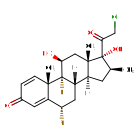
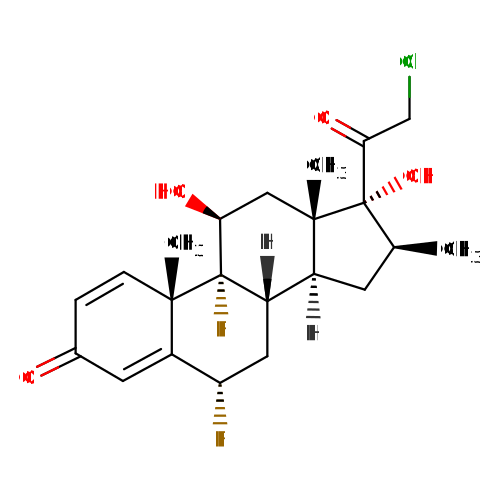
Structure for Ulobetasol (DB00596)
- Weight
- Average: 428.9
Monoisotopic: 428.1565934 - Chemical Formula
- C22H27ClF2O4
- Synonyms
- 21-chloro diflorasone
- Halobetasol
- Ulobetasol
- Ulobétasol
- Ulobetasolum

Pharmacology
- Indication
Ulobetasol cream and ointment are indicated in the treatment of inflammatory and pruritic corticosteroid responsive dermatoses.7 Ulobetasol lotion is indicated in the treatment of plaque psoriasis.8
 Reduce drug development failure ratesBuild, train, & validate machine-learning modelswith evidence-based and structured datasets.Build, train, & validate predictive machine-learning models with structured datasets.
- Associated Conditions
Indication Type Indication Combined Product Details Approval Level Age Group Patient Characteristics Dose Form Management of Psoriasis vulgaris (plaque psoriasis) •••••••••••• ••••••••••• ••••• Treatment of Corticosteroid responsive, inflammatory dermatosis •••••••••••• •••••• •••••••• Treatment of Corticosteroid responsive, pruritic dermatosis •••••••••••• •••••• •••••••• - Contraindications & Blackbox Warnings
 Prevent Adverse Drug Events TodayTap into our Clinical API for life-saving information on contraindications & blackbox warnings, population restrictions, harmful risks, & more.Avoid life-threatening adverse drug events with our Clinical API
- Pharmacodynamics
Corticosteroids bind to the glucocorticoid receptor, inhibiting pro-inflammatory signals, and promoting anti-inflammatory signals.2 Ulobetasol has a moderate duration of action as it is applied once or twice daily.7,8 Corticosteroids have a wide therapeutic window as patients may require doses that are multiples of what the body naturally produces.2 Patients taking corticosteroids should be counselled regarding the risk of hypothalamic-pituitary-adrenal axis suppression and increased susceptibility to infections.2
- Mechanism of action
The short term effects of corticosteroids are decreased vasodilation and permeability of capillaries, as well as decreased leukocyte migration to sites of inflammation.2 Corticosteroids binding to the glucocorticoid receptor mediates changes in gene expression that lead to multiple downstream effects over hours to days.2
Glucocorticoids inhibit phospholipase 2 and neutrophil apoptosis and demargination, resulting in decreased formation of arachidonic acid derivatives. They also inhibit NF-Kappa B and other inflammatory transcription factors while promoting anti-inflammatory genes like interleukin-10.1,2
Lower doses of corticosteroids provide an anti-inflammatory effect, while higher doses are immunosuppressive.2 High doses of glucocorticoids for an extended period bind to the mineralocorticoid receptor, raising sodium levels and decreasing potassium levels.2
Target Actions Organism AGlucocorticoid receptor agonistHumans - Absorption
Ulobetasol lotion reaches a Cmax of 201.1 ± 157.5 pg/mL, with a Tmax of 3 hours, and an AUC of 1632 ± 1147 pg*h/mL.8 Absorption can be influenced by skin integrity, the vehicle used, inflammation, or disease processes.7,8
- Volume of distribution
Not Available
- Protein binding
Ulobetasol is likely bound to corticosteroid binding globulin in serum.3
- Metabolism
- Not Available
- Route of elimination
Corticosteroids are eliminated predominantly in the urine.4
- Half-life
In vitro experiments show halobetasol propionate, a derivative of ulobetasol, has a half life of 33 minutes.9
- Clearance
Not Available
- Adverse Effects
 Improve decision support & research outcomesWith structured adverse effects data, including: blackbox warnings, adverse reactions, warning & precautions, & incidence rates. View sample adverse effects data in our new Data Library!Improve decision support & research outcomes with our structured adverse effects data.
- Toxicity
Data regarding acute overdoses of glucocorticoids are rare.7,8 Chronic high doses of glucocorticoids can lead to the development of cataract, glaucoma, hypertension, water retention, hyperlipidemia, peptic ulcer, pancreatitis, myopathy, osteoporosis, mood changes, psychosis, dermal atrophy, allergy, acne, hypertrichosis, immune suppression, decreased resistance to infection, moon face, hyperglycemia, hypocalcemia, hypophosphatemia, metabolic acidosis, growth suppression, and secondary adrenal insufficiency.5 Overdose may be treated by adjusting the dose or stopping the corticosteroid as well as initiating symptomatic and supportive treatment.5,10
- Pathways
- Not Available
- Pharmacogenomic Effects/ADRs
- Not Available
Interactions
- Drug Interactions
- This information should not be interpreted without the help of a healthcare provider. If you believe you are experiencing an interaction, contact a healthcare provider immediately. The absence of an interaction does not necessarily mean no interactions exist.
Drug Interaction Integrate drug-drug
interactions in your softwareAcarbose The risk or severity of hyperglycemia can be increased when Ulobetasol is combined with Acarbose. Acetohexamide The risk or severity of hyperglycemia can be increased when Ulobetasol is combined with Acetohexamide. Acetyldigitoxin The risk or severity of adverse effects can be increased when Ulobetasol is combined with Acetyldigitoxin. Albiglutide The risk or severity of hyperglycemia can be increased when Ulobetasol is combined with Albiglutide. Allogeneic processed thymus tissue The therapeutic efficacy of Allogeneic processed thymus tissue can be decreased when used in combination with Ulobetasol. - Food Interactions
- No interactions found.
Products
 Drug product information from 10+ global regionsOur datasets provide approved product information including:dosage, form, labeller, route of administration, and marketing period.Access drug product information from over 10 global regions.
- Product Ingredients
Ingredient UNII CAS InChI Key Ulobetasol propionate 91A0K1TY3Z 66852-54-8 BDSYKGHYMJNPAB-LICBFIPMSA-N - International/Other Brands
- Halobetasol (Fougera) / Halovate (Glenmark) / Hobs (Aamorb)
- Brand Name Prescription Products
Name Dosage Strength Route Labeller Marketing Start Marketing End Region Image Bryhali Lotion 0.1 mg/1g Topical Bausch Health US, LLC 2018-11-06 Not applicable US 
Bryhali Lotion 0.01 % w/w Topical Bausch Health, Canada Inc. 2021-08-06 Not applicable Canada 
Halobetasol propionate Aerosol, foam 0.5 mg/1g Topical Pharmasol Corporation 2019-02-04 2022-01-31 US Halobetasol propionate Aerosol, foam 0.5 mg/1g Topical Mayne Pharma 2019-02-04 Not applicable US Lexette Aerosol, foam 0.5 mg/1g Topical Mayne Pharma 2019-04-23 Not applicable US - Generic Prescription Products
Name Dosage Strength Route Labeller Marketing Start Marketing End Region Image Halobetasol propionate Aerosol, foam 0.5 mg/1g Topical Mayne Pharma 2023-11-27 Not applicable US Halobetasol Propionate Ointment 0.5 mg/1g Topical bryant ranch prepack 2009-02-05 Not applicable US Halobetasol Propionate Cream 0.5 mg/1g Topical Physicians Total Care, Inc. 2005-05-25 Not applicable US Halobetasol Propionate Ointment 0.5 mg/1g Topical bryant ranch prepack 2009-02-05 Not applicable US Halobetasol Propionate Ointment .5 mg/1g Topical Cosette Pharmaceuticals, Inc. 2005-06-14 Not applicable US - Mixture Products
Name Ingredients Dosage Route Labeller Marketing Start Marketing End Region Image Duobrii Ulobetasol propionate (0.1 mg/1g) + Tazarotene (0.45 mg/1g) Lotion Topical Bausch Health US, LLC 2019-04-25 Not applicable US Duobrii Ulobetasol propionate (0.01 % w/w) + Tazarotene (0.045 % w/w) Lotion Topical Bausch Health, Canada Inc. 2020-08-04 Not applicable Canada Ultravate X Ulobetasol propionate (0.50 mg/1g) + Ammonium lactate (100 mg/1g) Kit Topical Ranbaxy Inc. 2012-07-01 Not applicable US Ultravate X Ulobetasol propionate (0.5 mg/1g) + Ammonium lactate (100 mg/1g) Kit Topical Sun Pharmaceutical Industries, Inc. 2012-07-09 2017-08-31 US
Categories
- ATC Codes
- D05AX55 — Tazarotene and ulobetasol
- D05AX — Other antipsoriatics for topical use
- D05A — ANTIPSORIATICS FOR TOPICAL USE
- D05 — ANTIPSORIATICS
- D — DERMATOLOGICALS
- Drug Categories
- Adrenal Cortex Hormones
- Anti-Inflammatory Agents
- Antipsoriatics
- Antipsoriatics for Topical Use
- Cardiovascular Agents
- Corticosteroid Hormone Receptor Agonists
- Corticosteroids
- Corticosteroids, Dermatological Preparations
- Corticosteroids, Potent (Group III)
- Dermatologicals
- Fused-Ring Compounds
- Immunosuppressive Agents
- Pregnadienes
- Pregnadienetriols
- Pregnanes
- Steroids
- Steroids, Fluorinated
- Vasoconstrictor Agents
- Chemical TaxonomyProvided by Classyfire
- Description
- This compound belongs to the class of organic compounds known as gluco/mineralocorticoids, progestogins and derivatives. These are steroids with a structure based on a hydroxylated prostane moiety.
- Kingdom
- Organic compounds
- Super Class
- Lipids and lipid-like molecules
- Class
- Steroids and steroid derivatives
- Sub Class
- Pregnane steroids
- Direct Parent
- Gluco/mineralocorticoids, progestogins and derivatives
- Alternative Parents
- 20-oxosteroids / 11-beta-hydroxysteroids / 17-hydroxysteroids / 3-oxo delta-1,4-steroids / Halogenated steroids / Delta-1,4-steroids / Tertiary alcohols / Alpha-hydroxy ketones / Alpha-chloroketones / Secondary alcohols show 9 more
- Substituents
- 11-beta-hydroxysteroid / 11-hydroxysteroid / 17-hydroxysteroid / 20-oxosteroid / 3-oxo-delta-1,4-steroid / 3-oxosteroid / 6-halo-steroid / 9-halo-steroid / Alcohol / Aliphatic homopolycyclic compound show 26 more
- Molecular Framework
- Aliphatic homopolycyclic compounds
- External Descriptors
- Not Available
- Affected organisms
- Humans and other mammals
Chemical Identifiers
- UNII
- 9P6159HM7T
- CAS number
- 98651-66-2
- InChI Key
- LEHFPXVYPMWYQD-XHIJKXOTSA-N
- InChI
- InChI=1S/C22H27ClF2O4/c1-11-6-13-14-8-16(24)15-7-12(26)4-5-19(15,2)21(14,25)17(27)9-20(13,3)22(11,29)18(28)10-23/h4-5,7,11,13-14,16-17,27,29H,6,8-10H2,1-3H3/t11-,13-,14-,16-,17-,19-,20-,21-,22-/m0/s1
- IUPAC Name
- (1R,2S,8S,10S,11S,13S,14R,15S,17S)-14-(2-chloroacetyl)-1,8-difluoro-14,17-dihydroxy-2,13,15-trimethyltetracyclo[8.7.0.0²,⁷.0¹¹,¹⁵]heptadeca-3,6-dien-5-one
- SMILES
- [H][C@@]12C[C@H](C)[C@](O)(C(=O)CCl)[C@@]1(C)C[C@H](O)[C@@]1(F)[C@@]2([H])C[C@H](F)C2=CC(=O)C=C[C@]12C
References
- Synthesis Reference
Daniella Gutman, Shimon Chernyak, "Process for preparing a crystalline form of halobetasol propionate." U.S. Patent US20070167420, issued July 19, 2007.
US20070167420- General References
- Awad N, Preuss CV: Halobetasol Cream . [Article]
- Yasir M, Sonthalia S: Corticosteroid Adverse Effects . [Article]
- Gardill BR, Vogl MR, Lin HY, Hammond GL, Muller YA: Corticosteroid-binding globulin: structure-function implications from species differences. PLoS One. 2012;7(12):e52759. doi: 10.1371/journal.pone.0052759. Epub 2012 Dec 26. [Article]
- Czock D, Keller F, Rasche FM, Haussler U: Pharmacokinetics and pharmacodynamics of systemically administered glucocorticoids. Clin Pharmacokinet. 2005;44(1):61-98. doi: 10.2165/00003088-200544010-00003. [Article]
- Ciriaco M, Ventrice P, Russo G, Scicchitano M, Mazzitello G, Scicchitano F, Russo E: Corticosteroid-related central nervous system side effects. J Pharmacol Pharmacother. 2013 Dec;4(Suppl 1):S94-8. doi: 10.4103/0976-500X.120975. [Article]
- Watson WA, Kalb RE, Siskin SB, Freer JP, Krochmal L: The safety of halobetasol 0.05% ointment in the treatment of psoriasis. Pharmacotherapy. 1990;10(2):107-11. [Article]
- FDA Approved Drug Products: Halobetasol Propionate Cream or Ointment [Link]
- FDA Approved Drug Products: Halobetasol Propionate Topical Lotion [Link]
- FDA Summary Review: Halobetasol Propionate [Link]
- Health Canada Approved Drug Products: Ultravate Halobetasol Propionate Topical Cream or Ointment [Link]
- FDA Approved Drug Products: LEXETTE (halobetasol propionate) topical foam [Link]
- External Links
- PubChem Compound
- 5311167
- PubChem Substance
- 46506187
- ChemSpider
- 4470691
- 41208
- ChEMBL
- CHEMBL1201360
- ZINC
- ZINC000004214603
- Therapeutic Targets Database
- DAP001186
- PharmGKB
- PA164768832
- RxList
- RxList Drug Page
- Drugs.com
- Drugs.com Drug Page
- PDRhealth
- PDRhealth Drug Page
- Wikipedia
- Ulobetasol
- FDA label
- Download (399 KB)
Clinical Trials
- Clinical Trials
Phase Status Purpose Conditions Count 4 Completed Treatment Palmoplantar Psoriasis / Psoriasis Vulgaris (Plaque Psoriasis) 1 4 Completed Treatment Psoriasis Vulgaris (Plaque Psoriasis) 3 4 Completed Treatment Scalp Psoriasis 1 4 Completed Treatment Stable Plaque Psoriasis 1 4 Terminated Other Psoriasis Vulgaris (Plaque Psoriasis) 1
Pharmacoeconomics
- Manufacturers
- Altana inc
- G and w laboratories inc
- Perrigo israel pharmaceuticals ltd
- Taro pharmaceuticals usa inc
- Ranbaxy laboratories inc
- Actavis mid atlantic llc
- Perrigo co
- Packagers
- Actavis Group
- Contract Pharm
- E. Fougera and Co.
- G & W Labs
- JSJ Pharmaceuticals Inc.
- Nycomed Inc.
- Perrigo Co.
- Physicians Total Care Inc.
- Ranbaxy Laboratories
- Taro Pharmaceuticals USA
- Dosage Forms
Form Route Strength Lotion Topical 0.01 % w/w Lotion Topical 0.1 mg/1g Lotion Topical Ointment Cutaneous 0.500 mg Cream Topical .5 mg/1g Cream Topical 0.5 mg/1g Ointment Topical .5 mg/1g Ointment Topical 0.5 mg/1g Aerosol, foam Topical 0.5 mg/1g Cream Topical 0.050 g Cream Topical 0.05 % w/w Lotion Topical 0.5 mg/1g Ointment Topical 0.05 % w/w Kit Topical - Prices
Unit description Cost Unit Ultravate 0.05% Ointment 50 gm Tube 180.27USD tube Ultravate 0.05% Cream 50 gm Tube 152.54USD tube Halobetasol Propionate 0.05% Cream 50 gm Tube 79.14USD tube Halobetasol Propionate 0.05% Ointment 50 gm Tube 79.14USD tube Ultravate 0.05% Ointment 15 gm Tube 64.78USD tube Ultravate 0.05% Cream 15 gm Tube 63.16USD tube Halobetasol Propionate 0.05% Cream 15 gm Tube 32.92USD tube Halobetasol Propionate 0.05% Ointment 15 gm Tube 32.92USD tube Ultravate 0.05% cream 4.07USD g Halobetasol prop 0.05% cream 1.8USD g Ultravate 0.05 % Cream 0.9USD g Ultravate pac kit 0.59USD g DrugBank does not sell nor buy drugs. Pricing information is supplied for informational purposes only.- Patents
Patent Number Pediatric Extension Approved Expires (estimated) Region US8962028 No 2015-02-24 2033-06-19 US US8809307 No 2014-08-19 2031-11-02 US US6517847 No 2003-02-11 2020-08-03 US US10251895 No 2019-04-09 2036-06-06 US US10478502 No 2019-11-19 2031-11-02 US US10426787 No 2019-10-01 2036-06-06 US US10857159 Yes 2020-12-08 2037-05-30 US US11020407 No 2021-06-01 2036-11-30 US US11679115 No 2016-06-06 2036-06-06 US US11648256 No 2016-06-06 2036-06-06 US US11839656 No 2011-11-02 2031-11-02 US
Properties
- State
- Solid
- Experimental Properties
Property Value Source melting point (°C) 200-216 Health Canada Label water solubility Practically insoluble FDA Label - Predicted Properties
Property Value Source Water Solubility 0.022 mg/mL ALOGPS logP 2.93 ALOGPS logP 2.7 Chemaxon logS -4.3 ALOGPS pKa (Strongest Acidic) 12.46 Chemaxon pKa (Strongest Basic) -3.4 Chemaxon Physiological Charge 0 Chemaxon Hydrogen Acceptor Count 4 Chemaxon Hydrogen Donor Count 2 Chemaxon Polar Surface Area 74.6 Å2 Chemaxon Rotatable Bond Count 2 Chemaxon Refractivity 105.37 m3·mol-1 Chemaxon Polarizability 42.07 Å3 Chemaxon Number of Rings 4 Chemaxon Bioavailability 1 Chemaxon Rule of Five Yes Chemaxon Ghose Filter Yes Chemaxon Veber's Rule No Chemaxon MDDR-like Rule No Chemaxon - Predicted ADMET Features
Property Value Probability Human Intestinal Absorption + 0.9974 Blood Brain Barrier + 0.9789 Caco-2 permeable + 0.5865 P-glycoprotein substrate Substrate 0.7448 P-glycoprotein inhibitor I Inhibitor 0.6948 P-glycoprotein inhibitor II Non-inhibitor 0.8943 Renal organic cation transporter Non-inhibitor 0.857 CYP450 2C9 substrate Non-substrate 0.8553 CYP450 2D6 substrate Non-substrate 0.9136 CYP450 3A4 substrate Substrate 0.7689 CYP450 1A2 substrate Non-inhibitor 0.9093 CYP450 2C9 inhibitor Non-inhibitor 0.885 CYP450 2D6 inhibitor Non-inhibitor 0.7394 CYP450 2C19 inhibitor Non-inhibitor 0.8972 CYP450 3A4 inhibitor Inhibitor 0.8309 CYP450 inhibitory promiscuity Low CYP Inhibitory Promiscuity 0.8771 Ames test Non AMES toxic 0.8762 Carcinogenicity Non-carcinogens 0.8902 Biodegradation Not ready biodegradable 1.0 Rat acute toxicity 2.3204 LD50, mol/kg Not applicable hERG inhibition (predictor I) Weak inhibitor 0.9723 hERG inhibition (predictor II) Non-inhibitor 0.6521
Spectra
- Mass Spec (NIST)
- Not Available
- Spectra
Spectrum Spectrum Type Splash Key Predicted MS/MS Spectrum - 10V, Positive (Annotated) Predicted LC-MS/MS splash10-06r6-0004900000-6ff1487d4b44fdb7f0bc Predicted MS/MS Spectrum - 10V, Negative (Annotated) Predicted LC-MS/MS splash10-004i-0000900000-74929f2b0286af885e3a Predicted MS/MS Spectrum - 20V, Positive (Annotated) Predicted LC-MS/MS splash10-01tc-0236900000-1e77a061ed99f8e6c9d3 Predicted MS/MS Spectrum - 20V, Negative (Annotated) Predicted LC-MS/MS splash10-001i-5009100000-9efb3b69a63abecd8141 Predicted MS/MS Spectrum - 40V, Negative (Annotated) Predicted LC-MS/MS splash10-0100-0719200000-35f0c78da8402a87d9c1 Predicted MS/MS Spectrum - 40V, Positive (Annotated) Predicted LC-MS/MS splash10-0kbg-2490000000-478e8dfd4ec3b35cdce4 Predicted 1H NMR Spectrum 1D NMR Not Applicable Predicted 13C NMR Spectrum 1D NMR Not Applicable - Chromatographic Properties
Collision Cross Sections (CCS)
Adduct CCS Value (Å2) Source type Source [M-H]- 194.93102 predictedDeepCCS 1.0 (2019) [M+H]+ 196.82643 predictedDeepCCS 1.0 (2019) [M+Na]+ 202.95409 predictedDeepCCS 1.0 (2019)
Targets

- Kind
- Protein
- Organism
- Humans
- Pharmacological action
- Yes
- Actions
- Agonist
- General Function
- Zinc ion binding
- Specific Function
- Receptor for glucocorticoids (GC). Has a dual mode of action: as a transcription factor that binds to glucocorticoid response elements (GRE), both for nuclear and mitochondrial DNA, and as a modula...
- Gene Name
- NR3C1
- Uniprot ID
- P04150
- Uniprot Name
- Glucocorticoid receptor
- Molecular Weight
- 85658.57 Da
References
- Mohandas S, Rai R, Srinivas CR: Halobetasol versus clobetasol: a study of potency. Indian J Dermatol Venereol Leprol. 2009 Mar-Apr;75(2):186-7. [Article]
- Hofmann TG, Hehner SP, Bacher S, Droge W, Schmitz ML: Various glucocorticoids differ in their ability to induce gene expression, apoptosis and to repress NF-kappaB-dependent transcription. FEBS Lett. 1998 Dec 28;441(3):441-6. [Article]
Carriers
- Kind
- Protein
- Organism
- Humans
- Pharmacological action
- Unknown
- Actions
- Binder
- General Function
- Steroid binding
- Specific Function
- Major transport protein for glucocorticoids and progestins in the blood of almost all vertebrate species.
- Gene Name
- SERPINA6
- Uniprot ID
- P08185
- Uniprot Name
- Corticosteroid-binding globulin
- Molecular Weight
- 45140.49 Da
References
- Schoepe S, Schacke H, May E, Asadullah K: Glucocorticoid therapy-induced skin atrophy. Exp Dermatol. 2006 Jun;15(6):406-20. doi: 10.1111/j.0906-6705.2006.00435.x. [Article]
- Gardill BR, Vogl MR, Lin HY, Hammond GL, Muller YA: Corticosteroid-binding globulin: structure-function implications from species differences. PLoS One. 2012;7(12):e52759. doi: 10.1371/journal.pone.0052759. Epub 2012 Dec 26. [Article]

Drug created at June 13, 2005 13:24 / Updated at April 23, 2024 11:38