Identification
- Summary
Butorphanol is an opioid agonist-antagonist used to treat moderate to severe pain.
- Brand Names
- Stadol
- Generic Name
- Butorphanol
- DrugBank Accession Number
- DB00611
- Background
A synthetic morphinan analgesic with narcotic antagonist action. It is used in the management of severe pain.
- Type
- Small Molecule
- Groups
- Approved, Illicit, Vet approved
- Structure
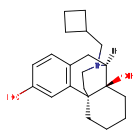
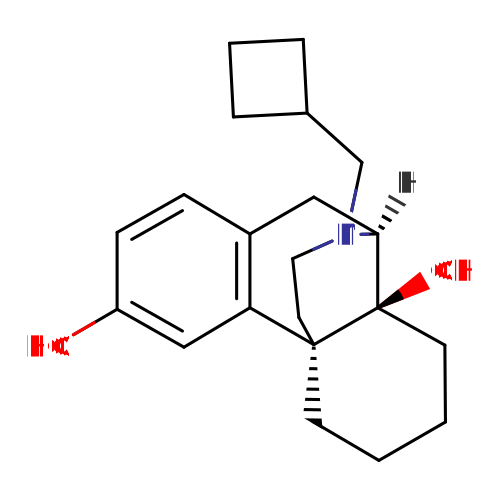
Structure for Butorphanol (DB00611)
- Weight
- Average: 327.4605
Monoisotopic: 327.219829177 - Chemical Formula
- C21H29NO2
- Synonyms
- (−)-17-(cyclobutylmethyl)morphinan-3,14-diol
- (−)-butorphanol
- (−)-N-cyclobutylmethyl-3,14-dihydroxymorphinan
- Butorfanol
- Butorphanol
- Butorphanolum
- External IDs
- BC-2627
- levo-BC 2627
- LEVO-BC-2627

Pharmacology
- Indication
For the relief of moderate to severe pain.
 Reduce drug development failure ratesBuild, train, & validate machine-learning modelswith evidence-based and structured datasets.Build, train, & validate predictive machine-learning models with structured datasets.
- Associated Conditions
Indication Type Indication Combined Product Details Approval Level Age Group Patient Characteristics Dose Form Management of Pain •••••••••••• •••••••••• •••••••••• •••••••• Treatment of Pain, perioperative •••••••••••• Treatment of Severe pain •••••••••••• - Contraindications & Blackbox Warnings
 Prevent Adverse Drug Events TodayTap into our Clinical API for life-saving information on contraindications & blackbox warnings, population restrictions, harmful risks, & more.Avoid life-threatening adverse drug events with our Clinical API
- Pharmacodynamics
Butorphanol is a synthetic opioid agonist-antagonist analgesic with a pharmacological and therapeutic profile that has been well established since its launch as a parenteral formulation in 1978. The introduction of a transnasal formulation of butorphanol represents a new and noninvasive presentation of an analgesic for moderate to severe pain. This route of administration bypasses the gastrointestinal tract, and this is an advantage for a drug such as butorphanol that undergoes significant first-pass metabolism after oral administration. The onset of action and systemic bioavailability of butorphanol following transnasal delivery are similar to those after parenteral administration. Butorphanol blocks pain impulses at specific sites in the brain and spinal cord.
- Mechanism of action
The exact mechanism of action is unknown, but is believed to interact with an opiate receptor site in the CNS (probably in or associated with the limbic system). The opiate antagonistic effect may result from competitive inhibition at the opiate receptor, but may also be a result of other mechanisms. Butorphanol is believed to have both partial agonism and partial antagonism at the μ-opioid receptor, as well as partial agonist and antagonist activity at the κ-opioid receptor.
Target Actions Organism AKappa-type opioid receptor agonistHumans ADelta-type opioid receptor agonistHumans AMu-type opioid receptor antagonistHumans - Absorption
Rapidly absorbed after intramuscular injection and peak plasma levels are reached in 20-40 minutes. The absolute bioavailability is 60-70% and is unchanged in patients with allergic rhinitis. In patients using a nasal vasoconstrictor (oxymetazoline) the fraction of the dose absorbed was unchanged, but the rate of absorption was slowed. Oral bioavailability is only 5-17% because of extensive first-pass metabolism.
- Volume of distribution
- 305 to 901 L
- Protein binding
Serum protein binding is approximately 80%.
- Metabolism
Extensively metabolized in the liver. The pharmacological activity of butorphanol metabolites has not been studied in humans; in animal studies, butorphanol metabolites have demonstrated some analgesic activity.
- Route of elimination
Butorphanol is extensively metabolized in the liver. Elimination occurs by urine and fecal excretion.
- Half-life
The elimination half-life of butorphanol is about 18 hours. In renally impaired patients with creatinine clearances <30 mL/min the elimination half-life is approximately doubled. After intravenous administration to patients with hepatic impairment, the elimination half-life of butorphanol was approximately tripled.
- Clearance
- 99 +/- 23 L/h [Young with IV 2 mg]
- 82 +/- 21 [Eldery with IV 2 mg]
- Adverse Effects
 Improve decision support & research outcomesWith structured adverse effects data, including: blackbox warnings, adverse reactions, warning & precautions, & incidence rates. View sample adverse effects data in our new Data Library!Improve decision support & research outcomes with our structured adverse effects data.
- Toxicity
The clinical manifestations of butorphanol overdose are those of opioid drugs in general. The most serious symptoms are hypoventilation, cardiovascular insufficiency, coma, and death.
- Pathways
- Not Available
- Pharmacogenomic Effects/ADRs
- Not Available
Interactions
- Drug Interactions
- This information should not be interpreted without the help of a healthcare provider. If you believe you are experiencing an interaction, contact a healthcare provider immediately. The absence of an interaction does not necessarily mean no interactions exist.
Drug Interaction Integrate drug-drug
interactions in your software1,2-Benzodiazepine The risk or severity of adverse effects can be increased when Butorphanol is combined with 1,2-Benzodiazepine. Acetazolamide The risk or severity of CNS depression can be increased when Butorphanol is combined with Acetazolamide. Acetophenazine The risk or severity of hypotension and CNS depression can be increased when Acetophenazine is combined with Butorphanol. Aclidinium The risk or severity of adverse effects can be increased when Aclidinium is combined with Butorphanol. Agomelatine The risk or severity of CNS depression can be increased when Butorphanol is combined with Agomelatine. - Food Interactions
- Avoid alcohol.
Products
 Drug product information from 10+ global regionsOur datasets provide approved product information including:dosage, form, labeller, route of administration, and marketing period.Access drug product information from over 10 global regions.
- Product Ingredients
Ingredient UNII CAS InChI Key Butorphanol tartrate 2L7I72RUHN 58786-99-5 GMTYREVWZXJPLF-AFHUBHILSA-N - International/Other Brands
- Butaro (Lotus Pharmaceuticals) / Butrum (Aristo)
- Brand Name Prescription Products
Name Dosage Strength Route Labeller Marketing Start Marketing End Region Image Stadol Injection, solution 2 mg/1mL Intramuscular; Intravenous E.R. Squibb & Sons, L.L.C. 2004-01-01 2005-05-31 US 
Stadol Injection, solution 2 mg/1mL Intramuscular; Intravenous E.R. Squibb & Sons, L.L.C. 2004-01-01 2005-08-31 US Stadol Injection, solution 2 mg/1mL Intramuscular; Intravenous Physicians Total Care, Inc. 1996-10-11 2011-05-31 US Stadol Injection, solution 1 mg/1mL Intramuscular; Intravenous E.R. Squibb & Sons, L.L.C. 2004-01-01 2005-08-31 US Stadol Injection, solution 2 mg/1mL Intramuscular; Intravenous E.R. Squibb & Sons, L.L.C. 1999-01-01 2000-01-01 US - Generic Prescription Products
Name Dosage Strength Route Labeller Marketing Start Marketing End Region Image Butorphanol Tartrate Spray 10 mg/1mL Nasal bryant ranch prepack 2002-12-04 Not applicable US Butorphanol Tartrate Injection 1 mg/1mL Intramuscular; Intravenous Bedford Pharmaceuticals 2008-05-05 2012-07-31 US Butorphanol tartrate Injection, solution 1 mg/1mL Intramuscular; Intravenous Apotex Corp. 2007-02-05 2019-05-15 US Butorphanol Tartrate Spray 10 mg/1mL Nasal Apotex Corp. 2002-12-04 Not applicable US Butorphanol Tartrate Injection, solution 2 mg/1mL Intramuscular; Intravenous Hikma Pharmaceuticals USA Inc. 2009-05-01 Not applicable US
Categories
- ATC Codes
- N02AF01 — Butorphanol
- Drug Categories
- Alkaloids
- Analgesics
- Antitussive Agents
- Central Nervous System Agents
- Central Nervous System Depressants
- Heterocyclic Compounds, Fused-Ring
- Mixed Agonist / Antagonist Opioids
- Morphinan Derivatives
- Morphinans
- Narcotics
- Nervous System
- Opiate Alkaloids
- Opiate Partial Agonists
- Opioid Agonist/Antagonist
- Opioid Antagonists
- Opioids
- Peripheral Nervous System Agents
- Phenanthrenes
- Respiratory System Agents
- Sensory System Agents
- Serotonergic Drugs Shown to Increase Risk of Serotonin Syndrome
- Chemical TaxonomyProvided by Classyfire
- Description
- This compound belongs to the class of organic compounds known as phenanthrenes and derivatives. These are polycyclic compounds containing a phenanthrene moiety, which is a tricyclic aromatic compound with three non-linearly fused benzene.
- Kingdom
- Organic compounds
- Super Class
- Benzenoids
- Class
- Phenanthrenes and derivatives
- Sub Class
- Not Available
- Direct Parent
- Phenanthrenes and derivatives
- Alternative Parents
- Benzazocines / Tetralins / Aralkylamines / 1-hydroxy-2-unsubstituted benzenoids / Piperidines / Tertiary alcohols / Trialkylamines / Cyclic alcohols and derivatives / 1,2-aminoalcohols / Azacyclic compounds show 2 more
- Substituents
- 1,2-aminoalcohol / 1-hydroxy-2-unsubstituted benzenoid / Alcohol / Amine / Aralkylamine / Aromatic heteropolycyclic compound / Azacycle / Benzazocine / Cyclic alcohol / Hydrocarbon derivative show 12 more
- Molecular Framework
- Aromatic heteropolycyclic compounds
- External Descriptors
- Not Available
- Affected organisms
- Humans and other mammals
Chemical Identifiers
- UNII
- QV897JC36D
- CAS number
- 42408-82-2
- InChI Key
- IFKLAQQSCNILHL-QHAWAJNXSA-N
- InChI
- InChI=1S/C21H29NO2/c23-17-7-6-16-12-19-21(24)9-2-1-8-20(21,18(16)13-17)10-11-22(19)14-15-4-3-5-15/h6-7,13,15,19,23-24H,1-5,8-12,14H2/t19-,20+,21-/m1/s1
- IUPAC Name
- (1S,9R,10S)-17-(cyclobutylmethyl)-17-azatetracyclo[7.5.3.0^{1,10}.0^{2,7}]heptadeca-2(7),3,5-triene-4,10-diol
- SMILES
- [H][C@@]12CC3=C(C=C(O)C=C3)[C@]3(CCCC[C@@]13O)CCN2CC1CCC1
References
- Synthesis Reference
Monkovic, I. and Conway, T.T.; U.S. Patent 3,775,414; November 27,1973; Monkovic, I.,Wong, H. and Lim, G.; U.S. Patent 3,980,641; September 14, 1976; Pachter, IJ., Belleau, B.R. and Monkovic, I.; U.S. Patent 3,819,635; June 25,1974; and Lim, G. and Hooper, J.W.; U.S. Patent 4,017,497; April 12,1977; all assigned to Bristol-Myers Company.
- General References
- Gear RW, Miaskowski C, Gordon NC, Paul SM, Heller PH, Levine JD: The kappa opioid nalbuphine produces gender- and dose-dependent analgesia and antianalgesia in patients with postoperative pain. Pain. 1999 Nov;83(2):339-45. [Article]
- Fan LW, Tanaka S, Tien LT, Ma T, Rockhold RW, Ho IK: Withdrawal from dependence upon butorphanol uniquely increases kappa(1)-opioid receptor binding in the rat brain. Brain Res Bull. 2002 Jun;58(2):149-60. [Article]
- External Links
- KEGG Drug
- D00837
- KEGG Compound
- C06863
- PubChem Compound
- 6916249
- PubChem Substance
- 46507553
- ChemSpider
- 16735714
- BindingDB
- 50240437
- 1841
- ChEBI
- 3242
- ChEMBL
- CHEMBL33986
- ZINC
- ZINC000003812988
- Therapeutic Targets Database
- DAP000214
- PharmGKB
- PA164745398
- RxList
- RxList Drug Page
- Drugs.com
- Drugs.com Drug Page
- Wikipedia
- Butorphanol
- FDA label
- Download (320 KB)
- MSDS
- Download (60.6 KB)
Clinical Trials
- Clinical Trials
Phase Status Purpose Conditions Count 4 Completed Treatment Colonoscopy 1 4 Completed Treatment Curettage / Pregnancy termination therapy 1 4 Completed Treatment Hysterectomy / Postoperative pain 1 4 Completed Treatment Postoperative pain 1 4 Not Yet Recruiting Treatment Respiratory Insufficiency 1
Pharmacoeconomics
- Manufacturers
- Bedford laboratories div ben venue laboratories inc
- Claris lifesciences ltd
- Hikma farmaceutica (portugal) sa
- Hikma farmaceutica sa
- Hospira inc
- Apothecon inc div bristol myers squibb
- Mylan pharmaceuticals inc
- Novex pharma
- Roxane laboratories inc
- Bristol myers squibb co pharmaceutical research institute
- Packagers
- Apotex Inc.
- A-S Medication Solutions LLC
- Bedford Labs
- Ben Venue Laboratories Inc.
- Bristol-Myers Squibb Co.
- Cardinal Health
- Dispensing Solutions
- Hikma Pharmaceuticals
- Hospira Inc.
- Intervet International
- Mead Johnson and Co.
- Meridian Medical Technologies Inc.
- Mylan
- Novex Pharma
- Patheon Inc.
- Physicians Total Care Inc.
- Roxane Labs
- West-Ward Pharmaceuticals
- Dosage Forms
Form Route Strength Solution Nasal 10 mg / mL Injection Intramuscular; Intravenous 1 mg/1mL Injection Intramuscular; Intravenous 2 mg/1mL Powder Not applicable 1 mg/1mg Spray, metered Nasal 10 mg/1mL Spray Nasal 10 mg / mL Injection, solution Intramuscular; Intravenous 1 mg/1mL Injection, solution Intramuscular; Intravenous 2 mg/1mL Spray Nasal 10 mg/1mL Aerosol, metered; liquid Nasal 10 mg / mL - Prices
Unit description Cost Unit Butorphanol Tartrate 10 mg/ml Solution 2.5ml Bottle 56.99USD bottle Butorphanol 10 mg/ml spray 39.63USD ml Stadol 2 mg/ml vial 10.11USD ml Butorphanol 2 mg/ml vial 7.2USD ml Butorphanol 1 mg/ml vial 3.6USD ml DrugBank does not sell nor buy drugs. Pricing information is supplied for informational purposes only.- Patents
- Not Available
Properties
- State
- Solid
- Experimental Properties
Property Value Source melting point (°C) 272-274 Monkovic, I. and Conway, T.T.; U.S. Patent 3,775,414; November 27,1973; Monkovic, I.,Wong, H. and Lim, G.; U.S. Patent 3,980,641; September 14, 1976; Pachter, IJ., Belleau, B.R. and Monkovic, I.; U.S. Patent 3,819,635; June 25,1974; and Lim, G. and Hooper, J.W.; U.S. Patent 4,017,497; April 12,1977; all assigned to Bristol-Myers Company. water solubility Moderate Not Available logP 3.3 Not Available - Predicted Properties
Property Value Source Water Solubility 0.16 mg/mL ALOGPS logP 3.65 ALOGPS logP 2.89 Chemaxon logS -3.3 ALOGPS pKa (Strongest Acidic) 9.86 Chemaxon pKa (Strongest Basic) 10.7 Chemaxon Physiological Charge 1 Chemaxon Hydrogen Acceptor Count 3 Chemaxon Hydrogen Donor Count 2 Chemaxon Polar Surface Area 43.7 Å2 Chemaxon Rotatable Bond Count 2 Chemaxon Refractivity 95.92 m3·mol-1 Chemaxon Polarizability 37.95 Å3 Chemaxon Number of Rings 5 Chemaxon Bioavailability 1 Chemaxon Rule of Five Yes Chemaxon Ghose Filter Yes Chemaxon Veber's Rule No Chemaxon MDDR-like Rule No Chemaxon - Predicted ADMET Features
Property Value Probability Human Intestinal Absorption + 0.9798 Blood Brain Barrier + 0.9463 Caco-2 permeable + 0.6844 P-glycoprotein substrate Substrate 0.8494 P-glycoprotein inhibitor I Inhibitor 0.5 P-glycoprotein inhibitor II Inhibitor 0.5667 Renal organic cation transporter Inhibitor 0.6508 CYP450 2C9 substrate Non-substrate 0.8248 CYP450 2D6 substrate Substrate 0.509 CYP450 3A4 substrate Substrate 0.5842 CYP450 1A2 substrate Non-inhibitor 0.6532 CYP450 2C9 inhibitor Non-inhibitor 0.9094 CYP450 2D6 inhibitor Inhibitor 0.6572 CYP450 2C19 inhibitor Non-inhibitor 0.8456 CYP450 3A4 inhibitor Non-inhibitor 0.8744 CYP450 inhibitory promiscuity Low CYP Inhibitory Promiscuity 0.9017 Ames test Non AMES toxic 0.7587 Carcinogenicity Non-carcinogens 0.9573 Biodegradation Not ready biodegradable 0.9368 Rat acute toxicity 2.6466 LD50, mol/kg Not applicable hERG inhibition (predictor I) Weak inhibitor 0.5378 hERG inhibition (predictor II) Inhibitor 0.5983
Spectra
- Mass Spec (NIST)
- Not Available
- Spectra
Spectrum Spectrum Type Splash Key Predicted GC-MS Spectrum - GC-MS Predicted GC-MS splash10-05c5-4090000000-ff08db00ae2474f6b4a5 Predicted MS/MS Spectrum - 10V, Positive (Annotated) Predicted LC-MS/MS splash10-004i-0009000000-6318eb7086cc2b613e65 Predicted MS/MS Spectrum - 10V, Negative (Annotated) Predicted LC-MS/MS splash10-004i-0009000000-b422041d34eb1ba53942 Predicted MS/MS Spectrum - 20V, Positive (Annotated) Predicted LC-MS/MS splash10-03fr-0029000000-829745194e66ba51af3c Predicted MS/MS Spectrum - 20V, Negative (Annotated) Predicted LC-MS/MS splash10-004i-0009000000-b422041d34eb1ba53942 Predicted MS/MS Spectrum - 40V, Positive (Annotated) Predicted LC-MS/MS splash10-004l-8296000000-760158b58d71322fa97a Predicted MS/MS Spectrum - 40V, Negative (Annotated) Predicted LC-MS/MS splash10-0zor-0494000000-f61295de819439a89e25 Predicted 1H NMR Spectrum 1D NMR Not Applicable Predicted 13C NMR Spectrum 1D NMR Not Applicable - Chromatographic Properties
Collision Cross Sections (CCS)
Not Available
Targets

- Kind
- Protein
- Organism
- Humans
- Pharmacological action
- Yes
- Actions
- Agonist
- General Function
- Opioid receptor activity
- Specific Function
- G-protein coupled opioid receptor that functions as receptor for endogenous alpha-neoendorphins and dynorphins, but has low affinity for beta-endorphins. Also functions as receptor for various synt...
- Gene Name
- OPRK1
- Uniprot ID
- P41145
- Uniprot Name
- Kappa-type opioid receptor
- Molecular Weight
- 42644.665 Da
References
- Vivian JA, DeYoung MB, Sumpter TL, Traynor JR, Lewis JW, Woods JH: kappa-Opioid receptor effects of butorphanol in rhesus monkeys. J Pharmacol Exp Ther. 1999 Jul;290(1):259-65. [Article]
- Park Y, Jang CG, Ho IK, Ko KH: kappa-opioid agonist stimulated regional distribution of [(35)S]GTPgammas binding in butorphanol continuously infused rat. Brain Res Bull. 2000 May 1;52(1):17-20. [Article]
- Fan LW, Tanaka S, Tien LT, Ma T, Rockhold RW, Ho IK: Withdrawal from dependence upon butorphanol uniquely increases kappa(1)-opioid receptor binding in the rat brain. Brain Res Bull. 2002 Jun;58(2):149-60. [Article]
- Fan LW, Tanaka S, Park Y, Sasaki K, Ma T, Tien LT, Rockhold RW, Ho IK: Butorphanol dependence and withdrawal decrease hippocampal kappa 2-opioid receptor binding. Brain Res. 2002 Dec 27;958(2):277-90. [Article]
- Commiskey S, Fan LW, Ho IK, Rockhold RW: Butorphanol: effects of a prototypical agonist-antagonist analgesic on kappa-opioid receptors. J Pharmacol Sci. 2005 Jun;98(2):109-16. Epub 2005 Jun 8. [Article]
- Picker MJ, Benyas S, Horwitz JA, Thompson K, Mathewson C, Smith MA: Discriminative stimulus effects of butorphanol: influence of training dose on the substitution patterns produced by Mu, Kappa and Delta opioid agonists. J Pharmacol Exp Ther. 1996 Dec;279(3):1130-41. [Article]
- Wakabayashi H, Tokuyama S, Ho IK: Simultaneous measurement of biogenic amines and their metabolites in rat brain regions after acute administration of and abrupt withdrawal from butorphanol or morphine. Neurochem Res. 1995 Oct;20(10):1179-85. [Article]
- Narita M, Feng Y, Makimura M, Hoskins B, Ho IK: Repeated administration of opioids alters characteristics of membrane-bound phorbol ester binding in rat brain. Eur J Pharmacol. 1994 Dec 27;271(2-3):547-50. [Article]
- Ohta S, Niwa M, Nozaki M, Tsurumi K, Shimonaka H, Tanahashi T, Uematsu H, Yamamoto M, Fujimura H: [Kappa-type opioid receptor in human placental membrane]. Masui. 1989 Oct;38(10):1293-300. [Article]
- Walsh SL, Chausmer AE, Strain EC, Bigelow GE: Evaluation of the mu and kappa opioid actions of butorphanol in humans through differential naltrexone blockade. Psychopharmacology (Berl). 2008 Jan;196(1):143-55. Epub 2007 Oct 2. [Article]
- Kind
- Protein
- Organism
- Humans
- Pharmacological action
- Yes
- Actions
- Agonist
- General Function
- Opioid receptor activity
- Specific Function
- G-protein coupled receptor that functions as receptor for endogenous enkephalins and for a subset of other opioids. Ligand binding causes a conformation change that triggers signaling via guanine n...
- Gene Name
- OPRD1
- Uniprot ID
- P41143
- Uniprot Name
- Delta-type opioid receptor
- Molecular Weight
- 40368.235 Da
References
- Fan LW, Tanaka S, Tien LT, Ma T, Rockhold RW, Ho IK: Withdrawal from dependence upon butorphanol uniquely increases kappa(1)-opioid receptor binding in the rat brain. Brain Res Bull. 2002 Jun;58(2):149-60. [Article]
- Fan LW, Tanaka S, Park Y, Sasaki K, Ma T, Tien LT, Rockhold RW, Ho IK: Butorphanol dependence and withdrawal decrease hippocampal kappa 2-opioid receptor binding. Brain Res. 2002 Dec 27;958(2):277-90. [Article]
- Commiskey S, Fan LW, Ho IK, Rockhold RW: Butorphanol: effects of a prototypical agonist-antagonist analgesic on kappa-opioid receptors. J Pharmacol Sci. 2005 Jun;98(2):109-16. Epub 2005 Jun 8. [Article]
- Picker MJ, Benyas S, Horwitz JA, Thompson K, Mathewson C, Smith MA: Discriminative stimulus effects of butorphanol: influence of training dose on the substitution patterns produced by Mu, Kappa and Delta opioid agonists. J Pharmacol Exp Ther. 1996 Dec;279(3):1130-41. [Article]
- Wakabayashi H, Tokuyama S, Ho IK: Simultaneous measurement of biogenic amines and their metabolites in rat brain regions after acute administration of and abrupt withdrawal from butorphanol or morphine. Neurochem Res. 1995 Oct;20(10):1179-85. [Article]
- Narita M, Feng Y, Makimura M, Hoskins B, Ho IK: Repeated administration of opioids alters characteristics of membrane-bound phorbol ester binding in rat brain. Eur J Pharmacol. 1994 Dec 27;271(2-3):547-50. [Article]
- Walsh SL, Chausmer AE, Strain EC, Bigelow GE: Evaluation of the mu and kappa opioid actions of butorphanol in humans through differential naltrexone blockade. Psychopharmacology (Berl). 2008 Jan;196(1):143-55. Epub 2007 Oct 2. [Article]
- Chen X, Ji ZL, Chen YZ: TTD: Therapeutic Target Database. Nucleic Acids Res. 2002 Jan 1;30(1):412-5. [Article]
- Kind
- Protein
- Organism
- Humans
- Pharmacological action
- Yes
- Actions
- Antagonist
- General Function
- Voltage-gated calcium channel activity
- Specific Function
- Receptor for endogenous opioids such as beta-endorphin and endomorphin. Receptor for natural and synthetic opioids including morphine, heroin, DAMGO, fentanyl, etorphine, buprenorphin and methadone...
- Gene Name
- OPRM1
- Uniprot ID
- P35372
- Uniprot Name
- Mu-type opioid receptor
- Molecular Weight
- 44778.855 Da
References
- Vivian JA, DeYoung MB, Sumpter TL, Traynor JR, Lewis JW, Woods JH: kappa-Opioid receptor effects of butorphanol in rhesus monkeys. J Pharmacol Exp Ther. 1999 Jul;290(1):259-65. [Article]
- Fan LW, Tanaka S, Tien LT, Ma T, Rockhold RW, Ho IK: Withdrawal from dependence upon butorphanol uniquely increases kappa(1)-opioid receptor binding in the rat brain. Brain Res Bull. 2002 Jun;58(2):149-60. [Article]
- Fan LW, Tanaka S, Park Y, Sasaki K, Ma T, Tien LT, Rockhold RW, Ho IK: Butorphanol dependence and withdrawal decrease hippocampal kappa 2-opioid receptor binding. Brain Res. 2002 Dec 27;958(2):277-90. [Article]
- Commiskey S, Fan LW, Ho IK, Rockhold RW: Butorphanol: effects of a prototypical agonist-antagonist analgesic on kappa-opioid receptors. J Pharmacol Sci. 2005 Jun;98(2):109-16. Epub 2005 Jun 8. [Article]
- Picker MJ, Benyas S, Horwitz JA, Thompson K, Mathewson C, Smith MA: Discriminative stimulus effects of butorphanol: influence of training dose on the substitution patterns produced by Mu, Kappa and Delta opioid agonists. J Pharmacol Exp Ther. 1996 Dec;279(3):1130-41. [Article]
- Wakabayashi H, Tokuyama S, Ho IK: Simultaneous measurement of biogenic amines and their metabolites in rat brain regions after acute administration of and abrupt withdrawal from butorphanol or morphine. Neurochem Res. 1995 Oct;20(10):1179-85. [Article]
- Picker MJ: Discriminative stimulus effects of the mixed-opioid agonist/antagonist dezocine: cross-substitution by mu and delta opioid agonists. J Pharmacol Exp Ther. 1997 Dec;283(3):1009-17. [Article]
- Narita M, Feng Y, Makimura M, Hoskins B, Ho IK: Repeated administration of opioids alters characteristics of membrane-bound phorbol ester binding in rat brain. Eur J Pharmacol. 1994 Dec 27;271(2-3):547-50. [Article]
- Walsh SL, Chausmer AE, Strain EC, Bigelow GE: Evaluation of the mu and kappa opioid actions of butorphanol in humans through differential naltrexone blockade. Psychopharmacology (Berl). 2008 Jan;196(1):143-55. Epub 2007 Oct 2. [Article]

Drug created at June 13, 2005 13:24 / Updated at April 27, 2024 09:44