Identification
- Summary
Rifabutin is an antibiotic used to treat mycobacterium avium complex disease in patients with HIV.
- Brand Names
- Mycobutin, Talicia
- Generic Name
- Rifabutin
- DrugBank Accession Number
- DB00615
- Background
A broad-spectrum antibiotic that is being used as prophylaxis against disseminated Mycobacterium avium complex infection in HIV-positive patients.
- Type
- Small Molecule
- Groups
- Approved, Investigational
- Structure
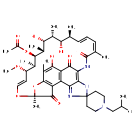
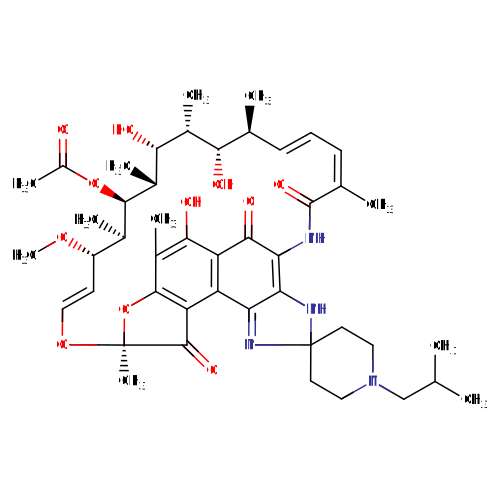
Structure for Rifabutin (DB00615)
- Weight
- Average: 847.0047
Monoisotopic: 846.441508846 - Chemical Formula
- C46H62N4O11
- Synonyms
- 1,4-Dihydro-1-deoxy-1',4-didehydro-5'-(2-methylpropyl)-1-oxorifamycin XIV
- 4-Deoxo-3,4-(2-spiro(N-isobutyl-4-piperidyl)-2,5-dihydro-1H-imidazo)-rifamycin S
- 4-N-isobutylspiropiperidylrifamycin S
- Ansamicin
- Ansamycin
- Rifabutin
- Rifabutina
- Rifabutine
- Rifabutinum
- External IDs
- LM 427
- LM-427

Pharmacology
- Indication
For the prevention of disseminated Mycobacterium avium complex (MAC) disease in patients with advanced HIV infection.
 Reduce drug development failure ratesBuild, train, & validate machine-learning modelswith evidence-based and structured datasets.Build, train, & validate predictive machine-learning models with structured datasets.
- Associated Conditions
Indication Type Indication Combined Product Details Approval Level Age Group Patient Characteristics Dose Form Used in combination to treat Helicobacter pylori infection Combination Product in combination with: Omeprazole (DB00338), Amoxicillin (DB01060) •••••••••••• ••••• •••••••• ••••••• ••••••• Treatment of Latent tuberculosis ••• ••••• Treatment of Mycobacterium avium complex infection ••• ••••• Prophylaxis of Mycobacterium avium complex infection •••••••••••• Treatment of Tuberculosis ••• ••••• - Contraindications & Blackbox Warnings
 Prevent Adverse Drug Events TodayTap into our Clinical API for life-saving information on contraindications & blackbox warnings, population restrictions, harmful risks, & more.Avoid life-threatening adverse drug events with our Clinical API
- Pharmacodynamics
Rifabutin is an antibiotic that inhibits DNA-dependent RNA polymerase activity in susceptible cells. Specifically, it interacts with bacterial RNA polymerase but does not inhibit the mammalian enzyme. It is bactericidal and has a very broad spectrum of activity against most gram-positive and gram-negative organisms (including Pseudomonas aeruginosa) and specifically Mycobacterium tuberculosis. Because of rapid emergence of resistant bacteria, use is restricted to treatment of mycobacterial infections and a few other indications. Rifabutin is well absorbed when taken orally and is distributed widely in body tissues and fluids, including the CSF. It is metabolized in the liver and eliminated in bile and, to a much lesser extent, in urine, but dose adjustments are unnecessary with renal insufficiency.
- Mechanism of action
Rifabutin acts via the inhibition of DNA-dependent RNA polymerase in gram-positive and some gram-negative bacteria, leading to a suppression of RNA synthesis and cell death.
Target Actions Organism ADNA-directed RNA polymerase subunit alpha inhibitorEscherichia coli (strain K12) ADNA-directed RNA polymerase subunit beta inhibitorEscherichia coli (strain K12) ADNA-directed RNA polymerase subunit beta' inhibitorEscherichia coli (strain K12) NHeat shock protein HSP 90-alpha other/unknownHumans NEndoplasmin other/unknownHumans - Absorption
Rifabutin is readily absorbed from the gastrointestinal tract, with an absolute bioavailability averaging 20%.
- Volume of distribution
Not Available
- Protein binding
85%
- Metabolism
Hepatic. Of the five metabolites that have been identified, 25-O-desacetyl and 31-hydroxy are the most predominant. The former metabolite has an activity equal to the parent drug and contributes up to 10% to the total antimicrobial activity.
Hover over products below to view reaction partners
- Route of elimination
A mass-balance study in three healthy adult volunteers with 14C-labeled rifabutin showed that 53% of the oral dose was excreted in the urine, primarily as metabolites. About 30% of the dose is excreted in the feces.
- Half-life
45 (± 17) hours
- Clearance
- 0.69 +/- 0.32 L/hr/kg
- Adverse Effects
 Improve decision support & research outcomesWith structured adverse effects data, including: blackbox warnings, adverse reactions, warning & precautions, & incidence rates. View sample adverse effects data in our new Data Library!Improve decision support & research outcomes with our structured adverse effects data.
- Toxicity
LD50 = 4.8 g/kg (mouse, male)
- Pathways
- Not Available
- Pharmacogenomic Effects/ADRs
- Not Available
Interactions
- Drug Interactions
- This information should not be interpreted without the help of a healthcare provider. If you believe you are experiencing an interaction, contact a healthcare provider immediately. The absence of an interaction does not necessarily mean no interactions exist.
Drug Interaction Integrate drug-drug
interactions in your softwareAbametapir The serum concentration of Rifabutin can be increased when it is combined with Abametapir. Abemaciclib The metabolism of Abemaciclib can be increased when combined with Rifabutin. Abrocitinib The metabolism of Abrocitinib can be increased when combined with Rifabutin. Acalabrutinib The metabolism of Acalabrutinib can be increased when combined with Rifabutin. Acenocoumarol The metabolism of Acenocoumarol can be increased when combined with Rifabutin. - Food Interactions
- Take with or without food. For those patients with propensity to nausea, vomiting, or other gastrointestinal upset, taking with food may be useful.
Products
 Drug product information from 10+ global regionsOur datasets provide approved product information including:dosage, form, labeller, route of administration, and marketing period.Access drug product information from over 10 global regions.
- Product Images


- International/Other Brands
- Ansatipin (Pfizer) / Ansatipine (SERB) / Ributin (Lupin)
- Brand Name Prescription Products
Name Dosage Strength Route Labeller Marketing Start Marketing End Region Image Mycobutin Capsule 150 mg Oral Pfizer Canada Ulc 1995-12-31 Not applicable Canada 
Mycobutin Capsule 150 mg/1 Oral Physicians Total Care, Inc. 1995-03-15 Not applicable US 

Mycobutin Capsule 150 mg/1 Oral Pfizer Laboratories Div Pfizer Inc 1992-12-23 Not applicable US 
Mycobutin Capsule 150 mg/1 Oral REMEDYREPACK INC. 2020-05-14 Not applicable US Mycobutin Capsule 150 mg/1 Oral Department Of State Health Services, Pharmacy Branch 1992-12-23 Not applicable US - Generic Prescription Products
Name Dosage Strength Route Labeller Marketing Start Marketing End Region Image Rifabutin Capsule 150 mg/1 Oral Avera McKennan Hospital 2016-03-03 2017-05-24 US Rifabutin Capsule 150 mg/1 Oral Greenstone LLC 2014-04-07 Not applicable US Rifabutin Capsule 150 mg/1 Oral Marlex Pharmaceuticals, Inc. 2022-05-01 Not applicable US Rifabutin Capsule 150 mg/1 Oral American Health Packaging 2016-06-08 2021-01-31 US Rifabutin Capsule 150 mg/1 Oral Novitium Pharma Llc 2021-12-17 Not applicable US - Mixture Products
Name Ingredients Dosage Route Labeller Marketing Start Marketing End Region Image Talicia Rifabutin (12.5 mg/1) + Amoxicillin Trihydrate (250 mg/1) + Omeprazole magnesium (10 mg/1) Capsule, delayed release Oral RedHill Biopharma Ltd 2020-03-09 Not applicable US


Categories
- ATC Codes
- J04AB04 — Rifabutin
- J04AB — Antibiotics
- J04A — DRUGS FOR TREATMENT OF TUBERCULOSIS
- J04 — ANTIMYCOBACTERIALS
- J — ANTIINFECTIVES FOR SYSTEMIC USE
- Drug Categories
- Alimentary Tract and Metabolism
- Anti-Bacterial Agents
- Anti-Infective Agents
- Antibiotics, Antitubercular
- Antiinfectives for Systemic Use
- Antimycobacterials
- Cytochrome P-450 CYP2B6 Inducers
- Cytochrome P-450 CYP2B6 Inducers (weak)
- Cytochrome P-450 CYP2C19 Inducers
- Cytochrome P-450 CYP2C19 Inducers (moderate)
- Cytochrome P-450 CYP2C8 Inducers
- Cytochrome P-450 CYP2C8 Inducers (weak)
- Cytochrome P-450 CYP2C9 Inducers
- Cytochrome P-450 CYP2C9 Inducers (strength unknown)
- Cytochrome P-450 CYP3A Inducers
- Cytochrome P-450 CYP3A Substrates
- Cytochrome P-450 CYP3A4 Inducers
- Cytochrome P-450 CYP3A4 Inducers (strength unknown)
- Cytochrome P-450 CYP3A4 Inducers (weak)
- Cytochrome P-450 CYP3A4 Substrates
- Cytochrome P-450 Enzyme Inducers
- Cytochrome P-450 Substrates
- Drugs for Acid Related Disorders
- Drugs for Peptic Ulcer and Gastro-Oesophageal Reflux Disease (Gord)
- Drugs for Treatment of Tuberculosis
- Heterocyclic Compounds, Fused-Ring
- Lactams, Macrocyclic
- P-glycoprotein inducers
- Rifamycin Antimycobacterial
- Rifamycins
- Chemical TaxonomyProvided by Classyfire
- Description
- This compound belongs to the class of organic compounds known as macrolactams. These are cyclic amides of amino carboxylic acids, having a 1-azacycloalkan-2-one structure, or analogues having unsaturation or heteroatoms replacing one or more carbon atoms of the ring. They are nitrogen analogues (the a nitrogen atom replacing the o atom of the cyclic carboxylic acid group ) of the naturally occurring macrolides.
- Kingdom
- Organic compounds
- Super Class
- Phenylpropanoids and polyketides
- Class
- Macrolactams
- Sub Class
- Not Available
- Direct Parent
- Macrolactams
- Alternative Parents
- Naphthofurans / Azaspirodecane derivatives / Naphthalenes / Benzofurans / Coumarans / Aryl alkyl ketones / Ketals / Piperidines / Vinylogous amides / Vinylogous acids show 19 more
- Substituents
- 3-imidazoline / Acetal / Alcohol / Amine / Amino acid or derivatives / Aromatic heteropolycyclic compound / Aryl alkyl ketone / Aryl ketone / Azacycle / Azaspirodecane show 40 more
- Molecular Framework
- Aromatic heteropolycyclic compounds
- External Descriptors
- rifamycin (CHEBI:45367)
- Affected organisms
- Enteric bacteria and other eubacteria
- Mycobacterium tuberculosis
- Mycobacterium leprae
- Mycobacterium avium
Chemical Identifiers
- UNII
- 1W306TDA6S
- CAS number
- 72559-06-9
- InChI Key
- ATEBXHFBFRCZMA-VXTBVIBXSA-N
- InChI
- InChI=1S/C46H62N4O11/c1-22(2)21-50-18-16-46(17-19-50)48-34-31-32-39(54)28(8)42-33(31)43(56)45(10,61-42)59-20-15-30(58-11)25(5)41(60-29(9)51)27(7)38(53)26(6)37(52)23(3)13-12-14-24(4)44(57)47-36(40(32)55)35(34)49-46/h12-15,20,22-23,25-27,30,37-38,41,49,52-54H,16-19,21H2,1-11H3,(H,47,57)/b13-12+,20-15+,24-14-/t23-,25+,26+,27+,30-,37-,38+,41+,45-/m0/s1
- IUPAC Name
- (7S,9E,11S,12R,13S,14R,15R,16R,17S,18S,19E,21Z)-2,15,17-trihydroxy-11-methoxy-3,7,12,14,16,18,22-heptamethyl-1'-(2-methylpropyl)-6,23,32-trioxo-8,33-dioxa-24,27,29-triazaspiro[pentacyclo[23.6.1.1^{4,7}.0^{5,31}.0^{26,30}]tritriacontane-28,4'-piperidin]-1(31),2,4,9,19,21,25,29-octaen-13-yl acetate
- SMILES
- CO[C@H]1\C=C\O[C@@]2(C)OC3=C(C2=O)C2=C(C(O)=C3C)C(=O)C(NC(=O)\C(C)=C/C=C/[C@H](C)[C@H](O)[C@@H](C)[C@@H](O)[C@@H](C)[C@H](OC(C)=O)[C@@H]1C)=C1NC3(CCN(CC3)CC(C)C)N=C21
References
- General References
- FDA Approved Drug Products: Talicia Amoxicillin, Omeprazole, and Rifabutin Oral Delayed Release Capsules [Link]
- External Links
- Human Metabolome Database
- HMDB14753
- KEGG Drug
- D00424
- KEGG Compound
- C07235
- PubChem Compound
- 6323490
- PubChem Substance
- 46506468
- ChemSpider
- 10482168
- BindingDB
- 50237607
- 55672
- ChEBI
- 45367
- ChEMBL
- CHEMBL444633
- ZINC
- ZINC000169621215
- Therapeutic Targets Database
- DAP000656
- PharmGKB
- PA451249
- PDBe Ligand
- RBT
- RxList
- RxList Drug Page
- Drugs.com
- Drugs.com Drug Page
- Wikipedia
- Rifabutin
- PDB Entries
- 2a68 / 4cp3 / 6bec / 6zo9
- FDA label
- Download (69.5 KB)
- MSDS
- Download (58.4 KB)
Clinical Trials
- Clinical Trials
Phase Status Purpose Conditions Count 4 Completed Treatment Human Immunodeficiency Virus (HIV) Infections 1 4 Completed Treatment Human Immunodeficiency Virus (HIV) Infections / Mycobacterium avium complex infection 1 4 Completed Treatment Human Immunodeficiency Virus (HIV) Infections / Tuberculosis (TB) 1 4 Completed Treatment Mycobacterium Avium Complex Lung Disease 1 4 Completed Treatment Mycobacterium Avium Intracellulare Complex (MAC) 1
Pharmacoeconomics
- Manufacturers
- Pharmacia and upjohn co
- Packagers
- CQ International Co. Inc.
- Kaiser Foundation Hospital
- Pfizer Inc.
- Pharmacia Inc.
- Physicians Total Care Inc.
- Dosage Forms
Form Route Strength Capsule Oral 150 mg/1 Capsule Oral 150 mg Capsule Oral Capsule, coated Oral 150 mg Capsule, delayed release Oral - Prices
Unit description Cost Unit Mycobutin 150 mg capsule 13.01USD capsule DrugBank does not sell nor buy drugs. Pricing information is supplied for informational purposes only.- Patents
Patent Number Pediatric Extension Approved Expires (estimated) Region US9603806 No 2017-03-28 2034-02-12 US US9498445 No 2016-11-22 2034-02-12 US US9050263 No 2015-06-09 2034-02-12 US US10238606 No 2019-03-26 2034-02-12 US US11135172 No 2021-10-05 2034-02-12 US US11878011 No 2022-05-27 2042-05-27 US
Properties
- State
- Solid
- Experimental Properties
Property Value Source water solubility Minimally soluble (0.19 mg/mL) Not Available logP 4.1 Not Available - Predicted Properties
Property Value Source Water Solubility 0.017 mg/mL ALOGPS logP 4.25 ALOGPS logP 3.66 Chemaxon logS -4.7 ALOGPS pKa (Strongest Acidic) 6.93 Chemaxon pKa (Strongest Basic) 9.03 Chemaxon Physiological Charge 0 Chemaxon Hydrogen Acceptor Count 13 Chemaxon Hydrogen Donor Count 5 Chemaxon Polar Surface Area 205.55 Å2 Chemaxon Rotatable Bond Count 5 Chemaxon Refractivity 232.64 m3·mol-1 Chemaxon Polarizability 89.99 Å3 Chemaxon Number of Rings 6 Chemaxon Bioavailability 0 Chemaxon Rule of Five No Chemaxon Ghose Filter No Chemaxon Veber's Rule No Chemaxon MDDR-like Rule No Chemaxon - Predicted ADMET Features
Property Value Probability Human Intestinal Absorption + 0.5507 Blood Brain Barrier - 0.9921 Caco-2 permeable - 0.7072 P-glycoprotein substrate Substrate 0.9612 P-glycoprotein inhibitor I Inhibitor 0.5415 P-glycoprotein inhibitor II Inhibitor 0.6516 Renal organic cation transporter Non-inhibitor 0.8178 CYP450 2C9 substrate Non-substrate 0.819 CYP450 2D6 substrate Non-substrate 0.9116 CYP450 3A4 substrate Substrate 0.745 CYP450 1A2 substrate Non-inhibitor 0.9046 CYP450 2C9 inhibitor Non-inhibitor 0.9071 CYP450 2D6 inhibitor Non-inhibitor 0.9231 CYP450 2C19 inhibitor Non-inhibitor 0.9026 CYP450 3A4 inhibitor Non-inhibitor 0.8308 CYP450 inhibitory promiscuity Low CYP Inhibitory Promiscuity 0.8909 Ames test Non AMES toxic 0.6724 Carcinogenicity Non-carcinogens 0.9195 Biodegradation Not ready biodegradable 0.9687 Rat acute toxicity 2.5143 LD50, mol/kg Not applicable hERG inhibition (predictor I) Weak inhibitor 0.946 hERG inhibition (predictor II) Inhibitor 0.5416
Spectra
- Mass Spec (NIST)
- Not Available
- Spectra
- Chromatographic Properties
Collision Cross Sections (CCS)
Adduct CCS Value (Å2) Source type Source [M-H]- 300.1250181 predictedDarkChem Lite v0.1.0 [M-H]- 280.66342 predictedDeepCCS 1.0 (2019) [M+H]+ 300.0635181 predictedDarkChem Lite v0.1.0 [M+H]+ 282.38715 predictedDeepCCS 1.0 (2019) [M+Na]+ 301.2806181 predictedDarkChem Lite v0.1.0 [M+Na]+ 288.5604 predictedDeepCCS 1.0 (2019)
Targets

- Kind
- Protein
- Organism
- Escherichia coli (strain K12)
- Pharmacological action
- Yes
- Actions
- Inhibitor
- General Function
- Zinc ion binding
- Specific Function
- DNA-dependent RNA polymerase (RNAP) catalyzes the transcription of DNA into RNA using the four ribonucleoside triphosphates as substrates. This subunit plays an important role in subunit assembly s...
- Gene Name
- rpoA
- Uniprot ID
- P0A7Z4
- Uniprot Name
- DNA-directed RNA polymerase subunit alpha
- Molecular Weight
- 36511.35 Da
References
- Overington JP, Al-Lazikani B, Hopkins AL: How many drug targets are there? Nat Rev Drug Discov. 2006 Dec;5(12):993-6. [Article]
- Imming P, Sinning C, Meyer A: Drugs, their targets and the nature and number of drug targets. Nat Rev Drug Discov. 2006 Oct;5(10):821-34. [Article]
- Maddix DS, Tallian KB, Mead PS: Rifabutin: a review with emphasis on its role in the prevention of disseminated Mycobacterium avium complex infection. Ann Pharmacother. 1994 Nov;28(11):1250-4. [Article]
- Kind
- Protein
- Organism
- Escherichia coli (strain K12)
- Pharmacological action
- Yes
- Actions
- Inhibitor
- General Function
- Ribonucleoside binding
- Specific Function
- DNA-dependent RNA polymerase catalyzes the transcription of DNA into RNA using the four ribonucleoside triphosphates as substrates.
- Gene Name
- rpoB
- Uniprot ID
- P0A8V2
- Uniprot Name
- DNA-directed RNA polymerase subunit beta
- Molecular Weight
- 150631.165 Da
References
- Maddix DS, Tallian KB, Mead PS: Rifabutin: a review with emphasis on its role in the prevention of disseminated Mycobacterium avium complex infection. Ann Pharmacother. 1994 Nov;28(11):1250-4. [Article]
- Kind
- Protein
- Organism
- Escherichia coli (strain K12)
- Pharmacological action
- Yes
- Actions
- Inhibitor
- General Function
- Dna-directed rna polymerase activity
- Specific Function
- DNA-dependent RNA polymerase catalyzes the transcription of DNA into RNA using the four ribonucleoside triphosphates as substrates.
- Gene Name
- rpoC
- Uniprot ID
- P0A8T7
- Uniprot Name
- DNA-directed RNA polymerase subunit beta'
- Molecular Weight
- 155158.84 Da
References
- Maddix DS, Tallian KB, Mead PS: Rifabutin: a review with emphasis on its role in the prevention of disseminated Mycobacterium avium complex infection. Ann Pharmacother. 1994 Nov;28(11):1250-4. [Article]
- Kind
- Protein
- Organism
- Humans
- Pharmacological action
- No
- Actions
- Other/unknown
- General Function
- Tpr domain binding
- Specific Function
- Molecular chaperone that promotes the maturation, structural maintenance and proper regulation of specific target proteins involved for instance in cell cycle control and signal transduction. Under...
- Gene Name
- HSP90AA1
- Uniprot ID
- P07900
- Uniprot Name
- Heat shock protein HSP 90-alpha
- Molecular Weight
- 84659.015 Da
References
- Schnaider T, Somogyi J, Csermely P, Szamel M: The Hsp90-specific inhibitor geldanamycin selectively disrupts kinase-mediated signaling events of T-lymphocyte activation. Cell Stress Chaperones. 2000 Jan;5(1):52-61. [Article]
- Neckers L, Schulte TW, Mimnaugh E: Geldanamycin as a potential anti-cancer agent: its molecular target and biochemical activity. Invest New Drugs. 1999;17(4):361-73. [Article]
- Srethapakdi M, Liu F, Tavorath R, Rosen N: Inhibition of Hsp90 function by ansamycins causes retinoblastoma gene product-dependent G1 arrest. Cancer Res. 2000 Jul 15;60(14):3940-6. [Article]
- Munster PN, Srethapakdi M, Moasser MM, Rosen N: Inhibition of heat shock protein 90 function by ansamycins causes the morphological and functional differentiation of breast cancer cells. Cancer Res. 2001 Apr 1;61(7):2945-52. [Article]
- Yang J, Yang JM, Iannone M, Shih WJ, Lin Y, Hait WN: Disruption of the EF-2 kinase/Hsp90 protein complex: a possible mechanism to inhibit glioblastoma by geldanamycin. Cancer Res. 2001 May 15;61(10):4010-6. [Article]
- Kind
- Protein
- Organism
- Humans
- Pharmacological action
- No
- Actions
- Other/unknown
- General Function
- Virion binding
- Specific Function
- Molecular chaperone that functions in the processing and transport of secreted proteins. When associated with CNPY3, required for proper folding of Toll-like receptors (By similarity). Functions in...
- Gene Name
- HSP90B1
- Uniprot ID
- P14625
- Uniprot Name
- Endoplasmin
- Molecular Weight
- 92468.06 Da
References
- Barzilay E, Ben-Califa N, Supino-Rosin L, Kashman Y, Hirschberg K, Elazar Z, Neumann D: Geldanamycin-associated inhibition of intracellular trafficking is attributed to a co-purified activity. J Biol Chem. 2004 Feb 20;279(8):6847-52. Epub 2003 Dec 1. [Article]
- Chavany C, Mimnaugh E, Miller P, Bitton R, Nguyen P, Trepel J, Whitesell L, Schnur R, Moyer J, Neckers L: p185erbB2 binds to GRP94 in vivo. Dissociation of the p185erbB2/GRP94 heterocomplex by benzoquinone ansamycins precedes depletion of p185erbB2. J Biol Chem. 1996 Mar 1;271(9):4974-7. [Article]
- Lawson B, Brewer JW, Hendershot LM: Geldanamycin, an hsp90/GRP94-binding drug, induces increased transcription of endoplasmic reticulum (ER) chaperones via the ER stress pathway. J Cell Physiol. 1998 Feb;174(2):170-8. [Article]
Enzymes
- Kind
- Protein
- Organism
- Humans
- Pharmacological action
- No
- Actions
- Inducer
- General Function
- Steroid hydroxylase activity
- Specific Function
- Responsible for the metabolism of a number of therapeutic agents such as the anticonvulsant drug S-mephenytoin, omeprazole, proguanil, certain barbiturates, diazepam, propranolol, citalopram and im...
- Gene Name
- CYP2C19
- Uniprot ID
- P33261
- Uniprot Name
- Cytochrome P450 2C19
- Molecular Weight
- 55930.545 Da
- Kind
- Protein
- Organism
- Humans
- Pharmacological action
- No
- Actions
- Inducer
- General Function
- Steroid hydroxylase activity
- Specific Function
- Cytochromes P450 are a group of heme-thiolate monooxygenases. In liver microsomes, this enzyme is involved in an NADPH-dependent electron transport pathway. It oxidizes a variety of structurally un...
- Gene Name
- CYP2B6
- Uniprot ID
- P20813
- Uniprot Name
- Cytochrome P450 2B6
- Molecular Weight
- 56277.81 Da
References
- Rendic S: Summary of information on human CYP enzymes: human P450 metabolism data. Drug Metab Rev. 2002 Feb-May;34(1-2):83-448. [Article]
- Kind
- Protein
- Organism
- Humans
- Pharmacological action
- No
- Actions
- Inducer
- General Function
- Steroid hydroxylase activity
- Specific Function
- Cytochromes P450 are a group of heme-thiolate monooxygenases. In liver microsomes, this enzyme is involved in an NADPH-dependent electron transport pathway. It oxidizes a variety of structurally un...
- Gene Name
- CYP2C8
- Uniprot ID
- P10632
- Uniprot Name
- Cytochrome P450 2C8
- Molecular Weight
- 55824.275 Da
References
- Kind
- Protein
- Organism
- Humans
- Pharmacological action
- No
- Actions
- Inducer
- Curator comments
- This drug is a member of the rifamycin derivative drug class, which are known to induce CYP2C9.
- General Function
- Steroid hydroxylase activity
- Specific Function
- Cytochromes P450 are a group of heme-thiolate monooxygenases. In liver microsomes, this enzyme is involved in an NADPH-dependent electron transport pathway. It oxidizes a variety of structurally un...
- Gene Name
- CYP2C9
- Uniprot ID
- P11712
- Uniprot Name
- Cytochrome P450 2C9
- Molecular Weight
- 55627.365 Da
References
- Lutz JD, Kirby BJ, Wang L, Song Q, Ling J, Massetto B, Worth A, Kearney BP, Mathias A: Cytochrome P450 3A Induction Predicts P-glycoprotein Induction; Part 2: Prediction of Decreased Substrate Exposure After Rifabutin or Carbamazepine. Clin Pharmacol Ther. 2018 Mar 23. doi: 10.1002/cpt.1072. [Article]
- Kind
- Protein
- Organism
- Humans
- Pharmacological action
- Unknown
- Actions
- SubstrateInducer
- General Function
- Vitamin d3 25-hydroxylase activity
- Specific Function
- Cytochromes P450 are a group of heme-thiolate monooxygenases. In liver microsomes, this enzyme is involved in an NADPH-dependent electron transport pathway. It performs a variety of oxidation react...
- Gene Name
- CYP3A4
- Uniprot ID
- P08684
- Uniprot Name
- Cytochrome P450 3A4
- Molecular Weight
- 57342.67 Da
References
- Ekins S, Bravi G, Wikel JH, Wrighton SA: Three-dimensional-quantitative structure activity relationship analysis of cytochrome P-450 3A4 substrates. J Pharmacol Exp Ther. 1999 Oct;291(1):424-33. [Article]
- Vourvahis M, Davis J, Wang R, Layton G, Choo HW, Chong CL, Tawadrous M: Effect of rifampin and rifabutin on the pharmacokinetics of lersivirine and effect of lersivirine on the pharmacokinetics of rifabutin and 25-O-desacetyl-rifabutin in healthy subjects. Antimicrob Agents Chemother. 2012 Aug;56(8):4303-9. doi: 10.1128/AAC.06282-11. Epub 2012 May 29. [Article]
- Sousa M, Pozniak A, Boffito M: Pharmacokinetics and pharmacodynamics of drug interactions involving rifampicin, rifabutin and antimalarial drugs. J Antimicrob Chemother. 2008 Nov;62(5):872-8. doi: 10.1093/jac/dkn330. Epub 2008 Aug 18. [Article]
- Flockhart Table of Drug Interactions [Link]
- Mycobutin (Rifabutin) FDA Label [Link]
Transporters
- Kind
- Protein
- Organism
- Humans
- Pharmacological action
- Unknown
- Actions
- Inducer
- General Function
- Xenobiotic-transporting atpase activity
- Specific Function
- Energy-dependent efflux pump responsible for decreased drug accumulation in multidrug-resistant cells.
- Gene Name
- ABCB1
- Uniprot ID
- P08183
- Uniprot Name
- Multidrug resistance protein 1
- Molecular Weight
- 141477.255 Da
References
- Baciewicz AM, Chrisman CR, Finch CK, Self TH: Update on rifampin, rifabutin, and rifapentine drug interactions. Curr Med Res Opin. 2013 Jan;29(1):1-12. doi: 10.1185/03007995.2012.747952. Epub 2012 Nov 30. [Article]
- Lutz JD, Kirby BJ, Wang L, Song Q, Ling J, Massetto B, Worth A, Kearney BP, Mathias A: Cytochrome P450 3A Induction Predicts P-glycoprotein Induction; Part 2: Prediction of Decreased Substrate Exposure After Rifabutin or Carbamazepine. Clin Pharmacol Ther. 2018 Mar 23. doi: 10.1002/cpt.1072. [Article]
- Vourvahis M, Davis J, Wang R, Layton G, Choo HW, Chong CL, Tawadrous M: Effect of rifampin and rifabutin on the pharmacokinetics of lersivirine and effect of lersivirine on the pharmacokinetics of rifabutin and 25-O-desacetyl-rifabutin in healthy subjects. Antimicrob Agents Chemother. 2012 Aug;56(8):4303-9. doi: 10.1128/AAC.06282-11. Epub 2012 May 29. [Article]

Drug created at June 13, 2005 13:24 / Updated at April 26, 2024 00:45