Identification
- Summary
Clorazepic acid is a benzodiazepine used to treat anxiety, partial seizures, and alcohol withdrawal.
- Generic Name
- Clorazepic acid
- DrugBank Accession Number
- DB00628
- Background
Clorazepic acid (clorazepate) is a water-soluble benzodiazepine with muscle-relaxant and anticonvulsant actions effective in the treatment of anxiety.1,8 Following administration, clorazepate is rapidly converted to nordiazepam (N-desmethyldiazepam), its active metabolite, before entering systemic circulation. Similar to other benzodiazepines, the active metabolite of clorazepate enhances the binding of gamma-aminobutyric acid (GABA) to the GABA type A (GABA-A) receptor, which promotes channel opening and neuronal hyperpolarization.5,7 The concomitant use of clorazepate and opioids may result in profound sedation, respiratory depression, coma, and death. Also, the use of clorazepate exposes users to users to the risks of abuse, misuse, and addiction, and its continued use may lead to significant physical dependence. In September 2020, a black box warning describing these risks was included on the product label of benzodiazepines as per FDA regulation.9 Clorazepate and its active metabolite, nordiazepam, are present in breast milk.2,8
- Type
- Small Molecule
- Groups
- Approved, Illicit
- Structure
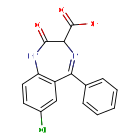
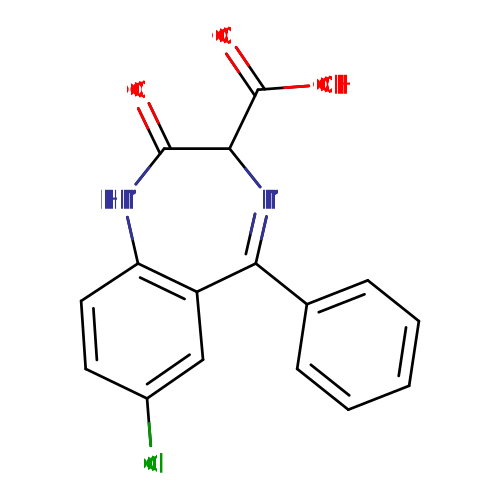
Structure for Clorazepic acid (DB00628)
- Weight
- Average: 314.723
Monoisotopic: 314.045819935 - Chemical Formula
- C16H11ClN2O3
- Synonyms
- 7-chloro-2,3-dihydro-2,2-dihydroxy-5-phenyl-1H-1,4-benzodiazepine-3-carboxylic acid
- Chlorazepate
- Clorazepate
- Clorazepic acid
- External IDs
- 4306-CB FREE ACID
- 4311 CB
- Abbott 35616
- AH 3232
- CB 4306
- Ro 6-6616
- TR 19119

Pharmacology
- Indication
Clorazepate is indicated for the management of anxiety disorders or the short-term relief of the symptoms of anxiety. It is also used as adjunctive therapy in the management of partial seizures and for the symptomatic relief of acute alcohol withdrawal.8
 Reduce drug development failure ratesBuild, train, & validate machine-learning modelswith evidence-based and structured datasets.Build, train, & validate predictive machine-learning models with structured datasets.
- Associated Conditions
Indication Type Indication Combined Product Details Approval Level Age Group Patient Characteristics Dose Form Symptomatic treatment of Acute alcohol withdrawal •••••••••••• Management of Generalized anxiety disorders •••••••••••• Adjunct therapy in treatment of Partial seizures •••••••••••• Symptomatic treatment of Acute anxiety •••••••••••• - Contraindications & Blackbox Warnings
 Prevent Adverse Drug Events TodayTap into our Clinical API for life-saving information on contraindications & blackbox warnings, population restrictions, harmful risks, & more.Avoid life-threatening adverse drug events with our Clinical API
- Pharmacodynamics
Pharmacologically, clorazepate has the characteristics of benzodiazepines. Studies in healthy men have shown that clorazepate has depressant effects on the central nervous system. Since orally administered clorazepate dipotassium is rapidly decarboxylated to form nordiazepam, there is essentially no circulating parent drug.8 The use of benzodiazepines, including clorazepate, exposes users to abuse, misuse, and addiction risks, which can lead to overdose and death. Patients treated with clorazepate may also develop suicidal behavior and ideation, and the use of clorazepate may cause interference with psychomotor performance. The concomitant use of clorazepate with opioids may result in profound sedation, respiratory depression, coma, and death.8
- Mechanism of action
Clorazepate is a benzodiazepine with depressant effects on the central nervous system.8 Benzodiazepines are able to enhance the binding of gamma-aminobutyric acid (GABA) to the GABA type A (GABA-A) receptor by binding to a region in the extracellular domain found at the interface between the alpha (α) and gamma (γ) subunits of the GABA-A receptor. The interaction of GABA and the GABA-A receptor promotes channel opening, leading to an increased chloride influx. Consequently, the use of benzodiazepines, such as clorazepate, leads to neuronal hyperpolarization.5,7
Target Actions Organism AGABA(A) Receptor positive allosteric modulatorHumans AGABA(A) Receptor Benzodiazepine Binding Site ligandHumans - Absorption
Clorazepate is a prodrug for nordiazepam, and this conversion occurs almost entirely before entering systemic circulation. Therefore, the pharmacokinetic parameters of clorazepate are based on nordiazepam concentrations. In healthy volunteers given a 20 mg oral dose of clorazepate, nordiazepam had a peak plasma level of 356 ng/mL, which was reached approximately 0.9 h after the administration of clorazepate.3 The plasma levels of nordiazepam increase proportionally with the clorazepate dose and show moderate accumulation with repeated administration.8 The oral bioavailability of clorazepate is 91%.6
- Volume of distribution
Following a single 20 mg intravenous dose, the volume of distribution of nordiazepam (active metabolite of clorazepate) was 1.24 L/kg.3
- Protein binding
The protein binding of nordiazepam (active metabolite of clorazepate) in plasma is high (97-98%).8
- Metabolism
Clorazepate is metabolized in the liver and excreted mainly through urine.8 Following oral administration, clorazepate is decarboxylated by the gastric acid of the stomach before absorption.4 The primary metabolite, nordiazepam, is further metabolized by hydroxylation. The major urinary metabolite is conjugated oxazepam (3-hydroxynordiazepam), and smaller amounts of conjugated p-hydroxynordiazepam and nordiazepam are also found in the urine.8
Hover over products below to view reaction partners
- Route of elimination
Clorazepate is mainly excreted through urine and feces. In two volunteers given 15 mg of [14C]-clorazepate, 62-67% of the radioactivity was excreted in the urine and 15-19% was eliminated in the feces within 10 days. On day 10, both subjects were still excreting about 1% of the [14C]-dose in the urine.8
- Half-life
The serum half-life of clorazepate is approximately 2 days. Nordiazepam, the primary metabolite, quickly appears in the blood and is eliminated from the plasma with an apparent half-life of about 40 to 50 hours.8
- Clearance
Following a single 20 mg intravenous dose, nordiazepam (the active metabolite of clorazepate) had a total clearance of 0.24 mL/min/kg.3
- Adverse Effects
 Improve decision support & research outcomesWith structured adverse effects data, including: blackbox warnings, adverse reactions, warning & precautions, & incidence rates. View sample adverse effects data in our new Data Library!Improve decision support & research outcomes with our structured adverse effects data.
- Toxicity
The overdosage of benzodiazepines, such as clorazepate, is characterized by central nervous system (CNS) depression ranging from drowsiness to coma. In mild to moderate cases, symptoms can include drowsiness, confusion, dysarthria, lethargy, hypnotic state, diminished reflexes, ataxia, and hypotonia. Paradoxical or disinhibitory reactions are rare but may occur. In severe cases, patients experiencing a benzodiazepine overdose may develop respiratory depression and coma. Overdosage of benzodiazepines in combination with other CNS depressants may be fatal. General supportive measures, including intravenous fluids and airway management, should be used to manage a benzodiazepine overdose. The use of flumazenil for the complete or partial reversal of benzodiazepine-sedative effects during an overdose can lead to withdrawal and adverse reactions. Refer to the product label of clorazepate for additional overdosage management recommendations.8
In rats, the oral LD50 of clorazepate is 1320 mg/kg, and in monkeys, it exceeds 1600 mg/kg. In animal reproduction studies, clorazepate did not affect fertility indices or the reproductive capacity of adult animals.8
- Pathways
- Not Available
- Pharmacogenomic Effects/ADRs
- Not Available
Interactions
- Drug Interactions
- This information should not be interpreted without the help of a healthcare provider. If you believe you are experiencing an interaction, contact a healthcare provider immediately. The absence of an interaction does not necessarily mean no interactions exist.
Drug Interaction Integrate drug-drug
interactions in your software1,2-Benzodiazepine The risk or severity of CNS depression can be increased when Clorazepic acid is combined with 1,2-Benzodiazepine. Abacavir Clorazepic acid may decrease the excretion rate of Abacavir which could result in a higher serum level. Abametapir The serum concentration of Clorazepic acid can be increased when it is combined with Abametapir. Aceclofenac Aceclofenac may decrease the excretion rate of Clorazepic acid which could result in a higher serum level. Acemetacin Acemetacin may decrease the excretion rate of Clorazepic acid which could result in a higher serum level. - Food Interactions
- Avoid alcohol. The concomitant use of clorazepate and alcohol may lead to an increased frequency of serious adverse outcomes.
- Take with or without food. The absorption is unaffected by food.
Products
 Drug product information from 10+ global regionsOur datasets provide approved product information including:dosage, form, labeller, route of administration, and marketing period.Access drug product information from over 10 global regions.
- Product Ingredients
Ingredient UNII CAS InChI Key Clorazepate dipotassium 63FN7G03XY 57109-90-7 QCHSEDTUUKDTIG-UHFFFAOYSA-L - Product Images
- International/Other Brands
- Anksen (Sanovel) / Calner (Medipharm) / Cloranxen (Teva) / Clorazepatum (sanofi-aventis) / Clozene (Weidar) / Dipot (Asian) / Flulium (Pharmasant) / Gen-xene (Alra) / Justum (Sandoz) / Manotran (March) / Medipax (Tecnifar) / Mendon (Abbott Japan) / Polizep (Polipharm) / Tencilan (Finadiet) / Trancap (T P Drug) / Transene (sanofi-aventis) / Tranxen (sanofi-aventis) / Tranxène (sanofi-aventis) / Tranxene (Lundbeck) / Tranxilene (sanofi-aventis) / Tranxilium (sanofi-aventis) / Zetran-5 (Masa Lab)
- Brand Name Prescription Products
Name Dosage Strength Route Labeller Marketing Start Marketing End Region Image Clorazepate Capsule 3.75 mg Oral Aa Pharma Inc 1990-12-31 Not applicable Canada 
Clorazepate Capsule 15 mg Oral Aa Pharma Inc 1990-12-31 Not applicable Canada Clorazepate Capsule 7.5 mg Oral Aa Pharma Inc 1990-12-31 Not applicable Canada Clorazepate Dipotassium T-Tab Tablet 7.5 mg/1 Oral Abbvie 1972-06-23 2018-04-30 US 
Tranxene Cap 15mg Capsule 15 mg Oral Abbott 1973-12-31 2003-08-01 Canada - Generic Prescription Products
Name Dosage Strength Route Labeller Marketing Start Marketing End Region Image Clorazepate Dipotassium Tablet 3.75 mg/1 Oral NorthStar Rx LLC 2022-10-24 Not applicable US Clorazepate Dipotassium Tablet 3.75 mg/1 Oral bryant ranch prepack 2000-04-27 2014-03-01 US 
Clorazepate dipotassium Tablet 7.5 mg/1 Oral Contract Pharmacy Services Pa 2017-09-28 Not applicable US Clorazepate Dipotassium Tablet 3.75 mg/1mg Oral Apotex Corp. 2022-09-22 Not applicable US Clorazepate Dipotassium Tablet 7.5 mg/1 Oral Mylan Pharmaceuticals Inc. 1987-07-17 Not applicable US


Categories
- ATC Codes
- N05BA05 — Potassium clorazepate
- Drug Categories
- Anti-Anxiety Agents
- Anticonvulsants
- Benzazepines
- Benzodiazepines and benzodiazepine derivatives
- Central Nervous System Agents
- Central Nervous System Depressants
- Cytochrome P-450 CYP3A Substrates
- Cytochrome P-450 CYP3A4 Substrates
- Cytochrome P-450 Substrates
- Drugs that are Mainly Renally Excreted
- GABA Agents
- GABA Modulators
- Heterocyclic Compounds, Fused-Ring
- Nervous System
- Neurotransmitter Agents
- Psycholeptics
- Psychotropic Drugs
- Tranquilizing Agents
- Chemical TaxonomyProvided by Classyfire
- Description
- This compound belongs to the class of organic compounds known as 1,4-benzodiazepines. These are organic compounds containing a benzene ring fused to a 1,4-azepine.
- Kingdom
- Organic compounds
- Super Class
- Organoheterocyclic compounds
- Class
- Benzodiazepines
- Sub Class
- 1,4-benzodiazepines
- Direct Parent
- 1,4-benzodiazepines
- Alternative Parents
- Alpha amino acids and derivatives / Benzene and substituted derivatives / Aryl chlorides / 1,3-dicarbonyl compounds / Secondary carboxylic acid amides / Lactams / Ketimines / Propargyl-type 1,3-dipolar organic compounds / Monocarboxylic acids and derivatives / Carboxylic acids show 5 more
- Substituents
- 1,3-dicarbonyl compound / 1,4-benzodiazepine / Alpha-amino acid or derivatives / Aromatic heteropolycyclic compound / Aryl chloride / Aryl halide / Azacycle / Benzenoid / Carbonyl group / Carboxamide group show 19 more
- Molecular Framework
- Aromatic heteropolycyclic compounds
- External Descriptors
- 1,4-benzodiazepinone (CHEBI:3761)
- Affected organisms
- Humans and other mammals
Chemical Identifiers
- UNII
- D51WO0G0L4
- CAS number
- 23887-31-2
- InChI Key
- XDDJGVMJFWAHJX-UHFFFAOYSA-N
- InChI
- InChI=1S/C16H11ClN2O3/c17-10-6-7-12-11(8-10)13(9-4-2-1-3-5-9)19-14(16(21)22)15(20)18-12/h1-8,14H,(H,18,20)(H,21,22)
- IUPAC Name
- 7-chloro-2-oxo-5-phenyl-2,3-dihydro-1H-1,4-benzodiazepine-3-carboxylic acid
- SMILES
- OC(=O)C1N=C(C2=CC=CC=C2)C2=C(NC1=O)C=CC(Cl)=C2
References
- Synthesis Reference
Schmitt, J. (1970). 1,4 benzodiazepine-2-ones having a carboxylic acid ester or amide group in the 3-position (U.S. Patent 3,516,988). U.S. Patent and Trademark Office. https://patentimages.storage.googleapis.com/ce/c5/88/de9de70d8e622e/US3516988.pdf
- General References
- Authors unspecified: Systematic review of the benzodiazepines. Guidelines for data sheets on diazepam, chlordiazepoxide, medazepam, clorazepate, lorazepam, oxazepam, temazepam, triazolam, nitrazepam, and flurazepam. Committee on the Review of Medicines. Br Med J. 1980 Mar 29;280(6218):910-2. [Article]
- McElhatton PR: The effects of benzodiazepine use during pregnancy and lactation. Reprod Toxicol. 1994 Nov-Dec;8(6):461-75. [Article]
- Ochs HR, Steinhaus E, Locniskar A, Knuchel M, Greenblatt DJ: Desmethyldiazepam kinetics after intravenous, intramuscular, and oral administration of clorazepate dipotassium. Klin Wochenschr. 1982 Apr 15;60(8):411-5. doi: 10.1007/BF01735933. [Article]
- Frey HH, Scherkl R: Clorazepate, correlation between metabolism and anticonvulsant activity. Eur J Pharmacol. 1988 Dec 13;158(3):213-6. doi: 10.1016/0014-2999(88)90069-6. [Article]
- Goldschen-Ohm MP: Benzodiazepine Modulation of GABA(A) Receptors: A Mechanistic Perspective. Biomolecules. 2022 Nov 30;12(12):1784. doi: 10.3390/biom12121784. [Article]
- Davies, JA (2007). Clorazepate. In XPharm: The comprehensive Pharmacology Reference (pp. 1-5). Elsevier.
- Trinka, E, Brigo F (2015). Benzodiazepines Used in the Treatment of Epilepsy. In The Treatment of Epilepsy, 4 (pp. 398-417). John Wiley & Sons, Ltd. [ISBN:9781118937006]
- FDA Approved Drug Products: Tranxene T-TAB (clorazepate dipotassium) tablets for oral use [Link]
- US Food & Drug Administration: FDA requiring Boxed Warning updated to improve safe use of benzodiazepine drug class [Link]
- Toronto Research Chemicals: Clorazepic acid dipotassium salt SDS [Link]
- External Links
- Human Metabolome Database
- HMDB0014766
- KEGG Drug
- D00694
- KEGG Compound
- C06921
- PubChem Compound
- 2809
- PubChem Substance
- 46506595
- ChemSpider
- 2707
- 235408
- ChEBI
- 3761
- ChEMBL
- CHEMBL1213252
- Therapeutic Targets Database
- DAP000240
- PharmGKB
- PA164749297
- RxList
- RxList Drug Page
- Drugs.com
- Drugs.com Drug Page
- Wikipedia
- Clorazepate
Clinical Trials
- Clinical Trials
Phase Status Purpose Conditions Count 4 Terminated Prevention Depression 1 4 Terminated Treatment Cutaneous T-Cell Lymphoma (CTCL) / Mycosis Fungoides (MF) 1 3 Recruiting Treatment Headache / Migraine / Migraine With Aura / Migraine Without Aura 1 Not Available Completed Not Available Healthy Volunteers (HV) 1
Pharmacoeconomics
- Manufacturers
- Able laboratories inc
- American therapeutics inc
- Clonmel healthcare ltd
- Gd searle llc
- Mylan pharmaceuticals inc
- Purepac pharmaceutical co
- Quantum pharmics ltd
- Sandoz inc
- Usl pharma inc
- Warner chilcott div warner lambert co
- Watson laboratories inc
- Lundbeck inc
- Lederle laboratories div american cyanamid co
- Ranbaxy laboratories ltd
- Taro pharmaceuticals usa inc
- Alra laboratories inc
- Packagers
- Abbott Laboratories Ltd.
- Aidarex Pharmacuticals LLC
- A-S Medication Solutions LLC
- Bryant Ranch Prepack
- Corepharma LLC
- Direct Dispensing Inc.
- Dispensing Solutions
- Diversified Healthcare Services Inc.
- Heartland Repack Services LLC
- Lundbeck Inc.
- Major Pharmaceuticals
- Murfreesboro Pharmaceutical Nursing Supply
- Mylan
- Nucare Pharmaceuticals Inc.
- Ohm Laboratories Inc.
- PD-Rx Pharmaceuticals Inc.
- Pharmedix
- Physicians Total Care Inc.
- Prepak Systems Inc.
- Prescript Pharmaceuticals
- Qualitest
- Ranbaxy Laboratories
- Rebel Distributors Corp.
- Remedy Repack
- Resource Optimization and Innovation LLC
- Sandhills Packaging Inc.
- Stat Rx Usa
- Taro Pharmaceuticals USA
- Watson Pharmaceuticals
- Dosage Forms
Form Route Strength Capsule Oral Capsule Oral 3.75 mg Capsule Oral 7.5 mg Tablet Oral 15 mg/1 Tablet Oral 15 mg/1mg Tablet Oral 3.75 mg/1 Tablet Oral 3.75 mg/1mg Tablet Oral 7.5 mg/1 Tablet Oral 7.5 mg/1mg Capsule Oral 10 MG Capsule Oral 15 MG Capsule Oral 5 MG Capsule Oral 7.5 mg / cap Capsule Oral 20 mg Tablet, film coated Oral 20 mg - Prices
Unit description Cost Unit Tranxene t-tablet 15 mg 5.41USD tablet Tranxene-T 15 mg tablet 5.08USD tablet Tranxene t-tablet 7.5 mg 3.99USD tablet Tranxene-T 7.5 mg tablet 3.6USD tablet Tranxene t-tablet 3.75 mg 3.21USD tablet Tranxene-T 3.75 mg tablet 3.04USD tablet Clorazepate 15 mg tablet 2.17USD tablet Clorazepate Dipotassium 15 mg tablet 1.27USD tablet Clorazepate Dipotassium 7.5 mg tablet 0.93USD tablet Clorazepate 7.5 mg tablet 0.79USD tablet Clorazepate Dipotassium 3.75 mg tablet 0.76USD tablet Clorazepate 3.75 mg tablet 0.73USD tablet Apo-Clorazepate 15 mg Capsule 0.4USD capsule Apo-Clorazepate 7.5 mg Capsule 0.2USD capsule Apo-Clorazepate 3.75 mg Capsule 0.15USD capsule DrugBank does not sell nor buy drugs. Pricing information is supplied for informational purposes only.- Patents
- Not Available
Properties
- State
- Solid
- Experimental Properties
Property Value Source melting point (°C) 228-235°C SDS water solubility Very soluble FDA label logP 3 Not Available - Predicted Properties
Property Value Source Water Solubility 0.0248 mg/mL ALOGPS logP 2.68 ALOGPS logP 3.21 Chemaxon logS -4.1 ALOGPS pKa (Strongest Acidic) 3.32 Chemaxon pKa (Strongest Basic) -0.64 Chemaxon Physiological Charge -1 Chemaxon Hydrogen Acceptor Count 4 Chemaxon Hydrogen Donor Count 2 Chemaxon Polar Surface Area 78.76 Å2 Chemaxon Rotatable Bond Count 2 Chemaxon Refractivity 82.68 m3·mol-1 Chemaxon Polarizability 30.62 Å3 Chemaxon Number of Rings 3 Chemaxon Bioavailability 1 Chemaxon Rule of Five Yes Chemaxon Ghose Filter Yes Chemaxon Veber's Rule No Chemaxon MDDR-like Rule No Chemaxon - Predicted ADMET Features
Property Value Probability Human Intestinal Absorption + 0.9285 Blood Brain Barrier + 0.8373 Caco-2 permeable + 0.5909 P-glycoprotein substrate Non-substrate 0.5597 P-glycoprotein inhibitor I Non-inhibitor 0.9328 P-glycoprotein inhibitor II Non-inhibitor 0.9386 Renal organic cation transporter Non-inhibitor 0.9049 CYP450 2C9 substrate Non-substrate 0.7365 CYP450 2D6 substrate Non-substrate 0.8745 CYP450 3A4 substrate Non-substrate 0.5798 CYP450 1A2 substrate Inhibitor 0.7086 CYP450 2C9 inhibitor Non-inhibitor 0.756 CYP450 2D6 inhibitor Non-inhibitor 0.819 CYP450 2C19 inhibitor Non-inhibitor 0.7451 CYP450 3A4 inhibitor Non-inhibitor 0.8333 CYP450 inhibitory promiscuity Low CYP Inhibitory Promiscuity 0.8165 Ames test Non AMES toxic 0.8311 Carcinogenicity Non-carcinogens 0.659 Biodegradation Not ready biodegradable 1.0 Rat acute toxicity 1.9282 LD50, mol/kg Not applicable hERG inhibition (predictor I) Weak inhibitor 0.9987 hERG inhibition (predictor II) Non-inhibitor 0.9207
Spectra
- Mass Spec (NIST)
- Not Available
- Spectra
Spectrum Spectrum Type Splash Key Predicted GC-MS Spectrum - GC-MS Predicted GC-MS splash10-0006-2090000000-36dc0db4681a42cb62d1 Predicted MS/MS Spectrum - 10V, Positive (Annotated) Predicted LC-MS/MS splash10-014i-0039000000-50f797e01d20acf561e5 Predicted MS/MS Spectrum - 10V, Negative (Annotated) Predicted LC-MS/MS splash10-03e9-5009000000-529a8532da290e709fbc Predicted MS/MS Spectrum - 20V, Positive (Annotated) Predicted LC-MS/MS splash10-0002-0094000000-ae6bc2088e25504cef36 Predicted MS/MS Spectrum - 20V, Negative (Annotated) Predicted LC-MS/MS splash10-014i-1190000000-50e89d8dec3242cc11a4 Predicted MS/MS Spectrum - 40V, Positive (Annotated) Predicted LC-MS/MS splash10-03di-0090000000-b755824623f8593b5546 Predicted MS/MS Spectrum - 40V, Negative (Annotated) Predicted LC-MS/MS splash10-0006-9030000000-c57f82f9f0c1a72f1a46 Predicted 1H NMR Spectrum 1D NMR Not Applicable Predicted 13C NMR Spectrum 1D NMR Not Applicable - Chromatographic Properties
Collision Cross Sections (CCS)
Adduct CCS Value (Å2) Source type Source [M-H]- 176.286604 predictedDarkChem Lite v0.1.0 [M-H]- 165.12926 predictedDeepCCS 1.0 (2019) [M+H]+ 176.463604 predictedDarkChem Lite v0.1.0 [M+H]+ 167.48738 predictedDeepCCS 1.0 (2019) [M+Na]+ 175.655104 predictedDarkChem Lite v0.1.0 [M+Na]+ 173.64911 predictedDeepCCS 1.0 (2019)
Targets

- Kind
- Protein group
- Organism
- Humans
- Pharmacological action
- Yes
- Actions
- Positive allosteric modulator
- Curator comments
- The GABA(A) receptor is pentameric (i.e. comprising 5 subunit proteins) and therefore has a multitude of potential isoforms. The above target is a collection of all possible GABA(A) subunits that may participate in the formation of the pentameric receptor and is not meant to imply direct a drug-protein interaction for each individual subunit.
- General Function
- Inhibitory extracellular ligand-gated ion channel activity
- Specific Function
- Component of the heteropentameric receptor for GABA, the major inhibitory neurotransmitter in the vertebrate brain. Functions also as histamine receptor and mediates cellular responses to histamine...
Components:
References
- Zhu S, Noviello CM, Teng J, Walsh RM Jr, Kim JJ, Hibbs RE: Structure of a human synaptic GABAA receptor. Nature. 2018 Jul;559(7712):67-72. doi: 10.1038/s41586-018-0255-3. Epub 2018 Jun 27. [Article]
- Sigel E, Steinmann ME: Structure, function, and modulation of GABA(A) receptors. J Biol Chem. 2012 Nov 23;287(48):40224-31. doi: 10.1074/jbc.R112.386664. Epub 2012 Oct 4. [Article]
- FDA Approved Drug Products: Tranxene T-TAB (clorazepate dipotassium) tablets for oral use [Link]
- Kind
- Protein group
- Organism
- Humans
- Pharmacological action
- Yes
- Actions
- Ligand
- Curator comments
- Benzodiazepines modulate GABA(A) function by binding at the interface between alpha (α) and gamma (γ) subunits. Of the 6 α-subunits, only 4 (α-1, -2, -3, and -5) participate in the formation of this binding site. The above target is a collection of all α- and γ-subunits that are known to participate in the formation of the benzodiazepine binding site.
- General Function
- Inhibitory extracellular ligand-gated ion channel activity
- Specific Function
- Component of the heteropentameric receptor for GABA, the major inhibitory neurotransmitter in the vertebrate brain. Functions also as histamine receptor and mediates cellular responses to histamine...
Components:
References
- Sigel E, Steinmann ME: Structure, function, and modulation of GABA(A) receptors. J Biol Chem. 2012 Nov 23;287(48):40224-31. doi: 10.1074/jbc.R112.386664. Epub 2012 Oct 4. [Article]
- Zhu S, Noviello CM, Teng J, Walsh RM Jr, Kim JJ, Hibbs RE: Structure of a human synaptic GABAA receptor. Nature. 2018 Jul;559(7712):67-72. doi: 10.1038/s41586-018-0255-3. Epub 2018 Jun 27. [Article]
Enzymes
- Kind
- Protein
- Organism
- Humans
- Pharmacological action
- Unknown
- Actions
- Substrate
- General Function
- Vitamin d3 25-hydroxylase activity
- Specific Function
- Cytochromes P450 are a group of heme-thiolate monooxygenases. In liver microsomes, this enzyme is involved in an NADPH-dependent electron transport pathway. It performs a variety of oxidation react...
- Gene Name
- CYP3A4
- Uniprot ID
- P08684
- Uniprot Name
- Cytochrome P450 3A4
- Molecular Weight
- 57342.67 Da
References
- Dresser GK, Spence JD, Bailey DG: Pharmacokinetic-pharmacodynamic consequences and clinical relevance of cytochrome P450 3A4 inhibition. Clin Pharmacokinet. 2000 Jan;38(1):41-57. [Article]
- Sachs B, Erdmann S, Al-Masaoudi T, Merk HF: In vitro drug allergy detection system incorporating human liver microsomes in chlorazepate-induced skin rash: drug-specific proliferation associated with interleukin-5 secretion. Br J Dermatol. 2001 Feb;144(2):316-20. [Article]
- Smolders EJ, de Kanter CT, de Knegt RJ, van der Valk M, Drenth JP, Burger DM: Drug-Drug Interactions Between Direct-Acting Antivirals and Psychoactive Medications. Clin Pharmacokinet. 2016 Dec;55(12):1471-1494. doi: 10.1007/s40262-016-0407-2. [Article]

Drug created at June 13, 2005 13:24 / Updated at April 26, 2024 00:45