Identification
- Summary
Clofarabine is a purine nucleoside used to treat relapsed or refractory acute lymphoblastic leukemia in patients 1 to 21 years old.
- Brand Names
- Clolar, Evoltra
- Generic Name
- Clofarabine
- DrugBank Accession Number
- DB00631
- Background
Clofarabine is a purine nucleoside antimetabolite that is being studied in the treatment of cancer. It is marketed as Clolar in the U.S. and Canada, or Evoltra in Europe, Australia, and New Zealand. Clofarabine is used in paediatrics to treat a type of leukaemia called relapsed or refractory acute lymphoblastic leukaemia (ALL), only after at least two other types of treatment have failed. It is not known if the drug extends life expectancy. Its potential use in acute myeloid leukaemia (AML) and juvenile myelomonocytic leukaemia (JMML) has been investigated.
- Type
- Small Molecule
- Groups
- Approved, Investigational
- Structure
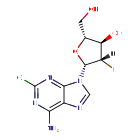
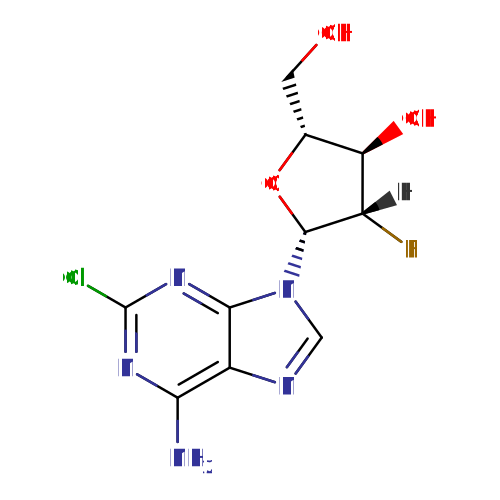
Structure for Clofarabine (DB00631)
- Weight
- Average: 303.677
Monoisotopic: 303.053445155 - Chemical Formula
- C10H11ClFN5O3
- Synonyms
- (2R,3R,4S,5R)-5-(6-amino-2-chloropurin-9-yl)-4-fluoro-2-(hydroxymethyl)oxolan-3-ol
- 2-chloro-9-(2-deoxy-2-fluoro-β-D-arabinofuranosyl)adenine
- 2-chloro-9-(2'-deoxy-2'-fluoro-β-D-arabinofuranosyl)adenine
- CAFdA
- Cl-F-Ara-A
- Clofarabin
- Clofarabina
- Clofarabine
- Clofarabinum
- External IDs
- C1-F-Ara-A
- CAfdA

Pharmacology
- Indication
For the treatment of pediatric patients 1 to 21 years old with relapsed or refractory acute lymphocytic (lymphoblastic) leukemia after at least two prior regimens. It is designated as an orphan drug by the FDA for this use.
 Reduce drug development failure ratesBuild, train, & validate machine-learning modelswith evidence-based and structured datasets.Build, train, & validate predictive machine-learning models with structured datasets.
- Associated Conditions
Indication Type Indication Combined Product Details Approval Level Age Group Patient Characteristics Dose Form Treatment of Refractory acute lymphoblastic leukemia •••••••••••• Used in combination to treat Refractory acute myeloid leukemia ••• ••••• Treatment of Relapsed acute lymphoblastic leukemia •••••••••••• Management of Refractory langerhans cell histiocytosis ••• ••••• ••••••••• - Contraindications & Blackbox Warnings
 Prevent Adverse Drug Events TodayTap into our Clinical API for life-saving information on contraindications & blackbox warnings, population restrictions, harmful risks, & more.Avoid life-threatening adverse drug events with our Clinical API
- Pharmacodynamics
Clofarabine is a purine nucleoside antimetabolite that differs from other puring nucleoside analogs by the presence of a chlorine in the purine ring and a flourine in the ribose moiety. Clofarabine seems to interfere with the growth of cancer cells, which are eventually destroyed. Since the growth of normal body cells may also be affected by clofarabine, other effects also occur. Clofarabine prevents cells from making DNA and RNA by interfering with the synthesis of nucleic acids, thus stopping the growth of cancer cells.
- Mechanism of action
Clofarabine is metabolized intracellularly to the active 5'-monophosphate metabolite by deoxycytidine kinase and 5'-triphosphate metabolite by mono- and di-phospho-kinases. This metabolite inhibits DNA synthesis through an inhibitory action on ribonucleotide reductase, and by terminating DNA chain elongation and inhibiting repair through competitive inhibition of DNA polymerases. This leads to the depletion of the intracellular deoxynucleotide triphosphate pool and the self-potentiation of clofarabine triphosphate incorporation into DNA, thereby intensifying the effectiveness of DNA synthesis inhibition. The affinity of clofarabine triphosphate for these enzymes is similar to or greater than that of deoxyadenosine triphosphate. In preclinical models, clofarabine has demonstrated the ability to inhibit DNA repair by incorporation into the DNA chain during the repair process. Clofarabine 5'-triphosphate also disrupts the integrity of mitochondrial membrane, leading to the release of the pro-apoptotic mitochondrial proteins, cytochrome C and apoptosis-inducing factor, leading to programmed cell death.
Target Actions Organism ADNA other/unknownHumans ADNA polymerase alpha catalytic subunit inhibitorHumans ARibonucleoside-diphosphate reductase large subunit inhibitorHumans - Absorption
Not Available
- Volume of distribution
- 172 L/m2
- Protein binding
47% bound to plasma proteins, predominantly to albumin.
- Metabolism
Clofarabine is sequentially metabolized intracellularly to the 5’-monophosphate metabolite by deoxycytidine kinase and mono- and di-phosphokinases to the active 5’-triphosphate metabolite. Clofarabine has high affinity for the activating phosphorylating enzyme, deoxycytidine kinase, equal to or greater than that of the natural substrate, deoxycytidine.
Hover over products below to view reaction partners
- Route of elimination
Based on 24-hour urine collections in the pediatric studies, 49 - 60% of the dose is excreted in the urine unchanged.
- Half-life
The terminal half-life is estimated to be 5.2 hours.
- Clearance
- 28.8 L/h/m2 [Pediatric patients (2 - 19 years old) with relapsed or refractory acute lymphoblastic leukemia (ALL) or acute myelogenous leukemia (AML) receiving 52 mg/m2 dose]
- Adverse Effects
 Improve decision support & research outcomesWith structured adverse effects data, including: blackbox warnings, adverse reactions, warning & precautions, & incidence rates. View sample adverse effects data in our new Data Library!Improve decision support & research outcomes with our structured adverse effects data.
- Toxicity
There were no known overdoses of clofarabine. The highest daily dose administered to a human to date (on a mg/m2 basis) has been 70 mg/m2/day × 5 days (2 pediatric ALL patients). The toxicities included in these 2 patients included grade 4 hyperbilirubinemia, grade 2 and 3 vomiting, and grade 3 maculopapular rash.
- Pathways
- Not Available
- Pharmacogenomic Effects/ADRs
- Not Available
Interactions
- Drug Interactions
- This information should not be interpreted without the help of a healthcare provider. If you believe you are experiencing an interaction, contact a healthcare provider immediately. The absence of an interaction does not necessarily mean no interactions exist.
Drug Interaction Integrate drug-drug
interactions in your softwareAbacavir Clofarabine may decrease the excretion rate of Abacavir which could result in a higher serum level. Abaloparatide The risk or severity of adverse effects can be increased when Clofarabine is combined with Abaloparatide. Abatacept The risk or severity of adverse effects can be increased when Clofarabine is combined with Abatacept. Abciximab The risk or severity of bleeding can be increased when Abciximab is combined with Clofarabine. Abemaciclib Abemaciclib may decrease the excretion rate of Clofarabine which could result in a higher serum level. - Food Interactions
- Avoid echinacea. Echinacea should be used with caution, if at all, in patients receiving therapeutic immunosuppressants. Monitor for reduced efficacy of the immunosuppressant during concomitant use.
Products
 Drug product information from 10+ global regionsOur datasets provide approved product information including:dosage, form, labeller, route of administration, and marketing period.Access drug product information from over 10 global regions.
- International/Other Brands
- Clofazic (Raffo)
- Brand Name Prescription Products
Name Dosage Strength Route Labeller Marketing Start Marketing End Region Image Clolar Injection 1 mg/1mL Intravenous sanofi-aventis U.S. LLC 2013-04-01 Not applicable US 
Clolar Solution 1 mg / mL Intravenous Sanofi Aventis 2010-02-10 Not applicable Canada 
Clolar Injection 1 mg/1mL Intravenous Genzyme Corporation 2004-12-28 2013-03-31 US Clolar Injection 1 mg/1mL Intravenous sanofi-aventis U.S. LLC 2017-07-01 2019-03-31 US Evoltra Injection, solution, concentrate 1 mg/ml Intravenous Sanofi B.V. 2016-09-20 Not applicable EU 
- Generic Prescription Products
Name Dosage Strength Route Labeller Marketing Start Marketing End Region Image Clofarabine Injection 1 mg/1mL Intravenous Mylan Institutional LLC 2017-11-06 Not applicable US Clofarabine Injection 1 mg/1mL Intravenous Gland Pharma Limited 2018-11-14 Not applicable US Clofarabine Injection 1 mg/1mL Intravenous Winthrop U.S, a business of sanofi-aventis U.S. LLC 2017-05-11 Not applicable US Clofarabine Injection 1 mg/1mL Intravenous Eugia US LLC 2022-10-03 Not applicable US Clofarabine Injection 1 mg/1mL Intravenous Zydus Lifesciences Limited 2017-05-10 Not applicable US
Categories
- ATC Codes
- L01BB06 — Clofarabine
- Drug Categories
- Adenine Nucleotides
- Antimetabolites
- Antineoplastic Agents
- Antineoplastic and Immunomodulating Agents
- Arabinonucleosides
- BCRP/ABCG2 Substrates
- Drugs that are Mainly Renally Excreted
- Heterocyclic Compounds, Fused-Ring
- Hypotensive Agents
- Immunosuppressive Agents
- Myelosuppressive Agents
- Narrow Therapeutic Index Drugs
- Noxae
- Nucleic Acid Synthesis Inhibitors
- Nucleic Acids, Nucleotides, and Nucleosides
- Nucleoside Metabolic Inhibitor
- Nucleosides
- Nucleotides
- OAT3/SLC22A8 Substrates
- OAT3/SLC22A8 Substrates with a Narrow Therapeutic Index
- OCT2 Substrates with a Narrow Therapeutic Index
- Purine Analogues
- Purine Nucleotides
- Purines
- Ribonucleotides
- Toxic Actions
- Chemical TaxonomyProvided by Classyfire
- Description
- This compound belongs to the class of organic compounds known as purine 2'-deoxyribonucleosides. These are compounds consisting of a purine linked to a ribose which lacks a hydroxyl group at position 2.
- Kingdom
- Organic compounds
- Super Class
- Nucleosides, nucleotides, and analogues
- Class
- Purine nucleosides
- Sub Class
- Purine 2'-deoxyribonucleosides
- Direct Parent
- Purine 2'-deoxyribonucleosides
- Alternative Parents
- 6-aminopurines / 2-halopyrimidines / Aminopyrimidines and derivatives / Aryl chlorides / Imidolactams / N-substituted imidazoles / Heteroaromatic compounds / Tetrahydrofurans / Secondary alcohols / Fluorohydrins show 9 more
- Substituents
- 2-halopyrimidine / 6-aminopurine / Alcohol / Alkyl fluoride / Alkyl halide / Amine / Aminopyrimidine / Aromatic heteropolycyclic compound / Aryl chloride / Aryl halide show 28 more
- Molecular Framework
- Aromatic heteropolycyclic compounds
- External Descriptors
- organofluorine compound, adenosines (CHEBI:681569)
- Affected organisms
- Humans and other mammals
Chemical Identifiers
- UNII
- 762RDY0Y2H
- CAS number
- 123318-82-1
- InChI Key
- WDDPHFBMKLOVOX-AYQXTPAHSA-N
- InChI
- InChI=1S/C10H11ClFN5O3/c11-10-15-7(13)5-8(16-10)17(2-14-5)9-4(12)6(19)3(1-18)20-9/h2-4,6,9,18-19H,1H2,(H2,13,15,16)/t3-,4+,6-,9-/m1/s1
- IUPAC Name
- (2R,3R,4S,5R)-5-(6-amino-2-chloro-9H-purin-9-yl)-4-fluoro-2-(hydroxymethyl)oxolan-3-ol
- SMILES
- [H][C@]1(F)[C@H](O)[C@@H](CO)O[C@H]1N1C=NC2=C(N)N=C(Cl)N=C12
References
- General References
- Pession A, Masetti R, Kleinschmidt K, Martoni A: Use of clofarabine for acute childhood leukemia. Biologics. 2010 Jun 24;4:111-8. [Article]
- Harned TM, Gaynon PS: Treating refractory leukemias in childhood, role of clofarabine. Ther Clin Risk Manag. 2008 Apr;4(2):327-36. [Article]
- Lech-Maranda E, Korycka A, Robak T: Clofarabine as a novel nucleoside analogue approved to treat patients with haematological malignancies: mechanism of action and clinical activity. Mini Rev Med Chem. 2009 Jun;9(7):805-12. [Article]
- Larson ML, Venugopal P: Clofarabine: a new treatment option for patients with acute myeloid leukemia. Expert Opin Pharmacother. 2009 Jun;10(8):1353-7. doi: 10.1517/14656560902997990. [Article]
- Zhenchuk A, Lotfi K, Juliusson G, Albertioni F: Mechanisms of anti-cancer action and pharmacology of clofarabine. Biochem Pharmacol. 2009 Dec 1;78(11):1351-9. doi: 10.1016/j.bcp.2009.06.094. Epub 2009 Jul 1. [Article]
- External Links
- Human Metabolome Database
- HMDB0014769
- PubChem Compound
- 119182
- PubChem Substance
- 46504968
- ChemSpider
- 106472
- BindingDB
- 50247921
- 44151
- ChEBI
- 681569
- ChEMBL
- CHEMBL1750
- ZINC
- ZINC000003798247
- Therapeutic Targets Database
- DAP000849
- PharmGKB
- PA164754863
- PDBe Ligand
- CFB
- RxList
- RxList Drug Page
- Drugs.com
- Drugs.com Drug Page
- Wikipedia
- Clofarabine
- PDB Entries
- 2a7q / 7cwa / 8pqq
- FDA label
- Download (281 KB)
Clinical Trials
- Clinical Trials
Pharmacoeconomics
- Manufacturers
- Genzyme corp
- Packagers
- AAIPharma Inc.
- Genzyme Inc.
- Dosage Forms
Form Route Strength Injection, solution, concentrate Intravenous 1 mg/ml Injection, solution, concentrate Intravenous Injection, solution, concentrate Intravenous; Parenteral 1 MG/ML Injection, solution Intravenous 1 mg/1mL Solution Intravenous 2000000 mg Solution Intravenous 20 mg Injection Intravenous 1 mg/1mL Solution Intravenous 1 mg / mL Solution, concentrate Intravenous 20 mg Injection, solution Intravenous 1 MG/ML Solution, concentrate Intravenous 1 mg/ml Injection, solution, concentrate 20 mg/20ml Solution Intravenous 1 mg/1ml Solution, concentrate Intravenous 1 mg Injection, solution Intravenous Solution Intravenous 20 mg/20ml - Prices
Unit description Cost Unit Clolar 20 mg/20 ml vial 135.0USD ml DrugBank does not sell nor buy drugs. Pricing information is supplied for informational purposes only.- Patents
Patent Number Pediatric Extension Approved Expires (estimated) Region CA2102782 No 2003-09-16 2012-05-07 Canada US5661136 Yes 1997-08-26 2018-07-14 US
Properties
- State
- Solid
- Experimental Properties
Property Value Source logP 0 Not Available - Predicted Properties
Property Value Source Water Solubility 4.89 mg/mL ALOGPS logP 0.32 ALOGPS logP -0.29 Chemaxon logS -1.8 ALOGPS pKa (Strongest Acidic) 12.71 Chemaxon pKa (Strongest Basic) 2.2 Chemaxon Physiological Charge 0 Chemaxon Hydrogen Acceptor Count 7 Chemaxon Hydrogen Donor Count 3 Chemaxon Polar Surface Area 119.31 Å2 Chemaxon Rotatable Bond Count 2 Chemaxon Refractivity 67 m3·mol-1 Chemaxon Polarizability 26.92 Å3 Chemaxon Number of Rings 3 Chemaxon Bioavailability 1 Chemaxon Rule of Five Yes Chemaxon Ghose Filter Yes Chemaxon Veber's Rule No Chemaxon MDDR-like Rule No Chemaxon - Predicted ADMET Features
Property Value Probability Human Intestinal Absorption + 1.0 Blood Brain Barrier + 0.9827 Caco-2 permeable - 0.7369 P-glycoprotein substrate Non-substrate 0.8001 P-glycoprotein inhibitor I Non-inhibitor 0.9382 P-glycoprotein inhibitor II Non-inhibitor 0.8279 Renal organic cation transporter Non-inhibitor 0.9144 CYP450 2C9 substrate Non-substrate 0.9031 CYP450 2D6 substrate Non-substrate 0.8291 CYP450 3A4 substrate Non-substrate 0.5681 CYP450 1A2 substrate Non-inhibitor 0.817 CYP450 2C9 inhibitor Non-inhibitor 0.8462 CYP450 2D6 inhibitor Non-inhibitor 0.8849 CYP450 2C19 inhibitor Non-inhibitor 0.8391 CYP450 3A4 inhibitor Non-inhibitor 0.8499 CYP450 inhibitory promiscuity Low CYP Inhibitory Promiscuity 0.9002 Ames test Non AMES toxic 0.7338 Carcinogenicity Non-carcinogens 0.7723 Biodegradation Not ready biodegradable 1.0 Rat acute toxicity 2.2651 LD50, mol/kg Not applicable hERG inhibition (predictor I) Weak inhibitor 0.9643 hERG inhibition (predictor II) Non-inhibitor 0.8304
Spectra
- Mass Spec (NIST)
- Not Available
- Spectra
- Chromatographic Properties
Collision Cross Sections (CCS)
Adduct CCS Value (Å2) Source type Source [M-H]- 167.3443188 predictedDarkChem Lite v0.1.0 [M-H]- 160.03941 predictedDeepCCS 1.0 (2019) [M+H]+ 167.2467188 predictedDarkChem Lite v0.1.0 [M+H]+ 162.43497 predictedDeepCCS 1.0 (2019) [M+Na]+ 167.2491188 predictedDarkChem Lite v0.1.0 [M+Na]+ 168.71321 predictedDeepCCS 1.0 (2019)
Targets

References
- Kind
- Protein
- Organism
- Humans
- Pharmacological action
- Yes
- Actions
- Inhibitor
- General Function
- Protein kinase binding
- Specific Function
- Plays an essential role in the initiation of DNA replication. During the S phase of the cell cycle, the DNA polymerase alpha complex (composed of a catalytic subunit POLA1/p180, a regulatory subuni...
- Gene Name
- POLA1
- Uniprot ID
- P09884
- Uniprot Name
- DNA polymerase alpha catalytic subunit
- Molecular Weight
- 165911.405 Da
References
- Overington JP, Al-Lazikani B, Hopkins AL: How many drug targets are there? Nat Rev Drug Discov. 2006 Dec;5(12):993-6. [Article]
- Imming P, Sinning C, Meyer A: Drugs, their targets and the nature and number of drug targets. Nat Rev Drug Discov. 2006 Oct;5(10):821-34. [Article]
- Pession A, Masetti R, Kleinschmidt K, Martoni A: Use of clofarabine for acute childhood leukemia. Biologics. 2010 Jun 24;4:111-8. [Article]
- Authors unspecified: Clofarabine. Drugs R D. 2004;5(4):213-7. [Article]
- Musto P, Ferrara F: Clofarabine: in search of combinations for the treatment of patients with high-risk acute myeloid leukemia. Cancer. 2008 Oct 15;113(8):1995-8. doi: 10.1002/cncr.23804. [Article]
- Harned TM, Gaynon PS: Treating refractory leukemias in childhood, role of clofarabine. Ther Clin Risk Manag. 2008 Apr;4(2):327-36. [Article]
- Kantarjian HM, Jeha S, Gandhi V, Wess M, Faderl S: Clofarabine: past, present, and future. Leuk Lymphoma. 2007 Oct;48(10):1922-30. [Article]
- Lech-Maranda E, Korycka A, Robak T: Clofarabine as a novel nucleoside analogue approved to treat patients with haematological malignancies: mechanism of action and clinical activity. Mini Rev Med Chem. 2009 Jun;9(7):805-12. [Article]
- Zhenchuk A, Lotfi K, Juliusson G, Albertioni F: Mechanisms of anti-cancer action and pharmacology of clofarabine. Biochem Pharmacol. 2009 Dec 1;78(11):1351-9. doi: 10.1016/j.bcp.2009.06.094. Epub 2009 Jul 1. [Article]
- Kind
- Protein
- Organism
- Humans
- Pharmacological action
- Yes
- Actions
- Inhibitor
- General Function
- Ribonucleoside-diphosphate reductase activity, thioredoxin disulfide as acceptor
- Specific Function
- Provides the precursors necessary for DNA synthesis. Catalyzes the biosynthesis of deoxyribonucleotides from the corresponding ribonucleotides.
- Gene Name
- RRM1
- Uniprot ID
- P23921
- Uniprot Name
- Ribonucleoside-diphosphate reductase large subunit
- Molecular Weight
- 90069.375 Da
References
- Overington JP, Al-Lazikani B, Hopkins AL: How many drug targets are there? Nat Rev Drug Discov. 2006 Dec;5(12):993-6. [Article]
- Imming P, Sinning C, Meyer A: Drugs, their targets and the nature and number of drug targets. Nat Rev Drug Discov. 2006 Oct;5(10):821-34. [Article]
- Pession A, Masetti R, Kleinschmidt K, Martoni A: Use of clofarabine for acute childhood leukemia. Biologics. 2010 Jun 24;4:111-8. [Article]
- Authors unspecified: Clofarabine. Drugs R D. 2004;5(4):213-7. [Article]
- Musto P, Ferrara F: Clofarabine: in search of combinations for the treatment of patients with high-risk acute myeloid leukemia. Cancer. 2008 Oct 15;113(8):1995-8. doi: 10.1002/cncr.23804. [Article]
- Harned TM, Gaynon PS: Treating refractory leukemias in childhood, role of clofarabine. Ther Clin Risk Manag. 2008 Apr;4(2):327-36. [Article]
- Kantarjian HM, Jeha S, Gandhi V, Wess M, Faderl S: Clofarabine: past, present, and future. Leuk Lymphoma. 2007 Oct;48(10):1922-30. [Article]
- Lech-Maranda E, Korycka A, Robak T: Clofarabine as a novel nucleoside analogue approved to treat patients with haematological malignancies: mechanism of action and clinical activity. Mini Rev Med Chem. 2009 Jun;9(7):805-12. [Article]
- Zhenchuk A, Lotfi K, Juliusson G, Albertioni F: Mechanisms of anti-cancer action and pharmacology of clofarabine. Biochem Pharmacol. 2009 Dec 1;78(11):1351-9. doi: 10.1016/j.bcp.2009.06.094. Epub 2009 Jul 1. [Article]
Enzymes
- Kind
- Protein
- Organism
- Humans
- Pharmacological action
- Unknown
- Actions
- Substrate
- General Function
- Protein homodimerization activity
- Specific Function
- Required for the phosphorylation of the deoxyribonucleosides deoxycytidine (dC), deoxyguanosine (dG) and deoxyadenosine (dA). Has broad substrate specificity, and does not display selectivity based...
- Gene Name
- DCK
- Uniprot ID
- P27707
- Uniprot Name
- Deoxycytidine kinase
- Molecular Weight
- 30518.315 Da
References
- Pession A, Masetti R, Kleinschmidt K, Martoni A: Use of clofarabine for acute childhood leukemia. Biologics. 2010 Jun 24;4:111-8. [Article]
- Zhenchuk A, Lotfi K, Juliusson G, Albertioni F: Mechanisms of anti-cancer action and pharmacology of clofarabine. Biochem Pharmacol. 2009 Dec 1;78(11):1351-9. doi: 10.1016/j.bcp.2009.06.094. Epub 2009 Jul 1. [Article]
- Kantarjian HM, Jeha S, Gandhi V, Wess M, Faderl S: Clofarabine: past, present, and future. Leuk Lymphoma. 2007 Oct;48(10):1922-30. [Article]
Transporters
- Kind
- Protein
- Organism
- Humans
- Pharmacological action
- Unknown
- Actions
- Substrate
- General Function
- Xenobiotic-transporting atpase activity
- Specific Function
- High-capacity urate exporter functioning in both renal and extrarenal urate excretion. Plays a role in porphyrin homeostasis as it is able to mediates the export of protoporhyrin IX (PPIX) both fro...
- Gene Name
- ABCG2
- Uniprot ID
- Q9UNQ0
- Uniprot Name
- ATP-binding cassette sub-family G member 2
- Molecular Weight
- 72313.47 Da
References
- de Wolf C, Jansen R, Yamaguchi H, de Haas M, van de Wetering K, Wijnholds J, Beijnen J, Borst P: Contribution of the drug transporter ABCG2 (breast cancer resistance protein) to resistance against anticancer nucleosides. Mol Cancer Ther. 2008 Sep;7(9):3092-102. doi: 10.1158/1535-7163.MCT-08-0427. Epub 2008 Sep 2. [Article]

Drug created at June 13, 2005 13:24 / Updated at April 27, 2024 09:44