Identification
- Summary
Dyclonine is an topical anesthetic used prior to examination to suppress the gag reflex or for pain relief from canker sores and fever blisters.
- Brand Names
- Dyclopro, Sucrets
- Generic Name
- Dyclonine
- DrugBank Accession Number
- DB00645
- Background
Dyclonine is an oral anaesthetic found in Sucrets, an over the counter throat lozenge. It may also be found in some Cepacol sore throat spray products.
- Type
- Small Molecule
- Groups
- Approved
- Structure
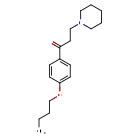
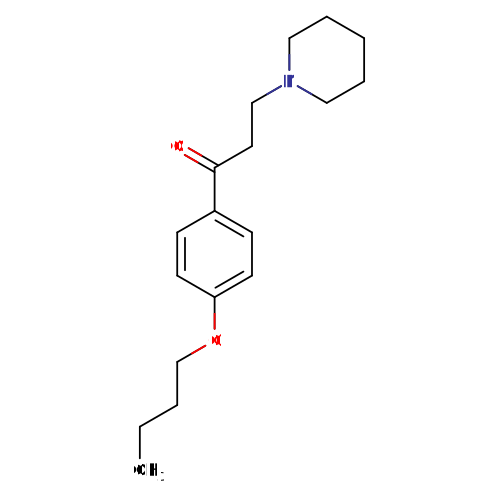
Structure for Dyclonine (DB00645)
- Weight
- Average: 289.4125
Monoisotopic: 289.204179113 - Chemical Formula
- C18H27NO2
- Synonyms
- 1-(4-Butoxyphenyl)-3-(1-piperidinyl)-1-propanone
- 2-(1-piperidyl)ethyl p-butoxyphenyl ketone
- 3-piperidino-4'-butoxypropiophenone
- 4-butoxy-β-piperidinopropiophenone
- 4-n-butoxy-β-(1-piperidyl)propiophenone
- 4'-butoxy-3-piperidinopropiophenone
- Diclonina
- Dyclocaine
- Dyclonin
- Dyclonine
- Dycloninum

Pharmacology
- Indication
Used to provide topical anesthesia of accessible mucous membranes prior to examination, endoscopy or instrumentation, or other procedures involving the esophagus, larynx, mouth, pharynx or throat, respiratory tract or trachea, urinary tract, or vagina. Also used to suppress the gag reflex and/or other laryngeal and esophageal reflexes to facilitate dental examination or procedures (including oral surgery), endoscopy, or intubation. Also used for relief of canker sores, cold sores or fever blister.
 Reduce drug development failure ratesBuild, train, & validate machine-learning modelswith evidence-based and structured datasets.Build, train, & validate predictive machine-learning models with structured datasets.
- Associated Conditions
Indication Type Indication Combined Product Details Approval Level Age Group Patient Characteristics Dose Form Symptomatic treatment of Cough ••• ••• Symptomatic treatment of Mouth irritation ••• ••• Symptomatic treatment of Sore throat ••• ••• - Contraindications & Blackbox Warnings
 Prevent Adverse Drug Events TodayTap into our Clinical API for life-saving information on contraindications & blackbox warnings, population restrictions, harmful risks, & more.Avoid life-threatening adverse drug events with our Clinical API
- Pharmacodynamics
Dyclonine is an oral anasthetic. If substantial quantities of local anesthetics are absorbed through the mucosa, actions on the central nervous system (CNS) may cause CNS stimulation and/or CNS depression. Actions on the cardiovascular system may cause depression of cardiac conduction and excitability and, with some of these agents, peripheral vasodilation.
- Mechanism of action
Local anesthetics block both the initiation and conduction of nerve impulses by decreasing the neuronal membrane's permeability to sodium ions. This reversibly stabilizes the membrane and inhibits depolarization, resulting in the failure of a propagated action potential and subsequent conduction blockade.
Target Actions Organism ASodium channel protein type 10 subunit alpha inhibitorHumans - Absorption
Readily absorbed through mucous membranes into the systemic circulation. The rate of absorption is influenced by the vascularity or rate of blood flow at the site of application, the total dosage (concentration and volume) administered, and the duration of exposure. Absorption from mucous membranes of the throat or respiratory tract may be especially rapid.
- Volume of distribution
Not Available
- Protein binding
Not Available
- Metabolism
- Not Available
- Route of elimination
Not Available
- Half-life
Approximately 30 to 60 minutes.
- Clearance
Not Available
- Adverse Effects
 Improve decision support & research outcomesWith structured adverse effects data, including: blackbox warnings, adverse reactions, warning & precautions, & incidence rates. View sample adverse effects data in our new Data Library!Improve decision support & research outcomes with our structured adverse effects data.
- Toxicity
Symptoms of overdose include cardiovascular system depression, CNS toxicity, and methemoglobinemia.
- Pathways
- Not Available
- Pharmacogenomic Effects/ADRs
- Not Available
Interactions
- Drug Interactions
- This information should not be interpreted without the help of a healthcare provider. If you believe you are experiencing an interaction, contact a healthcare provider immediately. The absence of an interaction does not necessarily mean no interactions exist.
Drug Interaction Integrate drug-drug
interactions in your software1,2-Benzodiazepine The risk or severity of CNS depression can be increased when Dyclonine is combined with 1,2-Benzodiazepine. Abemaciclib The risk or severity of methemoglobinemia can be increased when Abemaciclib is combined with Dyclonine. Abiraterone The risk or severity of methemoglobinemia can be increased when Abiraterone is combined with Dyclonine. Acetaminophen The risk or severity of methemoglobinemia can be increased when Acetaminophen is combined with Dyclonine. Acetazolamide The risk or severity of methemoglobinemia can be increased when Acetazolamide is combined with Dyclonine. - Food Interactions
- Take separate from meals. Using Dyclonine in the mouth or for relief of ulcers in the stomach may cause numbness of the mouth, which increases the risk of biting injury. Avoid ingesting food for 60 minutes after use, or until the numbness has subsided.
Products
 Drug product information from 10+ global regionsOur datasets provide approved product information including:dosage, form, labeller, route of administration, and marketing period.Access drug product information from over 10 global regions.
- Product Ingredients
Ingredient UNII CAS InChI Key Dyclonine hydrochloride ZEC193879Q 536-43-6 KNZADIMHVBBPOA-UHFFFAOYSA-N - International/Other Brands
- Dyclone (AstraZeneca)
- Generic Prescription Products
Name Dosage Strength Route Labeller Marketing Start Marketing End Region Image DycloPro Solution 5 mg/1mL Topical Septodont Inc 2019-09-01 Not applicable US 
DycloPro Solution 10 mg/1mL Topical Septodont Inc 2019-09-01 Not applicable US - Over the Counter Products
Name Dosage Strength Route Labeller Marketing Start Marketing End Region Image Cepacol Sore Throat Spray Spray 0.1 % w/w Oral Reckitt Benckiser 1999-07-01 2012-03-23 Canada 
PerioRinse Rinse 0.1 g/100mL Dental; Oral; Topical; Transmucosal CENTURA PHARMACEUTICALS INC 2016-06-16 2018-07-31 US Sore Throat Relief Lozenge 3 mg / loz Oral Stanley Pharmaceuticals, A Division Of Vita Health Products Inc. Not applicable Not applicable Canada Sucrets Black Cherry Lozenge 3 mg/1 Oral Insight Pharmaceuticals 2009-06-18 2017-08-31 US Sucrets Childrens Cherry Lozenge 1.2 mg/1 Oral Insight Pharmaceuticals 2009-07-28 2017-08-31 US - Mixture Products
Name Ingredients Dosage Route Labeller Marketing Start Marketing End Region Image Ambix First Aid Dyclonine hydrochloride (0.005 g/1g) + Phenol (0.005 g/1g) Cream Topical Suite K Value Added Services LLC 2013-08-19 2013-08-20 US Ambix First Aid Dyclonine hydrochloride (0.005 g/1g) + Phenol (0.005 g/1g) Cream Topical Organics Corporation Of America Dba Ambix Laboratories 2013-08-22 Not applicable US Benzethonium Chloride and Dyclonine Hydrochloride Dyclonine hydrochloride (0.75 mg/10mL) + Benzethonium chloride (0.2 mg/10mL) Liquid Topical CVS PHARMACY 2019-06-01 Not applicable US Benzethonium Chloride and Dyclonine Hydrochloride Dyclonine hydrochloride (0.75 mg/30mL) + Benzethonium chloride (0.2 mg/30mL) Liquid Topical Rite Aid Corporation 2020-02-01 Not applicable US Benzethonium chloride and Dyclonine hydrochloride Dyclonine hydrochloride (0.23 mg/29.6mL) + Benzethonium chloride (0.06 mg/29.6mL) Liquid Topical Walgreen Company 2012-01-12 Not applicable US
Categories
- ATC Codes
- N01BX02 — DyclonineR02AD04 — Dyclonine
- Drug Categories
- Chemical TaxonomyProvided by Classyfire
- Description
- This compound belongs to the class of organic compounds known as alkyl-phenylketones. These are aromatic compounds containing a ketone substituted by one alkyl group, and a phenyl group.
- Kingdom
- Organic compounds
- Super Class
- Organic oxygen compounds
- Class
- Organooxygen compounds
- Sub Class
- Carbonyl compounds
- Direct Parent
- Alkyl-phenylketones
- Alternative Parents
- Phenoxy compounds / Phenol ethers / Benzoyl derivatives / Aryl alkyl ketones / Alkyl aryl ethers / Piperidines / Beta-amino ketones / Trialkylamines / Azacyclic compounds / Organopnictogen compounds show 2 more
- Substituents
- Alkyl aryl ether / Alkyl-phenylketone / Amine / Aromatic heteromonocyclic compound / Aryl alkyl ketone / Azacycle / Benzenoid / Benzoyl / Beta-aminoketone / Ether show 12 more
- Molecular Framework
- Aromatic heteromonocyclic compounds
- External Descriptors
- piperidines, aromatic ketone (CHEBI:4724)
- Affected organisms
- Humans and other mammals
Chemical Identifiers
- UNII
- 078A24Q30O
- CAS number
- 586-60-7
- InChI Key
- BZEWSEKUUPWQDQ-UHFFFAOYSA-N
- InChI
- InChI=1S/C18H27NO2/c1-2-3-15-21-17-9-7-16(8-10-17)18(20)11-14-19-12-5-4-6-13-19/h7-10H,2-6,11-15H2,1H3
- IUPAC Name
- 1-(4-butoxyphenyl)-3-(piperidin-1-yl)propan-1-one
- SMILES
- CCCCOC1=CC=C(C=C1)C(=O)CCN1CCCCC1
References
- Synthesis Reference
Tianjiang Sun, Xiaohong Gu, Hongguo Lu, Min Chen, "Oral Preparation of Dyclonine Hydrochloride." U.S. Patent US20080200506, issued August 21, 2008.
US20080200506- General References
- Not Available
- External Links
- Human Metabolome Database
- HMDB0014783
- KEGG Compound
- C07881
- PubChem Compound
- 3180
- PubChem Substance
- 46506697
- ChemSpider
- 3068
- BindingDB
- 50240047
- 23744
- ChEBI
- 4724
- ChEMBL
- CHEMBL1201217
- ZINC
- ZINC000001530940
- Therapeutic Targets Database
- DAP000509
- PharmGKB
- PA164748037
- PDBe Ligand
- N8R
- Drugs.com
- Drugs.com Drug Page
- Wikipedia
- Dyclonine
- PDB Entries
- 7ugg
- MSDS
- Download (73.4 KB)
Clinical Trials
- Clinical Trials
Phase Status Purpose Conditions Count 1, 2 Completed Treatment Gingivitis 1
Pharmacoeconomics
- Manufacturers
- Astrazeneca lp
- Packagers
- Gallipot
- Long Wing International Inc.
- Dosage Forms
Form Route Strength Cream Topical Liquid Oral Spray Oral 0.1 % w/w Solution Topical 10 mg/1mL Solution Topical 5 mg/1mL Rinse Dental; Oral; Topical; Transmucosal 0.1 g/100mL Patch Topical Liquid Topical Lozenge Oral 3 mg/1 Lozenge Oral 1.2 mg/1 Lozenge Oral Lozenge Oral 3 mg / loz Lozenge Oral 1.2 mg Lozenge Oral 1.2 mg / loz Lozenge Oral 2 mg / loz Lozenge Oral 2 mg Lozenge Oral 3 mg Aerosol Oral .1 % Lozenge Oral 2 mg/1 Gel Topical - Prices
Unit description Cost Unit Dyclonine hcl powder 4.9USD g DrugBank does not sell nor buy drugs. Pricing information is supplied for informational purposes only.- Patents
- Not Available
Properties
- State
- Solid
- Experimental Properties
Property Value Source melting point (°C) 174-175 Bockstahler, E.R.; U.S.Patent 2,771,391; November 20,1956; assigned to Allied Laboratories, Inc. Florestano, H.J., Jeffries, S.F., Osborne, C.E. and Bahler, M.E.; U.S. Patent 2,868,689; January 13, 1959; assigned to Allied Laboratories, Inc. water solubility Soluble (HCl salt) Not Available logP 3.7 Not Available - Predicted Properties
Property Value Source Water Solubility 0.046 mg/mL ALOGPS logP 4.11 ALOGPS logP 3.68 Chemaxon logS -3.8 ALOGPS pKa (Strongest Acidic) 16.29 Chemaxon pKa (Strongest Basic) 8.36 Chemaxon Physiological Charge 1 Chemaxon Hydrogen Acceptor Count 3 Chemaxon Hydrogen Donor Count 0 Chemaxon Polar Surface Area 29.54 Å2 Chemaxon Rotatable Bond Count 8 Chemaxon Refractivity 87.07 m3·mol-1 Chemaxon Polarizability 35.14 Å3 Chemaxon Number of Rings 2 Chemaxon Bioavailability 1 Chemaxon Rule of Five Yes Chemaxon Ghose Filter Yes Chemaxon Veber's Rule Yes Chemaxon MDDR-like Rule No Chemaxon - Predicted ADMET Features
Property Value Probability Human Intestinal Absorption + 1.0 Blood Brain Barrier + 0.9856 Caco-2 permeable + 0.7155 P-glycoprotein substrate Substrate 0.7596 P-glycoprotein inhibitor I Inhibitor 0.8077 P-glycoprotein inhibitor II Non-inhibitor 0.6392 Renal organic cation transporter Inhibitor 0.7801 CYP450 2C9 substrate Non-substrate 0.8107 CYP450 2D6 substrate Non-substrate 0.5142 CYP450 3A4 substrate Substrate 0.5313 CYP450 1A2 substrate Inhibitor 0.8914 CYP450 2C9 inhibitor Inhibitor 0.793 CYP450 2D6 inhibitor Inhibitor 0.8932 CYP450 2C19 inhibitor Non-inhibitor 0.9026 CYP450 3A4 inhibitor Non-inhibitor 0.8574 CYP450 inhibitory promiscuity Low CYP Inhibitory Promiscuity 0.5388 Ames test Non AMES toxic 0.7961 Carcinogenicity Non-carcinogens 0.8823 Biodegradation Not ready biodegradable 0.7106 Rat acute toxicity 2.3661 LD50, mol/kg Not applicable hERG inhibition (predictor I) Strong inhibitor 0.8071 hERG inhibition (predictor II) Inhibitor 0.6351
Spectra
- Mass Spec (NIST)
- Not Available
- Spectra
Spectrum Spectrum Type Splash Key Predicted GC-MS Spectrum - GC-MS Predicted GC-MS splash10-006t-9440000000-a86aac6d96e16aac8d02 Predicted MS/MS Spectrum - 10V, Positive (Annotated) Predicted LC-MS/MS splash10-0006-2090000000-736a6e320c5178232c9a Predicted MS/MS Spectrum - 10V, Negative (Annotated) Predicted LC-MS/MS splash10-000i-1190000000-9d0d38849d27b461c917 Predicted MS/MS Spectrum - 20V, Positive (Annotated) Predicted LC-MS/MS splash10-007n-7690000000-5f7b3495ec762d130d3c Predicted MS/MS Spectrum - 20V, Negative (Annotated) Predicted LC-MS/MS splash10-000i-1690000000-53fc1a7a14e5790dba95 Predicted MS/MS Spectrum - 40V, Positive (Annotated) Predicted LC-MS/MS splash10-000g-9720000000-1f0efb8a121bef1c7a48 Predicted MS/MS Spectrum - 40V, Negative (Annotated) Predicted LC-MS/MS splash10-000j-0930000000-a35eca8c90b23894f97d Predicted 1H NMR Spectrum 1D NMR Not Applicable Predicted 13C NMR Spectrum 1D NMR Not Applicable - Chromatographic Properties
Collision Cross Sections (CCS)
Adduct CCS Value (Å2) Source type Source [M-H]- 190.1628446 predictedDarkChem Lite v0.1.0 [M-H]- 172.77568 predictedDeepCCS 1.0 (2019) [M+H]+ 190.1959446 predictedDarkChem Lite v0.1.0 [M+H]+ 175.13368 predictedDeepCCS 1.0 (2019) [M+Na]+ 190.2006446 predictedDarkChem Lite v0.1.0 [M+Na]+ 181.22682 predictedDeepCCS 1.0 (2019)
Targets

- Kind
- Protein
- Organism
- Humans
- Pharmacological action
- Yes
- Actions
- Inhibitor
- General Function
- Voltage-gated sodium channel activity
- Specific Function
- Tetrodotoxin-resistant channel that mediates the voltage-dependent sodium ion permeability of excitable membranes. Assuming opened or closed conformations in response to the voltage difference acro...
- Gene Name
- SCN10A
- Uniprot ID
- Q9Y5Y9
- Uniprot Name
- Sodium channel protein type 10 subunit alpha
- Molecular Weight
- 220623.605 Da
References
- Overington JP, Al-Lazikani B, Hopkins AL: How many drug targets are there? Nat Rev Drug Discov. 2006 Dec;5(12):993-6. [Article]
- Imming P, Sinning C, Meyer A: Drugs, their targets and the nature and number of drug targets. Nat Rev Drug Discov. 2006 Oct;5(10):821-34. [Article]
- Roghani S, Duperon DF, Barcohana N: Evaluating the efficacy of commonly used topical anesthetics. Pediatr Dent. 1999 May-Jun;21(3):197-200. [Article]
- Tella SR, Goldberg SR: Monoamine transporter and sodium channel mechanisms in the rapid pressor response to cocaine. Pharmacol Biochem Behav. 1998 Feb;59(2):305-12. [Article]

Drug created at June 13, 2005 13:24 / Updated at April 26, 2024 00:45