Identification
- Summary
Amphotericin B is an antifungal used to treat fungal infections in neutropenic patients, cryptococcal meningitis in HIV infection, fungal infections, and leishmaniasis.
- Brand Names
- Abelcet, Ambisome, Amphotec, Fungizone
- Generic Name
- Amphotericin B
- DrugBank Accession Number
- DB00681
- Background
Amphotericin B shows a high order of in vitro activity against many species of fungi. Histoplasma capsulatum, Coccidioides immitis, Candida species, Blastomyces dermatitidis, Rhodotorula, Cryptococcus neoformans, Sporothrix schenckii, Mucor mucedo, and Aspergillus fumigatus are all inhibited by concentrations of amphotericin B ranging from 0.03 to 1.0 mcg/mL in vitro. While Candida albicans is generally quite susceptible to amphotericin B, non-albicans species may be less susceptible. Pseudallescheria boydii and Fusarium sp. are often resistant to amphotericin B. The antibiotic is without effect on bacteria, rickettsiae, and viruses.
- Type
- Small Molecule
- Groups
- Approved, Investigational
- Structure

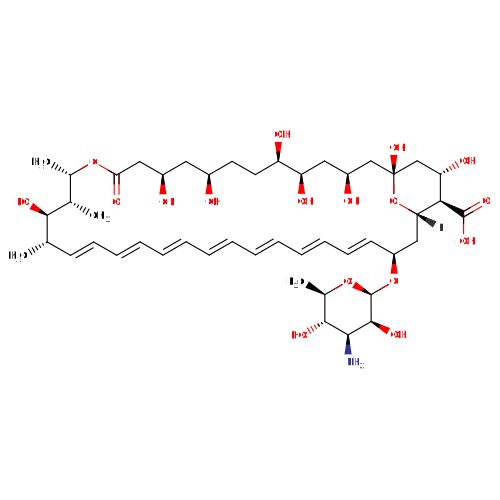
Structure for Amphotericin B (DB00681)
- Weight
- Average: 924.079
Monoisotopic: 923.487849915 - Chemical Formula
- C47H73NO17
- Synonyms
- Amfotericina B
- AMPH-b
- Amphotericin B
- Amphotéricine B
- Amphotericinum B
- Liposomal amphotericin B
- External IDs
- NSC-527017
- RP 17774

Pharmacology
- Indication
Used to treat potentially life threatening fungal infections.
 Reduce drug development failure ratesBuild, train, & validate machine-learning modelswith evidence-based and structured datasets.Build, train, & validate predictive machine-learning models with structured datasets.
- Associated Conditions
Indication Type Indication Combined Product Details Approval Level Age Group Patient Characteristics Dose Form Treatment of Coccidioidomycosis ••• ••••• Treatment of Coccidioidomycosis ••• ••••• Treatment of Coccidioidomycosis ••• ••••• Treatment of Cryptococcal meningitis •••••••••••• Treatment of Cryptococcal meningitis ••• ••••• - Contraindications & Blackbox Warnings
 Prevent Adverse Drug Events TodayTap into our Clinical API for life-saving information on contraindications & blackbox warnings, population restrictions, harmful risks, & more.Avoid life-threatening adverse drug events with our Clinical API
- Pharmacodynamics
Amphotericin B shows a high order of in vitro activity against many species of fungi. Histoplasma capsulatum, Coccidioides immitis, Candida species, Blastomyces dermatitidis, Rhodotorula, Cryptococcus neoformans, Sporothrix schenckii, Mucor mucedo, and Aspergillus fumigatus are all inhibited by concentrations of amphotericin B ranging from 0.03 to 1.0 mcg/mL in vitro. While Candida albicans is generally quite susceptible to amphotericin B, non-albicans species may be less susceptible. Pseudallescheria boydii and Fusarium sp. are often resistant to amphotericin B. The antibiotic is without effect on bacteria, rickettsiae, and viruses.
- Mechanism of action
Amphotericin B is fungistatic or fungicidal depending on the concentration obtained in body fluids and the susceptibility of the fungus. The drug acts by binding to sterols (ergosterol) in the cell membrane of susceptible fungi. This creates a transmembrane channel, and the resultant change in membrane permeability allowing leakage of intracellular components. Ergosterol, the principal sterol in the fungal cytoplasmic membrane, is the target site of action of amphotericin B and the azoles. Amphotericin B, a polyene, binds irreversibly to ergosterol, resulting in disruption of membrane integrity and ultimately cell death.
Target Actions Organism AErgosterol binderCandida albicans - Absorption
Bioavailability is 100% for intravenous infusion.
- Volume of distribution
Not Available
- Protein binding
Highly bound (>90%) to plasma proteins.
- Metabolism
Exclusively renal
- Route of elimination
Not Available
- Half-life
An elimination half-life of approximately 15 days follows an initial plasma half-life of about 24 hours.
- Clearance
- 39 +/- 22 mL/hr/kg [febrile neutropenic cancer and bone marrow transplant patients receiving infusion of 1 mg/kg/day at Day 1]
- 17 +/- 6 mL/hr/kg [febrile neutropenic cancer and bone marrow transplant patients receiving infusion of 1 mg/kg/day 3-20 days later]
- 51 +/- 44 mL/hr/kg [febrile neutropenic cancer and bone marrow transplant patients receiving infusion of 2.5 mg/kg/day at Day 1]
- 22 +/- 15 mL/hr/kg [febrile neutropenic cancer and bone marrow transplant patients receiving infusion of 2.5 mg/kg/day 3-20 days later]
- 21 +/- 14 mL/hr/kg [febrile neutropenic cancer and bone marrow transplant patients receiving infusion of 5 mg/kg/day at Day 1]
- 11 +/- 6 mL/hr/kg [febrile neutropenic cancer and bone marrow transplant patients receiving infusion of 5 mg/kg/day 3-20 days later]
- Adverse Effects
 Improve decision support & research outcomesWith structured adverse effects data, including: blackbox warnings, adverse reactions, warning & precautions, & incidence rates. View sample adverse effects data in our new Data Library!Improve decision support & research outcomes with our structured adverse effects data.
- Toxicity
Oral, rat: LD50 = >5 gm/kg. Amphotericin B overdoses can result in cardio-respiratory arrest.
- Pathways
- Not Available
- Pharmacogenomic Effects/ADRs
- Not Available
Interactions
- Drug Interactions
- This information should not be interpreted without the help of a healthcare provider. If you believe you are experiencing an interaction, contact a healthcare provider immediately. The absence of an interaction does not necessarily mean no interactions exist.
Drug Interaction Integrate drug-drug
interactions in your softwareAbacavir Amphotericin B may decrease the excretion rate of Abacavir which could result in a higher serum level. Abaloparatide The risk or severity of adverse effects can be increased when Amphotericin B is combined with Abaloparatide. Acebutolol The risk or severity of adverse effects can be increased when Amphotericin B is combined with Acebutolol. Aceclofenac The risk or severity of nephrotoxicity can be increased when Amphotericin B is combined with Aceclofenac. Acemetacin The risk or severity of nephrotoxicity can be increased when Amphotericin B is combined with Acemetacin. - Food Interactions
- No interactions found.
Products
 Drug product information from 10+ global regionsOur datasets provide approved product information including:dosage, form, labeller, route of administration, and marketing period.Access drug product information from over 10 global regions.
- Product Ingredients
Ingredient UNII CAS InChI Key Amphotericin B Cholesteryl Sulfate Complex 774X4698X3 120895-52-5 Not applicable Corifungin L26BTK4791 41610-51-9 MTSXPVSZJVNPBE-ALEYTFIZSA-M - International/Other Brands
- Abelect (Cephalon) / Ampho-Moronal (Dermapharm) / Amphocil (Alza) / Amphocin (Pfizer) / Amphotericin (Bristol-Myers Squibb) / Fungilin (Sigma) / Fungisome / Fungizone Intravenous (Bristol-Myers Squibb) / Halizon (Fuji Yakuhin)
- Brand Name Prescription Products
Name Dosage Strength Route Labeller Marketing Start Marketing End Region Image Abelcet Suspension 5 mg / mL Intravenous Leadiant Biosciences, Inc 1997-09-25 Not applicable Canada 
AmBisome Powder, for solution 50 mg / vial Intravenous Astellas Pharma Inc 2000-05-29 Not applicable Canada AmBisome Injection, powder, lyophilized, for solution 50 mg/12.5mL Intravenous Astellas Pharma US, Inc. 1997-08-11 Not applicable US 
Amphotec Injection, lipid complex 100 mg/20mL Intravenous InterMune, Inc. 2006-02-27 Not applicable US Amphotec Injection, lipid complex 50 mg/50mg Intravenous Kadmon Pharmaceuticals 2005-05-20 2011-05-31 US - Generic Prescription Products
Name Dosage Strength Route Labeller Marketing Start Marketing End Region Image Amphotericin B Injection, powder, lyophilized, for solution 50 mg/12.5mL Intravenous Eugia US LLC 2022-11-17 Not applicable US Amphotericin B Injectable, liposomal 50 mg/1 Intravenous Sun Pharmaceutical Industries, Inc. 2022-02-09 Not applicable US Amphotericin B Injection, powder, lyophilized, for solution 50 mg/10mL Intravenous XGen Pharmaceuticals DJB, Inc. 1992-04-29 Not applicable US Fungizone Injection, powder, lyophilized, for solution 50 mg/10mL Intravenous E.R. Squibb & Sons, L.L.C. 1966-03-01 2005-09-30 US - Mixture Products
Name Ingredients Dosage Route Labeller Marketing Start Marketing End Region Image Abelcet Amphotericin B (5 mg/1mL) + DL-dimyristoylphosphatidylcholine (3.4 mg/1mL) + DL-dimyristoylphosphatidylglycerol (1.5 mg/1mL) Injection Intravenous Leadiant Biosciences, Inc. 2010-10-18 Not applicable US
Categories
- ATC Codes
- G01AA03 — Amphotericin b
- G01AA — Antibiotics
- G01A — ANTIINFECTIVES AND ANTISEPTICS, EXCL. COMBINATIONS WITH CORTICOSTEROIDS
- G01 — GYNECOLOGICAL ANTIINFECTIVES AND ANTISEPTICS
- G — GENITO URINARY SYSTEM AND SEX HORMONES
- A07AA — Antibiotics
- A07A — INTESTINAL ANTIINFECTIVES
- A07 — ANTIDIARRHEALS, INTESTINAL ANTIINFLAMMATORY/ANTIINFECTIVE AGENTS
- A — ALIMENTARY TRACT AND METABOLISM
- A01AB — Antiinfectives and antiseptics for local oral treatment
- A01A — STOMATOLOGICAL PREPARATIONS
- A01 — STOMATOLOGICAL PREPARATIONS
- A — ALIMENTARY TRACT AND METABOLISM
- Drug Categories
- Agents Causing Muscle Toxicity
- Agents that reduce seizure threshold
- Alimentary Tract and Metabolism
- Amebicides
- Anti-Bacterial Agents
- Anti-Infective Agents
- Antidiarrheals, Intestinal Antiinflammatory/antiinfective Agents
- Antifungal Agents
- Antiinfectives and Antiseptics for Local Oral Treatment
- Antiinfectives for Systemic Use
- Antimycotics for Systemic Use
- Antiparasitic Agents
- Antiprotozoals
- Biomimetic Materials
- Carbohydrates
- Compounds used in a research, industrial, or household setting
- Drug Carriers
- Genito Urinary System and Sex Hormones
- Glycosides
- Gynecological Antiinfectives and Antiseptics
- Hypotensive Agents
- Intestinal Antiinfectives
- Lactones
- Lipid-based Polyene Antifungal
- Liposomes
- Membranes, Artificial
- Narrow Therapeutic Index Drugs
- Nephrotoxic agents
- Pharmaceutical Preparations
- Polyene Antifungal
- Polyenes
- Polyketides
- Stomatological Preparations
- Chemical TaxonomyProvided by Classyfire
- Description
- This compound belongs to the class of organic compounds known as aminoglycosides. These are molecules or a portion of a molecule composed of amino-modified sugars.
- Kingdom
- Organic compounds
- Super Class
- Organic oxygen compounds
- Class
- Organooxygen compounds
- Sub Class
- Carbohydrates and carbohydrate conjugates
- Direct Parent
- Aminoglycosides
- Alternative Parents
- Macrolides and analogues / Hexoses / O-glycosyl compounds / Beta hydroxy acids and derivatives / Oxanes / Dicarboxylic acids and derivatives / Secondary alcohols / 1,2-aminoalcohols / Amino acids / Lactones show 11 more
- Substituents
- 1,2-aminoalcohol / Acetal / Alcohol / Aliphatic heteropolycyclic compound / Amine / Amino acid / Amino acid or derivatives / Aminoglycoside core / Beta-hydroxy acid / Carbonyl group show 24 more
- Molecular Framework
- Aliphatic heteropolycyclic compounds
- External Descriptors
- antibiotic antifungal drug, macrolide antibiotic, polyene antibiotic (CHEBI:2682) / Plyenes (C06573) / Polyenes (LMPK06000002)
- Affected organisms
- Various Fungus Species
Chemical Identifiers
- UNII
- 7XU7A7DROE
- CAS number
- 1397-89-3
- InChI Key
- APKFDSVGJQXUKY-INPOYWNPSA-N
- InChI
- InChI=1S/C47H73NO17/c1-27-17-15-13-11-9-7-5-6-8-10-12-14-16-18-34(64-46-44(58)41(48)43(57)30(4)63-46)24-38-40(45(59)60)37(54)26-47(61,65-38)25-33(51)22-36(53)35(52)20-19-31(49)21-32(50)23-39(55)62-29(3)28(2)42(27)56/h5-18,27-38,40-44,46,49-54,56-58,61H,19-26,48H2,1-4H3,(H,59,60)/b6-5+,9-7+,10-8+,13-11+,14-12+,17-15+,18-16+/t27-,28-,29-,30+,31+,32+,33-,34-,35+,36+,37-,38-,40+,41-,42+,43+,44-,46-,47+/m0/s1
- IUPAC Name
- (1R,3S,5R,6R,9R,11R,15S,16R,17R,18S,19E,21E,23E,25E,27E,29E,31E,33R,35S,36R,37S)-33-{[(2R,3S,4S,5S,6R)-4-amino-3,5-dihydroxy-6-methyloxan-2-yl]oxy}-1,3,5,6,9,11,17,37-octahydroxy-15,16,18-trimethyl-13-oxo-14,39-dioxabicyclo[33.3.1]nonatriaconta-19,21,23,25,27,29,31-heptaene-36-carboxylic acid
- SMILES
- [H][C@]12C[C@@H](O[C@@H]3O[C@H](C)[C@@H](O)[C@H](N)[C@@H]3O)\C=C\C=C\C=C\C=C\C=C\C=C\C=C\[C@H](C)[C@@H](O)[C@@H](C)[C@H](C)OC(=O)C[C@H](O)C[C@H](O)CC[C@@H](O)[C@H](O)C[C@H](O)C[C@](O)(C[C@H](O)[C@H]1C(O)=O)O2
References
- Synthesis Reference
Frank Sipos, "Process for producing the methyl ester of amphotericin B." U.S. Patent US4035567, issued March, 1976.
US4035567- General References
- Not Available
- External Links
- Human Metabolome Database
- HMDB0014819
- KEGG Drug
- D00203
- KEGG Compound
- C06573
- PubChem Compound
- 5280965
- PubChem Substance
- 46505473
- ChemSpider
- 10237579
- BindingDB
- 50457967
- 236594
- ChEBI
- 2682
- ChEMBL
- CHEMBL267345
- ZINC
- ZINC000253387843
- Therapeutic Targets Database
- DAP001322
- PharmGKB
- PA448415
- RxList
- RxList Drug Page
- Drugs.com
- Drugs.com Drug Page
- Wikipedia
- Amphotericin_B
- FDA label
- Download (1.02 MB)
- MSDS
- Download (73.1 KB)
Clinical Trials
- Clinical Trials
Phase Status Purpose Conditions Count 4 Completed Other Obesity, Morbid 1 4 Completed Prevention Candidiasis 1 4 Completed Prevention Leukemias 1 4 Completed Treatment Candidemia / Invasive Candidiasis 1 4 Completed Treatment Central Line Fungal Infections 1
Pharmacoeconomics
- Manufacturers
- Apothecon inc div bristol myers squibb
- Sigma tau pharmaceuticals inc
- Three rivers pharmaceuticals llc
- Astellas pharma us inc
- Abbott laboratories
- Abraxis pharmaceutical products
- Teva parenteral medicines inc
- X gen pharmaceuticals inc
- Bristol myers squibb co
- Packagers
- Astellas Pharma Inc.
- Ben Venue Laboratories Inc.
- Bristol-Myers Squibb Co.
- Cardinal Health
- DSM Corp.
- E.R. Squibb and Sons LLC
- Enzon Inc.
- Gilead Sciences Inc.
- Medisca Inc.
- Oso Biopharmaceuticals Manufacturing LLC
- Pharmacia Inc.
- Sigma-Tau Pharmaceuticals Inc.
- Teva Pharmaceutical Industries Ltd.
- Three Rivers Pharmaceuticals LLC
- X-Gen Pharmaceuticals
- Dosage Forms
Form Route Strength Injection Intravenous Suspension Intravenous 5 mg / mL Injection, suspension Intravenous 100 mg/20ml Injection, solution, concentrate Intravenous 5 MG/ML Injection, powder, lyophilized, for solution Intravenous 50 mg/12.5mL Powder, for solution Intravenous 50 mg / vial Solution Intravenous 50.000 mg Injection, powder, for solution Parenteral Injection, powder, for suspension Intravenous Injection, powder, for solution Intravenous 50 mg Powder Intravenous Injection, powder, lyophilized, for solution Intravenous 50 mg Lozenge Oral Tablet Oral 100000 IU Suspension Oral Powder, for solution Solution 50 mg/1vial Suspension Intravenous 100 mg Suspension Intravenous 50 mg Injection, powder, for solution Intravenous Injection, lipid complex Intravenous 100 mg/20mL Injection, lipid complex Intravenous 100 mg/100mg Injection, lipid complex Intravenous 50 mg/10mL Injection, lipid complex Intravenous 50 mg/50mg Powder, for suspension Intravenous 100 mg / vial Powder, for suspension Intravenous 50 mg / vial Injectable, liposomal Intravenous 50 mg/1 Injection, powder, lyophilized, for solution Intravenous Solution Parenteral 50 mg Solution Parenteral 50.000 mg Solution 50.000 mg Ointment Ophthalmic Injection, powder, lyophilized, for solution Intravenous 50 mg/10mL Powder, for solution Parenteral 50 MG Injection Intravenous 50 mg Powder Intravenous 50 mg Injection, powder, for suspension Intravenous 50 mg Cream Vaginal Powder Intravenous 50 mg/1vial - Prices
Unit description Cost Unit Ambisome 50 mg vial 188.4USD vial Amphotec 100 mg vial 160.0USD vial Amphotec 50 mg vial 93.33USD vial Fungizone Iv 50 mg/vial 72.5USD vial Amphotericin b powder 29.99USD g Amphotericin b 50 mg vial 24.5USD vial Abelcet 5 mg/ml vial p-f 12.0USD ml DrugBank does not sell nor buy drugs. Pricing information is supplied for informational purposes only.- Patents
Patent Number Pediatric Extension Approved Expires (estimated) Region CA1339008 No 1997-03-25 2014-03-25 Canada CA1336890 No 1995-09-05 2012-09-05 Canada US6406713 No 2002-06-18 2019-06-18 US US5874104 No 1999-02-23 2016-02-23 US US5965156 No 1999-10-12 2016-10-12 US
Properties
- State
- Solid
- Experimental Properties
Property Value Source melting point (°C) 170.0 °C Not Available water solubility 750 mg/L (at 28 °C) YALKOWSKY,SH & DANNENFELSER,RM (1992) logP 0.8 Not Available - Predicted Properties
Property Value Source Water Solubility 0.0819 mg/mL ALOGPS logP -0.66 ALOGPS logP -2.3 Chemaxon logS -4 ALOGPS pKa (Strongest Acidic) 3.58 Chemaxon pKa (Strongest Basic) 9.11 Chemaxon Physiological Charge 0 Chemaxon Hydrogen Acceptor Count 17 Chemaxon Hydrogen Donor Count 12 Chemaxon Polar Surface Area 319.61 Å2 Chemaxon Rotatable Bond Count 3 Chemaxon Refractivity 244.67 m3·mol-1 Chemaxon Polarizability 99.4 Å3 Chemaxon Number of Rings 3 Chemaxon Bioavailability 0 Chemaxon Rule of Five No Chemaxon Ghose Filter No Chemaxon Veber's Rule No Chemaxon MDDR-like Rule No Chemaxon - Predicted ADMET Features
Property Value Probability Human Intestinal Absorption - 0.9308 Blood Brain Barrier - 0.9659 Caco-2 permeable - 0.7539 P-glycoprotein substrate Substrate 0.6404 P-glycoprotein inhibitor I Non-inhibitor 0.7322 P-glycoprotein inhibitor II Non-inhibitor 0.5977 Renal organic cation transporter Non-inhibitor 0.9491 CYP450 2C9 substrate Non-substrate 0.7992 CYP450 2D6 substrate Non-substrate 0.8785 CYP450 3A4 substrate Substrate 0.5496 CYP450 1A2 substrate Non-inhibitor 0.9046 CYP450 2C9 inhibitor Non-inhibitor 0.941 CYP450 2D6 inhibitor Non-inhibitor 0.9444 CYP450 2C19 inhibitor Non-inhibitor 0.921 CYP450 3A4 inhibitor Non-inhibitor 0.9381 CYP450 inhibitory promiscuity Low CYP Inhibitory Promiscuity 0.984 Ames test Non AMES toxic 0.9133 Carcinogenicity Non-carcinogens 0.9682 Biodegradation Not ready biodegradable 0.9414 Rat acute toxicity 2.2357 LD50, mol/kg Not applicable hERG inhibition (predictor I) Weak inhibitor 0.9777 hERG inhibition (predictor II) Non-inhibitor 0.7887
Spectra
- Mass Spec (NIST)
- Not Available
- Spectra
- Chromatographic Properties
Collision Cross Sections (CCS)
Adduct CCS Value (Å2) Source type Source [M-H]- 338.0327443 predictedDarkChem Lite v0.1.0 [M-H]- 314.8903443 predictedDarkChem Lite v0.1.0 [M-H]- 326.7812443 predictedDarkChem Lite v0.1.0 [M-H]- 337.0417443 predictedDarkChem Lite v0.1.0 [M-H]- 289.53116 predictedDeepCCS 1.0 (2019) [M+H]+ 332.8611443 predictedDarkChem Lite v0.1.0 [M+H]+ 318.1470443 predictedDarkChem Lite v0.1.0 [M+H]+ 332.8715443 predictedDarkChem Lite v0.1.0 [M+H]+ 291.18433 predictedDeepCCS 1.0 (2019) [M+Na]+ 333.0505443 predictedDarkChem Lite v0.1.0 [M+Na]+ 318.1333443 predictedDarkChem Lite v0.1.0 [M+Na]+ 297.34116 predictedDeepCCS 1.0 (2019)
Targets

References
- Laniado-Laborin R, Cabrales-Vargas MN: Amphotericin B: side effects and toxicity. Rev Iberoam Micol. 2009 Dec 31;26(4):223-7. doi: 10.1016/j.riam.2009.06.003. [Article]
- Baginski M, Czub J: Amphotericin B and its new derivatives - mode of action. Curr Drug Metab. 2009 Jun;10(5):459-69. [Article]
- Baginski M, Sternal K, Czub J, Borowski E: Molecular modelling of membrane activity of amphotericin B, a polyene macrolide antifungal antibiotic. Acta Biochim Pol. 2005;52(3):655-8. Epub 2005 Aug 5. [Article]

Drug created at June 13, 2005 13:24 / Updated at April 27, 2024 09:44