Identification
- Summary
Trovafloxacin is an antibiotic used to treat gonorrhea and chlamydia.
- Brand Names
- Trovan
- Generic Name
- Trovafloxacin
- DrugBank Accession Number
- DB00685
- Background
Trovafloxacin is a broad spectrum antibiotic that has been commonly marketed under the brand name Trovan by Pfizer. It exerts its antibacterial activity by inhibiting the uncoiling of supercoiled DNA in various bacteria by blocking the activity of DNA gyrase and topoisomerase IV. It was shown to be more effective against Gram-positive bacteria than Gram-negative bacteria when compared to previous fluoroquinolones. Due to its hepatotoxic potential, trovafloxacin was withdrawn from the market.
- Type
- Small Molecule
- Groups
- Approved, Investigational, Withdrawn
- Structure
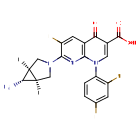
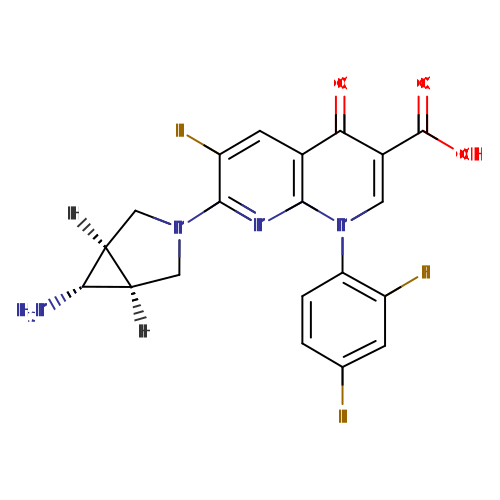
Structure for Trovafloxacin (DB00685)
- Weight
- Average: 416.36
Monoisotopic: 416.109624848 - Chemical Formula
- C20H15F3N4O3
- Synonyms
- Trovafloxacin
- trovafloxacino
- External IDs
- CP-99219

Pharmacology
- Indication
For treatment of infections caused by susceptible strains of the designated microorganisms in uncomplicated urethral gonorrhea in males and endocervical and rectal gonorrhea in females caused by Neisseria gonorrhoeae as well as non gonoccocal urethritis and cervicitis due to Chlamydia trachomatis.
 Reduce drug development failure ratesBuild, train, & validate machine-learning modelswith evidence-based and structured datasets.Build, train, & validate predictive machine-learning models with structured datasets.
- Associated Conditions
Indication Type Indication Combined Product Details Approval Level Age Group Patient Characteristics Dose Form Treatment of Community acquired pneumonia (cap) •••••••••••• ••••••• •••••• Treatment of Complicated intra-abdominal infections •••••••••••• ••••••• •••••• Treatment of Complicated skin and skin structure infection •••••••••••• ••••••• •••••• Treatment of Nosocomial pneumonia •••••••••••• ••••••• •••••• Treatment of Pelvic infections •••••••••••• ••••••• •••••• - Contraindications & Blackbox Warnings
 Prevent Adverse Drug Events TodayTap into our Clinical API for life-saving information on contraindications & blackbox warnings, population restrictions, harmful risks, & more.Avoid life-threatening adverse drug events with our Clinical API
- Pharmacodynamics
Trovafloxacin is a broad spectrum antibiotic that inhibits DNA supercoiling in various bacteria by blocking the activity of DNA gyrase and topoisomerase IV. It is not used widely due to the risk of hepatotoxicity. It tends to have better gram-positive bacterial coverage and less gram-negative coverage than the previous fluoroquinolones. Mechanism of action of fluoroquinolones including trovafloxacin is different from that of penicillins, cephalosporins, aminoglycosides, macrolides, and tetracyclines. Therefore fluoroquinolones may be active against pathogens that are resistant to these antibiotics. There is no cross-resistance between trovafloxacin and the mentioned classes of antibiotics. The overall results obtained from in vitro synergy studies, testing combinations of trovafloxacin with beta-lactams and aminoglycosides, indicate that synergy is strain specific and not commonly encountered. This agrees with results obtained previously with other fluoroquinolones. Resistance to trovafloxacin in vitro develops slowly via multiple-step mutation in a manner similar to other fluoroquinolones. Resistance to trovafloxacin in vitro occurs at a general frequency of between 1x10⁻⁷ to 10-10. Although cross-resistance has been observed between trovafloxacin and some other fluoroquinolones, some microorganisms resistant to other fluoroquinolones may be susceptible to trovafloxacin.
- Mechanism of action
Trovafloxacin is a fluoronaphthyridone related to the fluoroquinolones with in vitro activity against a wide range of gram-negative and gram-positive aerobic and anaerobic microorganisms. The bactericidal action of trovafloxacin results from inhibition of DNA gyrase and topoisomerase IV. DNA gyrase is an essential enzyme that is involved in the replication, transcription, and repair of bacterial DNA. Topoisomerase IV is an enzyme known to play a key role in the partitioning of the chromosomal DNA during bacterial cell division.
Target Actions Organism ADNA gyrase subunit A inhibitorHaemophilus influenzae (strain ATCC 51907 / DSM 11121 / KW20 / Rd) ADNA topoisomerase 4 subunit A inhibitorHaemophilus influenzae (strain ATCC 51907 / DSM 11121 / KW20 / Rd) UDNA topoisomerase 2-alpha inhibitorHumans - Absorption
Well-absorbed from the gastrointestinal tract after oral administration and does not depend on concomitant food intake. The absolute bioavailability is approximately 88%.
- Volume of distribution
Not Available
- Protein binding
The mean plasma protein bound fraction is approximately 76%, and is concentration-independent.
- Metabolism
Metabolism Trovafloxacin is metabolized by conjugation (the role of cytochrome P450 oxidative metabolism of trovafloxacin is minimal). The major metabolites include the ester glucuronide, which appears in the urine (13% of the administered dose); and the N -acetyl metabolite, which appears in the feces and serum (9% and 2.5% of the administered dose, respectively). Other minor metabolites include diacid, hydroxycarboxylic acid, and sulfamate, which have been identified in both the feces and the urine in small amounts (< 4% of the administered dose).
Hover over products below to view reaction partners
- Route of elimination
Approximately 50% of an oral dose is excreted unchanged (43% in the feces and 6% in the urine).
- Half-life
Following oral administration, half-life ranged from 9.1 hours to 12.2 hours over the dosage range of 100 to 200 mg tablets. Following intravenous infusion, half-life ranged from 9.4 to 12.7 hours over a dosage range of 100 to 300 mg.
- Clearance
Not Available
- Adverse Effects
 Improve decision support & research outcomesWith structured adverse effects data, including: blackbox warnings, adverse reactions, warning & precautions, & incidence rates. View sample adverse effects data in our new Data Library!Improve decision support & research outcomes with our structured adverse effects data.
- Toxicity
Symptoms of overdose include convulsions, decreased activity, diarrhea, sleepiness, tremors, and/or vomiting.
- Pathways
- Not Available
- Pharmacogenomic Effects/ADRs
- Not Available
Interactions
- Drug Interactions
- This information should not be interpreted without the help of a healthcare provider. If you believe you are experiencing an interaction, contact a healthcare provider immediately. The absence of an interaction does not necessarily mean no interactions exist.
Drug Interaction Integrate drug-drug
interactions in your softwareAcarbose The therapeutic efficacy of Acarbose can be increased when used in combination with Trovafloxacin. Aceclofenac Aceclofenac may increase the neuroexcitatory activities of Trovafloxacin. Acemetacin Acemetacin may increase the neuroexcitatory activities of Trovafloxacin. Acenocoumarol The therapeutic efficacy of Acenocoumarol can be increased when used in combination with Trovafloxacin. Acetaminophen The metabolism of Acetaminophen can be decreased when combined with Trovafloxacin. - Food Interactions
- Avoid multivalent ions.
- Take separate from antacids. Take at least 2 hours before or after antacids.
- Take with or without food. Taking trovafloxacin with food may reduce the risk of dizziness.
Products
 Drug product information from 10+ global regionsOur datasets provide approved product information including:dosage, form, labeller, route of administration, and marketing period.Access drug product information from over 10 global regions.
- Product Ingredients
Ingredient UNII CAS InChI Key Trovafloxacin hydrochloride 546454T03O 146961-34-4 VOYNIHWZMLJQHF-AHZSKCOESA-N Trovafloxacin mesylate 0P1LKO80WN 147059-75-4 DYNZICQDCVYXFW-AHZSKCOESA-N - International/Other Brands
- Trovan (Pfizer)
- Brand Name Prescription Products
Name Dosage Strength Route Labeller Marketing Start Marketing End Region Image Trovan Tablet, film coated 200 mg/1 Oral Roerig 2006-02-06 Not applicable US 
Trovan Injection, solution, concentrate 5 mg/1mL Intravenous Roerig 2006-02-06 Not applicable US Trovan Tablet, film coated 100 mg/1 Oral Roerig 2006-02-06 Not applicable US Trovan Injection, solution, concentrate 5 mg/1mL Intravenous Roerig 2006-02-06 Not applicable US Trovan Tablets 100mg Tablet 100 mg / tab Oral Pfizer Canada Ulc 1998-12-23 2001-11-22 Canada 
Categories
- ATC Codes
- J01MA13 — Trovafloxacin
- Drug Categories
- Anti-Bacterial Agents
- Anti-Infective Agents
- Antibacterials for Systemic Use
- Antiinfectives for Systemic Use
- Cytochrome P-450 CYP1A2 Inhibitors
- Cytochrome P-450 CYP1A2 Inhibitors (weak)
- Cytochrome P-450 Enzyme Inhibitors
- Drugs causing inadvertant photosensitivity
- Enzyme Inhibitors
- Fluoroquinolones
- Heterocyclic Compounds, Fused-Ring
- Highest Risk QTc-Prolonging Agents
- Photosensitizing Agents
- QTc Prolonging Agents
- Quinolines
- Quinolones
- Topoisomerase II Inhibitors
- Topoisomerase Inhibitors
- Chemical TaxonomyProvided by Classyfire
- Description
- This compound belongs to the class of organic compounds known as naphthyridine carboxylic acids and derivatives. These are compounds containing a naphthyridine moiety, where one of the ring atoms bears a carboxylic acid group.
- Kingdom
- Organic compounds
- Super Class
- Organoheterocyclic compounds
- Class
- Diazanaphthalenes
- Sub Class
- Naphthyridines
- Direct Parent
- Naphthyridine carboxylic acids and derivatives
- Alternative Parents
- Fluoroquinolones / Pyridinecarboxylic acids / Dialkylarylamines / Aminopiperidines / Aminopyridines and derivatives / Fluorobenzenes / Aryl fluorides / Imidolactams / Vinylogous amides / Pyrrolidines show 11 more
- Substituents
- 4-aminopiperidine / Amine / Amino acid / Amino acid or derivatives / Aminopyridine / Aromatic heteropolycyclic compound / Aryl fluoride / Aryl halide / Azacycle / Benzenoid show 28 more
- Molecular Framework
- Aromatic heteropolycyclic compounds
- External Descriptors
- tertiary amino compound, azabicycloalkane, monocarboxylic acid, primary amino compound, amino acid, difluorobenzene, 1,8-naphthyridine derivative, quinolone antibiotic, fluoroquinolone antibiotic (CHEBI:9763)
- Affected organisms
- Enteric bacteria and other eubacteria
Chemical Identifiers
- UNII
- 9F388J00UK
- CAS number
- 147059-72-1
- InChI Key
- WVPSKSLAZQPAKQ-CDMJZVDBSA-N
- InChI
- InChI=1S/C20H15F3N4O3/c21-8-1-2-15(13(22)3-8)27-7-12(20(29)30)17(28)9-4-14(23)19(25-18(9)27)26-5-10-11(6-26)16(10)24/h1-4,7,10-11,16H,5-6,24H2,(H,29,30)/t10-,11+,16+
- IUPAC Name
- 7-[(1R,5S,6S)-6-amino-3-azabicyclo[3.1.0]hexan-3-yl]-1-(2,4-difluorophenyl)-6-fluoro-4-oxo-1,4-dihydro-1,8-naphthyridine-3-carboxylic acid
- SMILES
- [H][C@@]12CN(C[C@]1([H])[C@H]2N)C1=NC2=C(C=C1F)C(=O)C(=CN2C1=C(F)C=C(F)C=C1)C(O)=O
References
- General References
- Dailymed: Trovan (trovafloxacin mesylate) oral tablet [Link]
- External Links
- KEGG Compound
- C07664
- PubChem Compound
- 62959
- PubChem Substance
- 46508751
- ChemSpider
- 16736478
- BindingDB
- 50146361
- 115552
- ChEBI
- 9763
- ChEMBL
- CHEMBL428
- ZINC
- ZINC000100030989
- Therapeutic Targets Database
- DAP000652
- PharmGKB
- PA164749184
- PDBe Ligand
- TR6
- RxList
- RxList Drug Page
- Drugs.com
- Drugs.com Drug Page
- Wikipedia
- Trovafloxacin
- PDB Entries
- 4koe / 4z2e / 4z53
Clinical Trials
- Clinical Trials
Phase Status Purpose Conditions Count Not Available Completed Not Available Bacteremia / Endocarditis / Sepsis / Staphylococcus Aureus 1
Pharmacoeconomics
- Manufacturers
- Pfizer chemicals div pfizer inc
- Pfizer central research
- Packagers
- Pfizer Inc.
- Dosage Forms
Form Route Strength Injection, solution, concentrate Intravenous 5 mg/1mL Tablet, film coated Oral 100 mg/1 Tablet, film coated Oral 200 mg/1 Tablet Oral 100 mg / tab Tablet Oral 200 mg / tab - Prices
- Not Available
- Patents
Patent Number Pediatric Extension Approved Expires (estimated) Region US5164402 No 1992-11-17 2009-11-17 US CA2023217 No 1996-12-10 2010-08-14 Canada US6187341 No 2001-02-13 2019-01-20 US
Properties
- State
- Solid
- Experimental Properties
Property Value Source water solubility 12.3 mg/L (at 25 °C) MCFARLAND,JW ET AL. (2001) logP 0.31 DAYLIGHT (2002) - Predicted Properties
Property Value Source Water Solubility 0.0704 mg/mL ALOGPS logP 0.86 ALOGPS logP 0.14 Chemaxon logS -3.8 ALOGPS pKa (Strongest Acidic) 5.41 Chemaxon pKa (Strongest Basic) 9.44 Chemaxon Physiological Charge 0 Chemaxon Hydrogen Acceptor Count 7 Chemaxon Hydrogen Donor Count 2 Chemaxon Polar Surface Area 99.76 Å2 Chemaxon Rotatable Bond Count 3 Chemaxon Refractivity 101.04 m3·mol-1 Chemaxon Polarizability 38.12 Å3 Chemaxon Number of Rings 5 Chemaxon Bioavailability 1 Chemaxon Rule of Five Yes Chemaxon Ghose Filter Yes Chemaxon Veber's Rule No Chemaxon MDDR-like Rule No Chemaxon - Predicted ADMET Features
Property Value Probability Human Intestinal Absorption + 0.9969 Blood Brain Barrier + 0.8109 Caco-2 permeable + 0.8867 P-glycoprotein substrate Substrate 0.5958 P-glycoprotein inhibitor I Non-inhibitor 0.9513 P-glycoprotein inhibitor II Non-inhibitor 0.8319 Renal organic cation transporter Non-inhibitor 0.7813 CYP450 2C9 substrate Non-substrate 0.8731 CYP450 2D6 substrate Non-substrate 0.8237 CYP450 3A4 substrate Non-substrate 0.7022 CYP450 1A2 substrate Non-inhibitor 0.7515 CYP450 2C9 inhibitor Non-inhibitor 0.7908 CYP450 2D6 inhibitor Non-inhibitor 0.834 CYP450 2C19 inhibitor Non-inhibitor 0.6968 CYP450 3A4 inhibitor Non-inhibitor 0.8746 CYP450 inhibitory promiscuity Low CYP Inhibitory Promiscuity 0.7571 Ames test AMES toxic 0.7022 Carcinogenicity Non-carcinogens 0.888 Biodegradation Not ready biodegradable 1.0 Rat acute toxicity 2.3897 LD50, mol/kg Not applicable hERG inhibition (predictor I) Weak inhibitor 0.9514 hERG inhibition (predictor II) Non-inhibitor 0.7112
Spectra
- Mass Spec (NIST)
- Not Available
- Spectra
Spectrum Spectrum Type Splash Key Predicted MS/MS Spectrum - 10V, Positive (Annotated) Predicted LC-MS/MS splash10-014j-0008900000-6349af6ab91cb6db8e51 Predicted MS/MS Spectrum - 10V, Negative (Annotated) Predicted LC-MS/MS splash10-0udi-0009200000-86cdfa65d5859bd36b02 Predicted MS/MS Spectrum - 20V, Positive (Annotated) Predicted LC-MS/MS splash10-0002-0009100000-19ec77a51b31ee5a7059 Predicted MS/MS Spectrum - 20V, Negative (Annotated) Predicted LC-MS/MS splash10-0udi-0009100000-05352518e230eb19f8e5 Predicted MS/MS Spectrum - 40V, Positive (Annotated) Predicted LC-MS/MS splash10-0019-0009100000-df6acd8fe94461e84200 Predicted MS/MS Spectrum - 40V, Negative (Annotated) Predicted LC-MS/MS splash10-0gb9-0039100000-1dd537f170caaaf52715 Predicted 1H NMR Spectrum 1D NMR Not Applicable Predicted 13C NMR Spectrum 1D NMR Not Applicable - Chromatographic Properties
Collision Cross Sections (CCS)
Adduct CCS Value (Å2) Source type Source [M-H]- 192.57436 predictedDeepCCS 1.0 (2019) [M+H]+ 194.94455 predictedDeepCCS 1.0 (2019) [M+Na]+ 200.85753 predictedDeepCCS 1.0 (2019)
Targets

- Kind
- Protein
- Organism
- Haemophilus influenzae (strain ATCC 51907 / DSM 11121 / KW20 / Rd)
- Pharmacological action
- Yes
- Actions
- Inhibitor
- General Function
- Dna topoisomerase type ii (atp-hydrolyzing) activity
- Specific Function
- DNA gyrase negatively supercoils closed circular double-stranded DNA in an ATP-dependent manner and also catalyzes the interconversion of other topological isomers of double-stranded DNA rings, inc...
- Gene Name
- gyrA
- Uniprot ID
- P43700
- Uniprot Name
- DNA gyrase subunit A
- Molecular Weight
- 97817.145 Da
References
- Overington JP, Al-Lazikani B, Hopkins AL: How many drug targets are there? Nat Rev Drug Discov. 2006 Dec;5(12):993-6. [Article]
- Imming P, Sinning C, Meyer A: Drugs, their targets and the nature and number of drug targets. Nat Rev Drug Discov. 2006 Oct;5(10):821-34. [Article]
- Brisse S, Milatovic D, Fluit AC, Verhoef J, Martin N, Scheuring S, Kohrer K, Schmitz FJ: Comparative in vitro activities of ciprofloxacin, clinafloxacin, gatifloxacin, levofloxacin, moxifloxacin, and trovafloxacin against Klebsiella pneumoniae, Klebsiella oxytoca, Enterobacter cloacae, and Enterobacter aerogenes clinical isolates with alterations in GyrA and ParC proteins. Antimicrob Agents Chemother. 1999 Aug;43(8):2051-5. [Article]
- Bebear CM, Grau O, Charron A, Renaudin H, Gruson D, Bebear C: Cloning and nucleotide sequence of the DNA gyrase (gyrA) gene from Mycoplasma hominis and characterization of quinolone-resistant mutants selected in vitro with trovafloxacin. Antimicrob Agents Chemother. 2000 Oct;44(10):2719-27. [Article]
- Gootz TD, Zaniewski RP, Haskell SL, Kaczmarek FS, Maurice AE: Activities of trovafloxacin compared with those of other fluoroquinolones against purified topoisomerases and gyrA and grlA mutants of Staphylococcus aureus. Antimicrob Agents Chemother. 1999 Aug;43(8):1845-55. [Article]
- Kind
- Protein
- Organism
- Haemophilus influenzae (strain ATCC 51907 / DSM 11121 / KW20 / Rd)
- Pharmacological action
- Yes
- Actions
- Inhibitor
- General Function
- Dna topoisomerase type ii (atp-hydrolyzing) activity
- Specific Function
- Topoisomerase IV is essential for chromosome segregation. It relaxes supercoiled DNA. Performs the decatenation events required during the replication of a circular DNA molecule.
- Gene Name
- parC
- Uniprot ID
- P43702
- Uniprot Name
- DNA topoisomerase 4 subunit A
- Molecular Weight
- 83366.24 Da
References
- Overington JP, Al-Lazikani B, Hopkins AL: How many drug targets are there? Nat Rev Drug Discov. 2006 Dec;5(12):993-6. [Article]
- Imming P, Sinning C, Meyer A: Drugs, their targets and the nature and number of drug targets. Nat Rev Drug Discov. 2006 Oct;5(10):821-34. [Article]
- Rafii F, Park M, Novak JS: Alterations in DNA gyrase and topoisomerase IV in resistant mutants of Clostridium perfringens found after in vitro treatment with fluoroquinolones. Antimicrob Agents Chemother. 2005 Feb;49(2):488-92. [Article]
- Daporta MT, Munoz Bellido JL, Guirao GY, Hernandez MS, Garcia-Rodriguez JA: In vitro activity of older and newer fluoroquinolones against efflux-mediated high-level ciprofloxacin-resistant Streptococcus pneumoniae. Int J Antimicrob Agents. 2004 Aug;24(2):185-7. [Article]
- Ruiz J, Jurado A, Garcia-Mendez E, Marco F, Aguilar L, Jimenez de Anta MT, Vila J: Frequency of selection of fluoroquinolone-resistant mutants of Neisseria gonorrhoeae exposed to gemifloxacin and four other quinolones. J Antimicrob Chemother. 2001 Oct;48(4):545-8. [Article]
- Kind
- Protein
- Organism
- Humans
- Pharmacological action
- Unknown
- Actions
- Inhibitor
- General Function
- Ubiquitin binding
- Specific Function
- Control of topological states of DNA by transient breakage and subsequent rejoining of DNA strands. Topoisomerase II makes double-strand breaks. Essential during mitosis and meiosis for proper segr...
- Gene Name
- TOP2A
- Uniprot ID
- P11388
- Uniprot Name
- DNA topoisomerase 2-alpha
- Molecular Weight
- 174383.88 Da
References
- Chen X, Ji ZL, Chen YZ: TTD: Therapeutic Target Database. Nucleic Acids Res. 2002 Jan 1;30(1):412-5. [Article]
Enzymes
- Kind
- Protein
- Organism
- Humans
- Pharmacological action
- No
- Actions
- Inhibitor
- General Function
- Oxidoreductase activity, acting on paired donors, with incorporation or reduction of molecular oxygen, reduced flavin or flavoprotein as one donor, and incorporation of one atom of oxygen
- Specific Function
- Cytochromes P450 are a group of heme-thiolate monooxygenases. In liver microsomes, this enzyme is involved in an NADPH-dependent electron transport pathway. It oxidizes a variety of structurally un...
- Gene Name
- CYP1A2
- Uniprot ID
- P05177
- Uniprot Name
- Cytochrome P450 1A2
- Molecular Weight
- 58293.76 Da
References
- Raaska K, Neuvonen PJ: Ciprofloxacin increases serum clozapine and N-desmethylclozapine: a study in patients with schizophrenia. Eur J Clin Pharmacol. 2000 Nov;56(8):585-9. [Article]

Drug created at June 13, 2005 13:24 / Updated at May 03, 2024 10:11