Identification
- Generic Name
- Alprenolol
- DrugBank Accession Number
- DB00866
- Background
One of the adrenergic beta-antagonists used as an antihypertensive, anti-anginal, and anti-arrhythmic agent. Alprenolol is no longer marketed by AstraZeneca, but may still be available in generic varieties.
- Type
- Small Molecule
- Groups
- Experimental, Withdrawn
- Structure
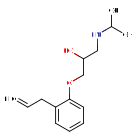
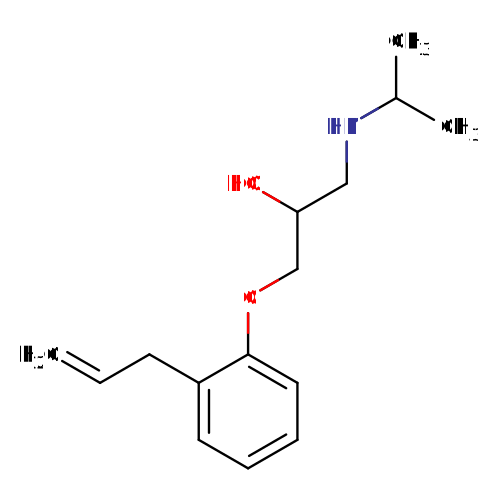
Structure for Alprenolol (DB00866)
- Weight
- Average: 249.3486
Monoisotopic: 249.172878985 - Chemical Formula
- C15H23NO2
- Synonyms
- (RS)-1-(2-allylphenoxy)-3-(isopropylamino)propan-2-ol
- 1-(2-Allylphenoxy)-3-isopropylamino-2-propanol
- 1-(o-Allylphenoxy)-3-(isopropylamino)-2-propanol
- Alfeprol
- Alprenolol
- Alprénolol
- Alprenololum
- Aprenololo
- External IDs
- H 56/28
- H 561/28

Pharmacology
- Indication
For the treatment of hypertension, angina, and arrhythmia
 Reduce drug development failure ratesBuild, train, & validate machine-learning modelswith evidence-based and structured datasets.Build, train, & validate predictive machine-learning models with structured datasets.
- Contraindications & Blackbox Warnings
 Prevent Adverse Drug Events TodayTap into our Clinical API for life-saving information on contraindications & blackbox warnings, population restrictions, harmful risks, & more.Avoid life-threatening adverse drug events with our Clinical API
- Pharmacodynamics
Alprenolol is a non-selective beta-blocker used in the treatment of hypertension, edema, ventricular tachycardias, and atrial fibrillation. Alprenolol impairs AV node conduction and decreases sinus rate and may also increase plasma triglycerides and decrease HDL-cholesterol levels. Alprenolol is nonpolar and hydrophobic, with low to moderate lipid solubility. Alprenolol has little to no intrinsic sympathomimetic activity and, unlike some other beta-adrenergic blocking agents, alprenolol has little direct myocardial depressant activity and does not have an anesthetic-like membrane-stabilizing action.
- Mechanism of action
Alprenolol non-selectively blocks beta-1 adrenergic receptors mainly in the heart, inhibiting the effects of epinephrine and norepinephrine resulting in a decrease in heart rate and blood pressure. Also, with a more minor effect, by binding beta-2 receptors in the juxtaglomerular apparatus, alprenolol inhibits the production of renin, thereby inhibiting angiotensin II and aldosterone production and therefore inhibits the vasoconstriction and water retention due to angiotensin II and aldosterone, respectively.
Target Actions Organism ABeta-1 adrenergic receptor antagonistHumans ABeta-2 adrenergic receptor antagonistHumans A5-hydroxytryptamine receptor 1A antagonistHumans UBeta-3 adrenergic receptor antagonistHumans - Absorption
Not Available
- Volume of distribution
Not Available
- Protein binding
80-90%
- Metabolism
Hepatic. One of the active metabolites, 4-OH-alprenolol, is an active beta-blocker.
Hover over products below to view reaction partners
- Route of elimination
Not Available
- Half-life
2-3 hours
- Clearance
Not Available
- Adverse Effects
 Improve decision support & research outcomesWith structured adverse effects data, including: blackbox warnings, adverse reactions, warning & precautions, & incidence rates. View sample adverse effects data in our new Data Library!Improve decision support & research outcomes with our structured adverse effects data.
- Toxicity
LD50=597.0 mg/kg (Orally in rats)
- Pathways
Pathway Category Alprenolol Action Pathway Drug action - Pharmacogenomic Effects/ADRs
- Not Available
Interactions
- Drug Interactions
- This information should not be interpreted without the help of a healthcare provider. If you believe you are experiencing an interaction, contact a healthcare provider immediately. The absence of an interaction does not necessarily mean no interactions exist.
Drug Interaction Integrate drug-drug
interactions in your software1,2-Benzodiazepine The risk or severity of CNS depression can be increased when Alprenolol is combined with 1,2-Benzodiazepine. Abaloparatide Abaloparatide may increase the hypotensive activities of Alprenolol. Abatacept The metabolism of Alprenolol can be increased when combined with Abatacept. Abiraterone The metabolism of Alprenolol can be decreased when combined with Abiraterone. Acarbose The therapeutic efficacy of Acarbose can be increased when used in combination with Alprenolol. - Food Interactions
- Not Available
Products
 Drug product information from 10+ global regionsOur datasets provide approved product information including:dosage, form, labeller, route of administration, and marketing period.Access drug product information from over 10 global regions.
- Product Ingredients
Ingredient UNII CAS InChI Key Alprenolol hydrochloride 2502C2OIRK 13707-88-5 RRCPAXJDDNWJBI-UHFFFAOYSA-N - International/Other Brands
- Apllobal (AstraZeneca) / Aptin (AstraZeneca) / Aptine / Aptol Duriles / Atenenol (Tsuruhara Seiyaku) / Elp (Shyh Dar) / Gubernal / Regletin / Skajilol (Kotobuki Seiyaku) / Yobir
Categories
- ATC Codes
- C07AA01 — Alprenolol
- Drug Categories
- Adrenergic Agents
- Adrenergic Antagonists
- Adrenergic beta-Antagonists
- Agents causing hyperkalemia
- Alcohols
- Amines
- Amino Alcohols
- Antiarrhythmic agents
- Antidepressive Agents
- Antihypertensive Agents
- Autonomic Agents
- Beta Blocking Agents, Non-Selective
- Bradycardia-Causing Agents
- Cardiovascular Agents
- Central Nervous System Depressants
- Cytochrome P-450 CYP2D6 Substrates
- Cytochrome P-450 Substrates
- Neurotransmitter Agents
- Peripheral Nervous System Agents
- Phenoxypropanolamines
- Propanolamines
- Propanols
- Serotonin 5-HT1 Receptor Antagonists
- Serotonin 5-HT1A Receptor Antagonists
- Serotonin Agents
- Serotonin Receptor Antagonists
- Sympatholytics
- Chemical TaxonomyProvided by Classyfire
- Description
- This compound belongs to the class of organic compounds known as phenol ethers. These are aromatic compounds containing an ether group substituted with a benzene ring.
- Kingdom
- Organic compounds
- Super Class
- Benzenoids
- Class
- Phenol ethers
- Sub Class
- Not Available
- Direct Parent
- Phenol ethers
- Alternative Parents
- Phenoxy compounds / Alkyl aryl ethers / Secondary alcohols / 1,2-aminoalcohols / Dialkylamines / Organopnictogen compounds / Hydrocarbon derivatives
- Substituents
- 1,2-aminoalcohol / Alcohol / Alkyl aryl ether / Amine / Aromatic homomonocyclic compound / Ether / Hydrocarbon derivative / Monocyclic benzene moiety / Organic nitrogen compound / Organic oxygen compound
- Molecular Framework
- Aromatic homomonocyclic compounds
- External Descriptors
- secondary alcohol, secondary amino compound (CHEBI:51211)
- Affected organisms
- Humans and other mammals
Chemical Identifiers
- UNII
- 877K5MQ27W
- CAS number
- 13655-52-2
- InChI Key
- PAZJSJFMUHDSTF-UHFFFAOYSA-N
- InChI
- InChI=1S/C15H23NO2/c1-4-7-13-8-5-6-9-15(13)18-11-14(17)10-16-12(2)3/h4-6,8-9,12,14,16-17H,1,7,10-11H2,2-3H3
- IUPAC Name
- 1-[2-(prop-2-en-1-yl)phenoxy]-3-[(propan-2-yl)amino]propan-2-ol
- SMILES
- CC(C)NCC(O)COC1=CC=CC=C1CC=C
References
- Synthesis Reference
http://www.google.com.mx/patents/US3466376
- General References
- Hold KM, de Boer D, Bos KL, van Ooijen RD, Zuidema J, Maes RA: Enantioselective quantitation of (R)- and (S)-alprenolol by gas chromatography-mass spectrometry in human saliva an plasma. J Chromatogr Sci. 1996 Jan;34(1):13-9. [Article]
- Himori N, Ishimori T, Izumi A, Hiramatsu Y: Effects of beta-adrenoceptor blocking agents, pindolol, alprenolol and practolol on blood pressure and heart rate in conscious renal hypertensive dogs. Arch Int Pharmacodyn Ther. 1977 Jan;225(1):152-65. [Article]
- External Links
- Human Metabolome Database
- HMDB0015004
- KEGG Drug
- D07156
- PubChem Compound
- 2119
- PubChem Substance
- 46506033
- ChemSpider
- 2035
- BindingDB
- 25764
- 597
- ChEBI
- 51211
- ChEMBL
- CHEMBL266195
- Therapeutic Targets Database
- DAP000941
- PharmGKB
- PA164750541
- Drugs.com
- Drugs.com Drug Page
- Wikipedia
- Alprenolol
- MSDS
- Download (28.7 KB)
Clinical Trials
Pharmacoeconomics
- Manufacturers
- Not Available
- Packagers
- Not Available
- Dosage Forms
- Not Available
- Prices
- Not Available
- Patents
Patent Number Pediatric Extension Approved Expires (estimated) Region US3466376 No 1966-06-17 1986-06-17 US 
Properties
- State
- Solid
- Experimental Properties
Property Value Source melting point (°C) 107-109 °C PhysProp water solubility 547 mg/L Not Available logP 3.10 HANSCH,C ET AL. (1995) Caco2 permeability -4.62 ADME Research, USCD - Predicted Properties
Property Value Source Water Solubility 0.188 mg/mL ALOGPS logP 2.59 ALOGPS logP 2.69 Chemaxon logS -3.1 ALOGPS pKa (Strongest Acidic) 14.09 Chemaxon pKa (Strongest Basic) 9.67 Chemaxon Physiological Charge 1 Chemaxon Hydrogen Acceptor Count 3 Chemaxon Hydrogen Donor Count 2 Chemaxon Polar Surface Area 41.49 Å2 Chemaxon Rotatable Bond Count 8 Chemaxon Refractivity 74.66 m3·mol-1 Chemaxon Polarizability 29.38 Å3 Chemaxon Number of Rings 1 Chemaxon Bioavailability 1 Chemaxon Rule of Five Yes Chemaxon Ghose Filter Yes Chemaxon Veber's Rule No Chemaxon MDDR-like Rule No Chemaxon - Predicted ADMET Features
Property Value Probability Human Intestinal Absorption + 0.9831 Blood Brain Barrier - 0.9394 Caco-2 permeable + 0.8866 P-glycoprotein substrate Substrate 0.6064 P-glycoprotein inhibitor I Inhibitor 0.5066 P-glycoprotein inhibitor II Non-inhibitor 0.8382 Renal organic cation transporter Non-inhibitor 0.8305 CYP450 2C9 substrate Non-substrate 0.824 CYP450 2D6 substrate Substrate 0.882 CYP450 3A4 substrate Non-substrate 0.7469 CYP450 1A2 substrate Inhibitor 0.9106 CYP450 2C9 inhibitor Non-inhibitor 0.9071 CYP450 2D6 inhibitor Inhibitor 0.8931 CYP450 2C19 inhibitor Non-inhibitor 0.9025 CYP450 3A4 inhibitor Non-inhibitor 0.8839 CYP450 inhibitory promiscuity Low CYP Inhibitory Promiscuity 0.8933 Ames test Non AMES toxic 0.9133 Carcinogenicity Non-carcinogens 0.9106 Biodegradation Not ready biodegradable 0.9646 Rat acute toxicity 2.5069 LD50, mol/kg Not applicable hERG inhibition (predictor I) Weak inhibitor 0.8664 hERG inhibition (predictor II) Non-inhibitor 0.6946
Spectra
- Mass Spec (NIST)
- Download (3.94 KB)
- Spectra
Spectrum Spectrum Type Splash Key Predicted GC-MS Spectrum - GC-MS Predicted GC-MS splash10-0089-8920000000-21e1f9aacdf6f681239a Predicted MS/MS Spectrum - 10V, Positive (Annotated) Predicted LC-MS/MS splash10-0udi-1390000000-df7c0b01bb018415168e Predicted MS/MS Spectrum - 10V, Negative (Annotated) Predicted LC-MS/MS splash10-01q9-1900000000-ff34b82d095c71336e20 Predicted MS/MS Spectrum - 20V, Positive (Annotated) Predicted LC-MS/MS splash10-00xs-9500000000-73f1dea66a1e31d98320 Predicted MS/MS Spectrum - 20V, Negative (Annotated) Predicted LC-MS/MS splash10-06si-2900000000-251a1e8d976295511ad6 Predicted MS/MS Spectrum - 40V, Positive (Annotated) Predicted LC-MS/MS splash10-052f-9400000000-501de36035b23f3fa4c7 Predicted MS/MS Spectrum - 40V, Negative (Annotated) Predicted LC-MS/MS splash10-052f-9600000000-b8251e04c8f4b5ae51c8 Predicted 1H NMR Spectrum 1D NMR Not Applicable Predicted 13C NMR Spectrum 1D NMR Not Applicable - Chromatographic Properties
Collision Cross Sections (CCS)
Adduct CCS Value (Å2) Source type Source [M-H]- 173.5630616 predictedDarkChem Lite v0.1.0 [M-H]- 154.80449 predictedDeepCCS 1.0 (2019) [M+H]+ 174.6556616 predictedDarkChem Lite v0.1.0 [M+H]+ 157.16249 predictedDeepCCS 1.0 (2019) [M+Na]+ 173.9505616 predictedDarkChem Lite v0.1.0 [M+Na]+ 163.61555 predictedDeepCCS 1.0 (2019)
Targets

- Kind
- Protein
- Organism
- Humans
- Pharmacological action
- Yes
- Actions
- Antagonist
- General Function
- Receptor signaling protein activity
- Specific Function
- Beta-adrenergic receptors mediate the catecholamine-induced activation of adenylate cyclase through the action of G proteins. This receptor binds epinephrine and norepinephrine with approximately e...
- Gene Name
- ADRB1
- Uniprot ID
- P08588
- Uniprot Name
- Beta-1 adrenergic receptor
- Molecular Weight
- 51322.1 Da
References
- Surman AJ, Doggrell SA: Alprenolol and bromoacetylalprenololmenthane are competitive slowly reversible antagonists at the beta 1-adrenoceptors of rat left atria. J Cardiovasc Pharmacol. 1993 Jan;21(1):35-9. [Article]
- De Ponti F, Cosentino M, Costa A, Girani M, Gibelli G, D'Angelo L, Frigo G, Crema A: Inhibitory effects of SR 58611A on canine colonic motility: evidence for a role of beta 3-adrenoceptors. Br J Pharmacol. 1995 Apr;114(7):1447-53. [Article]
- Varma DR, Shen H, Deng XF, Peri KG, Chemtob S, Mulay S: Inverse agonist activities of beta-adrenoceptor antagonists in rat myocardium. Br J Pharmacol. 1999 Jun;127(4):895-902. [Article]
- Brahmadevara N, Shaw AM, MacDonald A: Evidence against beta 3-adrenoceptors or low affinity state of beta 1-adrenoceptors mediating relaxation in rat isolated aorta. Br J Pharmacol. 2003 Jan;138(1):99-106. [Article]
- Im MJ, Holzhofer A, Bottinger H, Pfeuffer T, Helmreich EJ: Interactions of pure beta gamma-subunits of G-proteins with purified beta 1-adrenoceptor. FEBS Lett. 1988 Jan 25;227(2):225-9. [Article]
- Chen X, Ji ZL, Chen YZ: TTD: Therapeutic Target Database. Nucleic Acids Res. 2002 Jan 1;30(1):412-5. [Article]
- Kind
- Protein
- Organism
- Humans
- Pharmacological action
- Yes
- Actions
- Antagonist
- General Function
- Protein homodimerization activity
- Specific Function
- Beta-adrenergic receptors mediate the catecholamine-induced activation of adenylate cyclase through the action of G proteins. The beta-2-adrenergic receptor binds epinephrine with an approximately ...
- Gene Name
- ADRB2
- Uniprot ID
- P07550
- Uniprot Name
- Beta-2 adrenergic receptor
- Molecular Weight
- 46458.32 Da
References
- Brodde OE, Wang XL, O'Hara N, Daul A, Schiess W: Effect of propranolol, alprenolol, pindolol, and bopindolol on beta 2-adrenoceptor density in human lymphocytes. J Cardiovasc Pharmacol. 1986;8 Suppl 6:S70-3. [Article]
- Brodde OE, Daul A, Stuka N, O'Hara N, Borchard U: Effects of beta-adrenoceptor antagonist administration on beta 2-adrenoceptor density in human lymphocytes. The role of the "intrinsic sympathomimetic activity". Naunyn Schmiedebergs Arch Pharmacol. 1985 Feb;328(4):417-22. [Article]
- Abrahamsson T: The beta 1- and beta 2-adrenoceptor stimulatory effects of alprenolol, oxprenolol and pindolol: a study in the isolated right atrium and uterus of the rat. Br J Pharmacol. 1986 Apr;87(4):657-64. [Article]
- Kind
- Protein
- Organism
- Humans
- Pharmacological action
- Yes
- Actions
- Antagonist
- General Function
- Serotonin receptor activity
- Specific Function
- G-protein coupled receptor for 5-hydroxytryptamine (serotonin). Also functions as a receptor for various drugs and psychoactive substances. Ligand binding causes a conformation change that triggers...
- Gene Name
- HTR1A
- Uniprot ID
- P08908
- Uniprot Name
- 5-hydroxytryptamine receptor 1A
- Molecular Weight
- 46106.335 Da
References
- Millan MJ, Rivet JM, Canton H, Lejeune F, Bervoets K, Brocco M, Gobert A, Lefebvre de Ladonchamps B, Le Marouille-Girardon S, Verriele L, et al.: S 14671: a naphtylpiperazine 5-hydroxytryptamine1A agonist of exceptional potency and high efficacy possessing antagonist activity at 5-hydroxytryptamine1C/2 receptors. J Pharmacol Exp Ther. 1992 Aug;262(2):451-63. [Article]
- Darmani NA: Role of the inhibitory adrenergic alpha 2 and serotonergic 5-HT1A components of cocaine's actions on the DOI-induced head-twitch response in 5-HT2-receptor supersensitive mice. Pharmacol Biochem Behav. 1993 Jun;45(2):269-74. [Article]
- Kuipers W, Link R, Standaar PJ, Stoit AR, Van Wijngaarden I, Leurs R, Ijzerman AP: Study of the interaction between aryloxypropanolamines and Asn386 in helix VII of the human 5-hydroxytryptamine1A receptor. Mol Pharmacol. 1997 May;51(5):889-96. [Article]
- Misane I, Johansson C, Ogren SO: Analysis of the 5-HT1A receptor involvement in passive avoidance in the rat. Br J Pharmacol. 1998 Oct;125(3):499-509. [Article]
- Kind
- Protein
- Organism
- Humans
- Pharmacological action
- Unknown
- Actions
- Antagonist
- General Function
- Protein homodimerization activity
- Specific Function
- Beta-adrenergic receptors mediate the catecholamine-induced activation of adenylate cyclase through the action of G proteins. Beta-3 is involved in the regulation of lipolysis and thermogenesis.
- Gene Name
- ADRB3
- Uniprot ID
- P13945
- Uniprot Name
- Beta-3 adrenergic receptor
- Molecular Weight
- 43518.615 Da
References
- Hoffmann C, Leitz MR, Oberdorf-Maass S, Lohse MJ, Klotz KN: Comparative pharmacology of human beta-adrenergic receptor subtypes--characterization of stably transfected receptors in CHO cells. Naunyn Schmiedebergs Arch Pharmacol. 2004 Feb;369(2):151-9. Epub 2004 Jan 17. [Article]
Enzymes
- Kind
- Protein
- Organism
- Humans
- Pharmacological action
- Unknown
- Actions
- Substrate
- General Function
- Steroid hydroxylase activity
- Specific Function
- Responsible for the metabolism of many drugs and environmental chemicals that it oxidizes. It is involved in the metabolism of drugs such as antiarrhythmics, adrenoceptor antagonists, and tricyclic...
- Gene Name
- CYP2D6
- Uniprot ID
- P10635
- Uniprot Name
- Cytochrome P450 2D6
- Molecular Weight
- 55768.94 Da
References
- Zisaki A, Miskovic L, Hatzimanikatis V: Antihypertensive drugs metabolism: an update to pharmacokinetic profiles and computational approaches. Curr Pharm Des. 2015;21(6):806-22. [Article]
- Sicras-Mainar A, Guijarro P, Armada B, Blanca-Tamayo M, Navarro-Artieda R: Influence of the CYP2D6 isoenzyme in patients treated with venlafaxine for major depressive disorder: clinical and economic consequences. PLoS One. 2014 Nov 4;9(11):e90453. doi: 10.1371/journal.pone.0090453. eCollection 2014. [Article]
- Flockhart Table of Drug Interactions [Link]


Drug created at June 13, 2005 13:24 / Updated at February 02, 2024 22:45