Identification
- Summary
Conivaptan is an antidiuretic hormone inhibitor used to raise serum sodium levels.
- Brand Names
- Vaprisol
- Generic Name
- Conivaptan
- DrugBank Accession Number
- DB00872
- Background
Conivaptan is a non-peptide inhibitor of antidiuretic hormone (vasopressin). It was approved in 2004 for hyponatremia (low blood sodium levels) caused by syndrome of inappropriate antidiuretic hormone (SIADH). Conivaptan inhibits both isotypes of the vasopressin receptor (V1a and V2).
- Type
- Small Molecule
- Groups
- Approved, Investigational
- Structure
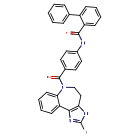
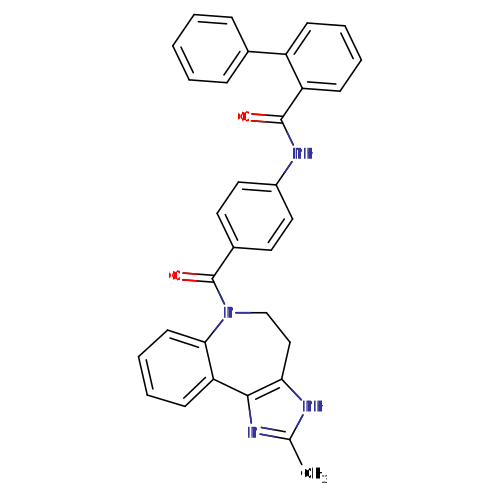
Structure for Conivaptan (DB00872)
- Weight
- Average: 498.5744
Monoisotopic: 498.205576096 - Chemical Formula
- C32H26N4O2
- Synonyms
- 4'-((4,5-dihydro-2-methylimidazo(4,5-d)(1)benzazepin-6(1H)-yl)carbonyl)-2-biphenylcarboxanilide
- Conivaptan
- External IDs
- YM 087
- YM-087

Pharmacology
- Indication
For the treatment of euvolemic or hypervolemic hyponatremia (e.g. the syndrome of inappropriate secretion of antidiuretic hormone, or in the setting of hypothyroidism, adrenal insufficiency, pulmonary disorders, etc.) in hospitalized patients.
 Reduce drug development failure ratesBuild, train, & validate machine-learning modelswith evidence-based and structured datasets.Build, train, & validate predictive machine-learning models with structured datasets.
- Associated Conditions
Indication Type Indication Combined Product Details Approval Level Age Group Patient Characteristics Dose Form Treatment of Euvolemic hyponatremia •••••••••••• Treatment of Hypervolemic hyponatremia •••••••••••• - Contraindications & Blackbox Warnings
 Prevent Adverse Drug Events TodayTap into our Clinical API for life-saving information on contraindications & blackbox warnings, population restrictions, harmful risks, & more.Avoid life-threatening adverse drug events with our Clinical API
- Pharmacodynamics
Conivaptan is a nonpeptide, dual antagonist of arginine vasopressin (AVP) V1A and V2 receptors. The level of AVP in circulating blood is critical for the regulation of water and electrolyte balance and is usually elevated in both euvolemic and hypervolemic hyponatremia. The AVP effect is mediated through V2 receptors, which are functionally coupled to aquaporin channels in the apical membrane of the collecting ducts of the kidney. These receptors help to maintain plasma osmolality within the normal range by increasing permeability of the renal collecting ducts to water. Vasopressin also causes vasoconstriction through its actions on vascular 1A receptors. The predominant pharmacodynamic effect of conivaptan in the treatment of hyponatremia is through its V2 antagonism of AVP in the renal collecting ducts, an effect that results in aquaresis, or excretion of free water. Conivaptan's antagonist activity on V1A receptors may also cause splanchnic vasodilation, resulting in possible hypotension or variceal bleeding in patients with cirrhosis. The pharmacodynamic effects of conivaptan include increased free water excretion (i.e., effective water clearance [EWC]) generally accompanied by increased net fluid loss, increased urine output, and decreased urine osmolality.
- Mechanism of action
Conivaptan is a dual AVP antagonist with nanomolar affinity for human arginine vasopressin V1A and V2 receptors in vitro. This antagonism occurs in the renal collecting ducts, resulting in aquaresis, or excretion of free water.
Target Actions Organism AVasopressin V1a receptor antagonistHumans AVasopressin V2 receptor antagonistHumans - Absorption
Not Available
- Volume of distribution
Not Available
- Protein binding
99%
- Metabolism
CYP3A4 is the sole cytochrome P450 isozyme responsible for the metabolism of conivaptan. Four metabolites have been identified. The pharmacological activity of the metabolites at V1a and V2 receptors ranged from approximately 3-50% and 50-100% that of conivaptan, respectively.
- Route of elimination
Not Available
- Half-life
5 hours
- Clearance
Not Available
- Adverse Effects
 Improve decision support & research outcomesWith structured adverse effects data, including: blackbox warnings, adverse reactions, warning & precautions, & incidence rates. View sample adverse effects data in our new Data Library!Improve decision support & research outcomes with our structured adverse effects data.
- Toxicity
Although no data on overdosage in humans are available, conivaptan has been administered as a 20 mg loading dose on Day 1 followed by continuous infusion of 80 mg/day for 4 days in hyponatremia patients and up to 120 mg/day for 2 days in CHF patients. No new toxicities were identified at these higher doses, but adverse events related to the pharmacologic activity of conivaptan, e.g. hypotension and thirst, occurred more frequently at these higher doses.
- Pathways
- Not Available
- Pharmacogenomic Effects/ADRs
- Not Available
Interactions
- Drug Interactions
- This information should not be interpreted without the help of a healthcare provider. If you believe you are experiencing an interaction, contact a healthcare provider immediately. The absence of an interaction does not necessarily mean no interactions exist.
Drug Interaction Integrate drug-drug
interactions in your software1,2-Benzodiazepine The metabolism of 1,2-Benzodiazepine can be decreased when combined with Conivaptan. Abacavir Conivaptan may increase the excretion rate of Abacavir which could result in a lower serum level and potentially a reduction in efficacy. Abaloparatide The risk or severity of adverse effects can be increased when Conivaptan is combined with Abaloparatide. Abametapir The serum concentration of Conivaptan can be increased when it is combined with Abametapir. Abatacept The metabolism of Conivaptan can be increased when combined with Abatacept. - Food Interactions
- No interactions found.
Products
 Drug product information from 10+ global regionsOur datasets provide approved product information including:dosage, form, labeller, route of administration, and marketing period.Access drug product information from over 10 global regions.
- Product Ingredients
Ingredient UNII CAS InChI Key Conivaptan hydrochloride 75L57R6X36 168626-94-6 BTYHAFSDANBVMJ-UHFFFAOYSA-N - Brand Name Prescription Products
Name Dosage Strength Route Labeller Marketing Start Marketing End Region Image Vaprisol Solution 20 mg/100mL Intravenous Astellas Pharma US, Inc. 2008-10-08 Not applicable US 
Vaprisol Liquid 5 mg/1mL Intravenous Astellas Pharma US, Inc. 2005-12-29 2009-09-30 US Vaprisol Dextrose In Plastic Container Injection, solution 20 mg/100mL Intravenous Cumberland Pharmaceuticals Inc. 2008-10-08 Not applicable US
Categories
- ATC Codes
- C03XA02 — Conivaptan
- Drug Categories
- Antidiuretic Hormone Receptor Antagonists
- Cytochrome P-450 CYP3A Inhibitors
- Cytochrome P-450 CYP3A Substrates
- Cytochrome P-450 CYP3A4 Inhibitors
- Cytochrome P-450 CYP3A4 Inhibitors (strong)
- Cytochrome P-450 CYP3A4 Substrates
- Cytochrome P-450 CYP3A4 Substrates with a Narrow Therapeutic Index
- Cytochrome P-450 Enzyme Inhibitors
- Cytochrome P-450 Substrates
- Diuretics
- Heterocyclic Compounds, Fused-Ring
- Hypotensive Agents
- Narrow Therapeutic Index Drugs
- Natriuretic Agents
- P-glycoprotein inhibitors
- Chemical TaxonomyProvided by Classyfire
- Description
- This compound belongs to the class of organic compounds known as benzanilides. These are aromatic compounds containing an anilide group in which the carboxamide group is substituted with a benzene ring. They have the general structure RNC(=O)R', where R,R'= benzene.
- Kingdom
- Organic compounds
- Super Class
- Benzenoids
- Class
- Benzene and substituted derivatives
- Sub Class
- Anilides
- Direct Parent
- Benzanilides
- Alternative Parents
- Biphenyls and derivatives / Benzazepines / Benzamides / Benzoyl derivatives / Azepines / Tertiary carboxylic acid amides / Imidazoles / Heteroaromatic compounds / Secondary carboxylic acid amides / Azacyclic compounds show 5 more
- Substituents
- Aromatic heteropolycyclic compound / Azacycle / Azepine / Azole / Benzamide / Benzanilide / Benzazepine / Benzoic acid or derivatives / Benzoyl / Biphenyl show 14 more
- Molecular Framework
- Aromatic heteropolycyclic compounds
- External Descriptors
- benzazepine (CHEBI:681850)
- Affected organisms
- Humans and other mammals
Chemical Identifiers
- UNII
- 0NJ98Y462X
- CAS number
- 210101-16-9
- InChI Key
- IKENVDNFQMCRTR-UHFFFAOYSA-N
- InChI
- InChI=1S/C32H26N4O2/c1-21-33-28-19-20-36(29-14-8-7-13-27(29)30(28)34-21)32(38)23-15-17-24(18-16-23)35-31(37)26-12-6-5-11-25(26)22-9-3-2-4-10-22/h2-18H,19-20H2,1H3,(H,33,34)(H,35,37)
- IUPAC Name
- N-(4-{4-methyl-3,5,9-triazatricyclo[8.4.0.0^{2,6}]tetradeca-1(14),2(6),3,10,12-pentaene-9-carbonyl}phenyl)-[1,1'-biphenyl]-2-carboxamide
- SMILES
- CC1=NC2=C(CCN(C(=O)C3=CC=C(NC(=O)C4=CC=CC=C4C4=CC=CC=C4)C=C3)C3=CC=CC=C23)N1
References
- General References
- Ali F, Raufi MA, Washington B, Ghali JK: Conivaptan: a dual vasopressin receptor v1a/v2 antagonist [corrected]. Cardiovasc Drug Rev. 2007 Fall;25(3):261-79. [Article]
- Mao ZL, Stalker D, Keirns J: Pharmacokinetics of conivaptan hydrochloride, a vasopressin V(1A)/V(2)-receptor antagonist, in patients with euvolemic or hypervolemic hyponatremia and with or without congestive heart failure from a prospective, 4-day open-label study. Clin Ther. 2009 Jul;31(7):1542-50. doi: 10.1016/j.clinthera.2009.07.011. [Article]
- Ghali JK, Farah JO, Daifallah S, Zabalawi HA, Zmily HD: Conivaptan and its role in the treatment of hyponatremia. Drug Des Devel Ther. 2009 Dec 29;3:253-68. [Article]
- External Links
- Human Metabolome Database
- HMDB0015010
- KEGG Drug
- D07748
- PubChem Compound
- 151171
- PubChem Substance
- 46504533
- ChemSpider
- 133239
- BindingDB
- 85095
- 302285
- ChEBI
- 681850
- ChEMBL
- CHEMBL1755
- ZINC
- ZINC000012503187
- Therapeutic Targets Database
- DNC001525
- PharmGKB
- PA164742939
- Guide to Pharmacology
- GtP Drug Page
- Drugs.com
- Drugs.com Drug Page
- Wikipedia
- Conivaptan
- FDA label
- Download (145 KB)
Clinical Trials
- Clinical Trials
Phase Status Purpose Conditions Count 4 Completed Treatment Euvolemia / Hyponatremia / Volume Overload 1 4 Completed Treatment Heart Failure 1 4 Terminated Treatment Hyponatremia 1 4 Withdrawn Treatment Heart Failure 1 3 Completed Treatment Hyponatremia 4
Pharmacoeconomics
- Manufacturers
- Astellas pharma us inc
- Packagers
- Astellas Pharma Inc.
- Baxter International Inc.
- Dosage Forms
Form Route Strength Liquid Intravenous 5 mg/1mL Solution Intravenous 20 mg/100mL Injection, solution Intravenous 20 mg/100mL - Prices
Unit description Cost Unit Vaprisol 20 mg/100 ml bag 6.3USD ml DrugBank does not sell nor buy drugs. Pricing information is supplied for informational purposes only.- Patents
Patent Number Pediatric Extension Approved Expires (estimated) Region US5723606 No 1998-03-03 2019-12-15 US
Properties
- State
- Solid
- Experimental Properties
Property Value Source water solubility Very slightly soluble (0.15 mg/mL at 23 °C) Not Available logP 6.3 Not Available - Predicted Properties
Property Value Source Water Solubility 0.00175 mg/mL ALOGPS logP 5.23 ALOGPS logP 5.44 Chemaxon logS -5.5 ALOGPS pKa (Strongest Acidic) 13.53 Chemaxon pKa (Strongest Basic) 6.23 Chemaxon Physiological Charge 0 Chemaxon Hydrogen Acceptor Count 3 Chemaxon Hydrogen Donor Count 2 Chemaxon Polar Surface Area 78.09 Å2 Chemaxon Rotatable Bond Count 4 Chemaxon Refractivity 150.83 m3·mol-1 Chemaxon Polarizability 55.51 Å3 Chemaxon Number of Rings 6 Chemaxon Bioavailability 1 Chemaxon Rule of Five No Chemaxon Ghose Filter No Chemaxon Veber's Rule No Chemaxon MDDR-like Rule No Chemaxon - Predicted ADMET Features
Property Value Probability Human Intestinal Absorption + 1.0 Blood Brain Barrier + 0.9522 Caco-2 permeable + 0.5291 P-glycoprotein substrate Substrate 0.5919 P-glycoprotein inhibitor I Inhibitor 0.6901 P-glycoprotein inhibitor II Inhibitor 0.8429 Renal organic cation transporter Non-inhibitor 0.6631 CYP450 2C9 substrate Non-substrate 0.7671 CYP450 2D6 substrate Non-substrate 0.7534 CYP450 3A4 substrate Substrate 0.6602 CYP450 1A2 substrate Inhibitor 0.7008 CYP450 2C9 inhibitor Inhibitor 0.5368 CYP450 2D6 inhibitor Non-inhibitor 0.6597 CYP450 2C19 inhibitor Inhibitor 0.8477 CYP450 3A4 inhibitor Inhibitor 0.9027 CYP450 inhibitory promiscuity High CYP Inhibitory Promiscuity 0.9043 Ames test Non AMES toxic 0.6672 Carcinogenicity Non-carcinogens 0.8831 Biodegradation Not ready biodegradable 0.9584 Rat acute toxicity 2.5446 LD50, mol/kg Not applicable hERG inhibition (predictor I) Weak inhibitor 0.9885 hERG inhibition (predictor II) Inhibitor 0.8456
Spectra
- Mass Spec (NIST)
- Not Available
- Spectra
Spectrum Spectrum Type Splash Key Predicted GC-MS Spectrum - GC-MS Predicted GC-MS splash10-001i-0902300000-bbe0e959903728fcb9dd Predicted MS/MS Spectrum - 10V, Positive (Annotated) Predicted LC-MS/MS splash10-0f89-0904000000-fc741947205ca717875a Predicted MS/MS Spectrum - 10V, Negative (Annotated) Predicted LC-MS/MS splash10-0002-0104900000-19b5d4f3e4edc452d4af Predicted MS/MS Spectrum - 20V, Positive (Annotated) Predicted LC-MS/MS splash10-001j-0903700000-ac582c3c7521fbe99437 Predicted MS/MS Spectrum - 20V, Negative (Annotated) Predicted LC-MS/MS splash10-0002-1113900000-01cec65b3e66b15d8f6f Predicted MS/MS Spectrum - 40V, Positive (Annotated) Predicted LC-MS/MS splash10-053r-0900000000-4a3e2515693792ea0be2 Predicted MS/MS Spectrum - 40V, Negative (Annotated) Predicted LC-MS/MS splash10-0udi-2900500000-7deb983db5fb6b8b247d Predicted 1H NMR Spectrum 1D NMR Not Applicable Predicted 13C NMR Spectrum 1D NMR Not Applicable - Chromatographic Properties
Collision Cross Sections (CCS)
Adduct CCS Value (Å2) Source type Source [M-H]- 245.4244055 predictedDarkChem Lite v0.1.0 [M-H]- 215.45164 predictedDeepCCS 1.0 (2019) [M+H]+ 245.3544055 predictedDarkChem Lite v0.1.0 [M+H]+ 217.8472 predictedDeepCCS 1.0 (2019) [M+Na]+ 245.9165055 predictedDarkChem Lite v0.1.0 [M+Na]+ 223.75972 predictedDeepCCS 1.0 (2019)
Targets

- Kind
- Protein
- Organism
- Humans
- Pharmacological action
- Yes
- Actions
- Antagonist
- General Function
- Vasopressin receptor activity
- Specific Function
- Receptor for arginine vasopressin. The activity of this receptor is mediated by G proteins which activate a phosphatidyl-inositol-calcium second messenger system. Has been involved in social behavi...
- Gene Name
- AVPR1A
- Uniprot ID
- P37288
- Uniprot Name
- Vasopressin V1a receptor
- Molecular Weight
- 46799.105 Da
References
- Chen X, Ji ZL, Chen YZ: TTD: Therapeutic Target Database. Nucleic Acids Res. 2002 Jan 1;30(1):412-5. [Article]
- Ali F, Raufi MA, Washington B, Ghali JK: Conivaptan: a dual vasopressin receptor v1a/v2 antagonist [corrected]. Cardiovasc Drug Rev. 2007 Fall;25(3):261-79. [Article]
- Wada K, Matsukawa U, Fujimori A, Arai Y, Sudoh K, Sasamata M, Miyata K: A novel vasopressin dual V1A/V2 receptor antagonist, conivaptan hydrochloride, improves hyponatremia in rats with syndrome of inappropriate secretion of antidiuretic hormone (SIADH). Biol Pharm Bull. 2007 Jan;30(1):91-5. [Article]
- Walter KA: Conivaptan: new treatment for hyponatremia. Am J Health Syst Pharm. 2007 Jul 1;64(13):1385-95. [Article]
- Mao ZL, Stalker D, Keirns J: Pharmacokinetics of conivaptan hydrochloride, a vasopressin V(1A)/V(2)-receptor antagonist, in patients with euvolemic or hypervolemic hyponatremia and with or without congestive heart failure from a prospective, 4-day open-label study. Clin Ther. 2009 Jul;31(7):1542-50. doi: 10.1016/j.clinthera.2009.07.011. [Article]
- Ghali JK, Koren MJ, Taylor JR, Brooks-Asplund E, Fan K, Long WA, Smith N: Efficacy and safety of oral conivaptan: a V1A/V2 vasopressin receptor antagonist, assessed in a randomized, placebo-controlled trial in patients with euvolemic or hypervolemic hyponatremia. J Clin Endocrinol Metab. 2006 Jun;91(6):2145-52. Epub 2006 Mar 7. [Article]
- Annane D, Decaux G, Smith N: Efficacy and safety of oral conivaptan, a vasopressin-receptor antagonist, evaluated in a randomized, controlled trial in patients with euvolemic or hypervolemic hyponatremia. Am J Med Sci. 2009 Jan;337(1):28-36. doi: 10.1097/MAJ.0b013e31817b8148. [Article]
- Ghali JK, Farah JO, Daifallah S, Zabalawi HA, Zmily HD: Conivaptan and its role in the treatment of hyponatremia. Drug Des Devel Ther. 2009 Dec 29;3:253-68. [Article]
- Ali F, Guglin M, Vaitkevicius P, Ghali JK: Therapeutic potential of vasopressin receptor antagonists. Drugs. 2007;67(6):847-58. [Article]
- Hoque MZ, Arumugham P, Huda N, Verma N, Afiniwala M, Karia DH: Conivaptan: promise of treatment in heart failure. Expert Opin Pharmacother. 2009 Sep;10(13):2161-9. doi: 10.1517/14656560903173237. [Article]
- Kind
- Protein
- Organism
- Humans
- Pharmacological action
- Yes
- Actions
- Antagonist
- General Function
- Vasopressin receptor activity
- Specific Function
- Receptor for arginine vasopressin. The activity of this receptor is mediated by G proteins which activate adenylate cyclase. Involved in renal water reabsorption.
- Gene Name
- AVPR2
- Uniprot ID
- P30518
- Uniprot Name
- Vasopressin V2 receptor
- Molecular Weight
- 40278.57 Da
References
- Chen X, Ji ZL, Chen YZ: TTD: Therapeutic Target Database. Nucleic Acids Res. 2002 Jan 1;30(1):412-5. [Article]
- Wada K, Fujimori A, Matsukawa U, Arai Y, Sudoh K, Yatsu T, Sasamata M, Miyata K: Intravenous administration of conivaptan hydrochloride improves cardiac hemodynamics in rats with myocardial infarction-induced congestive heart failure. Eur J Pharmacol. 2005 Jan 10;507(1-3):145-51. Epub 2005 Jan 1. [Article]
- Palm C, Pistrosch F, Herbrig K, Gross P: Vasopressin antagonists as aquaretic agents for the treatment of hyponatremia. Am J Med. 2006 Jul;119(7 Suppl 1):S87-92. [Article]
- Ali F, Raufi MA, Washington B, Ghali JK: Conivaptan: a dual vasopressin receptor v1a/v2 antagonist [corrected]. Cardiovasc Drug Rev. 2007 Fall;25(3):261-79. [Article]
- Wada K, Matsukawa U, Fujimori A, Arai Y, Sudoh K, Sasamata M, Miyata K: A novel vasopressin dual V1A/V2 receptor antagonist, conivaptan hydrochloride, improves hyponatremia in rats with syndrome of inappropriate secretion of antidiuretic hormone (SIADH). Biol Pharm Bull. 2007 Jan;30(1):91-5. [Article]
- Walter KA: Conivaptan: new treatment for hyponatremia. Am J Health Syst Pharm. 2007 Jul 1;64(13):1385-95. [Article]
- Mao ZL, Stalker D, Keirns J: Pharmacokinetics of conivaptan hydrochloride, a vasopressin V(1A)/V(2)-receptor antagonist, in patients with euvolemic or hypervolemic hyponatremia and with or without congestive heart failure from a prospective, 4-day open-label study. Clin Ther. 2009 Jul;31(7):1542-50. doi: 10.1016/j.clinthera.2009.07.011. [Article]
- Ghali JK, Koren MJ, Taylor JR, Brooks-Asplund E, Fan K, Long WA, Smith N: Efficacy and safety of oral conivaptan: a V1A/V2 vasopressin receptor antagonist, assessed in a randomized, placebo-controlled trial in patients with euvolemic or hypervolemic hyponatremia. J Clin Endocrinol Metab. 2006 Jun;91(6):2145-52. Epub 2006 Mar 7. [Article]
- Annane D, Decaux G, Smith N: Efficacy and safety of oral conivaptan, a vasopressin-receptor antagonist, evaluated in a randomized, controlled trial in patients with euvolemic or hypervolemic hyponatremia. Am J Med Sci. 2009 Jan;337(1):28-36. doi: 10.1097/MAJ.0b013e31817b8148. [Article]
- Ghali JK, Farah JO, Daifallah S, Zabalawi HA, Zmily HD: Conivaptan and its role in the treatment of hyponatremia. Drug Des Devel Ther. 2009 Dec 29;3:253-68. [Article]
- Ali F, Guglin M, Vaitkevicius P, Ghali JK: Therapeutic potential of vasopressin receptor antagonists. Drugs. 2007;67(6):847-58. [Article]
- Hoque MZ, Arumugham P, Huda N, Verma N, Afiniwala M, Karia DH: Conivaptan: promise of treatment in heart failure. Expert Opin Pharmacother. 2009 Sep;10(13):2161-9. doi: 10.1517/14656560903173237. [Article]
Enzymes
- Kind
- Protein
- Organism
- Humans
- Pharmacological action
- Unknown
- Actions
- SubstrateInhibitor
- General Function
- Vitamin d3 25-hydroxylase activity
- Specific Function
- Cytochromes P450 are a group of heme-thiolate monooxygenases. In liver microsomes, this enzyme is involved in an NADPH-dependent electron transport pathway. It performs a variety of oxidation react...
- Gene Name
- CYP3A4
- Uniprot ID
- P08684
- Uniprot Name
- Cytochrome P450 3A4
- Molecular Weight
- 57342.67 Da
References
- Ali F, Raufi MA, Washington B, Ghali JK: Conivaptan: a dual vasopressin receptor v1a/v2 antagonist [corrected]. Cardiovasc Drug Rev. 2007 Fall;25(3):261-79. [Article]
- Drug Interactions & Labeling - FDA [Link]
- FDA Drug Development and Drug Interactions: Table of Substrates, Inhibitors and Inducers [Link]
Transporters
- Kind
- Protein
- Organism
- Humans
- Pharmacological action
- Unknown
- Actions
- Inhibitor
- General Function
- Xenobiotic-transporting atpase activity
- Specific Function
- Energy-dependent efflux pump responsible for decreased drug accumulation in multidrug-resistant cells.
- Gene Name
- ABCB1
- Uniprot ID
- P08183
- Uniprot Name
- Multidrug resistance protein 1
- Molecular Weight
- 141477.255 Da

Drug created at June 13, 2005 13:24 / Updated at March 03, 2024 02:34