Identification
- Summary
Eprosartan is an ARB used to treat hypertension, diabetic nephropathy, and congestive heart failure.
- Brand Names
- Teveten HCT
- Generic Name
- Eprosartan
- DrugBank Accession Number
- DB00876
- Background
Eprosartan is an angiotensin II receptor antagonist used to treat hypertension. It performs 2 actions on the renin angiotensin system. By preventing the binding of angiotensin II to AT1, vascular smooth muscle relaxes and vasodilation occurs. By inhibiting norepinephrine production, blood pressure is further reduced.
- Type
- Small Molecule
- Groups
- Approved
- Structure

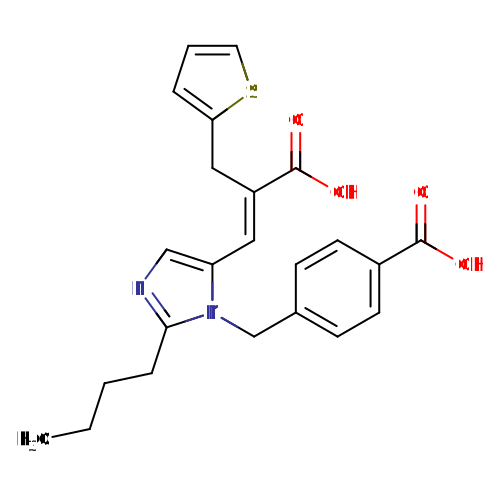
Structure for Eprosartan (DB00876)
- Weight
- Average: 424.513
Monoisotopic: 424.145677956 - Chemical Formula
- C23H24N2O4S
- Synonyms
- (E)-2-butyl-1-(p-carboxybenzyl)-α-2-thenylimidazole-5-acrylic acid
- (E)-3-[2-n-butyl-1-{(4-carboxyphenyl)methyl}-1H-imidazol-5-yl]-2-(2-thienyl)methyl-2-propenoic acid
- (E)-α{[2-butyl-1-[(4-carboxyphenyl)methyl]-1H-imidazole-5-yl]methylene}-2-thiopheneproprionic acid
- Éprosartan
- Eprosartan
- Eprosartanum
- External IDs
- SK&F-108566
- SKF 108566

Pharmacology
- Indication
For the management of hypertension alone or in combination with other classes of antihypertensive agents. Also used as a first-line agent in the treatment of diabetic nephropathy, as well as a second-line agent in the treatment of congestive heart failure (only in those intolerant of ACE inhibitors).
 Reduce drug development failure ratesBuild, train, & validate machine-learning modelswith evidence-based and structured datasets.Build, train, & validate predictive machine-learning models with structured datasets.
- Associated Conditions
Indication Type Indication Combined Product Details Approval Level Age Group Patient Characteristics Dose Form Management of Congestive heart failure ••• ••••• Management of Diabetic nephropathy ••• ••••• Used in combination to manage Hypertension Combination Product in combination with: Hydrochlorothiazide (DB00999) •••••••••••• •••••••••• ••••••• •••• ••••• •••••• Adjunct therapy in management of Hypertension •••••••••••• •••••• Management of Hypertension •••••••••••• •••••• - Contraindications & Blackbox Warnings
 Prevent Adverse Drug Events TodayTap into our Clinical API for life-saving information on contraindications & blackbox warnings, population restrictions, harmful risks, & more.Avoid life-threatening adverse drug events with our Clinical API
- Pharmacodynamics
Angiotensin II, the principal pressor agent of the renin-angiotensin system, is formed from angiotensin I in a reaction catalyzed by angiotensin-converting enzyme [kininase II]. It is responsible for effects such as vasoconstriction, stimulation of synthesis and release of aldosterone, cardiac stimulation, and renal reabsorption of sodium. Eprosartan selectively blocks the binding of angiotensin II to the AT1 receptor, which in turn leads to multiple effects including vasodilation, a reduction in the secretion of vasopressin, and reduction in the production and secretion of aldosterone. The resulting effect is a decrease in blood pressure.
- Mechanism of action
Eprosartan blocks the vasoconstrictor and aldosterone-secreting effects of angiotensin II by selectively blocking the binding of angiotensin II to the AT1 receptor found in many tissues (e.g., vascular smooth muscle, adrenal gland). There is also an AT2 receptor found in many tissues but it is not known to be associated with cardiovascular homeostasis. Eprosartan does not exhibit any partial agonist activity at the AT1 receptor. Its affinity for the AT1 receptor is 1,000 times greater than for the AT2 receptor. In vitro binding studies indicate that eprosartan is a reversible, competitive inhibitor of the AT1 receptor. Eprosartan has also been shown to bind to AT1 receptors both presynaptically and synaptically. Its action on presynaptic AT1 receptors results in the inhibition of sympathetically stimulated noradrenaline release. Unlike ACE inhibitors, eprosartan and other ARBs do not interfere with response to bradykinins and substance P, which allows for the absence of adverse effects that are present in ACE inhibitors (eg. dry cough).
Target Actions Organism AType-1 angiotensin II receptor antagonistHumans - Absorption
Absolute bioavailability following a single 300 mg oral dose of eprosartan is approximately 13%. Administering eprosartan with food delays absorption.
- Volume of distribution
Not Available
- Protein binding
Plasma protein binding of eprosartan is high (approximately 98%) and constant over the concentration range achieved with therapeutic doses.
- Metabolism
Eprosartan is not metabolized by the cytochrome P450 system. It is mainly eliminated as unchanged drug. Less than 2% of an oral dose is excreted in the urine as a glucuronide.
- Route of elimination
Not Available
- Half-life
The terminal elimination half-life of eprosartan following oral administration is typically 5 to 9 hours.
- Clearance
Not Available
- Adverse Effects
 Improve decision support & research outcomesWith structured adverse effects data, including: blackbox warnings, adverse reactions, warning & precautions, & incidence rates. View sample adverse effects data in our new Data Library!Improve decision support & research outcomes with our structured adverse effects data.
- Toxicity
There was no mortality in rats and mice receiving oral doses of up to 3000 mg eprosartan/kg and in dogs receiving oral doses of up to 1000 mg eprosartan/kg.
- Pathways
Pathway Category Eprosartan Action Pathway Drug action - Pharmacogenomic Effects/ADRs
- Not Available
Interactions
- Drug Interactions
- This information should not be interpreted without the help of a healthcare provider. If you believe you are experiencing an interaction, contact a healthcare provider immediately. The absence of an interaction does not necessarily mean no interactions exist.
Drug Interaction Integrate drug-drug
interactions in your softwareAbaloparatide The risk or severity of adverse effects can be increased when Eprosartan is combined with Abaloparatide. Acebutolol Eprosartan may increase the hypotensive activities of Acebutolol. Aceclofenac The risk or severity of renal failure, hyperkalemia, and hypertension can be increased when Eprosartan is combined with Aceclofenac. Acemetacin The risk or severity of renal failure, hyperkalemia, and hypertension can be increased when Eprosartan is combined with Acemetacin. Acetylsalicylic acid The risk or severity of renal failure, hyperkalemia, and hypertension can be increased when Eprosartan is combined with Acetylsalicylic acid. - Food Interactions
- Take with or without food. The absorption is unaffected by food.
Products
 Drug product information from 10+ global regionsOur datasets provide approved product information including:dosage, form, labeller, route of administration, and marketing period.Access drug product information from over 10 global regions.
- Product Ingredients
Ingredient UNII CAS InChI Key Eprosartan mesylate 8N2L1NX8S3 144143-96-4 DJSLTDBPKHORNY-XMMWENQYSA-N Eprosartan mesylate dihydrate 9G2HB74868 197855-71-3 HIUNDVRJXJGSGV-KMDBKMSFSA-N - Product Images


- International/Other Brands
- Eprozar (INTAS Pharmaceuticals) / Futuran (Merck) / Teveten
- Brand Name Prescription Products
Name Dosage Strength Route Labeller Marketing Start Marketing End Region Image Teveten Tablet 400 mg/1 Oral AbbVie Inc. 2010-05-24 2013-10-12 US 
Teveten Tablet 400 mg/1 Oral Physicians Total Care, Inc. 2003-04-30 2008-09-30 US Teveten Tablet 600 mg/1 Oral Kos Pharmaceuticals, Inc. 2007-02-20 2007-02-20 US Teveten Tablet 600 mg Oral Bgp Pharma Ulc 2001-05-25 2023-09-18 Canada 
Teveten Tablet 600 mg/1 Oral AbbVie Inc. 2010-05-24 2015-06-18 US 
- Generic Prescription Products
Name Dosage Strength Route Labeller Marketing Start Marketing End Region Image Eprosartan Mesylate Tablet, film coated 400 mg/1 Oral Mylan Pharmaceuticals Inc. 2011-11-16 2011-06-15 US Eprosartan Mesylate Tablet, film coated 600 mg/1 Oral Mylan Pharmaceuticals Inc. 2011-12-20 2019-03-31 US - Mixture Products
Name Ingredients Dosage Route Labeller Marketing Start Marketing End Region Image EPROSARTAN RAT COM600/12.5 Eprosartan mesylate (600 mg) + Hydrochlorothiazide (12.5 mg) Tablet, film coated Oral 2016-07-01 Not applicable Germany 
EPROSARTAN RAT COM600/12.5 Eprosartan mesylate (600 mg) + Hydrochlorothiazide (12.5 mg) Tablet, film coated Oral 2016-07-01 Not applicable Germany EPROSARTAN RAT COM600/12.5 Eprosartan mesylate (600 mg) + Hydrochlorothiazide (12.5 mg) Tablet, film coated Oral 2016-07-01 Not applicable Germany Teveten HCT Eprosartan mesylate (600 mg/1) + Hydrochlorothiazide (25 mg/1) Tablet Oral Abbvie 2010-05-24 2015-08-22 US 
Teveten HCT Eprosartan mesylate (600 mg/1) + Hydrochlorothiazide (25 mg/1) Tablet Oral Physicians Total Care, Inc. 2005-04-25 2011-06-30 US


Categories
- ATC Codes
- C09DA02 — Eprosartan and diuretics
- C09DA — Angiotensin II receptor blockers (ARBs) and diuretics
- C09D — ANGIOTENSIN II RECEPTOR BLOCKERS (ARBs), COMBINATIONS
- C09 — AGENTS ACTING ON THE RENIN-ANGIOTENSIN SYSTEM
- C — CARDIOVASCULAR SYSTEM
- Drug Categories
- Acids, Acyclic
- Agents Acting on the Renin-Angiotensin System
- Agents causing angioedema
- Agents causing hyperkalemia
- Agents Causing Muscle Toxicity
- Angiotensin 2 Receptor Blocker
- Angiotensin II receptor antagonists
- Angiotensin II receptor blockers (ARBs) and diuretics
- Angiotensin II receptor blockers (ARBs), plain
- Angiotensin II Type 1 Receptor Blockers
- Angiotensin Receptor Antagonists
- Antihypertensive Agents
- Antihypertensive Agents Indicated for Hypertension
- Cardiovascular Agents
- Hypotensive Agents
- Sulfur Compounds
- Chemical TaxonomyProvided by Classyfire
- Description
- This compound belongs to the class of organic compounds known as benzoic acids. These are organic Compounds containing a benzene ring which bears at least one carboxyl group.
- Kingdom
- Organic compounds
- Super Class
- Benzenoids
- Class
- Benzene and substituted derivatives
- Sub Class
- Benzoic acids and derivatives
- Direct Parent
- Benzoic acids
- Alternative Parents
- Imidazolyl carboxylic acids and derivatives / Benzoyl derivatives / 1,2,5-trisubstituted imidazoles / N-substituted imidazoles / Dicarboxylic acids and derivatives / Thiophenes / Heteroaromatic compounds / Carboxylic acids / Azacyclic compounds / Organopnictogen compounds show 4 more
- Substituents
- 1,2,5-trisubstituted-imidazole / Aromatic heteromonocyclic compound / Azacycle / Azole / Benzoic acid / Benzoyl / Carbonyl group / Carboxylic acid / Carboxylic acid derivative / Dicarboxylic acid or derivatives show 14 more
- Molecular Framework
- Aromatic heteromonocyclic compounds
- External Descriptors
- imidazoles, thiophenes, dicarboxylic acid (CHEBI:4814)
- Affected organisms
- Humans and other mammals
Chemical Identifiers
- UNII
- 2KH13Z0S0Y
- CAS number
- 133040-01-4
- InChI Key
- OROAFUQRIXKEMV-LDADJPATSA-N
- InChI
- InChI=1S/C23H24N2O4S/c1-2-3-6-21-24-14-19(12-18(23(28)29)13-20-5-4-11-30-20)25(21)15-16-7-9-17(10-8-16)22(26)27/h4-5,7-12,14H,2-3,6,13,15H2,1H3,(H,26,27)(H,28,29)/b18-12+
- IUPAC Name
- 4-({2-butyl-5-[(1E)-2-carboxy-2-[(thiophen-2-yl)methyl]eth-1-en-1-yl]-1H-imidazol-1-yl}methyl)benzoic acid
- SMILES
- CCCCC1=NC=C(\C=C(/CC2=CC=CS2)C(O)=O)N1CC1=CC=C(C=C1)C(O)=O
References
- Synthesis Reference
Richard T. Matsuoka, Peng Liu, "Process for preparing eprosartan using regioselective protection of 2,4-disubstituted-imidazole intermediates." U.S. Patent US6294675, issued June, 1992.
US6294675- General References
- Ruilope L, Jager B, Prichard B: Eprosartan versus enalapril in elderly patients with hypertension: a double-blind, randomized trial. Blood Press. 2001;10(4):223-9. [Article]
- Hedner T: The clinical profile of the angiotensin II receptor blocker eprosartan. J Hypertens Suppl. 2002 Jun;20(5):S33-8. [Article]
- Puig JG, Lopez MA, Bueso TS, Bernardino JI, Jimenez RT: Clinical profile of eprosartan. Cardiovasc Drugs Ther. 2002 Dec;16(6):543-9. [Article]
- Ruilope L, Jager B: Eprosartan for the treatment of hypertension. Expert Opin Pharmacother. 2003 Jan;4(1):107-14. [Article]
- de la Sierra A, Ram CV: Introduction: The pharmacological profile of eprosartan--implications for cerebrovascular and cardiovascular risk reduction. Curr Med Res Opin. 2007 Nov;23 Suppl 5:S1-3. doi: 10.1185/030079907X260692. [Article]
- Blankestijn PJ, Rupp H: Clinical profile of eprosartan: a different angiotensin II receptor blocker. Cardiovasc Hematol Agents Med Chem. 2008 Oct;6(4):253-7. [Article]
- FDA Approved Drug Products: Teveten HCT (eprosartan mesylate/hydrochlorothiazide) oral tablets [Link]
- External Links
- Human Metabolome Database
- HMDB0015014
- KEGG Drug
- D04040
- KEGG Compound
- C07467
- PubChem Compound
- 5281037
- PubChem Substance
- 46506765
- ChemSpider
- 4444504
- BindingDB
- 50011977
- 83515
- ChEBI
- 4814
- ChEMBL
- CHEMBL813
- ZINC
- ZINC000029319828
- Therapeutic Targets Database
- DAP001367
- PharmGKB
- PA449481
- RxList
- RxList Drug Page
- Drugs.com
- Drugs.com Drug Page
- PDRhealth
- PDRhealth Drug Page
- Wikipedia
- Eprosartan
- FDA label
- Download (1.09 MB)
Clinical Trials
- Clinical Trials
Phase Status Purpose Conditions Count 4 Completed Not Available Healthy Volunteers (HV) 1 4 Completed Not Available Hypertension, Essential Hypertension 1 4 Completed Treatment Coronavirus Disease 2019 (COVID‑19) 1 4 Recruiting Treatment Cardiovascular Disease (CVD) / Type 2 Diabetes Mellitus 1 4 Suspended Prevention Coronavirus Disease 2019 (COVID‑19) / Hypertension 1
Pharmacoeconomics
- Manufacturers
- Abbott laboratories
- Packagers
- Abbott Laboratories Ltd.
- BTA Pharmaceuticals
- Irvs Pharmacy and Sickroom Supply
- Physicians Total Care Inc.
- Solvay Pharmaceuticals
- Dosage Forms
Form Route Strength Tablet Oral Tablet Oral 735.80 mg Tablet, film coated Oral Tablet, film coated Oral 400 mg/1 Tablet, film coated Oral 600 mg/1 Tablet, coated Oral 600 mg Tablet Oral 400 mg Tablet Oral 400 mg/1 Tablet Oral 600 mg Tablet Oral 600 mg/1 Tablet, film coated Oral Tablet, film coated Oral 400 mg Tablet Oral Tablet, film coated Oral 600 mg Tablet Oral 300 mg Tablet, coated Oral Tablet Oral 200 MG Tablet Oral 600.00 mg - Prices
Unit description Cost Unit Teveten hct 600-12.5 mg tablet 3.52USD tablet Teveten hct 600-25 mg tablet 3.42USD tablet Teveten 600 mg tablet 3.19USD tablet Teveten 400 mg tablet 2.83USD tablet Teveten 400 mg tiltab 1.24USD tablet Teveten 600 mg Tablet 1.18USD tablet Teveten 400 mg Tablet 0.79USD tablet DrugBank does not sell nor buy drugs. Pricing information is supplied for informational purposes only.- Patents
Patent Number Pediatric Extension Approved Expires (estimated) Region US5656650 No 1997-08-12 2014-08-12 US US5185351 No 1993-02-09 2010-02-09 US CA2250395 No 2005-09-06 2017-03-26 Canada CA2115170 No 2004-05-25 2012-08-12 Canada
Properties
- State
- Solid
- Experimental Properties
Property Value Source melting point (°C) 248-250 °C (mesylate form) Not Available water solubility Insoluble (mesylate form) Not Available logP 3.9 Not Available - Predicted Properties
Property Value Source Water Solubility 0.00866 mg/mL ALOGPS logP 3.57 ALOGPS logP 3.75 Chemaxon logS -4.7 ALOGPS pKa (Strongest Acidic) 3.47 Chemaxon pKa (Strongest Basic) 6.67 Chemaxon Physiological Charge -2 Chemaxon Hydrogen Acceptor Count 5 Chemaxon Hydrogen Donor Count 2 Chemaxon Polar Surface Area 92.42 Å2 Chemaxon Rotatable Bond Count 10 Chemaxon Refractivity 117.02 m3·mol-1 Chemaxon Polarizability 45.37 Å3 Chemaxon Number of Rings 3 Chemaxon Bioavailability 1 Chemaxon Rule of Five Yes Chemaxon Ghose Filter Yes Chemaxon Veber's Rule No Chemaxon MDDR-like Rule Yes Chemaxon - Predicted ADMET Features
Property Value Probability Human Intestinal Absorption + 0.9863 Blood Brain Barrier - 0.6931 Caco-2 permeable - 0.6261 P-glycoprotein substrate Substrate 0.8011 P-glycoprotein inhibitor I Non-inhibitor 0.8577 P-glycoprotein inhibitor II Non-inhibitor 0.9574 Renal organic cation transporter Non-inhibitor 0.7673 CYP450 2C9 substrate Non-substrate 0.7897 CYP450 2D6 substrate Non-substrate 0.9116 CYP450 3A4 substrate Non-substrate 0.7557 CYP450 1A2 substrate Non-inhibitor 0.5798 CYP450 2C9 inhibitor Non-inhibitor 0.6617 CYP450 2D6 inhibitor Non-inhibitor 0.8325 CYP450 2C19 inhibitor Non-inhibitor 0.6234 CYP450 3A4 inhibitor Non-inhibitor 0.6086 CYP450 inhibitory promiscuity Low CYP Inhibitory Promiscuity 0.644 Ames test Non AMES toxic 0.7313 Carcinogenicity Non-carcinogens 0.9454 Biodegradation Not ready biodegradable 0.6117 Rat acute toxicity 2.4288 LD50, mol/kg Not applicable hERG inhibition (predictor I) Weak inhibitor 0.9464 hERG inhibition (predictor II) Non-inhibitor 0.8827
Spectra
- Mass Spec (NIST)
- Not Available
- Spectra
- Chromatographic Properties
Collision Cross Sections (CCS)
Adduct CCS Value (Å2) Source type Source [M-H]- 219.3919135 predictedDarkChem Lite v0.1.0 [M-H]- 223.3712135 predictedDarkChem Lite v0.1.0 [M-H]- 194.71751 predictedDeepCCS 1.0 (2019) [M+H]+ 217.3415135 predictedDarkChem Lite v0.1.0 [M+H]+ 220.5128135 predictedDarkChem Lite v0.1.0 [M+H]+ 197.07552 predictedDeepCCS 1.0 (2019) [M+Na]+ 216.6577135 predictedDarkChem Lite v0.1.0 [M+Na]+ 221.0652135 predictedDarkChem Lite v0.1.0 [M+Na]+ 203.21538 predictedDeepCCS 1.0 (2019)
Targets

- Kind
- Protein
- Organism
- Humans
- Pharmacological action
- Yes
- Actions
- Antagonist
- General Function
- Protein heterodimerization activity
- Specific Function
- Receptor for angiotensin II. Mediates its action by association with G proteins that activate a phosphatidylinositol-calcium second messenger system.
- Gene Name
- AGTR1
- Uniprot ID
- P30556
- Uniprot Name
- Type-1 angiotensin II receptor
- Molecular Weight
- 41060.53 Da
References
- Chen X, Ji ZL, Chen YZ: TTD: Therapeutic Target Database. Nucleic Acids Res. 2002 Jan 1;30(1):412-5. [Article]
- Heusser K, Vitkovsky J, Schmieder RE, Schobel HP: AT1 antagonism by eprosartan lowers heart rate variability and baroreflex gain. Auton Neurosci. 2003 Aug 29;107(1):45-51. [Article]
- Gremmler B, Kunert M, Schleiting H, Ulbricht LJ: Improvement of cardiac output in patients with severe heart failure by use of ACE-inhibitors combined with the AT1-antagonist eprosartan. Eur J Heart Fail. 2000 Jun;2(2):183-7. [Article]
- Suzuki G, Mishima T, Tanhehco EJ, Sharov VG, Todor A, Rostogi S, Gupta RC, Chaudhry PA, Anagnostopoulos PV, Nass O, Goldstein S, Sabbah HN: Effects of the AT1-receptor antagonist eprosartan on the progression of left ventricular dysfunction in dogs with heart failure. Br J Pharmacol. 2003 Jan;138(2):301-9. [Article]
- Ilson BE, Martin DE, Boike SC, Jorkasky DK: The effects of eprosartan, an angiotensin II AT1 receptor antagonist, on uric acid excretion in patients with mild to moderate essential hypertension. J Clin Pharmacol. 1998 May;38(5):437-41. [Article]
- Nap A, Mathy MJ, Balt JC, Pfaffendorf M, van Zwieten PA: Pre- and postsynaptic inhibitory potencies of the angiotensin AT1 receptor antagonists eprosartan and candesartan. Eur J Pharmacol. 2003 May 23;469(1-3):117-24. [Article]
- Hedner T: The clinical profile of the angiotensin II receptor blocker eprosartan. J Hypertens Suppl. 2002 Jun;20(5):S33-8. [Article]
- Puig JG, Lopez MA, Bueso TS, Bernardino JI, Jimenez RT: Clinical profile of eprosartan. Cardiovasc Drugs Ther. 2002 Dec;16(6):543-9. [Article]
- Ruilope L, Jager B: Eprosartan for the treatment of hypertension. Expert Opin Pharmacother. 2003 Jan;4(1):107-14. [Article]
- de la Sierra A, Ram CV: Introduction: The pharmacological profile of eprosartan--implications for cerebrovascular and cardiovascular risk reduction. Curr Med Res Opin. 2007 Nov;23 Suppl 5:S1-3. doi: 10.1185/030079907X260692. [Article]
- Murdoch DR, McDonagh TA, Farmer R, Morton JJ, McMurray JJ, Dargie HJ: ADEPT: Addition of the AT1 receptor antagonist eprosartan to ACE inhibitor therapy in chronic heart failure trial: hemodynamic and neurohormonal effects. Am Heart J. 2001 May;141(5):800-7. [Article]
Transporters
- Kind
- Protein
- Organism
- Humans
- Pharmacological action
- Unknown
- Actions
- Inducer
- General Function
- Organic anion transmembrane transporter activity
- Specific Function
- Mediates hepatobiliary excretion of numerous organic anions. May function as a cellular cisplatin transporter.
- Gene Name
- ABCC2
- Uniprot ID
- Q92887
- Uniprot Name
- Canalicular multispecific organic anion transporter 1
- Molecular Weight
- 174205.64 Da
References
- Weiss J, Sauer A, Divac N, Herzog M, Schwedhelm E, Boger RH, Haefeli WE, Benndorf RA: Interaction of angiotensin receptor type 1 blockers with ATP-binding cassette transporters. Biopharm Drug Dispos. 2010 Mar;31(2-3):150-61. doi: 10.1002/bdd.699. [Article]

Drug created at June 13, 2005 13:24 / Updated at April 26, 2024 00:45