Identification
- Summary
Mechlorethamine is an antineoplastic agent used to treat Hodgkin's disease, lymphosarcoma, and chronic myelocytic or lymphocytic leukemia.
- Brand Names
- Valchlor
- Generic Name
- Mechlorethamine
- DrugBank Accession Number
- DB00888
- Background
A vesicant and necrotizing irritant destructive to mucous membranes, mechlorethamine is an alkylating drug. It was formerly used as a war gas. The hydrochloride is used as an antineoplastic in Hodgkin's disease and lymphomas. It causes severe gastrointestinal and bone marrow damage.
The FDA granted marketing approval for the orphan drug Valchlor (mechlorethamine) gel on August 23, 2013 for the topical treatment of stage IA and IB mycosis fungoides-type cutaneous T-cell lymphoma (CTCL) in patients who have received prior skin-directed therapy. Each tube of Valchlor contains 0.016% of mechlorethamine which is equivalent to 0.02% mechlorethamine HCl.
- Type
- Small Molecule
- Groups
- Approved, Investigational
- Structure

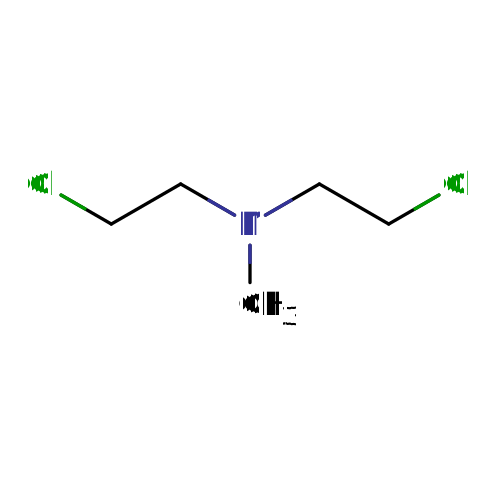
Structure for Mechlorethamine (DB00888)
- Weight
- Average: 156.054
Monoisotopic: 155.026854771 - Chemical Formula
- C5H11Cl2N
- Synonyms
- 2,2'-dichloro-N-methyldiethylamine
- bis(2-chloroethyl)methylamine
- bis(β-chloroethyl)methylamine
- Chlormethine
- Chlormethinum
- Clormetina
- Mechlorethamine
- methylbis(2-chloroethyl)amine
- methylbis(β-chloroethyl)amine
- Mustine
- N-methyl-bis(2-chloroethyl)amine
- N-methyl-bis(β-chloroethyl)amine
- Nitrogen mustard
- β,β'-dichlorodiethyl-N-methylamine
- External IDs
- NSC-128663

Pharmacology
- Indication
For the palliative treatment of Hodgkin's disease (Stages III and IV), lymphosarcoma, chronic myelocytic or chronic lymphocytic leukemia, polycythemia vera, mycosis fungoides, and bronchogenic carcinoma. Also for the palliative treatment of metastatic carcinoma resulting in effusion.
 Reduce drug development failure ratesBuild, train, & validate machine-learning modelswith evidence-based and structured datasets.Build, train, & validate predictive machine-learning models with structured datasets.
- Associated Conditions
Indication Type Indication Combined Product Details Approval Level Age Group Patient Characteristics Dose Form Symptomatic treatment of Bronchogenic carcinoma •••••••••••• Symptomatic treatment of Chronic lymphocytic leukemia •••••••••••• Symptomatic treatment of Hodgkin's disease •••••••••••• Symptomatic treatment of Lymphosarcoma •••••••••••• Symptomatic treatment of Mycosis fungoides •••••••••••• - Contraindications & Blackbox Warnings
 Prevent Adverse Drug Events TodayTap into our Clinical API for life-saving information on contraindications & blackbox warnings, population restrictions, harmful risks, & more.Avoid life-threatening adverse drug events with our Clinical API
- Pharmacodynamics
Mechlorethamine also known as mustine, nitrogen mustard, and HN2, is the prototype anticancer chemotherapeutic drug. Successful clinical use of mechlorethamine gave birth to the field of anticancer chemotherapy. The drug is an analogue of mustard gas and was derived from toxic gas warfare research. Mechlorethamine is a nitrogen mustard alkylating agent. Alkylating agents work by three different mechanisms all of which achieve the same end result - disruption of DNA function and cell death.
- Mechanism of action
Alkylating agents work by three different mechanisms: 1) attachment of alkyl groups to DNA bases, resulting in the DNA being fragmented by repair enzymes in their attempts to replace the alkylated bases, preventing DNA synthesis and RNA transcription from the affected DNA, 2) DNA damage via the formation of cross-links (bonds between atoms in the DNA) which prevents DNA from being separated for synthesis or transcription, and 3) the induction of mispairing of the nucleotides leading to mutations. Mechlorethamine is cell cycle phase-nonspecific.
Target Actions Organism ADNA intercalationHumans - Absorption
Partially absorbed following intracavitary administration, most likely due to rapid deactivation by body fluids. When it is topically administered, systemic exposure was undetectable.
- Volume of distribution
Not Available
- Protein binding
Not Available
- Metabolism
Undergoes rapid chemical transformation and combines with water or reactive compounds of cells, so that the drug is no longer present in active form a few minutes after administration.
- Route of elimination
Not Available
- Half-life
15 minutes
- Clearance
Not Available
- Adverse Effects
 Improve decision support & research outcomesWith structured adverse effects data, including: blackbox warnings, adverse reactions, warning & precautions, & incidence rates. View sample adverse effects data in our new Data Library!Improve decision support & research outcomes with our structured adverse effects data.
- Toxicity
Symptoms of overexposure include severe leukopenia, anemia, thrombocytopenia, and a hemorrhagic diathesis with subsequent delayed bleeding may develop. Death may follow. The most common adverse reactions (≥5%) of the topical formulation are dermatitis, pruritus, bacterial skin infection, skin ulceration or blistering, and hyperpigmentation. The oral LD50 for a rat is 10 mg/kg.
- Pathways
- Not Available
- Pharmacogenomic Effects/ADRs
- Not Available
Interactions
- Drug Interactions
- This information should not be interpreted without the help of a healthcare provider. If you believe you are experiencing an interaction, contact a healthcare provider immediately. The absence of an interaction does not necessarily mean no interactions exist.
Drug Interaction Integrate drug-drug
interactions in your softwareAbatacept The risk or severity of adverse effects can be increased when Mechlorethamine is combined with Abatacept. Abciximab The risk or severity of bleeding can be increased when Abciximab is combined with Mechlorethamine. Acebutolol Mechlorethamine may increase the bradycardic activities of Acebutolol. Acenocoumarol The risk or severity of bleeding can be increased when Acenocoumarol is combined with Mechlorethamine. Acetylcholine The risk or severity of adverse effects can be increased when Mechlorethamine is combined with Acetylcholine. - Food Interactions
- No interactions found.
Products
 Drug product information from 10+ global regionsOur datasets provide approved product information including:dosage, form, labeller, route of administration, and marketing period.Access drug product information from over 10 global regions.
- Product Ingredients
Ingredient UNII CAS InChI Key Mechlorethamine hydrochloride L0MR697HHI 55-86-7 QZIQJVCYUQZDIR-UHFFFAOYSA-N - Brand Name Prescription Products
Name Dosage Strength Route Labeller Marketing Start Marketing End Region Image Ledaga Gel 160 mcg/g Cutaneous Helsinn Birex Pharmaceuticals Ltd. 2020-12-22 Not applicable EU 
Ledaga Gel 160 mcg / g Topical Recordati Rare Diseases Canada Inc 2022-09-14 Not applicable Canada 
Mustargen Powder, for solution 10 mg/10mL Intracavitary; Intravenous RECORDATI RARE DISEASES, INC. 1949-03-15 2019-03-31 US 
Mustargen Powder, for solution 10 mg / vial Intravenous Lundbeck Pharmaceuticals Llc 1951-12-31 2011-11-11 Canada Mustargen Powder, for solution 10 mg/10mL Intracavitary; Intravenous Lundbeck Inc. 1949-03-15 2013-04-15 US
Categories
- ATC Codes
- L01AA05 — Chlormethine
- Drug Categories
- Alkylating Activity
- Alkylating Drugs
- Antineoplastic Agents
- Antineoplastic Agents, Alkylating
- Antineoplastic and Immunomodulating Agents
- Cardiotoxic antineoplastic agents
- Cholinesterase Inhibitors
- Compounds used in a research, industrial, or household setting
- Hydrocarbons, Halogenated
- Immunosuppressive Agents
- Irritants
- Mustard Compounds
- Myelosuppressive Agents
- Narrow Therapeutic Index Drugs
- Nitrogen Mustard Analogues
- Nitrogen Mustard Compounds
- Noxae
- Poisons
- Toxic Actions
- Chemical TaxonomyProvided by Classyfire
- Description
- This compound belongs to the class of organic compounds known as nitrogen mustard compounds. These are compounds having two beta-haloalkyl groups bound to a nitrogen atom.
- Kingdom
- Organic compounds
- Super Class
- Organic nitrogen compounds
- Class
- Organonitrogen compounds
- Sub Class
- Nitrogen mustard compounds
- Direct Parent
- Nitrogen mustard compounds
- Alternative Parents
- Trialkylamines / Organopnictogen compounds / Organochlorides / Hydrocarbon derivatives / Alkyl chlorides
- Substituents
- Aliphatic acyclic compound / Alkyl chloride / Alkyl halide / Amine / Hydrocarbon derivative / Nitrogen mustard / Organochloride / Organohalogen compound / Organopnictogen compound / Tertiary aliphatic amine
- Molecular Framework
- Aliphatic acyclic compounds
- External Descriptors
- organochlorine compound, nitrogen mustard (CHEBI:28925)
- Affected organisms
- Humans and other mammals
Chemical Identifiers
- UNII
- 50D9XSG0VR
- CAS number
- 51-75-2
- InChI Key
- HAWPXGHAZFHHAD-UHFFFAOYSA-N
- InChI
- InChI=1S/C5H11Cl2N/c1-8(4-2-6)5-3-7/h2-5H2,1H3
- IUPAC Name
- bis(2-chloroethyl)(methyl)amine
- SMILES
- CN(CCCl)CCCl
References
- Synthesis Reference
Paul Siedlecki, "Preparation of nitrogen mustard derivatives." U.S. Patent US20030162990, issued August 28, 2003.
US20030162990- General References
- Not Available
- External Links
- Human Metabolome Database
- HMDB0015025
- KEGG Drug
- D07671
- KEGG Compound
- C07115
- PubChem Compound
- 4033
- PubChem Substance
- 46505784
- ChemSpider
- 3893
- BindingDB
- 200297
- 6674
- ChEBI
- 28925
- ChEMBL
- CHEMBL427
- ZINC
- ZINC000002539484
- Therapeutic Targets Database
- DAP000790
- PharmGKB
- PA450336
- RxList
- RxList Drug Page
- Drugs.com
- Drugs.com Drug Page
- Wikipedia
- Chlormethine
- FDA label
- Download (306 KB)
- MSDS
- Download (37.2 KB)
Clinical Trials
- Clinical Trials
Phase Status Purpose Conditions Count 3 Active Not Recruiting Treatment DS Stage I Multiple Myeloma / DS Stage II Multiple Myeloma / DS Stage III Multiple Myeloma / Refractory Multiple Myeloma / Smoldering Multiple Myeloma (SMM) 1 3 Active Not Recruiting Treatment Lymphoma 2 3 Active Not Recruiting Treatment Multiple Myeloma (MM) 1 3 Active Not Recruiting Treatment Recurrent Diffuse Large B-Cell Lymphoma Activated B-Cell Type / Refractory Diffuse Large B-Cell Lymphoma Activated B-Cell Type 1 3 Completed Treatment Localized, resectable Neuroblastoma (NB) / Localized, unresectable Neuroblastoma (NB) / Recurrent Neuroblastoma / Regional Neuroblastoma / Stage 4 Neuroblastoma 1
Pharmacoeconomics
- Manufacturers
- Lundbeck inc
- Packagers
- Lundbeck Inc.
- Merck & Co.
- Dosage Forms
Form Route Strength Gel Cutaneous 160 mcg/g Gel Topical 160 MCG/G Gel Topical 160 mcg / g Powder, for solution Intracavitary; Intravenous 10 mg/10mL Powder, for solution Intravenous 10 mg / vial Gel Topical 0.012 g/60g - Prices
Unit description Cost Unit Mustargen 10 mg vial 178.71USD vial DrugBank does not sell nor buy drugs. Pricing information is supplied for informational purposes only.- Patents
Patent Number Pediatric Extension Approved Expires (estimated) Region US7872050 No 2011-01-18 2029-07-08 US US8501819 No 2013-08-06 2026-03-07 US US8450375 No 2013-05-28 2026-03-07 US US8501818 No 2013-08-06 2026-03-07 US US7838564 No 2010-11-23 2026-03-07 US US9382191 No 2016-07-05 2026-03-07 US
Properties
- State
- Solid
- Experimental Properties
Property Value Source melting point (°C) 108 - 110°C MSDS boiling point (°C) 87°C at 1.80E+01 mm Hg PhysProp water solubility Very soluble FDA label logP 0.91 SELASSIE,CD ET AL. (1990) pKa 6.43 (at 25°C) PERRIN,DD (1965) - Predicted Properties
Property Value Source Water Solubility 33.4 mg/mL ALOGPS logP 1.31 ALOGPS logP 1.52 Chemaxon logS -0.67 ALOGPS pKa (Strongest Basic) 6.08 Chemaxon Physiological Charge 0 Chemaxon Hydrogen Acceptor Count 1 Chemaxon Hydrogen Donor Count 0 Chemaxon Polar Surface Area 3.24 Å2 Chemaxon Rotatable Bond Count 4 Chemaxon Refractivity 38.67 m3·mol-1 Chemaxon Polarizability 15.84 Å3 Chemaxon Number of Rings 0 Chemaxon Bioavailability 1 Chemaxon Rule of Five Yes Chemaxon Ghose Filter No Chemaxon Veber's Rule Yes Chemaxon MDDR-like Rule No Chemaxon - Predicted ADMET Features
Property Value Probability Human Intestinal Absorption + 0.987 Blood Brain Barrier + 0.9735 Caco-2 permeable + 0.754 P-glycoprotein substrate Non-substrate 0.5964 P-glycoprotein inhibitor I Non-inhibitor 0.9388 P-glycoprotein inhibitor II Non-inhibitor 0.8382 Renal organic cation transporter Inhibitor 0.6023 CYP450 2C9 substrate Non-substrate 0.7811 CYP450 2D6 substrate Non-substrate 0.6069 CYP450 3A4 substrate Non-substrate 0.5986 CYP450 1A2 substrate Non-inhibitor 0.6607 CYP450 2C9 inhibitor Non-inhibitor 0.9504 CYP450 2D6 inhibitor Non-inhibitor 0.9153 CYP450 2C19 inhibitor Non-inhibitor 0.8068 CYP450 3A4 inhibitor Non-inhibitor 0.9804 CYP450 inhibitory promiscuity Low CYP Inhibitory Promiscuity 0.9421 Ames test AMES toxic 0.9108 Carcinogenicity Carcinogens 0.6585 Biodegradation Not ready biodegradable 0.9258 Rat acute toxicity 4.1619 LD50, mol/kg Not applicable hERG inhibition (predictor I) Strong inhibitor 0.5662 hERG inhibition (predictor II) Non-inhibitor 0.792
Spectra
- Mass Spec (NIST)
- Download (8.14 KB)
- Spectra
- Chromatographic Properties
Collision Cross Sections (CCS)
Adduct CCS Value (Å2) Source type Source [M-H]- 116.1605817 predictedDarkChem Lite v0.1.0 [M-H]- 129.75183 predictedDeepCCS 1.0 (2019) [M+H]+ 116.6555817 predictedDarkChem Lite v0.1.0 [M+H]+ 132.67055 predictedDeepCCS 1.0 (2019) [M+Na]+ 116.3071817 predictedDarkChem Lite v0.1.0 [M+Na]+ 141.39336 predictedDeepCCS 1.0 (2019)
Targets

References
- Overington JP, Al-Lazikani B, Hopkins AL: How many drug targets are there? Nat Rev Drug Discov. 2006 Dec;5(12):993-6. [Article]
- Imming P, Sinning C, Meyer A: Drugs, their targets and the nature and number of drug targets. Nat Rev Drug Discov. 2006 Oct;5(10):821-34. [Article]
- De Alencar TA, Leitao AC, Lage C: Nitrogen mustard- and half-mustard-induced damage in Escherichia coli requires different DNA repair pathways. Mutat Res. 2005 Apr 4;582(1-2):105-15. [Article]
- Loeber RL, Michaelson-Richie ED, Codreanu SG, Liebler DC, Campbell CR, Tretyakova NY: Proteomic analysis of DNA-protein cross-linking by antitumor nitrogen mustards. Chem Res Toxicol. 2009 Jun;22(6):1151-62. doi: 10.1021/tx900078y. [Article]
Enzymes
- Kind
- Protein
- Organism
- Humans
- Pharmacological action
- No
- Actions
- Inhibitor
- General Function
- Identical protein binding
- Specific Function
- Esterase with broad substrate specificity. Contributes to the inactivation of the neurotransmitter acetylcholine. Can degrade neurotoxic organophosphate esters.
- Gene Name
- BCHE
- Uniprot ID
- P06276
- Uniprot Name
- Cholinesterase
- Molecular Weight
- 68417.575 Da


Drug created at June 13, 2005 13:24 / Updated at April 26, 2024 00:45