Identification
- Summary
Dienestrol is a non steroidal estrogen used to treat atrophic vaginitis and kraurosis vulvae.
- Generic Name
- Dienestrol
- DrugBank Accession Number
- DB00890
- Background
Dienestrol is a synthetic, non-steroidal estrogen. It is an estrogen receptor agonist. Estrogens work partly by increasing a normal clear discharge from the vagina and making the vulva and urethra healthy. Using or applying an estrogen relieves or lessens: dryness and soreness in the vagina, itching, redness, or soreness of the vulva. Conditions that are treated with vaginal estrogens include a genital skin condition (vulvar atrophy), inflammation of the vagina (atrophic vaginitis), and inflammation of the urethra (atrophic urethritis).
- Type
- Small Molecule
- Groups
- Approved, Investigational
- Structure
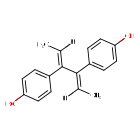
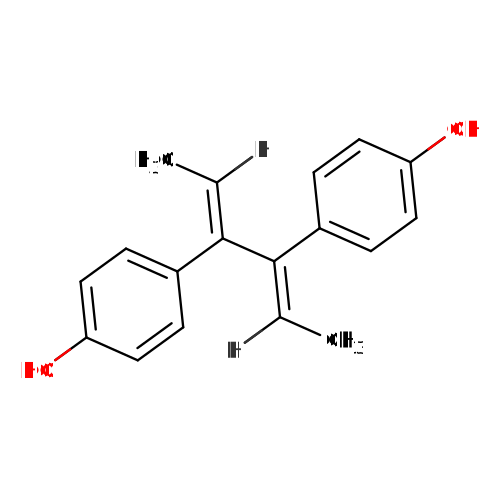
Structure for Dienestrol (DB00890)
- Weight
- Average: 266.34
Monoisotopic: 266.13067982 - Chemical Formula
- C18H18O2
- Synonyms
- 4,4'-Hydroxy-γ,δ-diphenyl-β,δ-hexadiene
- alpha-dienestrol diacetate
- Cycladiene
- Dehydrostilbestrol
- Dienestrol
- Diènestrol
- Dienestrolum
- p,p'-(Diethylideneethylene)diphenol

Pharmacology
- Indication
For use in the treatment of atrophic vaginitis and kraurosis vulvae.
 Reduce drug development failure ratesBuild, train, & validate machine-learning modelswith evidence-based and structured datasets.Build, train, & validate predictive machine-learning models with structured datasets.
- Contraindications & Blackbox Warnings
 Prevent Adverse Drug Events TodayTap into our Clinical API for life-saving information on contraindications & blackbox warnings, population restrictions, harmful risks, & more.Avoid life-threatening adverse drug events with our Clinical API
- Pharmacodynamics
Estrogens diffuse into their target cells and interact with a protein receptor. Target cells include the female reproductive tract, the mammary gland, the hypothalamus, and the pituitary. Estrogens increase the hepatic synthesis of sex hormone binding globulin (SHBG), thyroid-binding globulin (TBG), and other serum proteins and suppress follicle-stimulating hormone (FSH) from the anterior pituitary. The combination of an estrogen with a progestin suppresses the hypothalamic-pituitary system, decreasing the secretion of gonadotropin-releasing hormone (GnRH).
- Mechanism of action
Dienestrol is a synthetic, non-steroidal estrogen. Estrogens passively diffuse into target cells of responsive tissues, complex with the estrogen receptors, and enter the cell's nucleus to initiate or enhance gene transcription of protein synthesis after binding to DNA.
Target Actions Organism AEstrogen receptor alpha agonistHumans USex hormone-binding globulin Not Available Humans - Absorption
Systemic absorption and mode of action of dienestrol are undetermined.Estrogens diffuse into their target cells and interact with a protein receptor. Target cells include the female reproductive tract, the mammary gland, the hypothalamus, and the pituitary. Estrogens increase the hepatic synthesis of sex hormone binding globulin (SHBG), thyroid-binding globulin (TBG), and other serum proteins and suppress follicle-stimulating hormone (FSH) from the anterior pituitary. The combination of an estrogen with a progestin suppresses the hypothalamic-pituitary system, decreasing the secretion of gonadotropin-releasing hormone (GnRH).
- Volume of distribution
Not Available
- Protein binding
50 to 80%
- Metabolism
Hepatic.
- Route of elimination
Not Available
- Half-life
Not Available
- Clearance
Not Available
- Adverse Effects
 Improve decision support & research outcomesWith structured adverse effects data, including: blackbox warnings, adverse reactions, warning & precautions, & incidence rates. View sample adverse effects data in our new Data Library!Improve decision support & research outcomes with our structured adverse effects data.
- Toxicity
Symptoms of overdose include nausea and vomiting, and withdrawal bleeding may occur in females.
- Pathways
- Not Available
- Pharmacogenomic Effects/ADRs
- Not Available
Interactions
- Drug Interactions
- This information should not be interpreted without the help of a healthcare provider. If you believe you are experiencing an interaction, contact a healthcare provider immediately. The absence of an interaction does not necessarily mean no interactions exist.
Drug Interaction Integrate drug-drug
interactions in your softwareAbciximab Dienestrol may increase the thrombogenic activities of Abciximab. Acetohexamide The therapeutic efficacy of Acetohexamide can be decreased when used in combination with Dienestrol. Adalimumab Dienestrol may increase the thrombogenic activities of Adalimumab. Aducanumab Dienestrol may increase the thrombogenic activities of Aducanumab. Alemtuzumab Dienestrol may increase the thrombogenic activities of Alemtuzumab. - Food Interactions
- Not Available
Products
 Drug product information from 10+ global regionsOur datasets provide approved product information including:dosage, form, labeller, route of administration, and marketing period.Access drug product information from over 10 global regions.
- International/Other Brands
- Estraguard / Estroral / Ortho Dienestrol (Ortho-McNeil Pharmaceutical) / Restrol / Retalon / Sexadien (LEO Pharma A/S) / Synestrol
- Brand Name Prescription Products
Name Dosage Strength Route Labeller Marketing Start Marketing End Region Image Ortho Dienestrol Crm Cream .01 % Vaginal Ortho Pharmaceutical, Division Of Janssen Ortho Inc. 1951-12-31 2002-08-02 Canada 
Categories
- ATC Codes
- G03CB01 — Dienestrol
- G03CB — Synthetic estrogens, plain
- G03C — ESTROGENS
- G03 — SEX HORMONES AND MODULATORS OF THE GENITAL SYSTEM
- G — GENITO URINARY SYSTEM AND SEX HORMONES
- Drug Categories
- Benzene Derivatives
- Benzyl Compounds
- Benzylidene Compounds
- Bibenzyls
- Dihydrostilbenoids
- Estrogens
- Estrogens, Non-Steroidal
- Genito Urinary System and Sex Hormones
- Hormones
- Hormones, Hormone Substitutes, and Hormone Antagonists
- Phenols
- Sex Hormones and Modulators of the Genital System
- Stilbenes
- Stilbestrols
- Synthetic Estrogens, Plain
- Classification
- Not classified
- Affected organisms
- Humans and other mammals
Chemical Identifiers
- UNII
- RRW32X4U1F
- CAS number
- 13029-44-2
- InChI Key
- NFDFQCUYFHCNBW-SCGPFSFSSA-N
- InChI
- InChI=1S/C18H18O2/c1-3-17(13-5-9-15(19)10-6-13)18(4-2)14-7-11-16(20)12-8-14/h3-12,19-20H,1-2H3/b17-3+,18-4+
- IUPAC Name
- 4-[(2E,4E)-4-(4-hydroxyphenyl)hexa-2,4-dien-3-yl]phenol
- SMILES
- [H]\C(C)=C(/C(=C(\[H])C)/C1=CC=C(O)C=C1)\C1=CC=C(O)C=C1
References
- Synthesis Reference
Short, W.F. and Hobday, G.1; U.S. Patent 2,464,203; March 15,1949; assigned to Boots Pure Drug Company Limited, England. Adler, E.; U.S. Patent 2,465,505; March 29,1949; assigned to Hoffmann-La Roche Inc.
- General References
- Not Available
- External Links
- KEGG Drug
- D00898
- KEGG Compound
- C08090
- PubChem Compound
- 667476
- PubChem Substance
- 46504661
- ChemSpider
- 580857
- BindingDB
- 40491
- 3368
- ChEBI
- 4518
- ChEMBL
- CHEMBL1018
- ZINC
- ZINC000000001283
- Therapeutic Targets Database
- DAP001015
- PharmGKB
- PA164745534
- RxList
- RxList Drug Page
- Wikipedia
- Dienestrol
- MSDS
- Download (75.7 KB)
Clinical Trials
Pharmacoeconomics
- Manufacturers
- Ortho mcneil pharmaceutical inc
- Sanofi aventis us llc
- Solvay pharmaceuticals
- Packagers
- Spectrum Pharmaceuticals
- Dosage Forms
Form Route Strength Cream Vaginal .01 % - Prices
Unit description Cost Unit Dienestrol powder 442.23USD g DrugBank does not sell nor buy drugs. Pricing information is supplied for informational purposes only.- Patents
- Not Available
Properties
- State
- Solid
- Experimental Properties
Property Value Source melting point (°C) 233-234 Short, W.F. and Hobday, G.1; U.S. Patent 2,464,203; March 15,1949; assigned to Boots Pure Drug Company Limited, England. water solubility 3 mg/L (at 37 °C) YALKOWSKY,SH & DANNENFELSER,RM (1992) logP 5.9 Not Available logS -4.95 ADME Research, USCD - Predicted Properties
Property Value Source Water Solubility 0.0123 mg/mL ALOGPS logP 5.18 ALOGPS logP 4.83 Chemaxon logS -4.3 ALOGPS pKa (Strongest Acidic) 9.1 Chemaxon pKa (Strongest Basic) -6 Chemaxon Physiological Charge 0 Chemaxon Hydrogen Acceptor Count 2 Chemaxon Hydrogen Donor Count 2 Chemaxon Polar Surface Area 40.46 Å2 Chemaxon Rotatable Bond Count 3 Chemaxon Refractivity 84.36 m3·mol-1 Chemaxon Polarizability 30.27 Å3 Chemaxon Number of Rings 2 Chemaxon Bioavailability 1 Chemaxon Rule of Five Yes Chemaxon Ghose Filter Yes Chemaxon Veber's Rule No Chemaxon MDDR-like Rule No Chemaxon - Predicted ADMET Features
Property Value Probability Human Intestinal Absorption + 0.9971 Blood Brain Barrier - 0.7087 Caco-2 permeable + 0.8916 P-glycoprotein substrate Non-substrate 0.5491 P-glycoprotein inhibitor I Non-inhibitor 0.7795 P-glycoprotein inhibitor II Non-inhibitor 0.9557 Renal organic cation transporter Non-inhibitor 0.8322 CYP450 2C9 substrate Non-substrate 0.7849 CYP450 2D6 substrate Non-substrate 0.8857 CYP450 3A4 substrate Non-substrate 0.544 CYP450 1A2 substrate Inhibitor 0.9107 CYP450 2C9 inhibitor Inhibitor 0.8605 CYP450 2D6 inhibitor Non-inhibitor 0.8201 CYP450 2C19 inhibitor Inhibitor 0.8993 CYP450 3A4 inhibitor Inhibitor 0.7959 CYP450 inhibitory promiscuity High CYP Inhibitory Promiscuity 0.8844 Ames test Non AMES toxic 0.9658 Carcinogenicity Non-carcinogens 0.7133 Biodegradation Not ready biodegradable 0.7876 Rat acute toxicity 1.8229 LD50, mol/kg Not applicable hERG inhibition (predictor I) Weak inhibitor 0.7994 hERG inhibition (predictor II) Non-inhibitor 0.8584
Spectra
- Mass Spec (NIST)
- Download (9.48 KB)
- Spectra
Spectrum Spectrum Type Splash Key Predicted MS/MS Spectrum - 10V, Positive (Annotated) Predicted LC-MS/MS splash10-00kr-0910000000-9291c1e2fa636ec8565e Predicted MS/MS Spectrum - 10V, Negative (Annotated) Predicted LC-MS/MS splash10-00kr-0090000000-c670775f754081733d9c Predicted MS/MS Spectrum - 20V, Negative (Annotated) Predicted LC-MS/MS splash10-000i-0090000000-f8c951570ab4a1bc73f8 Predicted MS/MS Spectrum - 20V, Positive (Annotated) Predicted LC-MS/MS splash10-014i-0960000000-20158229372eeffedefd Predicted MS/MS Spectrum - 40V, Negative (Annotated) Predicted LC-MS/MS splash10-014i-1970000000-53e7cdedced591f88be2 Predicted MS/MS Spectrum - 40V, Positive (Annotated) Predicted LC-MS/MS splash10-014r-0930000000-b5b9c6a4b6c6205533e1 Predicted 1H NMR Spectrum 1D NMR Not Applicable Predicted 13C NMR Spectrum 1D NMR Not Applicable - Chromatographic Properties
Collision Cross Sections (CCS)
Adduct CCS Value (Å2) Source type Source [M-H]- 177.0453826 predictedDarkChem Lite v0.1.0 [M-H]- 178.3554 predictedDeepCCS 1.0 (2019) [M+H]+ 177.9022826 predictedDarkChem Lite v0.1.0 [M+H]+ 180.7134 predictedDeepCCS 1.0 (2019) [M+Na]+ 187.51936 predictedDeepCCS 1.0 (2019)
Targets

- Kind
- Protein
- Organism
- Humans
- Pharmacological action
- Yes
- Actions
- Agonist
- General Function
- Zinc ion binding
- Specific Function
- Nuclear hormone receptor. The steroid hormones and their receptors are involved in the regulation of eukaryotic gene expression and affect cellular proliferation and differentiation in target tissu...
- Gene Name
- ESR1
- Uniprot ID
- P03372
- Uniprot Name
- Estrogen receptor
- Molecular Weight
- 66215.45 Da
References
- Juriansz RL, Huseby RA, Wilcox RB: Interactions of putative estrogens with the intracellular receptor complex in mouse Leydig cells: relationship to preneoplastic hyperplasia. Cancer Res. 1988 Jan 1;48(1):14-8. [Article]
- Grove RI, Korach KS: Estrogen stimulation of phosphatidylinositol metabolism in mouse uterine tissue. Endocrinology. 1987 Sep;121(3):1083-8. [Article]
- Kuiper GG, Carlsson B, Grandien K, Enmark E, Haggblad J, Nilsson S, Gustafsson JA: Comparison of the ligand binding specificity and transcript tissue distribution of estrogen receptors alpha and beta. Endocrinology. 1997 Mar;138(3):863-70. [Article]
- Chae K, Lindzey J, McLachlan JA, Korach KS: Estrogen-dependent gene regulation by an oxidative metabolite of diethylstilbestrol, diethylstilbestrol-4',4"-quinone. Steroids. 1998 Mar;63(3):149-57. [Article]
- Bovee TF, Helsdingen RJ, Rietjens IM, Keijer J, Hoogenboom RL: Rapid yeast estrogen bioassays stably expressing human estrogen receptors alpha and beta, and green fluorescent protein: a comparison of different compounds with both receptor types. J Steroid Biochem Mol Biol. 2004 Jul;91(3):99-109. [Article]
- Maru BS, Tobias JH, Rivers C, Caunt CJ, Norman MR, McArdle CA: Potential use of an estrogen-glucocorticoid receptor chimera as a drug screen for tissue selective estrogenic activity. Bone. 2009 Jan;44(1):102-12. doi: 10.1016/j.bone.2008.09.016. Epub 2008 Oct 11. [Article]
- Chen X, Ji ZL, Chen YZ: TTD: Therapeutic Target Database. Nucleic Acids Res. 2002 Jan 1;30(1):412-5. [Article]
- Kind
- Protein
- Organism
- Humans
- Pharmacological action
- Unknown
- General Function
- Androgen binding
- Specific Function
- Functions as an androgen transport protein, but may also be involved in receptor mediated processes. Each dimer binds one molecule of steroid. Specific for 5-alpha-dihydrotestosterone, testosterone...
- Gene Name
- SHBG
- Uniprot ID
- P04278
- Uniprot Name
- Sex hormone-binding globulin
- Molecular Weight
- 43778.755 Da
References
- Hong H, Branham WS, Ng HW, Moland CL, Dial SL, Fang H, Perkins R, Sheehan D, Tong W: Human sex hormone-binding globulin binding affinities of 125 structurally diverse chemicals and comparison with their binding to androgen receptor, estrogen receptor, and alpha-fetoprotein. Toxicol Sci. 2015 Feb;143(2):333-48. doi: 10.1093/toxsci/kfu231. Epub 2014 Oct 27. [Article]


Drug created at June 13, 2005 13:24 / Updated at February 02, 2024 22:45