Identification
- Summary
Levosimendan is a calcium sensitizer indicated to treat acutely decompensated severe chronic heart failure.
- Generic Name
- Levosimendan
- DrugBank Accession Number
- DB00922
- Background
Levosimendan increases calcium sensitivity to myocytes by binding to troponin C in a calcium dependent manner. This increases contractility without raising calcium levels. It also relaxes vascular smooth muscle by opening adenosine triphosphate sensitive potassium channels. Levosimendan is used to manage acutely decompensated congestive heart failure.
- Type
- Small Molecule
- Groups
- Approved, Investigational
- Structure

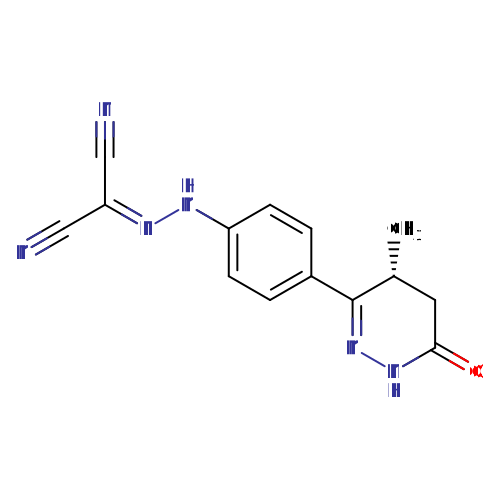
Structure for Levosimendan (DB00922)
- Weight
- Average: 280.2847
Monoisotopic: 280.107259036 - Chemical Formula
- C14H12N6O
- Synonyms
- Levosimendán
- Lévosimendan
- Levosimendan
- Levosimendanum
- External IDs
- OR-1259

Pharmacology
- Indication
For short term treatment of acutely decompensated severe chronic heart failure (CHF). Also being investigated for use/treatment in heart disease.
 Reduce drug development failure ratesBuild, train, & validate machine-learning modelswith evidence-based and structured datasets.Build, train, & validate predictive machine-learning models with structured datasets.
- Associated Conditions
Indication Type Indication Combined Product Details Approval Level Age Group Patient Characteristics Dose Form Treatment of Acute decompensated heart failure •••••••••••• •••••••••••• •••••••• •• ••••• ••••••••• •••••••••• ••••••• ••• •••••••• Treatment of Acute decompensation of chronic heart failure •••••••••••• •••••••••••• •••••••• •• ••••• ••••••• ••••••••• Used in combination for therapy Acute heart failure (ahf) Combination Product in combination with: Ethanol (DB00898), Propylene glycol (DB01839), Phosphoric acid (DB09394) •••••••••••• •••••• ••••••• •••••••••• •••••••• •• •••••••••••• ••••••• •••••••• Used in combination to manage Acute heart failure (ahf) Combination Product in combination with: Phosphoric acid (DB09394), Ethanol (DB00898), Propylene glycol (DB01839) •••••••••••• •••••• ••••••• •••••••• Used in combination to manage Acute heart failure (ahf) Combination Product in combination with: Propylene glycol (DB01839), Ethanol (DB00898), Phosphoric acid (DB09394) •••••••••••• •••••• ••••••• •••••••• - Associated Therapies
- Contraindications & Blackbox Warnings
 Prevent Adverse Drug Events TodayTap into our Clinical API for life-saving information on contraindications & blackbox warnings, population restrictions, harmful risks, & more.Avoid life-threatening adverse drug events with our Clinical API
- Pharmacodynamics
Levosimendan is a new Ca2+-sensitizing inotropic agent. Ca2+ sensitizers represent a new class of inotropic agents, which overcome the disadvantages associated with currently available inotropic agents in as they are not associated with an increased risk of arrhythmias, cell injury and death due to Ca2+ overload in myocardial cells; they do not increase the activation energy; and they have the potential to reverse contractile dysfunction under pathophysiologic conditions, such as acidosis or myocardial stunning. Levosimendan has not been approved for use in the U.S. or Canada.
- Mechanism of action
Levosimendan appears to increase myofilament calcium sensitivity by binding to cardiac troponin C in a calcium-dependent manner. This stabilizes the calcium-induced conformational change of troponin C, thereby (1) changing actin-myosin cross-bridge kinetics apparently without increasing the cycling rate of the cross-bridges or myocardial ATP consumption, (2) increasing the effects of calcium on cardiac myofilaments during systole and (3) improving contraction at low energy cost (inotropic effect). Calcium concentration and, therefore, sensitization decline during diastole, allowing normal or improved diastolic relaxation. Levosimendan also leads to vasodilation through the opening of ATP-sensitive potassium channels. By these inotropic and vasodilatory actions, levosimendan increases cardiac output without increasing myocardial oxygen demand. Levosimendan also has a selective phosphodiesterase (PDE)-III inhibitory action that may contribute to the inotropic effect of this compound under certain experimental conditions. It has been reported that levosimendan may act preferentially as a Ca2+ sensitizer at lower concentrations, whereas at higher concentrations its action as a PDE-III inhibitor becomes more prominent in experimental animals and humans.
Target Actions Organism ATroponin C, slow skeletal and cardiac muscles potentiatorHumans AATP-sensitive inward rectifier potassium channel 11 inducerHumans AATP-sensitive inward rectifier potassium channel 8 inducerHumans UcGMP-inhibited 3',5'-cyclic phosphodiesterase A inhibitorHumans - Absorption
The bioavailability of oral levosimendan is 85 ± 6% in healthy volunteers and 84 ± 4% in patients.
- Volume of distribution
Not Available
- Protein binding
98% bound to plasma protein.
- Metabolism
Complete metabolism, with some active metabolites (OR-1855 and OR-1896) possibly extending the drug's haemodynamic effects.
Hover over products below to view reaction partners
- Route of elimination
Not Available
- Half-life
Eliminination half-life is approximately 1 hour.
- Clearance
Not Available
- Adverse Effects
 Improve decision support & research outcomesWith structured adverse effects data, including: blackbox warnings, adverse reactions, warning & precautions, & incidence rates. View sample adverse effects data in our new Data Library!Improve decision support & research outcomes with our structured adverse effects data.
- Toxicity
Not Available
- Pathways
- Not Available
- Pharmacogenomic Effects/ADRs
- Not Available
Interactions
- Drug Interactions
- This information should not be interpreted without the help of a healthcare provider. If you believe you are experiencing an interaction, contact a healthcare provider immediately. The absence of an interaction does not necessarily mean no interactions exist.
Drug Interaction Integrate drug-drug
interactions in your softwareAbaloparatide The risk or severity of adverse effects can be increased when Levosimendan is combined with Abaloparatide. Acebutolol Levosimendan may increase the arrhythmogenic activities of Acebutolol. Acetyldigitoxin Acetyldigitoxin may increase the arrhythmogenic activities of Levosimendan. Acrivastine The risk or severity of QTc prolongation can be increased when Acrivastine is combined with Levosimendan. Adenosine Adenosine may increase the arrhythmogenic activities of Levosimendan. - Food Interactions
- Not Available
Products
 Drug product information from 10+ global regionsOur datasets provide approved product information including:dosage, form, labeller, route of administration, and marketing period.Access drug product information from over 10 global regions.
- International/Other Brands
- Simdax / Simendan
- Unapproved/Other Products
Name Ingredients Dosage Route Labeller Marketing Start Marketing End Region Image SIMDAX 2.5 MG/ML KONSANTRE INF.COZ.5 ML X FLAKON, 1 ADET Levosimendan (2.5 mg/ml) Injection DAİİCHİ SANKYO İLAÇ TİC. LTD. ŞTİ. 2013-01-29 2023-06-14 Turkey 
Categories
- ATC Codes
- C01CX08 — Levosimendan
- Drug Categories
- Antiarrhythmic agents
- Cardiac Stimulants Excl. Cardiac Glycosides
- Cardiac Therapy
- Cardiotonic Agents
- Cardiovascular Agents
- Compounds used in a research, industrial, or household setting
- Enzyme Inhibitors
- Hydrazines
- Hydrazones
- Hypotensive Agents
- Moderate Risk QTc-Prolonging Agents
- Phosphodiesterase 3 Inhibitors
- Phosphodiesterase Inhibitors
- Protective Agents
- Pyridazines
- QTc Prolonging Agents
- Vasodilating Agents
- Chemical TaxonomyProvided by Classyfire
- Description
- This compound belongs to the class of organic compounds known as phenylhydrazines. These are compounds containing a phenylhydrazide moiety, which consists of a hydrazide substituent attached to a phenyl group.
- Kingdom
- Organic compounds
- Super Class
- Benzenoids
- Class
- Benzene and substituted derivatives
- Sub Class
- Phenylhydrazines
- Direct Parent
- Phenylhydrazines
- Alternative Parents
- Pyridazinones / Nitriles / Hydrazones / Carboxylic acids and derivatives / Azacyclic compounds / Organopnictogen compounds / Organic oxides / Hydrocarbon derivatives / Carbonyl compounds
- Substituents
- Aromatic heteromonocyclic compound / Azacycle / Carbonitrile / Carbonyl group / Carboxylic acid derivative / Hydrazone / Hydrocarbon derivative / Nitrile / Organic nitrogen compound / Organic oxide
- Molecular Framework
- Aromatic heteromonocyclic compounds
- External Descriptors
- nitrile, pyridazinone, hydrazone (CHEBI:50567)
- Affected organisms
- Humans and other mammals
Chemical Identifiers
- UNII
- C6T4514L4E
- CAS number
- 141505-33-1
- InChI Key
- WHXMKTBCFHIYNQ-SECBINFHSA-N
- InChI
- InChI=1S/C14H12N6O/c1-9-6-13(21)19-20-14(9)10-2-4-11(5-3-10)17-18-12(7-15)8-16/h2-5,9,17H,6H2,1H3,(H,19,21)/t9-/m1/s1
- IUPAC Name
- 1-cyano-N-{4-[(4R)-4-methyl-6-oxo-1,4,5,6-tetrahydropyridazin-3-yl]phenyl}methanecarbohydrazonoyl cyanide
- SMILES
- C[C@@H]1CC(=O)NN=C1C1=CC=C(NN=C(C#N)C#N)C=C1
References
- Synthesis Reference
Dharmaraj Ramachandra Rao, Rajendra Narayanrao Kankan, Manjinder Singh Phull, Ashwini Amol Sawant, "Process for Preparing Levosimendan and Intermediates for Use in the Process." U.S. Patent US20120165524, issued June 28, 2012.
US20120165524- General References
- Mebazaa A, Nieminen MS, Packer M, Cohen-Solal A, Kleber FX, Pocock SJ, Thakkar R, Padley RJ, Poder P, Kivikko M: Levosimendan vs dobutamine for patients with acute decompensated heart failure: the SURVIVE Randomized Trial. JAMA. 2007 May 2;297(17):1883-91. [Article]
- Kasikcioglu HA, Cam N: A review of levosimendan in the treatment of heart failure. Vasc Health Risk Manag. 2006;2(4):389-400. [Article]
- External Links
- Human Metabolome Database
- HMDB0015058
- KEGG Drug
- D04720
- PubChem Compound
- 3033825
- PubChem Substance
- 46507149
- ChemSpider
- 2298414
- BindingDB
- 50469700
- 73107
- ChEBI
- 50567
- ChEMBL
- CHEMBL2051955
- ZINC
- ZINC000003915645
- Therapeutic Targets Database
- DAP000797
- PharmGKB
- PA164749138
- Wikipedia
- Levosimendan
- MSDS
- Download (57.1 KB)
Clinical Trials
- Clinical Trials
Phase Status Purpose Conditions Count 4 Completed Other Coarctation of the Aorta 1 4 Completed Prevention Mitral Valve Stenosis With Incompetence or Regurgitation 1 4 Completed Prevention Surgery, Cardiac 1 4 Completed Treatment Acute Kidney Injury (AKI) / Renal Insufficiency, Acute 1 4 Completed Treatment Cardiopulmonary Bypass Graft 1
Pharmacoeconomics
- Manufacturers
- Not Available
- Packagers
- Not Available
- Dosage Forms
Form Route Strength Injection, solution, concentrate Intravenous Solution Intravenous 1250000 mg Injection, powder, lyophilized, for solution Intravenous 12.5 mg Solution Intravenous Solution Intravenous 12.5 mg Injection, solution, concentrate Intravenous 2.5 MG/ML Injection, powder, for solution Parenteral 12.5 mg Injection, powder, for solution Intravenous 12.5 mg Injection, powder, for solution Injection Injection 2.5 MG/ML Solution Intravenous 12.500 mg Solution Intravenous 2.5 mg/1ml Injection, solution Intravenous 12.5 mg/5ml Solution Intravenous 25.000 mg - Prices
- Not Available
- Patents
- Not Available
Properties
- State
- Solid
- Experimental Properties
- Not Available
- Predicted Properties
Property Value Source Water Solubility 0.0881 mg/mL ALOGPS logP 2.69 ALOGPS logP 2.16 Chemaxon logS -3.5 ALOGPS pKa (Strongest Acidic) 5.77 Chemaxon pKa (Strongest Basic) 2.24 Chemaxon Physiological Charge -1 Chemaxon Hydrogen Acceptor Count 6 Chemaxon Hydrogen Donor Count 2 Chemaxon Polar Surface Area 113.43 Å2 Chemaxon Rotatable Bond Count 3 Chemaxon Refractivity 77.63 m3·mol-1 Chemaxon Polarizability 28.67 Å3 Chemaxon Number of Rings 2 Chemaxon Bioavailability 1 Chemaxon Rule of Five Yes Chemaxon Ghose Filter Yes Chemaxon Veber's Rule No Chemaxon MDDR-like Rule No Chemaxon - Predicted ADMET Features
Property Value Probability Human Intestinal Absorption + 0.9764 Blood Brain Barrier + 0.9248 Caco-2 permeable + 0.5602 P-glycoprotein substrate Non-substrate 0.5083 P-glycoprotein inhibitor I Non-inhibitor 0.5867 P-glycoprotein inhibitor II Non-inhibitor 0.9615 Renal organic cation transporter Non-inhibitor 0.8403 CYP450 2C9 substrate Non-substrate 0.7037 CYP450 2D6 substrate Non-substrate 0.8349 CYP450 3A4 substrate Substrate 0.6149 CYP450 1A2 substrate Inhibitor 0.8301 CYP450 2C9 inhibitor Non-inhibitor 0.7083 CYP450 2D6 inhibitor Non-inhibitor 0.8979 CYP450 2C19 inhibitor Non-inhibitor 0.5965 CYP450 3A4 inhibitor Non-inhibitor 0.8412 CYP450 inhibitory promiscuity High CYP Inhibitory Promiscuity 0.5918 Ames test Non AMES toxic 0.6333 Carcinogenicity Non-carcinogens 0.6764 Biodegradation Not ready biodegradable 1.0 Rat acute toxicity 2.6188 LD50, mol/kg Not applicable hERG inhibition (predictor I) Weak inhibitor 0.9745 hERG inhibition (predictor II) Non-inhibitor 0.854
Spectra
- Mass Spec (NIST)
- Not Available
- Spectra
- Chromatographic Properties
Collision Cross Sections (CCS)
Adduct CCS Value (Å2) Source type Source [M-H]- 178.6467591 predictedDarkChem Lite v0.1.0 [M-H]- 177.1481591 predictedDarkChem Lite v0.1.0 [M-H]- 158.83267 predictedDeepCCS 1.0 (2019) [M+H]+ 177.4549591 predictedDarkChem Lite v0.1.0 [M+H]+ 177.0351591 predictedDarkChem Lite v0.1.0 [M+H]+ 161.19066 predictedDeepCCS 1.0 (2019) [M+Na]+ 178.2941591 predictedDarkChem Lite v0.1.0 [M+Na]+ 168.00545 predictedDeepCCS 1.0 (2019)
Targets

- Kind
- Protein
- Organism
- Humans
- Pharmacological action
- Yes
- Actions
- Potentiator
- General Function
- Troponin t binding
- Specific Function
- Troponin is the central regulatory protein of striated muscle contraction. Tn consists of three components: Tn-I which is the inhibitor of actomyosin ATPase, Tn-T which contains the binding site fo...
- Gene Name
- TNNC1
- Uniprot ID
- P63316
- Uniprot Name
- Troponin C, slow skeletal and cardiac muscles
- Molecular Weight
- 18402.36 Da
References
- Kleerekoper Q, Putkey JA: Drug binding to cardiac troponin C. J Biol Chem. 1999 Aug 20;274(34):23932-9. [Article]
- Levijoki J, Pollesello P, Kaivola J, Tilgmann C, Sorsa T, Annila A, Kilpelainen I, Haikala H: Further evidence for the cardiac troponin C mediated calcium sensitization by levosimendan: structure-response and binding analysis with analogs of levosimendan. J Mol Cell Cardiol. 2000 Mar;32(3):479-91. [Article]
- Sorsa T, Heikkinen S, Abbott MB, Abusamhadneh E, Laakso T, Tilgmann C, Serimaa R, Annila A, Rosevear PR, Drakenberg T, Pollesello P, Kilpelainen I: Binding of levosimendan, a calcium sensitizer, to cardiac troponin C. J Biol Chem. 2001 Mar 23;276(12):9337-43. Epub 2000 Dec 11. [Article]
- Sorsa T, Pollesello P, Permi P, Drakenberg T, Kilpelainen I: Interaction of levosimendan with cardiac troponin C in the presence of cardiac troponin I peptides. J Mol Cell Cardiol. 2003 Sep;35(9):1055-61. [Article]
- Lehmann A, Boldt J, Lang J, Isgro F, Blome M: [Is levosimendan an inoprotective drug in patients with acute coronary syndrome undergoing surgical revascularization?]. Anasthesiol Intensivmed Notfallmed Schmerzther. 2003 Sep;38(9):577-82. [Article]
- Chen X, Ji ZL, Chen YZ: TTD: Therapeutic Target Database. Nucleic Acids Res. 2002 Jan 1;30(1):412-5. [Article]
- Kind
- Protein
- Organism
- Humans
- Pharmacological action
- Yes
- Actions
- Inducer
- General Function
- Voltage-gated potassium channel activity
- Specific Function
- This receptor is controlled by G proteins. Inward rectifier potassium channels are characterized by a greater tendency to allow potassium to flow into the cell rather than out of it. Their voltage ...
- Gene Name
- KCNJ11
- Uniprot ID
- Q14654
- Uniprot Name
- ATP-sensitive inward rectifier potassium channel 11
- Molecular Weight
- 43540.375 Da
References
- Yildiz O: Vasodilating mechanisms of levosimendan: involvement of K+ channels. J Pharmacol Sci. 2007 May;104(1):1-5. Epub 2007 Apr 24. [Article]
- Kind
- Protein
- Organism
- Humans
- Pharmacological action
- Yes
- Actions
- Inducer
- General Function
- Inward rectifier potassium channel activity
- Specific Function
- This potassium channel is controlled by G proteins. Inward rectifier potassium channels are characterized by a greater tendency to allow potassium to flow into the cell rather than out of it. Their...
- Gene Name
- KCNJ8
- Uniprot ID
- Q15842
- Uniprot Name
- ATP-sensitive inward rectifier potassium channel 8
- Molecular Weight
- 47967.455 Da
References
- Yildiz O: Vasodilating mechanisms of levosimendan: involvement of K+ channels. J Pharmacol Sci. 2007 May;104(1):1-5. Epub 2007 Apr 24. [Article]
- Kind
- Protein
- Organism
- Humans
- Pharmacological action
- Unknown
- Actions
- Inhibitor
- General Function
- Metal ion binding
- Specific Function
- Cyclic nucleotide phosphodiesterase with a dual-specificity for the second messengers cAMP and cGMP, which are key regulators of many important physiological processes.
- Gene Name
- PDE3A
- Uniprot ID
- Q14432
- Uniprot Name
- cGMP-inhibited 3',5'-cyclic phosphodiesterase A
- Molecular Weight
- 124978.06 Da
References
- Szilagyi S, Pollesello P, Levijoki J, Haikala H, Bak I, Tosaki A, Borbely A, Edes I, Papp Z: Two inotropes with different mechanisms of action: contractile, PDE-inhibitory and direct myofibrillar effects of levosimendan and enoximone. J Cardiovasc Pharmacol. 2005 Sep;46(3):369-76. [Article]

Drug created at June 13, 2005 13:24 / Updated at February 02, 2024 22:46