Identification
- Summary
Edetic acid is a chelating agent used to treat mercury and lead toxicity and some blood transfusion dependent anemias.
- Generic Name
- Edetic acid
- DrugBank Accession Number
- DB00974
- Background
A chelating agent (chelating agents) that sequesters a variety of polyvalent cations. It is used in pharmaceutical manufacturing and as a food additive.
- Type
- Small Molecule
- Groups
- Approved, Vet approved
- Structure
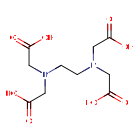
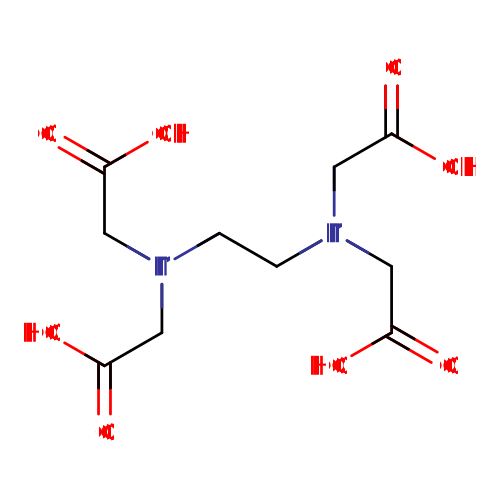
Structure for Edetic acid (DB00974)
- Weight
- Average: 292.2426
Monoisotopic: 292.090665498 - Chemical Formula
- C10H16N2O8
- Synonyms
- (ethylenedinitrilo)tetraacetic acid, ion(4−)
- {[-(bis-carboxymethyl-amino)-ethyl]-carboxymethyl-amino}-acetic acid
- 2,2',2'',2'''-(ethane-1,2-diyldinitrilo)tetraacetate
- Acide edetique
- Acide ethylenediaminetetracetique
- Acido edetico
- Acidum edeticum
- Edetic acid
- EDTA
- EDTA, ion(4-)
- Ethylenediaminetetraacetate
- Ethylenediaminetetraacetic acid
- N,N'-1,2-Ethane diylbis-(N-(carboxymethyl)glycine)

Pharmacology
- Indication
For the reduction of blood levels and depot stores of lead in lead poisoning (acute and chronic) and lead encephalopathy, in both pediatric populations and adults.
 Reduce drug development failure ratesBuild, train, & validate machine-learning modelswith evidence-based and structured datasets.Build, train, & validate predictive machine-learning models with structured datasets.
- Associated Conditions
Indication Type Indication Combined Product Details Approval Level Age Group Patient Characteristics Dose Form Treatment of Lead poisoning •••••••••••• Treatment of Lead encephalopathy •••••••••••• - Contraindications & Blackbox Warnings
 Prevent Adverse Drug Events TodayTap into our Clinical API for life-saving information on contraindications & blackbox warnings, population restrictions, harmful risks, & more.Avoid life-threatening adverse drug events with our Clinical API
- Pharmacodynamics
Edetate calcium is a heavy metal chelating agent. The calcium in edetate calcium can be displaced by divalent or trivalent metals to form a stable water soluble complex that can be excreted in the urine. In theory, 1 g of edetate calcium can theoretically bind 620 mg of lead, but in reality only about 5 mg per gram is actually excreted into the urine in lead poisoned patients. In addition to chelating lead, edetate calcium also chelates and eliminates zinc from the body. Edetate calcium also binds cadmium, copper, iron and manganese, but to a much lesser extent than either lead or zinc. Edetate calcium is relatively ineffective for use in treating mercury, gold or arsenic poisoning.
- Mechanism of action
The pharmacologic effects of edetate calcium disodium are due to the formation of chelates with divalent and trivalent metals. A stable chelate will form with any metal that has the ability to displace calcium from the molecule, a feature shared by lead, zinc, cadmium, manganese, iron and mercury. The amounts of manganese and iron metabolized are not significant. Copper is not mobilized and mercury is unavailable for chelation because it is too tightly bound to body ligands or it is stored in inaccessible body compartments. The excretion of calcium by the body is not increased following intravenous administration of edetate calcium disodium, but the excretion of zinc is considerably increased.
Target Actions Organism ALead chelatorHumans UIron chelatorHumans UManganese cation chelatorHumans - Absorption
Poorly absorbed from the gastrointestinal tract. Well absorbed following intramuscular injection.
- Volume of distribution
Not Available
- Protein binding
Not Available
- Metabolism
Almost none of the compound is metabolized.
- Route of elimination
It is excreted primarily by the kidney, with about 50% excreted in one hour and over 95% within 24 hours.2 Almost none of the compound is metabolized.
- Half-life
The half life of edetate calcium disodium is 20 to 60 minutes.
- Clearance
Not Available
- Adverse Effects
 Improve decision support & research outcomesWith structured adverse effects data, including: blackbox warnings, adverse reactions, warning & precautions, & incidence rates. View sample adverse effects data in our new Data Library!Improve decision support & research outcomes with our structured adverse effects data.
- Toxicity
Inadvertent administration of 5 times the recommended dose, infused intravenously over a 24 hour period, to an asymptomatic 16 month old patient with a blood lead content of 56 mcg/dl did not cause any ill effects. Edetate calcium disodium can aggravate the symptoms of severe lead poisoning, therefore, most toxic effects (cerebral edema, renal tubular necrosis) appear to be associated with lead poisoning. Because of cerebral edema, a therapeutic dose may be lethal to an adult or a pediatric patient with lead encephalopathy. Higher dosage of edetate calcium disodium may produce a more severe zinc deficiency.
- Pathways
- Not Available
- Pharmacogenomic Effects/ADRs
- Not Available
Interactions
- Drug Interactions
- This information should not be interpreted without the help of a healthcare provider. If you believe you are experiencing an interaction, contact a healthcare provider immediately. The absence of an interaction does not necessarily mean no interactions exist.
Drug Interaction Integrate drug-drug
interactions in your softwareAbciximab The risk or severity of bleeding can be increased when Abciximab is combined with Edetic acid. Aceclofenac The risk or severity of bleeding and hemorrhage can be increased when Aceclofenac is combined with Edetic acid. Acemetacin The risk or severity of bleeding and hemorrhage can be increased when Edetic acid is combined with Acemetacin. Acenocoumarol The risk or severity of bleeding can be increased when Edetic acid is combined with Acenocoumarol. Acetylsalicylic acid Acetylsalicylic acid may increase the anticoagulant activities of Edetic acid. - Food Interactions
- Avoid herbs and supplements with anticoagulant/antiplatelet activity. Examples include garlic, ginger, bilberry, danshen, piracetam, and ginkgo biloba.
Products
 Drug product information from 10+ global regionsOur datasets provide approved product information including:dosage, form, labeller, route of administration, and marketing period.Access drug product information from over 10 global regions.
- International/Other Brands
- Cheladrate (Pharmex) / Diso-Tate (O'Neal, Jones) / Endrate (Bersworth) / Uni Wash (United)
- Mixture Products
Name Ingredients Dosage Route Labeller Marketing Start Marketing End Region Image DETTOL ANTISEPTIC CREAM Edetic acid (0.2 G/100G) + Chloroxylenol (0.3 G/100G) + Triclosan (0.3 G/100G) Cream บริษัท เรกคิทท์ เบนคีเซอร์ (ประเทศไทย) จำกัด 2012-04-22 Not applicable Thailand 
Dettol Moisturising Formula Antiseptic Cream Edetic acid (0.2 %w/w) + Chloroxylenol (0.3 %w/w) + Triclosan (0.3 %w/w) Cream Topical RB (HEALTH) MALAYSIA SDN BHD 2020-09-08 2020-12-18 Malaysia 
Foam Care Pcmx Surgical Hand Scrub Edetic acid (.2 %) + Chloroxylenol (1.5 %) Liquid Topical Ballard Medical Products 1990-12-31 2008-09-17 Canada 
YIGANERJING SuifurSoap Edetic acid (0.0672 g/84g) + Octasulfur (0.84 g/84g) + Titanium dioxide (0.168 g/84g) Soap Topical TAIZHOU YOUPENG IMPORT AND EXPORT TRADING CO.,LTD. 2020-06-22 Not applicable US 
- Unapproved/Other Products
Name Ingredients Dosage Route Labeller Marketing Start Marketing End Region Image YIGANERJING SuifurSoap Edetic acid (0.0672 g/84g) + Octasulfur (0.84 g/84g) + Titanium dioxide (0.168 g/84g) Soap Topical TAIZHOU YOUPENG IMPORT AND EXPORT TRADING CO.,LTD. 2020-06-22 Not applicable US
Categories
- Drug Categories
- Acetates
- Acids, Acyclic
- Amines
- Anticoagulants
- Calcium Chelating Activity
- Calcium Chelating Agents
- Chelating Agents
- Compounds used in a research, industrial, or household setting
- Decreased Coagulation Factor Activity
- Diamines
- Diet, Food, and Nutrition
- Ethylenediamines
- Food
- Food Additives
- Food Ingredients
- Heavy Metal Antagonists
- Hematologic Agents
- Lead Chelating Activity
- Lead Chelator
- Physiological Phenomena
- Polyamines
- Sequestering Agents
- Chemical TaxonomyProvided by Classyfire
- Description
- This compound belongs to the class of organic compounds known as tetracarboxylic acids and derivatives. These are carboxylic acids containing exactly four carboxyl groups.
- Kingdom
- Organic compounds
- Super Class
- Organic acids and derivatives
- Class
- Carboxylic acids and derivatives
- Sub Class
- Tetracarboxylic acids and derivatives
- Direct Parent
- Tetracarboxylic acids and derivatives
- Alternative Parents
- Alpha amino acids / Trialkylamines / Amino acids / Carboxylic acids / Organopnictogen compounds / Organic oxides / Hydrocarbon derivatives / Carbonyl compounds
- Substituents
- Aliphatic acyclic compound / Alpha-amino acid / Alpha-amino acid or derivatives / Amine / Amino acid / Amino acid or derivatives / Carbonyl group / Carboxylic acid / Hydrocarbon derivative / Organic nitrogen compound
- Molecular Framework
- Aliphatic acyclic compounds
- External Descriptors
- ethylenediamine derivative, polyamino carboxylic acid, tetracarboxylic acid (CHEBI:42191)
- Affected organisms
- Humans and other mammals
Chemical Identifiers
- UNII
- 9G34HU7RV0
- CAS number
- 60-00-4
- InChI Key
- KCXVZYZYPLLWCC-UHFFFAOYSA-N
- InChI
- InChI=1S/C10H16N2O8/c13-7(14)3-11(4-8(15)16)1-2-12(5-9(17)18)6-10(19)20/h1-6H2,(H,13,14)(H,15,16)(H,17,18)(H,19,20)
- IUPAC Name
- 2-({2-[bis(carboxymethyl)amino]ethyl}(carboxymethyl)amino)acetic acid
- SMILES
- OC(=O)CN(CCN(CC(O)=O)CC(O)=O)CC(O)=O
References
- Synthesis Reference
Bersworth, F.C.; U.S. Patent 2,407,645; September 17,1946; assigned to The Martin Dennis Co.
- General References
- Not Available
- External Links
- Human Metabolome Database
- HMDB0015109
- KEGG Drug
- D00052
- KEGG Compound
- C00284
- PubChem Compound
- 6049
- PubChem Substance
- 46508301
- ChemSpider
- 5826
- BindingDB
- 50330325
- 1370600
- ChEBI
- 4735
- ChEMBL
- CHEMBL858
- ZINC
- ZINC000019364242
- Therapeutic Targets Database
- DNC000594
- PharmGKB
- PA449439
- PDBe Ligand
- EDT
- RxList
- RxList Drug Page
- Wikipedia
- Ethylenediaminetetraacetic_acid
- PDB Entries
- 1nnf / 1zlq / 2axn / 3rnj / 3t8n / 3wfa / 4oes / 5dsg / 5fx3 / 5jhd … show 18 more
Clinical Trials
- Clinical Trials
Pharmacoeconomics
- Manufacturers
- Graceway pharmaceuticals llc
- Watson laboratories inc
- 3m pharmaceuticals inc
- Packagers
- Bioniche Pharma
- Graceway Pharmaceuticals
- Hospira Inc.
- Merit Pharmaceuticals
- North America Genescience LLC
- Septodont Inc.
- Torrance Co.
- V Sab Medical Labs Inc.
- Dosage Forms
Form Route Strength Cream Cream Topical Liquid Topical Solution, concentrate 1 G/10ML Solution, concentrate Injection, solution, concentrate Intravenous Soap Topical - Prices
Unit description Cost Unit Endrate 150 mg/ml ampul 1.44USD ml DrugBank does not sell nor buy drugs. Pricing information is supplied for informational purposes only.- Patents
- Not Available
Properties
- State
- Solid
- Experimental Properties
Property Value Source melting point (°C) 237 °C Not Available water solubility 1000000 mg/L at 25 °C MEYLAN,WM et al. (1996) logP -2.6 Not Available - Predicted Properties
Property Value Source Water Solubility 9.26 mg/mL ALOGPS logP -1.2 ALOGPS logP -4.9 Chemaxon logS -1.5 ALOGPS pKa (Strongest Acidic) 2.35 Chemaxon pKa (Strongest Basic) 7.73 Chemaxon Physiological Charge -3 Chemaxon Hydrogen Acceptor Count 10 Chemaxon Hydrogen Donor Count 4 Chemaxon Polar Surface Area 155.68 Å2 Chemaxon Rotatable Bond Count 11 Chemaxon Refractivity 62.35 m3·mol-1 Chemaxon Polarizability 25.64 Å3 Chemaxon Number of Rings 0 Chemaxon Bioavailability 1 Chemaxon Rule of Five Yes Chemaxon Ghose Filter No Chemaxon Veber's Rule No Chemaxon MDDR-like Rule No Chemaxon - Predicted ADMET Features
Property Value Probability Human Intestinal Absorption - 0.8668 Blood Brain Barrier - 0.7126 Caco-2 permeable - 0.5739 P-glycoprotein substrate Substrate 0.6377 P-glycoprotein inhibitor I Non-inhibitor 0.9296 P-glycoprotein inhibitor II Non-inhibitor 0.972 Renal organic cation transporter Non-inhibitor 0.8473 CYP450 2C9 substrate Non-substrate 0.8457 CYP450 2D6 substrate Non-substrate 0.8271 CYP450 3A4 substrate Non-substrate 0.7616 CYP450 1A2 substrate Non-inhibitor 0.8959 CYP450 2C9 inhibitor Non-inhibitor 0.9225 CYP450 2D6 inhibitor Non-inhibitor 0.9306 CYP450 2C19 inhibitor Non-inhibitor 0.9174 CYP450 3A4 inhibitor Non-inhibitor 0.9288 CYP450 inhibitory promiscuity Low CYP Inhibitory Promiscuity 0.9891 Ames test Non AMES toxic 0.9132 Carcinogenicity Non-carcinogens 0.7715 Biodegradation Not ready biodegradable 0.8307 Rat acute toxicity 1.8974 LD50, mol/kg Not applicable hERG inhibition (predictor I) Weak inhibitor 0.8158 hERG inhibition (predictor II) Non-inhibitor 0.9341
Spectra
- Mass Spec (NIST)
- Download (10.2 KB)
- Spectra
- Chromatographic Properties
Collision Cross Sections (CCS)
Adduct CCS Value (Å2) Source type Source [M-H]- 170.7798687 predictedDarkChem Lite v0.1.0 [M-H]- 153.3975446 predictedDarkChem Standard v0.1.0 [M-H]- 162.24638 predictedDeepCCS 1.0 (2019) [M+H]+ 167.9805687 predictedDarkChem Lite v0.1.0 [M+H]+ 159.4417095 predictedDarkChem Standard v0.1.0 [M+H]+ 164.6044 predictedDeepCCS 1.0 (2019) [M+Na]+ 170.4443687 predictedDarkChem Lite v0.1.0 [M+Na]+ 170.0243687 predictedDarkChem Lite v0.1.0 [M+Na]+ 170.69754 predictedDeepCCS 1.0 (2019)
Targets

References
- Onnby L, Giorgi C, Plieva FM, Mattiasson B: Removal of heavy metals from water effluents using supermacroporous metal chelating cryogels. Biotechnol Prog. 2010 Sep-Oct;26(5):1295-302. doi: 10.1002/btpr.422. [Article]
- Chakraborty N, Banerjee A, Pal R: Accumulation of lead by free and immobilized cyanobacteria with special reference to accumulation factor and recovery. Bioresour Technol. 2011 Mar;102(5):4191-5. doi: 10.1016/j.biortech.2010.12.028. Epub 2010 Dec 13. [Article]
- Tian SK, Lu LL, Yang XE, Huang HG, Brown P, Labavitch J, Liao HB, He ZL: The impact of EDTA on lead distribution and speciation in the accumulator Sedum alfredii by synchrotron X-ray investigation. Environ Pollut. 2011 Mar;159(3):782-8. doi: 10.1016/j.envpol.2010.11.020. Epub 2010 Dec 18. [Article]
References
- Hasegawa H, Rahman IM, Kinoshita S, Maki T, Furusho Y: Separation of dissolved iron from the aqueous system with excess ligand. Chemosphere. 2011 Feb;82(8):1161-7. doi: 10.1016/j.chemosphere.2010.12.048. Epub 2011 Jan 3. [Article]
References
- Broncel M, Wagner SC, Paul K, Hackenberger CP, Koksch B: Towards understanding secondary structure transitions: phosphorylation and metal coordination in model peptides. Org Biomol Chem. 2010 Jun 7;8(11):2575-9. doi: 10.1039/c001458c. Epub 2010 Mar 29. [Article]
Enzymes
- Kind
- Protein
- Organism
- Humans
- Pharmacological action
- Unknown
- Actions
- Inhibitor
- General Function
- Zinc ion binding
- Specific Function
- Catalyzes the hydrolytic deamination of adenosine and 2-deoxyadenosine. Plays an important role in purine metabolism and in adenosine homeostasis. Modulates signaling by extracellular adenosine, an...
- Gene Name
- ADA
- Uniprot ID
- P00813
- Uniprot Name
- Adenosine deaminase
- Molecular Weight
- 40764.13 Da
References
- Abu-Shady MR, Elshafei AM, el-Beih FM, Mohamed LA: Properties of adenosine deaminase in extracts of Asperigillus terricola. Acta Microbiol Pol. 1994;43(3-4):305-11. [Article]
- Kind
- Protein
- Organism
- Humans
- Pharmacological action
- Unknown
- Actions
- Inhibitor
- General Function
- Protein homodimerization activity
- Specific Function
- Has low activity towards the organophosphate paraxon and aromatic carboxylic acid esters. Rapidly hydrolyzes lactones such as statin prodrugs (e.g. lovastatin). Hydrolyzes aromatic lactones and 5- ...
- Gene Name
- PON3
- Uniprot ID
- Q15166
- Uniprot Name
- Serum paraoxonase/lactonase 3
- Molecular Weight
- 39607.185 Da
References
- Pla A, Rodrigo L, Hernandez AF, Gil F, Lopez O: Effect of metal ions and calcium on purified PON1 and PON3 from rat liver. Chem Biol Interact. 2007 Apr 5;167(1):63-70. Epub 2007 Jan 16. [Article]
- Kind
- Protein
- Organism
- Humans
- Pharmacological action
- Unknown
- Actions
- Substrate
- General Function
- Oxygen binding
- Specific Function
- Catalyzes the formation of aromatic C18 estrogens from C19 androgens.
- Gene Name
- CYP19A1
- Uniprot ID
- P11511
- Uniprot Name
- Aromatase
- Molecular Weight
- 57882.48 Da
References
- Moslemi S, Vibet A, Papadopoulos V, Camoin L, Silberzahn P, Gaillard JL: Purification and characterization of equine testicular cytochrome P-450 aromatase: comparison with the human enzyme. Comp Biochem Physiol B Biochem Mol Biol. 1997 Sep;118(1):217-27. [Article]
- Bellino FL, Holben L: Placental estrogen synthetase (aromatase): evidence for phosphatase-dependent inactivation. Biochem Biophys Res Commun. 1989 Jul 14;162(1):498-504. [Article]
- Zhang F, Zhou D, Kao YC, Ye J, Chen S: Expression and purification of a recombinant form of human aromatase from Escherichia coli. Biochem Pharmacol. 2002 Nov 1;64(9):1317-24. [Article]
- Milczarek R, Sokolowska E, Hallmann A, Kaletha K, Klimek J: NADPH- and iron-dependent lipid peroxidation inhibit aromatase activity in human placental microsomes. J Steroid Biochem Mol Biol. 2008 Jun;110(3-5):230-5. doi: 10.1016/j.jsbmb.2007.11.004. Epub 2008 Apr 20. [Article]


Drug created at June 13, 2005 13:24 / Updated at April 27, 2024 09:44