Identification
- Summary
Ramelteon is a melatonin receptor agonist used to treat insomnia.
- Brand Names
- Rozerem
- Generic Name
- Ramelteon
- DrugBank Accession Number
- DB00980
- Background
Ramelteon is the first in a new class of sleep agents that selectively binds to the melatonin receptors in the suprachiasmatic nucleus (SCN). It is used for insomnia, particularly delayed sleep onset. Ramelteon has not been shown to produce dependence and has shown no potential for abuse.
- Type
- Small Molecule
- Groups
- Approved, Investigational
- Structure
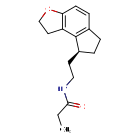
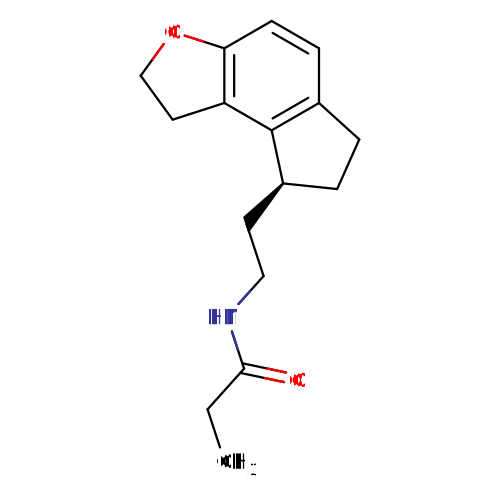
Structure for Ramelteon (DB00980)
- Weight
- Average: 259.3434
Monoisotopic: 259.157228921 - Chemical Formula
- C16H21NO2
- Synonyms
- Ramelteon
- External IDs
- TAK-375
- TAK375

Pharmacology
- Indication
For the treatment of insomnia characterized by difficulty with sleep onset.
 Reduce drug development failure ratesBuild, train, & validate machine-learning modelswith evidence-based and structured datasets.Build, train, & validate predictive machine-learning models with structured datasets.
- Associated Conditions
Indication Type Indication Combined Product Details Approval Level Age Group Patient Characteristics Dose Form Management of Insomnia •••••••••••• - Contraindications & Blackbox Warnings
 Prevent Adverse Drug Events TodayTap into our Clinical API for life-saving information on contraindications & blackbox warnings, population restrictions, harmful risks, & more.Avoid life-threatening adverse drug events with our Clinical API
- Pharmacodynamics
Ramelteon is the first selective melatonin agonist. It works by mimicking melatonin (MT), a naturally occuring hormone that is produced during the sleep period and thought to be responsible for the regulation of circadian rhythm underlying the normal sleep-wake cycle. Ramelteon has a high affinity for the MT1 and MT2 receptors. The MT1 and MT2 receptors are located in the brain's suprachiasmatic nuclei (SCN),which is known as the body's "master clock" because it regulates the 24-hour sleep-wake cycle. Ramelteon has an active metabolite that is less potent but circulates in higher concentrations than the parent compound. The metabolite also has weak affinity for the 5HT2b receptor.
- Mechanism of action
Ramelteon is a melatonin receptor agonist with both high affinity for melatonin MT1 and MT2 receptors, and lower selectivity for the MT3 receptor. Melatonin production is concurrent with nocturnal sleep, meaning that an increase in melatonin levels is related to the onset of self-reported sleepiness and an increase in sleep propensity. MT1 receptors are believed to be responsible for regulation of sleepiness and facilitation of sleep onset, and MT2 receptors are believed to mediate phase-shifting effects of melatonin on the circadian rhythm. While MT1 and MT2 receptors are associated with the sleep-wake cycle, MT3 has a completely different profile, and therefore is not likely to be involved in the sleep-wake cycle. Remelteon has no appreciable affinity for the gamma-aminobutyric acid (GABA) receptor complex or receptors that bind neuropeptides, cytokines, serotonin, dopamine, norepinephrine, acetylcholine, or opiates.
Target Actions Organism AMelatonin receptor type 1B multitargetHumans AMelatonin receptor type 1A multitargetHumans - Absorption
Rapid, total absorption is at least 84%.
- Volume of distribution
- 73.6 L
- Protein binding
~82% (in human serum)
- Metabolism
Hepatic
- Route of elimination
Following oral administration of radiolabeled ramelteon, 84% of total radioactivity was excreted in urine and approximately 4% in feces, resulting in a mean recovery of 88%. Less than 0.1% of the dose was excreted in urine and feces as the parent compound.
- Half-life
~1-2.6 hours
- Clearance
Not Available
- Adverse Effects
 Improve decision support & research outcomesWith structured adverse effects data, including: blackbox warnings, adverse reactions, warning & precautions, & incidence rates. View sample adverse effects data in our new Data Library!Improve decision support & research outcomes with our structured adverse effects data.
- Toxicity
Not Available
- Pathways
- Not Available
- Pharmacogenomic Effects/ADRs
- Not Available
Interactions
- Drug Interactions
- This information should not be interpreted without the help of a healthcare provider. If you believe you are experiencing an interaction, contact a healthcare provider immediately. The absence of an interaction does not necessarily mean no interactions exist.
Drug Interaction Integrate drug-drug
interactions in your software1,2-Benzodiazepine The risk or severity of CNS depression can be increased when Ramelteon is combined with 1,2-Benzodiazepine. Abacavir Ramelteon may decrease the excretion rate of Abacavir which could result in a higher serum level. Abametapir The serum concentration of Ramelteon can be increased when it is combined with Abametapir. Abatacept The metabolism of Ramelteon can be increased when combined with Abatacept. Abiraterone The serum concentration of Ramelteon can be increased when it is combined with Abiraterone. - Food Interactions
- Avoid alcohol.
- Do not take with or immediately after a high-fat meal.
Products
 Drug product information from 10+ global regionsOur datasets provide approved product information including:dosage, form, labeller, route of administration, and marketing period.Access drug product information from over 10 global regions.
- Product Images
- Brand Name Prescription Products
Name Dosage Strength Route Labeller Marketing Start Marketing End Region Image Rozerem Tablet, film coated 8 mg/1 Oral Avera McKennan Hospital 2015-03-05 2017-05-24 US 

Rozerem Tablet, film coated 8 mg/1 Oral Lake Erie Medical Dba Quality Care Produts Llc 2011-05-18 2017-06-01 US Rozerem Tablet, film coated 8 mg/1 Oral Takeda Pharmaceuticals America, Inc. 2005-07-22 Not applicable US 
Rozerem Tablet, film coated 8 mg/1 Oral Rebel Distributors 2005-07-22 Not applicable US 
Rozerem Tablet, film coated 8 mg/1 Oral bryant ranch prepack 2005-07-22 2015-10-30 US 
- Generic Prescription Products
Name Dosage Strength Route Labeller Marketing Start Marketing End Region Image Ramelteon Tablet, film coated 8 mg/1 Oral Xiromed, Llc 2022-11-25 Not applicable US Ramelteon Tablet, film coated 8 mg/1 Oral i3 Pharmaceuticals, LLC 2020-04-30 Not applicable US Ramelteon Tablet 8 mg/1 Oral AvKARE 2020-12-21 Not applicable US Ramelteon Tablet, film coated 8 mg/1 Oral Advanced Rx Pharmacy of Tennessee, LLC 2020-06-30 Not applicable US Ramelteon Tablet 8 mg/1 Oral Zydus Pharmaceuticals USA Inc. 2019-07-23 Not applicable US


Categories
- ATC Codes
- N05CH02 — Ramelteon
- Drug Categories
- Central Nervous System Depressants
- Cytochrome P-450 CYP1A2 Substrates
- Cytochrome P-450 CYP2C19 Substrates
- Cytochrome P-450 CYP2C9 Substrates
- Cytochrome P-450 CYP3A Substrates
- Cytochrome P-450 CYP3A4 Substrates
- Cytochrome P-450 Substrates
- Drugs that are Mainly Renally Excreted
- Hypnotics and Sedatives
- Melatonin Receptor Agonists
- Nervous System
- Psycholeptics
- Chemical TaxonomyProvided by Classyfire
- Description
- This compound belongs to the class of organic compounds known as indanes. These are compounds containing an indane moiety, which consists of a cyclopentane fused to a benzene ring.
- Kingdom
- Organic compounds
- Super Class
- Benzenoids
- Class
- Indanes
- Sub Class
- Not Available
- Direct Parent
- Indanes
- Alternative Parents
- Coumarans / Alkyl aryl ethers / Secondary carboxylic acid amides / Oxacyclic compounds / Organopnictogen compounds / Organonitrogen compounds / Organic oxides / Hydrocarbon derivatives / Carbonyl compounds
- Substituents
- Alkyl aryl ether / Aromatic heteropolycyclic compound / Carbonyl group / Carboxamide group / Carboxylic acid derivative / Coumaran / Ether / Hydrocarbon derivative / Indane / Organic nitrogen compound
- Molecular Framework
- Aromatic heteropolycyclic compounds
- External Descriptors
- Not Available
- Affected organisms
- Humans and other mammals
Chemical Identifiers
- UNII
- 901AS54I69
- CAS number
- 196597-26-9
- InChI Key
- YLXDSYKOBKBWJQ-LBPRGKRZSA-N
- InChI
- InChI=1S/C16H21NO2/c1-2-15(18)17-9-7-12-4-3-11-5-6-14-13(16(11)12)8-10-19-14/h5-6,12H,2-4,7-10H2,1H3,(H,17,18)/t12-/m0/s1
- IUPAC Name
- N-{2-[(8S)-1H,2H,6H,7H,8H-indeno[5,4-b]furan-8-yl]ethyl}propanamide
- SMILES
- CCC(=O)NCC[C@@H]1CCC2=C1C1=C(OCC1)C=C2
References
- Synthesis Reference
Vinod Kumar Kansal, Dhirenkumar N. Mistry, Sanjay L. Vasoya, "Intermediates and processes for the synthesis of Ramelteon." U.S. Patent US20080242877, issued October 02, 2008.
US20080242877- General References
- Karim A, Tolbert D, Cao C: Disposition kinetics and tolerance of escalating single doses of ramelteon, a high-affinity MT1 and MT2 melatonin receptor agonist indicated for treatment of insomnia. J Clin Pharmacol. 2006 Feb;46(2):140-8. [Article]
- Miyamoto M: Pharmacology of ramelteon, a selective MT1/MT2 receptor agonist: a novel therapeutic drug for sleep disorders. CNS Neurosci Ther. 2009 Winter;15(1):32-51. doi: 10.1111/j.1755-5949.2008.00066.x. [Article]
- Pandi-Perumal SR, Srinivasan V, Spence DW, Moscovitch A, Hardeland R, Brown GM, Cardinali DP: Ramelteon: a review of its therapeutic potential in sleep disorders. Adv Ther. 2009 Jun;26(6):613-26. doi: 10.1007/s12325-009-0041-6. Epub 2009 Jun 30. [Article]
- Borja NL, Daniel KL: Ramelteon for the treatment of insomnia. Clin Ther. 2006 Oct;28(10):1540-55. [Article]
- Roth T, Stubbs C, Walsh JK: Ramelteon (TAK-375), a selective MT1/MT2-receptor agonist, reduces latency to persistent sleep in a model of transient insomnia related to a novel sleep environment. Sleep. 2005 Mar;28(3):303-7. [Article]
- Simpson D, Curran MP: Ramelteon: a review of its use in insomnia. Drugs. 2008;68(13):1901-19. [Article]
- External Links
- Human Metabolome Database
- HMDB0015115
- PubChem Compound
- 208902
- PubChem Substance
- 46505923
- ChemSpider
- 181000
- BindingDB
- 50118470
- 596205
- ChEBI
- 109549
- ChEMBL
- CHEMBL1218
- ZINC
- ZINC000003960338
- Therapeutic Targets Database
- DAP000070
- PharmGKB
- PA164744896
- Guide to Pharmacology
- GtP Drug Page
- PDBe Ligand
- JEV
- RxList
- RxList Drug Page
- Drugs.com
- Drugs.com Drug Page
- Wikipedia
- Ramelteon
- PDB Entries
- 6me2 / 6me9 / 7db6 / 7vgz / 7vh0
- FDA label
- Download (2.36 MB)
Clinical Trials
- Clinical Trials
Phase Status Purpose Conditions Count 4 Completed Treatment ADHD With Sleep Onset Insomnia 1 4 Completed Treatment Bipolar Disorder (BD) 1 4 Completed Treatment Chronic Obstructive Pulmonary Disease (COPD) 1 4 Completed Treatment Circadian Dysregulation 1 4 Completed Treatment Cirrhosis of the Liver 1
Pharmacoeconomics
- Manufacturers
- Takeda global research development center inc
- Packagers
- Bryant Ranch Prepack
- DispenseXpress Inc.
- Innoviant Pharmacy Inc.
- Physicians Total Care Inc.
- Rebel Distributors Corp.
- Southwood Pharmaceuticals
- Takeda Pharmaceutical Co. Ltd.
- Dosage Forms
Form Route Strength Tablet, film coated Oral 8 mg Tablet Oral 8 mg/1 Tablet, coated Oral 8 mg/1 Tablet, film coated Oral 8 mg/1 - Prices
Unit description Cost Unit Rozerem 8 mg tablet 5.17USD tablet DrugBank does not sell nor buy drugs. Pricing information is supplied for informational purposes only.- Patents
Patent Number Pediatric Extension Approved Expires (estimated) Region US6034239 No 2000-03-07 2019-07-22 US US10098866 No 2018-10-16 2021-11-16 US
Properties
- State
- Solid
- Experimental Properties
Property Value Source logP 2.4 Not Available - Predicted Properties
Property Value Source Water Solubility 0.0164 mg/mL ALOGPS logP 3.03 ALOGPS logP 2.57 Chemaxon logS -4.2 ALOGPS pKa (Strongest Acidic) 15.82 Chemaxon pKa (Strongest Basic) -1.4 Chemaxon Physiological Charge 0 Chemaxon Hydrogen Acceptor Count 2 Chemaxon Hydrogen Donor Count 1 Chemaxon Polar Surface Area 38.33 Å2 Chemaxon Rotatable Bond Count 4 Chemaxon Refractivity 75.52 m3·mol-1 Chemaxon Polarizability 29.99 Å3 Chemaxon Number of Rings 3 Chemaxon Bioavailability 1 Chemaxon Rule of Five Yes Chemaxon Ghose Filter Yes Chemaxon Veber's Rule Yes Chemaxon MDDR-like Rule No Chemaxon - Predicted ADMET Features
Property Value Probability Human Intestinal Absorption + 1.0 Blood Brain Barrier + 0.9934 Caco-2 permeable + 0.5893 P-glycoprotein substrate Substrate 0.5211 P-glycoprotein inhibitor I Non-inhibitor 0.8548 P-glycoprotein inhibitor II Non-inhibitor 0.7877 Renal organic cation transporter Non-inhibitor 0.6381 CYP450 2C9 substrate Non-substrate 0.7876 CYP450 2D6 substrate Non-substrate 0.6392 CYP450 3A4 substrate Substrate 0.512 CYP450 1A2 substrate Inhibitor 0.7314 CYP450 2C9 inhibitor Non-inhibitor 0.6471 CYP450 2D6 inhibitor Non-inhibitor 0.5916 CYP450 2C19 inhibitor Inhibitor 0.8314 CYP450 3A4 inhibitor Non-inhibitor 0.9196 CYP450 inhibitory promiscuity High CYP Inhibitory Promiscuity 0.7763 Ames test Non AMES toxic 0.7016 Carcinogenicity Non-carcinogens 0.8206 Biodegradation Ready biodegradable 0.6635 Rat acute toxicity 2.1034 LD50, mol/kg Not applicable hERG inhibition (predictor I) Weak inhibitor 0.7898 hERG inhibition (predictor II) Inhibitor 0.5
Spectra
- Mass Spec (NIST)
- Not Available
- Spectra
- Chromatographic Properties
Collision Cross Sections (CCS)
Adduct CCS Value (Å2) Source type Source [M-H]- 170.1634556 predictedDarkChem Lite v0.1.0 [M-H]- 160.3073 predictedDeepCCS 1.0 (2019) [M+H]+ 170.8073556 predictedDarkChem Lite v0.1.0 [M+H]+ 162.66527 predictedDeepCCS 1.0 (2019) [M+Na]+ 170.2596556 predictedDarkChem Lite v0.1.0 [M+Na]+ 168.75844 predictedDeepCCS 1.0 (2019)
Targets

- Kind
- Protein
- Organism
- Humans
- Pharmacological action
- Yes
- Actions
- Multitarget
- General Function
- Melatonin receptor activity
- Specific Function
- High affinity receptor for melatonin. Likely to mediates the reproductive and circadian actions of melatonin. The activity of this receptor is mediated by pertussis toxin sensitive G proteins that ...
- Gene Name
- MTNR1B
- Uniprot ID
- P49286
- Uniprot Name
- Melatonin receptor type 1B
- Molecular Weight
- 40187.895 Da
References
- Kato K, Hirai K, Nishiyama K, Uchikawa O, Fukatsu K, Ohkawa S, Kawamata Y, Hinuma S, Miyamoto M: Neurochemical properties of ramelteon (TAK-375), a selective MT1/MT2 receptor agonist. Neuropharmacology. 2005 Feb;48(2):301-10. [Article]
- Karim A, Tolbert D, Cao C: Disposition kinetics and tolerance of escalating single doses of ramelteon, a high-affinity MT1 and MT2 melatonin receptor agonist indicated for treatment of insomnia. J Clin Pharmacol. 2006 Feb;46(2):140-8. [Article]
- Greenblatt DJ, Harmatz JS, Karim A: Age and gender effects on the pharmacokinetics and pharmacodynamics of ramelteon, a hypnotic agent acting via melatonin receptors MT1 and MT2. J Clin Pharmacol. 2007 Apr;47(4):485-96. [Article]
- Roth T, Stubbs C, Walsh JK: Ramelteon (TAK-375), a selective MT1/MT2-receptor agonist, reduces latency to persistent sleep in a model of transient insomnia related to a novel sleep environment. Sleep. 2005 Mar;28(3):303-7. [Article]
- Miyamoto M: Effect of ramelteon (TAK-375), a selective MT1/MT2 receptor agonist, on motor performance in mice. Neurosci Lett. 2006 Jul 24;402(3):201-4. Epub 2006 May 24. [Article]
- Authors unspecified: Ramelteon: TAK 375. Drugs R D. 2005;6(3):186-8. [Article]
- Miyamoto M: Pharmacology of ramelteon, a selective MT1/MT2 receptor agonist: a novel therapeutic drug for sleep disorders. CNS Neurosci Ther. 2009 Winter;15(1):32-51. doi: 10.1111/j.1755-5949.2008.00066.x. [Article]
- Miyamoto M: [A novel therapeutic drug: ramelteon]. Nihon Rinsho. 2009 Aug;67(8):1595-600. [Article]
- Pandi-Perumal SR, Srinivasan V, Spence DW, Moscovitch A, Hardeland R, Brown GM, Cardinali DP: Ramelteon: a review of its therapeutic potential in sleep disorders. Adv Ther. 2009 Jun;26(6):613-26. doi: 10.1007/s12325-009-0041-6. Epub 2009 Jun 30. [Article]
- Borja NL, Daniel KL: Ramelteon for the treatment of insomnia. Clin Ther. 2006 Oct;28(10):1540-55. [Article]
- Johnson MW, Suess PE, Griffiths RR: Ramelteon: a novel hypnotic lacking abuse liability and sedative adverse effects. Arch Gen Psychiatry. 2006 Oct;63(10):1149-57. [Article]
- Zammit G, Erman M, Wang-Weigand S, Sainati S, Zhang J, Roth T: Evaluation of the efficacy and safety of ramelteon in subjects with chronic insomnia. J Clin Sleep Med. 2007 Aug 15;3(5):495-504. [Article]
- Chen X, Ji ZL, Chen YZ: TTD: Therapeutic Target Database. Nucleic Acids Res. 2002 Jan 1;30(1):412-5. [Article]
- Kind
- Protein
- Organism
- Humans
- Pharmacological action
- Yes
- Actions
- Multitarget
- General Function
- Organic cyclic compound binding
- Specific Function
- High affinity receptor for melatonin. Likely to mediates the reproductive and circadian actions of melatonin. The activity of this receptor is mediated by pertussis toxin sensitive G proteins that ...
- Gene Name
- MTNR1A
- Uniprot ID
- P48039
- Uniprot Name
- Melatonin receptor type 1A
- Molecular Weight
- 39374.315 Da
References
- Kato K, Hirai K, Nishiyama K, Uchikawa O, Fukatsu K, Ohkawa S, Kawamata Y, Hinuma S, Miyamoto M: Neurochemical properties of ramelteon (TAK-375), a selective MT1/MT2 receptor agonist. Neuropharmacology. 2005 Feb;48(2):301-10. [Article]
- Karim A, Tolbert D, Cao C: Disposition kinetics and tolerance of escalating single doses of ramelteon, a high-affinity MT1 and MT2 melatonin receptor agonist indicated for treatment of insomnia. J Clin Pharmacol. 2006 Feb;46(2):140-8. [Article]
- Greenblatt DJ, Harmatz JS, Karim A: Age and gender effects on the pharmacokinetics and pharmacodynamics of ramelteon, a hypnotic agent acting via melatonin receptors MT1 and MT2. J Clin Pharmacol. 2007 Apr;47(4):485-96. [Article]
- Roth T, Stubbs C, Walsh JK: Ramelteon (TAK-375), a selective MT1/MT2-receptor agonist, reduces latency to persistent sleep in a model of transient insomnia related to a novel sleep environment. Sleep. 2005 Mar;28(3):303-7. [Article]
- Miyamoto M: Effect of ramelteon (TAK-375), a selective MT1/MT2 receptor agonist, on motor performance in mice. Neurosci Lett. 2006 Jul 24;402(3):201-4. Epub 2006 May 24. [Article]
- Authors unspecified: Ramelteon: TAK 375. Drugs R D. 2005;6(3):186-8. [Article]
- Miyamoto M: Pharmacology of ramelteon, a selective MT1/MT2 receptor agonist: a novel therapeutic drug for sleep disorders. CNS Neurosci Ther. 2009 Winter;15(1):32-51. doi: 10.1111/j.1755-5949.2008.00066.x. [Article]
- Miyamoto M: [A novel therapeutic drug: ramelteon]. Nihon Rinsho. 2009 Aug;67(8):1595-600. [Article]
- Pandi-Perumal SR, Srinivasan V, Spence DW, Moscovitch A, Hardeland R, Brown GM, Cardinali DP: Ramelteon: a review of its therapeutic potential in sleep disorders. Adv Ther. 2009 Jun;26(6):613-26. doi: 10.1007/s12325-009-0041-6. Epub 2009 Jun 30. [Article]
- Borja NL, Daniel KL: Ramelteon for the treatment of insomnia. Clin Ther. 2006 Oct;28(10):1540-55. [Article]
- Johnson MW, Suess PE, Griffiths RR: Ramelteon: a novel hypnotic lacking abuse liability and sedative adverse effects. Arch Gen Psychiatry. 2006 Oct;63(10):1149-57. [Article]
- Zammit G, Erman M, Wang-Weigand S, Sainati S, Zhang J, Roth T: Evaluation of the efficacy and safety of ramelteon in subjects with chronic insomnia. J Clin Sleep Med. 2007 Aug 15;3(5):495-504. [Article]
- Chen X, Ji ZL, Chen YZ: TTD: Therapeutic Target Database. Nucleic Acids Res. 2002 Jan 1;30(1):412-5. [Article]
Enzymes
- Kind
- Protein
- Organism
- Humans
- Pharmacological action
- Unknown
- Actions
- Substrate
- General Function
- Steroid hydroxylase activity
- Specific Function
- Responsible for the metabolism of a number of therapeutic agents such as the anticonvulsant drug S-mephenytoin, omeprazole, proguanil, certain barbiturates, diazepam, propranolol, citalopram and im...
- Gene Name
- CYP2C19
- Uniprot ID
- P33261
- Uniprot Name
- Cytochrome P450 2C19
- Molecular Weight
- 55930.545 Da
References
- Obach RS, Ryder TF: Metabolism of ramelteon in human liver microsomes and correlation with the effect of fluvoxamine on ramelteon pharmacokinetics. Drug Metab Dispos. 2010 Aug;38(8):1381-91. doi: 10.1124/dmd.110.034009. Epub 2010 May 17. [Article]
- Pandi-Perumal SR, Spence DW, Verster JC, Srinivasan V, Brown GM, Cardinali DP, Hardeland R: Pharmacotherapy of insomnia with ramelteon: safety, efficacy and clinical applications. J Cent Nerv Syst Dis. 2011 Apr 12;3:51-65. doi: 10.4137/JCNSD.S1611. Print 2011. [Article]
- Kind
- Protein
- Organism
- Humans
- Pharmacological action
- Unknown
- Actions
- Substrate
- General Function
- Vitamin d3 25-hydroxylase activity
- Specific Function
- Cytochromes P450 are a group of heme-thiolate monooxygenases. In liver microsomes, this enzyme is involved in an NADPH-dependent electron transport pathway. It performs a variety of oxidation react...
- Gene Name
- CYP3A4
- Uniprot ID
- P08684
- Uniprot Name
- Cytochrome P450 3A4
- Molecular Weight
- 57342.67 Da
References
- Obach RS, Ryder TF: Metabolism of ramelteon in human liver microsomes and correlation with the effect of fluvoxamine on ramelteon pharmacokinetics. Drug Metab Dispos. 2010 Aug;38(8):1381-91. doi: 10.1124/dmd.110.034009. Epub 2010 May 17. [Article]
- Kind
- Protein
- Organism
- Humans
- Pharmacological action
- No
- Actions
- Substrate
- General Function
- Steroid hydroxylase activity
- Specific Function
- Cytochromes P450 are a group of heme-thiolate monooxygenases. In liver microsomes, this enzyme is involved in an NADPH-dependent electron transport pathway. It oxidizes a variety of structurally un...
- Gene Name
- CYP2C9
- Uniprot ID
- P11712
- Uniprot Name
- Cytochrome P450 2C9
- Molecular Weight
- 55627.365 Da
- Kind
- Protein
- Organism
- Humans
- Pharmacological action
- Unknown
- Actions
- Substrate
- General Function
- Oxidoreductase activity, acting on paired donors, with incorporation or reduction of molecular oxygen, reduced flavin or flavoprotein as one donor, and incorporation of one atom of oxygen
- Specific Function
- Cytochromes P450 are a group of heme-thiolate monooxygenases. In liver microsomes, this enzyme is involved in an NADPH-dependent electron transport pathway. It oxidizes a variety of structurally un...
- Gene Name
- CYP1A2
- Uniprot ID
- P05177
- Uniprot Name
- Cytochrome P450 1A2
- Molecular Weight
- 58293.76 Da
References
- Obach RS, Ryder TF: Metabolism of ramelteon in human liver microsomes and correlation with the effect of fluvoxamine on ramelteon pharmacokinetics. Drug Metab Dispos. 2010 Aug;38(8):1381-91. doi: 10.1124/dmd.110.034009. Epub 2010 May 17. [Article]
- Neubauer DN: A review of ramelteon in the treatment of sleep disorders. Neuropsychiatr Dis Treat. 2008 Feb;4(1):69-79. [Article]
- Ramelteon FDA label [File]

Drug created at June 13, 2005 13:24 / Updated at February 02, 2024 22:47