Identification
- Summary
Exemestane is an aromatase inhibitor used to treat breast cancer in postmenopausal women after treatment with tamoxifen.
- Brand Names
- Aromasin
- Generic Name
- Exemestane
- DrugBank Accession Number
- DB00990
- Background
Exemestane is an oral steroidal aromatase inhibitor used in the adjuvant treatment of hormonally-responsive (also called hormone-receptor-positive, estrogen-responsive) breast cancer in postmenopausal women. It irreversibly binds to the active site of the enzyme resulting in permanent inhibition.
- Type
- Small Molecule
- Groups
- Approved, Investigational
- Structure
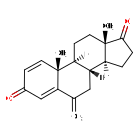
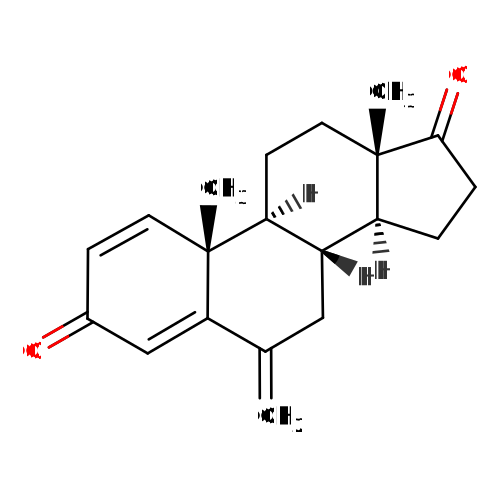
Structure for Exemestane (DB00990)
- Weight
- Average: 296.4034
Monoisotopic: 296.177630012 - Chemical Formula
- C20H24O2
- Synonyms
- 6-methyleneandrosta-1,4-diene-3,17-dione
- Exemestane
- Exemestano
- Exemestanum
- External IDs
- FCE-24304
- FCE24304
- PNU-155971

Pharmacology
- Indication
For the treatment of advanced breast cancer in postmenopausal women whose disease has progressed following tamoxifen therapy.
 Reduce drug development failure ratesBuild, train, & validate machine-learning modelswith evidence-based and structured datasets.Build, train, & validate predictive machine-learning models with structured datasets.
- Associated Conditions
Indication Type Indication Combined Product Details Approval Level Age Group Patient Characteristics Dose Form Adjunct therapy in treatment of Early breast cancer •••••••••••• •••••••••••••• ••• ••••• •• ••••••••• ••••••• Treatment of Refractory, advanced breast cancer •••••••••••• •••••••••••••• - Contraindications & Blackbox Warnings
 Prevent Adverse Drug Events TodayTap into our Clinical API for life-saving information on contraindications & blackbox warnings, population restrictions, harmful risks, & more.Avoid life-threatening adverse drug events with our Clinical API
- Pharmacodynamics
Aromatase is an enzyme that converts hormones to estrogen in the body's adrenal glands. The aromatase inhibitors (AIs) are drugs that reduce estrogen levels by blocking the action of aromatase in the adrenal glands. The selective AIs (SAIs) selectively reduce levels of estrogen without interfering with levels of other steroid hormones that are produced by the adrenal gland. Drugs in this class include anastrozole (Arimidex ™), letrozole (Femara ™) and exemestane (Aromasin ™).
- Mechanism of action
Breast cancer cell growth may be estrogen-dependent. Aromatase (exemestane) is the principal enzyme that converts androgens to estrogens both in pre- and postmenopausal women. While the main source of estrogen (primarily estradiol) is the ovary in premenopausal women, the principal source of circulating estrogens in postmenopausal women is from conversion of adrenal and ovarian androgens (androstenedione and testosterone) to estrogens (estrone and estradiol) by the aromatase enzyme in peripheral tissues. Estrogen deprivation through aromatase inhibition is an effective and selective treatment for some postmenopausal patients with hormone-dependent breast cancer. Exemestane is an irreversible, steroidal aromatase inactivator, structurally related to the natural substrate androstenedione. It irreversibly binds to the active site causing permanent inhibition necessitating de novo synthesis to restore enzymatic function. Exemestane significantly lowers circulating estrogen concentrations in postmenopausal women, but has no detectable effect on the adrenal biosynthesis of corticosteroids or aldosterone. This reduction in serum and tumor concentrations of estrogen delays tumor growth and disease progression. Exemestane has no effect on other enzymes involved in the steroidogenic pathway up to a concentration at least 600 times higher than that inhibiting the aromatase enzyme.
Target Actions Organism ACytochrome P450 19A1 inhibitorHumans - Absorption
42%
- Volume of distribution
Not Available
- Protein binding
90% (mainly α1-acid glycoprotein and albumin)
- Metabolism
Hepatic
- Route of elimination
Not Available
- Half-life
24 hours
- Clearance
Not Available
- Adverse Effects
 Improve decision support & research outcomesWith structured adverse effects data, including: blackbox warnings, adverse reactions, warning & precautions, & incidence rates. View sample adverse effects data in our new Data Library!Improve decision support & research outcomes with our structured adverse effects data.
- Toxicity
Convulsions
- Pathways
- Not Available
- Pharmacogenomic Effects/ADRs
- Not Available
Interactions
- Drug Interactions
- This information should not be interpreted without the help of a healthcare provider. If you believe you are experiencing an interaction, contact a healthcare provider immediately. The absence of an interaction does not necessarily mean no interactions exist.
Drug Interaction Integrate drug-drug
interactions in your softwareAbametapir The serum concentration of Exemestane can be increased when it is combined with Abametapir. Ambroxol The risk or severity of methemoglobinemia can be increased when Exemestane is combined with Ambroxol. Amiodarone The metabolism of Exemestane can be decreased when combined with Amiodarone. Amprenavir The metabolism of Exemestane can be decreased when combined with Amprenavir. Apalutamide The metabolism of Exemestane can be increased when combined with Apalutamide. - Food Interactions
- Take with food. The manufacturer recommends administration following a meal.
Products
 Drug product information from 10+ global regionsOur datasets provide approved product information including:dosage, form, labeller, route of administration, and marketing period.Access drug product information from over 10 global regions.
- Product Images


- International/Other Brands
- Exemestance
- Brand Name Prescription Products
Name Dosage Strength Route Labeller Marketing Start Marketing End Region Image Act Exemestane Tablet 25 mg Oral TEVA Canada Limited 2012-07-26 Not applicable Canada 
Aromasin Tablet 25 mg/1 Oral Pharmacia & Upjohn Company LLC 1999-10-21 Not applicable US 

Aromasin Tablet 25 mg/1 Oral Physicians Total Care, Inc. 2005-06-29 Not applicable US 
Aromasin Tablet 25 mg Oral Pfizer Canada Ulc 2000-08-17 Not applicable Canada - Generic Prescription Products
Name Dosage Strength Route Labeller Marketing Start Marketing End Region Image Apo-exemestane Tablet 25 mg Oral Apotex Corporation 2014-05-01 Not applicable Canada Exemestane Tablet 25 mg/1 Oral Eirgen Pharma Ltd 2013-11-22 Not applicable US Exemestane Tablet 25 mg/1 Oral Zydus Lifesciences Limited 2018-10-08 Not applicable US Exemestane Tablet, film coated 25 mg/1 Oral Aurobindo Pharma Limited 2022-05-20 Not applicable US Exemestane Tablet, film coated 25 mg/1 Oral Breckenridge Pharmaceutical, Inc. 2019-12-19 Not applicable US


Categories
- ATC Codes
- L02BG06 — Exemestane
- Drug Categories
- Androstanes
- Androstenes
- Antineoplastic Agents
- Antineoplastic and Immunomodulating Agents
- Aromatase Inhibitors
- Cytochrome P-450 CYP3A Substrates
- Cytochrome P-450 CYP3A4 Substrates
- Cytochrome P-450 Substrates
- Endocrine Therapy
- Enzyme Inhibitors
- Estrogen Antagonists
- Fused-Ring Compounds
- Hormone Antagonists
- Hormone Antagonists and Related Agents
- Hormones, Hormone Substitutes, and Hormone Antagonists
- Steroid Synthesis Inhibitors
- Steroids
- Chemical TaxonomyProvided by Classyfire
- Description
- This compound belongs to the class of organic compounds known as androgens and derivatives. These are 3-hydroxylated C19 steroid hormones. They are known to favor the development of masculine characteristics. They also show profound effects on scalp and body hair in humans.
- Kingdom
- Organic compounds
- Super Class
- Lipids and lipid-like molecules
- Class
- Steroids and steroid derivatives
- Sub Class
- Androstane steroids
- Direct Parent
- Androgens and derivatives
- Alternative Parents
- 3-oxo delta-1,4-steroids / 17-oxosteroids / Delta-1,4-steroids / Cyclic ketones / Organic oxides / Hydrocarbon derivatives
- Substituents
- 17-oxosteroid / 3-oxo-delta-1,4-steroid / 3-oxosteroid / Aliphatic homopolycyclic compound / Androgen-skeleton / Carbonyl group / Cyclic ketone / Delta-1,4-steroid / Hydrocarbon derivative / Ketone
- Molecular Framework
- Aliphatic homopolycyclic compounds
- External Descriptors
- 17-oxo steroid, 3-oxo-Delta(1),Delta(4)-steroid (CHEBI:4953)
- Affected organisms
- Humans and other mammals
Chemical Identifiers
- UNII
- NY22HMQ4BX
- CAS number
- 107868-30-4
- InChI Key
- BFYIZQONLCFLEV-DAELLWKTSA-N
- InChI
- InChI=1S/C20H24O2/c1-12-10-14-15-4-5-18(22)20(15,3)9-7-16(14)19(2)8-6-13(21)11-17(12)19/h6,8,11,14-16H,1,4-5,7,9-10H2,2-3H3/t14-,15-,16-,19+,20-/m0/s1
- IUPAC Name
- (3aS,3bR,9aR,9bS,11aS)-9a,11a-dimethyl-5-methylidene-1H,2H,3H,3aH,3bH,4H,5H,7H,9aH,9bH,10H,11H,11aH-cyclopenta[a]phenanthrene-1,7-dione
- SMILES
- [H][C@@]12CCC(=O)[C@@]1(C)CC[C@@]1([H])[C@@]2([H])CC(=C)C2=CC(=O)C=C[C@]12C
References
- Synthesis Reference
Kevin Kunnen, Nathan W. Stehle, Scot W. Weis, John M. Pascone, Richard J. Pariza, Scott G. Van Ornum, Paul Zizelman, "Exemestane and Its Intermediates and Methods of Making the Same." U.S. Patent US20080234505, issued September 25, 2008.
US20080234505- General References
- Coombes RC, Kilburn LS, Snowdon CF, Paridaens R, Coleman RE, Jones SE, Jassem J, Van de Velde CJ, Delozier T, Alvarez I, Del Mastro L, Ortmann O, Diedrich K, Coates AS, Bajetta E, Holmberg SB, Dodwell D, Mickiewicz E, Andersen J, Lonning PE, Cocconi G, Forbes J, Castiglione M, Stuart N, Stewart A, Fallowfield LJ, Bertelli G, Hall E, Bogle RG, Carpentieri M, Colajori E, Subar M, Ireland E, Bliss JM: Survival and safety of exemestane versus tamoxifen after 2-3 years' tamoxifen treatment (Intergroup Exemestane Study): a randomised controlled trial. Lancet. 2007 Feb 17;369(9561):559-70. [Article]
- Robinson A: A review of the use of exemestane in early breast cancer. Ther Clin Risk Manag. 2009 Feb;5(1):91-8. Epub 2009 Mar 26. [Article]
- Untch M, Jackisch C: Exemestane in early breast cancer: a review. Ther Clin Risk Manag. 2008 Dec;4(6):1295-304. [Article]
- Abrial C, Durando X, Mouret-Reynier MA, Thivat E, Bayet-Robert M, Nayl B, Dubray P, Pomel C, Chollet P, Penault-Llorca F: Role of neo-adjuvant hormonal therapy in the treatment of breast cancer: a review of clinical trials. Int J Gen Med. 2009 Jul 30;2:129-40. [Article]
- Nabholtz JM: Long-term safety of aromatase inhibitors in the treatment of breast cancer. Ther Clin Risk Manag. 2008 Feb;4(1):189-204. [Article]
- External Links
- Human Metabolome Database
- HMDB0015125
- KEGG Drug
- D00963
- KEGG Compound
- C08162
- PubChem Compound
- 60198
- PubChem Substance
- 46508243
- ChemSpider
- 54278
- BindingDB
- 50398447
- 258494
- ChEBI
- 4953
- ChEMBL
- CHEMBL1200374
- ZINC
- ZINC000003973334
- Therapeutic Targets Database
- DAP000625
- PharmGKB
- PA449563
- PDBe Ligand
- EXM
- RxList
- RxList Drug Page
- Drugs.com
- Drugs.com Drug Page
- Wikipedia
- Exemestane
- PDB Entries
- 3s7s
- FDA label
- Download (74.6 KB)
Clinical Trials
- Clinical Trials
Phase Status Purpose Conditions Count 4 Completed Not Available Breast Neoplasms 1 4 Completed Other HER2/Neu-negative Carcinoma of Breast / Hormone Receptor Positive Malignant Neoplasm of Breast / Recurrent Breast Cancer 1 4 Completed Treatment Breast Cancer 2 4 Completed Treatment Breast Neoplasms 1 4 Completed Treatment Hormono-depending Adjuvant Breast Cancer 1
Pharmacoeconomics
- Manufacturers
- Pharmacia and upjohn co
- Packagers
- Pfizer Inc.
- Pharmacia Inc.
- Physicians Total Care Inc.
- Dosage Forms
Form Route Strength Tablet Oral 25 mg Tablet Oral 25 mg/1 Tablet, sugar coated Oral Tablet, sugar coated Oral 25 mg Tablet, coated Oral Tablet Oral 25.00 mg Tablet, film coated Oral 25 mg/1 Tablet, sugar coated Oral 25 mg/1 Tablet, film coated Oral 25.00 mg Tablet, coated Oral 25 mg Tablet, film coated Oral 25 mg Tablet Oral Tablet, film coated Oral Tablet Oral 25.000 mg - Prices
Unit description Cost Unit Aromasin 25 mg tablet 13.77USD tablet DrugBank does not sell nor buy drugs. Pricing information is supplied for informational purposes only.- Patents
Patent Number Pediatric Extension Approved Expires (estimated) Region US4808616 No 1989-02-28 2011-04-01 US CA2409059 No 2006-04-18 2021-04-25 Canada
Properties
- State
- Solid
- Experimental Properties
Property Value Source melting point (°C) 155.13 °C Not Available water solubility Non-soluble Not Available logP 3.7 Not Available - Predicted Properties
Property Value Source Water Solubility 0.00683 mg/mL ALOGPS logP 2.67 ALOGPS logP 3.87 Chemaxon logS -4.6 ALOGPS pKa (Strongest Basic) -5 Chemaxon Physiological Charge 0 Chemaxon Hydrogen Acceptor Count 2 Chemaxon Hydrogen Donor Count 0 Chemaxon Polar Surface Area 34.14 Å2 Chemaxon Rotatable Bond Count 0 Chemaxon Refractivity 89.03 m3·mol-1 Chemaxon Polarizability 33.72 Å3 Chemaxon Number of Rings 4 Chemaxon Bioavailability 1 Chemaxon Rule of Five Yes Chemaxon Ghose Filter Yes Chemaxon Veber's Rule Yes Chemaxon MDDR-like Rule No Chemaxon - Predicted ADMET Features
Property Value Probability Human Intestinal Absorption + 1.0 Blood Brain Barrier + 0.9778 Caco-2 permeable + 0.7992 P-glycoprotein substrate Substrate 0.5589 P-glycoprotein inhibitor I Inhibitor 0.8974 P-glycoprotein inhibitor II Non-inhibitor 0.6749 Renal organic cation transporter Non-inhibitor 0.6499 CYP450 2C9 substrate Non-substrate 0.8764 CYP450 2D6 substrate Non-substrate 0.9115 CYP450 3A4 substrate Substrate 0.7167 CYP450 1A2 substrate Non-inhibitor 0.8552 CYP450 2C9 inhibitor Non-inhibitor 0.9224 CYP450 2D6 inhibitor Non-inhibitor 0.9373 CYP450 2C19 inhibitor Non-inhibitor 0.751 CYP450 3A4 inhibitor Non-inhibitor 0.8309 CYP450 inhibitory promiscuity Low CYP Inhibitory Promiscuity 0.8276 Ames test Non AMES toxic 0.9483 Carcinogenicity Non-carcinogens 0.9245 Biodegradation Not ready biodegradable 0.9539 Rat acute toxicity 1.7582 LD50, mol/kg Not applicable hERG inhibition (predictor I) Weak inhibitor 0.76 hERG inhibition (predictor II) Non-inhibitor 0.7791
Spectra
- Mass Spec (NIST)
- Not Available
- Spectra
- Chromatographic Properties
Collision Cross Sections (CCS)
Adduct CCS Value (Å2) Source type Source [M-H]- 179.5093476 predictedDarkChem Lite v0.1.0 [M-H]- 179.7242476 predictedDarkChem Lite v0.1.0 [M-H]- 168.85423 predictedDeepCCS 1.0 (2019) [M+H]+ 180.1684476 predictedDarkChem Lite v0.1.0 [M+H]+ 180.3247476 predictedDarkChem Lite v0.1.0 [M+H]+ 171.2241 predictedDeepCCS 1.0 (2019) [M+Na]+ 180.0186476 predictedDarkChem Lite v0.1.0 [M+Na]+ 179.8958476 predictedDarkChem Lite v0.1.0 [M+Na]+ 177.13664 predictedDeepCCS 1.0 (2019)
Targets

- Kind
- Protein
- Organism
- Humans
- Pharmacological action
- Yes
- Actions
- Inhibitor
- General Function
- Oxygen binding
- Specific Function
- Catalyzes the formation of aromatic C18 estrogens from C19 androgens.
- Gene Name
- CYP19A1
- Uniprot ID
- P11511
- Uniprot Name
- Aromatase
- Molecular Weight
- 57882.48 Da
References
- Chen X, Ji ZL, Chen YZ: TTD: Therapeutic Target Database. Nucleic Acids Res. 2002 Jan 1;30(1):412-5. [Article]
- Koutras A, Giannopoulou E, Kritikou I, Antonacopoulou A, Evans TR, Papavassiliou AG, Kalofonos H: Antiproliferative effect of exemestane in lung cancer cells. Mol Cancer. 2009 Nov 24;8:109. doi: 10.1186/1476-4598-8-109. [Article]
- Robinson A: A review of the use of exemestane in early breast cancer. Ther Clin Risk Manag. 2009 Feb;5(1):91-8. Epub 2009 Mar 26. [Article]
- Untch M, Jackisch C: Exemestane in early breast cancer: a review. Ther Clin Risk Manag. 2008 Dec;4(6):1295-304. [Article]
- Barnadas A, Gil M, Gonzalez S, Tusquets I, Munoz M, Arcusa A, Prieto L, Margeli-Vila M, Moreno A: Exemestane as primary treatment of oestrogen receptor-positive breast cancer in postmenopausal women: a phase II trial. Br J Cancer. 2009 Feb 10;100(3):442-9. doi: 10.1038/sj.bjc.6604868. Epub 2009 Jan 20. [Article]
- Abrial C, Durando X, Mouret-Reynier MA, Thivat E, Bayet-Robert M, Nayl B, Dubray P, Pomel C, Chollet P, Penault-Llorca F: Role of neo-adjuvant hormonal therapy in the treatment of breast cancer: a review of clinical trials. Int J Gen Med. 2009 Jul 30;2:129-40. [Article]
- Nabholtz JM: Long-term safety of aromatase inhibitors in the treatment of breast cancer. Ther Clin Risk Manag. 2008 Feb;4(1):189-204. [Article]
- Brueggemeier RW: Update on the use of aromatase inhibitors in breast cancer. Expert Opin Pharmacother. 2006 Oct;7(14):1919-30. [Article]
- Brueggemeier RW, Hackett JC, Diaz-Cruz ES: Aromatase inhibitors in the treatment of breast cancer. Endocr Rev. 2005 May;26(3):331-45. Epub 2005 Apr 6. [Article]
Enzymes
- Kind
- Protein
- Organism
- Humans
- Pharmacological action
- Unknown
- Actions
- Inhibitor
- General Function
- Oxygen binding
- Specific Function
- Catalyzes the formation of aromatic C18 estrogens from C19 androgens.
- Gene Name
- CYP19A1
- Uniprot ID
- P11511
- Uniprot Name
- Aromatase
- Molecular Weight
- 57882.48 Da
References
- Kind
- Protein
- Organism
- Humans
- Pharmacological action
- Unknown
- Actions
- Substrate
- General Function
- Vitamin d3 25-hydroxylase activity
- Specific Function
- Cytochromes P450 are a group of heme-thiolate monooxygenases. In liver microsomes, this enzyme is involved in an NADPH-dependent electron transport pathway. It performs a variety of oxidation react...
- Gene Name
- CYP3A4
- Uniprot ID
- P08684
- Uniprot Name
- Cytochrome P450 3A4
- Molecular Weight
- 57342.67 Da
References
- Robinson A: A review of the use of exemestane in early breast cancer. Ther Clin Risk Manag. 2009 Feb;5(1):91-8. Epub 2009 Mar 26. [Article]
- Kamdem LK, Flockhart DA, Desta Z: In vitro cytochrome P450-mediated metabolism of exemestane. Drug Metab Dispos. 2011 Jan;39(1):98-105. doi: 10.1124/dmd.110.032276. Epub 2010 Sep 28. [Article]
- Peterson A, Xia Z, Chen G, Lazarus P: In vitro metabolism of exemestane by hepatic cytochrome P450s: impact of nonsynonymous polymorphisms on formation of the active metabolite 17beta-dihydroexemestane. Pharmacol Res Perspect. 2017 Apr 27;5(3):e00314. doi: 10.1002/prp2.314. eCollection 2017 Jun. [Article]

Drug created at June 13, 2005 13:24 / Updated at April 26, 2024 00:45