Identification
- Summary
Oxaprozin is an NSAID used to treat osteoarthritis, rheumatoid arthritis, and juvenile rheumatoid arthritis.
- Brand Names
- Coxanto, Daypro
- Generic Name
- Oxaprozin
- DrugBank Accession Number
- DB00991
- Background
Oxaprozin is a non-narcotic, non-steroidal anti-inflammatory drug (NSAID), used to relieve the inflammation, swelling, stiffness, and joint pain associated with osteoarthritis and rheumatoid arthritis.
- Type
- Small Molecule
- Groups
- Approved
- Structure
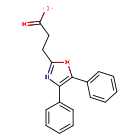
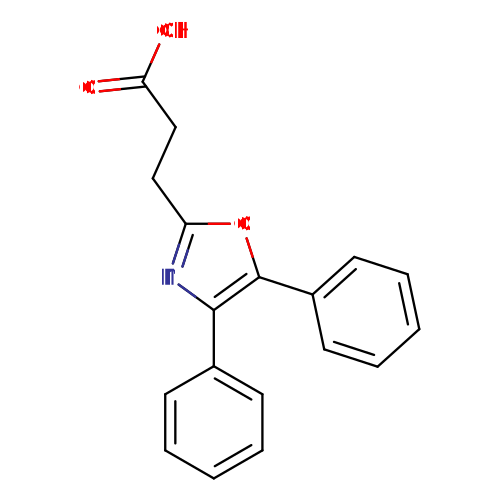
Structure for Oxaprozin (DB00991)
- Weight
- Average: 293.3166
Monoisotopic: 293.105193351 - Chemical Formula
- C18H15NO3
- Synonyms
- Oxaprozin
- Oxaprozina
- Oxaprozine
- Oxaprozinum
- External IDs
- WY-21,743
- WY-21743

Pharmacology
- Indication
Used to relieve the inflammation, swelling, stiffness, and joint pain associated with rheumatoid arthritis and osteoarthritis.
 Reduce drug development failure ratesBuild, train, & validate machine-learning modelswith evidence-based and structured datasets.Build, train, & validate predictive machine-learning models with structured datasets.
- Associated Conditions
Indication Type Indication Combined Product Details Approval Level Age Group Patient Characteristics Dose Form Symptomatic treatment of Juvenile rheumatoid arthritis •••••••••••• Symptomatic treatment of Osteoarthritis •••••••••••• Symptomatic treatment of Rheumatoid arthritis •••••••••••• - Contraindications & Blackbox Warnings
 Prevent Adverse Drug Events TodayTap into our Clinical API for life-saving information on contraindications & blackbox warnings, population restrictions, harmful risks, & more.Avoid life-threatening adverse drug events with our Clinical API
- Pharmacodynamics
Oxaprozin is a nonsteroidal anti-inflammatory drug (NSAID) with analgesic and antipyretic properties. Oxaprozin is used to treat rheumatoid arthritis, osteoarthritis, dysmenorrhea, and to alleviate moderate pain.
- Mechanism of action
Anti-inflammatory effects of Oxaprozin are believed to be due to inhibition of cylooxygenase in platelets which leads to the blockage of prostaglandin synthesis. Antipyretic effects may be due to action on the hypothalamus, resulting in an increased peripheral blood flow, vasodilation, and subsequent heat dissipation. Oxaprozin is a non-selective NSAID, with a cell assay system showing lower COX-2 selectivity implying higher COX-1 selectivity.
Target Actions Organism AProstaglandin G/H synthase 1 inhibitorHumans AProstaglandin G/H synthase 2 inhibitorHumans - Absorption
Oxaprozin is 95% absorbed after oral administration. Food may reduce the rate of absorption of oxaprozin, but the extent of absorption is unchanged. Antacids do not significantly affect the extent and rate of oxaprozin absorption.
- Volume of distribution
- 11 to 17 L/70 kg
- Protein binding
>99.5% bound to albumin
- Metabolism
Hepatic. Ester and ether glucuronide are the major conjugated metabolites of oxaprozin, and do not have significant pharmacologic activity.
- Route of elimination
Oxaprozin is expected to be excreted in human milk based on its physical-chemical properties; however, the amount of oxaprozin excreted in breast milk has not been evaluated. Approximately 95% of oxaprozin is metabolized by the liver. Approximately 5% of the oxaprozin dose is excreted unchanged in the urine. Sixty-five percent (65%) of the dose is excreted in the urine and 35% in the feces as metabolite. Biliary excretion of unchanged oxaprozin is a minor pathway. Several oxaprozin metabolites have been identified in human urine or feces.
- Half-life
54.9 hours
- Clearance
Not Available
- Adverse Effects
 Improve decision support & research outcomesWith structured adverse effects data, including: blackbox warnings, adverse reactions, warning & precautions, & incidence rates. View sample adverse effects data in our new Data Library!Improve decision support & research outcomes with our structured adverse effects data.
- Toxicity
Oral, mouse: LD50 = 1210 mg/kg; Oral, rabbit: LD50 = 172 mg/kg; Oral, rat: LD50 = 4470 mg/kg
- Pathways
Pathway Category Oxaprozin Action Pathway Drug action - Pharmacogenomic Effects/ADRs
- Not Available
Interactions
- Drug Interactions
- This information should not be interpreted without the help of a healthcare provider. If you believe you are experiencing an interaction, contact a healthcare provider immediately. The absence of an interaction does not necessarily mean no interactions exist.
Drug Interaction Integrate drug-drug
interactions in your softwareAbacavir Oxaprozin may decrease the excretion rate of Abacavir which could result in a higher serum level. Abciximab The risk or severity of bleeding and hemorrhage can be increased when Oxaprozin is combined with Abciximab. Acebutolol Oxaprozin may decrease the antihypertensive activities of Acebutolol. Aceclofenac The risk or severity of adverse effects can be increased when Oxaprozin is combined with Aceclofenac. Acemetacin The risk or severity of adverse effects can be increased when Oxaprozin is combined with Acemetacin. - Food Interactions
- Take with food. Take once daily after breakfast. Food decreases the rate but not the extent of absorption.
Products
 Drug product information from 10+ global regionsOur datasets provide approved product information including:dosage, form, labeller, route of administration, and marketing period.Access drug product information from over 10 global regions.
- Product Ingredients
Ingredient UNII CAS InChI Key Oxaprozin potassium ML56O2Z92I 174064-08-5 QTAQWNSMRSLSCG-UHFFFAOYSA-M - Product Images
- International/Other Brands
- Alvo / Danoprox / Dayrun / Deflam / Duraprox / Walix
- Brand Name Prescription Products
Name Dosage Strength Route Labeller Marketing Start Marketing End Region Image Coxanto Capsule 300 mg/1 Oral Solubiomix, LLC 2023-10-24 Not applicable US 
Daypro Tablet, film coated 600 mg/1 Oral PD-Rx Pharmaceuticals, Inc. 1992-10-29 Not applicable US Daypro Tablet, film coated 600 mg/1 Oral Physicians Total Care, Inc. 1992-10-29 2010-06-30 US Daypro Tablet 600 mg Oral Pfizer Canada Ulc 1997-01-07 2012-09-20 Canada 
Daypro Tablet, film coated 600 mg/1 Oral Pfizer Laboratories Div Pfizer Inc 1992-10-29 Not applicable US 
- Generic Prescription Products
Name Dosage Strength Route Labeller Marketing Start Marketing End Region Image Apo-oxaprozin Tablet 600 mg Oral Apotex Corporation 2001-05-29 2018-04-26 Canada Oxaprozin Tablet 600 mg/1 Oral AvKARE, Inc. 2014-03-06 2018-09-17 US Oxaprozin Tablet 600 mg/1 Oral California Pharmaceutical Llc 2018-01-02 Not applicable US Oxaprozin Tablet, film coated 600 mg/1 Oral Rebel Distributors 2010-09-08 Not applicable US 
Oxaprozin Tablet, film coated 600 mg/1 Oral Apotex Corp. 2004-09-03 2012-06-30 US


Categories
- ATC Codes
- M01AE12 — Oxaprozin
- Drug Categories
- Acids, Acyclic
- Agents causing hyperkalemia
- Agents that produce hypertension
- Analgesics
- Analgesics, Non-Narcotic
- Anti-Inflammatory Agents
- Anti-Inflammatory Agents, Non-Steroidal
- Anti-Inflammatory Agents, Non-Steroidal (Non-Selective)
- Antiinflammatory and Antirheumatic Products
- Antiinflammatory and Antirheumatic Products, Non-Steroids
- Antirheumatic Agents
- Cyclooxygenase Inhibitors
- Drugs causing inadvertant photosensitivity
- Drugs that are Mainly Renally Excreted
- Enzyme Inhibitors
- Musculo-Skeletal System
- Nephrotoxic agents
- Non COX-2 selective NSAIDS
- Other Nonsteroidal Anti-inflammatory Agents
- Oxazoles
- Peripheral Nervous System Agents
- Photosensitizing Agents
- Propionates
- Sensory System Agents
- Chemical TaxonomyProvided by Classyfire
- Description
- This compound belongs to the class of organic compounds known as phenyl-1,3-oxazoles. These are aromatic heterocyclic compounds containing a 1,3-oxazole substituted at one or more positions by a phenyl group.
- Kingdom
- Organic compounds
- Super Class
- Organoheterocyclic compounds
- Class
- Azoles
- Sub Class
- Oxazoles
- Direct Parent
- Phenyl-1,3-oxazoles
- Alternative Parents
- 2,4,5-trisubstituted oxazoles / Benzene and substituted derivatives / Heteroaromatic compounds / Oxacyclic compounds / Monocarboxylic acids and derivatives / Carboxylic acids / Azacyclic compounds / Organopnictogen compounds / Organonitrogen compounds / Organic oxides show 2 more
- Substituents
- 2,4,5-trisubstituted 1,3-oxazole / Aromatic heteromonocyclic compound / Azacycle / Benzenoid / Carbonyl group / Carboxylic acid / Carboxylic acid derivative / Heteroaromatic compound / Hydrocarbon derivative / Monocarboxylic acid or derivatives show 9 more
- Molecular Framework
- Aromatic heteromonocyclic compounds
- External Descriptors
- 1,3-oxazoles, monocarboxylic acid (CHEBI:7822)
- Affected organisms
- Humans and other mammals
Chemical Identifiers
- UNII
- MHJ80W9LRB
- CAS number
- 21256-18-8
- InChI Key
- OFPXSFXSNFPTHF-UHFFFAOYSA-N
- InChI
- InChI=1S/C18H15NO3/c20-16(21)12-11-15-19-17(13-7-3-1-4-8-13)18(22-15)14-9-5-2-6-10-14/h1-10H,11-12H2,(H,20,21)
- IUPAC Name
- 3-(4,5-diphenyl-1,3-oxazol-2-yl)propanoic acid
- SMILES
- OC(=O)CCC1=NC(=C(O1)C1=CC=CC=C1)C1=CC=CC=C1
References
- Synthesis Reference
Zhou XP, Zhang MX, Sun W, Yang XH, Wang GS, Sui DY, Yu XF, Qu SC: Design, synthesis, and in-vivo evaluation of 4,5-diaryloxazole as novel nonsteroidal anti-inflammatory drug. Biol Pharm Bull. 2009 Dec;32(12):1986-90. Pubmed.
- General References
- Heller B, Tarricone R: Oxaprozin versus diclofenac in NSAID-refractory periarthritis pain of the shoulder. Curr Med Res Opin. 2004 Aug;20(8):1279-90. [Article]
- External Links
- Human Metabolome Database
- HMDB0015126
- KEGG Drug
- D00463
- KEGG Compound
- C07356
- PubChem Compound
- 4614
- PubChem Substance
- 46506429
- ChemSpider
- 4453
- BindingDB
- 50002861
- 32613
- ChEBI
- 7822
- ChEMBL
- CHEMBL1071
- ZINC
- ZINC000049643479
- Therapeutic Targets Database
- DAP000622
- PharmGKB
- PA450730
- PDBe Ligand
- BJ6
- RxList
- RxList Drug Page
- Drugs.com
- Drugs.com Drug Page
- Wikipedia
- Oxaprozin
- PDB Entries
- 7xc4
- FDA label
- Download (47 KB)
- MSDS
- Download (63.1 KB)
Clinical Trials
- Clinical Trials
Phase Status Purpose Conditions Count 1 Completed Basic Science Healthy Volunteers (HV) 1
Pharmacoeconomics
- Manufacturers
- Gd searle llc
- Actavis elizabeth llc
- Apotex inc etobicoke site
- Caraco pharmaceutical laboratories ltd
- Dr reddys laboratories ltd
- Genpharm inc
- Ivax pharmaceuticals inc sub teva pharmaceuticals usa
- Mylan pharmaceuticals inc
- Sandoz inc
- Teva pharmaceuticals usa inc
- Watson laboratories
- Packagers
- Aidarex Pharmacuticals LLC
- Amerisource Health Services Corp.
- Apotex Inc.
- Apotheca Inc.
- A-S Medication Solutions LLC
- Blenheim Pharmacal
- Bryant Ranch Prepack
- Caraco Pharmaceutical Labs
- Corepharma LLC
- DHHS Program Support Center Supply Service Center
- Direct Dispensing Inc.
- Dispensing Solutions
- Diversified Healthcare Services Inc.
- Doctor Reddys Laboratories Ltd.
- Eon Labs
- GD Searle LLC
- H.J. Harkins Co. Inc.
- Innoviant Pharmacy Inc.
- Ivax Pharmaceuticals
- Keltman Pharmaceuticals Inc.
- Lake Erie Medical and Surgical Supply
- Murfreesboro Pharmaceutical Nursing Supply
- Mylan
- Nucare Pharmaceuticals Inc.
- Palmetto Pharmaceuticals Inc.
- Par Pharmaceuticals
- PD-Rx Pharmaceuticals Inc.
- Pharmacia Inc.
- Physicians Total Care Inc.
- Preferred Pharmaceuticals Inc.
- Prescription Dispensing Service Inc.
- Rebel Distributors Corp.
- Southwood Pharmaceuticals
- St Mary's Medical Park Pharmacy
- Stat Rx Usa
- Teva Pharmaceutical Industries Ltd.
- Dosage Forms
Form Route Strength Capsule Oral 300 mg/1 Tablet Oral 600 mg Tablet, film coated Oral Tablet, coated Oral 600 mg Tablet Oral 600 mg/1 Tablet, film coated Oral 600 mg/1 Tablet, film coated Oral 600 mg Tablet Oral - Prices
Unit description Cost Unit Daypro 600 mg tablet 2.98USD tablet Daypro 600 mg caplet 2.87USD caplet Oxaprozin 600 mg tablet 1.54USD tablet DrugBank does not sell nor buy drugs. Pricing information is supplied for informational purposes only.- Patents
Patent Number Pediatric Extension Approved Expires (estimated) Region US6030643 No 2000-02-29 2017-05-16 US
Properties
- State
- Solid
- Experimental Properties
Property Value Source melting point (°C) 158-159 °C Not Available water solubility Insoluble Not Available logP 4.19 HANSCH,C ET AL. (1995) pKa 4.3 Not Available - Predicted Properties
Property Value Source Water Solubility 0.0325 mg/mL ALOGPS logP 3.33 ALOGPS logP 3.46 Chemaxon logS -4 ALOGPS pKa (Strongest Acidic) 4.95 Chemaxon pKa (Strongest Basic) -0.59 Chemaxon Physiological Charge -1 Chemaxon Hydrogen Acceptor Count 3 Chemaxon Hydrogen Donor Count 1 Chemaxon Polar Surface Area 63.33 Å2 Chemaxon Rotatable Bond Count 5 Chemaxon Refractivity 81.88 m3·mol-1 Chemaxon Polarizability 31.69 Å3 Chemaxon Number of Rings 3 Chemaxon Bioavailability 1 Chemaxon Rule of Five Yes Chemaxon Ghose Filter Yes Chemaxon Veber's Rule No Chemaxon MDDR-like Rule No Chemaxon - Predicted ADMET Features
Property Value Probability Human Intestinal Absorption + 1.0 Blood Brain Barrier + 0.9512 Caco-2 permeable - 0.5255 P-glycoprotein substrate Non-substrate 0.7938 P-glycoprotein inhibitor I Non-inhibitor 0.8801 P-glycoprotein inhibitor II Non-inhibitor 0.9047 Renal organic cation transporter Non-inhibitor 0.8467 CYP450 2C9 substrate Non-substrate 0.7623 CYP450 2D6 substrate Non-substrate 0.8163 CYP450 3A4 substrate Non-substrate 0.5781 CYP450 1A2 substrate Non-inhibitor 0.9045 CYP450 2C9 inhibitor Non-inhibitor 0.907 CYP450 2D6 inhibitor Non-inhibitor 0.9327 CYP450 2C19 inhibitor Non-inhibitor 0.9025 CYP450 3A4 inhibitor Non-inhibitor 0.93 CYP450 inhibitory promiscuity Low CYP Inhibitory Promiscuity 0.6313 Ames test Non AMES toxic 0.9191 Carcinogenicity Non-carcinogens 0.9364 Biodegradation Ready biodegradable 0.6095 Rat acute toxicity 1.8484 LD50, mol/kg Not applicable hERG inhibition (predictor I) Weak inhibitor 0.9906 hERG inhibition (predictor II) Non-inhibitor 0.9123
Spectra
- Mass Spec (NIST)
- Not Available
- Spectra
- Chromatographic Properties
Collision Cross Sections (CCS)
Adduct CCS Value (Å2) Source type Source [M-H]- 182.7003606 predictedDarkChem Lite v0.1.0 [M-H]- 182.7105606 predictedDarkChem Lite v0.1.0 [M-H]- 164.16786 predictedDeepCCS 1.0 (2019) [M+H]+ 184.1886606 predictedDarkChem Lite v0.1.0 [M+H]+ 183.9830606 predictedDarkChem Lite v0.1.0 [M+H]+ 166.52586 predictedDeepCCS 1.0 (2019) [M+Na]+ 183.2406606 predictedDarkChem Lite v0.1.0 [M+Na]+ 183.0714606 predictedDarkChem Lite v0.1.0 [M+Na]+ 172.619 predictedDeepCCS 1.0 (2019)
Targets

- Kind
- Protein
- Organism
- Humans
- Pharmacological action
- Yes
- Actions
- Inhibitor
- General Function
- Prostaglandin-endoperoxide synthase activity
- Specific Function
- Converts arachidonate to prostaglandin H2 (PGH2), a committed step in prostanoid synthesis. Involved in the constitutive production of prostanoids in particular in the stomach and platelets. In gas...
- Gene Name
- PTGS1
- Uniprot ID
- P23219
- Uniprot Name
- Prostaglandin G/H synthase 1
- Molecular Weight
- 68685.82 Da
References
- Kawai S: Cyclooxygenase selectivity and the risk of gastro-intestinal complications of various non-steroidal anti-inflammatory drugs: a clinical consideration. Inflamm Res. 1998 Oct;47 Suppl 2:S102-6. [Article]
- Kean WF: Oxaprozin: kinetic and dynamic profile in the treatment of pain. Curr Med Res Opin. 2004 Aug;20(8):1275-7. [Article]
- Zhou XP, Zhang MX, Sun W, Yang XH, Wang GS, Sui DY, Yu XF, Qu SC: Design, synthesis, and in-vivo evaluation of 4,5-diaryloxazole as novel nonsteroidal anti-inflammatory drug. Biol Pharm Bull. 2009 Dec;32(12):1986-90. [Article]
- Ottonello L, Bertolotto M, Montecucco F, Bianchi G, Dallegri F: Delayed apoptosis of human monocytes exposed to immune complexes is reversed by oxaprozin: role of the Akt/IkappaB kinase/nuclear factor kappaB pathway. Br J Pharmacol. 2009 May;157(2):294-306. doi: 10.1111/j.1476-5381.2009.00162.x. Epub 2009 Mar 26. [Article]
- Yood MU, Watkins E, Wells K, Kucera G, Johnson CC: The impact of NSAID or COX-2 inhibitor use on the initiation of antihypertensive therapy. Pharmacoepidemiol Drug Saf. 2006 Dec;15(12):852-60. [Article]
- Kind
- Protein
- Organism
- Humans
- Pharmacological action
- Yes
- Actions
- Inhibitor
- General Function
- Prostaglandin-endoperoxide synthase activity
- Specific Function
- Converts arachidonate to prostaglandin H2 (PGH2), a committed step in prostanoid synthesis. Constitutively expressed in some tissues in physiological conditions, such as the endothelium, kidney and...
- Gene Name
- PTGS2
- Uniprot ID
- P35354
- Uniprot Name
- Prostaglandin G/H synthase 2
- Molecular Weight
- 68995.625 Da
References
- Yood MU, Watkins E, Wells K, Kucera G, Johnson CC: The impact of NSAID or COX-2 inhibitor use on the initiation of antihypertensive therapy. Pharmacoepidemiol Drug Saf. 2006 Dec;15(12):852-60. [Article]
- Kawai S, Nishida S, Kato M, Furumaya Y, Okamoto R, Koshino T, Mizushima Y: Comparison of cyclooxygenase-1 and -2 inhibitory activities of various nonsteroidal anti-inflammatory drugs using human platelets and synovial cells. Eur J Pharmacol. 1998 Apr 17;347(1):87-94. [Article]
- Kawai S: Cyclooxygenase selectivity and the risk of gastro-intestinal complications of various non-steroidal anti-inflammatory drugs: a clinical consideration. Inflamm Res. 1998 Oct;47 Suppl 2:S102-6. [Article]
- Yamazaki R, Kusunoki N, Matsuzaki T, Hashimoto S, Kawai S: Nonsteroidal anti-inflammatory drugs induce apoptosis in association with activation of peroxisome proliferator-activated receptor gamma in rheumatoid synovial cells. J Pharmacol Exp Ther. 2002 Jul;302(1):18-25. [Article]
- Zhou XP, Zhang MX, Sun W, Yang XH, Wang GS, Sui DY, Yu XF, Qu SC: Design, synthesis, and in-vivo evaluation of 4,5-diaryloxazole as novel nonsteroidal anti-inflammatory drug. Biol Pharm Bull. 2009 Dec;32(12):1986-90. [Article]
- Ottonello L, Bertolotto M, Montecucco F, Bianchi G, Dallegri F: Delayed apoptosis of human monocytes exposed to immune complexes is reversed by oxaprozin: role of the Akt/IkappaB kinase/nuclear factor kappaB pathway. Br J Pharmacol. 2009 May;157(2):294-306. doi: 10.1111/j.1476-5381.2009.00162.x. Epub 2009 Mar 26. [Article]

Drug created at June 13, 2005 13:24 / Updated at April 27, 2024 09:44