Identification
- Summary
Guanfacine is an alpha-2A adrenergic receptor agonist used to treat ADHD.
- Brand Names
- Intuniv, Tenex
- Generic Name
- Guanfacine
- DrugBank Accession Number
- DB01018
- Background
Guanfacine, or BS 100-141,8,9 is a selective alpha-A2 adrenergic receptor agonist initially indicated for the treatment of hypertension10 but is now indicated as an extended release tablet for the treatment of ADHD.11 Guanfacine was first described in the literature in 1974.9
Guanfacine was granted FDA approval on 27 October 1986.10
- Type
- Small Molecule
- Groups
- Approved, Investigational
- Structure
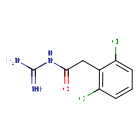
Structure for Guanfacine (DB01018)

- Weight
- Average: 246.093
Monoisotopic: 245.012267339 - Chemical Formula
- C9H9Cl2N3O
- Synonyms
- Guanfacina
- Guanfacine
- Guanfacinum
- External IDs
- SPD 503

Pharmacology
- Indication
Guanfacine is indicated alone or as an adjunct with stimulants to treat ADHD.11
 Reduce drug development failure ratesBuild, train, & validate machine-learning modelswith evidence-based and structured datasets.Build, train, & validate predictive machine-learning models with structured datasets.
- Associated Conditions
Indication Type Indication Combined Product Details Approval Level Age Group Patient Characteristics Dose Form Adjunct therapy in management of Attention deficit disorder with hyperactivity (adhd) •••••••••••• ••••••••••• •••••••• ••••••• •••••••• ••••••• Management of Attention deficit disorder with hyperactivity (adhd) •••••••••••• ••••••••••• •••••••• ••••••••• •• ••••••••••• ••••••• •••••••• ••••••• Management of Hypertension ••• ••••• •••••• Prophylaxis of Migraine ••• ••••• Management of Tourette syndrome ••• ••••• - Contraindications & Blackbox Warnings
 Prevent Adverse Drug Events TodayTap into our Clinical API for life-saving information on contraindications & blackbox warnings, population restrictions, harmful risks, & more.Avoid life-threatening adverse drug events with our Clinical API
- Pharmacodynamics
Guanfacine is a selective alpha-2A adrenergic receptor agonist but it is unclear how this translates to the treatment of ADHD.11 It has a long duration of action as it is given once daily and a wide therapeutic window as fatal overdoses have not been described in literature.11 Patients should be counselled regarding the risk of hypotension, bradycardia, and syncope.11
- Mechanism of action
Guanfacine is a selective alpha-2A adrenergic receptor agonist, which reduces the effects of the sympathetic nervous system on the heart and circulatory system.11 The link between guanfacine’s molecular mechanism and it’s effect on the treatment of ADHD has not been determined.11
Target Actions Organism AAlpha-2A adrenergic receptor agonistHumans UAlpha-2B adrenergic receptor binderHumans - Absorption
Guanfacine is 80% orally bioavailable.1
1mg immediate release oral guanfacine reaches a Cmax of 2.5±0.6ng/mL with a Tmax of 3.0h and an AUC of 56±15ng*h/mL.11 1mg extended release oral guanfacine reaches a Cmax of 1.0±0.3ng/mL with a Tmax of 6.0h and an AUC of 32±9ng*h/mL.11
In adults, a 4mg oral extended release dose reaches a Cmax of 3.58±1.39ng/mL with a Tmax of 5.5h; in children, a 2mg oral extended relsease dose reaches a Cmax of 2.6±1.03ng/mL with a Tmax of 4.98h; in adolescents, a 2mg oral extended release dose reaches a Cmax of 1.7±0.43ng/mL with a Tmax of 4.96h.7
- Volume of distribution
Guanfacine has a volume of distribution of 6.3L/kg.1
- Protein binding
- Metabolism
Guanfacine is oxidized by CYP3A46 to it's main metabolite, 3-hydroxyguanfacine.4 3-hydroxyguanfacine is then either glucuronidated or sulphated.4,5
Hover over products below to view reaction partners
- Route of elimination
Guanfacine is 57.0±32.0% eliminated in the urine in patients with normal renal function.2 Patients with a glomerular filtration rate (GFR) of 10-30mL/min eliminate 14.0±9.0% of a dose in the urine, while patients with a GFR of <1mL/min eliminate 7.5±2.4% of a dose in the urine.2
- Half-life
Guanfacine has a half life of 17 hours, but this may range from 10-30 hours.1 The half life is largely independant of renal function.2
- Clearance
Guanfacine has a total body cleraance of 360±262mL/min and a renal clearance of 233±245mL/min in patients with normal renal function. Patients with a glomerular filtration rate (GFR) of 10-30mL/min had a total body clearance of 308±274mL/min and a renal clearance of 34±22mL/min.2 Patients with a GFR of <1mL/min had a total body clearance of 257±187mL/min and a renal clearance of 18±15mL/min.2
- Adverse Effects
 Improve decision support & research outcomesWith structured adverse effects data, including: blackbox warnings, adverse reactions, warning & precautions, & incidence rates. View sample adverse effects data in our new Data Library!Improve decision support & research outcomes with our structured adverse effects data.
- Toxicity
The oral LD50 in rats is 142mg/kg and 15.3mg/kg in mice.12 The subcutaneous LD50 in rats is 114mg/kg and 46mg/kg in mice.12
Patients experiencing and overdose may present with hypotension, drowsiness, lethargy, and bradycardia.11 Overdose should be managed by first calling local poison control. Patients may require intravenous saline to maintain blood pressure.3
- Pathways
- Not Available
- Pharmacogenomic Effects/ADRs
- Not Available
Interactions
- Drug Interactions
- This information should not be interpreted without the help of a healthcare provider. If you believe you are experiencing an interaction, contact a healthcare provider immediately. The absence of an interaction does not necessarily mean no interactions exist.
Drug Interaction Integrate drug-drug
interactions in your software1,2-Benzodiazepine The risk or severity of CNS depression can be increased when Guanfacine is combined with 1,2-Benzodiazepine. Abacavir Guanfacine may decrease the excretion rate of Abacavir which could result in a higher serum level. Abaloparatide The risk or severity of adverse effects can be increased when Guanfacine is combined with Abaloparatide. Abametapir The serum concentration of Guanfacine can be increased when it is combined with Abametapir. Acebutolol The therapeutic efficacy of Guanfacine can be decreased when used in combination with Acebutolol. - Food Interactions
- Avoid alcohol.
- Do not take with or immediately after a high-fat meal. High fat meals increase drug exposure.
Products
 Drug product information from 10+ global regionsOur datasets provide approved product information including:dosage, form, labeller, route of administration, and marketing period.Access drug product information from over 10 global regions.
- Product Ingredients
Ingredient UNII CAS InChI Key Guanfacine hydrochloride PML56A160O 29110-48-3 DGFYECXYGUIODH-UHFFFAOYSA-N - Product Images
- International/Other Brands
- Estulic (Egis)
- Brand Name Prescription Products
Name Dosage Strength Route Labeller Marketing Start Marketing End Region Image Intuniv Tablet, extended release 2 mg/1 Oral Takeda Pharmaceuticals America, Inc. 2009-09-02 Not applicable US 

Intuniv Tablet, extended release 2 mg/1 Oral TYA Pharmaceuticals 2009-09-02 Not applicable US 
Intuniv Tablet, extended release 4 mg Oral Takeda Pharmaceuticals International Ag Ireland Branch 2016-09-08 Not applicable EU 
Intuniv Tablet, extended release 2 mg Oral Takeda Pharmaceuticals International Ag Ireland Branch 2016-09-08 Not applicable EU Intuniv Tablet, extended release 1 mg Oral Takeda Pharmaceuticals International Ag Ireland Branch 2016-09-08 Not applicable EU - Generic Prescription Products
Name Dosage Strength Route Labeller Marketing Start Marketing End Region Image Ag-guanfacine XR Tablet, extended release 3 mg Oral Angita Pharma Inc. Not applicable Not applicable Canada 
Ag-guanfacine XR Tablet, extended release 1 mg Oral Angita Pharma Inc. Not applicable Not applicable Canada Ag-guanfacine XR Tablet, extended release 2 mg Oral Angita Pharma Inc. Not applicable Not applicable Canada Ag-guanfacine XR Tablet, extended release 4 mg Oral Angita Pharma Inc. Not applicable Not applicable Canada Apo-guanfacine XR Tablet, extended release 4 mg Oral Apotex Corporation 2022-01-31 Not applicable Canada - Mixture Products
Name Ingredients Dosage Route Labeller Marketing Start Marketing End Region Image Intuniv Guanfacine hydrochloride (1 mg/1) + Guanfacine hydrochloride (2 mg/1) Kit; Tablet, extended release Oral Takeda Pharmaceuticals America, Inc. 2009-09-02 2015-10-29 US Intuniv Guanfacine hydrochloride (1 mg/1) + Guanfacine hydrochloride (2 mg/1) Kit Oral Shire US Manufacturing Inc. 2009-09-02 2011-06-15 US Intuniv Guanfacine hydrochloride (1 mg/1) + Guanfacine hydrochloride (2 mg/1) Kit; Tablet, extended release Oral Takeda Pharmaceuticals America, Inc. 2009-09-02 2015-10-29 US Intuniv Guanfacine hydrochloride (1 mg/1) + Guanfacine hydrochloride (2 mg/1) Kit Oral Shire US Manufacturing Inc. 2009-09-02 2011-06-15 US


Categories
- ATC Codes
- C02AC02 — Guanfacine
- Drug Categories
- Adrenergic Agents
- Adrenergic Agonists
- Adrenergic alpha-2 Receptor Agonists
- Adrenergic alpha-Agonists
- Agents producing tachycardia
- Agents that produce hypertension
- Amidines
- Antiadrenergic Agents, Centrally Acting
- Antihypertensive Agents
- Antihypertensive Agents Indicated for Hypertension
- Bradycardia-Causing Agents
- Cardiovascular Agents
- Central alpha-2 Adrenergic Agonist
- Central Alpha-agonists
- Central Nervous System Depressants
- Cytochrome P-450 CYP2C19 Substrates
- Cytochrome P-450 CYP3A Substrates
- Cytochrome P-450 CYP3A4 Substrates
- Cytochrome P-450 Substrates
- Drugs that are Mainly Renally Excreted
- Guanidines
- Hypotensive Agents
- Imidazoline Receptor Agonists
- MATE 1 Inhibitors
- MATE inhibitors
- Neurotransmitter Agents
- OCT1 inhibitors
- OCT1 substrates
- OCT2 Substrates
- Chemical TaxonomyProvided by Classyfire
- Description
- This compound belongs to the class of organic compounds known as dichlorobenzenes. These are compounds containing a benzene with exactly two chlorine atoms attached to it.
- Kingdom
- Organic compounds
- Super Class
- Benzenoids
- Class
- Benzene and substituted derivatives
- Sub Class
- Halobenzenes
- Direct Parent
- Dichlorobenzenes
- Alternative Parents
- Aryl chlorides / Propargyl-type 1,3-dipolar organic compounds / Carboximidamides / Organopnictogen compounds / Organooxygen compounds / Organochlorides / Imines / Hydrocarbon derivatives
- Substituents
- 1,3-dichlorobenzene / Aromatic homomonocyclic compound / Aryl chloride / Aryl halide / Carboximidamide / Hydrocarbon derivative / Imine / Organic 1,3-dipolar compound / Organic nitrogen compound / Organic oxygen compound
- Molecular Framework
- Aromatic homomonocyclic compounds
- External Descriptors
- acetamides (CHEBI:5558)
- Affected organisms
- Humans and other mammals
Chemical Identifiers
- UNII
- 30OMY4G3MK
- CAS number
- 29110-47-2
- InChI Key
- INJOMKTZOLKMBF-UHFFFAOYSA-N
- InChI
- InChI=1S/C9H9Cl2N3O/c10-6-2-1-3-7(11)5(6)4-8(15)14-9(12)13/h1-3H,4H2,(H4,12,13,14,15)
- IUPAC Name
- N-carbamimidoyl-2-(2,6-dichlorophenyl)acetamide
- SMILES
- NC(=N)NC(=O)CC1=C(Cl)C=CC=C1Cl
References
- Synthesis Reference
U.S. Patent 3,632,645.
- General References
- Cruz MP: Guanfacine Extended-Release Tablets (Intuniv), a Nonstimulant Selective Alpha(2A)-Adrenergic Receptor Agonist For Attention-Deficit/Hyperactivity Disorder. P T. 2010 Aug;35(8):448-51. [Article]
- Kirch W, Kohler H, Braun W: Elimination of guanfacine in patients with normal and impaired renal function. Br J Clin Pharmacol. 1980;10 Suppl 1:33S-35S. doi: 10.1111/j.1365-2125.1980.tb04902.x. [Article]
- Minns AB, Clark RF, Schneir A: Guanfacine overdose resulting in initial hypertension and subsequent delayed, persistent orthostatic hypotension. Clin Toxicol (Phila). 2010 Feb;48(2):146-8. doi: 10.3109/15563650903505174. [Article]
- Kiechel JR: Pharmacokinetics and metabolism of guanfacine in man: a review. Br J Clin Pharmacol. 1980;10 Suppl 1:25S-32S. doi: 10.1111/j.1365-2125.1980.tb04901.x. [Article]
- Guerret M, Julien-Larose C, Kiechel JR, Lavene D: Determination of 3-hydroxy-guanfacine in biological fluids by electron-capture gas-liquid chromatography. J Chromatogr. 1982 Dec 10;233:181-92. doi: 10.1016/s0378-4347(00)81745-4. [Article]
- Inoue Y, Morita H, Nozawa K, Kanazu T: Metabolite profiling of guanfacine in plasma and urine of healthy Japanese subjects after oral administration of guanfacine extended-release tablets. Biopharm Drug Dispos. 2019 Sep;40(8):282-293. doi: 10.1002/bdd.2201. Epub 2019 Aug 7. [Article]
- Martin P, Satin L, Vince BD, Padilla AF, White C, Corcoran M, Stevenson A, Ermer J: Pharmacokinetics and pharmacodynamics of guanfacine extended release in adolescents aged 13-17 years with attention-deficit/hyperactivity disorder. Clin Pharmacol Drug Dev. 2014 Jul;3(4):252-61. doi: 10.1002/cpdd.124. Epub 2014 May 17. [Article]
- Dubach UC, Huwyler R, Radielovic P, Singeisen M: A new centrally action antihypertensive agent guanfacine (BS 100-141). Arzneimittelforschung. 1977;27(3):674-6. [Article]
- Scholtysik G: Proceedings: Inhibition of effects of accelerator nerve stimulation in cats and rabbits by BS 100-141 and guanabenz. Naunyn Schmiedebergs Arch Pharmacol. 1974;282(Suppl):suppl 282:R86. [Article]
- FDA Approved Drug Products: Tenex Guanfacine Hydrochloride Oral Tablets (Discontinued) [Link]
- FDA Approved Drug Products: Intuniv Guanfacine Hydrochloride Extended Release Oral Tablets [Link]
- Cayman Chemical: Guanfacine MSDS [Link]
- External Links
- Human Metabolome Database
- HMDB0015153
- KEGG Drug
- D08031
- KEGG Compound
- C07037
- PubChem Compound
- 3519
- PubChem Substance
- 46506169
- ChemSpider
- 3399
- BindingDB
- 81984
- 40114
- ChEBI
- 5558
- ChEMBL
- CHEMBL862
- ZINC
- ZINC000003872738
- Therapeutic Targets Database
- DAP000900
- PharmGKB
- PA449825
- Guide to Pharmacology
- GtP Drug Page
- RxList
- RxList Drug Page
- Drugs.com
- Drugs.com Drug Page
- PDRhealth
- PDRhealth Drug Page
- Wikipedia
- Guanfacine
Clinical Trials
- Clinical Trials
Phase Status Purpose Conditions Count 4 Active Not Recruiting Treatment Chronic Pain 1 4 Completed Basic Science Attention Deficit Hyperactivity Disorder (ADHD) 1 4 Completed Treatment ADHD - Inattentive Type / Childhood Aggression / Defiant Disorder, Oppositional / Intermittent Explosive Disorder 1 4 Completed Treatment Adult Attention Deficit Hyperactivity Disorder (ADHD) 1 4 Completed Treatment Attention Deficit Hyperactivity Disorder (ADHD) 5
Pharmacoeconomics
- Manufacturers
- Shire development inc
- Amneal pharmaceutical
- Mikah pharma llc
- Mylan pharmaceuticals inc
- Watson laboratories inc
- Promius pharma llc
- Packagers
- Actavis Group
- Advanced Pharmaceutical Services Inc.
- Amerisource Health Services Corp.
- Amneal Pharmaceuticals
- Atlantic Biologicals Corporation
- Cardinal Health
- Industriale Chimica S.R.L.
- Major Pharmaceuticals
- Murfreesboro Pharmaceutical Nursing Supply
- Mylan
- Par Pharmaceuticals
- Patheon Inc.
- Pharmaceutical Utilization Management Program VA Inc.
- Pharmedix
- Physicians Total Care Inc.
- Promius Pharma
- Qualitest
- Resource Optimization and Innovation LLC
- Shire Inc.
- Southwood Pharmaceuticals
- Watson Pharmaceuticals
- Dosage Forms
Form Route Strength Tablet, extended release Oral Tablet, extended release Oral 3 mg/1 Tablet, extended release Oral 4 mg/1 Tablet Oral 1 mg/1 Tablet Oral 2 mg/1 Tablet, film coated, extended release Oral 1 mg/1 Tablet, film coated, extended release Oral 2 mg/1 Tablet, film coated, extended release Oral 3 mg/1 Tablet, film coated, extended release Oral 4 mg/1 Kit Oral Kit; tablet, extended release Oral Tablet, extended release Oral 1 mg/1 Tablet, extended release Oral 2 mg/1 Tablet, extended release Oral 1 mg Tablet, extended release Oral 2 mg Tablet, extended release Oral 3 mg Tablet, extended release Oral 4 mg - Prices
Unit description Cost Unit Intuniv 1 mg 24 Hour tablet 5.72USD tablet Intuniv 2 mg 24 Hour tablet 5.72USD tablet Intuniv 3 mg 24 Hour tablet 5.72USD tablet Intuniv 4 mg 24 Hour tablet 5.72USD tablet Intuniv er 1 mg tablet 5.5USD tablet Intuniv er 2 mg tablet 5.5USD tablet Intuniv er 3 mg tablet 5.5USD tablet Intuniv er 4 mg tablet 5.5USD tablet Tenex 2 mg tablet 4.3USD tablet Tenex 1 mg tablet 2.9USD tablet Guanfacine HCl 2 mg tablet 1.22USD tablet Guanfacine 2 mg tablet 1.18USD tablet Guanfacine HCl 1 mg tablet 0.91USD tablet Guanfacine 1 mg tablet 0.87USD tablet DrugBank does not sell nor buy drugs. Pricing information is supplied for informational purposes only.- Patents
Patent Number Pediatric Extension Approved Expires (estimated) Region US5854290 Yes 1998-12-29 2016-03-21 US US6811794 Yes 2004-11-02 2023-01-04 US US6287599 Yes 2001-09-11 2021-06-20 US
Properties
- State
- Solid
- Experimental Properties
Property Value Source melting point (°C) 213-216 U.S. Patent 3,632,645. water solubility 1mg/mL FDA Label logP 0.857 ChemSpider - Predicted Properties
Property Value Source Water Solubility 0.139 mg/mL ALOGPS logP 2.28 ALOGPS logP 1.74 Chemaxon logS -3.2 ALOGPS pKa (Strongest Acidic) 11.64 Chemaxon pKa (Strongest Basic) 8.65 Chemaxon Physiological Charge 1 Chemaxon Hydrogen Acceptor Count 3 Chemaxon Hydrogen Donor Count 3 Chemaxon Polar Surface Area 78.97 Å2 Chemaxon Rotatable Bond Count 2 Chemaxon Refractivity 69.63 m3·mol-1 Chemaxon Polarizability 22.44 Å3 Chemaxon Number of Rings 1 Chemaxon Bioavailability 1 Chemaxon Rule of Five Yes Chemaxon Ghose Filter Yes Chemaxon Veber's Rule No Chemaxon MDDR-like Rule No Chemaxon - Predicted ADMET Features
Property Value Probability Human Intestinal Absorption + 0.9313 Blood Brain Barrier + 0.9567 Caco-2 permeable - 0.5101 P-glycoprotein substrate Non-substrate 0.6778 P-glycoprotein inhibitor I Non-inhibitor 0.8782 P-glycoprotein inhibitor II Non-inhibitor 0.9833 Renal organic cation transporter Non-inhibitor 0.6443 CYP450 2C9 substrate Non-substrate 0.7572 CYP450 2D6 substrate Non-substrate 0.7948 CYP450 3A4 substrate Non-substrate 0.6475 CYP450 1A2 substrate Non-inhibitor 0.9046 CYP450 2C9 inhibitor Non-inhibitor 0.8893 CYP450 2D6 inhibitor Inhibitor 0.8931 CYP450 2C19 inhibitor Non-inhibitor 0.7376 CYP450 3A4 inhibitor Non-inhibitor 0.831 CYP450 inhibitory promiscuity Low CYP Inhibitory Promiscuity 0.6619 Ames test Non AMES toxic 0.7223 Carcinogenicity Non-carcinogens 0.8107 Biodegradation Not ready biodegradable 0.9843 Rat acute toxicity 2.7408 LD50, mol/kg Not applicable hERG inhibition (predictor I) Weak inhibitor 0.9677 hERG inhibition (predictor II) Non-inhibitor 0.9285
Spectra
- Mass Spec (NIST)
- Not Available
- Spectra
Spectrum Spectrum Type Splash Key Predicted GC-MS Spectrum - GC-MS Predicted GC-MS splash10-0a4l-5900000000-766dd9f92ab525fb3d7f Predicted MS/MS Spectrum - 10V, Positive (Annotated) Predicted LC-MS/MS splash10-0002-0090000000-50a2b041228c1ef7c8d4 Predicted MS/MS Spectrum - 10V, Negative (Annotated) Predicted LC-MS/MS splash10-0udi-0190000000-14ce6bf26b6072d3b6b3 Predicted MS/MS Spectrum - 20V, Positive (Annotated) Predicted LC-MS/MS splash10-0006-9100000000-004c9a6dc06583cf69a5 Predicted MS/MS Spectrum - 20V, Negative (Annotated) Predicted LC-MS/MS splash10-0006-9100000000-255a7a3dcd356cc46e1b Predicted MS/MS Spectrum - 40V, Negative (Annotated) Predicted LC-MS/MS splash10-0006-9000000000-0c3e14d9066e2d3fd1a9 Predicted MS/MS Spectrum - 40V, Positive (Annotated) Predicted LC-MS/MS splash10-0006-9500000000-6e112e5aeb6150468df0 Predicted 1H NMR Spectrum 1D NMR Not Applicable Predicted 13C NMR Spectrum 1D NMR Not Applicable - Chromatographic Properties
Collision Cross Sections (CCS)
Adduct CCS Value (Å2) Source type Source [M-H]- 147.3237162 predictedDarkChem Lite v0.1.0 [M-H]- 147.56963 predictedDeepCCS 1.0 (2019) [M+H]+ 147.6717162 predictedDarkChem Lite v0.1.0 [M+H]+ 149.92763 predictedDeepCCS 1.0 (2019) [M+Na]+ 147.1192162 predictedDarkChem Lite v0.1.0 [M+Na]+ 156.22723 predictedDeepCCS 1.0 (2019)
Targets

- Kind
- Protein
- Organism
- Humans
- Pharmacological action
- Yes
- Actions
- Agonist
- General Function
- Thioesterase binding
- Specific Function
- Alpha-2 adrenergic receptors mediate the catecholamine-induced inhibition of adenylate cyclase through the action of G proteins. The rank order of potency for agonists of this receptor is oxymetazo...
- Gene Name
- ADRA2A
- Uniprot ID
- P08913
- Uniprot Name
- Alpha-2A adrenergic receptor
- Molecular Weight
- 48956.275 Da
References
- Avery RA, Franowicz JS, Studholme C, van Dyck CH, Arnsten AF: The alpha-2A-adrenoceptor agonist, guanfacine, increases regional cerebral blood flow in dorsolateral prefrontal cortex of monkeys performing a spatial working memory task. Neuropsychopharmacology. 2000 Sep;23(3):240-9. [Article]
- Sagvolden T: The alpha-2A adrenoceptor agonist guanfacine improves sustained attention and reduces overactivity and impulsiveness in an animal model of Attention-Deficit/Hyperactivity Disorder (ADHD). Behav Brain Funct. 2006 Dec 15;2:41. [Article]
- Yuan R, Wu Z, Kostenyuk IA, Burns JK: G-protein-coupled alpha2A-adrenoreceptor agonists differentially alter citrus leaf and fruit abscission by affecting expression of ACC synthase and ACC oxidase. J Exp Bot. 2005 Jul;56(417):1867-75. Epub 2005 May 31. [Article]
- Birnbaum SG, Podell DM, Arnsten AF: Noradrenergic alpha-2 receptor agonists reverse working memory deficits induced by the anxiogenic drug, FG7142, in rats. Pharmacol Biochem Behav. 2000 Nov;67(3):397-403. [Article]
- Millan MJ: Evidence that an alpha 2A-adrenoceptor subtype mediates antinociception in mice. Eur J Pharmacol. 1992 May 14;215(2-3):355-6. [Article]
- Stahl SM: Mechanism of action of alpha 2A-adrenergic agonists in attention-deficit/hyperactivity disorder with or without oppositional symptoms. J Clin Psychiatry. 2010 Mar;71(3):223-4. doi: 10.4088/JCP.09bs05899pur. [Article]
- FDA Approved Drug Products: Intuniv Guanfacine Hydrochloride Extended Release Oral Tablets [Link]
- Kind
- Protein
- Organism
- Humans
- Pharmacological action
- Unknown
- Actions
- Binder
- Curator comments
- Guanfacine binds to Alpha-2B adrenergic receptors with such low affinity that it is not clinically relevant.
- General Function
- Epinephrine binding
- Specific Function
- Alpha-2 adrenergic receptors mediate the catecholamine-induced inhibition of adenylate cyclase through the action of G proteins. The rank order of potency for agonists of this receptor is clonidine...
- Gene Name
- ADRA2B
- Uniprot ID
- P18089
- Uniprot Name
- Alpha-2B adrenergic receptor
- Molecular Weight
- 49565.8 Da
References
- Uhlen S, Wikberg JE: Delineation of rat kidney alpha 2A- and alpha 2B-adrenoceptors with [3H]RX821002 radioligand binding: computer modelling reveals that guanfacine is an alpha 2A-selective compound. Eur J Pharmacol. 1991 Sep 17;202(2):235-43. [Article]
Enzymes
- Kind
- Protein
- Organism
- Humans
- Pharmacological action
- Unknown
- Actions
- Substrate
- General Function
- Steroid hydroxylase activity
- Specific Function
- Responsible for the metabolism of a number of therapeutic agents such as the anticonvulsant drug S-mephenytoin, omeprazole, proguanil, certain barbiturates, diazepam, propranolol, citalopram and im...
- Gene Name
- CYP2C19
- Uniprot ID
- P33261
- Uniprot Name
- Cytochrome P450 2C19
- Molecular Weight
- 55930.545 Da
References
- Clement B, Demesmaeker M: Microsomal catalyzed N-hydroxylation of guanfacine and reduction of N-hydroxyguanfacine. Arch Pharm (Weinheim). 1997 Oct;330(9-10):303-6. [Article]
- Guillouzo A, Le Bigot JF, Guguen-Guillouzo C, Kiechel JR: Presence of phase I and phase II drug metabolizing enzymes in cultured human foetal hepatocytes. Biochem Pharmacol. 1982 Jul 15;31(14):2427-30. [Article]
- Kind
- Protein
- Organism
- Humans
- Pharmacological action
- Unknown
- Actions
- Substrate
- General Function
- Vitamin d3 25-hydroxylase activity
- Specific Function
- Cytochromes P450 are a group of heme-thiolate monooxygenases. In liver microsomes, this enzyme is involved in an NADPH-dependent electron transport pathway. It performs a variety of oxidation react...
- Gene Name
- CYP3A4
- Uniprot ID
- P08684
- Uniprot Name
- Cytochrome P450 3A4
- Molecular Weight
- 57342.67 Da
References
- Clement B, Demesmaeker M: Microsomal catalyzed N-hydroxylation of guanfacine and reduction of N-hydroxyguanfacine. Arch Pharm (Weinheim). 1997 Oct;330(9-10):303-6. [Article]
- Guillouzo A, Le Bigot JF, Guguen-Guillouzo C, Kiechel JR: Presence of phase I and phase II drug metabolizing enzymes in cultured human foetal hepatocytes. Biochem Pharmacol. 1982 Jul 15;31(14):2427-30. [Article]
- FDA Approved Drug Products: Intuniv Guanfacine Hydrochloride Extended Release Oral Tablets [Link]
Transporters
- Kind
- Protein
- Organism
- Humans
- Pharmacological action
- Unknown
- Actions
- Inhibitor
- General Function
- Monovalent cation:proton antiporter activity
- Specific Function
- Solute transporter for tetraethylammonium (TEA), 1-methyl-4-phenylpyridinium (MPP), cimetidine, N-methylnicotinamide (NMN), metformin, creatinine, guanidine, procainamide, topotecan, estrone sulfat...
- Gene Name
- SLC47A1
- Uniprot ID
- Q96FL8
- Uniprot Name
- Multidrug and toxin extrusion protein 1
- Molecular Weight
- 61921.585 Da
References
- FDA Approved Drug Products: Intuniv Guanfacine Hydrochloride Extended Release Oral Tablets [Link]
- Kind
- Protein
- Organism
- Humans
- Pharmacological action
- Unknown
- Actions
- SubstrateInhibitor
- General Function
- Secondary active organic cation transmembrane transporter activity
- Specific Function
- Translocates a broad array of organic cations with various structures and molecular weights including the model compounds 1-methyl-4-phenylpyridinium (MPP), tetraethylammonium (TEA), N-1-methylnico...
- Gene Name
- SLC22A1
- Uniprot ID
- O15245
- Uniprot Name
- Solute carrier family 22 member 1
- Molecular Weight
- 61153.345 Da
References
- FDA Approved Drug Products: Intuniv Guanfacine Hydrochloride Extended Release Oral Tablets [Link]
- Kind
- Protein
- Organism
- Humans
- Pharmacological action
- Unknown
- Actions
- Substrate
- General Function
- Quaternary ammonium group transmembrane transporter activity
- Specific Function
- Mediates tubular uptake of organic compounds from circulation. Mediates the influx of agmatine, dopamine, noradrenaline (norepinephrine), serotonin, choline, famotidine, ranitidine, histamin, creat...
- Gene Name
- SLC22A2
- Uniprot ID
- O15244
- Uniprot Name
- Solute carrier family 22 member 2
- Molecular Weight
- 62579.99 Da
References
- FDA Approved Drug Products: Intuniv Guanfacine Hydrochloride Extended Release Oral Tablets [Link]

Drug created at June 13, 2005 13:24 / Updated at April 23, 2024 11:38