Identification
- Summary
Nitrendipine is a dihydropyridine calcium channel blocker indicated in the treatment of arterial hypertension.
- Generic Name
- Nitrendipine
- DrugBank Accession Number
- DB01054
- Background
Nitrendipine is a calcium channel blocker with marked vasodilator action. It is an effective antihypertensive agent and differs from other calcium channel blockers in that it does not reduce glomerular filtration rate and is mildly natriuretic, rather than sodium retentive.
- Type
- Small Molecule
- Groups
- Approved, Investigational
- Structure
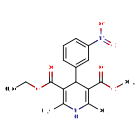
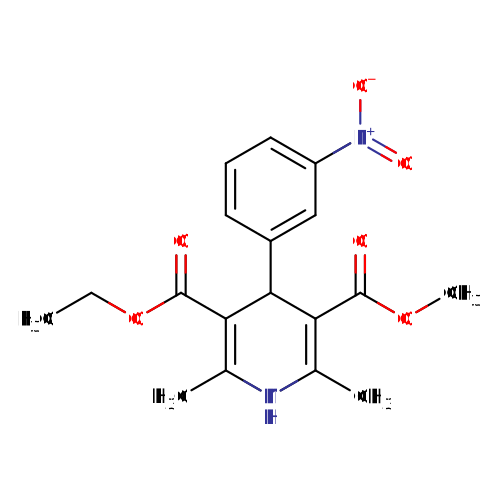
Structure for Nitrendipine (DB01054)
- Weight
- Average: 360.3612
Monoisotopic: 360.132136382 - Chemical Formula
- C18H20N2O6
- Synonyms
- 1,4-dihydro-2,6-dimethyl-4-(3-nitrophenyl)-3,5-pyridinedicarboxylic acid ethyl methyl ester
- Nitrendipine
- Nitrendipino
- Nitrendipinum
- External IDs
- BAY E 5009
- BAY-E-5009

Pharmacology
- Indication
For the treatment of mild to moderate hypertension
 Reduce drug development failure ratesBuild, train, & validate machine-learning modelswith evidence-based and structured datasets.Build, train, & validate predictive machine-learning models with structured datasets.
- Associated Conditions
Indication Type Indication Combined Product Details Approval Level Age Group Patient Characteristics Dose Form Used in combination to treat High blood pressure (hypertension) Combination Product in combination with: Enalapril (DB00584) •••••••••••• •••••• Management of High blood pressure (hypertension) •••••••••••• •••••• - Contraindications & Blackbox Warnings
 Prevent Adverse Drug Events TodayTap into our Clinical API for life-saving information on contraindications & blackbox warnings, population restrictions, harmful risks, & more.Avoid life-threatening adverse drug events with our Clinical API
- Pharmacodynamics
Nitrendipine, a dihydropyridine calcium-channel blocker, is used alone or with an angiotensin-converting enzyme inhibitor, to treat hypertension, chronic stable angina pectoris, and Prinzmetal's variant angina. Nitrendipine is similar to other peripheral vasodilators. Nitrendipine inhibits the influx of extra cellular calcium across the myocardial and vascular smooth muscle cell membranes possibly by deforming the channel, inhibiting ion-control gating mechanisms, and/or interfering with the release of calcium from the sarcoplasmic reticulum. The decrease in intracellular calcium inhibits the contractile processes of the myocardial smooth muscle cells, causing dilation of the coronary and systemic arteries, increased oxygen delivery to the myocardial tissue, decreased total peripheral resistance, decreased systemic blood pressure, and decreased afterload.
- Mechanism of action
By deforming the channel, inhibiting ion-control gating mechanisms, and/or interfering with the release of calcium from the sarcoplasmic reticulum, Nitrendipine inhibits the influx of extracellular calcium across the myocardial and vascular smooth muscle cell membranes The decrease in intracellular calcium inhibits the contractile processes of the myocardial smooth muscle cells, causing dilation of the coronary and systemic arteries, increased oxygen delivery to the myocardial tissue, decreased total peripheral resistance, decreased systemic blood pressure, and decreased afterload.
Target Actions Organism AVoltage-dependent L-type calcium channel subunit alpha-1C inhibitorHumans AVoltage-dependent calcium channel subunit alpha-2/delta-1 inhibitorHumans AVoltage-dependent L-type calcium channel subunit beta-2 inhibitorHumans AVoltage-dependent L-type calcium channel subunit alpha-1D inhibitorHumans AVoltage-dependent L-type calcium channel subunit alpha-1S inhibitorHumans UVoltage-dependent calcium channel subunit alpha-2/delta-2 inhibitorHumans UVoltage-dependent T-type calcium channel subunit alpha-1H inhibitorHumans UVoltage-dependent L-type calcium channel inhibitorHumans UCalcium-activated potassium channel inhibitorHumans - Absorption
Not Available
- Volume of distribution
Not Available
- Protein binding
> 99%
- Metabolism
- Not Available
- Route of elimination
Not Available
- Half-life
Not Available
- Clearance
Not Available
- Adverse Effects
 Improve decision support & research outcomesWith structured adverse effects data, including: blackbox warnings, adverse reactions, warning & precautions, & incidence rates. View sample adverse effects data in our new Data Library!Improve decision support & research outcomes with our structured adverse effects data.
- Toxicity
Not Available
- Pathways
Pathway Category Nitrendipine Action Pathway Drug action - Pharmacogenomic Effects/ADRs
- Not Available
Interactions
- Drug Interactions
- This information should not be interpreted without the help of a healthcare provider. If you believe you are experiencing an interaction, contact a healthcare provider immediately. The absence of an interaction does not necessarily mean no interactions exist.
Drug Interaction Integrate drug-drug
interactions in your softwareAbaloparatide The risk or severity of adverse effects can be increased when Nitrendipine is combined with Abaloparatide. Abametapir The serum concentration of Nitrendipine can be increased when it is combined with Abametapir. Abatacept The metabolism of Nitrendipine can be increased when combined with Abatacept. Acalabrutinib The metabolism of Nitrendipine can be decreased when combined with Acalabrutinib. Acarbose The risk or severity of hypoglycemia can be increased when Nitrendipine is combined with Acarbose. - Food Interactions
- Take with or without food.
Products
 Drug product information from 10+ global regionsOur datasets provide approved product information including:dosage, form, labeller, route of administration, and marketing period.Access drug product information from over 10 global regions.
- International/Other Brands
- Bayotensin / Baypress / Bylotensin / Deiten / Nidrel / Nitrepin / Nitrezic
- Mixture Products
Name Ingredients Dosage Route Labeller Marketing Start Marketing End Region Image Baroprine 10 mg/20 mg Tabletten Nitrendipine (20 mg) + Enalapril maleate (10 mg) Tablet Oral Ferrer Internacional S.A. 2002-12-16 Not applicable Austria 
Cenipres 10 mg/20 mg Tabletten Nitrendipine (20 mg) + Enalapril maleate (10 mg) Tablet Oral Ferrer Internacional Sa 2002-12-16 Not applicable Austria ENEAS 10/20 MG TABLET, 30 ADET Nitrendipine (20 mg) + Enalapril maleate (10 mg) Tablet Oral INNOGENS İLAÇ SAN.VE TİC. A.Ş. 2011-02-25 Not applicable Turkey 
ENEAS 10/20MG Nitrendipine (20 mg) + Enalapril maleate (10 mg) Tablet Oral 2016-07-01 Not applicable Germany 
ENEAS 10/20MG Nitrendipine (20 mg) + Enalapril maleate (10 mg) Tablet Oral 2016-07-01 Not applicable Germany
Categories
- ATC Codes
- C08CA08 — Nitrendipine
- C08CA — Dihydropyridine derivatives
- C08C — SELECTIVE CALCIUM CHANNEL BLOCKERS WITH MAINLY VASCULAR EFFECTS
- C08 — CALCIUM CHANNEL BLOCKERS
- C — CARDIOVASCULAR SYSTEM
- Drug Categories
- ACE Inhibitors and Calcium Channel Blockers
- Agents causing hyperkalemia
- Antiarrhythmic agents
- Antihypertensive Agents
- Bradycardia-Causing Agents
- BSEP/ABCB11 Substrates
- Calcium Channel Blockers
- Calcium-Regulating Hormones and Agents
- Cardiovascular Agents
- Cytochrome P-450 CYP3A Substrates
- Cytochrome P-450 CYP3A4 Substrates
- Cytochrome P-450 CYP3A5 Substrates
- Cytochrome P-450 CYP3A7 Substrates
- Cytochrome P-450 Substrates
- Dihydropyridine Derivatives
- Dihydropyridines
- Hypotensive Agents
- Membrane Transport Modulators
- P-glycoprotein inhibitors
- Potential QTc-Prolonging Agents
- Pyridines
- QTc Prolonging Agents
- Selective Calcium Channel Blockers With Mainly Vascular Effects
- Vasodilating Agents
- Chemical TaxonomyProvided by Classyfire
- Description
- This compound belongs to the class of organic compounds known as dihydropyridinecarboxylic acids and derivatives. These are compounds containing a dihydropyridine moiety bearing a carboxylic acid group.
- Kingdom
- Organic compounds
- Super Class
- Organoheterocyclic compounds
- Class
- Pyridines and derivatives
- Sub Class
- Hydropyridines
- Direct Parent
- Dihydropyridinecarboxylic acids and derivatives
- Alternative Parents
- Nitrobenzenes / Nitroaromatic compounds / Dicarboxylic acids and derivatives / Vinylogous amides / Enoate esters / Methyl esters / Amino acids and derivatives / Propargyl-type 1,3-dipolar organic compounds / Azacyclic compounds / Enamines show 6 more
- Substituents
- Allyl-type 1,3-dipolar organic compound / Alpha,beta-unsaturated carboxylic ester / Amine / Amino acid or derivatives / Aromatic heteromonocyclic compound / Azacycle / Benzenoid / C-nitro compound / Carbonyl group / Carboxylic acid derivative show 23 more
- Molecular Framework
- Aromatic heteromonocyclic compounds
- External Descriptors
- C-nitro compound, ethyl ester, diester, dihydropyridine (CHEBI:7582)
- Affected organisms
- Humans and other mammals
Chemical Identifiers
- UNII
- 9B627AW319
- CAS number
- 39562-70-4
- InChI Key
- PVHUJELLJLJGLN-UHFFFAOYSA-N
- InChI
- InChI=1S/C18H20N2O6/c1-5-26-18(22)15-11(3)19-10(2)14(17(21)25-4)16(15)12-7-6-8-13(9-12)20(23)24/h6-9,16,19H,5H2,1-4H3
- IUPAC Name
- 3-ethyl 5-methyl 2,6-dimethyl-4-(3-nitrophenyl)-1,4-dihydropyridine-3,5-dicarboxylate
- SMILES
- CCOC(=O)C1=C(C)NC(C)=C(C1C1=CC(=CC=C1)[N+]([O-])=O)C(=O)OC
References
- Synthesis Reference
Wolfgang Schmidt, Bernhard Streuff, Manfred Winter, "Preparation of solid medicament formulation containing nitrendipine." U.S. Patent US4724141, issued April, 1980.
US4724141- General References
- External Links
- Human Metabolome Database
- HMDB0015187
- KEGG Drug
- D00629
- KEGG Compound
- C07713
- PubChem Compound
- 4507
- PubChem Substance
- 46508817
- ChemSpider
- 4351
- BindingDB
- 50237611
- 7441
- ChEBI
- 7582
- ChEMBL
- CHEMBL475534
- Therapeutic Targets Database
- DAP001263
- PharmGKB
- PA146096020
- Guide to Pharmacology
- GtP Drug Page
- Wikipedia
- Nitrendipine
Clinical Trials
- Clinical Trials
Phase Status Purpose Conditions Count 4 Recruiting Treatment Hypertension 1 4 Suspended Prevention Coronavirus Disease 2019 (COVID‑19) / Hypertension 1 4 Unknown Status Treatment Hypertension 1 4 Withdrawn Treatment Chronic Kidney Disease (CKD) / Hypertension 1 3 Completed Treatment Isolated Systolic Hypertension (ISH) 1
Pharmacoeconomics
- Manufacturers
- Not Available
- Packagers
- Not Available
- Dosage Forms
Form Route Strength Tablet Oral 20 mg/1 Tablet Oral 10 mg/1 Tablet Oral Tablet Oral Tablet, film coated Oral 10 MG Tablet, film coated Oral 20 MG Tablet, coated Oral 10 mg Tablet, coated Oral 20 mg Tablet Oral 20 mg Tablet Oral 10 mg - Prices
- Not Available
- Patents
- Not Available
Properties
- State
- Solid
- Experimental Properties
Property Value Source melting point (°C) 156-160 °C Not Available water solubility Insoluble Not Available logP 2.88 MASUMATO,K ET AL. (1995) Caco2 permeability -4.77 ADME Research, USCD - Predicted Properties
Property Value Source Water Solubility 0.0142 mg/mL ALOGPS logP 3.21 ALOGPS logP 2.17 Chemaxon logS -4.4 ALOGPS pKa (Strongest Acidic) 16.97 Chemaxon pKa (Strongest Basic) -6.6 Chemaxon Physiological Charge 0 Chemaxon Hydrogen Acceptor Count 5 Chemaxon Hydrogen Donor Count 1 Chemaxon Polar Surface Area 107.77 Å2 Chemaxon Rotatable Bond Count 7 Chemaxon Refractivity 95.91 m3·mol-1 Chemaxon Polarizability 36.19 Å3 Chemaxon Number of Rings 2 Chemaxon Bioavailability 1 Chemaxon Rule of Five Yes Chemaxon Ghose Filter Yes Chemaxon Veber's Rule No Chemaxon MDDR-like Rule No Chemaxon - Predicted ADMET Features
Property Value Probability Human Intestinal Absorption + 0.9536 Blood Brain Barrier - 0.9549 Caco-2 permeable + 0.7853 P-glycoprotein substrate Substrate 0.5265 P-glycoprotein inhibitor I Inhibitor 0.8564 P-glycoprotein inhibitor II Inhibitor 0.8313 Renal organic cation transporter Non-inhibitor 0.8984 CYP450 2C9 substrate Non-substrate 0.8212 CYP450 2D6 substrate Non-substrate 0.8931 CYP450 3A4 substrate Substrate 0.7266 CYP450 1A2 substrate Inhibitor 0.9107 CYP450 2C9 inhibitor Inhibitor 0.8949 CYP450 2D6 inhibitor Non-inhibitor 0.9231 CYP450 2C19 inhibitor Inhibitor 0.8993 CYP450 3A4 inhibitor Inhibitor 0.8037 CYP450 inhibitory promiscuity High CYP Inhibitory Promiscuity 0.9247 Ames test Non AMES toxic 0.7334 Carcinogenicity Non-carcinogens 0.5186 Biodegradation Not ready biodegradable 0.9581 Rat acute toxicity 2.3810 LD50, mol/kg Not applicable hERG inhibition (predictor I) Weak inhibitor 0.8131 hERG inhibition (predictor II) Non-inhibitor 0.9094
Spectra
- Mass Spec (NIST)
- Not Available
- Spectra
- Chromatographic Properties
Collision Cross Sections (CCS)
Adduct CCS Value (Å2) Source type Source [M-H]- 198.816179 predictedDarkChem Lite v0.1.0 [M-H]- 186.48006 predictedDeepCCS 1.0 (2019) [M+H]+ 198.562479 predictedDarkChem Lite v0.1.0 [M+H]+ 189.73979 predictedDeepCCS 1.0 (2019) [M+Na]+ 198.688879 predictedDarkChem Lite v0.1.0 [M+Na]+ 198.20183 predictedDeepCCS 1.0 (2019)
Targets

- Kind
- Protein
- Organism
- Humans
- Pharmacological action
- Yes
- Actions
- Inhibitor
- General Function
- Voltage-gated calcium channel activity
- Specific Function
- Voltage-sensitive calcium channels (VSCC) mediate the entry of calcium ions into excitable cells and are also involved in a variety of calcium-dependent processes, including muscle contraction, hor...
- Gene Name
- CACNA1C
- Uniprot ID
- Q13936
- Uniprot Name
- Voltage-dependent L-type calcium channel subunit alpha-1C
- Molecular Weight
- 248974.1 Da
References
- Chen X, Ji ZL, Chen YZ: TTD: Therapeutic Target Database. Nucleic Acids Res. 2002 Jan 1;30(1):412-5. [Article]
- Regulla S, Schneider T, Nastainczyk W, Meyer HE, Hofmann F: Identification of the site of interaction of the dihydropyridine channel blockers nitrendipine and azidopine with the calcium-channel alpha 1 subunit. EMBO J. 1991 Jan;10(1):45-9. [Article]
- Striessnig, J. (2004). Ca 2+ channel blockers. In Encyclopedic reference of molecular pharmacology (pp. 201-207). Berlin: Springer. [ISBN:9783540298328]
- Kind
- Protein
- Organism
- Humans
- Pharmacological action
- Yes
- Actions
- Inhibitor
- General Function
- Voltage-gated calcium channel activity
- Specific Function
- The alpha-2/delta subunit of voltage-dependent calcium channels regulates calcium current density and activation/inactivation kinetics of the calcium channel. Plays an important role in excitation-...
- Gene Name
- CACNA2D1
- Uniprot ID
- P54289
- Uniprot Name
- Voltage-dependent calcium channel subunit alpha-2/delta-1
- Molecular Weight
- 124566.93 Da
References
- Chen X, Ji ZL, Chen YZ: TTD: Therapeutic Target Database. Nucleic Acids Res. 2002 Jan 1;30(1):412-5. [Article]
- Striessnig, J. (2004). Ca 2+ channel blockers. In Encyclopedic reference of molecular pharmacology (pp. 201-207). Berlin: Springer. [ISBN:9783540298328]
- Kind
- Protein
- Organism
- Humans
- Pharmacological action
- Yes
- Actions
- Inhibitor
- General Function
- Voltage-gated calcium channel activity
- Specific Function
- The beta subunit of voltage-dependent calcium channels contributes to the function of the calcium channel by increasing peak calcium current, shifting the voltage dependencies of activation and ina...
- Gene Name
- CACNB2
- Uniprot ID
- Q08289
- Uniprot Name
- Voltage-dependent L-type calcium channel subunit beta-2
- Molecular Weight
- 73579.925 Da
References
- Chen X, Ji ZL, Chen YZ: TTD: Therapeutic Target Database. Nucleic Acids Res. 2002 Jan 1;30(1):412-5. [Article]
- Striessnig, J. (2004). Ca 2+ channel blockers. In Encyclopedic reference of molecular pharmacology (pp. 201-207). Berlin: Springer. [ISBN:9783540298328]
- Kind
- Protein
- Organism
- Humans
- Pharmacological action
- Yes
- Actions
- Inhibitor
- General Function
- Voltage-gated calcium channel activity involved sa node cell action potential
- Specific Function
- Voltage-sensitive calcium channels (VSCC) mediate the entry of calcium ions into excitable cells and are also involved in a variety of calcium-dependent processes, including muscle contraction, hor...
- Gene Name
- CACNA1D
- Uniprot ID
- Q01668
- Uniprot Name
- Voltage-dependent L-type calcium channel subunit alpha-1D
- Molecular Weight
- 245138.75 Da
References
- Sinnegger-Brauns MJ, Huber IG, Koschak A, Wild C, Obermair GJ, Einzinger U, Hoda JC, Sartori SB, Striessnig J: Expression and 1,4-dihydropyridine-binding properties of brain L-type calcium channel isoforms. Mol Pharmacol. 2009 Feb;75(2):407-14. doi: 10.1124/mol.108.049981. Epub 2008 Nov 24. [Article]
- Regulla S, Schneider T, Nastainczyk W, Meyer HE, Hofmann F: Identification of the site of interaction of the dihydropyridine channel blockers nitrendipine and azidopine with the calcium-channel alpha 1 subunit. EMBO J. 1991 Jan;10(1):45-9. [Article]
- Kind
- Protein
- Organism
- Humans
- Pharmacological action
- Yes
- Actions
- Inhibitor
- General Function
- Voltage-gated calcium channel activity
- Specific Function
- Voltage-sensitive calcium channels (VSCC) mediate the entry of calcium ions into excitable cells and are also involved in a variety of calcium-dependent processes, including muscle contraction, hor...
- Gene Name
- CACNA1S
- Uniprot ID
- Q13698
- Uniprot Name
- Voltage-dependent L-type calcium channel subunit alpha-1S
- Molecular Weight
- 212348.1 Da
References
- Peterson BZ, Catterall WA: Allosteric interactions required for high-affinity binding of dihydropyridine antagonists to Ca(V)1.1 Channels are modulated by calcium in the pore. Mol Pharmacol. 2006 Aug;70(2):667-75. Epub 2006 May 4. [Article]
- Regulla S, Schneider T, Nastainczyk W, Meyer HE, Hofmann F: Identification of the site of interaction of the dihydropyridine channel blockers nitrendipine and azidopine with the calcium-channel alpha 1 subunit. EMBO J. 1991 Jan;10(1):45-9. [Article]
- Kind
- Protein
- Organism
- Humans
- Pharmacological action
- Unknown
- Actions
- Inhibitor
- General Function
- Voltage-gated calcium channel activity
- Specific Function
- The alpha-2/delta subunit of voltage-dependent calcium channels regulates calcium current density and activation/inactivation kinetics of the calcium channel. Acts as a regulatory subunit for P/Q-t...
- Gene Name
- CACNA2D2
- Uniprot ID
- Q9NY47
- Uniprot Name
- Voltage-dependent calcium channel subunit alpha-2/delta-2
- Molecular Weight
- 129816.095 Da
References
- Perez-Reyes E, Van Deusen AL, Vitko I: Molecular pharmacology of human Cav3.2 T-type Ca2+ channels: block by antihypertensives, antiarrhythmics, and their analogs. J Pharmacol Exp Ther. 2009 Feb;328(2):621-7. doi: 10.1124/jpet.108.145672. Epub 2008 Oct 30. [Article]
- Kind
- Protein
- Organism
- Humans
- Pharmacological action
- Unknown
- Actions
- Inhibitor
- General Function
- Scaffold protein binding
- Specific Function
- Voltage-sensitive calcium channels (VSCC) mediate the entry of calcium ions into excitable cells and are also involved in a variety of calcium-dependent processes, including muscle contraction, hor...
- Gene Name
- CACNA1H
- Uniprot ID
- O95180
- Uniprot Name
- Voltage-dependent T-type calcium channel subunit alpha-1H
- Molecular Weight
- 259160.2 Da
References
- Perez-Reyes E, Van Deusen AL, Vitko I: Molecular pharmacology of human Cav3.2 T-type Ca2+ channels: block by antihypertensives, antiarrhythmics, and their analogs. J Pharmacol Exp Ther. 2009 Feb;328(2):621-7. doi: 10.1124/jpet.108.145672. Epub 2008 Oct 30. [Article]
- Regulla S, Schneider T, Nastainczyk W, Meyer HE, Hofmann F: Identification of the site of interaction of the dihydropyridine channel blockers nitrendipine and azidopine with the calcium-channel alpha 1 subunit. EMBO J. 1991 Jan;10(1):45-9. [Article]
- Kind
- Protein group
- Organism
- Humans
- Pharmacological action
- Unknown
- Actions
- Inhibitor
- General Function
- Voltage-gated calcium channel activity
- Specific Function
- Voltage-sensitive calcium channels (VSCC) mediate the entry of calcium ions into excitable cells and are also involved in a variety of calcium-dependent processes, including muscle contraction, hor...
Components:
References
- Mize RR, Lo F: Nitric oxide, impulse activity, and neurotrophins in visual system development(1). Brain Res. 2000 Dec 15;886(1-2):15-32. doi: 10.1016/s0006-8993(00)02750-5. [Article]
- Goswami C, Dezaki K, Wang L, Inui A, Seino Y, Yada T: Ninjin'yoeito Targets Distinct Ca(2+) Channels to Activate Ghrelin-Responsive vs. Unresponsive NPY Neurons in the Arcuate Nucleus. Front Nutr. 2020 Jul 17;7:104. doi: 10.3389/fnut.2020.00104. eCollection 2020. [Article]
- Kind
- Protein group
- Organism
- Humans
- Pharmacological action
- Unknown
- Actions
- Inhibitor
- General Function
- Voltage-gated potassium channel activity
- Specific Function
- Potassium channel activated by both membrane depolarization or increase in cytosolic Ca(2+) that mediates export of K(+). It is also activated by the concentration of cytosolic Mg(2+). Its activati...
Components:
References
- Ellory JC, Kirk K, Culliford SJ, Nash GB, Stuart J: Nitrendipine is a potent inhibitor of the Ca(2+)-activated K+ channel of human erythrocytes. FEBS Lett. 1992 Jan 20;296(2):219-21. doi: 10.1016/0014-5793(92)80383-r. [Article]
Enzymes
- Kind
- Protein
- Organism
- Humans
- Pharmacological action
- Unknown
- Actions
- Substrate
- General Function
- Vitamin d3 25-hydroxylase activity
- Specific Function
- Cytochromes P450 are a group of heme-thiolate monooxygenases. In liver microsomes, this enzyme is involved in an NADPH-dependent electron transport pathway. It performs a variety of oxidation react...
- Gene Name
- CYP3A4
- Uniprot ID
- P08684
- Uniprot Name
- Cytochrome P450 3A4
- Molecular Weight
- 57342.67 Da
References
- Kind
- Protein
- Organism
- Humans
- Pharmacological action
- Unknown
- Actions
- Substrate
- General Function
- Oxygen binding
- Specific Function
- Cytochromes P450 are a group of heme-thiolate monooxygenases. In liver microsomes, this enzyme is involved in an NADPH-dependent electron transport pathway. It oxidizes a variety of structurally un...
- Gene Name
- CYP3A5
- Uniprot ID
- P20815
- Uniprot Name
- Cytochrome P450 3A5
- Molecular Weight
- 57108.065 Da
References
- Flockhart Table of Drug Interactions [Link]
- Kind
- Protein
- Organism
- Humans
- Pharmacological action
- Unknown
- Actions
- Substrate
- General Function
- Oxygen binding
- Specific Function
- Cytochromes P450 are a group of heme-thiolate monooxygenases. In liver microsomes, this enzyme is involved in an NADPH-dependent electron transport pathway. It oxidizes a variety of structurally un...
- Gene Name
- CYP3A7
- Uniprot ID
- P24462
- Uniprot Name
- Cytochrome P450 3A7
- Molecular Weight
- 57525.03 Da
References
- Flockhart Table of Drug Interactions [Link]
Transporters
- Kind
- Protein
- Organism
- Humans
- Pharmacological action
- Unknown
- Actions
- Inhibitor
- General Function
- Xenobiotic-transporting atpase activity
- Specific Function
- Energy-dependent efflux pump responsible for decreased drug accumulation in multidrug-resistant cells.
- Gene Name
- ABCB1
- Uniprot ID
- P08183
- Uniprot Name
- Multidrug resistance protein 1
- Molecular Weight
- 141477.255 Da
References
- Polli JW, Wring SA, Humphreys JE, Huang L, Morgan JB, Webster LO, Serabjit-Singh CS: Rational use of in vitro P-glycoprotein assays in drug discovery. J Pharmacol Exp Ther. 2001 Nov;299(2):620-8. [Article]
- Takara K, Sakaeda T, Tanigawara Y, Nishiguchi K, Ohmoto N, Horinouchi M, Komada F, Ohnishi N, Yokoyama T, Okumura K: Effects of 12 Ca2+ antagonists on multidrug resistance, MDR1-mediated transport and MDR1 mRNA expression. Eur J Pharm Sci. 2002 Aug;16(3):159-65. [Article]
- Kind
- Protein
- Organism
- Humans
- Pharmacological action
- No
- Actions
- Substrate
- General Function
- Transporter activity
- Specific Function
- Involved in the ATP-dependent secretion of bile salts into the canaliculus of hepatocytes.
- Gene Name
- ABCB11
- Uniprot ID
- O95342
- Uniprot Name
- Bile salt export pump
- Molecular Weight
- 146405.83 Da
References
- Pedersen JM, Matsson P, Bergstrom CA, Hoogstraate J, Noren A, LeCluyse EL, Artursson P: Early identification of clinically relevant drug interactions with the human bile salt export pump (BSEP/ABCB11). Toxicol Sci. 2013 Dec;136(2):328-43. doi: 10.1093/toxsci/kft197. Epub 2013 Sep 6. [Article]

Drug created at June 13, 2005 13:24 / Updated at February 02, 2024 22:48