Identification
- Summary
Fludarabine is a purine analog antimetabolite that inhibits DNA synthesis.
- Brand Names
- Fludara
- Generic Name
- Fludarabine
- DrugBank Accession Number
- DB01073
- Background
Fludarabine is a chemotherapeutic agent used in the treatment of hematological malignancies. It is commonly marketed under the brand name Fludara.
- Type
- Small Molecule
- Groups
- Approved
- Structure
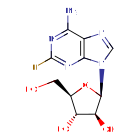
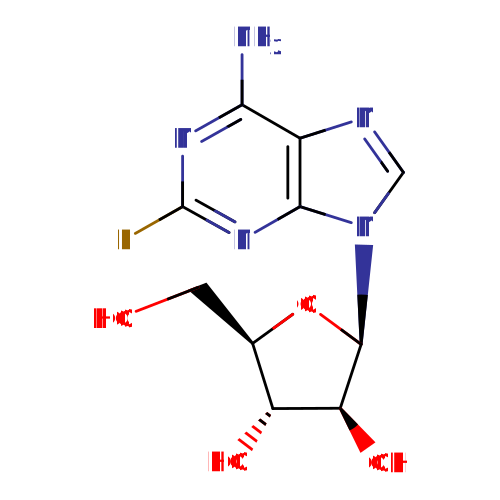
Structure for Fludarabine (DB01073)
- Weight
- Average: 285.235
Monoisotopic: 285.087332049 - Chemical Formula
- C10H12FN5O4
- Synonyms
- 2-F-ARAA
- 2-fluoro ARA-A
- Fludarabina
- Fludarabine
- Fludarabinum
- External IDs
- NSC-118218
- NSC-118218H

Pharmacology
- Indication
For the treatment of adult patients with B-cell chronic lymphocytic leukemia (CLL) who have not responded to or whose disease has progressed during treatment with at least one standard alkylating-agent containing regimen
 Reduce drug development failure ratesBuild, train, & validate machine-learning modelswith evidence-based and structured datasets.Build, train, & validate predictive machine-learning models with structured datasets.
- Associated Conditions
Indication Type Indication Combined Product Details Approval Level Age Group Patient Characteristics Dose Form Treatment of Refractory b-cell chronic lymphocytic leukemia •••••••••••• Treatment of Refractory non-hodgkin's lymphoma •••••••••••• - Contraindications & Blackbox Warnings
 Prevent Adverse Drug Events TodayTap into our Clinical API for life-saving information on contraindications & blackbox warnings, population restrictions, harmful risks, & more.Avoid life-threatening adverse drug events with our Clinical API
- Pharmacodynamics
Fludarabine is a chemotherapy drug used in the treatment of chronic lymphocytic leukemia. It acts at DNA polymerase alpha, ribonucleotide reductase and DNA primase, results in the inhibition of DNA synthesis, and destroys the cancer cells.
- Mechanism of action
Fludarabine phosphate is rapidly dephosphorylated to 2-fluoro-ara-A and then phosphorylated intracellularly by deoxycytidine kinase to the active triphosphate, 2-fluoro-ara-ATP. This metabolite appears to act by inhibiting DNA polymerase alpha, ribonucleotide reductase and DNA primase, thus inhibiting DNA synthesis. The mechanism of action of this antimetabolite is not completely characterized and may be multi-faceted.
Target Actions Organism ADNA incorporation into and destabilizationHumans ADeoxycytidine kinase agonistHumans ADNA polymerase alpha catalytic subunit inhibitorHumans ARibonucleoside-diphosphate reductase large subunit inhibitorHumans - Absorption
Bioavailability is 55% following oral administration.
- Volume of distribution
Not Available
- Protein binding
19-29%
- Metabolism
- Not Available
- Route of elimination
Not Available
- Half-life
20 hours
- Clearance
- 117-145 mL/min [patients with B-cell CLL receiving IV administration of a single dose of 40 mg/m^2.
- Adverse Effects
 Improve decision support & research outcomesWith structured adverse effects data, including: blackbox warnings, adverse reactions, warning & precautions, & incidence rates. View sample adverse effects data in our new Data Library!Improve decision support & research outcomes with our structured adverse effects data.
- Toxicity
Not Available
- Pathways
- Not Available
- Pharmacogenomic Effects/ADRs
- Not Available
Interactions
- Drug Interactions
- This information should not be interpreted without the help of a healthcare provider. If you believe you are experiencing an interaction, contact a healthcare provider immediately. The absence of an interaction does not necessarily mean no interactions exist.
Drug Interaction Integrate drug-drug
interactions in your softwareAbatacept The risk or severity of adverse effects can be increased when Fludarabine is combined with Abatacept. Abciximab The risk or severity of bleeding can be increased when Abciximab is combined with Fludarabine. Acenocoumarol The risk or severity of bleeding can be increased when Acenocoumarol is combined with Fludarabine. Acetyldigitoxin Acetyldigitoxin may decrease the cardiotoxic activities of Fludarabine. Acetylsalicylic acid The risk or severity of bleeding can be increased when Acetylsalicylic acid is combined with Fludarabine. - Food Interactions
- Take with or without food. Administration with food delays absorption, but not to a clinically significant extent.
Products
 Drug product information from 10+ global regionsOur datasets provide approved product information including:dosage, form, labeller, route of administration, and marketing period.Access drug product information from over 10 global regions.
- Product Ingredients
Ingredient UNII CAS InChI Key Fludarabine phosphate 1X9VK9O1SC 75607-67-9 GIUYCYHIANZCFB-FJFJXFQQSA-N - Brand Name Prescription Products
Name Dosage Strength Route Labeller Marketing Start Marketing End Region Image Fludara Tablet 10 mg Oral Sanofi Aventis 2002-09-24 Not applicable Canada 
Fludara Injection, powder, lyophilized, for solution 50 mg/2mL Intravenous Bayer 1991-04-18 2013-06-30 US 
Fludara Powder, for solution 50 mg / vial Intravenous Sanofi Genzyme, a Division of Sanofi Aventis Canada Inc 1993-12-31 2011-03-31 Canada Fludara Injection, powder, lyophilized, for solution 50 mg/2mL Intravenous Genzyme Corporation 2010-07-29 2012-03-09 US Fludarabine Phosphate Injection, solution 25 mg/1mL Intravenous Teva Pharmaceuticals, Inc. 2023-08-31 Not applicable US - Generic Prescription Products
Name Dosage Strength Route Labeller Marketing Start Marketing End Region Image Aj-fludarabine Solution 25.0 mg / mL Intravenous Agila Jamp Canada Inc Not applicable Not applicable Canada Fludarabine Injection, solution 25 mg/1mL Intravenous Fresenius Kabi USA, LLC 2007-11-16 Not applicable US Fludarabine Injection, powder, lyophilized, for solution 25 mg/1mL Intravenous Fresenius Kabi USA, LLC 2009-12-11 2010-06-01 US Fludarabine Phosphate Injection 25 mg/1mL Intravenous Lannett Company, Inc. 2019-12-31 Not applicable US Fludarabine Phosphate Injection, powder, lyophilized, for solution 50 mg/2mL Intravenous Sagent Pharmaceuticals 2009-02-01 2018-05-31 US - Unapproved/Other Products
Name Ingredients Dosage Route Labeller Marketing Start Marketing End Region Image Fludarabine Phosphate Fludarabine phosphate (25 mg/1mL) Injection Intravenous Accord Healthcare, Inc. 2022-11-22 Not applicable US Fludarabine Phosphate Fludarabine phosphate (25 mg/1mL) Injection, solution Intravenous Teva Pharmaceuticals, Inc. 2023-08-31 Not applicable US
Categories
- ATC Codes
- L01BB05 — Fludarabine
- Drug Categories
- Adenine Nucleotides
- Antimetabolites
- Antineoplastic Agents
- Antineoplastic and Immunomodulating Agents
- Arabinonucleosides
- Arabinonucleotides
- Cardiotoxic antineoplastic agents
- DNA (Cytosine-5-)-Methyltransferases, antagonists & inhibitors
- Heterocyclic Compounds, Fused-Ring
- Immunologic Factors
- Immunosuppressive Agents
- Myeloablative Agonists
- Myelosuppressive Agents
- Narrow Therapeutic Index Drugs
- Noxae
- Nucleic Acid Synthesis Inhibitors
- Nucleic Acids, Nucleotides, and Nucleosides
- Nucleoside Metabolic Inhibitor
- Nucleosides
- Nucleotides
- Purine Analogues
- Purine Nucleosides
- Purine Nucleotides
- Purines
- Toxic Actions
- Chemical TaxonomyProvided by Classyfire
- Description
- This compound belongs to the class of organic compounds known as purine nucleosides. These are compounds comprising a purine base attached to a ribosyl or deoxyribosyl moiety.
- Kingdom
- Organic compounds
- Super Class
- Nucleosides, nucleotides, and analogues
- Class
- Purine nucleosides
- Sub Class
- Not Available
- Direct Parent
- Purine nucleosides
- Alternative Parents
- Glycosylamines / 6-aminopurines / Pentoses / 2-halopyrimidines / Aminopyrimidines and derivatives / Aryl fluorides / Imidolactams / N-substituted imidazoles / Heteroaromatic compounds / Tetrahydrofurans show 8 more
- Substituents
- 2-halopyrimidine / 6-aminopurine / Alcohol / Amine / Aminopyrimidine / Aromatic heteropolycyclic compound / Aryl fluoride / Aryl halide / Azacycle / Azole show 27 more
- Molecular Framework
- Aromatic heteropolycyclic compounds
- External Descriptors
- Not Available
- Affected organisms
- Humans and other mammals
Chemical Identifiers
- UNII
- P2K93U8740
- CAS number
- 21679-14-1
- InChI Key
- HBUBKKRHXORPQB-FJFJXFQQSA-N
- InChI
- InChI=1S/C10H12FN5O4/c11-10-14-7(12)4-8(15-10)16(2-13-4)9-6(19)5(18)3(1-17)20-9/h2-3,5-6,9,17-19H,1H2,(H2,12,14,15)/t3-,5-,6+,9-/m1/s1
- IUPAC Name
- (2R,3S,4S,5R)-2-(6-amino-2-fluoro-9H-purin-9-yl)-5-(hydroxymethyl)oxolane-3,4-diol
- SMILES
- NC1=NC(F)=NC2=C1N=CN2[C@@H]1O[C@H](CO)[C@@H](O)[C@@H]1O
References
- Synthesis Reference
John G. Bauman, Randolph C. Wirsching, "Process for the preparation of fludarabine or fludarabine phosphate from guanosine." U.S. Patent US5602246, issued January, 1992.
US5602246- General References
- Rai KR, Peterson BL, Appelbaum FR, Kolitz J, Elias L, Shepherd L, Hines J, Threatte GA, Larson RA, Cheson BD, Schiffer CA: Fludarabine compared with chlorambucil as primary therapy for chronic lymphocytic leukemia. N Engl J Med. 2000 Dec 14;343(24):1750-7. [Article]
- Gonzalez H, Leblond V, Azar N, Sutton L, Gabarre J, Binet JL, Vernant JP, Dighiero G: Severe autoimmune hemolytic anemia in eight patients treated with fludarabine. Hematol Cell Ther. 1998 Jun;40(3):113-8. [Article]
- Tournilhac O, Cazin B, Lepretre S, Divine M, Maloum K, Delmer A, Grosbois B, Feugier P, Maloisel F, Villard F, Villemagne B, Bastit D, Belhadj K, Azar N, Michallet M, Manhes G, Travade P: Impact of frontline fludarabine and cyclophosphamide combined treatment on peripheral blood stem cell mobilization in B-cell chronic lymphocytic leukemia. Blood. 2004 Jan 1;103(1):363-5. Epub 2003 Sep 11. [Article]
- External Links
- KEGG Drug
- D01907
- PubChem Compound
- 657237
- PubChem Substance
- 46507525
- ChemSpider
- 571392
- BindingDB
- 68391
- 24698
- ChEBI
- 94701
- ChEMBL
- CHEMBL1568
- ZINC
- ZINC000004216238
- Therapeutic Targets Database
- DAP000567
- PharmGKB
- PA449655
- RxList
- RxList Drug Page
- Drugs.com
- Drugs.com Drug Page
- Wikipedia
- Fludarabine
- MSDS
- Download (48.1 KB)
Clinical Trials
- Clinical Trials
Phase Status Purpose Conditions Count 4 Completed Treatment Acute Myeloid Leukemia 1 4 Completed Treatment Acute Myeloid Leukemia / Myelodysplastic Syndrome 1 4 Completed Treatment B-Cell Chronic Lymphocytic Leukemia 1 4 Completed Treatment Leukemia, Lymphocytic, Acute, Adult 2 4 Completed Treatment Lymphocytic Leukemia / Lymphoma / Multiple Myeloma (MM) / Myelodysplastic Syndrome / Myeloproliferative Disorders (MPD) 1
Pharmacoeconomics
- Manufacturers
- Not Available
- Packagers
- APP Pharmaceuticals
- Bayer Healthcare
- Ben Venue Laboratories Inc.
- Ebewe Pharma
- Genzyme Inc.
- Hospira Inc.
- Sagent Pharmaceuticals
- Sanofi-Aventis Inc.
- Sicor Pharmaceuticals
- Teva Pharmaceutical Industries Ltd.
- Dosage Forms
Form Route Strength Solution Intravenous 25.0 mg / mL Solution Parenteral 50 mg Tablet Oral 10.000 mg Injection, powder, lyophilized, for solution Intravenous 50 mg/2mL Powder, for solution Intravenous 50 mg / vial Tablet Oral 10 mg Tablet, film coated Oral Tablet, film coated Oral 10 mg Injection Intravenous Tablet, coated Oral 10 mg Injection, solution Parenteral 25 mg/ml Solution, concentrate Parenteral 25 MG/ML Injection, powder, for solution Intravenous 50 MG Injection, powder, lyophilized, for solution Intravenous 50 mg Injection, powder, for solution Intravenous Solution, concentrate Solution, concentrate Intravenous 50 mg Injection, powder, lyophilized, for solution Intravenous Injection Intravenous 25 mg/1mL Injection, powder, lyophilized, for solution Intravenous 25 mg/1mL Injection, solution Intravenous 25 mg/1mL Tablet, film coated Oral 10 mg/1 Solution Intravenous 25 mg / mL Liquid Intravenous 25 mg / mL Injection, solution, concentrate Parenteral 50 mg/2ml Solution Intravenous 50 mg/2ml Injection, solution Intravenous 50 mg/2ml Solution Intravenous 200.00 mg Powder 50 mg/1vial - Prices
Unit description Cost Unit Fludara 50 mg vial 367.02USD vial Fludarabine 50 mg vial 240.0USD vial Oforta 10 mg tablet 92.57USD tablet DrugBank does not sell nor buy drugs. Pricing information is supplied for informational purposes only.- Patents
Patent Number Pediatric Extension Approved Expires (estimated) Region US7148207 No 2006-12-12 2022-12-20 US US7547776 No 2009-06-16 2018-12-10 US
Properties
- State
- Solid
- Experimental Properties
Property Value Source melting point (°C) 260 °C Not Available water solubility 3.53 mg/ml Not Available logP -2.8 Not Available - Predicted Properties
Property Value Source Water Solubility 12.1 mg/mL ALOGPS logP -0.62 ALOGPS logP -1.5 Chemaxon logS -1.4 ALOGPS pKa (Strongest Acidic) 12.45 Chemaxon pKa (Strongest Basic) 0.76 Chemaxon Physiological Charge 0 Chemaxon Hydrogen Acceptor Count 8 Chemaxon Hydrogen Donor Count 4 Chemaxon Polar Surface Area 139.54 Å2 Chemaxon Rotatable Bond Count 2 Chemaxon Refractivity 64.06 m3·mol-1 Chemaxon Polarizability 25.33 Å3 Chemaxon Number of Rings 3 Chemaxon Bioavailability 1 Chemaxon Rule of Five Yes Chemaxon Ghose Filter No Chemaxon Veber's Rule No Chemaxon MDDR-like Rule No Chemaxon - Predicted ADMET Features
Property Value Probability Human Intestinal Absorption - 0.5639 Blood Brain Barrier + 0.9233 Caco-2 permeable - 0.7128 P-glycoprotein substrate Non-substrate 0.6729 P-glycoprotein inhibitor I Non-inhibitor 0.8877 P-glycoprotein inhibitor II Non-inhibitor 0.9758 Renal organic cation transporter Non-inhibitor 0.9454 CYP450 2C9 substrate Non-substrate 0.879 CYP450 2D6 substrate Non-substrate 0.8252 CYP450 3A4 substrate Non-substrate 0.5202 CYP450 1A2 substrate Non-inhibitor 0.7718 CYP450 2C9 inhibitor Non-inhibitor 0.8907 CYP450 2D6 inhibitor Non-inhibitor 0.8648 CYP450 2C19 inhibitor Non-inhibitor 0.8716 CYP450 3A4 inhibitor Non-inhibitor 0.8466 CYP450 inhibitory promiscuity Low CYP Inhibitory Promiscuity 0.9276 Ames test Non AMES toxic 0.7735 Carcinogenicity Non-carcinogens 0.8925 Biodegradation Not ready biodegradable 1.0 Rat acute toxicity 2.2806 LD50, mol/kg Not applicable hERG inhibition (predictor I) Weak inhibitor 0.98 hERG inhibition (predictor II) Non-inhibitor 0.7675
Spectra
- Mass Spec (NIST)
- Not Available
- Spectra
- Chromatographic Properties
Collision Cross Sections (CCS)
Adduct CCS Value (Å2) Source type Source [M-H]- 157.43149 predictedDeepCCS 1.0 (2019) [M+H]+ 159.82704 predictedDeepCCS 1.0 (2019) [M+Na]+ 166.80373 predictedDeepCCS 1.0 (2019)
Targets

References
- Robak T, Lech-Maranda E, Korycka A, Robak E: Purine nucleoside analogs as immunosuppressive and antineoplastic agents: mechanism of action and clinical activity. Curr Med Chem. 2006;13(26):3165-89. [Article]
- Kind
- Protein
- Organism
- Humans
- Pharmacological action
- Yes
- Actions
- Agonist
- General Function
- Protein homodimerization activity
- Specific Function
- Required for the phosphorylation of the deoxyribonucleosides deoxycytidine (dC), deoxyguanosine (dG) and deoxyadenosine (dA). Has broad substrate specificity, and does not display selectivity based...
- Gene Name
- DCK
- Uniprot ID
- P27707
- Uniprot Name
- Deoxycytidine kinase
- Molecular Weight
- 30518.315 Da
References
- Jordheim LP, Galmarini CM, Dumontet C: [Metabolism, mechanism of action and resistance to cytotoxic nucleoside analogues]. Bull Cancer. 2005 Mar;92(3):239-48. [Article]
- Yao L, Xu W, Fan L, Miao KR, Wu YJ, Qiao C, Zhu DX, Zhu HY, Liu P, Li JY: [Correlation of deoxycytidine kinase gene expression with fludarabine resistance in patients with chronic lymphocytic leukemia]. Zhongguo Shi Yan Xue Ye Xue Za Zhi. 2010 Feb;18(1):36-9. [Article]
- Zhang Y, Secrist JA 3rd, Ealick SE: The structure of human deoxycytidine kinase in complex with clofarabine reveals key interactions for prodrug activation. Acta Crystallogr D Biol Crystallogr. 2006 Feb;62(Pt 2):133-9. Epub 2006 Jan 18. [Article]
- Kind
- Protein
- Organism
- Humans
- Pharmacological action
- Yes
- Actions
- Inhibitor
- General Function
- Protein kinase binding
- Specific Function
- Plays an essential role in the initiation of DNA replication. During the S phase of the cell cycle, the DNA polymerase alpha complex (composed of a catalytic subunit POLA1/p180, a regulatory subuni...
- Gene Name
- POLA1
- Uniprot ID
- P09884
- Uniprot Name
- DNA polymerase alpha catalytic subunit
- Molecular Weight
- 165911.405 Da
References
- Overington JP, Al-Lazikani B, Hopkins AL: How many drug targets are there? Nat Rev Drug Discov. 2006 Dec;5(12):993-6. [Article]
- Imming P, Sinning C, Meyer A: Drugs, their targets and the nature and number of drug targets. Nat Rev Drug Discov. 2006 Oct;5(10):821-34. [Article]
- Lech-Maranda E, Korycka A, Robak T: Clofarabine as a novel nucleoside analogue approved to treat patients with haematological malignancies: mechanism of action and clinical activity. Mini Rev Med Chem. 2009 Jun;9(7):805-12. [Article]
- Robak T, Korycka A, Lech-Maranda E, Robak P: Current status of older and new purine nucleoside analogues in the treatment of lymphoproliferative diseases. Molecules. 2009 Mar 23;14(3):1183-226. doi: 10.3390/molecules14031183. [Article]
- Robak T, Lech-Maranda E, Korycka A, Robak E: Purine nucleoside analogs as immunosuppressive and antineoplastic agents: mechanism of action and clinical activity. Curr Med Chem. 2006;13(26):3165-89. [Article]
- Kind
- Protein
- Organism
- Humans
- Pharmacological action
- Yes
- Actions
- Inhibitor
- General Function
- Ribonucleoside-diphosphate reductase activity, thioredoxin disulfide as acceptor
- Specific Function
- Provides the precursors necessary for DNA synthesis. Catalyzes the biosynthesis of deoxyribonucleotides from the corresponding ribonucleotides.
- Gene Name
- RRM1
- Uniprot ID
- P23921
- Uniprot Name
- Ribonucleoside-diphosphate reductase large subunit
- Molecular Weight
- 90069.375 Da
References
- Overington JP, Al-Lazikani B, Hopkins AL: How many drug targets are there? Nat Rev Drug Discov. 2006 Dec;5(12):993-6. [Article]
- Imming P, Sinning C, Meyer A: Drugs, their targets and the nature and number of drug targets. Nat Rev Drug Discov. 2006 Oct;5(10):821-34. [Article]
- Lech-Maranda E, Korycka A, Robak T: Clofarabine as a novel nucleoside analogue approved to treat patients with haematological malignancies: mechanism of action and clinical activity. Mini Rev Med Chem. 2009 Jun;9(7):805-12. [Article]
- Robak T, Korycka A, Lech-Maranda E, Robak P: Current status of older and new purine nucleoside analogues in the treatment of lymphoproliferative diseases. Molecules. 2009 Mar 23;14(3):1183-226. doi: 10.3390/molecules14031183. [Article]
Transporters
- Kind
- Protein
- Organism
- Humans
- Pharmacological action
- Unknown
- Actions
- Substrate
- General Function
- Nucleoside transmembrane transporter activity
- Specific Function
- Mediates both influx and efflux of nucleosides across the membrane (equilibrative transporter). It is sensitive (ES) to low concentrations of the inhibitor nitrobenzylmercaptopurine riboside (NBMPR...
- Gene Name
- SLC29A1
- Uniprot ID
- Q99808
- Uniprot Name
- Equilibrative nucleoside transporter 1
- Molecular Weight
- 50218.805 Da
References
- Santini D, Vincenzi B, Fratto ME, Perrone G, Lai R, Catalano V, Cass C, Ruffini PA, Spoto C, Muretto P, Rizzo S, Muda AO, Mackey JR, Russo A, Tonini G, Graziano F: Prognostic role of human equilibrative transporter 1 (hENT1) in patients with resected gastric cancer. J Cell Physiol. 2010 May;223(2):384-8. doi: 10.1002/jcp.22045. [Article]
- Kind
- Protein
- Organism
- Humans
- Pharmacological action
- Unknown
- General Function
- Pyrimidine- and adenine-specific:sodium symporter activity
- Specific Function
- Sodium-dependent, pyrimidine- and purine-selective. Involved in the homeostasis of endogenous nucleosides. Exhibits the transport characteristics of the nucleoside transport system cib or N3 subtyp...
- Gene Name
- SLC28A3
- Uniprot ID
- Q9HAS3
- Uniprot Name
- Solute carrier family 28 member 3
- Molecular Weight
- 76929.61 Da
References
- Badagnani I, Chan W, Castro RA, Brett CM, Huang CC, Stryke D, Kawamoto M, Johns SJ, Ferrin TE, Carlson EJ, Burchard EG, Giacomini KM: Functional analysis of genetic variants in the human concentrative nucleoside transporter 3 (CNT3; SLC28A3). Pharmacogenomics J. 2005;5(3):157-65. [Article]

Drug created at June 13, 2005 13:24 / Updated at April 26, 2024 00:45