Identification
- Summary
Flucytosine is an antifungal indicated only to treat severe infections throughout the body caused by susceptible strains of Candida or Cryptococcus.
- Brand Names
- Ancobon
- Generic Name
- Flucytosine
- DrugBank Accession Number
- DB01099
- Background
A fluorinated cytosine analog that is used as an antifungal agent.
- Type
- Small Molecule
- Groups
- Approved, Investigational
- Structure
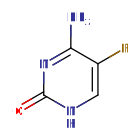
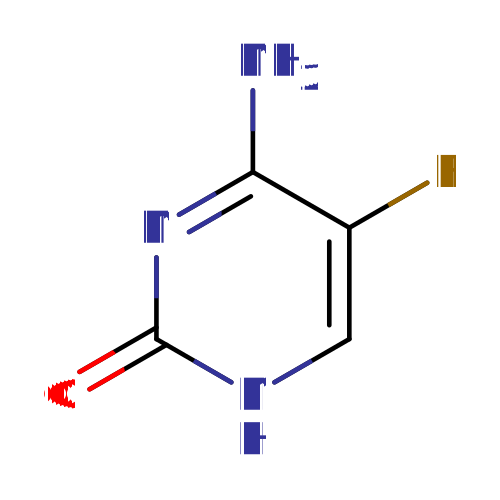
Structure for Flucytosine (DB01099)
- Weight
- Average: 129.0925
Monoisotopic: 129.03383997 - Chemical Formula
- C4H4FN3O
- Synonyms
- 5-FC
- 5-Fluorocystosine
- 5-Fluorocytosine
- flucytosina
- Flucytosine
- Flucytosinum
- External IDs
- NSC-103805
- RO 2-9915
- RO-2-9915

Pharmacology
- Indication
For the treatment (in combination with amphotericin B) of serious infections caused by susceptible strains of Candida (septicemia, endocarditis and urinary system infections) and/or Cryptococcus (meningitis and pulmonary infections).
 Reduce drug development failure ratesBuild, train, & validate machine-learning modelswith evidence-based and structured datasets.Build, train, & validate predictive machine-learning models with structured datasets.
- Associated Conditions
Indication Type Indication Combined Product Details Approval Level Age Group Patient Characteristics Dose Form Treatment of Candida infections •••••••••••• Treatment of Cryptococcal infections •••••••••••• Treatment of Fungal infections •••••••••••• Treatment of Fungal meningitis •••••••••••• Treatment of Fungal endocarditis •••••••••••• - Contraindications & Blackbox Warnings
 Prevent Adverse Drug Events TodayTap into our Clinical API for life-saving information on contraindications & blackbox warnings, population restrictions, harmful risks, & more.Avoid life-threatening adverse drug events with our Clinical API
- Pharmacodynamics
Flucytosine is an antimetabolite that acts as an antifungal agent with in vitro and in vivo activity against Candida and Cryptococcus. Flucytosine enters the fungal cell via cytosine permease; thus, flucytosine is metabolized to 5-fluorouracil within fungal organisms. The 5-fluorouracil is extensively incorporated into fungal RNA and inhibits synthesis of both DNA and RNA. The result is unbalanced growth and death of the fungal organism. Antifungal synergism between Ancobon and polyene antibiotics, particularly amphotericin B, has been reported.
- Mechanism of action
Although the exact mode of action is unknown, it has been proposed that flucytosine acts directly on fungal organisms by competitive inhibition of purine and pyrimidine uptake and indirectly by intracellular metabolism to 5-fluorouracil. Flucytosine enters the fungal cell via cytosine permease; thus, flucytosine is metabolized to 5-fluorouracil within fungal organisms. The 5-fluorouracil is extensively incorporated into fungal RNA and inhibits synthesis of both DNA and RNA. The result is unbalanced growth and death of the fungal organism. It also appears to be an inhibitor of fungal thymidylate synthase.
Target Actions Organism ADNA cross-linking/alkylationHumans UDNA (cytosine-5)-methyltransferase 1 otherHumans UThymidylate synthase inhibitorYeast - Absorption
Rapidly and virtually completely absorbed following oral administration. Bioavailability 78% to 89%.
- Volume of distribution
Not Available
- Protein binding
28-31%
- Metabolism
Flucytosine is deaminated, possibly by gut bacteria or by the fungal targets, to 5-fluorouracil, the active metabolite.
- Route of elimination
Flucytosine is excreted via the kidneys by means of glomerular filtration without significant tubular reabsorption. A small portion of the dose is excreted in the feces.
- Half-life
2.4 to 4.8 hours.
- Clearance
Not Available
- Adverse Effects
 Improve decision support & research outcomesWith structured adverse effects data, including: blackbox warnings, adverse reactions, warning & precautions, & incidence rates. View sample adverse effects data in our new Data Library!Improve decision support & research outcomes with our structured adverse effects data.
- Toxicity
Oral, rat: LD50 = >15 gm/kg.
- Pathways
- Not Available
- Pharmacogenomic Effects/ADRs
- Not Available
Interactions
- Drug Interactions
- This information should not be interpreted without the help of a healthcare provider. If you believe you are experiencing an interaction, contact a healthcare provider immediately. The absence of an interaction does not necessarily mean no interactions exist.
Drug Interaction Integrate drug-drug
interactions in your softwareAbacavir Abacavir may decrease the excretion rate of Flucytosine which could result in a higher serum level. Abatacept The risk or severity of adverse effects can be increased when Flucytosine is combined with Abatacept. Abciximab The risk or severity of bleeding can be increased when Abciximab is combined with Flucytosine. Aceclofenac Aceclofenac may decrease the excretion rate of Flucytosine which could result in a higher serum level. Acemetacin Acemetacin may decrease the excretion rate of Flucytosine which could result in a higher serum level. - Food Interactions
- No interactions found.
Products
 Drug product information from 10+ global regionsOur datasets provide approved product information including:dosage, form, labeller, route of administration, and marketing period.Access drug product information from over 10 global regions.
- International/Other Brands
- Ancotil (Meda) / Flusine (TTY Biopharm)
- Brand Name Prescription Products
Name Dosage Strength Route Labeller Marketing Start Marketing End Region Image Ancobon Capsule 250 mg/1 Oral Bausch Health US LLC 1971-11-26 Not applicable US 
Ancobon Capsule 500 mg/1 Oral Cardinal Health 1982-01-01 2013-02-28 US Ancobon Capsule 500 mg/1 Oral Bausch Health US LLC 1971-11-26 Not applicable US - Generic Prescription Products
Name Dosage Strength Route Labeller Marketing Start Marketing End Region Image Flucytosine Capsule 500 mg/1 Oral Vensun Pharmaceuticals, Inc. 2016-08-21 Not applicable US Flucytosine Capsule 500 mg/1 Oral bryant ranch prepack 2017-07-26 Not applicable US Flucytosine Capsule 500 mg/1 Oral Oceanside Pharmaceuticals 2012-01-17 2014-12-31 US Flucytosine Capsule 500 mg/1 Oral Lupin Pharmaceuticals,Inc. 2017-07-07 Not applicable US Flucytosine Capsule 250 mg/1 Oral Avera McKennan Hospital 2015-03-01 2017-05-24 US
Categories
- ATC Codes
- J02AX01 — Flucytosine
- J02AX — Other antimycotics for systemic use
- J02A — ANTIMYCOTICS FOR SYSTEMIC USE
- J02 — ANTIMYCOTICS FOR SYSTEMIC USE
- J — ANTIINFECTIVES FOR SYSTEMIC USE
- Drug Categories
- Anti-Infective Agents
- Antifungal Agents
- Antifungals for Dermatological Use
- Antifungals for Topical Use
- Antiinfectives for Systemic Use
- Antimetabolites
- Antimycotics for Systemic Use
- Cytosine
- Dermatologicals
- Drugs causing inadvertant photosensitivity
- Drugs that are Mainly Renally Excreted
- Fluorouracil and prodrugs
- Immunosuppressive Agents
- Myelosuppressive Agents
- Noxae
- Nucleoside Analog Antifungal
- Photosensitizing Agents
- Pyrimidines
- Pyrimidinones
- Toxic Actions
- Chemical TaxonomyProvided by Classyfire
- Description
- This compound belongs to the class of organic compounds known as halopyrimidines. These are aromatic compounds containing a halogen atom linked to a pyrimidine ring. Pyrimidine is a 6-membered ring consisting of four carbon atoms and two nitrogen centers at the 1- and 3- ring positions.
- Kingdom
- Organic compounds
- Super Class
- Organoheterocyclic compounds
- Class
- Diazines
- Sub Class
- Pyrimidines and pyrimidine derivatives
- Direct Parent
- Halopyrimidines
- Alternative Parents
- Pyrimidones / Aminopyrimidines and derivatives / Hydropyrimidines / Aryl fluorides / Heteroaromatic compounds / Azacyclic compounds / Primary amines / Organopnictogen compounds / Organooxygen compounds / Organofluorides show 2 more
- Substituents
- Amine / Aminopyrimidine / Aromatic heteromonocyclic compound / Aryl fluoride / Aryl halide / Azacycle / Halopyrimidine / Heteroaromatic compound / Hydrocarbon derivative / Hydropyrimidine show 10 more
- Molecular Framework
- Aromatic heteromonocyclic compounds
- External Descriptors
- organofluorine compound, aminopyrimidine, pyrimidone, nucleoside analogue, pyrimidine antifungal drug (CHEBI:5100)
- Affected organisms
- Yeast and other fungi
Chemical Identifiers
- UNII
- D83282DT06
- CAS number
- 2022-85-7
- InChI Key
- XRECTZIEBJDKEO-UHFFFAOYSA-N
- InChI
- InChI=1S/C4H4FN3O/c5-2-1-7-4(9)8-3(2)6/h1H,(H3,6,7,8,9)
- IUPAC Name
- 4-amino-5-fluoro-1,2-dihydropyrimidin-2-one
- SMILES
- NC1=C(F)C=NC(=O)N1
References
- Synthesis Reference
Bernd Baasner, Erich Klauke, "Process for the preparation of 5-fluorocytosine." U.S. Patent US4703121, issued September, 1961.
US4703121- General References
- Not Available
- External Links
- Human Metabolome Database
- HMDB0015231
- KEGG Drug
- D00323
- PubChem Compound
- 3366
- PubChem Substance
- 46504735
- ChemSpider
- 3249
- BindingDB
- 50248003
- 4451
- ChEBI
- 5100
- ChEMBL
- CHEMBL1463
- ZINC
- ZINC000000896546
- Therapeutic Targets Database
- DAP001542
- PharmGKB
- PA449654
- PDBe Ligand
- 1LD
- RxList
- RxList Drug Page
- Drugs.com
- Drugs.com Drug Page
- Wikipedia
- Flucytosine
- PDB Entries
- 4r88
- FDA label
- Download (128 KB)
- MSDS
- Download (57.3 KB)
Clinical Trials
- Clinical Trials
Phase Status Purpose Conditions Count 4 Enrolling by Invitation Treatment Antifungal Agents / Meningitis, Cryptococcal 1 3 Unknown Status Treatment Human Immunodeficiency Virus (HIV) Infections / Meningitis, Cryptococcal 1 2 Completed Treatment Human Immunodeficiency Virus (HIV) Infections / Meningitis, Cryptococcal 2 2 Not Yet Recruiting Treatment Anaplastic Astrocytoma (AA) / High Grade Glioma (HGG) 1 2 Terminated Treatment Cryptococcal Infection Disseminated 1
Pharmacoeconomics
- Manufacturers
- Not Available
- Packagers
- Cardinal Health
- Kaiser Foundation Hospital
- Legacy Pharmaceuticals Packaging LLC
- Valeant Ltd.
- Dosage Forms
Form Route Strength Injection, solution Parenteral 2.5 G/250ML Tablet 500 MG Injection Parenteral 2.5 g/250ml Capsule, coated Oral 500 mg Capsule Oral 250 mg/1 Capsule Oral 500 mg/1 Solution Intravenous 10 mg Capsule Oral 500 mg - Prices
Unit description Cost Unit Ancobon 500 mg capsule 45.54USD capsule Ancobon 250 mg capsule 23.09USD capsule DrugBank does not sell nor buy drugs. Pricing information is supplied for informational purposes only.- Patents
- Not Available
Properties
- State
- Solid
- Experimental Properties
Property Value Source melting point (°C) 296 °C PhysProp water solubility 1.5E+004 mg/L (at 25 °C) MERCK INDEX (1996) logP -1.1 Not Available pKa 3.26 BUDAVARI,S ET AL. (1996) - Predicted Properties
Property Value Source Water Solubility 2.14 mg/mL ALOGPS logP -0.69 ALOGPS logP -1 Chemaxon logS -1.8 ALOGPS pKa (Strongest Acidic) 8.31 Chemaxon pKa (Strongest Basic) 1.78 Chemaxon Physiological Charge 0 Chemaxon Hydrogen Acceptor Count 3 Chemaxon Hydrogen Donor Count 2 Chemaxon Polar Surface Area 67.48 Å2 Chemaxon Rotatable Bond Count 0 Chemaxon Refractivity 28.15 m3·mol-1 Chemaxon Polarizability 10.04 Å3 Chemaxon Number of Rings 1 Chemaxon Bioavailability 1 Chemaxon Rule of Five Yes Chemaxon Ghose Filter No Chemaxon Veber's Rule No Chemaxon MDDR-like Rule No Chemaxon - Predicted ADMET Features
Property Value Probability Human Intestinal Absorption + 0.9734 Blood Brain Barrier + 0.9653 Caco-2 permeable - 0.606 P-glycoprotein substrate Non-substrate 0.8098 P-glycoprotein inhibitor I Non-inhibitor 0.9304 P-glycoprotein inhibitor II Non-inhibitor 0.9945 Renal organic cation transporter Non-inhibitor 0.8989 CYP450 2C9 substrate Non-substrate 0.8239 CYP450 2D6 substrate Non-substrate 0.8854 CYP450 3A4 substrate Non-substrate 0.7224 CYP450 1A2 substrate Non-inhibitor 0.9045 CYP450 2C9 inhibitor Non-inhibitor 0.9629 CYP450 2D6 inhibitor Non-inhibitor 0.9669 CYP450 2C19 inhibitor Non-inhibitor 0.918 CYP450 3A4 inhibitor Non-inhibitor 0.9831 CYP450 inhibitory promiscuity Low CYP Inhibitory Promiscuity 0.9703 Ames test Non AMES toxic 0.692 Carcinogenicity Non-carcinogens 0.9287 Biodegradation Not ready biodegradable 1.0 Rat acute toxicity 1.9498 LD50, mol/kg Not applicable hERG inhibition (predictor I) Weak inhibitor 0.9624 hERG inhibition (predictor II) Non-inhibitor 0.9071
Spectra
- Mass Spec (NIST)
- Not Available
- Spectra
- Chromatographic Properties
Collision Cross Sections (CCS)
Adduct CCS Value (Å2) Source type Source [M-H]- 116.1501977 predictedDarkChem Lite v0.1.0 [M-H]- 123.65211 predictedDeepCCS 1.0 (2019) [M-H]- 116.1501977 predictedDarkChem Lite v0.1.0 [M-H]- 123.65211 predictedDeepCCS 1.0 (2019) [M+H]+ 115.4500977 predictedDarkChem Lite v0.1.0 [M+H]+ 126.363304 predictedDeepCCS 1.0 (2019) [M+H]+ 115.4500977 predictedDarkChem Lite v0.1.0 [M+H]+ 126.363304 predictedDeepCCS 1.0 (2019) [M+Na]+ 116.1824977 predictedDarkChem Lite v0.1.0 [M+Na]+ 135.10094 predictedDeepCCS 1.0 (2019) [M+Na]+ 116.1824977 predictedDarkChem Lite v0.1.0 [M+Na]+ 135.10094 predictedDeepCCS 1.0 (2019)
Targets

References
- Osterman DG, DePillis GD, Wu JC, Matsuda A, Santi DV: 5-Fluorocytosine in DNA is a mechanism-based inhibitor of HhaI methylase. Biochemistry. 1988 Jul 12;27(14):5204-10. [Article]
- Waldorf AR, Polak A: Mechanisms of action of 5-fluorocytosine. Antimicrob Agents Chemother. 1983 Jan;23(1):79-85. [Article]
- Wyszynski MW, Gabbara S, Kubareva EA, Romanova EA, Oretskaya TS, Gromova ES, Shabarova ZA, Bhagwat AS: The cysteine conserved among DNA cytosine methylases is required for methyl transfer, but not for specific DNA binding. Nucleic Acids Res. 1993 Jan 25;21(2):295-301. [Article]
- Kind
- Protein
- Organism
- Humans
- Pharmacological action
- Unknown
- Actions
- Other
- General Function
- Zinc ion binding
- Specific Function
- Methylates CpG residues. Preferentially methylates hemimethylated DNA. Associates with DNA replication sites in S phase maintaining the methylation pattern in the newly synthesized strand, that is ...
- Gene Name
- DNMT1
- Uniprot ID
- P26358
- Uniprot Name
- DNA (cytosine-5)-methyltransferase 1
- Molecular Weight
- 183163.635 Da
References
- Overington JP, Al-Lazikani B, Hopkins AL: How many drug targets are there? Nat Rev Drug Discov. 2006 Dec;5(12):993-6. [Article]
- Imming P, Sinning C, Meyer A: Drugs, their targets and the nature and number of drug targets. Nat Rev Drug Discov. 2006 Oct;5(10):821-34. [Article]
- Shieh FK, Reich NO: AdoMet-dependent methyl-transfer: Glu119 is essential for DNA C5-cytosine methyltransferase M.HhaI. J Mol Biol. 2007 Nov 9;373(5):1157-68. Epub 2007 Aug 19. [Article]
- Wyszynski MW, Gabbara S, Kubareva EA, Romanova EA, Oretskaya TS, Gromova ES, Shabarova ZA, Bhagwat AS: The cysteine conserved among DNA cytosine methylases is required for methyl transfer, but not for specific DNA binding. Nucleic Acids Res. 1993 Jan 25;21(2):295-301. [Article]
- Kind
- Protein
- Organism
- Yeast
- Pharmacological action
- Unknown
- Actions
- Inhibitor
- General Function
- Thymidylate synthase activity
- Specific Function
- Not Available
- Gene Name
- TMP1
- Uniprot ID
- P12461
- Uniprot Name
- Thymidylate synthase
- Molecular Weight
- 35996.01 Da
References
- Overington JP, Al-Lazikani B, Hopkins AL: How many drug targets are there? Nat Rev Drug Discov. 2006 Dec;5(12):993-6. [Article]
- Imming P, Sinning C, Meyer A: Drugs, their targets and the nature and number of drug targets. Nat Rev Drug Discov. 2006 Oct;5(10):821-34. [Article]
- Fox BA, Belperron AA, Bzik DJ: Stable transformation of Toxoplasma gondii based on a pyrimethamine resistant trifunctional dihydrofolate reductase-cytosine deaminase-thymidylate synthase gene that confers sensitivity to 5-fluorocytosine. Mol Biochem Parasitol. 1999 Jan 5;98(1):93-103. [Article]
- Rehemtulla A, Hamstra DA, Kievit E, Davis MA, Ng EY, Dornfeld K, Lawrence TS: Extracellular expression of cytosine deaminase results in increased 5-FU production for enhanced enzyme/prodrug therapy. Anticancer Res. 2004 May-Jun;24(3a):1393-9. [Article]
- Wang ZH, Samuels S, Gama Sosa MA, Kolodny EH: 5-Fluorocytosine-mediated apoptosis and DNA damage in glioma cells engineered to express cytosine deaminase and their enhancement with interferon. J Neurooncol. 1998 Feb;36(3):219-29. [Article]

Drug created at June 13, 2005 13:24 / Updated at May 07, 2021 21:22