Identification
- Summary
Pimozide is an antipsychotic used to manage debilitating motor and phonic tics in patients with Tourette's Disorder.
- Brand Names
- Orap
- Generic Name
- Pimozide
- DrugBank Accession Number
- DB01100
- Background
A diphenylbutylpiperidine that is effective as an antipsychotic agent and as an alternative to haloperidol for the suppression of vocal and motor tics in patients with Tourette syndrome. Although the precise mechanism of action is unknown, blockade of postsynaptic dopamine receptors has been postulated. (From AMA Drug Evaluations Annual, 1994, p403)
- Type
- Small Molecule
- Groups
- Approved
- Structure
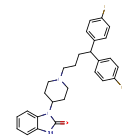
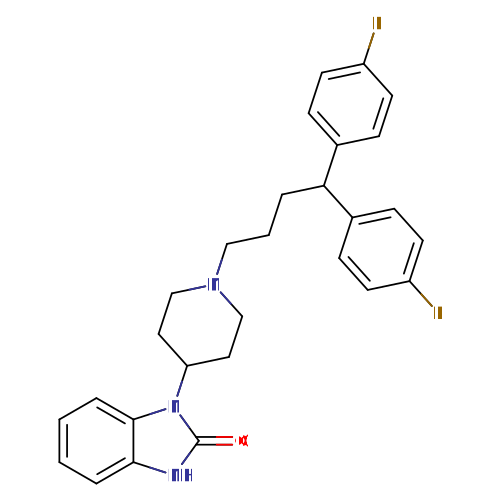
Structure for Pimozide (DB01100)
- Weight
- Average: 461.5462
Monoisotopic: 461.227868975 - Chemical Formula
- C28H29F2N3O
- Synonyms
- Pimozida
- Pimozide
- Pimozidum
- External IDs
- MCN-JR-6238
- R 623
- R-623
- R-6238

Pharmacology
- Indication
Used for the suppression of motor and phonic tics in patients with Tourette's Disorder who have failed to respond satisfactorily to standard treatment.
 Reduce drug development failure ratesBuild, train, & validate machine-learning modelswith evidence-based and structured datasets.Build, train, & validate predictive machine-learning models with structured datasets.
- Associated Conditions
Indication Type Indication Combined Product Details Approval Level Age Group Patient Characteristics Dose Form Management of Delusional parasitosis ••• ••••• Management of Tics •••••••••••• - Contraindications & Blackbox Warnings
 Prevent Adverse Drug Events TodayTap into our Clinical API for life-saving information on contraindications & blackbox warnings, population restrictions, harmful risks, & more.Avoid life-threatening adverse drug events with our Clinical API
- Pharmacodynamics
Pimozide is an orally active antipsychotic drug product which shares with other antipsychotics the ability to blockade dopaminergic receptors on neurons in the central nervous system. However, receptor blockade is often accompanied by a series of secondary alterations in central dopamine metabolism and function which may contribute to both pimozide's therapeutic and untoward effects. In addition, pimozide, in common with other antipsychotic drugs, has various effects on other central nervous system receptor systems which are not fully characterized. Pimozide also has less potential for inducing sedation and hypotension as it has more specific dopamine receptor blocking activity than other neuroleptic agents (and is therefore a suitable alternative to haloperidol).
- Mechanism of action
The ability of pimozide to suppress motor and phonic tics in Tourette's Disorder is thought to be primarily a function of its dopaminergic blocking activity. Pimozide binds and inhibits the dopamine D2 receptor in the CNS.
Target Actions Organism ADopamine D2 receptor antagonistHumans ADopamine D3 receptor antagonistHumans APotassium voltage-gated channel subfamily H member 2 inhibitorHumans UCalmodulin inhibitorHumans - Absorption
Greater than 50% absorption after oral administration. Serum peak appears 6-8 hours post ingestion.
- Volume of distribution
Not Available
- Protein binding
Not Available
- Metabolism
Notable first-pass metabolism in the liver, primarily by N-dealkylation via the cytochrome P450 isoenzymes CYP3A and CYP1A2 (and possibly CYP2D6). The activity of the two major metabolites has not been determined.
- Route of elimination
Not Available
- Half-life
29 ± 10 hours (single-dose study of healthy volunteers).
- Clearance
Not Available
- Adverse Effects
 Improve decision support & research outcomesWith structured adverse effects data, including: blackbox warnings, adverse reactions, warning & precautions, & incidence rates. View sample adverse effects data in our new Data Library!Improve decision support & research outcomes with our structured adverse effects data.
- Toxicity
LD50 = 1100 mg/kg (rat, oral), 228 mg/kg (mouse, oral)
- Pathways
- Not Available
- Pharmacogenomic Effects/ADRs
Interacting Gene/Enzyme Allele name Genotype(s) Defining Change(s) Type(s) Description Details Cytochrome P450 2D6 CYP2D6*3 Not Available C allele Effect Inferred Poor drug metabolizer, lower dose requirement. Details Cytochrome P450 2D6 CYP2D6*4 Not Available C allele Effect Inferred Poor drug metabolizer, lower dose requirement. Details Cytochrome P450 2D6 CYP2D6*5 Not Available Whole-gene deletion Effect Inferred Poor drug metabolizer, lower dose requirement. Details Cytochrome P450 2D6 CYP2D6*6 Not Available 1707delT Effect Inferred Poor drug metabolizer, lower dose requirement. Details Cytochrome P450 2D6 CYP2D6*7 Not Available 2935A>C Effect Inferred Poor drug metabolizer, lower dose requirement. Details Cytochrome P450 2D6 CYP2D6*8 Not Available 1758G>T Effect Inferred Poor drug metabolizer, lower dose requirement. Details Cytochrome P450 2D6 CYP2D6*11 Not Available 883G>C Effect Inferred Poor drug metabolizer, lower dose requirement. Details Cytochrome P450 2D6 CYP2D6*12 Not Available 124G>A Effect Inferred Poor drug metabolizer, lower dose requirement. Details Cytochrome P450 2D6 CYP2D6*13 Not Available CYP2D7/2D6 hybrid gene structure Effect Inferred Poor drug metabolizer, lower dose requirement. Details Cytochrome P450 2D6 CYP2D6*14A Not Available 1758G>A Effect Inferred Poor drug metabolizer, lower dose requirement. Details Cytochrome P450 2D6 CYP2D6*15 Not Available 137insT, 137_138insT Effect Inferred Poor drug metabolizer, lower dose requirement. Details Cytochrome P450 2D6 CYP2D6*19 Not Available 2539_2542delAACT Effect Inferred Poor drug metabolizer, lower dose requirement. Details Cytochrome P450 2D6 CYP2D6*20 Not Available 1973_1974insG Effect Inferred Poor drug metabolizer, lower dose requirement. Details Cytochrome P450 2D6 CYP2D6*21 Not Available 2573insC Effect Inferred Poor drug metabolizer, lower dose requirement. Details Cytochrome P450 2D6 CYP2D6*31 Not Available -1770G>A / -1584C>G … show all Effect Inferred Poor drug metabolizer, lower dose requirement. Details Cytochrome P450 2D6 CYP2D6*36 Not Available 100C>T / -1426C>T … show all Effect Inferred Poor drug metabolizer, lower dose requirement. Details Cytochrome P450 2D6 CYP2D6*38 Not Available 2587_2590delGACT Effect Inferred Poor drug metabolizer, lower dose requirement. Details Cytochrome P450 2D6 CYP2D6*40 Not Available 1863_1864ins(TTT CGC CCC)2 Effect Inferred Poor drug metabolizer, lower dose requirement. Details Cytochrome P450 2D6 CYP2D6*42 Not Available 3259_3260insGT Effect Inferred Poor drug metabolizer, lower dose requirement. Details Cytochrome P450 2D6 CYP2D6*44 Not Available 2950G>C Effect Inferred Poor drug metabolizer, lower dose requirement. Details Cytochrome P450 2D6 CYP2D6*47 Not Available 100C>T / -1426C>T … show all Effect Inferred Poor drug metabolizer, lower dose requirement. Details Cytochrome P450 2D6 CYP2D6*51 Not Available -1584C>G / -1235A>G … show all Effect Inferred Poor drug metabolizer, lower dose requirement. Details Cytochrome P450 2D6 CYP2D6*56 Not Available 3201C>T Effect Inferred Poor drug metabolizer, lower dose requirement. Details Cytochrome P450 2D6 CYP2D6*57 Not Available 100C>T / 310G>T … show all Effect Inferred Poor drug metabolizer, lower dose requirement. Details Cytochrome P450 2D6 CYP2D6*62 Not Available 4044C>T Effect Inferred Poor drug metabolizer, lower dose requirement. Details Cytochrome P450 2D6 CYP2D6*68A Not Available -1426C>T / -1235A>G … show all Effect Inferred Poor drug metabolizer, lower dose requirement. Details Cytochrome P450 2D6 CYP2D6*68B Not Available Similar but not identical switch region compared to CYP2D6*68A. Found in tandem arrangement with CYP2D6*4. Effect Inferred Poor drug metabolizer, lower dose requirement. Details Cytochrome P450 2D6 CYP2D6*69 Not Available 2988G>A / -1426C>T … show all Effect Inferred Poor drug metabolizer, lower dose requirement. Details Cytochrome P450 2D6 CYP2D6*92 Not Available 1995delC Effect Inferred Poor drug metabolizer, lower dose requirement. Details Cytochrome P450 2D6 CYP2D6*100 Not Available -1426C>T / -1235A>G … show all Effect Inferred Poor drug metabolizer, lower dose requirement. Details Cytochrome P450 2D6 CYP2D6*101 Not Available -1426C>T / -1235A>G … show all Effect Inferred Poor drug metabolizer, lower dose requirement. Details
Interactions
- Drug Interactions
- This information should not be interpreted without the help of a healthcare provider. If you believe you are experiencing an interaction, contact a healthcare provider immediately. The absence of an interaction does not necessarily mean no interactions exist.
Drug Interaction Integrate drug-drug
interactions in your software1,2-Benzodiazepine The risk or severity of CNS depression can be increased when Pimozide is combined with 1,2-Benzodiazepine. Abametapir The serum concentration of Pimozide can be increased when it is combined with Abametapir. Abatacept The metabolism of Pimozide can be increased when combined with Abatacept. Abemaciclib The metabolism of Abemaciclib can be decreased when combined with Pimozide. Abiraterone The metabolism of Pimozide can be decreased when combined with Abiraterone. - Food Interactions
- Avoid grapefruit products. Grapefruit inhibits CYP3A4 and, therefore, may increase pimozide serum levels.
- Exercise caution with St. John's Wort.
Products
 Drug product information from 10+ global regionsOur datasets provide approved product information including:dosage, form, labeller, route of administration, and marketing period.Access drug product information from over 10 global regions.
- Product Images


- International/Other Brands
- Halomonth / Neoperidole / Opiran
- Brand Name Prescription Products
Name Dosage Strength Route Labeller Marketing Start Marketing End Region Image Orap Tablet 1 mg/1 Oral Teva Select Brands 2000-06-07 2019-04-11 US 

Orap Tablet 2 mg Oral Aa Pharma Inc 1975-12-31 Not applicable Canada 
Orap Tablet 2 mg/1 Oral Teva Select Brands 1990-09-30 2017-10-31 US 
Orap Tablet 2 mg/1 Oral Teva Select Brands 2014-10-31 2019-04-08 US Orap Tablet 4 mg Oral Aa Pharma Inc 1975-12-31 Not applicable Canada - Generic Prescription Products
Name Dosage Strength Route Labeller Marketing Start Marketing End Region Image Pimozide Tablet 2 mg/1 Oral Par Pharmaceutical 2015-09-28 Not applicable US Pimozide Tablet 1 mg/1 Oral Par Pharmaceutical 2015-09-28 Not applicable US Pimozide Tablet 2 mg/1 Oral Avera McKennan Hospital 2016-01-07 2017-05-24 US PMS-pimozide Tablet 2 mg Oral Pharmascience Inc 2002-10-18 Not applicable Canada PMS-pimozide Tablet 10 mg Oral Pharmascience Inc Not applicable Not applicable Canada


Categories
- ATC Codes
- N05AG02 — Pimozide
- Drug Categories
- Agents that reduce seizure threshold
- Anti-Dyskinesia Agents
- Antipsychotic Agents
- Antipsychotic Agents (First Generation [Typical])
- Benzimidazoles
- Central Nervous System Agents
- Central Nervous System Depressants
- Cytochrome P-450 CYP1A2 Substrates
- Cytochrome P-450 CYP1A2 Substrates with a Narrow Therapeutic Index
- Cytochrome P-450 CYP2D6 Inhibitors
- Cytochrome P-450 CYP2D6 Inhibitors (strength unknown)
- Cytochrome P-450 CYP2D6 Substrates
- Cytochrome P-450 CYP2D6 Substrates with a Narrow Therapeutic Index
- Cytochrome P-450 CYP3A Inhibitors
- Cytochrome P-450 CYP3A Substrates
- Cytochrome P-450 CYP3A4 Inhibitors
- Cytochrome P-450 CYP3A4 Substrates
- Cytochrome P-450 CYP3A4 Substrates (strength unknown)
- Cytochrome P-450 CYP3A4 Substrates with a Narrow Therapeutic Index
- Cytochrome P-450 CYP3A5 Substrates
- Cytochrome P-450 CYP3A5 Substrates with a Narrow Therapeutic Index
- Cytochrome P-450 CYP3A7 Substrates
- Cytochrome P-450 CYP3A7 Substrates with a Narrow Therapeutic Index
- Cytochrome P-450 Enzyme Inhibitors
- Cytochrome P-450 Substrates
- Diphenylbutylpiperidine Derivatives
- Dopamine Agents
- Dopamine Antagonists
- Dopamine D2 Receptor Antagonists
- Heterocyclic Compounds, Fused-Ring
- Highest Risk QTc-Prolonging Agents
- Miscellaneous Antipsychotics
- Narrow Therapeutic Index Drugs
- Nervous System
- Neurotoxic agents
- Neurotransmitter Agents
- P-glycoprotein inhibitors
- Psycholeptics
- Psychotropic Drugs
- QTc Prolonging Agents
- Tranquilizing Agents
- Chemical TaxonomyProvided by Classyfire
- Description
- This compound belongs to the class of organic compounds known as diphenylmethanes. These are compounds containing a diphenylmethane moiety, which consists of a methane wherein two hydrogen atoms are replaced by two phenyl groups.
- Kingdom
- Organic compounds
- Super Class
- Benzenoids
- Class
- Benzene and substituted derivatives
- Sub Class
- Diphenylmethanes
- Direct Parent
- Diphenylmethanes
- Alternative Parents
- Phenylbutylamines / Benzimidazoles / Fluorobenzenes / Aralkylamines / Piperidines / N-substituted imidazoles / Aryl fluorides / Heteroaromatic compounds / Trialkylamines / Azacyclic compounds show 4 more
- Substituents
- Amine / Aralkylamine / Aromatic heteropolycyclic compound / Aryl fluoride / Aryl halide / Azacycle / Azole / Benzimidazole / Diphenylmethane / Fluorobenzene show 17 more
- Molecular Framework
- Aromatic heteropolycyclic compounds
- External Descriptors
- organofluorine compound, benzimidazoles, heteroarylpiperidine (CHEBI:8212)
- Affected organisms
- Humans and other mammals
Chemical Identifiers
- UNII
- 1HIZ4DL86F
- CAS number
- 2062-78-4
- InChI Key
- YVUQSNJEYSNKRX-UHFFFAOYSA-N
- InChI
- InChI=1S/C28H29F2N3O/c29-22-11-7-20(8-12-22)25(21-9-13-23(30)14-10-21)4-3-17-32-18-15-24(16-19-32)33-27-6-2-1-5-26(27)31-28(33)34/h1-2,5-14,24-25H,3-4,15-19H2,(H,31,34)
- IUPAC Name
- 1-{1-[4,4-bis(4-fluorophenyl)butyl]piperidin-4-yl}-2,3-dihydro-1H-1,3-benzodiazol-2-one
- SMILES
- FC1=CC=C(C=C1)C(CCCN1CCC(CC1)N1C(=O)NC2=CC=CC=C12)C1=CC=C(F)C=C1
References
- General References
- Not Available
- External Links
- Human Metabolome Database
- HMDB0015232
- KEGG Drug
- D00560
- KEGG Compound
- C07566
- PubChem Compound
- 16362
- PubChem Substance
- 46507096
- ChemSpider
- 15520
- BindingDB
- 50334150
- 8331
- ChEBI
- 8212
- ChEMBL
- CHEMBL1423
- ZINC
- ZINC000004175630
- Therapeutic Targets Database
- DAP000316
- PharmGKB
- PA450965
- Guide to Pharmacology
- GtP Drug Page
- PDBe Ligand
- 1II
- RxList
- RxList Drug Page
- Drugs.com
- Drugs.com Drug Page
- Wikipedia
- Pimozide
- PDB Entries
- 7wll / 8gu1
- MSDS
- Download (29 KB)
Clinical Trials
- Clinical Trials
Phase Status Purpose Conditions Count 4 Completed Treatment Psychosis / Schizophrenia 1 4 Completed Treatment Schizoaffective Disorders / Schizophrenia / Schizophrenia and Disorders With Psychotic Features 1 3 Terminated Treatment Anxiety Disorders / Dementia / Depression / Psychosomatic Disorders / Schizophrenia 1 3 Unknown Status Treatment Psychosis Nos/Other 1 2 Active Not Recruiting Treatment Intellectual Disabilities / Psychosis 1
Pharmacoeconomics
- Manufacturers
- Not Available
- Packagers
- Gate Pharmaceuticals
- McNeil Laboratories
- Teva Pharmaceutical Industries Ltd.
- Dosage Forms
Form Route Strength Tablet Oral Solution / drops 2.5 MG/ML Tablet Oral 10 MG Tablet Oral 2 mg/1 Tablet Oral 10 mg / tab Tablet Oral 1 mg/1 Tablet Oral 2 mg Tablet Oral 1 mg Tablet Oral 4 mg - Prices
Unit description Cost Unit Orap 1 mg tablet 1.22USD tablet Orap 2 mg tablet 1.17USD tablet Orap 4 mg Tablet 0.47USD tablet Apo-Pimozide 4 mg Tablet 0.43USD tablet Apo-Pimozide 2 mg Tablet 0.24USD tablet DrugBank does not sell nor buy drugs. Pricing information is supplied for informational purposes only.- Patents
- Not Available
Properties
- State
- Solid
- Experimental Properties
Property Value Source melting point (°C) 214-218 °C PhysProp water solubility 10 mg/L (at 25 °C) MERCK INDEX (1996) logP 6.30 HANSCH,C ET AL. (1995) pKa 8.63 EL TAYAR,N ET AL. (1985) - Predicted Properties
Property Value Source Water Solubility 0.00173 mg/mL ALOGPS logP 6.36 ALOGPS logP 5.83 Chemaxon logS -5.4 ALOGPS pKa (Strongest Acidic) 12.9 Chemaxon pKa (Strongest Basic) 8.38 Chemaxon Physiological Charge 1 Chemaxon Hydrogen Acceptor Count 2 Chemaxon Hydrogen Donor Count 1 Chemaxon Polar Surface Area 35.58 Å2 Chemaxon Rotatable Bond Count 7 Chemaxon Refractivity 132.21 m3·mol-1 Chemaxon Polarizability 50.04 Å3 Chemaxon Number of Rings 5 Chemaxon Bioavailability 1 Chemaxon Rule of Five No Chemaxon Ghose Filter No Chemaxon Veber's Rule Yes Chemaxon MDDR-like Rule Yes Chemaxon - Predicted ADMET Features
Property Value Probability Human Intestinal Absorption + 0.9974 Blood Brain Barrier + 0.9685 Caco-2 permeable - 0.8957 P-glycoprotein substrate Substrate 0.6639 P-glycoprotein inhibitor I Inhibitor 0.8842 P-glycoprotein inhibitor II Inhibitor 0.8388 Renal organic cation transporter Inhibitor 0.7255 CYP450 2C9 substrate Non-substrate 0.7829 CYP450 2D6 substrate Non-substrate 0.9112 CYP450 3A4 substrate Substrate 0.6579 CYP450 1A2 substrate Inhibitor 0.9062 CYP450 2C9 inhibitor Non-inhibitor 0.907 CYP450 2D6 inhibitor Inhibitor 0.8932 CYP450 2C19 inhibitor Non-inhibitor 0.9026 CYP450 3A4 inhibitor Inhibitor 0.686 CYP450 inhibitory promiscuity High CYP Inhibitory Promiscuity 0.9217 Ames test Non AMES toxic 0.7856 Carcinogenicity Non-carcinogens 0.9348 Biodegradation Not ready biodegradable 1.0 Rat acute toxicity 2.5907 LD50, mol/kg Not applicable hERG inhibition (predictor I) Strong inhibitor 0.6925 hERG inhibition (predictor II) Inhibitor 0.9192
Spectra
- Mass Spec (NIST)
- Not Available
- Spectra
- Chromatographic Properties
Collision Cross Sections (CCS)
Adduct CCS Value (Å2) Source type Source [M-H]- 227.2931844 predictedDarkChem Lite v0.1.0 [M-H]- 216.3933006 predictedDarkChem Lite v0.1.0 [M-H]- 206.17851 predictedDeepCCS 1.0 (2019) [M+H]+ 227.3809844 predictedDarkChem Lite v0.1.0 [M+H]+ 218.0460423 predictedDarkChem Lite v0.1.0 [M+H]+ 208.5365 predictedDeepCCS 1.0 (2019) [M+Na]+ 227.4231844 predictedDarkChem Lite v0.1.0 [M+Na]+ 226.5064727 predictedDarkChem Lite v0.1.0 [M+Na]+ 215.35577 predictedDeepCCS 1.0 (2019)
Targets

- Kind
- Protein
- Organism
- Humans
- Pharmacological action
- Yes
- Actions
- Antagonist
- General Function
- Potassium channel regulator activity
- Specific Function
- Dopamine receptor whose activity is mediated by G proteins which inhibit adenylyl cyclase.
- Gene Name
- DRD2
- Uniprot ID
- P14416
- Uniprot Name
- D(2) dopamine receptor
- Molecular Weight
- 50618.91 Da
References
- Chen X, Ji ZL, Chen YZ: TTD: Therapeutic Target Database. Nucleic Acids Res. 2002 Jan 1;30(1):412-5. [Article]
- Seeman P: Atypical antipsychotics: mechanism of action. Can J Psychiatry. 2002 Feb;47(1):27-38. [Article]
- Silva MR, Bernardi MM, Cruz-Casallas PE, Felicio LF: Pimozide injections into the Nucleus accumbens disrupt maternal behaviour in lactating rats. Pharmacol Toxicol. 2003 Jul;93(1):42-7. [Article]
- Muscat R, Sampson D, Willner P: Dopaminergic mechanism of imipramine action in an animal model of depression. Biol Psychiatry. 1990 Aug 1;28(3):223-30. [Article]
- Zarrindast MR, Heidari MR: On the mechanisms by which theophylline changes core body temperature in mice. Eur J Pharmacol. 1994 May 12;257(1-2):13-20. [Article]
- Freedman SB, Patel S, Marwood R, Emms F, Seabrook GR, Knowles MR, McAllister G: Expression and pharmacological characterization of the human D3 dopamine receptor. J Pharmacol Exp Ther. 1994 Jan;268(1):417-26. [Article]
- Cusack B, Nelson A, Richelson E: Binding of antidepressants to human brain receptors: focus on newer generation compounds. Psychopharmacology (Berl). 1994 May;114(4):559-65. [Article]
- Murphy LL, Adrian BA, Kohli M: Inhibition of luteinizing hormone secretion by delta9-tetrahydrocannabinol in the ovariectomized rat: effect of pretreatment with neurotransmitter or neuropeptide receptor antagonists. Steroids. 1999 Sep;64(9):664-71. [Article]
- Kind
- Protein
- Organism
- Humans
- Pharmacological action
- Yes
- Actions
- Antagonist
- General Function
- G-protein coupled amine receptor activity
- Specific Function
- Dopamine receptor whose activity is mediated by G proteins which inhibit adenylyl cyclase. Promotes cell proliferation.
- Gene Name
- DRD3
- Uniprot ID
- P35462
- Uniprot Name
- D(3) dopamine receptor
- Molecular Weight
- 44224.335 Da
References
- Freedman SB, Patel S, Marwood R, Emms F, Seabrook GR, Knowles MR, McAllister G: Expression and pharmacological characterization of the human D3 dopamine receptor. J Pharmacol Exp Ther. 1994 Jan;268(1):417-26. [Article]
- Kind
- Protein
- Organism
- Humans
- Pharmacological action
- Yes
- Actions
- Inhibitor
- General Function
- Voltage-gated potassium channel activity involved in ventricular cardiac muscle cell action potential repolarization
- Specific Function
- Pore-forming (alpha) subunit of voltage-gated inwardly rectifying potassium channel. Channel properties are modulated by cAMP and subunit assembly. Mediates the rapidly activating component of the ...
- Gene Name
- KCNH2
- Uniprot ID
- Q12809
- Uniprot Name
- Potassium voltage-gated channel subfamily H member 2
- Molecular Weight
- 126653.52 Da
References
- Kang J, Wang L, Cai F, Rampe D: High affinity blockade of the HERG cardiac K(+) channel by the neuroleptic pimozide. Eur J Pharmacol. 2000 Mar 31;392(3):137-40. [Article]
- Osypenko VM, Degtiar VIe, Naid'onov VG, Shuba IaM: [Blockade of HERG K+ channels expressed in Xenopus oocytes by antipsychotic agents]. Fiziol Zh. 2001;47(1):17-25. [Article]
- Shuba YM, Degtiar VE, Osipenko VN, Naidenov VG, Woosley RL: Testosterone-mediated modulation of HERG blockade by proarrhythmic agents. Biochem Pharmacol. 2001 Jul 1;62(1):41-9. [Article]
- Kang J, Chen XL, Rampe D: The antipsychotic drugs sertindole and pimozide block erg3, a human brain K(+) channel. Biochem Biophys Res Commun. 2001 Aug 24;286(3):499-504. [Article]
- Kind
- Protein
- Organism
- Humans
- Pharmacological action
- Unknown
- Actions
- Inhibitor
- General Function
- Titin binding
- Specific Function
- Calmodulin mediates the control of a large number of enzymes, ion channels, aquaporins and other proteins by Ca(2+). Among the enzymes to be stimulated by the calmodulin-Ca(2+) complex are a number...
- Gene Name
- CALM1
- Uniprot ID
- P0DP23
- Uniprot Name
- Calmodulin
- Molecular Weight
- 16837.47 Da
References
- Papadopoulos V, Brown AS, Hall PF: Calcium-calmodulin-dependent phosphorylation of cytoskeletal proteins from adrenal cells. Mol Cell Endocrinol. 1990 Dec 3;74(2):109-23. [Article]
- Wang XB, Sato N, Greer MA, Greer SE, McAdams S: Role of extracellular calcium and calmodulin in prolactin secretion induced by hyposmolarity, thyrotropin-releasing hormone, and high K+ in GH4C1 cells. Acta Endocrinol (Copenh). 1990 Aug;123(2):218-24. [Article]
- Strobl JS, Kirkwood KL, Lantz TK, Lewine MA, Peterson VA, Worley JF 3rd: Inhibition of human breast cancer cell proliferation in tissue culture by the neuroleptic agents pimozide and thioridazine. Cancer Res. 1990 Sep 1;50(17):5399-405. [Article]
- Cimino M, Weiss B: Characteristics of the binding of phenoxybenzamine to calmodulin. Biochem Pharmacol. 1988 Jul 15;37(14):2739-45. [Article]
- Mody I, Baimbridge KG, Miller JJ: Blockade of tetanic- and calcium-induced long-term potentiation in the hippocampal slice preparation by neuroleptics. Neuropharmacology. 1984 Jun;23(6):625-31. [Article]
Enzymes
- Kind
- Protein
- Organism
- Humans
- Pharmacological action
- No
- Actions
- Inhibitor
- General Function
- Steroid hydroxylase activity
- Specific Function
- Responsible for the metabolism of many drugs and environmental chemicals that it oxidizes. It is involved in the metabolism of drugs such as antiarrhythmics, adrenoceptor antagonists, and tricyclic...
- Gene Name
- CYP2D6
- Uniprot ID
- P10635
- Uniprot Name
- Cytochrome P450 2D6
- Molecular Weight
- 55768.94 Da
References
- Desta Z, Kerbusch T, Soukhova N, Richard E, Ko JW, Flockhart DA: Identification and characterization of human cytochrome P450 isoforms interacting with pimozide. J Pharmacol Exp Ther. 1998 May;285(2):428-37. [Article]
- Kind
- Protein
- Organism
- Humans
- Pharmacological action
- Unknown
- Actions
- Substrate
- General Function
- Vitamin d3 25-hydroxylase activity
- Specific Function
- Cytochromes P450 are a group of heme-thiolate monooxygenases. In liver microsomes, this enzyme is involved in an NADPH-dependent electron transport pathway. It performs a variety of oxidation react...
- Gene Name
- CYP3A4
- Uniprot ID
- P08684
- Uniprot Name
- Cytochrome P450 3A4
- Molecular Weight
- 57342.67 Da
References
- Desta Z, Kerbusch T, Soukhova N, Richard E, Ko JW, Flockhart DA: Identification and characterization of human cytochrome P450 isoforms interacting with pimozide. J Pharmacol Exp Ther. 1998 May;285(2):428-37. [Article]
- Naguy A: Pimozide: An Old Wine in a New Bottle! Indian J Psychol Med. 2017 May-Jun;39(3):382-383. doi: 10.4103/IJPSYM.IJPSYM_400_16. [Article]
- Flockhart Table of Drug Interactions [Link]
- Kind
- Protein
- Organism
- Humans
- Pharmacological action
- Unknown
- Actions
- Substrate
- General Function
- Oxidoreductase activity, acting on paired donors, with incorporation or reduction of molecular oxygen, reduced flavin or flavoprotein as one donor, and incorporation of one atom of oxygen
- Specific Function
- Cytochromes P450 are a group of heme-thiolate monooxygenases. In liver microsomes, this enzyme is involved in an NADPH-dependent electron transport pathway. It oxidizes a variety of structurally un...
- Gene Name
- CYP1A2
- Uniprot ID
- P05177
- Uniprot Name
- Cytochrome P450 1A2
- Molecular Weight
- 58293.76 Da
References
- Kind
- Protein
- Organism
- Humans
- Pharmacological action
- Unknown
- Actions
- Substrate
- General Function
- Oxygen binding
- Specific Function
- Cytochromes P450 are a group of heme-thiolate monooxygenases. In liver microsomes, this enzyme is involved in an NADPH-dependent electron transport pathway. It oxidizes a variety of structurally un...
- Gene Name
- CYP3A5
- Uniprot ID
- P20815
- Uniprot Name
- Cytochrome P450 3A5
- Molecular Weight
- 57108.065 Da
References
- Flockhart Table of Drug Interactions [Link]
- Kind
- Protein
- Organism
- Humans
- Pharmacological action
- Unknown
- Actions
- Substrate
- General Function
- Oxygen binding
- Specific Function
- Cytochromes P450 are a group of heme-thiolate monooxygenases. In liver microsomes, this enzyme is involved in an NADPH-dependent electron transport pathway. It oxidizes a variety of structurally un...
- Gene Name
- CYP3A7
- Uniprot ID
- P24462
- Uniprot Name
- Cytochrome P450 3A7
- Molecular Weight
- 57525.03 Da
References
- Flockhart Table of Drug Interactions [Link]
Transporters
- Kind
- Protein
- Organism
- Humans
- Pharmacological action
- Unknown
- Actions
- Inhibitor
- General Function
- Xenobiotic-transporting atpase activity
- Specific Function
- Energy-dependent efflux pump responsible for decreased drug accumulation in multidrug-resistant cells.
- Gene Name
- ABCB1
- Uniprot ID
- P08183
- Uniprot Name
- Multidrug resistance protein 1
- Molecular Weight
- 141477.255 Da
References
- Schwab D, Fischer H, Tabatabaei A, Poli S, Huwyler J: Comparison of in vitro P-glycoprotein screening assays: recommendations for their use in drug discovery. J Med Chem. 2003 Apr 24;46(9):1716-25. [Article]
- Ibrahim S, Peggins J, Knapton A, Licht T, Aszalos A: Influence of antipsychotic, antiemetic, and Ca(2+) channel blocker drugs on the cellular accumulation of the anticancer drug daunorubicin: P-glycoprotein modulation. J Pharmacol Exp Ther. 2000 Dec;295(3):1276-83. [Article]

Drug created at June 13, 2005 13:24 / Updated at April 27, 2024 09:44